
Quick Answer
Start by structuring the relationship as independent delivery, not internal staffing. For scheinselbstständigkeit for us developer risk in Germany, the article’s core point is that real working practice carries more weight than contractor labels, with § 7 SGB IV focused on instruction control and integration into the client organization. Use a model screen, tighten scope and autonomy clauses, and keep audit-ready records from day one in case DRV or another authority reviews the file.
What this guide solves for a US software developer working with German clients#
This guide is for decisions, not theory. If you are a US software developer, freelancer, or consultant selling services into Germany, the goal is straightforward: choose a setup that is less likely to look like employment, then document it in a way that still makes sense if someone reviews the relationship later.
- A Germany-facing contractor guide, not a general legal lecture
The scope is narrow on purpose: cross-border software services from the United States into Germany. You will not get a broad tour of every freelancer rule, visa route, or tax issue that can touch independent work. The focus here is practical fit. If your real question is, "How do I structure this client relationship so it does not drift into contractor misclassification risk?" you are in the right place.
- The real subject is the working relationship, not just the contract
In these cases, the main issue is not whether your agreement says "independent contractor." Public guidance is consistent on one point: authorities look at the practical reality of the relationship, and a setup that behaves like employment can be treated that way regardless of the label on the paper. That is why this guide stays close to the facts that usually matter in practice: the day-to-day setup of the work and whether economic dependency is becoming visible.
- Clear limits on what this article can honestly claim
Some of this guidance is general and cross-European, and that matters. There is no single European test for employment status, so be careful with any article that suggests one checklist guarantees a German answer in every edge case. Where the guidance is general, I will say so. Where an outcome depends on facts you cannot see from the contract alone, I will flag that instead of pretending certainty.
- Three outputs you can actually use before signing
You should leave with three working tools: a model-selection checklist for choosing the engagement shape, clause-level decisions for the contract, and an evidence pack outline for a potential classification review. One detail matters from day one: keep records that show independent decision-making, not just signed paperwork. One failure mode matters just as much: a clean contract paired with employee-like daily behavior that makes the relationship function like employment.
That is the lens for the rest of the article. The point is not to win a semantic argument about status. It is to make your contractor-client relationship look, read, and operate like genuine independent work under the scrutiny that increasingly follows disguised employment across Europe.
If you want a deeper dive, read Freiberufler vs. Gewerbetreibender: A Critical Distinction for German Freelancers.
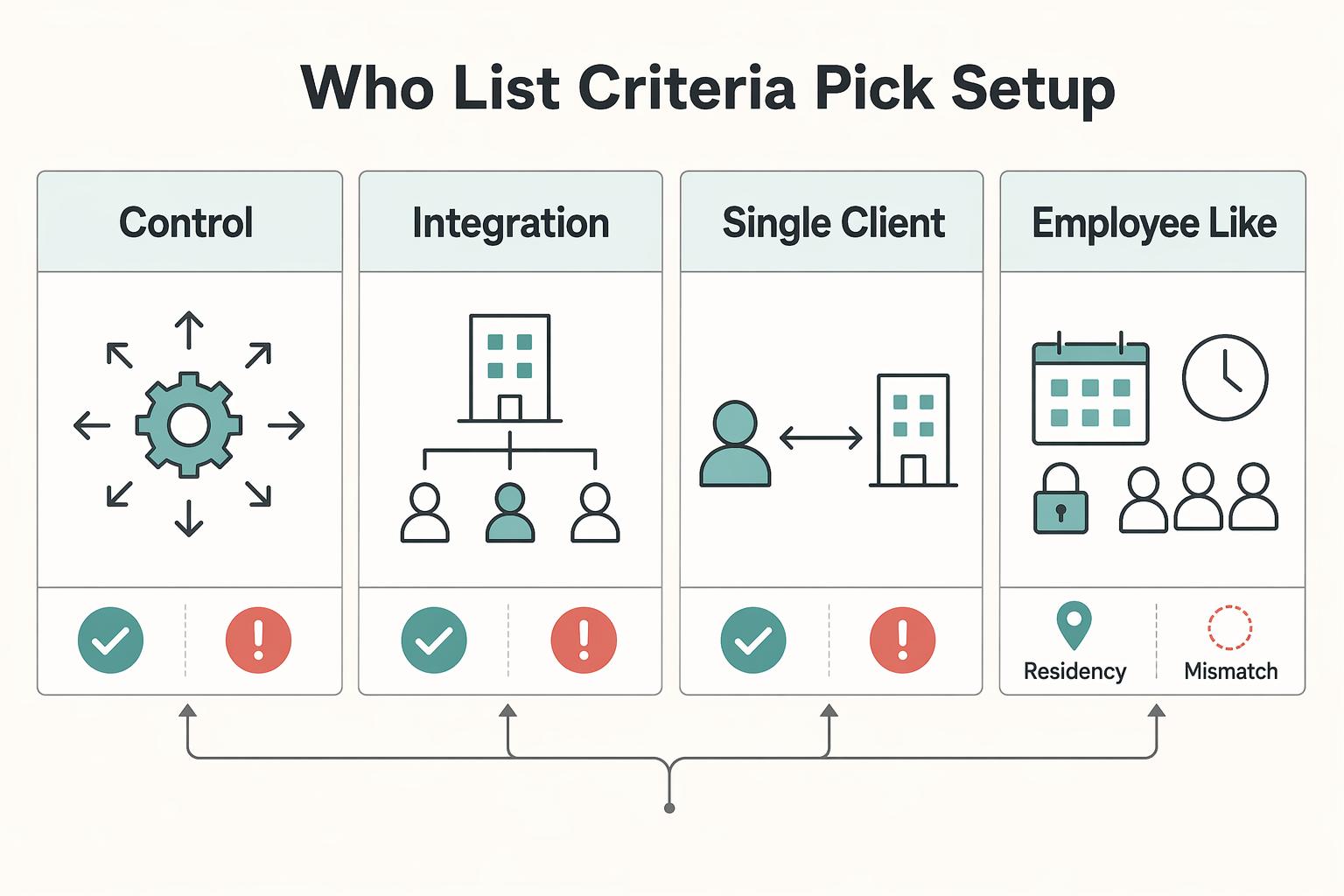
Who this list is for and the criteria to pick your setup#
Use this list if you are a US software developer, consultant, or freelancer selling software services to clients in Germany and you want the relationship to operate as genuinely independent work. It is most relevant when your setup fits the German freelancer categories Freiberufler or Gewerbetreibender.
| Filter | What raises risk |
|---|---|
| Control over hours and location | The client controls your day-to-day schedule, location, and working method |
| Degree of client integration | You are integrated into the client's work organization, even if the contract labels you an independent contractor |
| Single-client dependency | You are self-employed in name but dependent on a single client in practice, especially where entrepreneurial freedom is limited |
| Employee-like subordinate relationship | Day-to-day control sits mostly with the client; treat risk as high and restructure before signing |
If your main question is immigration, use a dedicated visa resource instead, such as Germany Freelance Visa: A Step-by-Step Application Guide. This section is about contractor-status risk, not visa or Blue Card eligibility.
Before choosing a model, apply these four filters:
- Control over hours and location
If the client controls your day-to-day schedule, location, and working method, risk rises because the relationship looks less independent.
- Degree of client integration
Risk rises when you are integrated into the client's work organization, even if the contract labels you an independent contractor.
- Single-client dependency
A core risk signal is being self-employed in name but dependent on a single client in practice, especially where entrepreneurial freedom is limited.
- Employee-like subordinate relationship (decision checkpoint)
If day-to-day control sits mostly with the client, treat risk as high and restructure before signing.
You might also find this useful: A Guide to Errors and Omissions (E&O) Insurance for Software Developers. If you want a quick next step, try the SOW generator.
The 3 engagement setups ranked by false self-employment risk#
Use this ranking as a practical risk screen: the more a setup creates persönliche Abhängigkeit (personal dependency), the higher the false self-employment risk. DRV looks at the full picture (Gesamtwürdigung), including fixed working times, client-designated work locations, and broad instruction control. The same profession can be classified differently based on how the relationship is actually lived. If a setup requires fixed internal attendance and manager-style supervision, downgrade it or reject it before onboarding. A status determination can take im Durchschnitt drei Monate, so do not treat it as a fast cleanup tool.
| setup | best for | key pros | key cons | typical failure mode | what to fix first |
|---|---|---|---|---|---|
| Independent project delivery with clear scope and outcome ownership | Freelancer serving multiple clients in Germany | Strong independence signal; outcome-based delivery is easier to defend; lower integration risk | Requires tighter scoping and client buy-in on autonomy | Work drifts into daily direction and attendance expectations | Rebuild the SOW around deliverables, acceptance criteria, and contractor control over method, time, and tooling |
| Long retainer with bounded autonomy | Consultant with one anchor client but visible independent business activity | Predictable revenue; can work when autonomy is real | One-client dependency optics; retainers can drift into employee-like routines | Retainer becomes fixed-hours participation inside client workflows | Set explicit autonomy boundaries and keep visible independent business activity |
| Embedded team-member style arrangement | Almost no one | Easy for client operations | Highest risk of looking like an employee under German labor law | Contractor wording is overridden by day-to-day subordination | Remove fixed hours, required internal presence, and instruction-heavy supervision before start |
1. Independent project delivery with clear scope and outcome ownership This is usually the lowest-risk structure because you are selling a defined result, not ongoing internal availability. Keep the operating model outcome-based in both contract terms and daily practice.
2. Long retainer with bounded autonomy This can be workable, but only if autonomy stays real over time. One anchor client is not automatically disqualifying, yet lasting single-client dependency raises scrutiny, so keep clear evidence that you operate as an independent business.
3. Embedded team-member style arrangement This is typically the highest-risk setup because it most closely resembles dependent employment in practice. If you cannot remove fixed attendance, client-directed location rules, and broad instruction control before onboarding, treat it as a restructure-or-decline case.
Contract item 1 to get right first is scope and independence language#
Get this clause right early: your scope should describe deliverable-based work with real Weisungsfreiheit, not employee-style availability. If the relationship cannot be run that way in day-to-day practice, you are taking on avoidable status risk.
The goal is not polished wording. The goal is contract terms that match gelebte Praxis. DRV makes clear status turns on concrete terms as they are actually lived, and BSG highlights both freedom from instructions and the risk of integration into a client's business order. So this section has to do two things at once: define outcomes and protect independence.
The 3 parts that matter most#
- Deliverables over availability
Define outputs the client can accept or reject, not supervised time. Use named deliverables, milestone timing, and acceptance criteria. The client buys results, not a seat on the team.
- Autonomy over method, schedule, and tooling
State that you control how services are performed, including sequencing, working time, and tools, except for specific client security requirements. This matters because fixed working-time control is a known risk signal.
- Acceptance and coordination without subordination
Allow client review of requirements and deliverables, but avoid manager-style direction of your daily work. Replace wording like "work under team lead direction" with outcome-based acceptance language and explicit contractor control of performance method and work organization.
Use one checkpoint before signing: compare the clause to onboarding reality. If the contract says "independent" but operations require daily standups, fixed internal hours, or team-lead approvals, the paper and practice already conflict.
In a Statusfeststellungsverfahren, DRV can request all agreements tied to the engagement. Keep the MSA, SOWs, change orders, and acceptance records aligned. If the client will not accept deliverable-based drafting, restructure before work starts or run status determination in advance.
Contract item 2 is Governing Law, Jurisdiction, and Dispute Resolution#
Treat these clauses as cost and evidence controls, not as a fix for a weak operating model. In a United States-to-Germany deal, set law, forum, and escalation around where the work is performed, where records are kept, and who would need to explain the relationship if it breaks down.
| Clause | Practical goal | What to check |
|---|---|---|
| Governing Law | Use one governing-law choice across the full contract set | The master agreement, statement of work, and change orders tell one contract-law story with matching clause text |
| Jurisdiction | Choose forum based on where usable proof actually is | Where witnesses, delivery records, acceptance emails, tickets, and commercial contacts are on day one of a dispute, and whether the clause is one-sided on travel, translation, or counsel burden |
| Dispute Resolution | Add a short escalation ladder before formal proceedings | Require evidence exchange during escalation, such as the SOW, acceptance records, invoices, and relevant message threads |
Whether you operate as a Freiberufler or Gewerbetreibender, this part should reduce conflict drag, not create another negotiation trap. If the day-to-day facts look employee-like, polished boilerplate will not rescue your position later.
- Governing Law
Use one governing-law choice across the full contract set: master agreement, statement of work, and change orders. The practical goal is to avoid a side fight over which rules control payment, acceptance, confidentiality, or termination when the core dispute is already hard enough. What to check: one contract-law story across every signed document, with matching clause text.
- Jurisdiction
Choose forum based on where usable proof actually is, not just who had leverage during negotiation. If witnesses, delivery records, acceptance emails, tickets, and commercial contacts cluster in one place, a distant forum can raise cost without strengthening your real position. What to check: where the key people and documents are on day one of a dispute, and whether the clause is one-sided on travel, translation, or counsel burden.
- Dispute Resolution
Add a short escalation ladder before formal proceedings: operational contacts try first, business owners escalate next, then formal forum if unresolved. This keeps a structured off-ramp without assuming every issue should jump straight into litigation. What to check: require evidence exchange during escalation, such as the SOW, acceptance records, invoices, and relevant message threads, so "good faith discussion" does not become delay.
Practical rule: if the client insists on a distant, one-sided forum while also controlling your day-to-day work, treat that combination as a serious warning sign.
Contract item 3 is Limitation of Liability, Indemnification, and Termination#
After aligning law, forum, and escalation, tighten these three clauses as a set. For Germany-US software engagements, the practical move is to cap downside where you can, narrow indemnity to risks you actually control, and define a short, written exit path. If indemnity is unlimited but the fee is modest, the risk-reward is usually broken.
The public materials available here are general informational publications, and they are not a substitute for legal, tax, or other adviser input. Treat this section as negotiation judgment, not case-specific legal advice.
- Limitation of Liability
Your goal is a real cap that works across the full contract stack, not a cap that disappears in another document. What to check: the MSA, SOW, and change orders all tell the same liability story. If one document re-opens full liability, fix that before signature.
- Indemnification
Keep indemnity targeted and tied to specific fault areas you can evidence. What to check: what triggers indemnity, what is covered, and whether the scope matches your fee and control. If the clause pushes broad, unlimited downside onto a modest engagement, renegotiate immediately or decline.
- Termination
Termination terms should produce a clean contractor exit, not an open-ended handover that looks like ongoing subordination. What to check: written notice mechanics, deliverables handoff, access return, and final invoice handling. If those steps are vague, fix them now so offboarding stays bounded and documentable.
We covered this in detail in Liability Insurance for Freelance IT Consultants: Do You Need It?.
Operating behaviors that keep a freelancer from looking like an employee#
The practical rule is simple: your contract and your day-to-day behavior should tell the same independent story. In an employee-protective environment, "independent freelancer" language carries less weight if your working pattern mirrors internal staff.
- Start with autonomy on paper, then match it in practice
Sign terms that preserve independence, then operate that way from day one. If the contract says you control method, timing, and delivery approach, your calendar, approvals, and communication should reflect that.
A common failure mode is clean contract language followed by employee-style routines: mandatory daily standups, leave approval, and task-by-task direction from a team lead. If onboarding introduces approval chains, HR-style availability rules, or fixed attendance blocks that were not agreed, pause and reset expectations before work starts.
- Set communication boundaries early
Use communication to support delivery, not supervision. Status updates are normal; being managed through recurring internal routines is the risk.
Internal process participation should stay optional unless it is directly tied to deliverable acceptance or a specific project decision. Joining a checkpoint to unblock scope is different from having your workday structured by the client's meeting cadence.
Run this monthly check:
- How many active clients or active leads do you have?
- Who set your working hours this month?
- Did anyone approve or deny your time off?
- Were internal meetings and tools optional, or effectively mandatory?
If the pattern points to client control, treat it as an early warning and adjust the operating model while the engagement is still stable.
- Manage delivery by milestones, not attendance
Anchor the relationship in outputs: scoped milestones, acceptance notes, and written decisions. You should be evaluated on agreed deliverables, not on employee-like presence inside the client's internal process.
Keep a clear record of independent delivery: milestone acceptances, repository history, change approvals, invoices, and short written summaries of decisions. If you stay concentrated on one client for an extended period, document ongoing business development and visible independent commercial activity. Single-client work is not automatically unlawful, but that record helps counter single-client dependency optics.
Your evidence pack for a Tax office or Pension insurance association review#
Your strongest position is a dated evidence pack you can produce quickly, with the same facts told consistently across contract, delivery, and billing records.
Build the core pack before anyone asks#
Set up one folder now and maintain it as you work. Keep five record types current: signed contract versions, statements of work, invoices, deliverable acceptance records, and communication logs that show independent decision-making.
| Document type | Why it matters | Owner | Storage location |
|---|---|---|---|
| Signed contract versions | Shows agreed structure and how terms changed over time | You and client | Contracts folder with dated filenames |
| Statements of work and change records | Connects work to scoped deliverables rather than open-ended attendance | You and client | Project folder linked to contract |
| Invoices and payment records | Shows commercial billing history and engagement continuity | You | Accounting folder plus payment export |
| Deliverable acceptance records | Shows output-based delivery and milestone signoff | Shared, but you should retain copies | Project evidence folder |
| Communication logs showing independent decision-making | Shows who chose method, sequencing, and approach in practice | Mostly you | Archived email and chat export folder |
Use one quick control: at each milestone or invoice cycle, confirm you can match one invoice to one scope record and one acceptance trail in minutes.
Map one pack to different review lenses#
Keep one evidence set, but prepare to explain it through different lenses. Exact document expectations can vary by case, so avoid assuming a single fixed checklist for every authority.
| Review lens | Main focus | What to present |
|---|---|---|
| Tax office | Clean commercial trail | Contracts, scopes, invoices, payments, and business activity |
| Labour courts | How the relationship operated in practice | Day-to-day autonomy and delivery behavior |
| Pension insurance association | Consistency between contract wording and actual working pattern | Consistency between contract wording and actual working pattern, especially where Social contribution payments exposure is being reviewed |
For the Tax office, present a clean commercial trail: contracts, scopes, invoices, payments, and business activity. For Labour courts, show how the relationship operated in practice: day-to-day autonomy and delivery behavior. For the Pension insurance association, show consistency between contract wording and actual working pattern, especially where Social contribution payments exposure is being reviewed.
If contact starts, freeze edits and build a fact timeline#
If you are contacted about a Scheinselbstständigkeit audit, stop ad hoc cleanup. Preserve originals, keep chronology intact, and build a dated timeline from first proposal to latest invoice before giving a substantive response.
Include contract dates, SOW changes, invoices, acceptances, and any shift in working pattern. If something is missing, say it is missing instead of reconstructing from memory. Use one response owner to avoid inconsistent explanations across threads.
If facts are disputed or unclear, get case-specific legal or tax advice early. This guide is general informational material and not a substitute for competent advice on your exact file. For a deeper response process, see How to Handle a German 'Scheinselbstständigkeit' (False Self-Employment) Audit.
The bottom line for staying compliant without slowing deals#
Start with the operating model, then draft the contract around it. For Scheinselbstständigkeit risk, labels alone are not decisive; what matters is how the work is actually performed in practice.
- Choose a structure you can run in real life
Decide early whether you are delivering an outcome or working under client instruction inside the client organization. If the engagement depends on instruction-based work and tight integration into internal operations, treat that as a structural risk and fix the setup before signature.
- Prioritize clauses that change outcomes, not cosmetics
Once the model is workable, focus on Governing Law, Jurisdiction, Dispute Resolution, Limitation of Liability, Indemnification, and Termination. Cross-border contracts can pre-select applicable law and the court with jurisdiction, which reduces default uncertainty. Liability caps, indemnity scope, and termination mechanics determine whether the deal is still defensible when problems happen.
- Make day-to-day execution match the contract story
Use regular checkpoints: who sets method, who controls schedule, and how much the work is integrated into the client's organization. The common failure pattern is an "independent" contract paired with working practices that look employee-like. Keep delivery and communications aligned with independent execution.
- Build your evidence pack from day one
For status review, DRV says all agreements affecting the assignment are needed, especially the Honorarvertrag (or other core engagement contract). Keep contract versions, statements of work, invoices, payment records, acceptance evidence, and execution communications organized from the start. If risk is borderline, a Statusfeststellungsverfahren can be requested before work begins, and DRV indicates an average duration of about three months.
The practical takeaway: choose a model that is independent in real operation, draft to support it, and keep records that prove it.
This pairs well with our guide on Professional Indemnity Insurance for IT Consultants Who Want Fewer Claim Surprises.
Frequently Asked Questions
What is Scheinselbstständigkeit in practical terms for a US software developer working with German clients?
In plain terms, it means your agreement says “freelancer,” but the relationship is treated as dependent employment because of how the work is actually carried out in Germany. The practical test is not your title or invoice format. The core indicators in § 7 SGB IV are whether you work under client instructions and whether you are integrated into the client’s work organization.
Is having one client automatically illegal, or does risk depend on how the work is controlled?
One client is not automatically illegal, and there is no universal client-count rule that decides the case by itself. What matters more is control and integration: if that one client sets your work instructions and treats you like part of the internal team, risk increases. If you do have one anchor client, the checkpoint is whether you still operate like an independent business in practice, not just on paper.
Which matters more in Germany, what my contract says or how I actually work day to day?
Day-to-day reality carries more weight when the two conflict. Deutsche Rentenversicherung guidance is explicit that only concrete, actually practiced contractual relationships can be assessed, not hypothetical setups or generic advance rulings. That is the big failure mode: a clean contract paired with a real working routine that looks like employee supervision.
What are the first warning signs that a freelancer setup is drifting into an employee-like relationship?
Watch for manager-style instructions and signs that you are being integrated into the client’s internal work organization. Another red flag is when you stop operating as an external provider and start functioning like a team member in daily operations. If your client controls not just the result but your day-to-day execution, treat that as an early compliance warning.
Which contract clauses should I fix first if a client pushes for tight control over hours and process?
Fix the clauses that create instruction rights or team integration first. Rewrite open-ended “work under team lead direction” language into deliverables, milestones, and acceptance terms, and make sure the agreement does not hand the client broad authority over your daily method or schedule. If the client insists on fixed internal attendance plus process supervision, the bigger recommendation is to restructure the engagement, not just polish the wording.
If a review starts, what records should I gather first for a Tax office or Pension insurance association inquiry?
Start with every agreement tied to the engagement, because the DRV says all agreements affecting the assignment are needed, especially the service or fee contract such as the Honorarvertrag. Then gather the related records and statements that show how the work is actually carried out in practice. If a formal Statusfeststellungsverfahren reaches the DRV Bund Clearingstelle, remember it is a written process decided on the documents and statements submitted, and the average duration is about three months.
Try a related tool
Researched and edited by the Gruv editorial team. Gruv builds cross-border billing, payouts, and finance-operations software for global businesses.
Sources
Includes 2 external sources outside the trusted-domain allowlist.
- ela.europa.eu/sites/default/files/2021-09/Report%20UDW%20i...trusted
- eur-lex.europa.eu/EN/legal-content/summary/convention-on-the-l...trusted
- eur-lex.europa.eu/legal-content/FR/TXT/HTMLtrusted
- law.cornell.edu/wex/governing_lawtrusted
- law.cornell.edu/wex/forum_selection_clausetrusted
- sec.gov/Archives/edgar/data/1603756/0001603756210000...trusted
- bsg.bund.de/SharedDocs/Entscheidungen/DE/2022/2022_06_28...external
- clevver.io/freelancing-in-germany-all-you-need-to-knowexternal
Educational content only. Not legal, tax, or financial advice.
Related Posts

Germany Freelance Visa Application Path for Freiberufler and Gewerbe
Choose your track before you collect documents. That first decision determines what your file needs to prove and which label should appear everywhere: `Freiberufler` for liberal-profession services, or `Selbständiger/Gewerbetreibender` for business and trade activity.
How to Handle a German 'Scheinselbstständigkeit' (False Self-Employment) Audit
Protect your status by proving day-to-day independence, not by leaning on contract labels. In Germany, authorities look at the real working relationship, and private agreements do not override German labor law.

Freiberufler vs Gewerbetreibender for German Freelancers
**Classify first, then file and invoice from the same description.** The safer path is the one that matches your real services, not the one that looks easier on admin.