
Quick Answer
Choose by trust boundary: use OAuth 2.0 for delegated partner or user access, keep API keys for deterministic internal service calls, and accept bearer JWT only with strict issuer, audience, and signature checks. Then roll controls in phases with baseline request gating first, stronger token and key validation next, and explicit revocation plus sandbox/production separation after that. This sequencing preserves delivery speed while reducing cleanup from leaked credentials and unclear ownership.
API authentication choices can speed delivery or lock in security debt#
Your first authentication choice is not just a security decision. It shapes how quickly you can launch payments, onboarding, reporting, and payouts, and how expensive cleanup becomes once partner access, credential rotation, or incident response starts to matter.
The risk is not abstract. A 2024 analysis cited by DevOps.com reported that 52% of APIs reviewed had no authentication mechanisms in place. It also reported that 85% had not implemented rate limiting, and that over half of API requests analyzed in 2023 used no encryption. That does not describe every API, but it is a useful warning for engineering leads tempted to treat auth as a post-launch patch.
The scope here is narrower, and more useful, than most login tutorials. We are comparing OAuth 2.0 and JSON Web Token (JWT) choices for platform integrations, where services call other services, partners need controlled access, and money movement raises the cost of mistakes. If you are deciding how your product should expose or consume API access in production, that is the decision surface that matters.
It also helps to separate roles early. OAuth 2.0 is an authorization process. It can authorize user access to an API or let third-party services access end-user account information without exposing the user's credentials to that third party. A JWT is different. It is a token format used to share information between parties, and its cryptographic signature protects claim integrity against tampering. Those pieces often work together, but they are not interchangeable. When a team treats them as the same thing, the result is usually confused architecture and weak controls.
Before you pick anything, do a simple endpoint inventory. For each integration surface, list the caller, whose data or money is being acted on, whether access is delegated from an end user, and who can revoke that access if something leaks. Do this separately for payments, onboarding, reporting, and payout paths. A common risk pattern is choosing a simple static credential to get the first partner live quickly. Later, you discover that you needed delegated access, finer policy control, or a clean revocation path that was never designed in.
That is the point of this article. It does not argue for one universal winner. It walks through a decision sequence: how to choose the architecture based on caller and risk, what to ship first and what to harden next, and which operating guardrails actually keep production integrations stable. If you want one rule up front, use the method that matches your trust boundary now, not the one that is merely quickest to demo.
Related: What is Two-Factor Authentication (2FA) and Why You Need It.
Build the right mental model before picking a protocol#
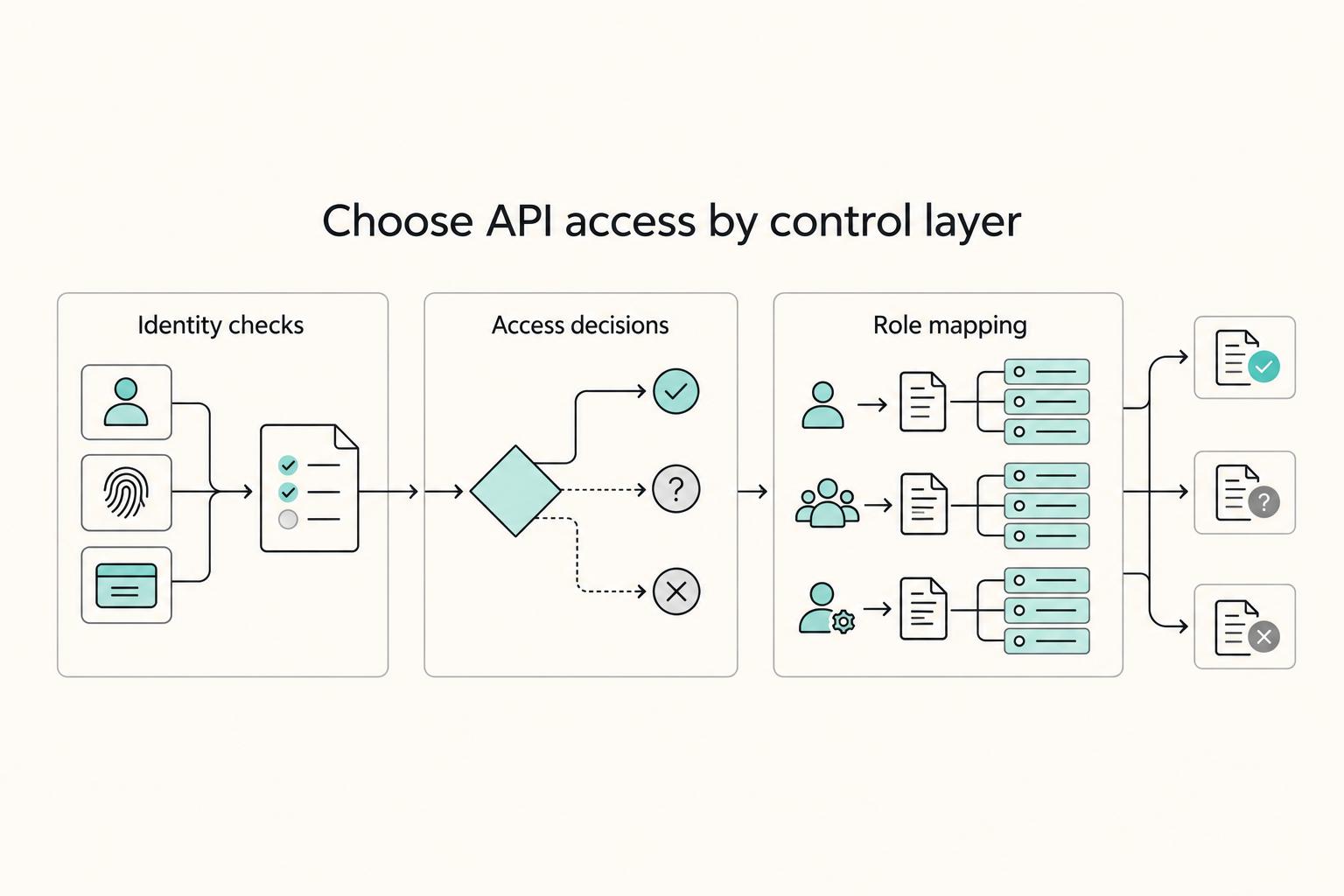
Pick your protocol after you separate responsibilities, not before. Keep identity checks, access decisions, and role mapping distinct so each API surface has a clear control point.
| Design part | Endpoint question |
|---|---|
| Identity checks | What proves the caller's identity? |
| Access decisions | What decides which actions are allowed? |
| Role mapping | Where are role assignments managed? |
Use those three questions as a quick check for each endpoint. If you cannot answer all three cleanly, your model is still mixed and harder to operate safely.
OAuth 2.0 and JWT are different layers#
Treat OAuth 2.0 and JSON Web Token (JWT) as different layers, not interchangeable choices. Keep OAuth in the lane of authorization flow and JWT in the lane of token format, with clear boundaries for what each one does and does not do.
If access leaks, impact is driven by how you issue, accept, and revoke tokens, not by token format alone. Since revocation is widely treated as a hard problem, design that path intentionally instead of assuming tokens will manage risk on their own.
For related workflow support, see The Best API Documentation Tools for Developers.
Compare API key, OAuth 2.0, and JWT by integration risk#
Pick the lightest method that still matches your trust boundary, because each option trades off security, complexity, and maintainability. For low-risk internal automation, start with a tightly scoped API key. For delegated third-party access, partner scope, or consent, use OAuth 2.0. Use bearer tokens with JWT when stateless validation is worth the token-lifecycle overhead.
| method | best-fit use case | failure mode | operational burden |
|---|---|---|---|
| API key | Simple internal service calls and low-risk backend automation | Weak key management can turn one leaked key into broad access; many implementations also lack built-in expiry | Low to moderate: easy to issue, but you still need scoping, rotation, and ownership |
| OAuth 2.0 | Third-party integrations that require delegated access | Setup is complex and resource-heavy, so teams can end up with partial or inconsistent rollout | High: strong delegation model, heavier to design, test, and support |
Bearer token with JWT | Distributed APIs that benefit from stateless, fast token checks | Revocation is weak, and token size can add overhead as usage spreads | Moderate: scalable, but only with disciplined issuance, validation, and expiry |
Match the method to the trust boundary#
Start with who is calling and whose authority they are using. If the caller is your own backend doing deterministic internal work, an API key is usually the fastest path. If the caller acts on behalf of a customer or partner, OAuth 2.0 is the better fit for delegated access and scoped permissions, even with the heavier setup.
Bearer tokens with JWT solve a different problem. They are efficient in distributed services because validation can stay stateless and fast, often via the Authorization header. But if a valid token leaks, revocation options are limited, so you should treat lifecycle controls as mandatory, not optional.
Tradeoff rules that hold up under pressure#
- If speed matters and the task is low-risk internal automation, start with a tightly scoped API key.
- If the integration needs delegated third-party access, partner-specific scope, or consent, prefer OAuth 2.0.
- If you use bearer tokens with
JWT, do it for stateless architecture benefits, not because the format sounds more advanced.
Before you standardize, check two things: which endpoints accept each credential type, and what your recovery path is if one leaks. Shared credentials and unclear ownership are early warning signs.
Why Basic Authentication usually drops out#
For modern platform integrations, Basic Authentication is usually a legacy exception, not a default. It is simple to set up, but it carries higher security risk and relies on HTTPS in transit.
If you must support tightly constrained legacy interoperability, Basic Auth can still be the least-bad option. For new integrations, API keys, bearer tokens, and OAuth 2.0 usually provide a cleaner path to scoped access and operations.
Choose auth by endpoint type and actor#
Choose auth per trust boundary: when a user or partner app needs delegated access, use OAuth 2.0; when your own backend performs fixed tasks, use service credentials with explicit ownership and rotation.
Start with who is acting#
Ask whose authority the call uses before you pick a credential. OAuth is built for delegated access without sharing original credentials, so it fits calls made on a user's behalf. Internal service-to-service calls are a different case and should use service credentials tied to a named owner and an operational lifecycle.
This split keeps authentication and authorization decisions clearer: identify the requester first, then grant only the access that actor needs.
Validate what the token was meant for#
If you accept a Bearer token, validate it fully every time. JWT is a message format, not an auth protocol, so security depends on issuance and validation discipline. At minimum, verify signature, issuer, and audience, and do not use access tokens and ID tokens interchangeably.
| Validation item | Article guidance |
|---|---|
| Signature | Verify it every time |
| Issuer | Verify it every time |
| Audience | Verify it every time and reject audience mismatches |
| Token type | Do not use access tokens and ID tokens interchangeably |
| Token lifetime | Use short-lived tokens where possible |
Use short-lived tokens where possible to reduce theft impact, and test for audience mismatches so a token for one API is rejected by another.
Keep sensitive endpoints on tighter boundaries#
Do not let "works for one endpoint" become "works everywhere." Sensitive operations should have narrower scopes and stricter actor separation than low-risk reads, with a clear revoke path for each credential type.
Keep a compact credential register: accepted credential type, intended actor, required scope, token audience, owner, and emergency revoke path. For a step-by-step walkthrough, see How to Choose API Testing Tools by Cost, Compliance, and CI/CD Fit.
Implement in sequence from day 1 baseline to day 30 hardening#
Use a phased rollout: establish baseline auth gates first, then tighten token trust, then add containment and operational proof. Treat day 1, day 7, and day 30 as an implementation sequence, not a standards-mandated timeline.
| Phase | Core controls | What to verify |
|---|---|---|
| Day 1 baseline | Enforce HTTPS, validate the Authorization header early, require short-lived JWT for bearer flows, hash stored passwords, and add basic audit events | Auth failures stop requests before business logic, and secrets or tokens are not logged in raw form |
| Day 7 controls | Rotate each API key, validate JWT signature plus issuer and aud, and use asymmetric signing (such as RSA or ECDSA) with centralized key management or managed Public Key Infrastructure (PKI) where available | A validly signed token with the wrong aud or issuer is rejected |
| Day 30 hardening | Add revocation paths, leaked-credential response steps, and strict sandbox vs production separation | You can disable one credential without broad impact across integrations |
A JWT is a message format, not an auth protocol by itself, so token trust depends on issuance and validation practice. For bearer flows, keep tokens short-lived, and do not treat access tokens and ID tokens as interchangeable.
At each checkpoint, track failed-token telemetry, watch for replay patterns on sensitive paths, and review auth-error trends alongside payout and webhook success rates. That combination gives you a practical signal for abuse, integration mistakes, or key-rotation regressions.
Need the full breakdown? Read How to Build an Airtable API Client Dashboard Without Access Risk.
Govern API keys like production credentials not convenience strings#
Treat API key usage as a production credential decision, not a convenience shortcut. Keep ownership, intended use, and revocation clear for each key so authentication stays traceable and authorization stays bounded.
Set policy around identity and permission#
Start from the core split: authentication confirms who is calling, and authorization controls what that caller can do. A key may identify a caller, but it should not imply broad access by default. Scope each key to a defined use, and make sure you can answer who owns it, what it can access, and how to disable it without affecting unrelated traffic.
Build a lifecycle checkpoint into that policy. That checkpoint can be expiry, renewal, or reissue, but it should force periodic review of active keys and their permissions.
Add operator safeguards before an incident#
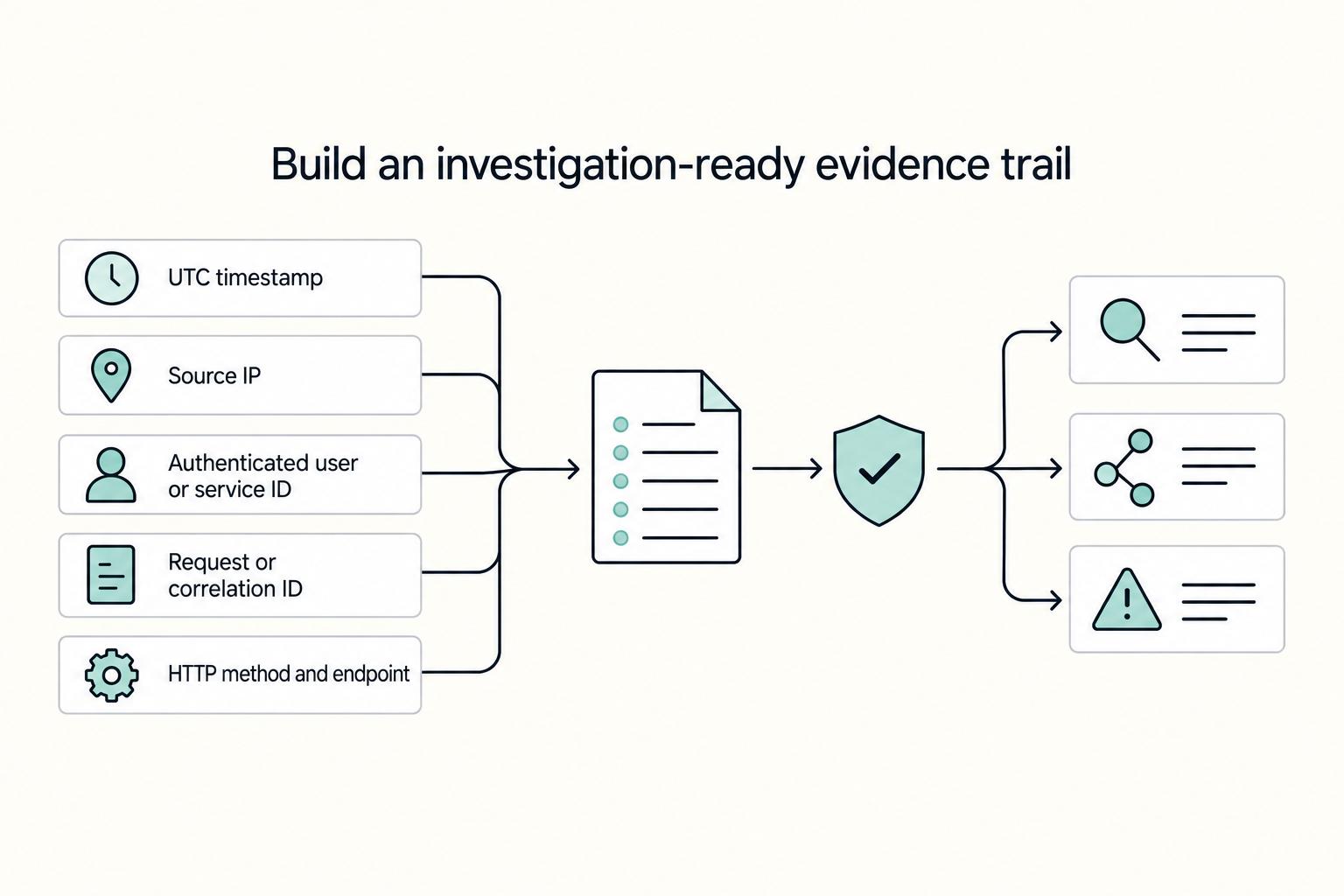
Operational safeguards are what keep a credential issue contained. Log a non-secret key fingerprint or truncated identifier with request context, redact secrets across logs and support surfaces, and rehearse rotation so replacement and rollback are both documented.
These controls do not change your auth model, but they make investigation, containment, and recovery practical when something goes wrong.
Keep keys for service identity, and move delegated access to OAuth 2.0#
For service-to-service calls, keys can remain workable when governance is disciplined. For delegated user access, OAuth 2.0 is typically the better fit: an identity provider (IdP) verifies identity, the service does not handle user credentials directly, and authorization can follow delegated permissions in API code.
You can phase this in. Keep compatibility for existing key-based integrations while moving sensitive delegated actions first.
| Governance control | Implementation effort | Risk reduction outcome |
|---|---|---|
| Scoped keys with clear owner and intended use | Mostly policy plus provisioning discipline | Smaller blast radius and clearer accountability |
| Lifecycle review point (expiry, renewal, or reissue) plus revocation path | Process and platform coordination | Less credential drift and faster containment |
| Non-secret fingerprint logging plus secret redaction | Logging and observability updates | Better auditability with lower secret exposure |
| Rotation drill with rollback notes | Runbook and partner-change rehearsal | Lower outage risk during real rotations |
Shift delegated user actions to OAuth 2.0 | Integration and auth-flow changes | Clear separation of service identity and user-delegated access |
This pairs well with our guide on A Deep Dive into Wise's API for Automated Payments.
Secure async money movement paths where teams usually get burned#
Authentication is only the start; async paths are where reliability and security issues usually surface. A design that looks clean on a whiteboard can still fail in production, and retry loops can amplify outages instead of absorbing them.
Design and test for convergence under stress: delayed delivery, repeated attempts, and overlapping retry behavior should still lead to one controlled outcome for the same logical operation. If you cannot show that with test artifacts, you do not yet know how the path behaves when conditions degrade.
For token handling, treat uncertainty as risk, not proof. In JWT-based setups, including stateless server designs, storing a JWT in a cookie is not, by itself, settled evidence that XSS risk is handled. Be explicit about what your controls do and do not protect, then validate those assumptions in production-like tests.
Keep incident evidence simple and decisive: correlate request IDs, operation identifiers, auth results, and final state so you can reconstruct failures without guesswork. If you want a deeper dive, read How to Secure a REST API.
Add compliance and audit evidence without blocking shipping velocity#
For audit and compliance, passing auth is only part of the story; you also need a clear record of the authorization decision behind each sensitive action.
| Step | Action |
|---|---|
| 1 | Pick one high-impact request |
| 2 | Trace it from the inbound auth decision to the downstream provider or system outcome |
| 3 | Confirm one team can reconstruct that path without ad hoc log forensics |
If you need stronger traceability, OAuth 2.0 is generally easier to audit than a shared API key because it supports fine-grained access control for delegated access. By comparison, API keys are simple for internal services, but they are described as having limited security and no expiration unless you add stronger management controls.
In compliance-driven environments such as HIPAA, PCI DSS, SOC 2, and GDPR contexts, keep the decision trail simple and consistent so teams can explain what was allowed, under which access context, and what downstream system outcome followed.
Pick the simplest model that survives real operations#
Choose authentication by trust boundary and endpoint risk first, then harden it with rotation, token verification on every request, and audit evidence you can actually use under pressure.
OAuth 2.0 is widely presented as a leading framework for delegated access between applications, so it is a strong fit when third-party or user-granted delegation is part of the requirement. It is not automatically the right default for every endpoint, and public expert commentary has explicitly challenged OAuth 2.0 fit and behavior in some contexts.
This week, make the decision explicit with a simple endpoint table:
- endpoint and actor: partner app, internal service, webhook sender, human user
- auth choice: API key, OAuth 2.0, bearer token, or another constrained option
- risk notes: delegated access, money movement, read-only paths, support burden
- proof points: how the API validates the token, how credentials rotate, what auth events you log
Then roll out in stages from baseline controls to hardening. Start with consistent request-time token validation and basic auth-event logging, then add stronger rotation and revocation coverage for higher-risk paths. If refresh tokens are in scope, treat token theft as an expected risk scenario, not an edge case.
Before production, confirm requirements in provider docs and with your security and compliance owners. Control expectations and compliance gating can vary by market, partner program, and endpoint class.
Related reading: How to Use ClickUp's API to Automate Project Creation from a HubSpot Deal.
Frequently Asked Questions
What is the difference between OAuth 2.0 and JSON Web Token (JWT) in one minute?
OAuth 2.0 is an open standard for token-based authentication over public networks. It is commonly used to let a third party access account data without exposing the user’s credentials directly, and the process of obtaining a token is the authorization flow. A JWT is an open industry standard token format for sharing information between entities, often sent as a Bearer token.
When should a team use an API key instead of OAuth 2.0?
This guide does not define a strict API key-versus-OAuth cutoff. One grounded distinction is complexity: OAuth is widely seen as more complex than a basic JWT-based setup. If delegated third-party access without sharing user credentials is a requirement, OAuth 2.0 is usually the better fit; otherwise, teams often evaluate simpler options such as API keys based on their own constraints.
Are JWT tokens encrypted or only signed?
Do not assume a JWT is encrypted. The grounded point here is signing: a signed JWT helps prove the claims were not tampered with after issuance. That protects integrity, not confidentiality.
Can user tokens be used to authenticate backend-to-backend API calls?
This guide does not establish a universal rule for that design choice. It does support that Bearer tokens are sent on requests, so any implementation should validate token claims and permissions against the intended context.
What is the minimum secure baseline for API authentication before launch?
This guide does not define a full launch checklist. At minimum, treat bearer tokens as request credentials and validate signed token claims before protected logic runs. Broader baseline controls depend on your provider and security requirements.
How should teams rotate and revoke credentials without breaking integrations?
The grounded red flag is revocation and invalidation: token invalidation is a known pain point in JWT discussions. Do not assume this is easy later; define an explicit path to cut off compromised access.
What details are still unknown from public guides when comparing auth methods?
Public explainers are strong on definitions and basic flow, but they can stop short of provider-specific operating details. A key gap in this guide is immediate invalidation behavior. Before choosing an approach, verify the provider’s exact token handling and invalidation behavior in its own docs.
Try a related tool
Researched and edited by the Gruv editorial team. Gruv builds cross-border billing, payouts, and finance-operations software for global businesses.
Sources
Includes 7 external sources outside the trusted-domain allowlist.
- pmc.ncbi.nlm.nih.gov/articles/PMC10052058trusted
- baeldung.com/spring-security-oauth-auth-serverexternal
- birjob.com/blog/oauth-jwt-guideexternal
- curity.io/resources/learn/jwt-best-practicesexternal
- devops.com/7-critical-api-protection-strategies-to-fort...external
- exhaustthemind.medium.com/from-monoliths-to-modularization-rebuilding-...external
- frontegg.com/blog/oauth-vs-jwtexternal
- frontegg.com/guides/api-authentication-api-authorizationexternal
Educational content only. Not legal, tax, or financial advice.
Related Posts
How to Secure a REST API: Prevention, BOLA Protection, Detection, and Response
If you want to know **how to secure a rest api**, start by rejecting the idea that a generic Top 10 list is a strategy. The OWASP API Security Top 10 (2023) is useful for naming common risks, but if you choose controls from a checklist before you define business exposure, you create false confidence. For incident follow-through, pair this with [How to Handle Data Breach in Your Freelance Business](/blog/how-to-handle-data-breach-in-your-freelance-business).
What is Two-Factor Authentication (2FA) and Why You Need It
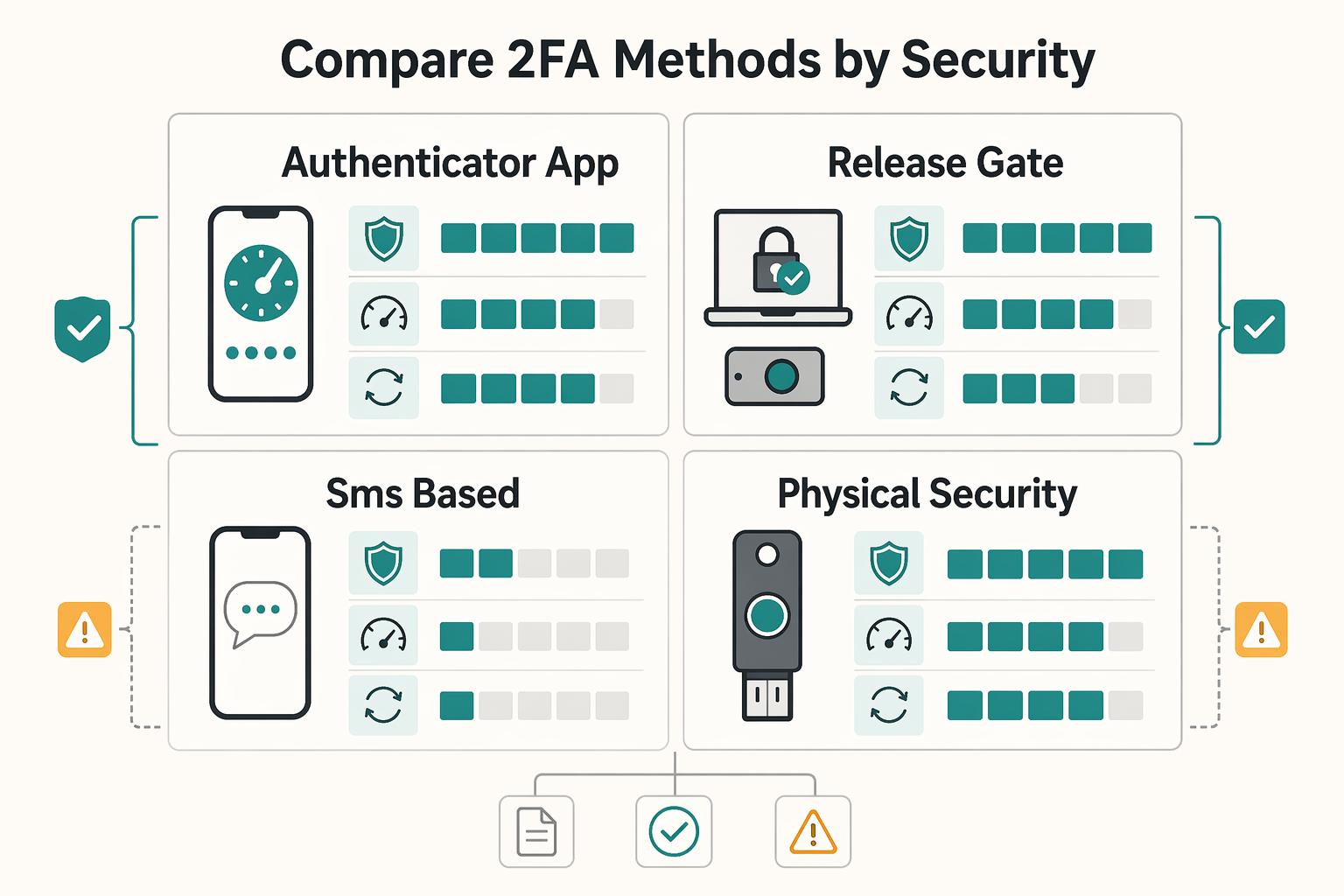
Two-Factor Authentication (2FA) is a practical way to reduce avoidable account risk. It adds a second identity check, so a stolen password is less likely to lead to unauthorized access to billing, payouts, or client delivery.
The Best API Documentation Tools for Developers
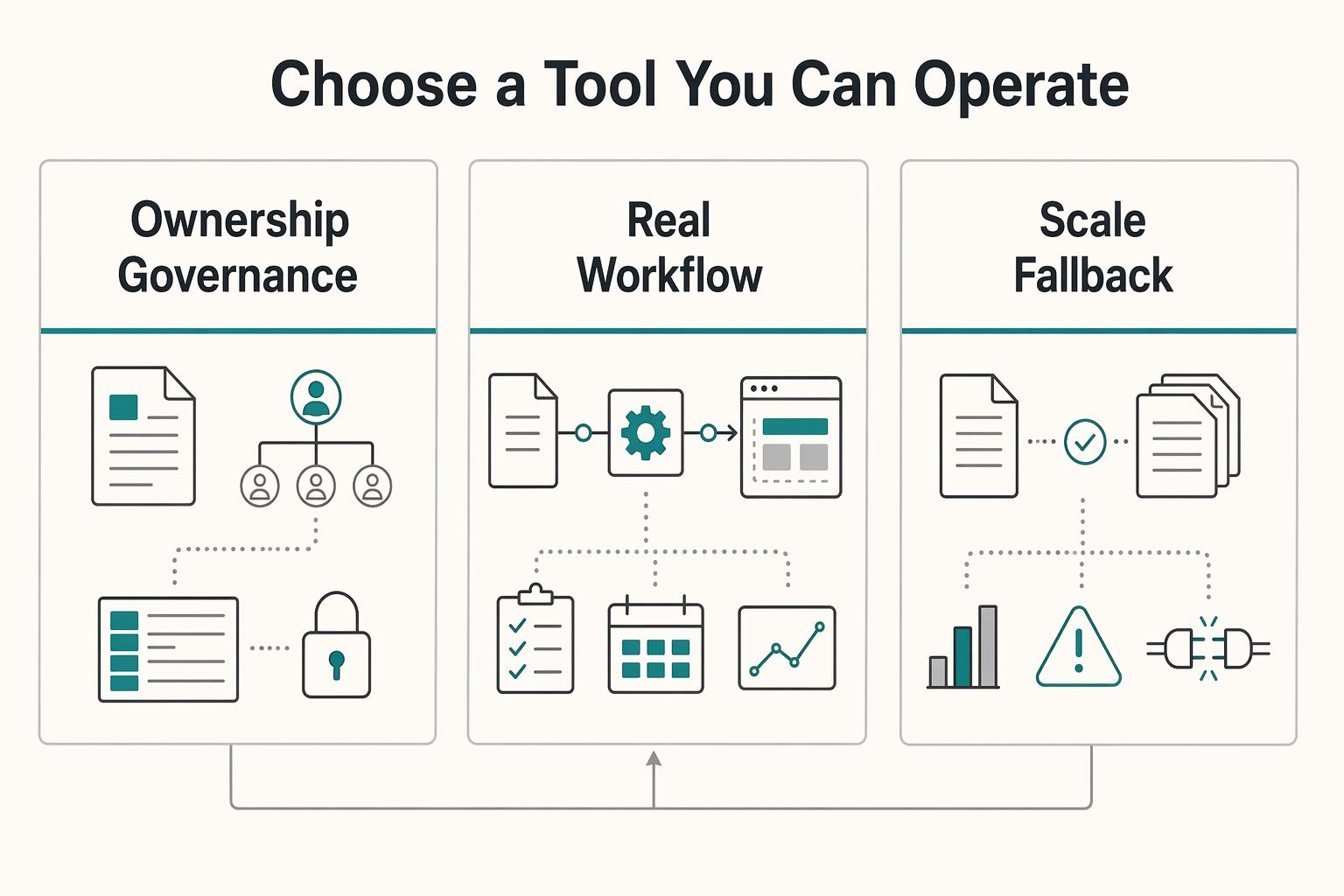
If you are comparing the **best api documentation tools** for your team, do not start with the slickest demo. Start with the stack you can actually own, review, roll back, and maintain when releases get busy. If that discipline is weak, a prettier portal can hide the problem until documentation drift shows up.