
Quick Answer
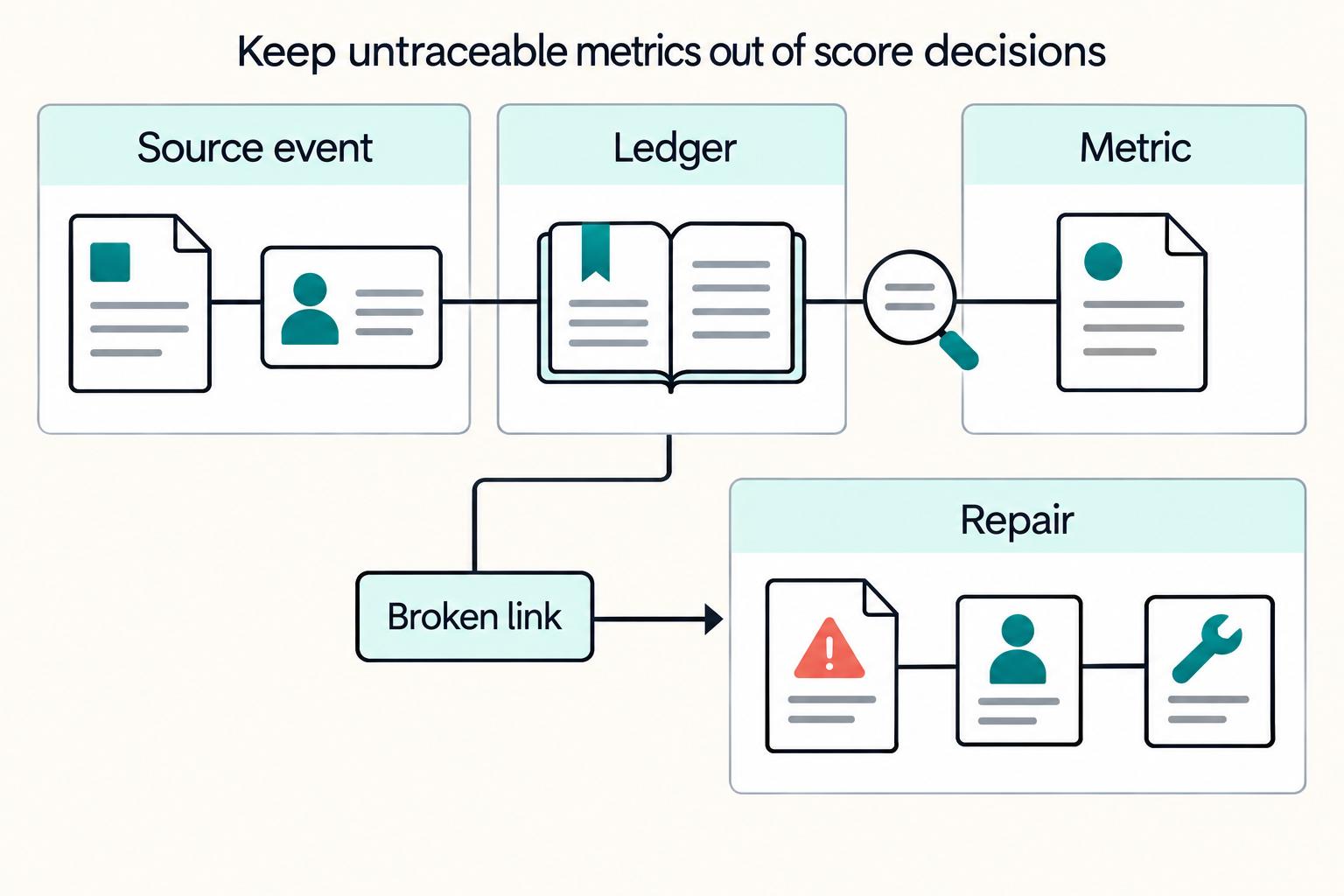
A marketplace payment-health score combines defined measures of acceptance, payouts, reconciliation, losses and recovery. Fix each metric’s denominator, window and source lineage before weighting it. Publish coverage with the score, mark affected rollups incomplete when a feed breaks, and keep severe incident triggers separate from the average.
What a Marketplace Health Score Should Tell You#
Build a Marketplace Health Score as a weekly operating check for payment quality, not another dashboard number. Its job is to surface payout risk, matching noise, and timing drift early enough for you to act before close gets messy.
This guide is for platform operations leaders and the finance, ops, and product owners responsible for Ledger integrity, Reconciliation completeness, Settlement timing, and payout execution risk. If you are dealing with unexplained variances, delayed payouts, or a growing exception queue, this score gives you a weekly measure you can trace back to evidence.
Use payment-system guidance as operating context, not as a generic health-score metaphor. The Federal Reserve's payment systems material and its Payment System Risk framework are better reminders that money-movement quality depends on clear controls, defined responsibilities, and review cadence.
A score can reward the wrong behavior if its definitions hide manual work, change cutoffs or count submission as successful payment. Keep those checks alongside the composite so a higher score reflects better operations rather than easier measurement.
- Prepare evidence across journal entries, matching outputs, fund-movement states, payout batches, and event history.
- Build domains, weights, checks, owner actions, and thresholds for your own operating context.
- Run a weekly review cadence that drives decisions.
If a metric cannot be tied to its source records, mark it untrusted. Keep the missing coverage visible and suspend any composite or decision that depends on it; verified incident evidence can still justify containment.
What the marketplace health score measures and what it does not#
The Marketplace Health Score in this section is an internal payment-operations lens, not a validated external formula. A practical scope is Ledger accuracy, Reconciliation completeness, Settlement timeliness, and Payout Batch reliability.
| Area | What it covers |
|---|---|
| Payment success | authorization, capture, and settlement behavior for the intended payment |
| Reconciliation integrity | provider records, journals, and close outputs line up without unexplained breaks |
| Payout completion | payouts move through expected states without silent drops, duplicate sends, or manual patching |
| Disputes and returns | post-settlement loss signals stay visible and assigned to an owner |
| Recovery speed | exceptions are classified, worked, and closed before they compound |
If score movement cannot be traced to journal IDs, matching outputs, status timestamps, and payout batch records, treat the result as provisional. One failure mode to avoid is treating submission speed as success while later mismatches or reversals remain unresolved.
Use external rail and provider rules as calibration inputs, not as a universal marketplace formula. Keep scope, versioning, and review cadence explicit so operators know whether they are looking at payment success, payout completion, reconciliation health, or dispute pressure.
One practical discipline check is version control. Record which payout statuses, webhook event types, reconciliation exports, and dispute states the score uses so you do not compare two weeks with different definitions as if nothing changed.
Also keep evidence access controlled. PCI DSS is a useful baseline reminder that payment data should be segmented, protected, and exposed to operators only as needed for triage.
What to prepare before you start scoring#
Before you score anything, make traceability real. If you cannot follow one transaction from provider reference to journal to settlement and payout outcome, you are measuring report neatness, not payment quality.
| Step | Focus | Key detail |
|---|---|---|
| Step 1 | Assemble the minimum evidence pack | Start with raw event logs, provider references, webhook delivery history, and idempotency records tied to each lifecycle stage |
| Step 2 | Declare one Ledger source of truth | Use one canonical Ledger source for journals and status transitions and reconcile by population and cutoff |
| Step 3 | Document constraints and assign owners before metrics | Write constraints first, then metrics, and give every metric a named owner and defined response when it turns red |
| Step 4 | Map return, dispute, and payout-failure channels | Track which failure classes come from ACH returns, disputes, provider review, or payout failure before they distort the score |
Step 1: Assemble the minimum evidence pack#
Start with the smallest record set that can reconstruct a payment lifecycle without guesswork: raw event logs, provider references, webhook delivery history, and idempotent request records tied to each lifecycle stage.
Sample a handful of recent payments and confirm each one has:
- Provider reference
- Internal transaction or journal ID
- Webhook attempt history, including retries
- Idempotency Key used at creation or replay
Treat any missing artifact as a coverage gap now, not during an incident. Without webhook history, a single "paid" status can hide delayed callbacks or timeout-path assumptions. Without idempotency records, duplicate sends can look like ordinary retry volume.
Step 2: Declare one Ledger source of truth#
Use one canonical Ledger source for journals and status transitions, and map every downstream report back to it. Finance close files, ops dashboards, summaries of funds movement, and payout reports can differ in format, but not in underlying journal and status logic.
Run one hard check: reconcile by population and cutoff. If ops says 1,000 settled and finance says 996, determine whether the gap is timing, scope, or broken mapping. Keep a simple report map with field names, definitions, cutoff time, and version date so score changes reflect operations, not reporting drift.
Step 3: Document constraints and assign owners before metrics#
Write constraints first, then metrics. Capture policy gates, compliance reviews, and each flow's SLA commitments. Assign owners by domain before you publish any score: finance for close integrity, ops for exception handling, and product or engineering for event quality and automation debt.
Every metric should have both a named owner and a defined response when it turns red. Without that, the score becomes an orphaned dashboard. Keep policy holds separate from operational defects so exception queues do not hide the real bottleneck.
Step 4: Map return, dispute, and payout-failure channels#
Where external rails or networks can reverse, return, or dispute a payment, map that dependency up front. Nacha's ACH Network Risk and Enforcement Topics are a practical reminder that return activity belongs in your payment-quality view, not in a separate afterthought. Do the same for card disputes and platform-initiated reversals in your own operating model.
Do the same for card and platform disputes. Track which outcomes count as dispute intake, evidence submission, win, loss, payout failure, provider review, or manual reversal. If teams use different labels for the same event, the score will drift before the operation does.
Capture the exact evidence you will need later: provider reference, payout or transfer ID, dispute or return code when applicable, and the owner who works that failure class. The goal is not to weight every rail equally. It is to make returns, disputes, and payout failures visible before they distort the weekly read. Related: State of Platform Payments: Benchmark Report for B2B Marketplace Operators.
Step 1 map your payment lifecycle and measurement points#
If a step cannot produce auditable evidence from your Ledger, do not score it as healthy. Build a short checkpoint chain and tie each checkpoint to a clear input, state transition, and proof artifact.
Use this as an internal operating map, not a vendor scorecard. Start by making lifecycle checkpoints explicit across payment acceptance, settlement, payout execution, and post-settlement loss events before you assign weights.
| Checkpoint | Input event | Expected state transition | Minimum proof artifact |
|---|---|---|---|
| Authorization decision | Initial payment attempt | Pending to authorized or declined | Provider response plus internal payment ID |
| Capture and settlement posting | Capture result followed by separate settlement evidence | Authorized to captured; later settlement recorded separately | Capture reference, settlement record and linked journals |
| Payout execution | Payout batch or transfer creation | Payable to in transit, paid, failed, or canceled | Payout ID, provider status, and failure code when present |
| Returns and disputes | ACH return, dispute intake, or reversal event | Settled to returned, disputed, or reserve-adjusted | Return or dispute code plus linked transaction reference |
For each checkpoint, write three fields in plain language:
- what starts it
- what state should change
- what record proves it
Then mark uncertainty paths explicitly where they exist in your flow: missing provider references, unclassified retries, unmapped payout statuses, late return files, and dispute events that arrive after finance has already closed the period.
Finish by tagging your Exception Queue by checkpoint and failure class so issues are diagnosable instead of blended together:
authorization | high_soft_decline_ratepayouts | failed_or_canceled_payoutreconciliation | unmatched_journal_or_settlementreturns_disputes | ach_return_or_card_dispute_without_owner
Use this checkpoint before you publish anything. If a queue item cannot be tied to a checkpoint and auditable evidence, fix instrumentation first.
Step 2 build the score formula and metric weights#
The formula only works if it reflects your real priorities. This guide provides a measurement method, not fixed payment-domain priorities, so treat tradeoffs as local decisions you validate with your own data.
Define domains before weight math. Start with domains, not weights. Payment teams usually need a mix of workflow reliability, payout completion, reconciliation integrity, dispute or return pressure, and recovery speed. The formula should mirror how your operators intervene, not how a slide looks.
| Domain | What to score | Leading signal (pressure) | Lagging signal (damage) |
|---|---|---|---|
| Payment acceptance | Authorization, capture, and settlement reliability | Decline drift, retry spikes, or processing delays | Lost volume, failed collection, or manual rework |
| Payout execution | Payout states and completion quality | Aging in pending or in-transit states | Failed, canceled, or reversed payouts |
| Reconciliation integrity | Provider-to-ledger and close alignment | Growth in unmatched records or stale files | Close delays, adjustments, or unexplained breaks |
| Disputes and returns | Post-settlement loss and seller-impact pressure | Rising dispute intake or ACH return activity | Chargeback losses, reserve pressure, or reversals |
| Recovery effectiveness | Exception routing, ownership, and RCA follow-through | Backlog growth and aging | Repeat incidents and SLA misses |
Keep leading and lagging signals separate. Do not collapse them into one line. Pressure and damage tell you different things.
Use a regular trace check. For a low-scoring case, confirm that you can pull auditable lifecycle artifacts. If you cannot, treat that metric as provisional and revisit its influence.
Weight by maturity, then rebalance on patterns. Rebalance after repeated patterns, not one noisy week, and use mixed evidence each time: incident history, lifecycle artifacts, and operator review.
In practice:
launch: keep the model simple and prioritize metrics you can audit end to end.scale: expand coverage only where evidence quality stays strong.enterprise: rebalance so strength in one area does not mask weakness in another.
Add anti-gaming checks before go-live. Treat these as local governance controls, not source-established rules.
Common checks:
work_reclassification: visible score improvement while untracked manual work rises.cutoff_shift: timing appears better while post-cutoff aging increases.measurement_pause: quality appears better because events are deferred or excluded.
Document these disqualifiers in the scoring note. If domains still conflict after those checks, record the tradeoff and rationale, then re-evaluate after another evidence cycle. For a separate implementation walkthrough, see How to Build a Payment Health Dashboard for Your Platform.
Define the denominator before calculating a domain#
| Metric | Illustrative definition | Keep beside the rate |
|---|---|---|
| On-time payout completion | Payouts confirmed complete by the promised deadline / all payouts due in the period | Due count, failed count, unresolved count, amount and corridor; do not exclude failures to improve the denominator. |
| Reconciliation match coverage | In-scope provider records matched to the appropriate ledger entries / all records expected for the same cutoff | Unmatched amount, duplicate matches, late files and coverage gaps. |
| Recovery within target | Exceptions resolved with verified outcomes by their target / all exceptions whose targets fell in the period | Open and overdue cases, severity, reopened cases and age distribution. |
Define whether each rate uses attempts, unique business payments, payouts or monetary value. Keep authorization, capture and settlement rates separate. Dispute and return rates need a stated observation window and rail-specific denominator; a cohort still within its return window is immature, not proven loss-free. Segment by provider, rail and corridor so a large healthy cohort cannot hide a small failing one.
A worked composite with an explicit missing-data rule#
For illustration, choose three trusted domains scored from 0 to 100, with higher meaning healthier, and weights fixed before the review: payout completion 40%, reconciliation 40%, recovery 20%. A week with domain scores of 95, 90 and 80 produces 0.40 × 95 + 0.40 × 90 + 0.20 × 80 = 90. These scores and weights are hypothetical internal policy choices, not provider benchmarks. Define how raw rates map to each domain score and retain that version.
If the reconciliation feed breaks, the 40% reconciliation domain is untrusted. The remaining domains contribute 38 + 16 = 54 points across 60% coverage. Dividing 54 by 0.60 would display 90 again and conceal the missing domain. Publish the composite as incomplete, show the two trusted domain scores and 60% coverage, and repair the feed. Separately, an unresolved duplicate payout triggers its incident response regardless of the composite.
Step 3 instrument data pipelines and verification checks#
Mark a metric untrusted when the source-to-ledger or source-to-status link cannot be reconstructed. Suspend dependent score comparisons until the data is repaired. Continue acting on independently verified incidents; a broken aggregate does not mean operations are safe.
Define canonical IDs before tuning alerts#
Fix joins before you tune alerts. During RCA, you should have a deterministic way to connect the business event, provider response, journal entry, Webhook history, and final Settlement state.
No single canonical ID standard is mandated here, so treat this as a consistency pattern:
- internal transaction ID
- provider ID or reference
- Idempotency Key at ingest or retry boundaries
The labels matter less than consistency. If keys change across stages or retries break the original link, joins become probabilistic and incident review turns into manual guesswork.
Run a quick readiness check: pick three recent incidents and verify that you can reconstruct the full chain through one query path, or one documented lookup path. If reconstruction depends on manual stitching across exports, treat instrumentation as incomplete.
Fragmented governance, quality, and observability tooling increases manual troubleshooting and can make it harder to connect causes, impacts, and policy violations across the flow. Even if you use multiple tools, keep one shared ID map and one operator-visible relationship view.
Add daily checks that catch drift before close#
Use a small team-defined daily verification set before close. Check the same population, cutoff and account scope across journals, provider activity and payment outcomes.
| Checkpoint | What to match | Failure signal | Primary owner |
|---|---|---|---|
| Journal-to-provider match | Posted journals vs provider-confirmed activity using transaction ID and provider ID | Journal with no provider confirmation, or provider activity with no booked journal | Finance ops |
| Webhook replay dedupe | Incoming verified webhook events versus processed event IDs and business-object transitions; request idempotency is tracked separately | Same business event creates multiple outcomes or duplicate side effects | Engineering |
| Settlement status reconciliation | Internal status vs provider status before close | Conflicting terminal states across systems | Ops with finance review |
Boundary checks can be higher signal than vanity rates. Require linked evidence for each exception, even when it resolves as delay or duplicate, so postmortems and repeat-issue detection remain possible.
Tie alerts to operator actions and handoffs#
An alert should start an action, not just report movement. The recipient should know whether to open reconciliation incident work, pause replay, hold reporting, or escalate lineage defects.
Include triage fields in every alert payload:
- transaction ID
- provider ID
- last known-good status timestamp
- whether the Ledger has posted
Set first-responder ownership explicitly:
- Ops: first-pass triage and impact sizing
- Engineering: event production, ingest, dedupe, and lineage defects
- Finance: reporting-close and Reconciliation signoff decisions
Retain reusable evidence with masked access#
For audits and postmortems, retain evidence that reconstructs decisions, not just final outcomes. Keep provider payload, normalized internal event, join keys, journal reference, settlement updates, replay attempts, processing result, operator notes, and change history.
Keep restricted raw records and provide masked views for routine triage. That reduces unnecessary exposure of payment data while still letting operators reconstruct what happened across webhook payloads, payout events, and reconciliation reports.
When storing external references, keep the exact provider event type, report name, account scope, and document version used in the score. That way an operator can reopen the same evidence path even after provider schemas or dispute states change.
Exclude broken metrics until lineage is repaired#
If lineage breaks, mark the metric untrusted, suspend dependent rollups and open a repair task with a named owner. Publish coverage alongside any remaining trusted metrics. Do not redistribute a missing domain’s weight to the healthy domains: that can make the score rise while a control disappears.
Report an incomplete score as incomplete. If you publish a partial calculation, label its coverage and do not compare it directly with a prior full score. Document any backfill, proxy or rule change before resuming the trend.
Step 4 set thresholds, owner actions, and escalation paths#
Once your inputs are trusted, hesitation and unclear incentive direction become failure modes. Thresholds should trigger a specific action by a named owner within a defined response window. Use "monitor only" only when that choice is explicit and approved.
Step 4.1 define bands by operational consequence#
Use three action bands: monitor, intervene, escalate. The point of a band is to tell operators what to do, not just how bad a chart looks. If SLA risk rises while the Exception Queue grows, each band should map to a different operational response.
Attach red bands to a specific intervention, such as investigating an affected payout batch, containing a known duplicate risk or reviewing a missing settlement record. Reroute only after establishing that the first route did not move funds and that the alternative path is approved. An aggregate score alone does not authorize a new payment.
| Band | Condition trend | Default action | Required evidence |
|---|---|---|---|
| Monitor | Drift that still appears recoverable | Verify provider and ledger status, then recover event processing with deduplication if needed | Transaction ID, provider ID, last known-good timestamp |
| Intervene | Risk to close timing, settlement timing, or queue stability | Apply targeted correction in flow | Impacted batch or queue segment, current ledger status, owner assignment |
| Escalate | Partner impact, reporting risk, or unresolved control break | Contain impact, widen notification, open RCA | Affected scope, decision log, supporting artifacts for finance and leadership |
Test these bands against recent incidents. If different operators choose different actions from the same band, tighten the language.
Step 4.2 attach every threshold to one owner and one clock#
Each threshold entry should name a primary owner, backup owner, response expectation, and escalation destination. Red status should trigger a first move, not shared ambiguity.
Keep the threshold register versioned and explicit about role actions, such as containment, defect validation, or reporting-close decision. Even when several teams are informed, keep one primary owner per trigger. Competing priorities and incentive confusion are known failure risks.
Step 4.3 route common incidents by failure class#
Route incidents by the failure classes you defined in Step 1. A temporary Webhook delay and a Reconciliation break should not follow the same path.
For delayed webhooks, verify provider status and ledger effects before replaying event processing. Replay should recover missing internal work with deduplication, not submit another funds-transfer request. If the money-movement result is uncertain, recover it before retrying or switching providers. For a matching break, contain the affected reporting or payout subset according to verified impact and preserve the trace for investigation.
Step 4.4 version escalation policy against authoritative references#
If escalation triggers depend on contractual or regulatory interpretation, anchor them to versioned references rather than team memory. Store the document identifier, date checkpoint, and path to official text.
Keep the network or provider reference that governs the escalation rule, such as the ACH return guidance you use, the dispute-state definition you follow, or the payout-status mapping that triggers manual review. Store the rule name, effective date, and internal owner beside the threshold so you can explain why the band fired.
For a payout workflow, keep the batch, provider result and recipient references together so operators can resolve an exception without creating a second send.
Step 5 run a weekly operating cadence that improves the score#
A score only helps if it changes decisions. Use a fixed operating rhythm so the Marketplace Health Score drives action instead of status theater. A practical pattern is frequent flow-health checks, a weekly review for trend and ownership, and a periodic review for structural fixes and policy updates.
Review more than outcomes. A weekly score change tells you what happened, but not why. Track outcome, process, and input metrics together so decisions stay tied to results, execution, and capacity.
Step 5.1 split the cadence by decision type#
Use frequent check-ins for incident pressure and data quality. Exclude an untrusted metric from score-based decisions, mark affected rollups incomplete, and repair its source path. Independently verified payment failures or control breaks still need a response.
Use the weekly review to assign ownership and resolve repeated failures. Use a periodic strategic review for changes that do not fit queue-clearing work, such as policy updates, recurring manual-step removal, and larger design fixes.
Step 5.2 keep the agenda fixed#
Keep the agenda stable each week so trend reading stays consistent:
- Score movement by domain
- Top incident classes by count and operational consequence
- Unresolved RCA items and evidence status
- Exception Queue backlog, including aged or blocked work
- Automation opportunities linked to repeated failure classes
Treat vanity metrics as a warning sign. If a metric looks positive but does not change decisions, remove it from the core review set.
Step 5.3 track remediation as measurable tasks#
Every weekly decision should become a task tied to a score domain, with an owner, due date, and measurable outcome. Avoid generic actions like "improve ops."
At minimum, each task should include:
- affected score domain and failure class
- owner and due date
- baseline, target, and verification date
- evidence required to confirm impact
Close tasks only after a later review cycle confirms the result in the agreed evidence.
Step 5.4 maintain two views of the same operating truth#
Keep one leadership view and one operator view, both sourced from the same data. Leadership needs score movement, business impact, unresolved escalations, and structural blockers. Operators need incident detail, queue state, current owner, and next action.
Tie both views back to the same score domains and evidence so priorities stay aligned over time. You might also find this useful: Improve Payment Experience Across Your Partner Ecosystem.
Step 6 execute a 30 60 90 day improvement plan#
Turn the weekly review into a staged plan, not a grab bag of fixes. Establish trust first, then reduce repeat failures, then improve speed. If Ledger and Reconciliation close quality are still unstable, treat throughput gains as provisional until traceability is reliable.
Step 6.1 stabilize the evidence trail in days 1 to 30#
Use the first 30 days to make core records dependable across Ledger, Webhook, and Reconciliation. The goal is traceability. You should be able to follow a state change from the originating transaction to journal posting, provider callback, and close output.
Use a practical checkpoint. Sample recent Exception Queue cases and verify that each one can be reconstructed from canonical IDs, timestamps, provider references, and webhook delivery history, without side spreadsheets or memory. If close still depends on manual patch files because source journal mapping is incomplete, pause new score views and fix mapping first.
Keep an untrusted metric out of scoring decisions and flag its missing coverage. Continue incident response using verified records while the aggregate is repaired.
Step 6.2 reduce repeat incidents in days 31 to 60#
Once the basics are stable, use days 31 to 60 to reduce repeat failures in your own operating data. Focus on retry behavior, clearer Idempotency Key handling, and exception classes that separate failure modes cleanly.
Verify more than retry completion. Confirm that you can distinguish a legitimate retry from a duplicate event, and that this is visible without manual investigation each time. If duplicate callbacks, missing transitions, and manual overrides all collapse into one bucket, classification is not ready to guide decisions.
Watch for partial-success patterns: a payment appears complete, but duplicate journals, duplicate queue entries, or unclear replay history remain. If that appears, tighten replay controls before further optimization.
Step 6.3 optimize throughput in days 61 to 90#
Only after the earlier checkpoints hold should you push Settlement timing and clean Payout Batch completion. Check whether the flow gets faster without adding new reconciliation or exception cleanup.
Compare scheduled versus actual handoff timestamps, then review batch outcomes alongside exception creation and manual intervention volume. Flag cases where faster batches coincide with work deferred into hidden queues or relaxed close discipline.
| Phase | Main focus | Exit criteria to define up front | Red flag |
|---|---|---|---|
| Days 1 to 30 | Ledger, Webhook, Reconciliation | Predefined score checks plus proof that close traces to source records | Untrusted metrics still driving weekly actions |
| Days 31 to 60 | Retries, Idempotency Key hygiene, exception classes | Predefined score checks plus clear replay evidence by failure mode | Retries look successful but duplicates still post or queue |
| Days 61 to 90 | Settlement and Payout Batch throughput | Predefined score checks plus cleaner completion evidence and manual-handling checks | On-time metrics improve only because work is deferred or hidden |
Step 6.4 define proof before you start each phase#
Set exit criteria before each phase begins, and require both score movement and operational proof. Use predeclared checks such as evidence quality, escalation volume, incident recovery time, and manual touch in close and exception handling, then validate against those checks at phase end.
If resources are limited, prioritize work that removes recurring RCA categories before adding reporting layers. When a plan depends on provider docs or rail rules, log the exact version or retrieval date used so later score changes are not just documentation drift.
Related reading: Platform Economy Payment Index for Contractor Payment Quality Across 20 Industries.
Common mistakes that tank payment quality and how to recover#
Check state definitions, source coverage and recovery evidence before reading a score improvement as an operational improvement. A higher average can conceal a missing feed or a concentrated loss in one corridor.
| Mistake | Recovery |
|---|---|
| Blending pending and settled states | Split payment states by lifecycle checkpoint before rolling them into the weekly score. |
| Counting retries as recovery | Verify the final business outcome, not just a replay or callback success. |
| Scoring with broken joins | Mark untraceable metrics untrusted, suspend dependent rollups and publish missing coverage until repaired. |
| Ignoring returns and disputes until month-end | Bring ACH returns, disputes, reversals, and failed payouts into the weekly score with named owners. |
Challenge source relevance. Use a source for direction only when it clearly matches the payment decision in front of you. If the topic domain is different, treat it as context, not operating evidence.
Control joins before rollout. When provider IDs, internal IDs, payout IDs, or dispute references do not align, your score is describing reporting friction, not payment quality. Repair the joins before you widen the dashboard.
Check denominators and maturity. Compare like populations: a newly authorized payment cohort and a fully settled cohort have different observation windows. Show immature cohorts separately so late returns and disputes are not mistaken for an absence of losses.
Keep severe exceptions visible. A strong composite must not offset an unresolved duplicate payout, unexplained reconciliation balance or failed required control. Give those events their own incident trigger and owner.
If you want a deeper dive, read Vendor Risk Assessment for Platforms: How to Score and Monitor Third-Party Payment Risk.
Copy and paste your weekly operating checklist#
Begin the weekly review with source coverage, cutoff and population checks. Mark untraceable metrics untrusted and dependent rollups incomplete. Then review trusted domain results and severe exceptions with their owners.
| Step | Main action | Decision check |
|---|---|---|
| Step 1 | Confirm input completeness and trust | Mark dependent scores incomplete; keep verified incident evidence visible and repair the feed. |
| Step 2 | Review scores against your own thresholds and assign owners | Every red metric gets one named owner and one next action |
| Step 3 | Triage incidents by failure class and clear the highest-risk open items | Prioritize record correctness and close risk before speed issues |
| Step 4 | Verify last week's remediation with before and after evidence | Keep the result provisional if populations, time windows, or coverage changed |
| Step 5 | Decide the next action and publish one page | Classify each issue as maintain, intervene, or escalate |
Step 1 Confirm input completeness and trust#
Validate the population before you review score movement. Separate collection, validation, and publication so a late report feed or broken payout export cannot silently contaminate the score.
Run a join test across core inputs for the same period, IDs and account scope. Flag late or partial feeds and suspend dependent scores. Keep verified incident records in the review even when aggregate coverage is incomplete.
Step 2 Review scores against your own thresholds and assign owners#
Once inputs are trusted, compare domain scores and breaches against your internal thresholds. There is no universal threshold here, so the real control is ownership: every red metric gets one named owner and one next action.
Use strict ownership language. Shared labels like "finance and ops" usually delay action. Cross-functional causes still need a single accountable owner.
Step 3 Triage incidents by failure class and clear the highest-risk open items#
Triage by failure class first, then clear the highest-risk open items. Prioritize record correctness and close risk before speed issues so downstream reporting stays reliable.
Log root-cause follow-up actions while evidence is still easy to retrieve. Capture the failure class, affected records, reviewed evidence, suspected cause, and what will count as recovery proof next week.
Step 4 Verify last week's remediation with before and after evidence#
Accept proof, not anecdotal updates. A credible remediation check needs a before snapshot, an after snapshot, and at least one source artifact showing that the underlying records changed.
If populations, time windows, or coverage changed, say so plainly and keep the result provisional. Validate the dataset before claiming the intervention worked.
Step 5 Decide the next action and publish one page#
Close by classifying each issue as maintain, intervene, or escalate. Publish a one-page decision note for finance, ops, and product with the decision, owner, evidence used, blocked dependencies, and exact re-review checkpoint.
Keep the decision note tied to provider and network definitions used by your actual integration, such as Adyen webhook types. Retain the source event, normalized status and ledger reference so another operator can reconstruct the decision.
Frequently Asked Questions
What belongs in a marketplace health score for platform payments?
Use record-verifiable domains for payment acceptance, payout completion, reconciliation, disputes or returns, and recovery. Define the population and observation window for each. If a metric loses traceability, mark it untrusted and report affected rollups as incomplete rather than hiding its weight.
Which metrics should be leading indicators versus lagging indicators?
Leading indicators show pressure before money is visibly damaged: aging retries, queue growth, unclassified webhook events, or rising unmatched records. Lagging indicators show damage after the fact: failed payouts, late settlements, ACH returns, disputes, reversals, or manual close adjustments. Keep both, but do not blend them into one line.
Which metrics are table stakes at launch versus advanced at scale for Ledger, Settlement, and Reconciliation?
At launch, track only the metrics you can verify end to end: provider-reference coverage, payout success, unmatched-record rate, and basic return or dispute visibility. At scale, add segmentation by rail, provider, corridor, or seller cohort once the baseline fields stay trustworthy.
How often should teams review score health across daily operations, weekly governance, and monthly planning?
Use frequent checks for incident pressure, a weekly operating review for ownership and thresholds, and a monthly planning view for structural fixes. Increase review frequency when payout failures, reconciliation breaks, or dispute volume start climbing.
What are the most common root causes of poor payout quality, and how should teams prioritize fixes?
The usual root causes are broken identifiers, replay or dedupe gaps, mismatched status mappings, hidden manual workarounds, and delayed return or dispute visibility. Prioritize correctness first, then close risk, then throughput.
How quickly can a team improve score performance in a practical 30 60 90-day window?
Use 30/60/90 as a sequencing frame: first restore traceability, then reduce repeat failures, then speed up clean throughput. Judge progress by fewer untrusted metrics, fewer recurring failure classes, and cleaner payout and reconciliation evidence.
When should a metric be excluded from the health score?
Mark a metric untrusted as soon as its source lineage breaks. Suspend dependent rollups and show missing coverage explicitly; do not reweight the remaining domains to create an apparently healthy composite. Continue acting on independently verified incidents while repairing the metric.
Where Gruv fits
Gruv for marketplaces
Carry each seller’s approved payable amount, source reference, payout state, and exception context through one reviewed batch.
See reconciliation and mismatch review
Compare ledger entries, provider payment records, and statement rows to see what matches and what finance needs to review.
Researched and edited by the Gruv editorial team. Gruv builds cross-border billing, payouts, and finance-operations software for global businesses.
Sources
Includes 4 external sources outside the trusted-domain allowlist.
- docs.stripe.com/api/idempotent_requeststrusted
- docs.stripe.com/webhookstrusted
- federalreserve.gov/paymentsystems.htmtrusted
- federalreserve.gov/paymentsystems/psr_about.htmtrusted
- docs.adyen.com/development-resources/webhooks/webhook-typesexternal
- docs.adyen.com/marketplaces/reports-and-fees/balance-platfo...external
- nacha.org/rules/ach-network-risk-and-enforcement-topicsexternal
- pcisecuritystandards.org/standards/pci-dssexternal
Educational content only. Not legal, tax, or financial advice.
Related Posts

The Freelance Payment Penalty: A Modeled Audit of Platform Fees, FX Spreads, and Payout Delays
The money rarely disappears through a single, easy-to-spot fee. The real loss is stacked. A marketplace takes its commission, a processor adds a charge for international cards, a bank or payment company converts the currency at a spread, a platform holds the funds before release, and a wire sheds a little to intermediaries on the way in. Each layer looks defensible on its own, but the worker feels the combined result as a smaller deposit and a later payday.

How to Respond to a Subpoena for Business Records
Move fast, but do not produce records on instinct. If you need to **respond to a subpoena for business records**, your immediate job is to control deadlines, preserve records, and make any later production defensible.
A US Expat's Guide to Investing in UCITS ETFs to Avoid PFIC Issues
The real problem is a two-system conflict. U.S. tax treatment can punish the wrong fund choice, while local product-access constraints can block the funds you want to buy in the first place. For **us expat ucits etfs**, the practical question is not "Which product is best?" It is "What can I access, report, and keep doing every year without guessing?" Use this four-part filter before any trade: