
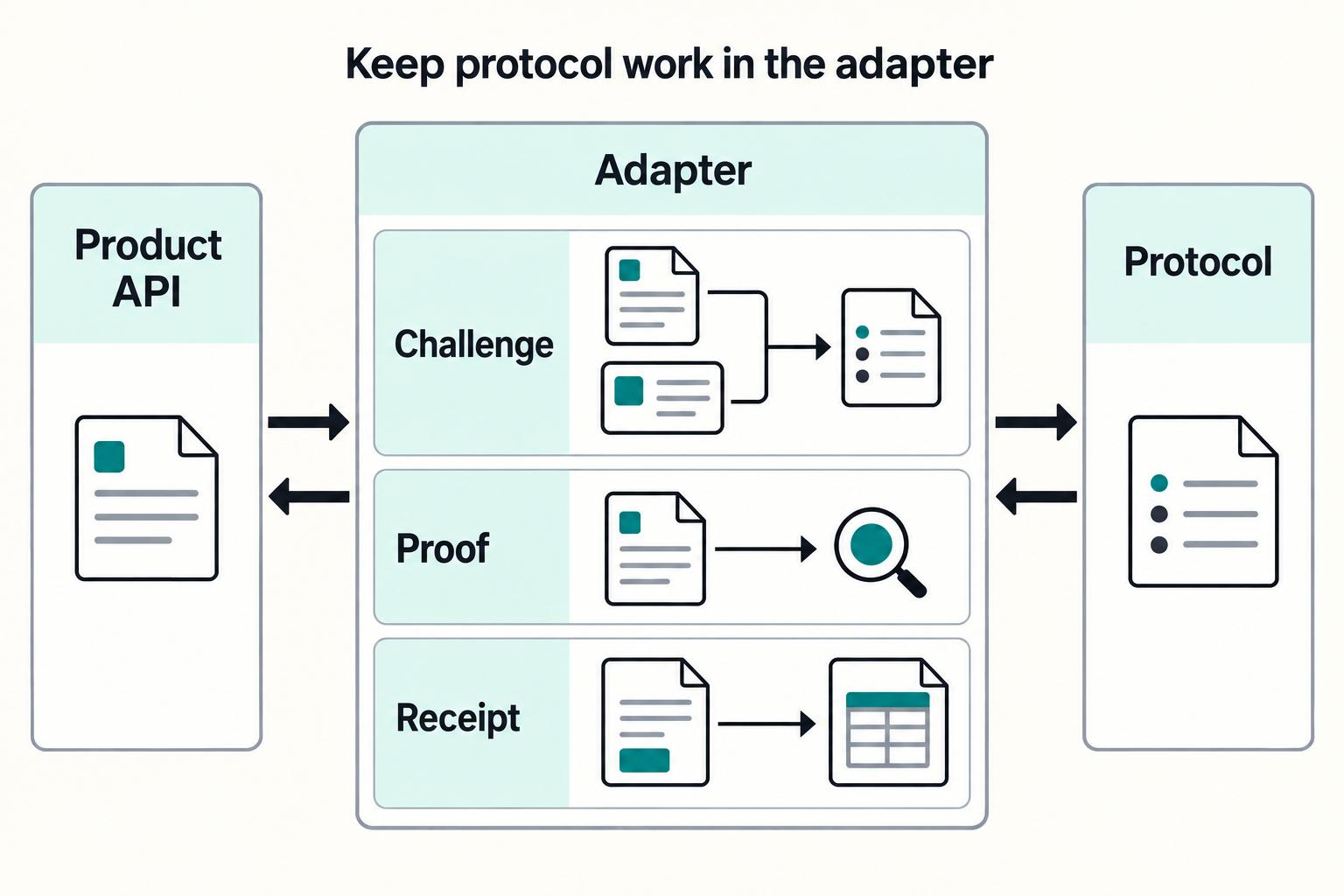
Quick Answer
Start with one monetized endpoint and prove the full challenge cycle before adding sessions or rail routing. In a machine payments protocol implementation, treat HTTP 402 Payment Required handling, payment-proof validation, and delivery as one controlled path tied to a single internal record. A Stripe PaymentIntents plus Shared Payment Tokens pilot can be a practical first step for existing Stripe teams, but scale only after replay testing, duplicate-charge checks, and reconciliation outputs remain stable.
Machine Payments Protocol can be piloted now, but it is not a plug-in billing toggle#
Machine Payments Protocol can be piloted now, but it is not a plug-in billing toggle. In a machine payments protocol implementation, the main risk is usually not whether HTTP 402 Payment Required exists. It is choosing the wrong payment pattern for your traffic and controls, then creating reconciliation gaps, payout surprises, or brittle edge behavior.
Stripe introduced MPP with Tempo on March 18, 2026. Use the current protocol and provider documentation for your integration version: the Payment authentication exchange, supported methods, and settlement behavior are separate contracts. Pin the SDK and test the wire exchange before upgrading.
- What MPP actually changes
MPP moves payment into the request cycle: request, payment challenge, agent authorization, then resource delivery. The practical shift is machine-readable challenge and response behavior, including examples of HTTP 402 with WWW-Authenticate: Payment, instead of sending agents through human checkout UX.
That matters because browser-first payment flows are a poor fit for agent traffic. If your current answer for machine buyers is still "open a checkout page," the automation path stays fragile.
- What teams can implement now
A clear current path is Stripe's PaymentIntents API, with agent payments via Shared Payment Tokens (SPTs). The company also states these payments can settle into your existing balance, default currency, and standard payout schedule. That can lower lift for teams already on that stack.
A practical pilot must issue a valid challenge, verify the returned payment credential against its original terms, and record payment and delivery outcomes. A receipt is the server’s acknowledgement; it is not a substitute for verifying the method-specific proof or tracking later settlement.
- What this guide optimizes for
This guide is for CTOs, engineering leads, and solution architects who need production reliability, not just a demo. The focus is sequencing: choose a pattern that matches request shape, risk tolerance, and finance-ops constraints, then roll it out in phases with explicit verification gates.
In practice, protocol elegance is not enough. You need an implementation you can verify from API request to payment event to payout outcome. Failures usually show up first in fulfillment mismatches and unresolved exceptions, not in protocol diagrams.
Who this list is for and how to choose#
This list is for teams that already need request-time payments and now have to choose a path they can operate reliably.
| Criterion | Grounded detail | Why it matters |
|---|---|---|
| Endpoint type | API calls, agent tasks, MCP tools, or other HTTP-addressable services | The flow should stay request, payment challenge, authorization, then delivery |
| Settlement rail needs | Fiat vs stablecoin | Rail needs should drive selection |
| Operational risk tolerance | Idempotency, reconciliation, and payout controls | If these are the top risks, favor patterns that map cleanly into PaymentIntents plus internal ledger events |
| Auditability | Request to payment posting | Check whether the client can retry after 402 and whether the server can return a payment receipt header reliably |
- Teams already selling machine-accessible work
Use this list if you charge for API calls, agent tasks, MCP tools, or other HTTP-addressable services where the flow is request, payment challenge, authorization, then delivery. If you already run on familiar payment rails, the practical starting question is whether you can fit MPP behavior into surfaces like PaymentIntents API and Shared Payment Tokens (SPTs) without adding a human checkout step.
- Teams that should solve checkout fit first
If your current path still depends on human-style checkout for agent requests, treat that as a blocker before you scale this flow. Browser-style checkout automation is often brittle, slow, and expensive to maintain.
- The four criteria that should drive selection
After a 402 response with WWW-Authenticate: Payment, can your client select an offered method and retry with the matching credential? The default credential header is Authorization: Payment. If your API already uses bearer authentication, advertise header="Payment-Authorization" in the challenge so the retry preserves both service identity and payment evidence. A Payment-Receipt response header is optional.
- Default choice when controls are the priority
If idempotency, reconciliation, and payout controls are your top risks, favor patterns that map cleanly into PaymentIntents plus internal ledger events instead of custom protocol glue. That mapping is an implementation choice, not an MPP requirement. It can be easier to verify because payments appear like other transactions while your internal records still govern fulfillment and exceptions.
Related: Machine-to-Machine Payments: How Platforms Will Process Autonomous Agent Transactions.
Table-stakes architecture every credible MPP rollout needs#
A credible rollout should let you explain one paid request end to end, even while protocol details keep moving. In practice, that means explicit challenge handling, accountability records, policy gates where needed, and an adapter layer between product APIs and protocol mechanics.
| Element | Purpose | Key control |
|---|---|---|
| Explicit challenge and proof flow | Model challenge, agent authorization, payment proof, fulfillment, and accounting records tied to one internal request flow | Trace one request from initial challenge to recorded accounting output without ambiguity |
| Ledger-first internal truth | Keep one internal accounting record as the source of truth for fulfillment decisions and exceptions | Anchor each transaction to one internal request flow, then attach external references |
| Policy gates before money moves | Treat service authorization and fund release as separate decisions when verification is still pending | Store policy outcomes and hold state in the same internal record used for payment and fulfillment |
| Protocol adapter for change | Isolate changing protocol surfaces behind an adapter layer | Keep challenge handling, proof validation, and receipt mapping behind the adapter |
1. Explicit challenge and proof flow#
Model the exchange explicitly: authenticate the caller, check its spending authority, issue a payment challenge, verify the credential, and deliver the resource. MPP challenges carry id, intent, method, realm, and an encoded request. Optional expiry, digest, opaque state, and credential-header selection add constraints. Preserve the original encoded terms when validating the retry.
For a hypothetical paid report, bind the challenge to the authenticated account, report parameters, amount, currency, recipient, and an expiry you choose. A body digest can prevent a retry from changing the report inputs. Use stored terms or an authenticated challenge identifier to detect tampering. That binding alone does not prevent proof replay: keep an independent, atomic record of consumed payment evidence.
2. Ledger-first internal truth#
Keep a durable operation record that connects payment evidence and fulfillment state. Use a unique logical operation ID plus caller identity and request hash; attach challenge IDs, method, external payment reference, verified amount, fulfillment result, and settlement status. An external payment update changes this record through a checked transition, rather than silently overriding delivery history.
A paid request that loses its response needs recovery, not another purchase. For the same authenticated operation and unchanged request, return the stored result or resume unfinished work under an execution lock. Reject changed inputs under the old operation ID. A proof already consumed for one operation must not authorize another operation, even if a challenge remains unexpired.
3. Policy gates before money moves#
Payment evidence does not grant permission to access another customer’s data. Check service authorization and agent spending authority before initiating a charge, then evaluate fulfillment and payout eligibility separately. A valid payment for an unauthorized report must not bypass access controls.
Store policy outcomes and hold state in the same internal record used for payment and fulfillment. That keeps holds, reviews, and later reconciliation operationally clear instead of turning into manual cleanup work.
4. Protocol adapter for change#
Keep challenge parsing, method verification, and receipt mapping behind an adapter. Pin the supported intent and method versions and reject unsupported combinations explicitly. Application operation IDs and accounting states should survive an SDK upgrade without changing meaning.
Keep user-granted authority separate from payment execution. If your product uses an additional agent authorization framework, retain its evidence alongside the operation record; it is not an MPP prerequisite or a replacement for challenge and credential validation.
Best implementation options at a glance#
Use this table to narrow the field, not to overfit architecture too early. The consistent takeaway here is that automated payment implementations can reduce manual processing, but they still introduce risk and complexity that you have to manage deliberately.
| Option | Fit and rails | What is known here | Major failure mode | Verification checkpoint |
|---|---|---|---|---|
| Stripe SPT charge | Existing Stripe teams; card payments, optional Tempo stablecoins | Documented charge integration and method minimums | Charge succeeds but response is lost | Recover using one operation and provider reference |
| Tempo session | Repeated metered calls; funded Tempo channel | Cumulative signed vouchers and method-specific settlement | Concurrent updates overcount usage | Atomic highest-voucher state plus delivery deduplication |
| Multiple-method routing | Clients need different supported methods | Advertise multiple offers; client chooses a compatible one | Timeout triggers a second payment on another method | Resolve the original attempt before switching |
| Custom network method | Existing network is a product requirement | Implement client credentials and server verification | A reference is accepted without validating payment terms | Verify amount, recipient, network and replay use |
| Hybrid internal orchestration | Several providers or policy and finance controls | Architectural pattern requiring implementation evidence | Provider success bypasses internal holds | Trace payment, delivery, adjustment and release independently |
Choose the option you can verify end to end in your operating environment. Confirm that clients support the offered method, provider events map into your ledger, and finance can explain reversals and unresolved payments. Related reading: Webhook Implementation Guide: Real-Time Payment Notifications.
Option 1 Stripe PaymentIntents plus SPTs for fast production launch#
If you already operate on Stripe, this can be a practical first path to test because it may limit operational change while you validate agent-payment behavior. The real benefit is continuity in finance and ops workflows, not proof that every machine-payment detail is already settled.
Why teams start here#
Stripe’s MPP integration supports a charge flow with Shared Payment Tokens (SPTs) by default and optional Tempo stablecoin payments. It is not inherently a streaming session or a complete compliance program. Existing Stripe teams can evaluate machine payments while retaining familiar provider records and downstream finance processes.
What is attractive, and what is still unproven#
The Stripe implementation guide documents an MPP profile and SDK charge flow. Check account availability and method configuration before choosing it. The documented minimum is USD 0.50 for SPT card payments and 0.01 USDC for stablecoin payments; a lower-priced endpoint cannot simply assume the card path will work.
Main tradeoff#
You are taking a dependency on this provider's MPP evolution. If you later need non-provider routing or different protocol behavior, you may have to unwind early assumptions.
Concrete pilot and go/no-go check#
A good pilot is a paid API or MCP endpoint with end-to-end payment and fulfillment traceability. Before you call this your production choice, verify:
- One request record maps to one payment reference and one fulfillment outcome.
- Provider event behavior is tested for retries and duplicate delivery.
- Finance can reconcile exports or ledger views without manual stitching.
Option 2 Session-based MPP for high-frequency microtransactions#
Choose session-based Machine Payments Protocol (MPP) when the same agent needs to make many related calls in a short window. If calls are sparse, one-shot authorization is usually simpler.
Why this option exists#
MPP separates the charge intent for a known purchase from the session intent for ongoing usage. A session maintains reusable payment state and accepts usage updates; funding and settlement depend on the method. It does not automatically preserve application permissions or impose a complete spending policy.
Where it works well#
The Tempo session method uses a funded channel and signed cumulative vouchers. In a hypothetical channel, an accepted voucher for 20 units followed by one for 35 units means 35 units of cumulative usage, with a 15-unit increase; adding both values would overcharge. Keep the highest accepted amount and settle according to the channel’s rules.
The risks that show up fast#
Session state introduces failure modes tied to freshness and replay: stale authorization, replayed proofs, and retries that cross session boundaries after expiry. 402 Payment Required handling can also get complex in session flows, so session-validity and scope checks should not share one generic retry path. If you collapse these cases, replay or duplicate-fulfillment risk goes up.
What to verify before production#
Store session state atomically across all server instances. Bind it to the channel, payer, recipient, token, and application task; apply spending limits and expiry rules separately. A local in-memory lock is insufficient when two instances can accept concurrent updates. Before rollout, test failure paths on purpose:
- Submit the same voucher on two server instances simultaneously.
- Send a lower cumulative voucher after a higher one was accepted.
- Attempt usage beyond funding or agent spending authority.
- Crash after accepting payment evidence and recover without duplicate delivery.
Track request ID, session/channel ID, accepted cumulative amount, fulfilled usage, and settlement reference. A session receipt can identify the channel rather than an individual transfer; unused channel funding and actual settled revenue need separate records. Test top-up, close, and recovery after a crash between accepting a voucher and recording delivery.
Need the full breakdown? Read Payments Infrastructure for Creator Platforms: A Complete Build vs. Buy Guide.
Option 3 Routing across supported payment methods#
Choose this option when rail diversity is the main constraint, not call frequency. It earns its keep when one settlement path cannot cover the commercial reality of your platform.
- Best for: platforms with mixed market or program needs where card rails and other payment rails may all matter.
- Pros: more business flexibility, market-by-market rail selection, and less lock-in to one settlement path.
- Cons: heavier routing logic, more compliance permutations, and harder reconciliation across rail-specific event models.
- Decision rule: set clear interoperability and operational-risk requirements first, then choose the rail that best fits operations, not just apparent fee.
- Concrete use case: a global merchant mix where some flows stay card-oriented and others use bank-transfer or instant-payment paths.
Where this option earns its keep#
This option is strongest when one settlement path cannot cover your full platform footprint. The U.S. payments market is already "many systems," so interoperation is the real implementation problem, not just adding another method. It also reduces concentrated outage risk from a single-provider design.
What to define before coding#
Define "interoperability" in concrete terms before you write router logic. For each rail you enable, document what counts as authorization, what event counts as settled, how reversals are handled, and which reference is the ledger source of truth.
The key architectural control is to separate authorization and settlement, with distinct modules for authorization, settlement, compliance, and rail connectivity. Without that boundary, reconciliation gets harder to control.
What to verify before production#
Use release gates that prove traceability and control across rails:
- One request ID maps to one fulfillment outcome, even when events arrive at different times.
- A provider-side authorization issue does not create duplicate fulfillment.
- Mixed-rail traffic reconciles into one internal ledger model while preserving rail-specific references.
If you cannot trace request to fulfillment to ledger cleanly for each enabled rail, do not scale this option yet.
This pairs well with our guide on How Platforms Reconcile Foreign Contractor Payments in QuickBooks Online.
Option 4 A custom MPP method for an existing onchain product#
Use this option only when onchain settlement is already a product requirement. If a Stripe or PaymentIntents API flow can support the same buyer and seller journey, that path may be simpler to ship, reconcile, and support.
A product already operating on a particular blockchain may need a custom MPP adapter. Treat MultiversX as a possible existing-network requirement, not as a documented native MPP channel implementation. Network throughput figures do not establish that a payment method, client, or settlement verifier exists for your service.
Where this option actually fits#
This path fits when your buyers already use that network and the service needs its settlement evidence. The custom-method guide defines client credential creation and server verification hooks. You must supply the method-specific schemas and proof verification; wrapping a transaction reference in a header does not make it trustworthy.
The tradeoff is a higher implementation and operations burden. This path can mean more protocol surface and more edge cases around signing, wallet behavior, finality, and event ingestion.
What to verify before you commit#
Prioritize traceability before throughput. You should be able to map one service request to one authorization artifact, one fulfillment outcome, one onchain reference, and one internal ledger posting without ambiguity.
A server can verify an onchain payment and deliver an offchain service without recording completion onchain. Oracle infrastructure becomes relevant when a smart contract’s settlement decision depends on external usage or completion facts. In that design, define who supplies those facts and how disputes are resolved; a valid payment transaction alone does not prove that the commercial service was completed.
What to keep out of assumption-land#
Verify a payment against the original amount, token/currency, recipient, network, and required confirmation policy. Reject references already assigned to another operation. If verification involves creating an invoice or transfer request, make that creation idempotent because the challenge path may run more than once. Do not assume native channel, gasless, or wallet support from the network name alone.
You might also find this useful: How to Handle Multi-Currency Pricing for Your SaaS Product.
Option 5 Hybrid Gruv orchestration for finance-ops-heavy platforms#
Choose this control pattern when payment methods may change, but finance and operations need one internal record for posting, review, and release decisions. “Hybrid orchestration” here describes an architecture to implement and validate; it does not establish a shipped Gruv MPP integration.
Where this option earns its keep#
This can fit when engineering, finance, and operations all need to trust the same transaction state. The goal is to make retries and later adjustments operationally clear because the internal record, not an external dashboard alone, drives decisions.
A practical control model is simple:
- A coordinator reserves a logical operation and records its policy decision.
- A worker verifies payment evidence and claims execution with a durable lock.
- The worker persists delivery state and external references before a retry can repeat the operation.
Persist verification and execution checkpoints so a worker restart can recover the same operation. A stored payment reference without a fulfillment state cannot explain whether the buyer received the resource.
The mapping you actually need#
You do not need a large schema on day one, but you do need a consistent map from external events to internal consequences. Use one internal join key so every row can be traced end to end.
| External event | External reference | Internal posting/decision | Durable record status |
|---|---|---|---|
| Event received | Provider/event ID | Initial internal state set | Stored |
| Event validated | Same ID + internal request/task ID | Posting or hold decision | Stored |
| Exception or reversal | Correction/dispute/reversal ID | Offset/block/review decision | Stored |
What to verify before you approve build#
Before you scale implementation, consider requiring one happy-path and one exception-path evidence pack persisted in the database. Confirm replay behavior does not create duplicate financial impact when a task is retried and prior results already exist.
Failure modes and tradeoffs#
A likely tradeoff is coordination: teams have to align on state names, posting timing, and exception ownership. Without that alignment, you may get cleaner data but slower execution.
Define accounting transitions explicitly. A verified payment may permit delivery while settlement, refunds, disputes, and payouts remain separate states. A generated label or provider success string must not automatically become a revenue posting or a release approval.
Treat chargeback and billing as a separate operating surface from initial payment success, and give it dedicated handling in your internal model.
For a step-by-step walkthrough, see Xero Integration for Payout Platforms: How to Sync Contractor Payments with Your Accounting System.
Implementation sequence that avoids platform debt#
The lowest-debt implementation starts narrow, proves traceability, and expands only after control evidence is stable.
| Phase | What you ship | What must be true before you expand | Debt if you rush |
|---|---|---|---|
| 1 | One endpoint with service authorization, spending limits, replay protection and reconciliation | Request, verified payment and fulfillment agree under concurrent retries and failure recovery | Unauthorized charges, duplicate execution, weak audit trail |
| 2 | Supported sessions or additional payment methods | Atomic session state or per-method recovery works and exceptions have owners | More branches than finance can reconcile |
| 3 | Separately gated payout release | Collection controls and required release approvals are recorded | Funds move before required checks |
1. Ship one endpoint and make it traceable#
Start with one endpoint, one commercial rule, and one reconciliation output. Keep one internal join key that survives retries and replay. Operators should be able to trace a request from log to payment verification, fulfillment result, and ledger posting without stitching multiple systems by hand.
Idempotency is the first control gate: replay the same request path and confirm there is no second financial impact. If that is not consistently true on both normal and exception paths, do not expand scope yet.
2. Add sessions or routing only after failure controls are credible#
Add complexity only after your failure queue is understandable. Review duplicate-charge rate, fulfillment mismatch rate, and unresolved exception aging on a regular cadence, and require clear owners and next actions for open exceptions.
Run a margin check before the first live charge. For illustration only, a hypothetical USD 0.50 sale with a 2.9% plus USD 0.30 processing fee leaves USD 0.1855 before service costs. These are assumptions for the calculation, not a quote for MPP pricing. Compare actual account fees, minimum amounts, currencies, and refund treatment for each enabled method.
If the per-call price is below a supported minimum or fixed fees dominate margin, evaluate prepaid usage or sessions where supported. Include funding, settlement, unused-balance handling, and support costs; aggregating usage changes those obligations rather than making them disappear.
3. Add payout release after collection controls are proven#
Wire payout release only after collection controls are stable. Make release decisions follow your recorded policy outcomes, for example, risk-based KYC checks and other program controls, and store approval evidence where required.
Model payout costs separately from collection costs. Include any account, transfer, payout, conversion, and reversal fees that apply to your actual program. A change in payout frequency can alter expense and liquidity needs even when the paid endpoint’s price stays constant.
4. Prove the control path before live expansion#
- Check service access and reserve spending authority before charging.
- Issue bound challenge terms and verify method-specific proof.
- Persist payment state and execute fulfillment once.
- Exercise retries, concurrent requests and delayed events before expansion.
- Reconcile settlement and separately gate any payout release.
Replay and concurrent-request checks belong before live expansion. Payment verification precedes fulfillment; application authorization and spending limits precede charging. Payout release remains a later, separately gated operation.
If you want a deeper dive, read The Machine Payments Protocol: What Platform Operators Should Prepare For. Before Phase 2, map idempotency keys, webhook replay testing, and payout gating into one implementation checklist using the Gruv docs.
Failure modes that break MPP projects in production#
A major production risk is control drift: payment proof, fulfillment, and funds movement can stop agreeing under retries and edge cases. A durable implementation treats replay resistance, freshness, and release status as first-class controls, not just API plumbing.
| Failure mode | How it appears | Needed evidence or control |
|---|---|---|
Duplicate execution around HTTP 402 Payment Required | A client gets HTTP 402, retries, and the retry is handled like a new purchase | Link challenge and retry artifacts to fulfillment records as an explicit control point |
| State mismatch between payment and fulfillment | Systems disagree on which state is authoritative when settlement and fulfillment happen in separate steps | Keep request ID, payment reference, fulfillment result, and settlement status with clear ownership |
| Session drift and freshness gaps | Session-based flows raise replay and freshness risk | Use session binding, anti-replay, transaction freshness, and time synchronization with clock-skew management |
| Policy-state blind spots before disbursement | Payout release is inferred instead of gated on explicit policy status | Store policy result, rule or review version, timestamp, and release status |
| No replay checkpoint before broader exposure | The same challenge and retry paths are not replay-tested before expanding to more endpoints | Replay the same flow and confirm what changes versus what stays stable across financial and fulfillment states |
- Duplicate execution around HTTP
402 Payment Required
Suppose a report operation times out after payment succeeds. The buyer retries with the same operation ID. Retrieve the persisted payment and fulfillment state, then return the result or resume only unfinished work. Do not accept the same proof as a new purchase or create a fresh charge because the HTTP response was lost.
- State mismatch between payment and fulfillment
Access can still fail when systems disagree on which state is authoritative, especially when settlement and fulfillment happen in separate steps. Define one state model up front, define conflict rules, and keep evidence for each edge case: request ID, payment reference, fulfillment result, and settlement status. If two sources disagree and ownership is unclear, your rollout is not ready to expand.
- Session drift and freshness gaps
For sessions, test concurrent vouchers and a crash after acceptance. Enforce monotonic cumulative amounts in shared atomic storage and prevent duplicate delivery for the same application request. Session funding alone does not mean the agent still has permission to use a resource or spend beyond its configured scope.
- Policy-state blind spots before disbursement
If your design includes payout release, gate release on explicit policy status instead of inferred status. Store a minimal evidence pack for each release decision: policy result, rule or review version, timestamp, and release status. If support cannot reconstruct why funds moved, operations risk is already accumulating.
- No replay checkpoint before broader exposure
Test duplicate credentials, simultaneous retries, changed request bodies, expired challenges, payment success followed by delivery failure, and delayed settlement events. An expired challenge does not undo a payment already made. Recover through the existing operation record rather than asking the client to pay again.
If you fix one thing early, fix the evidence chain. Keep the challenge artifact, signed retry where applicable, payment reference, fulfillment result, and payout status in one traceable record.
If your rollout risk is mostly reconciliation and payout control drift, talk with Gruv to pressure-test the operating model before broad launch.
Conclusion#
The win in an MPP rollout is not shipping 402 Payment Required as fast as possible. It is shipping the smallest flow you can verify end to end, then widening behind explicit gates.
- Launch one auditable path first.
Start with one endpoint where you can trace the challenge terms, returned credential, verification result, delivered resource, and accounting record. Preserve application authentication alongside the payment header and keep the payment proof tied to the intended operation.
- Add complexity only after controls hold under exceptions.
Add sessions or additional methods only after concurrent retries, stale challenges, and lost responses have predictable outcomes. Keep verification method-specific while normalizing operation, fulfillment, and settlement records for finance.
- Make traceability a launch requirement.
Demonstrate both successful delivery and recovery after a paid request fails. Your evidence should show who was authorized, what price and resource were agreed, which payment was verified, and whether the resource was delivered. Keep payout decisions separately attributable.
Begin with one rail, one challenge pattern, and one verifiable request path. Expand to richer lifecycle handling or broader rail coverage only after retries, mismatches, and replay tests are consistently clean.
Frequently Asked Questions
What is Machine Payments Protocol in one sentence?
Machine Payments Protocol (MPP) is a machine-to-machine payment protocol that lets software pay for service access inside request flows. A common pattern is an HTTP 402 Payment Required challenge, followed by a retry with payment attached in a header before fulfillment.
What can teams implement today, and what is still uncertain?
Teams can implement MPP challenge-and-credential flows and supported charge or session methods using current protocol and provider documentation. Availability, minimum payment amounts, and method-specific settlement differ. Pin the SDK and method versions and test their supported combinations before enabling them.
When should we use one-shot payments instead of sessions?
Use one-shot-style payments for isolated requests where each call can be settled independently. Use sessions when agents make many requests in short windows and per-request settlement becomes operationally heavy.
Does MPP replace existing billing and payout systems?
MPP handles payment exchange in the request path. You still need billing records, fulfillment recovery, reconciliation, refunds or disputes, and any separately required payout controls.
How should we handle mixed payment capabilities?
Start by advertising accepted payment methods and constraints in the challenge response. Then use capability negotiation and verify fallback paths so clients recover cleanly when a capability is unavailable.
What is the biggest rollout mistake?
A common rollout mistake is treating MPP as a happy-path API integration. Production readiness depends on testing negotiated fallbacks, handling unavailable capabilities gracefully, and keeping reconciliation-visible records when flows diverge.
Try a related tool
Researched and edited by the Gruv editorial team. Gruv builds cross-border billing, payouts, and finance-operations software for global businesses.
Sources
Includes 2 external sources outside the trusted-domain allowlist.
Educational content only. Not legal, tax, or financial advice.
Related Posts

The Freelance Payment Penalty: A Modeled Audit of Platform Fees, FX Spreads, and Payout Delays
The money rarely disappears through a single, easy-to-spot fee. The real loss is stacked. A marketplace takes its commission, a processor adds a charge for international cards, a bank or payment company converts the currency at a spread, a platform holds the funds before release, and a wire sheds a little to intermediaries on the way in. Each layer looks defensible on its own, but the worker feels the combined result as a smaller deposit and a later payday.

How to Respond to a Subpoena for Business Records
Move fast, but do not produce records on instinct. If you need to **respond to a subpoena for business records**, your immediate job is to control deadlines, preserve records, and make any later production defensible.

A US Expat's Guide to Investing in UCITS ETFs to Avoid PFIC Issues
The real problem is a two-system conflict. U.S. tax treatment can punish the wrong fund choice, while local product-access constraints can block the funds you want to buy in the first place. For **us expat ucits etfs**, the practical question is not "Which product is best?" It is "What can I access, report, and keep doing every year without guessing?" Use this four-part filter before any trade: