
To sync contractor payments with Xero cleanly, decide ownership, mapping, and reconciliation rules before you build. The safest starting point is often one-way export when finance edits records in Xero, then promotion to two-way sync only after controls are proven. Map each payout event to one accounting action, use idempotent writes, and roll out with finance review and exception handling in place.
A strong Xero integration launch is not just about moving data. It is about creating a sync finance can trace and reconcile early in the close process. Treat this as an accounting integration with clear posting logic and review paths so it reduces manual entry and double handling instead of pushing cleanup downstream.
This guide is for CTOs, engineering leads, and solution architects making architecture decisions for payout-to-accounting sync. The scope is sync design and reconciliation controls. It is not a marketplace ranking or purchasing guide.
Use baseline capability claims as direction, not proof of fit. Connected apps can sync financial data, approved invoices can be raised in Xero for reconciliation, and payment activity can be reflected across connected platforms. You still need to confirm that your workflow states, exceptions, and accounting objects line up in your own design.
Before you commit to a connector or a custom build, validate the integration shape during setup, especially the mapping to Xero accounts. Xero notes that integrations differ by app, and the Dubsado setup explicitly includes mapping app data to Xero accounts before automatic invoice sync. Keep pricing and regional availability as app-level verification items until architecture decisions are final.
For a step-by-step walkthrough, see ERP Integration for Payment Platforms: How to Connect NetSuite, SAP, and Microsoft Dynamics 365 to Your Payout System.
Decide the commercial model, ownership rules, and reconciliation criteria before you connect Xero. If you integrate first and decide later, you can end up reworking fee logic, payout mapping, and accounting treatment during close.
Make sure every open integration question has a named decider, especially questions about payout meaning and the expected accounting outcome.
Use one shared data and mapping spec. Define the payout states, the fields that drive amounts and coding, and how fee treatment should appear in accounting. Then validate that spec with a few real payout examples you can trace end to end.
Lock your Stripe model and fee assumptions up front if Connect is in scope. Stripe presents this as a tradeoff between offloading maintenance to Stripe and keeping full control and ownership of payments. That choice affects who carries fees and what gets charged at month end.
If Stripe bills connected accounts directly for payment fees, Stripe says you do not incur additional account, payout-volume, tax-reporting, or per-payout fees. Under You handle pricing, Stripe says the platform is responsible for processing fees and is charged at month end based on total payouts sent, including $2 per monthly active account and 0.25% + 25¢ per payout sent. Instant Payouts are listed at 1% of payout volume, and Managed Payments adds 3.5% per successful transaction on top of standard processing fees. Reverify country and payment-method pricing before sign-off, because fee tables can change and country-specific pricing can supersede listed tables.
Set acceptance criteria before code, and keep them evidence-based: expected accounting outputs for sample payouts, clear exception-handling expectations, and an agreed reconciliation check for close.
Related: How Platforms Should Prepare for CBDC Payments: What Digital Currency Means for Contractor Payouts.
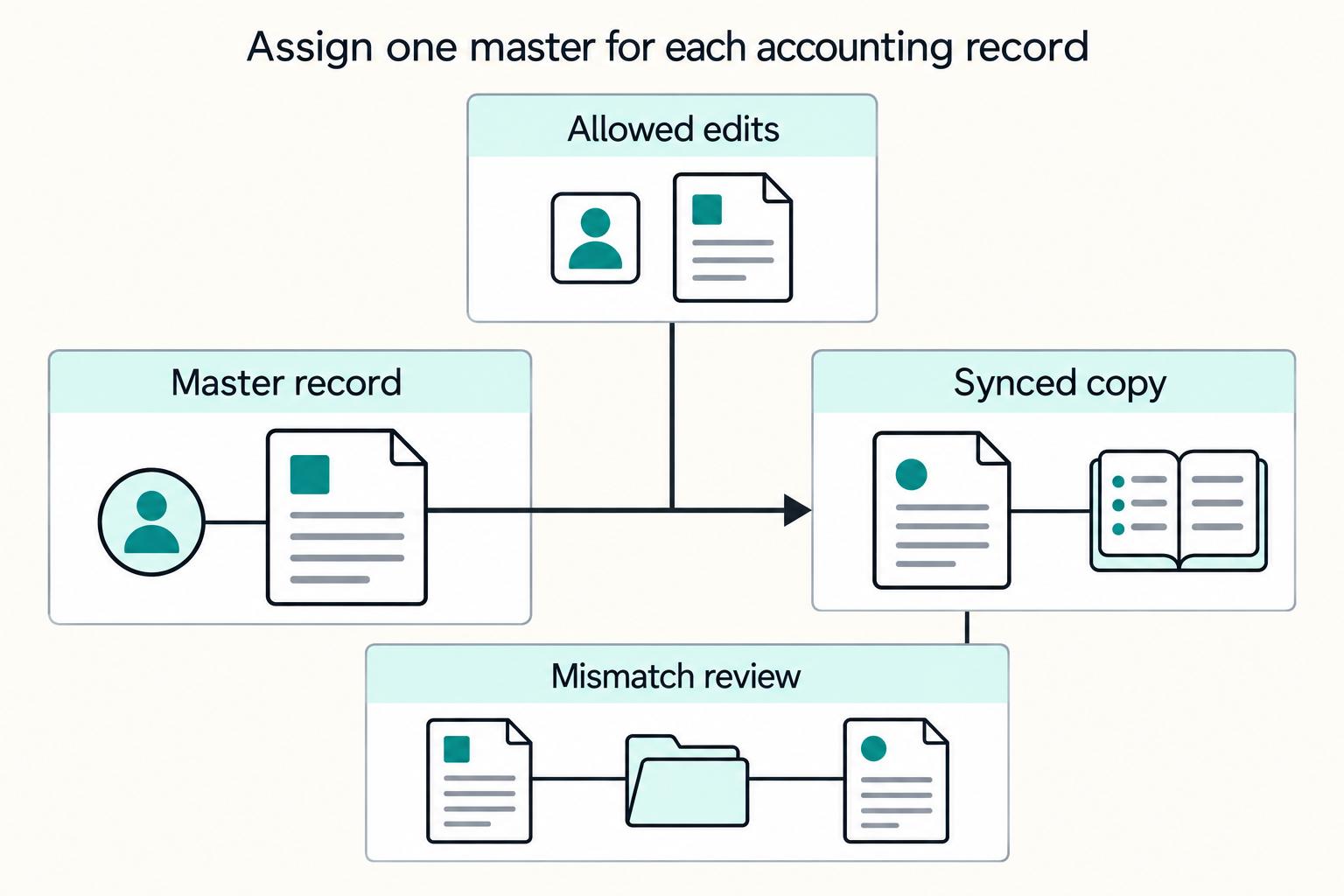
Pick ownership by record type before implementation. Each record type should have one master system and one sync direction. If the same record is edited in both systems, drift is expected.
Assign a master system for each object type and document it in a short ownership matrix. Include the object, master system, allowed editors, sync direction, and expected behavior when someone edits the non-master copy.
This is the control that keeps behavior predictable. For example, if contacts or accounts are mastered outside Xero, direct edits in Xero can be overwritten on the next sync.
Account for Xero's contact model early as well. Xero uses one Contact object for both customer and supplier roles. If multiple counterparties map there, decide ownership before teams start manual cleanup in Xero.
Separate operational state from accounting state on purpose. Define which records live in your operational system versus accounting, and which records are owned in Xero.
The point is traceability without dual ownership. Store the identifiers needed to connect both sides, but do not design both systems as co-masters of the same record type.
Protect accounting-side edits from overwrite. If finance updates records in Xero, your sync design should not push conflicting values back onto those same accounting fields.
When teams skip this, work often falls back to manual checks and delayed invoicing. If operational visibility is needed, send back separate status or reference fields instead of overwriting accounting entries.
Define mismatch handling before go-live. When platform state and accounting state disagree, plan a review path instead of silently forcing a match.
Document delete behavior too. Deleting in one system does not automatically delete it in the other. Missing records are exceptions to reconcile, not automatic delete instructions.
Start with the model that limits failure blast radius during close, then add complexity only when live cross-tool state is necessary. In teams where finance regularly adjusts records in Xero, that often means starting with one-way export and moving to two-way sync only after reconciliation is stable.
Once source-of-truth decisions are set, this becomes a failure-cost question: what can break during approvals, payment prep, and close, and what is the recovery cost when it does?
Use one-way export when you want failures contained to export attempts and exception handling in one direction. Consider two-way sync when the operational value of live shared state outweighs added reconciliation effort across systems.
Xero is part of an AP workflow, including a payment-file export step before bank transfer. Manual steps and disconnected systems are associated with delays and supplier dissatisfaction, so failure handling should be explicit.
Verification point: list the Xero-side edits finance makes after initial posting, such as approval updates, coding fixes, payee cleanup, or payment prep. If that list is active, one-way export is often the safer starting posture.
Do not design from a generic "Xero integration" assumption. Connector behavior varies, so the decision has to match the exact connector you are running.
In documented Procore-Xero connector behavior, constraints include one-organization connection scope, single-user authorization, accounting-approver checkpoints, and once-daily background sync for some data. Documented gaps include non-syncing timecards/timesheets. In practice, "two-way" can be partial, gated, and cadence-bound.
| Criteria | Start with one-way export when | Consider two-way sync when | Why it matters |
|---|---|---|---|
| Update frequency | Records are posted, then mostly adjusted in Xero | State must stay current across tools throughout the day | Higher change volume raises reconciliation pressure |
| Approval model | Finance approvals or checkpoints happen in Xero | Approvals happen upstream and Xero receives finalized records | Approval handoffs must stay unambiguous |
| Rollback complexity | You need simple stop-fix-resend in one direction | You can unwind and reconcile writes across both systems | Recovery design differs for one-direction vs bi-directional flows |
| Support burden | Team capacity for exception handling is limited | Team can monitor and resolve continuous cross-system mismatches | Two-way flows require ongoing monitoring and triage capacity |
If finance edits are frequent and your volume does not require constant live status outside Xero, consider keeping one-way export as the default. Move to two-way sync only after reconciliation controls are proven in production-like conditions.
If marketplace operations truly need live payment-state visibility across tools, implement two-way with explicit exception and reconciliation controls in your design.
Keep exception routing explicit. When states disagree, including partial payments, overpayments, or credits, route the record to review instead of silently forcing a match. Before promotion, confirm all three in testing:
If your team is about to lock the architecture decision, pressure-test exception handling and accounting traceability first: Read the docs.
Freeze the payout-to-accounting map before connector code. This is a policy decision, not just a technical one. For each payout event, define one accounting action, one visible status, and one traceable record set.
Document each payout event, its internal meaning, the accounting action, and the evidence you retain. Do not assume a universal Xero lifecycle map across connectors. Define your own mapping explicitly.
| Example internal payout status | Internal ops meaning | Accounting action (your policy) | Evidence to retain |
|---|---|---|---|
| Pending | Calculated, not released | Pre-accounting hold or no posting | worker/account ID, earning period, payout ID |
| Approved | Cleared for release | Trigger bill creation if this is your posting point | payout ID, bill ID, source lines |
| Settled / paid | Funds sent | Record payment against the bill | provider reference, settlement date, payment account |
| Failed | Attempt did not complete | Keep unpaid and route to exception or retry flow | failure code, retry decision, operator notes |
| Returned | Funds came back after release | Route to exception and document record adjustments | return reference, reason, linked original payout |
Use the exact object names from your Xero tenant in the spec. One grounded connector example, Deel, states that when payment is processed, it creates a bill in Xero.
Decide what detail reaches accounting: timesheet lines, commissions, fees, FX differences, and tax-treatment fields. This is the tradeoff between simpler posting and easier reconciliation.
For Stripe Connect flows, model fee ownership deliberately. Stripe defines a payout as funds sent to a user's bank account or debit card. Under "you handle pricing" it lists fees such as $2 per monthly active account and 0.25% + 25¢ per payout sent; an account is active in months when payouts are sent. If margin reporting depends on these amounts, keep them explicit in your map. Recheck pricing before hard-coding assumptions, because fees can change.
Keep operational status and accounting status separate on purpose. Your platform should show payout lifecycle state, while Xero should reflect the accounting consequence.
If you use labels like pending, approved, paid, failed, and returned, define each one in your spec and show how it appears in both systems. Do not let paid mean two different things, such as provider settlement in one place and accounting completion in another.
If your payout model splits amounts into separate components, track each component explicitly so reconciliation does not depend on net-only amounts.
For each posted item, keep a minimum evidence pack: source payout ID, worker or connected account ID, gross, fee components, net, bill ID, payment reference, and synced documents when available. In the grounded Deel example, the integration supports syncing invoice and expense documents and bill payments mapped to stored payment methods, and it includes an Unsynced invoices tab for past-invoice sync. Use the same design principle in your connector choice: explicit backfill controls over blind bulk resend.
If you want a deeper dive, read Xero + Global Payouts: How to Sync International Contractor Payments into Your Accounting System.
Once the payout-to-accounting map is fixed, design for duplicate-safe processing. A practical approach is to use one immutable idempotency key for the payout action and a separate key for the accounting write, rather than deriving keys from mutable status labels.
Build keys from stable business identifiers and action intent, not from labels like pending, paid, or failed. Keep one key for the payout action and another for the Xero write action so later lifecycle steps do not collide with earlier writes. A simple replay check is that the same source event resolves to the same keys every time.
Store a correlation record before any Xero write so retries can be handled as safe replays. Include your own ingress receipt ID, source payout reference, connected organisation context, event category or type when present, and the resulting Xero object ID after success. This matters because webhooks are configured per app and events are sent for every connected Xero organisation on that app.
Treat webhook delivery as event input. Do not assume guaranteed business sequence from this excerpt. Xero confirms HTTP POST JSON payload delivery to your configured URL, but this excerpt does not provide ordering, sequence, or retry guarantees.
Set your own replay rule, for example by accepting only valid state transitions, and run periodic consistency reconciliation to catch misses.
Add duplicate checks at both boundaries: check the accounting-write key before creating Xero objects, then enforce uniqueness in your own storage for organisation + write key + object type.
Also verify prerequisites before debugging flow issues: at least one organisation must be connected to receive webhook payloads, and if you need a connection longer than 30 minutes, request offline_access.
Roll this out in phases with finance gates, not as a single cutover. Prove one narrow path first, then add ingestion, posting, reconciliation controls, and finally production expansion by tenant.
Lock the object mapping and review checkpoints before building broad services. Keep the first path intentionally narrow: in integrations that support it, approved purchase orders and invoices can sync to Xero, then move to reconciliation review. This phase is evidence-building, not just delivery. For the first mapped cases, collect:
Once mapping is accepted, implement ingestion that stores the source facts your support team will need: document reference, tenant or organisation context, event type, and timestamps.
The goal is simple: never write in a way your team cannot later explain. Strong ingestion records can reduce duplicate-entry cleanup and spreadsheet-heavy investigation.
Start with one complete, reviewable flow and leave edge cases manual for now. Focus on a flow where approved purchase orders and invoices can sync to Xero, then validate a small sample end to end so finance can confirm that amounts and posting dates match expectations.
Before enabling more tenants, add the operational controls you will need under pressure: clear tenant rollout checkpoints, a pause/resume plan, and documented retry procedures.
Make exception logs part of the finance signoff pack alongside reporting and audit-trail evidence, so rollback and recovery are testable before scale.
Roll out tenant by tenant. End each phase with explicit finance signoff on journal traces, exception logs, and close-check screenshots. If finance cannot explain posted results from the evidence pack alone, pause expansion and fix traceability before you widen rollout.
Catch drift early so bank reconciliations and month-end close stay reviewable instead of turning into manual cleanup. The practical baseline is simple: run regular checks, surface issues quickly, and clear aging items before close pressure builds.
Use this as your operating baseline:
If reconciliation effort keeps expanding, treat that as an operational warning. Time spent reconciling accounts and chasing transactions is time your team is not spending on growth work.
Traceability usually breaks first when payout volume grows, so design the audit path before you scale. Keep one immutable trace record per payout line and a separate record for each payment attempt. Finance should be able to move from batch ID to contractor record to the Xero entry without spreadsheet stitching.
For each payout batch, persist the IDs needed to reconstruct the flow: internal batch ID, provider reference, contractor record ID, payout line ID, and the accounting object IDs created from that line. If you generate bank files, keep durable links between exported lines and the payout lines that produced them.
Keep Xero as the system of record, and decide up front how bills enter it: draft, awaiting approval, or awaiting payment. Use that checkpoint to block posting when pre-posting checks flag duplicates, missing data, bank account changes, or mismatches.
A simple validation baseline is to pick one batch and reconcile counts and totals from batch summary to payout lines to created Xero object IDs.
Do not store only net payout outcomes. Persist each component needed for gross-to-net review, including split legs and fees, with provider reference, internal payout ID, currency, component amounts, and resulting Xero posting IDs.
This matters because pricing model choice changes who absorbs payout-related costs. Under Stripe's "you handle pricing" model, published examples include $2 per monthly active account and 0.25% + 25¢ per payout sent. In other arrangements, some of those charges can shift away from the platform. Treat published fee examples as context-dependent, since country-specific payment-method pricing can supersede listed managed-payments fees.
If reviewers cannot explain the net from stored components, auditability is at risk.
If you run mixed rails, such as card, bank file, or wallet, map provider-specific states into one internal status model before any accounting write. Do not let raw provider wording directly trigger posting actions. Block unmapped states until they are classified.
Use mixed-rail test cases to confirm equivalent events land in the same internal state before any supplier bill or payment write is attempted.
When a bank-file line is returned or rejected, route it through the payment-attempt path rather than bill creation. Keep separate identifiers for the accounting document and each payout submission attempt to reduce duplicate risk on retries.
Treat successful lines as immutable. For failed lines, create a new attempt record with reason and link it to the original batch line, then run duplicate and mismatch checks again before retrying.
Cross-border payout operations should be modeled as variable, and tax reporting should stay separate from accounting sync outputs.
Do not assume one market pattern will hold everywhere. Keep market and rail differences explicit in your payout model so release logic, settlement behavior, and exceptions can be handled without rewriting your accounting flow.
Before rollout, test one contractor path per target market and confirm your internal records can carry the release and settlement fields you need end to end.
Payout release approval is its own operational decision, not something proved by a successful accounting post. If you use internal compliance checkpoints, for example identity or tax profile completeness checks, persist those decisions and timestamps in a separate state that the sync process reads. That keeps auditability intact and avoids conflating posted with cleared to release.
Your sync should preserve usable records, but it should not be framed as producing filings like FinCEN Form 114 (FBAR) or Form 8938.
For Form 8938 specifically, IRS guidance says it is used to report specified foreign financial assets, including certain foreign financial accounts. It may apply when aggregate value exceeds $50,000, with higher thresholds for some groups. It is attached to the annual return and due by that return's deadline, including extensions, and it must indicate the applicable calendar or tax year.
Filing Form 8938 does not replace FinCEN Form 114 (FBAR) when FBAR criteria are met. If no income tax return is required for the year, Form 8938 is not required even if foreign assets exceed a reporting threshold. Because Form 8938 instructions are maintained as continuous-use and FinCEN can publish event-driven deadline relief notices, keep compliance calendars and checks reviewable rather than hard-coded.
If you add new rails, keep rail-specific handling modular and map into the same reconciliation core used by other rails. That lets you add rails without rewriting core posting and exception logic.
Make failure testing a release gate, not a nice-to-have. The available evidence here is process-level (roadmap/status and press context), not integration-level failure documentation, so define and validate your own failure and recovery scenarios before launch.
List the event and handoff failures your architecture needs to tolerate, then document the accounting and operational result you will treat as a pass for each scenario before testing starts. Keep those expectations explicit so pass or fail is based on observable outcomes, not assumptions made during incident pressure.
If your stack supports replay and retry testing, run controlled exercises at representative volume and record whether outcomes stay consistent. If repeated processing of the same input changes accounting results, treat that as a pre-launch risk to resolve.
Test how your team recovers exceptions, including who owns each action, when manual intervention is allowed, and what audit evidence must be captured. Recovery is more dependable when operators can trace the original event, the correction, and the final accounting state without ambiguity.
Use a single go-live test matrix with scenario, expected result, owner, and proof for pass or fail. Require joint review across the teams responsible for system behavior and accounting outcomes so launch decisions are based on verified evidence, not roadmap status labels alone.
After go-live, treat monitoring and ownership as part of sync correctness, not just ops hygiene. In the first production cycle, confirm that approved invoices appear in Xero, shared records stay consistent between systems, and exceptions have a clear owner.
Start with a small set of outcome checks your team can act on: approved invoices in ServiceM8 are raised in Xero for automatic reconciliation, clients and items stay aligned when changes happen in either system, and invoice payment updates sync both directions.
Anchor checks to known sync behavior. If your workflow depends on approved records being raised in Xero and payment status updates across systems, monitor those paths directly and investigate mismatches quickly. Also confirm tax rates and income account codes are imported as expected after setup or mapping changes.
Define ownership before incidents happen: set a clear owner for sync configuration issues and a clear owner for accounting exceptions.
Keep ownership aligned to the fault domain. When clients, items, tax rates, or income account code mappings change, someone should verify those changes still land in the right accounting destination.
Document the lookup references your stack actually stores for synced invoices and payments. Include one working query example per reference and where cross-references are maintained.
Do not assume every internal identifier is directly searchable in Xero. If operators cannot move from a captured external reference to the accounting record in one or two hops, close that gap early.
Once you have real production data, review mismatch patterns and manual finance corrections across the core sync paths, then prioritize mapping or process fixes.
Focus first on keeping create and update behavior stable and the audit trail easy for operators to follow.
Related reading: Same-Day ACH for Platforms: How to Speed Up Contractor Payments Without Wire Transfer Fees.
Launch readiness is an evidence decision, not a posting milestone. Your payout sync is ready when ownership, retry behavior, reconciliation gates, and compliance or pricing assumptions are documented and actively verified.
Lock the decisions you made, and explicitly mark what this evidence set does not prove. The provided sources do not validate your timesheet to payout to supplier bill mapping, one-way export versus two-way sync choice, idempotency key design, webhook dedupe logic, or Stripe Connect/ABA/NACHA/SEPA traceability model. Treat each one as a launch gate with internal signoff, test evidence, and rollback notes.
Use one shared document that finance and engineering can both read to answer what happens on approve, settle, fail, return, and replay. If that is unclear, cutover risk is still high.
Assemble the evidence pack before production cutover. At minimum: the approved mapping table, architecture decision record, duplicate and replay test results, sample transaction traces, and a named owner for each reconciliation exception.
Your recovery path should be fast and direct. An operator should be able to go from provider reference or event ID to the resulting accounting record in one or two lookups.
Keep compliance scope as a live reference, especially for cross-border contexts. For FBAR, capture the FinCEN page titled "Report Foreign Bank and Financial Accounts," including the "FBAR Filing Due Date" resource. That page also includes dated notices such as "Additional Extension Due to Hurricane Milton (10/11/2024)."
Do not hard-code tax or filing assumptions and leave them stale. From this evidence set, only FBAR page references are substantiated; threshold amounts and non-FBAR obligation rules are not. If FBAR, FATCA, Form 8938, or Schedule SE appear in your checklist, mark what is in scope, what is downstream reporting, and who revalidates before go-live.
Document pricing assumptions anywhere Stripe-related collection or settlement affects economics, and revalidate before launch. Stripe states standard pricing has "No setup fees, monthly fees, or hidden fees," while effective cost can vary by payment mix, country, and flow.
| Item | Grounded value |
|---|---|
| Domestic card transaction | 2.9% + 30¢ |
| Manual entry add-on | +0.5% |
| International card add-on | +1.5% |
| Currency conversion add-on | +1% |
| ACH Direct Debit | 0.8%, $5.00 cap |
| Stablecoin payment fee | 1.5% of USD transaction amount |
| 3D Secure (custom pricing accounts) | $0.03 per attempt |
| Custom pricing availability | IC+ pricing, volume discounts, and country-specific rates |
Copy, paste, and assign owners before cutover from this checklist:
timesheet -> payout -> supplier bill -> reconciliation state)one-way export or two-way sync) with rollback planwebhook dedupe and replay controls tested with failure scenariosStripe Connect, ABA/NACHA/SEPA where used)FBAR/FATCA/Form 8938/Schedule SE as applicable)If your launch checklist is done but you still need to confirm payout coverage and compliance gating by market, talk with Gruv.
The provided sources do not show a supported, Xero-native contractor payout mapping pattern. What they do show is invoice-side collection, including a Pay now flow and the Add online payments to your invoices setup checkpoint. If your payout mapping is custom, validate it with sample transactions and finance signoff before go live, and keep screenshots and exports as evidence.
Choose one-way export when you want failures contained in one direction and finance regularly edits records in Xero. Move to two-way sync only when live shared state outweighs the added reconciliation and support burden. Make the decision from your own failure-cost and operability review, not from a generic Xero integration assumption.
The article recommends duplicate-safe processing rather than blind retries. Use one immutable key for the payout action, a separate key for the Xero write, and store a correlation record before any write so replays resolve to the same result. On retries, confirm whether the first write landed by checking your provider reference, internal transaction reference, and the resulting accounting record in your own logs.
Pick one master system for each record type and document the allowed editors and sync direction. Keep payout lifecycle state in your operational system and the accounting consequence in Xero, with the identifiers needed to connect both sides. If statuses disagree, route them to review instead of silently overwriting one side.
Reconcile batches by persisting batch metadata, payout line IDs, provider references, contractor records, and the accounting object IDs created from each line. A simple baseline is to pick one batch and reconcile counts and totals from the batch summary to payout lines to created Xero object IDs. If operators cannot move from batch metadata to payout records and then to accounting entries in one or two lookups, fix traceability before scaling volume.
Traceability often breaks first as payout volume grows, especially around batches, split payouts, and payment attempts. Recovery is fastest when current admin access, setup documentation, and provider connection state are clear, and when an operator can go from provider reference or event ID to the accounting record in one or two lookups. Use settings checkpoints and stored evidence to confirm configuration before retrying or widening rollout.
Avery writes for operators who care about clean books: reconciliation habits, payout workflows, and the systems that prevent month-end chaos when money crosses borders.
Educational content only. Not legal, tax, or financial advice.

Move fast, but do not produce records on instinct. If you need to **respond to a subpoena for business records**, your immediate job is to control deadlines, preserve records, and make any later production defensible.
The real problem is a two-system conflict. U.S. tax treatment can punish the wrong fund choice, while local product-access constraints can block the funds you want to buy in the first place. For **us expat ucits etfs**, the practical question is not "Which product is best?" It is "What can I access, report, and keep doing every year without guessing?" Use this four-part filter before any trade:

Stop collecting more PDFs. The lower-risk move is to lock your route, keep one control sheet, validate each evidence lane in order, and finish with a strict consistency check. If you cannot explain your file on one page, the pack is still too loose.

