
Quick Answer
Offer 2/10 net 30 only when earlier payment creates more value than the 2% discount after financing costs, operating overhead, and exception risk. The buyer pays 98% of the invoice within 10 days from the invoice date, or the full amount in 30 days. Use one consistent annualization method, align terms across the purchase order and invoice, and pilot the offer in a narrow segment before scaling.
Why this decision matters for platform margins#
An early payment discount can improve conversion, but it is not automatically margin-positive. If your platform is effectively funding faster payment, 2/10 net 30 can become a subsidy when financing and operating costs outweigh the value you recover.
This is not just wording on an invoice. You are choosing between 2/10 net 30 and Net 30 based on unit economics, financing reality, and execution risk. A headline annualized return can look attractive, but buyer-side return is not the same as platform-side profit.
There is real upside and real downside. Net terms can function as financing for buyers and can improve flexibility in B2B checkout and invoice flows. At the same time, delayed payment can strain seller cash flow while amounts stay open for 30 to 90 days. So the same offer can support growth and still weaken margin if eligibility or funding design is wrong.
This guide is for platform operators setting offer design, eligibility, and rollout controls across billing and payout flows. In practice, that means product, finance, and payments teams deciding where terms appear, who qualifies, how discounts are calculated, and how exceptions are handled. The control details matter. Terms should be clear in the purchase order and related invoice, and discount timing should be counted from the invoice date. Before launch, pressure-test three questions:
- Does earlier payment create enough value to beat your funding cost?
- Does the discount change behavior in the segment you care about, or mostly reward customers with strong pre-period behavior?
- Can your operations apply discounts accurately and handle timing or reconciliation exceptions?
Use a strict standard: launch only when ROI stays positive after financing costs, operating overhead, and failure risk are included. If it does not, keep Net 30 or narrow eligibility until it does.
You might also find this useful: Net-30 Payment Terms for Platforms: How to Set Vendor Payment Terms Without Killing Contractor Cash Flow.
Get the math baseline right before you debate strategy#
Get the baseline right first. If teams are using different date anchors, discount bases, or accounting treatment, the strategy debate goes nowhere.
Anchor the term to the invoice date#
Under 2/10 net 30, a form of trade credit, the buyer can take a 2% discount if payment is made within 10 days of the invoice date. Otherwise, the full amount is due in 30 days.
State the term on both the purchase order and the related invoice so every team is working from the same rule.
- Discounted amount = original amount x 98%
- Implied savings = original amount x 2%
Example: a $500 amount becomes $490 if paid within the first 10 days, so savings are $10. If that window is missed, the discount no longer applies and the full $500 is due by day 30.
Separate buyer math from platform math#
Keep the baseline discount math separate from broader internal strategy analysis. For the baseline, stick to what the term itself supports: the invoice-date anchor, the 10-day discount window, the 30-day due date, and the 2% discount calculation.
Once teams agree on that baseline, they can compare internal scenarios from the same starting point.
Align accounting treatment before reporting results#
Choose the accounting treatment early so your performance reads stay consistent:
- Net Method: record the amount at the discounted value.
- Gross Method: record the amount at the full value.
If teams mix methods, discount performance can look different even when the underlying transactions are the same.
For related controls, see OFAC Compliance for Payment Platforms: How to Screen Every Payout Against the Sanctions List.
Reconcile annualized ROI numbers so finance and product use one method#
This is where teams often drift. Use one internal annualization policy, not mixed calculator outputs. For 2/10 net 30, treat published annualized percentages as method-dependent outputs, so the decision standard should stay simple: same inputs, same method, visible assumptions.
A $500 amount still becomes $490 when paid within 10 days, and the discount is lost after that window. Misalignment usually starts when teams annualize that result differently or review percentages without method context.
Identify why published percentages can differ#
You will see published examples that cite 36.7% annualized return for 2/10 net 30. Treat that as a published output, not a universal approval number.
Do not assume two percentages are directly comparable unless each model shows its assumptions, including:
- term inputs (2% / 10 days / 30 days, from invoice date)
- which annualized view is being used (for example, Annualized ROI vs Effective Annual Rate)
- how results are presented
If an annualized percentage appears without assumptions, it is not ready for review.
Standardize one internal policy#
Pick one internal annualization method and use that policy across product reviews, finance sign-off, and reporting. If you report more than one annualized view, define each method once and keep it consistent. The goal is consistency in decisions, not matching a public headline number.
Keep accounting treatment explicit too. Net method and gross method use different bases, and mixing them changes interpretation even when payment activity is unchanged.
| Method view | What it is for | When to use it | Main caution |
|---|---|---|---|
| Raw discount savings | Amount-level validation, such as $500 to $490 and $10 saved | QA and operational checks | Not an annualized decision metric |
| Annualized ROI | Internal comparison benchmark | Product and finance prioritization | Only comparable when assumptions are shown |
| Effective Annual Rate (if used) | Alternative annualized view | Finance or treasury-style comparison | Do not compare to ROI outputs unless assumptions match |
| Published external figure | Market context, including common 36.7% references | Reference only | Not an approval metric without full method disclosure |
Enforce an approval checkpoint#
Require an assumptions block before any annualized output is approved. At minimum, show:
- invoice-date anchor
- term days and discount percentage
- discount basis
- accounting treatment note (net or gross)
- annualized-view label
One operating rule keeps everyone aligned: no annualized number goes into roadmap or pricing decisions unless the assumptions are shown beside it.
For the full breakdown, read Accounting Cycle for Payment Platforms: How to Structure Month-End and Quarter-End Close.
Should you offer 2/10 net 30 or keep net 30#
Use a simple rule: test 2/10 net 30 only when your assumptions show the cash-timing benefit is worth the 2% discount cost. Otherwise, keep Net 30.
Set the hurdle before debating upside#
Set the hurdle before anyone starts selling the upside. With 2/10 net 30, the buyer gets a 2% discount when paying within 10 days. After that, the full amount is due in 30 days. Your decision is whether getting paid earlier is worth the discount cost.
Annualized ROI outputs can vary by method, so use one internal method consistently and keep assumptions visible. If the model does not show clear value for your objective, stay on Net 30. If it does, start with a controlled segment test rather than a broad rollout.
Lock down execution details too. Terms should match across the purchase order and invoice, and discount eligibility should be counted from the invoice date.
Choose based on your current platform reality#
Your current cash-timing needs matter here. If faster payment timing is valuable, a targeted test can make sense where payment timing is slow or uneven. But the 2% give-up is still real, so the bar should stay disciplined.
If payment behavior is already strong under Net 30, the main risk is paying for behavior you were already getting.
Tie the offer to one goal and score it on that goal#
Do not approve this as a generic cash flow improvement initiative. Pick one primary objective, then evaluate the offer against that objective.
| Primary goal | What to measure first | Signal to stop or tighten |
|---|---|---|
| Conversion lift | Offer uptake, paid-in-window rate, contribution margin on eligible transactions | Discount use rises but margin drops without clear behavior change |
| Default-risk reduction | Post-day-30 overdue rate, collections exceptions, records with term issues | Discount usage is inconsistent and late-pay behavior is unchanged |
| Working Capital acceleration | Days-to-pay shift, cash inside day-10 window, forecast reliability | Most early payments came from accounts that already paid early |
For Working Capital acceleration, check whether timing value exceeds discount cost. On a $500 amount, paying in-window changes payment to $490, which is a $10 discount. On $10,000, it becomes $9,800, a $200 discount. If payment still lands at the end of the net term, no discount is captured, so the intended value never materializes for that transaction.
Related reading: How Payment Platforms Should Sequence Workday Payroll and Finance Integration.
Prepare the data and controls before launch#
Do not launch until the inputs, approvals, and reporting are tied to production fields. Otherwise, it is hard to tell whether results came from payment-timing change or from invoices that would have paid early anyway.
Gather the baseline from live invoice history#
Start with live billing history, not modeled averages. Pull invoice date, full amount, payment date, and whether payment fell inside the 10-day window.
The first baseline question is simple: how many records already pay within 10 days under Net 30? If that share is high, discount cost may rise without much behavior change.
Match baseline metrics to your launch goal. For working-capital use cases, track days to pay and cash collected inside day 10 before launch, and keep discount take-rate assumptions separate from observed early-pay behavior.
Write the sign-off pack before policy approval#
Write the sign-off pack before policy approval, not after. State that discount eligibility is counted from the invoice date, and that missing the early window means the full amount is due in 30 days.
| Pack item | What to confirm |
|---|---|
| Discount timing | Eligibility is counted from the invoice date |
| Missed window | Missing the early window means the full amount is due in 30 days |
| Document consistency | Terms are consistent across the purchase order and related billing record |
| Accounting treatment | Include the selected accounting treatment |
| Recording method | State whether you will record using the Net Method or Gross Method |
Confirm that terms are consistent across the purchase order and related billing record, since those are the main transaction artifacts. Include the selected accounting treatment and state whether you will record using the Net Method or Gross Method.
Validate the calculator against production fields#
Validate your early payment discount calculator against the fields your platform actually stores, not spreadsheet-only proxies. Run a known test case end to end: a $500 amount paid inside the 10-day window should be $490. Outside that window, it should remain $500. This helps catch mismatches between model logic and production date logic before launch.
For a step-by-step walkthrough, see Account Reconciliation for Payment Platforms: How to Automate the Match Between Payouts and GL Entries.
Step 1 set discount policy and eligibility rules#
Set the policy before launch. Define where 2/10 net 30 applies, who is excluded, how you will handle fixed terms versus Dynamic Discounting, and which policy changes need internal approval.
Choose where fixed terms actually apply. Do not make 2/10 net 30 a blanket default. It is trade credit: 2% off if payment is made within 10 days, otherwise the full amount is due in 30 days.
Define eligibility with production fields your team already trusts, for example segment, amount band, or risk tier. Make the decision traceable on the transaction artifacts that carry terms: the purchase order and related invoice. If you cannot show which field qualified a transaction and which term was attached, the policy is not ready.
Write exclusions before the first invoice goes out. Write exclusion rules before launch so application stays consistent under real operating load. You can choose the exclusion list, but it should be explicit and auditable before records are issued.
This matters in practice because teams can miss discount windows when identification, deadline tracking, and approval coordination break down. A practical readiness check is to test eligible, excluded, and ambiguous cases and confirm consistent outcomes across finance, ops, and product.
Set the line between fixed terms and Dynamic Discounting. Document an internal boundary for when fixed terms are used and when cases are handled through Dynamic Discounting. If one standing offer is clear and repeatable for a cohort, fixed terms may be simpler to run; if pricing or timing needs vary, Dynamic Discounting may be a better fit.
Document that boundary in policy language. Keep the fixed-term mechanics explicit, including that discount-window timing is counted from the invoice date. If the boundary is still unclear for a cohort, hold it out and model it separately. For a deeper comparison, see What Is Dynamic Discounting? How Platforms Can Offer Early Payment to Contractors for a Discount.
Require finance sign-off when exposure increases. Treat policy edits as economic decisions, not configuration changes. Consider a finance-owner approval gate for changes that increase expected discount exposure versus the current rule set.
Use a short sign-off pack with the proposed eligibility change, affected cohorts, expected cost impact, and accounting treatment, either Net Method or Gross Method. If key details are missing, hold the change until the pack is complete.
For a deeper dive, read What Is Invoice Factoring? How Platforms Can Offer Early Payment to Contractors in Cash Flow Crunch.
Step 2 wire invoicing, payment rails, and ledger behavior#
Once eligibility is set, the next risk is operational drift. Make the billing record your source of truth so terms, amounts, and downstream decisions stay consistent.
In the contract-to-cash process, vendor-stated results show manual handling can be slower and less accurate than automation. The cited figures are 45-60 days versus 25-35 days, and 94-96% invoice accuracy versus 99%+. Treat those as directional vendor figures, not universal benchmarks. They are still a practical signal to keep discount handling out of spreadsheets and inbox threads.
Make the invoice record authoritative. Keep discount logic in one controlled place and persist the result on the record. Do not let client, checkout, and reconciliation each recalculate the discount independently.
For a standing early-payment offer, the same billing record should preserve one coherent commercial state across teams. If support, payer, and finance each see different amounts or terms, exceptions can scale quickly and auditability can drop.
Before launch, sample real records and confirm that product, finance ops, and accounting are reading the same production fields for qualification, applied terms, and resulting amount.
Keep one clear order of operations. Define one documented order of operations for your workflow, then enforce it consistently across billing status, payment status, and ledger status. If you support multiple payment rails, document those state transitions explicitly rather than assuming they move together. For rail detail, see ACH Payment Processing for Platforms: How to Move Money via the US Banking Network.
The core tradeoff is speed versus certainty. Post too early and you can hide reversals or mismatches. Post too late and operations can stall. Choose the boundary finance accepts, then make it explicit in code and operating procedures.
Review retry behavior before you scale volume. Use rollout checks for duplicate or delayed events and review whether posting outcomes stay consistent. If exception rates rise after adding discount terms, inspect billing-to-cash-to-posting handoffs, not just pricing logic. As part of readiness, baseline process performance with DSO and error rates before deployment, then compare post-launch drift. Consider phased deployment, starting with high-volume customers.
Decide how delayed or failed settlement changes the invoice state. Avoid assuming payment initiation equals collected cash. Define before launch how delayed, failed, or unmatched settlement affects status.
The key control is visibility. Route these cases into an explicit exception path with ownership instead of leaving discounted-and-settled states unresolved in the background.
Keep a trace from issue to settlement. Maintain enough event traceability to reconstruct outcomes and support operational review later. If that trace is incomplete, fix traceability before widening rollout.
Related: Early Payment Discounts: How to Incentivize Clients to Pay Faster.
Step 3 model unit economics with scenario comparisons#
Do not approve this on discount appeal alone. Approve it only if per-transaction economics still work after discount expense, payment costs, financing spread, collections behavior, and exception handling are modeled together. If modeled ROI looks strong but net contribution margin declines, reject a broad launch and either narrow eligibility or keep Net 30.
Use one base setup across every scenario so results are comparable. Model multiple amounts from your own distribution instead of one blended average. If your book is concentrated in the cited $5,000-$50,000 range, test several points inside that range because the same discount can behave differently at the low and high end.
Build one comparable scenario table first. Use the same amount, expected payment timing, and Cost of Capital in each row.
| Option | Margin impact to model | Cash timing effect | Operational complexity |
|---|---|---|---|
| Net 30 | No discount expense; may carry more collections effort | Standard due date under NET terms | Baseline complexity when billing and reconciliation are stable |
| 2/10 NET 30 | Discount expense if paid early | Earlier cash only when the payer takes the offer; otherwise standard due date | Added complexity for eligibility, window tracking, and settlement exceptions |
| Dynamic Discounting | Model discount expense by term structure | Cash timing depends on offer design and acceptance | Model operational complexity explicitly; keep all-units and incremental structures separate in modeling |
| Invoice Factoring | Model financing spread and provider costs | Cash timing depends on provider terms | Model provider coordination and control requirements explicitly |
Treat this as a screening pass, not a final decision.
Include the full cost stack every time. At minimum, model these inputs in every scenario:
- Discount give-up, such as the 2% in 2/10 NET 30
- Processing cost by rail or tender
- Collections effort under slower payment behavior
- Financing spread versus Cost of Capital
- Exception-handling cost for failed, partial, disputed, or unmatched payments
Tie each modeled cost to a production field or observable event. If you use vendor-stated assumptions such as 1% vs 3% processing cost, treat them as hypotheses and validate against your actual routing mix before finance approval.
Stress test downside before approval. Base case is not enough. Run downside cases before go or no-go decisions:
- Lower-than-expected early-pay take rate.
- Delayed settlement or manual-review timing.
- Higher funding cost that compresses spread.
Include reconciliation failure modes such as multiple invoices per payment, partial payments, and disputes. Add a control checkpoint like PO-to-invoice matching or three-way matching where supported. If matching is weak, confidence in modeled outcomes is overstated.
Set enforceable decision rules. Define approval rules before reviewing individual cases. Set a finance-agreed ROI hurdle and payback window before go or no-go decisions. If returns look attractive but contribution margin falls after the full cost stack, reject or constrain eligibility. If results only hold in the base case and fail under mild stress, treat the program as not ready to launch.
If thresholds are not yet agreed, use an interim gate: run a limited test with signed assumptions, then reassess based on interim results before broader rollout.
Before setting thresholds, pressure-test your assumptions with the same inputs you plan to govern in production: Use the pricing calculator.
Step 4 pilot in one segment and verify before full rollout#
Run this as a controlled pilot, not a broad launch: one segment, one early-payment term set, and one defined baseline comparison cohort (for example, Net 30). If you scale before you can explain exceptions and reconciliation breaks at the record level, averages can hide risk instead of proving economics.
| Pilot control | Requirement |
|---|---|
| Scope | One segment and one early-payment term set |
| Baseline cohort | One defined comparison cohort, for example Net 30 |
| Evidence pack | Segment definition, cohort start date, eligible fields, finance owner, ops owner, and pre-agreed rollback triggers |
| Weekly review | Discount uptake, payment-timing movement, exception volume, and reconciliation breaks |
| Rollback response | Pause expansion and narrow scope until root cause is resolved |
Constrain the pilot before you launch it. Constrain the pilot hard before the first record goes out. Keep the offer fixed for the full pilot: same eligibility rule, same term language, same presentation, and same posting logic. Do not mix in other trade credit options during this phase.
Use a simple pilot evidence pack: segment definition, cohort start date, eligible fields, finance owner, ops owner, and pre-agreed rollback triggers. Tag every pilot record in production data, not only in spreadsheet exports.
Also confirm where terms are captured in intake. In AP workflows, terms can appear in email subject lines or email bodies, not just on the billing document, so weak capture upstream can look like weak adoption.
Track weekly checkpoints at the cohort level. Review weekly by cohort for both pilot and baseline, not only in aggregate. This can help separate real timing movement from volume or exception noise. Track a small set of weekly signals, defined in advance, for example:
- Discount uptake among eligible records
- Payment-timing movement versus baseline
- Exception volume: disputes, partial payments, delayed approvals, failed settlement, or manual review
- Reconciliation breaks: unmatched payments, duplicate discount application, missing record references, or term mismatches
Do not treat cash timing alone as success. Manual double handling can create bottlenecks that raise cost and slow payments. If extracted invoice data is not feeding directly into your AP system, your pilot metrics are less reliable.
Compare against Net 30 without overclaiming. Keep a live Net 30 cohort running alongside the pilot. This comparison can reduce false positives, but it does not prove causality by itself.
If pilot timing improves while control timing also improves in the same period, hold expansion and recheck whether the change came from terms, collections behavior, or intake quality.
Define rollback triggers before first invoice goes out. Write rollback triggers before launch and tie each one to an explicit action. Use pre-agreed operational risk signals from your plan and avoid expanding scope until those signals are stable.
If a trigger is hit, pause expansion and narrow scope until root cause is resolved. If reconciliation or term capture is unstable, revert that segment to Net 30 and validate the full record trail before reopening rollout.
Common mistakes and how to recover fast#
The fastest recovery move is to distrust early wins until the math, scope, and operations all agree. If results look strong in a model but weak in cash timing or exceptions, pause expansion and fix the measurement path first.
| Issue | Recovery | Detail |
|---|---|---|
| Calculator output without explicit method | Hold approval until the tool shows term days, formula logic, and annualization method | Published annualized figures vary, including 36.7%, 37.2%, and 45.67% |
| Broad rollout before fit is proven | Restrict the offer to the pilot segment and keep Net 30 elsewhere | Expand only after cohort-level results stay stable across adoption, timing, and exceptions |
| Reporting definitions drift | Lock one reporting method and rerun prior-period comparisons on the same basis | Keep dashboards out of decision meetings until alignment is complete |
| Payments do not settle cleanly | Require reconciliation checks before counting any discount as captured | Route missing, mismatched, or delayed payments to an exception queue first |
Challenge calculator output before you trust it. Treat calculator output as directional until the methodology is explicit. With the same 2/10 net 30 structure, published annualized figures vary, including 36.7%, 37.2%, and 45.67%. A single result is not decision-ready on its own.
Run a quick sanity check: on a $10,000 invoice, 2% is $200, so payment is $9,800 in 10 days versus full payment in 30 days. If the tool cannot show term days, formula logic, and annualization method, hold approval.
Narrow the offer before broad rollout hides a bad fit. Broad rollout can hide a weak fit. Taking the discount means paying sooner than full net terms, so scaling the offer changes your cash position quickly.
Recover by restricting the offer to the pilot segment that performed cleanly and keeping Net 30 elsewhere while you diagnose the gaps. Expand only after cohort-level results stay stable across adoption, timing, and exceptions.
Stabilize reporting definitions before comparing ROI. Do not compare ROI across periods if teams are using different calculation assumptions. When definitions drift, apparent gains can come from reporting changes instead of payment behavior.
Recover by locking one reporting method, documenting it in every review, and rerunning prior-period comparisons on the same basis. Keep dashboards out of decision meetings until that alignment is complete.
Force exception review when payments do not settle cleanly. Unresolved payment exceptions can overstate discount capture. Manual AP timing can consume the discount window, with 10-15 days in some workflows, and late invoice entry can push net terms to expiry before payment completes.
Recover by requiring reconciliation checks before counting any discount as captured. Route missing, mismatched, or delayed payments to an exception queue first, then include them in ROI only after resolution.
For more on the implementation side, see ERP Integration for Payment Platforms: How to Connect NetSuite, SAP, and Microsoft Dynamics 365 to Your Payout System.
Choose the right alternative when 2/10 net 30 is not the best fit#
Use 2/10 net 30 when you want one standing offer with fixed economics. If the right discount changes by invoice size, supplier segment, or timing window, Dynamic Discounting is usually a better fit because it lets you vary the offer instead of hard-coding one rule across every invoice.
Use Invoice Factoring when the seller needs external liquidity and you do not want the platform to fund earlier payment directly. For a quick outside baseline on fixed-term mechanics and discount trade-offs, compare Tipalti's 2/10 net 30 explainer, Credlix's ROI discussion, and Allianz Trade's early-payment-discount overview.
| Artifact | What the capture shows | Why it is not enough for term selection |
|---|---|---|
| Necessary cookies | Core functions like secure log-in and consent preferences | Site infrastructure detail, not commercial guidance |
__cf_bm | Cloudflare bot-management cookie (1 hour) | Security metadata, not payment-term analysis |
_cq_duid / _cq_suid | Malicious-traffic safeguards (3 months shown for _cq_duid) | Technical controls, not alternative-selection evidence |
Keep terms unchanged until evidence is sufficient. Pause recommendation changes when a grounded comparison across alternatives is not yet available. Tell stakeholders plainly that the evidence is insufficient for a decision.
Do not confuse technical specificity with commercial evidence. Cookie names, durations, and security notes can look detailed while still being irrelevant to term choice, and some records also show "No description available."
Rebuild the comparison with auditable inputs. Before selecting an alternative, require an evidence pack that includes:
- source captures with visible body text, not only consent or cookie modules
- the exact URLs reviewed
- one internal note that separates confirmed points from assumptions and unsupported items
Approval should stay blocked until a second reviewer can open the same source and confirm the same substantive content quickly. For now, the only grounded conclusion is that the research is not ready for a decision.
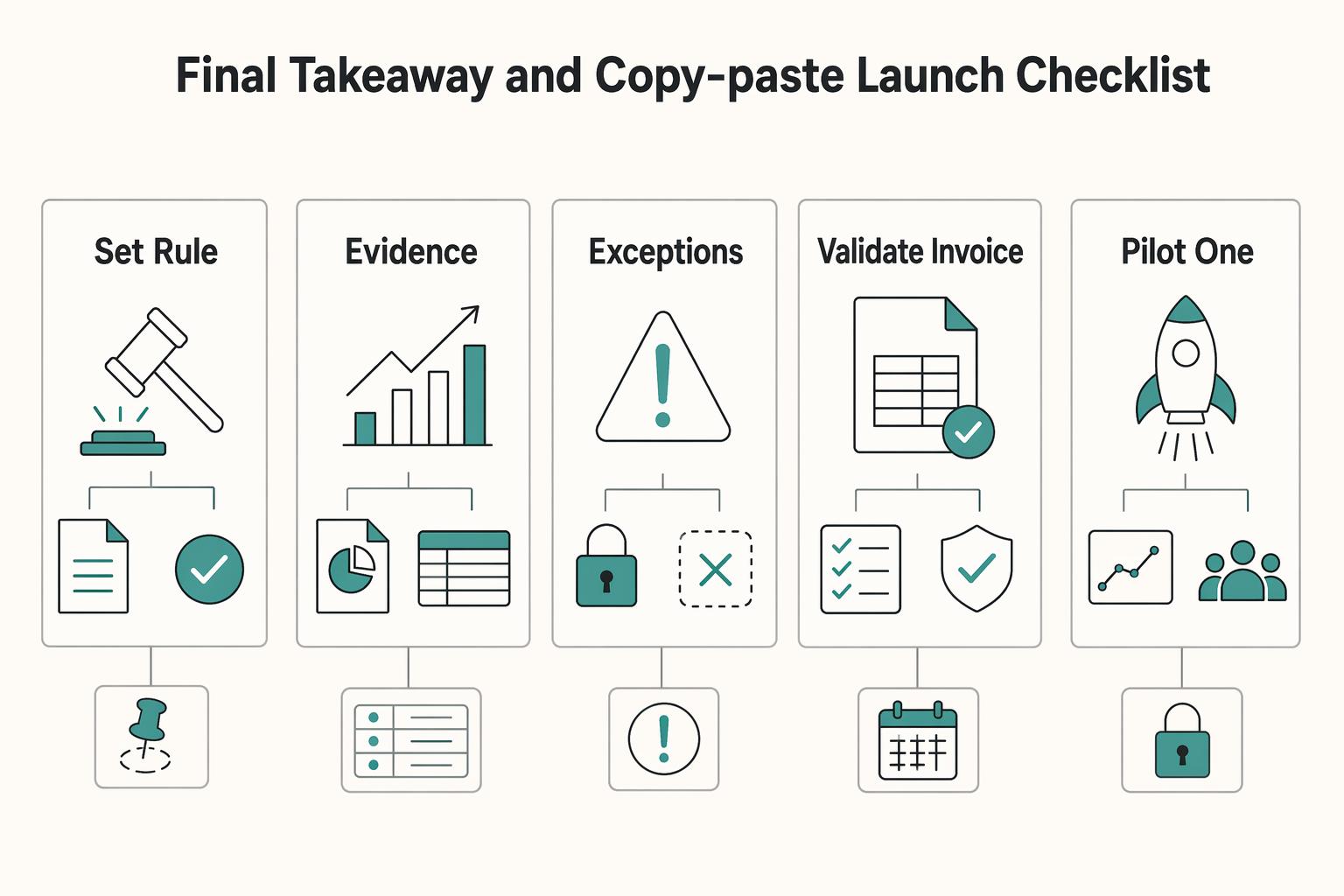
Final takeaway and copy-paste launch checklist#
Use this operating rule: make payment-term decisions only when your scoped business case is defined and operating costs are included. Do not rely on discount math alone.
- Set the go/no-go rule in writing.
Define the exact scope first, because ROI quality depends on scope. Name the cohort, record types, and cost inputs, including cost per transaction, before debating edge cases.
- Lock one calculation method and one evidence pack.
Keep one shared ROI method across finance and product. Document assumptions next to outputs, and keep a simple baseline table so inputs are traceable.
- Define policy scope and exception ownership.
State where the pilot policy applies, where it does not, and who approves exceptions. Make sure exception handling aligns with your verification controls so speed does not outrun control quality.
- Validate the invoice flow end to end before pilot launch.
For each test case, you should be able to reconstruct the full process flow from recorded events, including each Activity Name. Keep three-way match in place (PO, receipt or delivery confirmation, and vendor invoice), since it is a safeguard against overpayments, duplicates, and fraud.
- Pilot one representative, high-impact cohort and compare against baseline.
Start with a controlled pilot cohort, not a broad rollout. Document baselines and target improvements before starting, capture 3-6 months of before data, set 3-5 measurable objectives, and compare pilot outcomes against your baseline.
- Write operating cadence before scaling.
Assign an owner for the exception queue, define the review cadence, and track a small KPI set tied to your baseline and objectives. Scale only if pilot controls and outcomes hold.
When you move from checklist to implementation planning, align owners and integration details early. Review the docs.
Frequently Asked Questions
What does 2/10 net 30 mean in plain terms for a platform business?
It means the buyer can take a 2% discount by paying within 10 days from the invoice date. If that window is missed, the full amount is due in 30 days. The term should be stated on the purchase order and related invoice.
How do you calculate the discounted invoice payment amount correctly?
Multiply the invoice amount by 98% to apply the 2% discount. A $500 amount becomes $490, and a $10,000 amount becomes $9,800. Count the discount window from the invoice date.
How should a platform calculate annualized ROI for an early payment discount?
Use one explicit method and keep it consistent across reviews and reporting. One worked example uses a 2.04% periodic return over 20 days and annualizes it as (1 + 0.0204)^(365/20) - 1 = 45.67%. Document the day count, compounding rule, discount basis, and accounting treatment so the same figure is being evaluated.
Why can the same 2/10 net 30 term produce different annualized percentages?
Because annualized percentages depend on the calculation method and timing assumptions, not just the term label. Different day counts, formulas, or presentation methods can produce different annualized outputs for the same 2/10 net 30 term. Treat any calculator result as incomplete unless the assumptions are shown.
When should you offer early payment discounts instead of keeping Net 30?
Offer early payment discounts when faster collections, lower late-payment risk, or working-capital acceleration outweigh the discount cost under your assumptions. Keep Net 30 when those benefits do not justify the concession. A narrow segment test is safer than a broad rollout.
Is an Early Payment Discount Calculator enough for a launch decision?
No. A calculator is useful for baseline math, but it is not enough for a launch decision by itself. Require a documented formula, visible assumptions, and clear accounting treatment, then test the economics against production data and operating controls.
How do Dynamic Discounting and Invoice Factoring compare to 2/10 net 30?
This article does not provide enough grounded evidence for a quantified comparison. Treat 2/10 net 30 as a specific trade-credit term, and model Dynamic Discounting and Invoice Factoring separately before comparing fit or economics. Do not reuse fixed-term math as a substitute for alternative-specific analysis.
Researched and edited by the Gruv editorial team. Gruv builds cross-border billing, payouts, and finance-operations software for global businesses.
Sources
Includes 4 external sources outside the trusted-domain allowlist.
- finance.wharton.upenn.edu/~mrrobert/resources/FDM/fdm.pdftrusted
- pages.stern.nyu.edu/~adamodar/pdfiles/eqnotes/valpacket1spr22.pdftrusted
- utsystem.edu/offices/contracts-and-procurement/23-payment...trusted
- wct.lsu.edu/administration/ofa/oas/pdfs/bmm421-earlypayd...trusted
- allianz-trade.com/en_US/insights/early-payment-discount.htmlexternal
- cleo-pay.com/blog/ap-automation-roiexternal
- credlix.com/blogs/understanding-the-roi-of-early-payment...external
- tipalti.com/resources/learn/210-net-30external
Educational content only. Not legal, tax, or financial advice.
Related Posts

The Freelance Payment Penalty: A Modeled Audit of Platform Fees, FX Spreads, and Payout Delays
The money rarely disappears through a single, easy-to-spot fee. The real loss is stacked. A marketplace takes its commission, a processor adds a charge for international cards, a bank or payment company converts the currency at a spread, a platform holds the funds before release, and a wire sheds a little to intermediaries on the way in. Each layer looks defensible on its own, but the worker feels the combined result as a smaller deposit and a later payday.

How to Respond to a Subpoena for Business Records
Move fast, but do not produce records on instinct. If you need to **respond to a subpoena for business records**, your immediate job is to control deadlines, preserve records, and make any later production defensible.
A US Expat's Guide to Investing in UCITS ETFs to Avoid PFIC Issues
The real problem is a two-system conflict. U.S. tax treatment can punish the wrong fund choice, while local product-access constraints can block the funds you want to buy in the first place. For **us expat ucits etfs**, the practical question is not "Which product is best?" It is "What can I access, report, and keep doing every year without guessing?" Use this four-part filter before any trade: