
Quick Answer
For payment platforms, the accounting cycle is the recurring process of recording transactions, reconciling settlements and bank activity, updating the GL, and producing period-end statements. The strongest close structure prioritizes source-event to payout-batch to bank-statement to GL traceability, with clear owners, verification checkpoints, and an exception path for items that cannot be proved by cutoff.
Why month-end close breaks on payment platforms#
Month-end close on payment platforms usually breaks in three places: timing mismatch, explanation debt, and unclear ownership. The fix is to choose a close structure you can actually run, assign clear ownership for each tie-out, and set verification checkpoints for month-end and quarter-end. That keeps financial statements accurate without pushing cleanup into the next period.
- Transactions and cash do not move on the same clock
In the accounting cycle, transactions are identified, recorded, and aggregated into period-end statements. Cash movement on payment platforms runs on a more asynchronous timetable. Payment capture, refunds, chargebacks, PSP settlements, payout creation, and bank deposits can all post on different dates. Settlement timing can also vary by market, payment method, and transaction type.
Close starts to fail when teams post to the General ledger (GL) from transaction totals, while cash arrives later through payout batches. The key checkpoint is matching each bank deposit to the payout batches behind it, not just to transaction volume. Your evidence should show batch-level payment, refund, and chargeback detail.
- Volume turns small mismatches into explanation debt
High volume does not just create more reconciliation lines. It amplifies data-quality gaps and unclear adjustments. Teams can end up spending more time explaining mismatches than fixing them, and Perry D. Wiggins links close delays directly to poor data quality and cleanup labor.
APQC benchmark figures cited by CFO.com show a median monthly close of 6.4 calendar days, top quartile at 4.8 days or less, and bottom quartile at 10 or more calendar days. If your close consistently runs long, one common issue is weak traceability from payment event to payout batch to bank activity to GL entry. If a mismatch cannot be explained from source evidence in one pass, treat it as a design issue, not a one-month fire drill.
- Quarter-end exposes monthly shortcuts
Financial close follows a recurring month-end, quarter-end, and year-end cadence, so unresolved monthly issues can carry forward. For public-company filers, Form 10-Q deadlines are 40 days after quarter-end for large accelerated and accelerated filers, and 45 days for other registrants. That leaves little room for rework.
Weak dependency design makes this worse. Teams repeat tasks or re-prove the same balances across reports when ownership is not explicit. In practice, success looks simple: a clean GL, exceptions that are explainable with evidence, and fewer surprise quarter-end adjustments.
For a practical month-end checklist, see Month-End Close for Payment Platforms: A Step-by-Step Checklist for Finance Teams.
How to choose the right close structure for your team#
Choose your close structure for control and evidence first. Speed matters, but only after you can prove the balances.
| Criterion | What to assess |
|---|---|
| GL control | Who owns final posting and adjustment logic? |
| Reporting speed with integrity | How fast can you publish a reliable profit and loss statement without treating pending funds as available? |
| Exception visibility | Can you match payout batches to bank statements, then drill into transaction-level payments, refunds, chargebacks, and costs? |
| Quarter-end readiness | Can the structure hold up under the real quarter-end timeline, including 10-Q windows of 40 days for large accelerated and accelerated filers, or 45 days for other registrants? |
- Use this framework when close evidence is shared across teams
This matters most when finance, ops, and product owners share responsibility for Accounts payable, Accounts receivable, payout execution, and reconciliation. If one team owns PSP settlements, another owns bank statements, and finance owns journal entries and adjustments in the GL, you need a structure that makes ownership explicit. Period-end controls only work if it is clear how entries and adjustments are recorded.
- You still need close discipline whatever model you choose
You still need close discipline: bank tie-out, settlement support where relevant, and review of posted entries. For smaller and less complex organizations, a standalone ISA for LCE is effective for audits beginning on or after December 15, 2025, where adopted or permitted.
- Score each option on four criteria, not just speed
- GL control: Who owns final posting and adjustment logic?
- Reporting speed with integrity: How fast can you publish a reliable profit and loss statement without treating pending funds as available?
- Exception visibility: Can you match payout batches to bank statements, then drill into transaction-level payments, refunds, chargebacks, and costs?
- Quarter-end readiness: Can the structure hold up under the real quarter-end timeline, including 10-Q windows of 40 days for large accelerated and accelerated filers, or 45 days for other registrants?
- Decision rule for first redesign: prioritize traceability when exceptions are high
In the first redesign cycle, favor source-event to payout-batch to bank-statement to GL traceability over raw speed. If an exception cannot be explained from source evidence in one pass, treat it as not ready to close. A fast monthly close that hides settlement timing breaks can force rework in cash, liabilities, or revenue at quarter-end.
Compare the close structures before you pick one#
Pick one primary close anchor and one fallback path for items you cannot prove by cutoff. In practice, teams can anchor on the subledger, settlement batches, invoice flows, or an exception lane.
| Close structure | Best for | Data inputs | Owner model | Failure mode | Quarter-end impact | Required evidence pack |
|---|---|---|---|---|---|---|
| Daily subledger with monthly GL close | High transaction volume and frequent payouts where transaction history is reliable | Transaction-level subledger activity, customer invoices, vendor invoices where relevant, PSP settlements, bank statements, tie-out to GL reconciliation accounts | Ops or platform finance owns daily subledger review; accounting owns monthly GL adjustments and adjusted trial balance | Breaks accumulate if subledger activity is not matched back to GL reconciliation accounts, so month-end turns into catch-up | Can be strong for quarter-end when daily review is consistent | Daily reconciliation output, month-end subledger-to-GL tie-out, bank reconciliation, adjustment journal support, open-items log |
| Settlement-first anchored on bank reality | Teams where cash accuracy and payout execution drive risk more than invoice timing | PSP settlements by batch, payout-frequency setup, external bank statements, payment balance data showing pending versus available, GL cash and clearing accounts | Treasury, payments ops, or finance ops owns settlement matching; accounting owns period-end postings | Timing differences are treated as errors, or pending funds are treated as available. Payout setup gaps block reconciliation | Can improve quarter-end cash confidence, but revenue and liability true-ups can build if invoice and settlement timing diverge | Settlement batch reports, payout-frequency configuration evidence, bank reconciliation, payout-to-bank match file, journal links for timing adjustments |
| Invoice-led with strict AP and AR ownership | Mature billing and payables controls with predictable invoice governance | Customer invoices, vendor invoices, AR aging, AP trial balance, bank statements, GL revenue, expense, AR, and AP balances | AR owner controls receivables, AP owner controls payables, controller or accounting manager owns GL posting review | Invoice status looks clean while payment execution lags, leaving unsupported cash, liability, or clearing balances | Can keep period-end reporting moving, but quarter-end can reopen if receivables or payables are not tied to cash movement and GL | Receivables-to-GL reconciliation, AP trial balance to GL tie-out, invoice support, accrual journals, reviewer sign-off |
| Exception-first with formal unresolved-items lane | Teams with repeated breaks across PSP settlements, bank statements, and GL | All core artifacts above plus exception register, reconciliation status, supporting journals and transactions | Named owner per exception, with accounting approving treatment and reversal criteria | Close is posted without enough proof, and exception traceability is lost | Protects quarter-end when used with discipline. Weak discipline carries risk into the Form 10-Q window for U.S. public filers | Exception register, account impact by asset or liability, source-event proof, drill-down links to journals and transactions, reversal or follow-up criteria |
What changes between these options#
What changes is where proof starts. In a subledger-led model, you trust transaction detail first and confirm that GL reconciliation accounts reflect those postings. In a settlement-first model, you start from settled batches and bank movement, then explain differences back to the books, which helps prevent pending funds from being treated as available.
In an invoice-led model, control over receivables and payables can be clearer, but invoice timing still has to be checked against PSP settlements and bank statements. In an exception-first model, the value is containment and proof preservation when some items cannot be resolved by cutoff.
The tradeoff to watch most closely#
A faster close only helps if evidence coverage stays intact. If your reconciliation checklist does not force a tie-out across bank statements, PSP settlements, and the GL, you can shift work from month-end to quarter-end. For U.S. public filers, that pressure is time-bound because Form 10-Q is due in 40 days for large accelerated and accelerated filers, and 45 days for other registrants.
Pick a primary path and a fallback path#
- Choose the primary anchor based on the balance that is hardest to prove.
- Use exception-first as the fallback for unresolved items, with named ownership, account impact, and supporting evidence.
- Run one final pass across customer invoices, vendor invoices, bank statements, PSP settlements, and the GL before sign-off.
For payment platforms, keep the close structure simple: one primary anchor, one exception path, and evidence that holds up at quarter-end.
For ways to reduce close time, see How Finance Teams Shorten Month-End Close With Automation.
If you are scoring close models by evidence quality and exception handling, map your process to the implementation surfaces in Gruv Docs.
Daily subledger with monthly GL close#
If transaction detail is dependable and payouts are frequent, this is a practical operating model. Reconcile detailed subledger activity daily, then use the monthly GL close to finalize the period.
Subledger journal account entries hold source-level detail before transfer to the ledger, so proof starts near the transaction date instead of being deferred to month-end. That matters when payout activity can produce multiple deposits in a day and reconciliation breaks can stack quickly.
Why this structure works#
A key advantage is earlier detection of drift between subledger activity and GL reconciliation accounts. Daily payment reconciliation keeps matching work current, while the monthly close focuses on formal review, adjustments, and final statement preparation. In practice, that supports period-end preparation for the Balance sheet and Cash flow statement.
What you need in place#
You need consistent daily ownership, especially for Accounts receivable and Accounts payable subledgers. You also need disciplined control of manual postings to subledger-driven accounts so the subledger and GL stay aligned and reconciliation evidence stays intact.
What to verify each period#
- Daily checkpoint: Tie transaction feeds to subledger activity, then compare settlement or payout detail with posted bank activity on a consistent cadence.
- Month-end checkpoint: Complete subledger-to-GL tie-outs for receivables, payables, and cash accounts. Log unresolved items with an owner, account impact, and support.
- Evidence pack: Maintain daily reconciliation outputs, bank statements, relevant customer and vendor invoice support, settlement batch reports, and adjustment-journal support.
A practical pattern is daily transaction and payout reconciliation paired with a monthly GL close. It helps surface unresolved items earlier and move them through a formal exception lane instead of being patched late.
Settlement-first close anchored on bank reality#
Use this structure when settlement timing is the main cash-accuracy risk, even if invoice timing still matters. A settlement-first close starts with PSP settlements, ties payouts to bank deposits, then finalizes the affected General ledger (GL) cash, clearing, and related liabilities accounts.
When this structure earns its keep#
This model fits periods where cash confidence is the main close risk. Funds move to an available balance after settlement, and settlement timing can vary by location and payment method. In Stripe card flows, settlement is often one to three business days, and initial payouts can be delayed by 7 to 14 days. Anchoring on bank-linked reconciliation supports the Cash flow statement objective of reporting historical changes in cash and cash equivalents.
The key mechanic is batch-level matching. Reconcile each payout to the batch of transactions it settles, not just to a single deposit line. Where provider reporting allows it, that batch view can include payments, refunds, and chargebacks in the same payout group.
What you actually verify#
The checkpoint is straightforward: can you explain each bank deposit with a settlement batch and post it to the ledger without unexplained residue?
- Bank statement line or deposit confirmation
- Provider payout ID or batch reference
- Payout reconciliation report with underlying transactions
- Included refunds and chargebacks, where applicable
- Posted GL entries to cash, clearing, and settlement-related accounts
If you use instant payouts, reconciliation ownership still sits with your team. Initial matching and follow-up on reconciling items are part of the control, not optional cleanup.
The main tradeoff#
This structure improves cash confidence, but it does not complete the revenue view on its own. Revenue timing and settlement timing can diverge, and IFRS 15 ties revenue recognition to satisfaction of performance obligations, not cash settlement timing. At quarter-end close, you can have well-supported cash and still need accrual or revenue work before the full statement set is ready.
Decision rule for breaks#
When a settlement variance is above your documented tolerance, treat it as an open exception for the affected accounts. Escalate it with provider reference evidence: payout ID, bank deposit amount, date, settlement report, and underlying transaction detail. Do not label variances as "timing" without proof. Unresolved breaks can roll from month-end into quarter-end. For a deeper evidence checklist, use Month-End Close Checklist for Payment Platforms: Reconciling PSP Settlements Bank Statements and Ledger.
Invoice-led close with strict AP and AR ownership#
Use this structure when invoices are your most reliable control point and billing operations are already disciplined. Start from Customer invoices and Vendor invoices, then require clear ownership to support what sits in Accounts receivable and Accounts payable before publishing the Profit and loss statement.
Under the accrual method, income is recognized when earned and expenses when incurred, not when cash moves. If invoicing is timely and controlled, it helps keep support for Revenues and Expenses aligned to accrual timing.
Where this structure earns its keep#
This model works when invoice governance stays consistent during the period, not when you rebuild it at close. Keep transaction recording current. IRS guidance notes that daily recording is generally best.
Your balance-sheet controls also need to be active. Accounts receivable tracks what customers owe on credit sales. Accounts payable tracks what you owe vendors and typically sits in current liabilities due within the next 12 months. Under accrual accounting, revenue and expense recognition does not wait for cash settlement.
What you actually assign and verify#
The practical control here is ownership. A common control is to assign one owner for AR aging and one owner for AP accruals before month-end output is issued. No rule requires those exact role labels, but management is responsible for establishing and maintaining adequate internal control over financial reporting.
Use these minimum checks:
- AR owner: support open receivables with customer invoice detail and support for outstanding balances that could change period results.
- AP owner: support payables and accruals with vendor invoices, paid bills where available, and support for expenses incurred but not yet paid.
Evidence quality is the real gate. Supporting records include invoices, receipts, paid bills, deposit slips, and canceled checks. If support is missing for a receivable or payable item, treat it as an open accounting exception.
The failure mode to watch#
The core risk is timing drift between invoice status and payment execution. You can have sound accrual logic while cash status is still unresolved.
Use a simple decision rule: if invoice support is strong but payment execution lags, keep accrual conclusions separate from cash conclusions. Do not clear an item on invoice presence alone. Keep the related cash or clearing questions open until payment evidence is in hand.
That is why this structure can support the Profit and loss statement while still leaving cash risk if invoice status is overread. Revenue and expense support can be solid, yet close risk remains if AR aging is stale or AP accruals lack vendor support.
Exception-first close with a formal unresolved-items lane#
Use an exception-first close when breaks between Bank statements and PSP settlements repeat across periods. The goal is to close with control and traceability, not to force weak matches into the General ledger (GL).
If invoice support is strong but cash or settlement proof is incomplete, move those items into a formal unresolved-items lane with clear ownership.
When this structure is the right call#
Choose this model when reconciliation differences are recurring, not just one-off. Reconciliation means comparing records across systems, analyzing the differences, and correcting them. Repeated variances can indicate a control design issue, not just close-week noise.
A strong fit signal is repeated impact on balance-sheet accounts, especially Assets and Liabilities. Another signal is unclear accountability. Designate a reconciler for each relevant account and clear ownership for every open exception.
What the unresolved-items register must hold#
The register should be standing, not rebuilt each close. Each line should show current treatment plus closure criteria.
| Register field | Why it matters | Minimum evidence |
|---|---|---|
| Source event or reference | Confirms the exception came from a real bank or PSP event | Payout ID, settlement batch ID, bank line reference, or provider report row |
| Affected GL account and statement area | Shows where the issue sits and what it can impact | Account name or number and statement area, for example cash, receivable, payable, or clearing |
| Controlled treatment at cutoff | Prevents ad hoc close adjustments | Approved journal entry, explicit hold decision, or documented no-post rationale |
| Reversal or closure criteria | Prevents permanent parking of open items | Clear condition for reversal, clearing, or reclass once evidence is available |
| Owner and reviewer | Enforces accountability and review | Named reconciler, reviewer, and current status |
How to treat items still open at cutoff#
If an exception cannot be supported with evidence within cutoff, use controlled treatment and document reversal criteria for the next period. Do not guess just to make balances look clean.
Common controlled treatments are:
- Post an approved journal entry when support is strong enough to explain the GL and statement impact.
- Hold the balance when movement is unproven, with reviewer-approved rationale in the register.
- Reclass only when evidence supports both the account move and the period effect.
The closure test that keeps the register credible#
Do not mark an exception closed unless the evidence links all three: source event, GL impact, and statement effect. If any link is missing, the item is still open.
Use provider evidence that matches your operating model. Stripe's Payout reconciliation report is for automatic payouts and ties payouts to settlement batches. For manual payouts, Stripe points to the Balance report. Adyen's Settlement details report supports transaction-level settlement reconciliation.
Include bank activity, PSP settlement detail, and ledger movement for each exception line. Also align cutoff windows: Stripe reporting uses 12:00 am to 11:59 pm, so mismatched boundaries can make the wrong period look resolved.
This structure can look less tidy at month-end because open items stay visible. The benefit is that unresolved items remain owned, explainable, and reversible, which can reduce quarter-end surprises.
For a step-by-step walkthrough, see Usage-Based Billing for Platforms That Holds Up at Month-End Close.
Quarter-end overlay that prevents last-week fire drills#
When month-end is stable but quarter-end still needs material true-ups, do not rebuild the whole process. Keep the monthly close and add a quarter-end overlay: deeper account review, formal sign-off, and statement-ready narratives in the final month.
Use the unresolved-items lane from the prior section as a quarter-end input. Any open item that could move the Balance sheet, Profit and loss statement, Statement of changes in equity, or Cash flow statement should get elevated review before quarter close.
1. Add quarter-specific review depth#
The goal is not more reconciliations. It is deeper review of the reconciliations you already have, focused on unusual movements, weak explanations, and cross-statement coherence.
At quarter-end, increase review depth with analytical procedures and inquiry on unusual relationships or items. For sharp changes in clearing accounts, reserves, or payout-related liabilities, do not accept "timing" without support that ties bank activity, settlement detail, and the General ledger (GL).
Quarter-ready checkpoint: for each high-impact balance, the reviewer can clearly answer what changed this quarter, why it changed, and where it appears in the statements.
2. Tie monthly artifacts to quarter deliverables#
Map monthly close outputs to the interim reporting package so the quarter file is review-ready, not just operationally closed.
| Monthly output | Quarter-end overlay | Evidence you should have ready |
|---|---|---|
Balance sheet reconciliations | Substantiate material Assets and Liabilities with explicit reviewer conclusions | Account reconciliations, aging or support detail, unresolved-items status, cutoff rationale |
Profit and loss statement by month | Run quarter trend checks for unusual swings, reversals, or late postings | Variance narrative, posting analysis, explanation of significant events and transactions |
| Cash movement and settlement summaries | Confirm Cash flow statement coherence against bank and settlement activity | Bank statements, settlement reports, cash bridge, major noncash or reclass explanations |
A common failure mode is that balances reconcile account by account, but the links across statements are not explained. A fix in one statement can create an unexplained movement in another.
3. Add formal sign-off and a readiness trigger#
Quarter-end needs management sign-off, not just preparer completion. In SEC scope, quarter-end includes evaluating disclosure controls and procedures and completing required principal executive and principal financial officer certifications in periodic reports.
If you are not in SEC scope, keep the same operating discipline with a cross-functional readiness review involving finance, operations, treasury, tax, legal, and controllership when risk is rising. Set an entity-defined trigger to run that review before the final month close when high-impact unresolved items remain open.
Your quarter evidence pack should include narratives for significant changes, not only schedules. If a material movement explanation is still "TBD," the quarter is not ready.
Multi-entity and multi-currency close sequencing#
For cross-border platforms, use an auditable sequence: close at the entity level first, then translate, then consolidate. That keeps measurement, FX treatment, and consolidation review tied to entity-level evidence instead of group-level fixes.
| Stage | Key rule | Review checkpoint |
|---|---|---|
| Close entity books before group consolidation | Close each entity on its own records and functional currency before building the group view. | Reconcile bank accounts at least monthly and within 30 days of statement receipt, tie the GL balance to the same statement date, and list reconciling items. |
| Translate first, then consolidate | Follow a documented sequence from local currency to translated results to consolidated reporting. | Compare local ending balances, translated balances, and consolidation entries for each entity. |
| Do not use payout status as recognition timing | Revenue recognition follows performance-obligation satisfaction under IFRS 15, not payout or settlement status alone. | Require each entity package to show the source event, recognition basis, FX treatment, and any elimination entry. |
1. Close entity books before group consolidation#
Close each entity on its own records and functional currency before building the group view. IFRS 10 requires consolidated reporting for controlled subsidiaries. IAS 21 requires each entity to determine its own functional currency, rather than using a single group functional currency. Skipping the entity step can weaken the basis for later consolidation.
Each entity package should stand on its own before consolidation. Include reconciled Bank statements, support for material cash, receivables, payables, and clearing balances, and a record of expected consolidation adjustments. The practical checkpoint is that a reviewer can explain ending General ledger (GL) balances without relying on group-level plugs.
Use bank reconciliation as a close gate. As a control baseline, reconcile bank accounts at least monthly and within 30 days of statement receipt, tie the GL balance to the same statement date, and list reconciling items. If that support is missing, treat the entity close as incomplete.
2. Translate first, then consolidate#
After entity close, follow a documented sequence from local currency to translated results to consolidated reporting. Without that sequence, teams often blend transaction FX, remeasurement, and presentation-currency translation into one bucket that is hard to defend in review.
Separate income-statement FX effects from equity translation effects. Under IAS 21 presentation-currency translation, liabilities are translated at the closing rate. Resulting translation differences are recognized in OCI and accumulated in a separate equity component until disposal of the foreign operation. Your review file should clearly show what hit Revenues or Expenses versus what went to OCI or equity.
A strong check is to compare three layers per entity: local ending balances, translated balances, and consolidation entries. If an FX movement appears only in consolidation with no entity-level basis, stop and trace it before reporting.
3. Do not use payout status as recognition timing#
Keep payout operations and accounting recognition logic separate. Revenue recognition follows performance-obligation satisfaction under IFRS 15, not payout or settlement status alone.
When payout completion becomes the trigger for all recognition, teams can mix liabilities, platform Revenues, and cross-entity settlements in ways that are hard to eliminate in consolidation. Consolidated reporting should remove internal balances and transactions so results reflect external economics.
Use a strict review rule: if a balance is explained only by payout status, it is not fully explained. Require each entity package to show the source event, recognition basis, FX treatment, and any elimination entry.
Related reading: What Is RegTech? How Compliance Technology Helps Payment Platforms Automate Regulatory Reporting.
Automation-first close with explicit human checkpoints#
Use automation for high-volume, repeatable close tasks, and keep explicit human sign-off for high-risk General ledger (GL) decisions. This model is strongest when retries are deterministic, adjustments are fully traceable, and close approval is blocked until reconciliation is complete.
| Stage | Control focus | Checkpoint |
|---|---|---|
| Automate ingestion and matching first | Automate source-event ingestion, reference matching, and deterministic posting prep; use an idempotency key for retryable create and update workflows. | Replaying a settlement or payout event should not duplicate cash, receivable, or liability movement. |
| Keep humans on high-risk postings | Keep human review for judgment-heavy accruals and period-end adjustments. | If a reviewer cannot clearly explain the entry across Assets, Liabilities, Revenues, or Expenses, do not auto-post it. |
| Lock the period before final approval | A close process should prevent new postings to the closed-period GL, and it can require lockout of A/P, A/R, and Payroll before final review and adjustments. | Complete the Reconciliation checklist, lock it, then approve the close; post-lock entries require formal reopen approval and documented rationale. |
1. Automate ingestion and matching first#
Automate the mechanical flow first: source-event ingestion, reference matching, and deterministic posting prep. For retryable create and update workflows, use an idempotency key so repeated attempts map to one outcome instead of duplicate accounting effects. In idempotent APIs, reusing the same key should return the same result, including 500 errors, and retry design should account for key-retention windows that may be as short as 24 hours.
Checkpoint: replaying a settlement or payout event should not duplicate cash, receivable, or liability movement. If retry keys are missing or inconsistent, duplicate entries can look like valid volume until reconciliation fails.
2. Keep humans on high-risk postings#
Keep human review for judgment-heavy accruals and period-end adjustments, even when upstream matching is automated. Period-end journal entries remain a higher-risk area for inappropriate or unauthorized postings, so assign a named reviewer before high-risk entries are approved.
Require an approval pack with the source event or calculation, proposed GL impact, adjustment rationale, and an audit trail of who changed what. If a reviewer cannot clearly explain the entry across Assets, Liabilities, Revenues, or Expenses, do not auto-post it.
3. Lock the period before final approval#
Treat period lock as a control, not a label. A close process should prevent new postings to the closed-period GL, and it can require lockout of A/P, A/R, and Payroll before final review and adjustments.
Make the Reconciliation checklist a hard gate: complete it, lock it, then approve the close. If post-lock entries are needed, require formal reopen approval and documented rationale. If you are an SEC registrant filing Form 10-Q, include quarter-end ICFR change evaluation and align close checkpoints to the 40- or 45-day filing window based on filer status.
For reducing manual journals during close, see Accounting Automation for Platforms That Removes Manual Journals and Speeds Close.
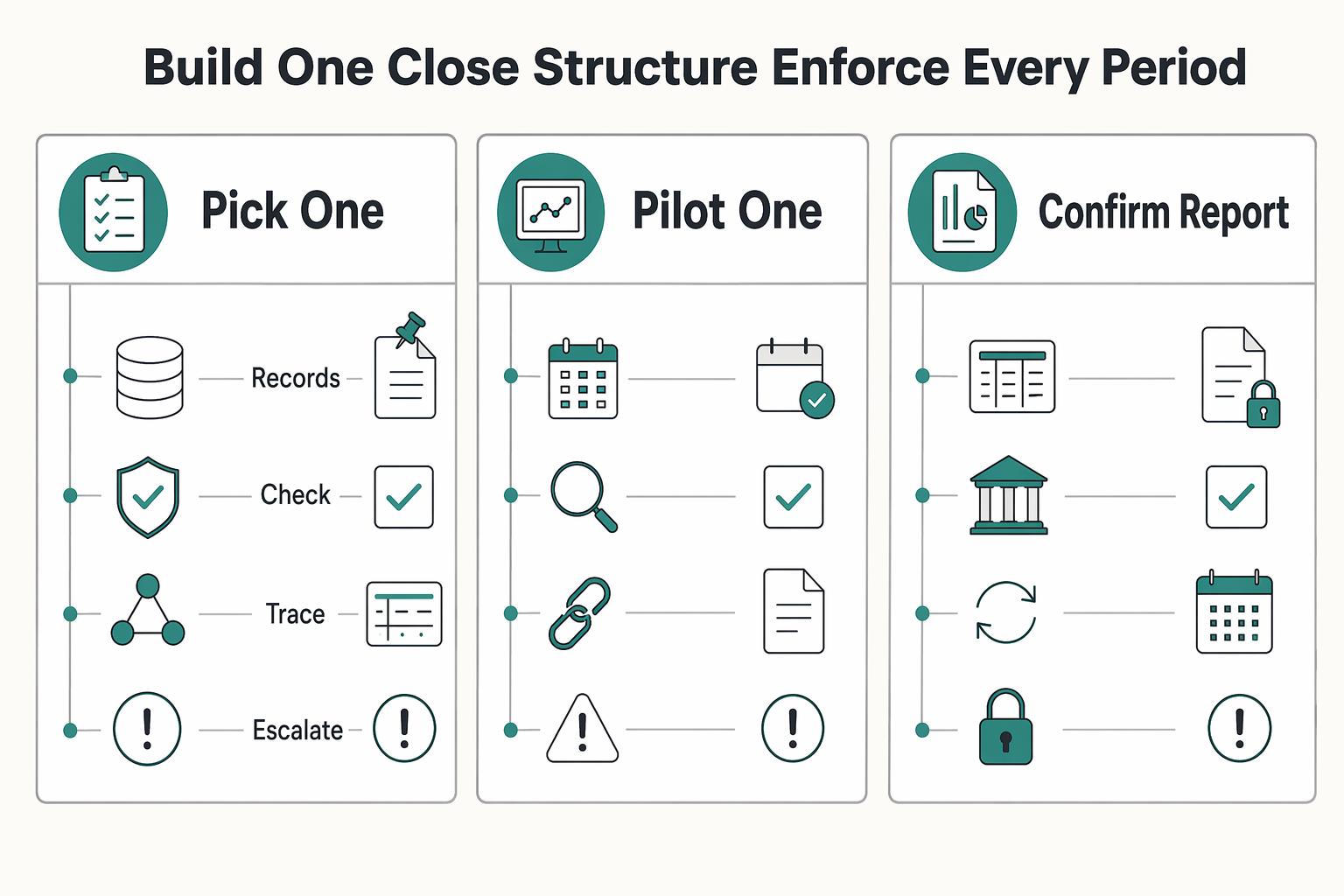
Build one close structure and enforce it every period#
Predictable close quality usually comes from using one explicit close structure every accounting period, with clear owners, exception rules, and fixed verification checkpoints. If you want fewer month-end surprises and fewer quarter-end fire drills, keep the core process stable instead of redesigning it every cycle.
The goal is not a universally "best" model. It is a repeatable accounting cycle so the general ledger (GL), bank activity, and settlement records support one consistent financial story across month-end, quarter-end, and year-end.
- Pick one primary structure and keep it consistent
Choose one structure from this article as your default path, then run it consistently across periods. A close process works better when evidence is comparable period to period, and unresolved items move through a documented exception lane instead of changing the main process mid-close.
- Pilot for one quarter and measure carryover quality
Run the structure through a full quarter of month-end cycles, then review what carried into quarter-end. Close speed matters, but durability matters more: which reconciliation items remained open, which accounts they affected, and whether the statement impact was explainable without rebuilding support.
If you have SEC reporting obligations, quarter-end discipline matters even more. Form 10-Q applies to the first three fiscal quarters, with filing deadlines of 40 days after quarter-end for large accelerated and accelerated filers, and 45 days for other registrants.
- Confirm report and audit-trail coverage in platform docs
Before standardizing your close, verify the reconciliation evidence your stack can actually produce. For Stripe, the payout reconciliation report is built to match bank payouts to transaction batches and supports drill-down review of underlying transactions. For Adyen, the settlement details report provides transaction-level settlement detail for reconciliation.
Use one hard checkpoint: do not mark an item reconciled until you can tie the source event, payout or settlement report, bank statement effect, and GL impact.
Choose one structure from this list, pilot it for one quarter, and measure exception carryover into quarter-end before you redesign. To confirm which reconciliation, payout, and audit-trail capabilities are enabled for your market or program, review the docs or book a Gruv demo.
When you are ready to pilot one close structure for a quarter, align payout controls, reconciliation handoffs, and audit trail requirements with your market setup via Talk to Gruv.
Frequently Asked Questions
What is the accounting cycle for a payment platform in practical terms?
It is the recurring process of identifying and recording transactions and then aggregating them into period-end financial statements. For payment platforms, that cadence usually runs at month-end, quarter-end, and year-end. Many teams describe it in 8 steps, but the workflow can vary by team and system.
What are the minimum steps every month-end close must include?
Every month-end close should record transactions, reconcile accounts, update the GL, and produce financial statements. For payment platforms, reconciliation must tie PSP settlement activity to bank statement activity and ledger balances.
How should month-end and quarter-end close responsibilities be split?
Use month-end for recurring transaction capture and reconciliations, and use quarter-end for deeper variance analysis and additional review. The handoff is the key control. Quarter-end should build on complete monthly work, not replace it.
Why do unresolved monthly reconciliation issues become quarter-end delays?
Because quarter-end adds scrutiny on top of month-end, unresolved breaks usually carry forward and become larger review problems. When month-end quality is messy, quarter-end and year-end pressure both increase. That added review load can slow the close.
Which records matter most when reconciling PSP settlements to the GL?
The most important records are the ones that anchor both settlement batches and cash movement. For Stripe automatic payouts, use the payout reconciliation report; for manual payout workflows, use the Balance report. For Adyen, use the settlement details report for transaction-level reconciliation and the aggregate settlement details report for batch totals and counts, with batch closure as a core checkpoint.
How do you close on time when some exceptions are still open?
There is no universal rule for when to delay close versus close with documented exceptions. If items stay open, document each one, assign an owner, and set a next review date. If an item cannot be tied to a specific settlement or bank-statement effect, escalate it instead of letting it roll forward without explanation.
Researched and edited by the Gruv editorial team. Gruv builds cross-border billing, payouts, and finance-operations software for global businesses.
Sources
- ecfr.gov/current/title-17/chapter-II/part-240/subpart...trusted
- ecfr.gov/current/title-17/chapter-II/part-240/subpart...trusted
- investor.gov/introduction-investing/general-resources/new...trusted
- irs.gov/publications/p538trusted
- irs.gov/businesses/small-businesses-self-employed/wh...trusted
- ojp.gov/sites/g/files/xyckuh241/files/media/document...trusted
- ojp.gov/tfmc/guidesheets/bank_reconciliation_guide_5...trusted
- sao.georgia.gov/document/publication/bpbankreconciliationsao...trusted
Educational content only. Not legal, tax, or financial advice.
Related Posts

The Freelance Payment Penalty: A Modeled Audit of Platform Fees, FX Spreads, and Payout Delays
The money rarely disappears through a single, easy-to-spot fee. The real loss is stacked. A marketplace takes its commission, a processor adds a charge for international cards, a bank or payment company converts the currency at a spread, a platform holds the funds before release, and a wire sheds a little to intermediaries on the way in. Each layer looks defensible on its own, but the worker feels the combined result as a smaller deposit and a later payday.

How to Respond to a Subpoena for Business Records
Move fast, but do not produce records on instinct. If you need to **respond to a subpoena for business records**, your immediate job is to control deadlines, preserve records, and make any later production defensible.
A US Expat's Guide to Investing in UCITS ETFs to Avoid PFIC Issues
The real problem is a two-system conflict. U.S. tax treatment can punish the wrong fund choice, while local product-access constraints can block the funds you want to buy in the first place. For **us expat ucits etfs**, the practical question is not "Which product is best?" It is "What can I access, report, and keep doing every year without guessing?" Use this four-part filter before any trade: