
Quick Answer
Platform operators should hedge currency risk by mapping exposure by currency pair first, reducing same-pair inflows and outflows through natural hedging, and then choosing a forward for predictable residual flows or an FX option for uncertain ones. The process should be controlled through approval rules, idempotent execution, webhook monitoring, and reconciliation from provider records to ledger entries and payout outcomes.
Why currency hedging breaks for platform operators and how this guide fixes it#
Currency hedging can break at the platform level when teams choose instruments before they have a usable exposure map. This guide reverses that order. First, map cross-border inflows and outflows by Currency Pair. Then reduce what you can through Natural Hedging. Only then decide whether the remaining risk belongs in a Currency Forward, an FX Option, or no hedge at all.
Set scope at the platform level#
Treat this as a platform exposure problem, not a one-off payment problem. The real risk is recurring inflows and outflows across multiple pairs, often on different timelines and rails, with different owners.
That matters because exposure can compound. A move that looks manageable on one payout is harder to absorb when you collect in one currency, hold in another, and pay out in a third. Start with exposure measurement and management, then move to instrument selection.
Map exposure before choosing products#
Map exposure first, then choose tools. Your job is to separate what is predictable from what is uncertain, and to identify what can be offset operationally before you commit to a hedge product.
For many platform teams, a practical first pass is to split committed inflows and outflows from forecast-only volume, then identify offsets within the same pair. Natural Hedging can reduce risk without adding a separate hedge contract. If net exposure remains, evaluate that residual against a forward or an option.
Use this rule for the rest of the guide: stable amount and timing favor a forward, while uncertain amount or timing can justify paying for option flexibility.
Lock constraints early#
Execution is constrained by market and program realities, so define them early. This is operational guidance, not legal, tax, accounting, or investment advice. Product availability, onboarding, settlement, and compliance controls vary by jurisdiction and program.
Do not assume provider verification replaces your own legal KYC/KYB/AML obligations. A common failure mode is timing a hedge to forecast payouts, then running into country-specific or program-specific verification requirements that can shift settlement timing. If hedge-accounting treatment matters, formal designation and documentation at inception are required, not a cleanup task after execution.
Define success as auditable execution#
Success is not just a treasury view; it is traceable execution. You should be able to follow each hedge-related action from API initiation through Webhook status changes into internal ledger entries and provider transaction records.
That traceability is what lets you control approvals, execution, and reconciliation. If retries can create duplicate actions, implement idempotency before automation. If you cannot reconcile exposure assumptions to settlement and payout outcomes, pause rollout and fix the data path first.
By the end of this guide, you should have a sequence your team can approve, run, and observe without manual patching. If you want a deeper dive, read A Guide to Currency Hedging for Freelancers.
Get the instrument basics right before you model anything#
Modeling goes wrong early when teams treat spot, forwards, options, and futures as interchangeable. They are not. Choose the wrong instrument class up front, and the execution model can break later.
Use a forward when amount and timing are predictable#
Use a Currency Forward when amount and timing are reasonably predictable. A forward is a contract to exchange two currencies at a pre-agreed future date and price. It is commonly implemented in the OTC Market, where terms are negotiated directly between counterparties. That makes it useful when you need terms that match a real payout or receivable profile.
Use an option when amount or timing is uncertain#
Use an FX Option when amount or timing is genuinely uncertain. An option gives the buyer the right, but not the obligation, to buy or sell at a pre-determined price. That flexibility is purchased through an option premium. If exposure is variable, that premium can be worth paying. If cash flow is already committed and date-specific, it may just be extra cost.
Treat spot as immediate conversion#
Treat a Spot Contract as immediate conversion, not the default hedge for future cash flows. Spot FX is an outright exchange agreed on trade date, commonly for delivery within two business days. It is for near-term delivery. A forward is the instrument that fixes terms for a future-date exchange.
Keep futures separate from OTC hedging#
Do not treat Currency Futures as the same as OTC hedging. Futures are exchange-traded and standardized, with set unit size, fixed expiration, and centralized clearing. If your model assumes custom sizing and bilateral OTC execution, you can run into execution mismatches.
Related: A guide to currency options for 'hedging' against forex risk.
Build an exposure map and evidence pack before selecting any hedge#
If the exposure map is weak, the hedge decision will be weak too. Build the map first, and if you cannot reconcile internal ledger records to payout outcomes, treat that as a control gap and resolve it before relying on the map for execution decisions.
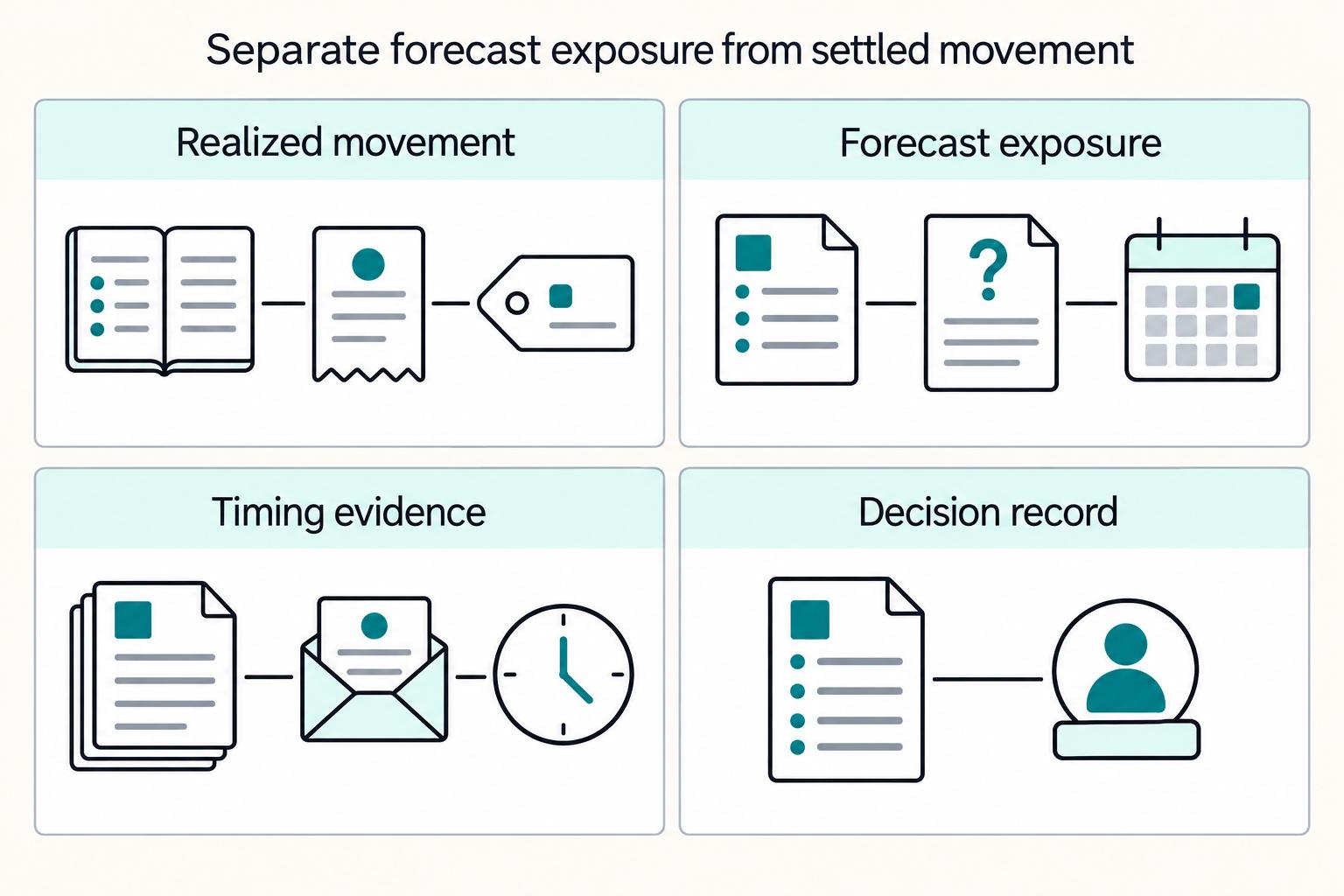
Use realized ledger movement and operational payout records to create a decision pack the business can trust. The point is to separate what actually settled from what is still forecast.
Start with an exposure table by pair and direction#
Start with a simple exposure table by Currency Pair and direction. Keep forecast inflows and forecast outflows in separate groups instead of blending them.
Include:
Currency Pair- Inflow or outflow direction
- Expected magnitude
- Timing window
- Certainty bucket
- Named owner
Use clear certainty buckets such as committed, highly probable forecast, and forecast-only. Document forecast rows with enough specificity on both magnitude and timing. If either is too uncertain, keep it out of committed treatment.
Separate realized from forecast movement#
Classify realized versus forecast movement before you classify hedgeable exposure. Break realized data into posted inflows, posted outflows, reversals, and timing slippage so timing risk stays visible instead of getting buried in net totals.
Then label forward-looking rows by certainty level and mark known seasonal windows directly in the table. That keeps temporary spikes from being mistaken for steady-state exposure.
Capture settlement timing evidence#
Settlement timing needs its own evidence. Payout availability varies by country and industry, and initial payouts can differ from steady-state timing, so capture behavior by market or program and by funding rail.
| Evidence source | Capture | Why it matters |
|---|---|---|
| Internal ledger export | Realized inflow/outflow amounts, posted dates, internal references | Establishes actual movement by pair, including reversals and delayed posting |
| Payout or settlement batch records | Batch date, deposit amount, transaction linkage, market/program | Reconciles bank deposits to settlement batches and underlying line items |
API and Webhook records | Request IDs, status changes, retry history, duplicate events, idempotency key (if supported) | Makes asynchronous state changes auditable and duplicate-safe |
Turn the map into a decision pack#
Once the map is built, turn it into a short decision pack: assumptions, confidence by certainty bucket, approval thresholds, and exception rules tied to API and Webhook status signals. Set those thresholds internally and assign who approves, escalates, and blocks execution.
Make duplicate-safe behavior explicit for retries and repeated webhook delivery. If idempotent POSTs are available, reuse the same idempotency key for retries. Keys can be up to 255 characters and may be pruned after 24 hours, so store them with the request record for the full retry window.
Use one hard checkpoint before execution: reconcile ledger entries to payout outcomes by matching bank deposits to settlement batches and then to underlying transactions. If that chain does not hold, the exposure map is not ready for decision use. You might also find this useful: Best Multi-Currency Accounting Software for Platform Operators in 2026.
Reduce exposure with natural offsets before buying derivatives#
Once the exposure map is clean, reduce what you can operationally before you buy derivatives. Start with Natural Hedging, match inflows and outflows in the same pair where that match is reliable, and treat the residual as the first hedgeable risk slice.
Net same-pair inflows and outflows first#
Offset same-pair inflows and outflows on a net basis where feasible before pricing derivatives. Natural hedging reduces risk by aligning currency revenues and costs, and it is often less costly than derivative hedging, though it is also less flexible.
Use evidence, not intuition. In your exposure table, show committed inflows, committed outflows, and the net residual for each pair. If timing slippage repeatedly breaks the match, treat it as an unreliable offset rather than a true hedge.
Hedge the residual first, then decide on gross flow#
Use derivatives when offsets are not enough. Many teams start with residual exposure after offsets. Some firms also hedge gross cash currency risk, depending on policy and context. Use a Forward Contract to fix a future exchange rate for a planned exchange, or an FX Option when you need the right, but not the obligation, to exchange at a specified future rate.
Keep the economics explicit. A forward is a commitment agreed at inception, while an option requires paying a premium for that contingent right. If operational offsets are reliable, use them before paying option premium.
Review residual exposure on a regular cadence#
Track residual exposure on a regular finance ops cadence so hedge size follows current risk rather than louder gross volumes. Treat this as an operating cadence tied to settled results and forecast confidence, not as a regulatory requirement.
Two common errors show up here. One is over-hedging because inflows and outflows are hedged separately after operations already offset part of them. The other is assuming offsets will hold when timing or forecast quality says otherwise. Keep your evidence pack explicit on matched-flow logic by pair, residual after offset, and where uncertainty makes the offset weak.
This pairs well with our guide on How to Lock In FX Rates for Contractor Payouts Using Forward Contracts.
Choose forwards or options with explicit decision rules and tradeoffs#
Choose the instrument based on certainty of amount and timing. Lean toward a Forward Contract for well-supported, near-certain residual flows. Lean toward an FX Option when amount or settlement timing is uncertain enough that a binding hedge could create mismatch risk.
Classify each residual exposure by certainty#
Do this by pair, not only at the portfolio headline level. The decision should reflect whether the specific flow is contracted or still forecast-driven.
Use this rule as guidance, not law: predictable receivables or payables from contracted activity can lean forward, while launch-driven or forecast-heavy volumes can lean option. If a bucket is partly contracted and partly forecast, split it instead of forcing one instrument across the full amount.
Before calling a lane predictable, keep evidence for its amount basis, settlement window, and accountable business owner. If the evidence is weak, treat the exposure as uncertain.
Choose by commitment risk and cash impact#
A forward foreign exchange contract is a binding agreement set now for future exchange. That supports budget-rate certainty when settlement is expected to occur as planned. An option gives a right without obligation, which is why it is used when flexibility matters.
| Decision point | Forward Contract | FX Option |
|---|---|---|
| Commitment risk | Binding agreement for future exchange. | Right without obligation. |
| Cash impact | Confirm actual pricing with the provider. | Often described as premium-based, but some structures can have little or no upfront payment. Confirm term-sheet cash treatment. |
| Settlement flexibility | Lower flexibility once booked. Changes in amount or date can create mismatch risk. | Higher flexibility if the underlying flow changes. |
| Operational burden | Needs stronger confidence in amount and settlement timing before execution. | Needs clear structure rationale, approval, and ongoing term monitoring. |
The tradeoff is simple: certainty versus optionality. If budget-rate certainty matters more than flexibility, lean forward. If being wrong on amount or timing is the bigger risk, lean option.
Verify with a per-pair evidence pack#
For each pair, keep a short record of the exposure description, contracted versus forecast status, settlement window, proposed hedge size, and accountable owner.
For options, verify cash treatment before approval. For forwards, verify settlement realism before execution. If uncertainty remains, reduce size, split the exposure, or move the uncertain piece to an option decision.
Add approval ownership and escalation before execution#
Set approval ownership in policy: who approves instrument type, who approves size, and how exceptions are handled when policy or counterparty limits are exceeded.
Treat governance as an execution control, not paperwork. The FX Global Code includes sections on governance, risk management, and compliance. Its latest update is December 2024.
Use a clear escalation rule: if proposed hedge size exceeds documented policy limits for that pair or counterparty, pause and escalate before execution. Then record the decision and any exception.
If your forward-vs-option policy is set, map it into idempotent execution and status handling in the Gruv docs.
Vet hedging operators on execution risk, not marketing claims#
Pick the operator that can prove execution controls, not the one with the nicest FX story. The goal is risk reduction, not trading the market.
Compare operators on money-moving facts#
Start with four checks: pricing transparency, settlement process, onboarding requirements, and supported Currency Pair coverage.
If a provider cannot show pre-trade FX fees and expected settlement amounts, you are approving blind. Stripe's FX quote flow explicitly supports previewing FX fees so you can anticipate settlement amounts before execution.
Do not assume coverage from marketing copy. Verify that the sell and buy currencies are actually supported on your account before you design approval logic or payout timing.
Ask for the actual booking path your team will operate: quoted amount, fees, expected settlement amount, quote expiry, and booking confirmation or rejection records. If cutoffs, funding sequence, or confirmation evidence are unclear, treat that as execution risk.
Test stale-quote controls before production#
Expired quotes should not be executed under the expired quote. Quote-validity windows are provider-specific, so your controls need to match the operator's actual behavior.
Stripe supports fixed windows of 5 minute, 1 hour, or 24 hour. Airwallex lists 1 minute, 15 minutes, 30 minutes, 1 hour, 4 hour, 8 hour, and 24 hour, and requires conversion before valid_to_at. Use a simple pilot test:
- Create a short-window quote.
- Let it expire.
- Attempt conversion.
- Confirm the expired quote cannot execute without a fresh quote.
- Confirm the attempt still produces an auditable record.
If the provider cannot clearly show quote-expiry behavior and rejection evidence, keep it out of automated payout flows.
Require explicit KYC, KYB, and AML gating details#
Compliance gating is execution risk because missing information can block payouts or other transaction flows. Require exact answers on what must be complete before execution, what triggers review, and how blocked or rejected transactions are reported back.
For legal-entity customers, U.S. rules require identifying and verifying beneficial owners. For money services businesses, U.S. rules require an AML program sized to risk. Use these as control anchors, not as a universal checklist for every jurisdiction.
Your evidence pack should include trackable compliance status, escalation paths, and transaction identifiers retained for rejects. Sanctions-related rejection handling specifically calls for identifiers like reference numbers, account numbers, dates, or similar transaction details.
Also validate hold behavior up front. Stripe notes payouts may pause when required information is missing, and if forms are complete with no remaining requirements, payouts should be restored within two business days. If your payout deadlines cannot absorb that hold pattern, resolve dependencies before go-live.
We covered this in detail in Foreign Exchange Risk for Platform Operators and the Decisions That Cut FX Exposure.
Implement approvals and systems so hedges survive real operations#
Once you pick an operator, execution discipline becomes the next control point. Use a fixed workflow and enforce it in systems so retries, duplicate events, and payout timing gaps do not create duplicate or unreconciled conversions.
Freeze the exposure snapshot before hedge proposal#
Start from a frozen exposure record, not a live balance that can shift during review. Capture details such as Currency Pair, amount, timing window, and owner, then build the proposal from that snapshot.
A practical order is: exposure snapshot, hedge proposal, approval, execution and confirmation, reconciliation, post-trade review. This aligns with common treasury practice across exposure analysis, execution/confirmation, settlement, and accounting handoffs. At minimum, each proposal should carry snapshot timestamp, covered risk period, and the policy limit it is tested against.
Enforce approval gates in your API and event handling#
Put policy enforcement in product and finance controls, not email. If a request breaches approved limits, stop and escalate before execution so policy compliance is visible and testable.
Use idempotent requests on hedge-related execution calls to prevent duplicate financial actions during retries. A common pattern allows idempotency keys up to 255 characters and pruning after at least 24 hours. In practice, use one key per intended financial action. Persist it before the outbound call.
Treat every Webhook as potentially duplicated. Deduplicate by event ID or provider reference so repeat events do not create duplicate approvals, postings, or false booked states.
Tie execution to Payout Batch timing before payout day#
A booked hedge helps only if settlement cash arrives in time for the payout it is meant to fund. Reconcile hedge activity to the specific Payout Batch or settlement batch, not just to gross daily activity.
Where mapping is not automatic, for example instant payouts, run explicit reconciliation against transaction history. If your provider uses a typical initial payout window of 7-14 days after first successful payment, use that window to verify hedge settlement, funding movement, and payout release timing. If timing does not line up, pause automated release for that currency until operations resolve the gap.
Store one audit trail from request to Ledger Journal#
For each hedge-related conversion, keep a single trace from internal request through approver, provider reference, confirmation record, settlement status, and resulting Ledger Journal entries. Confirm trades as soon as practicable after execution, amendment, or cancellation to reduce avoidable settlement risk.
Your control test is one-to-one traceability in both directions: journal entry to source object, and source object back to the approved request. If the journal exists but the originating request and provider reference cannot be recovered, treat it as an audit and fraud-control gap.
Run day-two monitoring with clear failure modes and recovery steps#
After go-live, small operational misses can quickly turn into payout or funding incidents. Run daily monitoring that catches exposure drift, execution exceptions, and reconciliation breaks before they escalate.
Watch three internal signals every day#
Track these three signals for each live pair in your operating model. Keep an intraday exception queue if your rails run continuously, since payment operations can run 24x7x365 and end-of-day-only checks can miss funding-critical breaks.
| Daily signal | What to compare | What needs action |
|---|---|---|
| Exposure drift by pair | Latest net receivable or payable vs booked hedge amount and settlement window | Covered amount no longer matches expected payout or collection timing |
| Execution exceptions | Conversion and payout states (processing, failed, returned, canceled) | Items stuck in processing too long, or any reject without a documented next step |
Reconciliation gaps in Ledger Journal | Provider reference, settlement status, and journal posting | Trade or payout event cannot be traced to a journal entry, or a journal exists with no source reference |
Use one checkpoint test: select an exception and verify end-to-end traceability from source request to provider reference to Ledger Journal. If traceability fails, treat it as a financial-control issue, not reporting noise.
Define recovery for common failure modes#
Start with delayed credits on Virtual Account rails where those destinations are supported. Do not assume sent instructions mean funds posted. Payout timing can vary, and first payouts may take longer in some onboarding contexts. If funding is late, hold the affected payout batch, confirm pending versus posted status, and age the exception until resolved.
For rejected conversions, treat quote expiry as a primary failure mode. Some quotes expire after 30 minutes, while some APIs provide 1-hour or 24-hour validity windows. If a conversion fails after expiry, generate a fresh quote, reconfirm the exposure, and recheck approvals before re-execution.
For late payout funding, enforce a hard rule: intent is not funding. If payout state is processing, failed, returned, or canceled, do not treat the batch as covered until settlement cash and the related Ledger Journal posting match. Closed destination accounts can trigger returned funds, and returns can take up to 5 business days.
Route compliance holds before reattempting settlement or payout#
When an AML or verification hold appears, pause automated retries and route the case through your compliance workflow, including manual review where required, before reattempting settlement or payout. Ongoing due diligence and transaction scrutiny obligations make this a control point, not a routine retry path.
Maintain a compact case file with alert reason, party identifiers, transaction references, screening result, analyst decision, and timestamp. For sanctions-related blocked property events, reporting can be due within 10 business days, so these holds need compliance workflow handling, not standard payment retry handling.
Compare hedge plan with cash reality monthly#
Run a monthly review by pair that compares planned hedge timing against actual receivable and payout timing. Focus on repeated slippage patterns, not one-off noise.
Use the same evidence pack each month: hedge proposal, execution confirmation, payout batch timestamps, Virtual Account credit timestamps, and Ledger Journal records. If a lane repeatedly misses timing windows, adjust hedge horizon or coverage until cash timing becomes more predictable. Related reading: Accounts Payable Automation for Dummies for Platform Operators.
Avoid the mistakes that create hidden FX losses#
Hidden FX losses can come from exposure sizing and execution readiness, not just market calls. Before launch, fix four things: hedge only the residual after Natural Hedging, use an FX Option only when uncertainty is real, verify Webhook plus reconciliation behavior, and clear KYC and other compliance gates early.
Hedge the net residual, not the gross flow#
Do not hedge gross inflows and outflows that already offset. Match receivables and payables, then hedge only the remainder.
The hedge-accounting illustration is straightforward: USD100,000 sales and USD90,000 purchases leave a USD10,000 net exposure, and the forward is executed on that residual USD10,000. IFRS-oriented guidance also allows designating a net position with offsetting items as the hedged item.
Use one approval check before any Forward Contract: every gross line is either matched by Natural Hedging or marked open with timing evidence from your ledger and settlement windows. If that mapping is incomplete, pause the trade.
Use an option only when uncertainty justifies the premium#
Use an FX Option when amount or timing uncertainty is material enough to justify paying for flexibility. An option gives the right, not the obligation, to transact.
Document the case in a short scenario range: committed versus forecast amount, earliest versus latest settlement, and what could cancel the flow. Then state why optionality is worth paying for versus a forward commitment.
Keep the failure mode explicit. If the option is not exercised, the premium paid can become a realized loss. That can be acceptable when uncertainty is genuine and approved, but it is a preventable cost when used as a default.
Treat onboarding as incomplete until events and reconciliation are proven#
Onboarding is not complete when credentials work. It is complete when you can trace events from request to provider reference to Ledger Journal, including exception paths.
Do not assume webhook coverage is complete. Provider documentation notes that some legal-entity data changes may not trigger webhooks, and custom API-based onboarding flows need updates as verification requirements change.
Run staged dry runs before go-live where possible: one successful flow and one broken flow. Confirm successful posting, and confirm missing or delayed events are caught by reconciliation.
Pre-clear compliance gates before live execution#
If verification is unresolved, execution readiness is incomplete. Provider docs show unresolved verification can disallow capabilities, and payout controls can block both automatic and manual payouts.
This is operationally material. Paused payouts can leave in-flight payouts pending for up to 10 days. Build a pre-go-live evidence set per entity covering KYC, legal-entity verification path, beneficial-owner information where applicable, escalation owner, and hold-release contacts.
For U.S. CDD-covered programs, include 31 CFR 1010.230 in your control set because it requires identifying beneficial owners when opening a new legal-entity account.
Execute a 30-day rollout with named owners and checkpoints#
Treat this as a gated 30-day rollout, not a broad launch. Use it as an internal operating cadence, not an industry-mandated template. Expand only when exposure measurement, execution decisions, and settlement outcomes reconcile cleanly.
Build the exposure map from actual records#
In week 1, assign finance to produce the exposure map from internal ledger and transaction records using timing buckets, not just booked amounts. Receivables can stay open for up to a few months, so timing belongs in the hedge decision, not only invoice value.
Have system owners confirm the required fields are available for timely exposure measurement. The checkpoint is a one-page view of top exposures showing committed versus forecast flow, residual after natural offsets, and any records that still cannot be traced to source events. If traceability gaps are material, fix data quality before moving on.
Choose the instrument and write the approval rule#
In week 2, treasury and finance should decide Forward Contract versus Currency Option for the largest residual exposures. Use the same rule throughout: predictable future settlements fit forwards, while uncertain amount or timing can justify options with explicit premium approval.
Document more than instrument choice: objective, policy, process, approval authority, escalation path, and acceptable premium spend. Include senior-level oversight for FX settlement-related risk. This becomes the control record for the hedge decision.
Test settlement sequencing before payout day#
In week 3, ops should validate sequencing across funding, conversion settlement, and downstream payouts. Name the risk directly: settlement risk means one side is paid while the counter-currency is not received.
Run one normal-path dry run and one stress path with delayed funding or failed conversion. Set settlement and exposure limits, monitor against those limits, and define response procedures for failed transactions before payout release. If a delay can leave payouts underfunded, sequencing is not ready.
Launch narrowly and expand only after reconciliation passes#
In week 4, go live with limited scope, then review exceptions daily in the first cycle. Focus on mismatches between planned hedge amount, executed amount, settlement result, and payout timing.
Expand by pair only after end-to-end reconciliation is stable. If exceptions cluster in one lane, keep scope narrow and fix that lane before adding volume.
For a step-by-step walkthrough, see How to Handle Currency Gain and Loss Reporting for a Multi-Currency Platform.
Take this checklist to your next treasury and product meeting#
Bring one page and force five decisions: owner, confidence, instrument, controls, and launch scope. If a bucket lacks a named owner, confidence level, or clean reconciliation path, do not approve a hedge yet.
Confirm exposure buckets#
Start with your top Currency Pair exposures and make each bucket decision-ready. For each one, record direction of risk, expected timing, committed versus forecast status, and who owns the call when numbers move. Finance may own policy, but ops and product should own buckets tied to payout timing, collection rails, or settlement behavior.
Use confidence labels that reflect real evidence. A contracted receivable or payable is not the same as a launch forecast. If hedge accounting is a goal under IFRS, forecast transactions must be highly probable, so check whether recent months can be traced from Ledger Journal entries to actual payout or collection outcomes without manual guesswork.
Choose the instrument for each bucket#
Choose one instrument per bucket and write the reason. Use Natural Hedging where payables and receivables in the same currency lane can be matched, but do not assume that fully removes risk. Natural offsets are often limited, so hedge material residual risk when needed.
For predictable amount and timing, an outright Forward Contract is typically the cleaner fit: rate set on trade date, settlement later than spot, more than two business days. For uncertain amount or timing, an FX Option can fit because it gives a right, not an obligation, to transact at the agreed rate. If you choose no hedge, document why, such as low-confidence forecast, immaterial exposure, or a short spot need that settles in two business days or less.
According to BIS foreign-exchange references and OECD exchange-rate data, treasury teams get a cleaner view when they separate committed exposure from forecast exposure before comparing instruments. Use data from the last 30 days of settlements and an analysis by currency pair, tenor, and payout window before asking a provider for live quotes.
- Use a forward when amount and timing are committed and the funding date is clear.
- Use an FX option when launch timing, payout volume, or corridor demand can still move.
- Delay the hedge decision when exposure is immaterial or the forecast is not yet decision-ready.
Approve controls before anyone executes#
Lock policy and escalation before execution starts. Define policy gates, who can approve within policy, and who is escalated when size, uncertainty, or settlement risk exceeds team comfort. Keep it simple, but document it before anyone clicks execute.
Confirm compliance dependencies in the same meeting. Depending on market, program, and institution scope, KYC, KYB, and AML controls can affect onboarding or settlement even when treasury is ready. For U.S. legal-entity customers opening accounts with covered financial institutions, beneficial owner identification and verification may be required at account opening, so validate that dependency early.
- Name the approver and escalation limit for each hedgeable pair.
- Write the quote-expiry, retry, and idempotency rule before anyone executes.
- Assign one owner for settlement-to-ledger reconciliation and post-trade review.
Validate the pipes and the records#
Make your API and Webhook paths deterministic before scaling. Attach an idempotency key to each execution request so retries are recognized as the same action, not a second trade. A retry with the same key should return the same result, including an error result, rather than create duplicate side effects.
Add duplicate-event defenses to webhook handling. Since asynchronous events can be delivered more than once, log processed event IDs and keep handlers replay-safe. Then verify the chain: request ID, provider reference, pair, settlement date, and related Ledger Journal entries should reconcile end to end.
Launch narrow and expand only after proof#
Start narrow with one or two high-confidence pairs, ideally committed flows. Review exceptions on a defined cadence, then look for stable settlement timing, minimal manual fixes, and clean reconciliation from hedge action to payout outcome.
Expand only after that baseline is stable. If early weeks show duplicate-handling failures, missing journal links, or settlement-to-funding timing mismatches, pause and fix those first. A narrow pilot that reconciles cleanly is more valuable than broad coverage hidden by exceptions.
Frequently Asked Questions
What is a currency forward for platform operators?
A currency forward is a binding agreement to exchange an agreed amount of one currency for another at a fixed rate on a future date. For platform operators, it fits predictable exposure such as committed receivables or known payout funding needs.
When should a platform choose an FX option instead of a forward?
Choose an FX option when the amount or timing is uncertain and you need the right, but not the obligation, to transact. It offers flexibility when exposure may shrink, move, or disappear, but that flexibility comes with a premium.
Can projected cross-border receipts and disbursements be hedged?
Yes, but forecast flows are not all equally hedge-ready. Near-term needs can fit spot, while later exposures can fit forward tenors such as 30, 60, or 90 days. For cash flow hedge-accounting treatment, forecast transactions must be highly probable, so keep evidence supporting the forecast.
What should we validate before choosing a hedging provider?
Validate pricing method, quote-validity window, settlement flow, and execution records first. Also confirm expiry handling, retry rules, and idempotent requests. Confirm onboarding and compliance gates early, since failed verification can block payouts.
How do finance, ops, and product split ownership?
One practical model is that finance owns exposure policy and approval rules, ops owns execution and exceptions, and product or engineering owns API reliability, idempotency, and webhook observability. The key is clear handoffs for failure cases, including provider references, ledger checks, and event-trail review.
Where does natural hedging fit in practice?
Natural hedging fits before derivatives where operationally feasible. Teams can match same-currency inflows and outflows to reduce residual exposure, then hedge only the remaining net risk.
What is the first proof that our hedge process is working?
The first proof is clean end-to-end reconciliation without manual patching. You should be able to match the hedge action to execution records, provider references, internal ledger entries, and payout lifecycle states for the same exposure.
Researched and edited by the Gruv editorial team. Gruv builds cross-border billing, payouts, and finance-operations software for global businesses.
Sources
- bis.org/statistics/rpfx25_fx.htmtrusted
- bsaaml.ffiec.gov/manual/OfficeOfForeignAssetsControl/01trusted
- cftc.gov/csl/25-10/downloadtrusted
- cftc.gov/sites/default/files/filings/ptc/15/02/ptc022...trusted
- data.bis.org/help/glossarytrusted
- data.bis.org/help/glossarytrusted
- ecfr.gov/current/title-31/subtitle-B/chapter-X/part-1...trusted
- ecfr.gov/current/title-31/subtitle-B/chapter-X/part-1...trusted
Educational content only. Not legal, tax, or financial advice.
Related Posts

The Freelance Payment Penalty: A Modeled Audit of Platform Fees, FX Spreads, and Payout Delays
The money rarely disappears through a single, easy-to-spot fee. The real loss is stacked. A marketplace takes its commission, a processor adds a charge for international cards, a bank or payment company converts the currency at a spread, a platform holds the funds before release, and a wire sheds a little to intermediaries on the way in. Each layer looks defensible on its own, but the worker feels the combined result as a smaller deposit and a later payday.

How to Respond to a Subpoena for Business Records
Move fast, but do not produce records on instinct. If you need to **respond to a subpoena for business records**, your immediate job is to control deadlines, preserve records, and make any later production defensible.

A US Expat's Guide to Investing in UCITS ETFs to Avoid PFIC Issues
The real problem is a two-system conflict. U.S. tax treatment can punish the wrong fund choice, while local product-access constraints can block the funds you want to buy in the first place. For **us expat ucits etfs**, the practical question is not "Which product is best?" It is "What can I access, report, and keep doing every year without guessing?" Use this four-part filter before any trade: