
Quick Answer
Map the currencies, net amounts and dates, then compare operational controls, deliberate acceptance of limited exposure and eligible financial hedges. A budget rate or foreign wallet does not lock a rate. For a forward, verify direction, amount, rate, maturity, funding and closeout terms, including a late client. Reconcile net cash against budget and the defined risk target.
Currency hedging for freelancers starts with cash-flow protection, not market prediction#
Currency hedging reduces the sensitivity of a defined cash flow to exchange-rate movement. Start with the currency of your costs and the amount you must convert, rather than trying to predict the market. A forward can fix a rate for a specified amount and date; it does not insure client payment, provider access or profit.
Separate exchange-rate risk from late payment, fees and holds. A delay can keep foreign currency exposure open longer, but a lower payout might also reflect a transfer charge or conversion spread rather than a market loss. Hedging rate risk does not remove those frictions.
Map your actual sequence: invoice, client payment, receipt, availability, conversion and payout. Some providers convert before funds become available, or convert automatically on receipt. Exposure to a given currency pair normally ends when that conversion or other effective offset occurs; later payout delay is liquidity risk unless another currency conversion remains.
Before payment, the expected foreign-currency receivable is exposed. After receipt, an unconverted balance remains exposed. Once converted into the currency needed for your bills, that amount no longer fluctuates with the original pair, although fees, holds and access risk can remain. Keeping funds in a foreign-currency wallet delays conversion; the wallet itself is not a hedge.
Choose the cash-flow outcome you need: a tolerable home-currency range, sufficient liquidity and a process you can afford. Improve invoice terms and estimate net exposure first. Then compare operational methods, deliberate acceptance of a small exposure and any eligible financial hedge. No approach universally reduces losses or guarantees a better rate.
Use this pre-commit check before accepting cross-border terms:
- Confirm invoice currency, settlement currency, and where conversion will happen.
- Ask for the expected clearing window and whether extra holds apply to your account profile.
- Document who absorbs FX spread and transfer fees in the contract or statement of work.
- Verify country support, identity checks, and payout eligibility with your provider before signing.
If any of those answers are vague, do not jump straight to hedging. First tighten the payment terms or confirm the payout route. A weak process with a hedge layered on top is still a weak process.
Keep those answers with the proposal, statement of work, or invoice terms. If the final payout is weaker than expected, you need a clean record of what was agreed, what the provider setup allowed, and what actually happened in execution. That makes later review easier because you can compare expected timing and conversion steps with the real path rather than relying on memory.
Availability differs by jurisdiction, client type, amount and provider. Verify currency retention, automatic conversion and any mandatory conversion or repatriation rules before planning a foreign balance. Confirm that a forward is available for your account and permitted purpose; payment-account access does not automatically include derivatives access. Do not assume a provider hold changes a separate forward's maturity date.
Build your exposure map before choosing any hedge#
Start with the map. Hedging is a risk-management move, and foreign exchange risk appears when rates move between transaction initiation and settlement.
Start with two buckets in your workflow:
- Foreign currency receivables: what you expect to receive, by currency.
- Foreign currency payables: what you expect to spend, by currency.
Rates can change before conversion, including gaps around market closures. You do not need continuous trading to manage an invoice: record the quote convention, agreed payment dates and the conversion or offset point. A provider's advertised availability is not a guarantee of continuous liquidity or immediate settlement.
A one-page map is enough:
- List each receivable by currency, amount, and expected payment date.
- List each payable by currency, amount, and due date.
- Record your payment-cycle checkpoints and note where processing delays occurred.
- Mark periods when funds stayed unconverted.
For each line item, note when the amount became known, when payment was expected, and when you planned to convert or use the funds. That helps you separate three problems that can look similar from the outside: late client payment, delayed provider availability, and delayed conversion after the money is already sitting in the account.
The map should be simple enough that you will actually update it. If it takes too long to maintain, you will stop trusting it and fall back to guesswork. Use the same labels every month so you can scan quickly for the same types of gaps: amount known, due date, funds available, converted, paid out. Consistency matters more than complexity. The purpose is to see open exposure clearly, not to build a treasury dashboard.
If a receivable and a payable are in the same foreign currency and close in timing, mark them together when you review the map. The point is not just to list gross amounts but to see where a real mismatch leaves cash flow exposed.
That review should focus on net exposure, not headline invoice value. A large foreign-currency invoice may look risky on its own, but if you have same-currency expenses due in a similar window, the real conversion need may be smaller. The reverse is also true: a natural match that looks good on paper may fail if the timing is off and you still have to convert earlier than planned. A map that ignores timing will overstate protection.
Cover each material currency pair in the initial map; do not leave a smaller pair out just because another is larger. Start with a simple record and expand detail where the exposure or deadlines require it. Subtract only same-currency obligations whose amount and timing make a genuine match; do not count the same currency twice against two uses.
Choose invoicing currency with a clear decision rule#
Choose invoice currency based on one goal: reduce avoidable FX exposure while keeping cash flow predictable. Cross-border payments often involve conversion, and exchange-rate moves, processing delays, fees, and country-specific rules can change what you actually receive.
The currency choice is not just a billing preference. It decides who carries more of the timing friction and how much control you keep over conversion.
| Path | Main upside | Main tradeoff | Best fit |
|---|---|---|---|
| Invoice in your cost/home currency | A fixed invoice paid in that currency can remove your receivable's direct conversion exposure | Buyer bears conversion risk; negotiation, fees and nonpayment risk remain | Costs mainly in that currency and client accepts the terms |
| Invoice in the client's currency | May make the price and payment easier for the client; can match your same-currency costs | You carry rate risk on the residual amount you must convert | A workable collection route and measurable net exposure |
| Invoice in a third currency | May fit an established payment route | Can expose either side and your costs to another currency pair | Only where terms, costs and conversion path support it |
Make “local currency” unambiguous: yours or the client's. If your costs are in USD and you invoice a euro-area client a fixed USD amount payable in USD, you shift the invoice conversion burden to the client. If you invoice EUR, you bear EUR/USD risk on the portion not offset by EUR costs. The choice should include collection friction and fees, not just a preferred currency label.
A fixed invoice in your cost currency can remove direct FX exposure on that receivable, but not client credit or transfer-fee risk. A client-currency invoice may collect more smoothly yet leave a foreign balance exposed. A recorded invoice-date exchange rate is a planning baseline, not a rate lock, unless a separate enforceable conversion or pricing arrangement actually fixes it.
A useful way to compare the paths is to walk through the full timeline for each option before you send the first invoice. Ask what happens at receipt, who controls conversion, when funds become usable, and where the uncertainty sits. The best choice is often the one that gives you the cleanest operational path, not the one that sounds easiest in conversation. If a currency choice creates less confusion around settlement and fewer points where value can leak, it is often the stronger choice for cash flow.
Before accepting a mismatch, stress-test the residual conversion need against a clearly stated adverse scenario. “Normal movement” has no guaranteed limit. If the result threatens bill payments, negotiate a shorter payment period, an advance, a different currency or another suitable control; do not assume a later hedge will solve an uncollectible debt.
A useful decision rule is to ask two questions in order. First, which option shortens the open exposure window? Second, which option gives you the cleaner, more controllable settlement path? If the answers point in different directions, choose the path that protects cash flow more reliably, not the one that looks better as a pricing story.
If the client strongly prefers one currency, keep the question practical: can your margin and process absorb the remaining exposure under those terms? That framing helps avoid abstract debate. You are not trying to pick the universally best invoice currency. You are trying to decide whether a specific payment path is workable for this client, with this provider setup, under this timing pattern.
Before you sign, confirm in writing the invoice currency, who covers conversion costs, expected settlement timing, and any payment-rail constraints linked to currency, region, value, or speed. Write down why the currency was chosen so you can review later whether the result was driven by rates, fees, or timing. For a practical next step, try the free invoice generator.
Set hedge triggers and hedge size before each invoice cycle#
Set trigger and sizing rules before each invoice cycle so hedging is driven by cash-flow risk, not market opinions.
Use a must-hedge test when each invoice is created. Flag invoices where downside risk is harder to absorb, such as larger-than-usual amounts, thinner margins, or longer payment timelines. If risk is lower, use lighter coverage or no hedge.
Size any financial hedge against the net exposure, its uncertainty and your ability to meet the hedge independently. Greater certainty may support more coverage, but there is no universal ratio. A forward remains an obligation if the client pays late, cancels or disputes the invoice, so check how you would fund, amend or close it and what that could cost.
A practical way to apply this is to answer the same questions every time an invoice is issued: Is the amount stable? Is the due date credible? Is the payer reliable? Is the conversion path clear? The more uncertainty remains, the lighter the hedge should be. If the basics are not settled, the correct answer may be no hedge yet.
Use a planning checklist and recheck it when material facts change:
- State each budget rate with its units, such as USD per EUR.
- Calculate net conversion exposure after genuine same-currency cost matches.
- Use hypothetical adverse/favorable rates to assess cash and opportunity-cost effects.
- Choose any coverage amount from the exposure, collection confidence and liquidity, not a fixed universal percentage.
- Verify product eligibility, full quoted costs, maturity, deposit/margin and late-client scenarios before booking.
If you use internal coverage bands, define their actual currency amounts and why they fit the exposure. Labels such as low/medium/high are not a calculation. Update the plan when scope, timing, payables or liquidity change; a deliberate policy update differs from chasing a favorable market move.
Before the cycle begins, decide what makes an invoice hedge-ready in your own process. For example, the amount should be settled enough to trust, the due date should be credible enough to plan around, and the payout route should be clear enough that you know where conversion will happen. You do not need a complex scoring model. You need a small set of readiness checks that stops you from locking in a hedge against a receivable that still has basic business uncertainty around it.
If amount, timing or product suitability remains unresolved, avoid signing a binding contract you cannot fund. Keep ordinary invoicing, collection and other permitted risk controls moving. If a hedge is already booked, contact the provider promptly when the exposure changes; you cannot simply pause or delete that obligation.
Review a documented policy rather than repeatedly betting on a better rate. Still respond to changed facts: a canceled invoice, partial payment or new same-currency expense can make yesterday's hedge too large. The correct response is a controlled reassessment with the provider where needed, not blindly keeping the original hedge ratio.
Compare operational methods before taking on a financial contract#
Operational methods may reduce exposure with less financial-contract administration. They are useful options, not prerequisites that must be completed before every external hedge. Each changes a different part of the payment flow, so choose based on costs, timing and the outcome you need.
Invoicing in your own cost currency can shift the receivable's conversion risk to the buyer where the buyer accepts that fixed-currency obligation. Invoicing in the client's currency mainly improves price/payment convenience; it does not by itself hedge your different-currency costs. Be explicit about which party's currency you mean.
“Leading” means bringing a payment or conversion forward; “lagging” means delaying it. An agreed advance followed by conversion can shorten exposure. Waiting for a better rate leaves exposure open and is not guaranteed protection. Do not delay a supplier payment past its due date or alter a client's payment deadline unilaterally. Use timing changes only where contractual and cash-flow constraints permit.
Expand natural hedging before adding external products. Match same-currency income and expenses where possible so fewer conversions are needed and less cash flow is exposed to exchange-rate moves. In practice, that means checking whether upcoming same-currency costs can be covered directly from same-currency income before you convert everything out of habit.
| Internal method | Certainty gained | Client friction | Admin burden | Use it when | Main failure mode |
|---|---|---|---|---|---|
| Invoice in your cost currency | Fixes the amount receivable in that currency if paid as agreed | May be harder for the buyer | Low | Client accepts it and it matches your costs | Fees/nonpayment remain; buyer may resist currency risk |
| Leading/lagging | Changes the time exposure remains open; does not fix a rate | Can affect agreed timing | Medium | Both parties agree and due dates/liquidity allow it | Delayed conversion can increase exposure or cause overdue obligations |
| Natural hedging | Offsets a matched same-currency inflow and outflow | Usually limited | Medium | Amounts and timing match and retaining/using that currency is permitted | Double-counting, timing gaps or mandatory conversion defeat the match |
Internal methods also reveal where your process is weak. If you cannot track same-currency inflows and outflows accurately, natural hedging will look stronger on paper than it is in practice. If clients rarely pay on the expected date, leading and lagging will create more noise than protection. That feedback is useful because it shows what needs fixing before you consider external tools.
When foreign funds arrive, check permitted retention and any automatic conversion first. If you can retain and spend them, reserve the amount needed for genuinely matching near-term same-currency bills, then convert the residual according to your policy. If a bill falls due before the receipt, you may still need liquidity to fund it; a natural match on paper does not make the money arrive sooner.
Keep one monthly checkpoint: compare contract timing with actual settlement timing. If timing gaps keep widening, tighten payment terms first, then reassess whether you need external hedging. Do not keep treating the paper terms as the real exposure if the actual pattern says otherwise.
Worked example: net exposure, partial forward and a late client#
Assume an invented U.S. freelancer expects €10,000 in 60 days and has €2,000 of genuine same-period EUR bills that can legally be paid from that receipt. The residual conversion exposure is €8,000. At a budget rate of $1.10 per EUR, expected USD proceeds after those EUR bills are $8,800, before other USD costs and fees. If the rate falls to $1.02, an unhedged conversion gives $8,160: a $640 budget shortfall. These are scenarios, not forecasts or live quotes.
| Scenario | Unhedged residual €8,000 | €6,000 forward at $1.09/EUR plus €2,000 at spot |
|---|---|---|
| Spot at receipt $1.02/EUR | 8,000×1.02=$8,160 | 6,000×1.09+2,000×1.02=$8,580 |
| Spot at receipt $1.18/EUR | 8,000×1.18=$9,440 | 6,000×1.09+2,000×1.18=$8,900 |
The partial hedge reduces the downside in the adverse scenario by $420, but produces $540 less than unhedged conversion in the favorable scenario. It covers 75% of the €8,000 net exposure, not 75% of the €10,000 invoice. Fees, quoted spreads, taxes and funding costs are excluded; these figures are conversion proceeds, not net profit. The €2,000 payable must actually match the receipt and is not also available to settle the forward.
If the client pays nothing by maturity, the €6,000 forward obligation still exists. As one hypothetical funding response, buying €6,000 at $1.18 would cost $7,080 while the forward pays $6,540, creating a $540 difference before fees, with the customer debt still outstanding. Actual amendment or closeout charges use the provider's terms and quote, not this simplified spot calculation. Keep enough liquidity for the chosen plan and get a valid provider response before maturity.
Compare external hedging tools with the residual exposure#
Evaluate external tools for the residual exposure and compare their obligations with the risk you want to reduce. A forward is not merely a setting in the payment app. An FX option, where accessible and suitable, can provide a right rather than an obligation to exchange at a specified rate, but requires a premium and its own terms. A limit order depends on a target being reached and is not guaranteed rate protection.
For a freelancer, the test is narrow: is the receivable clear enough that a binding rate lock solves a real cash-flow problem? If not, adding an external contract can leave you managing a separate obligation without fixing the business issue underneath it.
A deliverable forward agrees to exchange specified currencies, amount and rate at the agreed maturity or permitted window. Confirm the quote convention and direction: selling EUR for USD differs from buying EUR with USD. The quoted forward rate need not equal today's spot rate and may include pricing effects and the provider's margin.
Before booking, obtain the actual written quote and terms: currencies and direction, amount, rate, maturity/window, deposit and margin calls, funding deadlines, minimum size, fees/spread, amendments, early drawdown and cancellation/closeout. Ask what happens if the client is late or pays only part. Country/account eligibility and credit checks are separate from the exchange-rate arithmetic.
Keep contract risk separate from business risk. A hedge can address exchange-rate exposure, but it does not fix late payment behavior or invoice disputes. Write down what the hedge is meant to protect and what it is not meant to solve so you do not use a financial tool to compensate for weak collections.
If a EUR receipt is delayed but your EUR-selling forward matures, you may have to source EUR independently or arrange an amendment with the provider. Neither is automatically free or available. A booked hedge can consume liquidity before the customer pays; nonpayment does not erase the obligation.
Confirm the regulated provider and the specific local product terms. For example, OFX's U.S. deposit FAQ says a deposit may be required and varies with assessment; it is not a universal fixed percentage. Its New Zealand product disclosure describes advance-payment, termination and counterparty risks for that jurisdiction. Read the current agreement applying to your account rather than treating a foreign product disclosure as your own contract.
Review monthly and act on payment or hedge events#
Use a monthly reconciliation to improve the policy, with more immediate checks for each booking, material exposure change, margin request or maturity. Monthly review alone is too late for a forward due earlier in the month.
- Confirm amounts, same-currency costs, payment confidence and existing hedge obligations.
- Calculate the residual exposure and compare scenarios with your budget rate.
- Select a suitable permitted method; book only after checking funding and written terms.
- Calendar every funding/margin/maturity deadline and reassess changes promptly.
- Reconcile net cash, hedge results, fees and timing against both budget and the unhedged comparison.
If an invoice becomes unlikely to pay, stop treating it as a certain new exposure. If a hedge already exists, record the mismatch and contact the provider about the allowed response; do not simply remove it from the spreadsheet. Distinguish changes in the invoice from changes in the financial contract.
Keep one monthly evidence pack, even at low volume. Include invoice terms, chosen method, execution timestamps, provider confirmations, and brief outcome notes. One folder or file per month is enough if it lets you reconstruct the decision without relying on memory.
Make the evidence pack useful, not decorative. If you decided not to hedge, store that reason too. If a provider placed a hold or if conversion happened later than planned, keep the related confirmation with the file. The goal is to preserve the logic of the decision and the sequence of events around it. When you review later, you should be able to see what you expected, what you did, and where the path diverged.
Track payment receipt, availability, each conversion and payout separately. Record the conversion date, amount, actual rate and fees. If conversion occurs automatically on receipt, identify that as the FX point; a later hold or payout delay still affects usable cash without reopening the already-converted pair.
Judge the hedge against the defined risk and cash-flow target, not just whether it beat the eventual spot rate. A hedge can work as intended even when the unhedged outcome would have been better. Separate budget variance, opportunity cost, fees, client delay and hedge funding costs.
Add one policy/compliance checkpoint for account dependencies that affect execution, such as required verification steps or corridor availability where applicable. Keep legal interpretation tied to controlling rules, and treat older macro commentary as context rather than current operating guidance.
If you operate through an LLC, align this file with the same bookkeeping cadence you use for tax and expense records. See Separating Business and Personal Finances: An Important Step for LLCs.
Avoid the mistakes that make freelancers lose money even when they hedge#
Hedging protects cash flow only when you avoid preventable process errors. Use this screen before and after each decision:
| Mistake | Why it fails | What to do instead |
|---|---|---|
| Hedging uncertain receivables | If payment probability is weak or the amount or timing changes, the protection no longer matches a clean exposure | Pause new bookings when the exposure is unsuitable. For existing contracts, preserve maturity/margin duties and promptly ask the provider about permitted funding, amendment or closeout. |
| Hedging more than the actual net exposure | Excess coverage creates a new currency position even when the invoice is small | Deduct genuinely matched costs and existing coverage; reassess changes rather than treating gross invoice value as hedge size |
| Copying enterprise playbooks without adapting them | A process that assumes constant monitoring or a treasury-style workflow is probably too heavy for a freelancer | Simplify execution to match solo cash-flow reality |
| Treating forum tactics as universal rules | What works in one corridor or account setup may fail in another | Check legal, tax, and provider implications for your setup |
| Skipping post-cycle review | Without reconciliation, you cannot tell whether your hedging rules reduced risk or just moved losses to a different step | Compare net receipts with budget, the unhedged scenario and actual liquidity/fee effects; do not equate a favorable-rate gain with successful risk management |
- Hedging uncertain receivables. Pause new financial-contract bookings when payment probability, amount or timing is too weak for a suitable plan. If a hedge already exists, its maturity and margin duties remain: contact the provider promptly about permitted funding, amendment or closeout instead of treating it as paused.
- Hedging more than the actual net exposure. Calculate what genuinely needs conversion after matched costs and prior coverage. Covering the gross invoice can create an excess currency position; unnecessary fees or admin can also outweigh the benefit on small exposures.
- Copying enterprise playbooks without adapting them. Keep the principle, but simplify execution to match solo cash-flow reality. If a process assumes constant monitoring or a treasury-style workflow, it is probably too heavy for you to run consistently.
- Treating forum tactics as universal rules. Community tips can be useful prompts, but they are not policy until you check legal, tax, and provider implications for your setup. What works in one corridor or account setup may fail in another.
- Skipping review. Compare the net outcome with budget and an unhedged scenario, including fees and funding. A hedge is designed to reduce uncertainty, so a worse result than favorable spot does not automatically mean it failed.
The pattern behind these mistakes is false confidence: assuming the exposure is cleaner, smaller, or more controllable than it really is. Good hedging process is less about perfect prediction and more about refusing to act on weak inputs.
Another warning sign is when the explanation for a bad outcome keeps changing after the fact. If one month's result is blamed on the market, the next on the provider, and the next on the client, that may simply mean the original rule was not clear enough. Strong process makes it easier to say, with evidence, whether the miss came from pricing, timing, fees, settlement friction, or a preventable decision error.
Currency conversion and cross-border transfer are separate concepts: a domestic transaction can involve FX, and an international USD-to-USD payment can have transfer costs without conversion. Record actual currencies and conversions rather than calling every foreign-client payment a forex payment. Keep dated provider terms and quotes; old macro reports or investment-fund regulations are not freelancer account instructions.
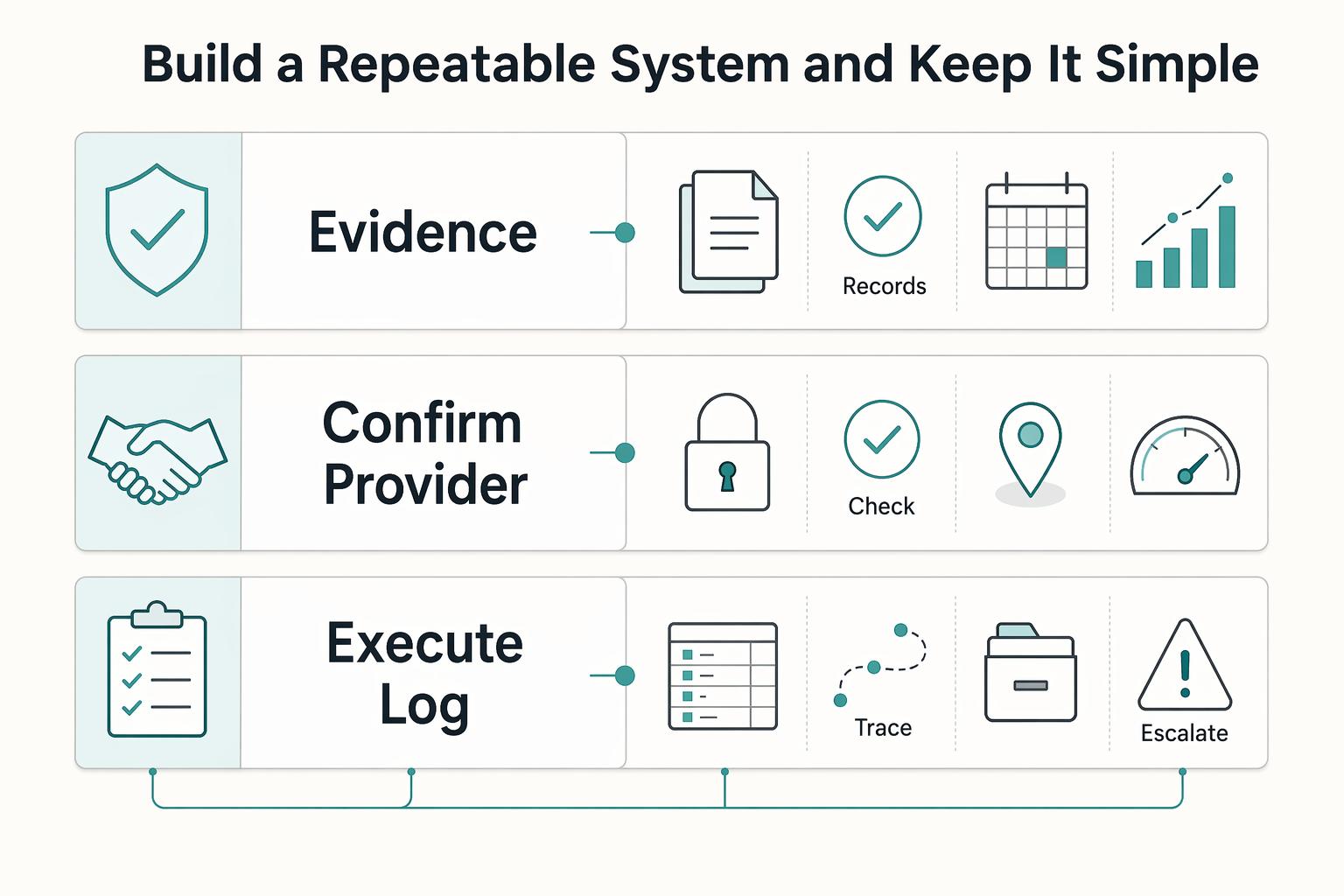
Build a repeatable system and keep it simple#
Build a repeatable exposure and liquidity review that fits your workload. Use simple operational methods where suitable, evaluate financial contracts on their own terms and preserve the records needed to distinguish the plan from the outcome. Avoid treating monthly review as a substitute for live maturity or margin deadlines.
Keep one monthly cycle that is easy to audit:
- Record the rule before execution and why the invoice was hedged or not hedged.
- Confirm provider fit for the corridor using practical checks like fees, reach, and ease of use.
- Execute and log key timestamps, including exchange-rate checks.
- Reconcile planned versus actual outcomes and record one improvement for next month.
A good system answers the same questions every month and makes exceptions obvious. Making the perfect call every time is not the goal. Making consistent calls from the same rule set is, so you can improve the process with evidence instead of memory.
This works only if your records are complete. In cross-border payment work, monitoring exchange rates and keeping detailed records are basic operating habits. Automation can support execution by syncing invoices, payments, and ledgers with accounting workflows and reducing manual work, but it does not guarantee savings in every case.
A useful sign that the system is working is that monthly review becomes easier, not harder. You should be able to tell quickly which invoices created real exposure, which method was used, what actually happened in settlement, and what should change next cycle. If the process is so complicated that you avoid the review step, simplify the rule set until it fits how you actually work.
Before booking, write the currencies/direction, amount, quoted rate, settlement date, funding obligations and response to a late client. After settlement, compare net cash with budget and the defined risk target. A stable, affordable cash outcome can be the purpose even when an unhedged favorable rate would have paid more.
Frequently Asked Questions
What is currency hedging for freelancers?
It means reducing the effect of exchange-rate changes on a defined freelance cash flow. Methods include fixing an invoice in your cost currency, genuine same-currency cost matching, and suitable financial hedges. A wallet balance, budget rate or exchange-rate alert alone does not lock a rate. Identify when conversion or another effective offset occurs. Before that point, foreign receivables and balances can be exposed. After conversion into the currency needed for bills, later payout delay is normally access/liquidity risk rather than the original pair's rate risk.
Do I need hedging or just better invoice terms?
Improve unclear terms and collection first where possible, then measure the remaining exposure. Operational controls and financial hedges can be considered together; no universal sequence fits every contract. A forward does not guarantee payment and must be funded even if the invoice is delayed or disputed. A simple test is whether you can describe the expected payment path clearly before execution. If you cannot yet trust the amount, due date, or payout route, the business process usually needs work before hedging adds value.
What is the simplest low-complexity hedging method?
A fixed invoice paid in your cost currency can remove direct conversion risk on that receivable if the client accepts it. Matching permitted same-currency income and expenses can reduce the amount to convert. Recording an invoice-date rate is useful for budgeting, but does not hedge the exposure or bind a provider to that rate. Tracking has to be reliable. A simple method stops being simple if you cannot tell which balances are already committed to same-currency costs or how long funds stayed unconverted.
How do I choose invoice currency versus convert later?
Compare your cost currency, the client's payment preference, fees, permitted retention and net exposure. “Local currency” must identify whose currency it is. A client-currency invoice can be easier to collect while leaving you exposed on the part you must convert. When the decision is close, walk through the settlement path for both options and choose the one that gives you more control over cash flow with less avoidable uncertainty.
How much exposure should I hedge?
Use a rule tied to payment certainty and margin sensitivity, not market opinions. There is no single hedge ratio that fits every freelancer. The right amount is the amount you can justify from the underlying invoice facts and your own cash-flow tolerance. Calculate the residual conversion need after genuine same-currency costs and existing hedges, then consider uncertainty and your ability to fund obligations. Reassess scope, partial payment and timing changes. There is no universal ratio, and hedging the gross invoice can exceed the real exposure.
When should I consider forward contracts?
Consider a forward when the amount and timing support a defined exchange obligation and the product is eligible and affordable for your account. Check rate, maturity, margin/deposit, settlement and closeout terms. It fixes the rate for the covered amount, including the possibility of missing out on favorable movements; it does not insure invoice collection. If the client pays late, the forward still needs a valid response under its terms. Contact the provider about permitted funding, date changes or closeout; these can cost money and are not guaranteed. Plan liquidity before booking, not after the deadline passes.
What varies by country or provider?
Supported currencies, account eligibility, minimums, currency retention, conversion rules, funding requirements, pricing and cancellation terms differ. A payment account may be available while forwards are not. Confirm the actual local product and current quote; do not use another jurisdiction's disclosure as your own agreement. That is why provider checks belong inside the hedging process, not outside it. A strategy that looks sound in theory can fail in practice if the account setup cannot support the expected settlement path.
Try a related tool
Researched and edited by the Gruv editorial team. Gruv builds cross-border billing, payouts, and finance-operations software for global businesses.
Sources
Includes 2 external sources outside the trusted-domain allowlist.
Educational content only. Not legal, tax, or financial advice.
Related Posts

How LLC Owners Separate Business and Personal Finances
For an LLC, separating business and personal money is best treated as a weekly habit, not a one-time bank setup. It keeps records cleaner, cuts month-end cleanup, and creates clearer boundaries as the company grows.

The Freelance Payment Penalty: A Modeled Audit of Platform Fees, FX Spreads, and Payout Delays
The money rarely disappears through a single, easy-to-spot fee. The real loss is stacked. A marketplace takes its commission, a processor adds a charge for international cards, a bank or payment company converts the currency at a spread, a platform holds the funds before release, and a wire sheds a little to intermediaries on the way in. Each layer looks defensible on its own, but the worker feels the combined result as a smaller deposit and a later payday.

How to Respond to a Subpoena for Business Records
Move fast, but do not produce records on instinct. If you need to **respond to a subpoena for business records**, your immediate job is to control deadlines, preserve records, and make any later production defensible.