
Quick Answer
Use currency options for hedging when one foreign-currency invoice could materially weaken your home-currency cashflow before settlement. You pay a premium for the choice to exchange at a strike rate, so adverse moves are limited while favorable moves can still be taken at spot. Make the call invoice by invoice using exposure size, payment timing, pair behavior, and margin sensitivity, then document the rationale and trade details on entry.
Beyond the Invoice: How to Protect Your Global Contracts from Currency Risk#
You can deliver the work and still receive less in your home currency by the time payment arrives. If your contract is in one currency but your home currency is another, the invoice value can change between signing and settlement.
That is transaction exposure in practice. You invoice in GBP, but you run the business in EUR or USD. The rate may look acceptable when you send the invoice, then move against you before payout, so the same receivable converts into less in home-currency terms. Foreign-currency receivables and payables can create cash flow uncertainty before settlement as exchange rates move.
A currency option, also called an FX option, is one way to manage that exposure. It gives you the right, not the obligation, to exchange currency at a pre-agreed rate by or on a pre-agreed date. The strike price is that pre-agreed rate, and the premium is what you pay to buy the contract. In return, you get protection against adverse moves at the strike while keeping the ability to use spot if market pricing is better.
In practical terms:
- Unhedged invoice: no downside protection. Your home-currency value can fall before payout, but you keep any favorable move if the rate goes your way.
- Option-hedged invoice: protection at the strike rate, subject to premium and contract terms. If spot is better than strike, you can use spot instead, but you still pay the premium.
Before placing any trade, run a simple hedge-or-no-hedge check on the specific invoice: currency, amount, and expected settlement timing. That helps you align any hedge terms with when cash is expected. It also reflects a basic truth: options involve risk and are not suitable for every situation.
Related reading: What is 'Natural Hedging' for a Freelance Business?.
Check Exposure, Timing, Volatility, and Margin Before You Hedge#
Do not hedge every foreign-currency invoice by default. Hedge when this invoice creates real cash flow risk. Otherwise, monitor it or skip the hedge for now.
Use this scorecard to decide hedge now, monitor, or skip. You are not forecasting markets. You are checking exposure, timing, volatility conditions, and margin impact.
| Factor | Low exposure signal | Medium exposure signal | High exposure signal |
|---|---|---|---|
| Invoice concentration | This payment helps, but a weaker rate would not change core plans. | It matters to near-term cash, and a weaker rate would force tradeoffs. | This invoice is critical to upcoming obligations or operating continuity. |
| Payment timing | Payment is due soon and timing looks reliable. | Timing is somewhat uncertain or not near-term. | Terms are long, milestone-based, or late payment is a real risk. |
| Pair volatility | Recent moves look contained before settlement. | The recent range is widening before settlement. | The pair is swinging sharply and payment timing is uncertain. |
| Cashflow sensitivity | A rate move would hurt, but margin and reserves can absorb it. | A move would materially compress profit. | A 10% FX move could wipe out profit, especially if margin is around 10% or less. |
1. Invoice concentration#
Start with the business impact, not the market chart. If this invoice settles at a worse rate, does it change what you can pay or when you can pay it? If yes, hedge now or hedge part of the exposure. If no, continue to factor 2.
Write down the invoice currency, home currency, amount, and which costs depend on this cash. That keeps the decision tied to actual profit-and-loss impact.
2. Payment timing#
Timing risk can matter as much as rate risk. Ask whether there is a realistic chance this payment lands later than expected. If yes, treat the extra time as added exposure and hedge now or monitor closely with a trigger date. If no, continue to factor 3.
Use a practical test: what happens if the client does not pay on time? If delay would leave you exposed longer than planned, count that as elevated risk.
3. Pair volatility#
You do not need a macro view here. You need to know whether the range is getting wider before settlement. If the pair's recent range has widened or client payment certainty is weak, risk is higher. Hedge now or protect part of the invoice. If neither applies, continue to factor 4.
In practice, operational signals are enough here: recent range behavior and payment certainty.
4. Business continuity and focus#
This is the final checkpoint. Can your margin absorb a 10% move? If no, hedge now. If yes, you can monitor or skip this invoice.
A hedge can set a protected exchange outcome for a period and make planning more predictable. If full coverage feels heavy in a borderline case, a partial hedge, for example 50% of exposure, can reduce damage while preserving some flexibility.
If one critical factor is high, you will usually hedge now. If most factors are medium, monitor with clear triggers. If factors are low across the board, skip for now.
For a step-by-step walkthrough, see A Guide to Functional Currency for Your Business.
Before you place a hedge, estimate your baseline payment and conversion drag first. That tells you what risk you are actually managing. The payment fee comparison tool can help.
Your Step-by-Step Guide to Executing a Currency Option#
Once you decide an invoice deserves protection, execution is mostly a matching exercise. Keep it simple: one option for one invoice, one currency exposure, and one payment window. You are not trying to predict FX moves. You are setting a minimum acceptable outcome, paying a known upfront premium, and reducing execution risk.
Start with access before you open a trade ticket#
Settle the access question before you look at quotes. You need to know you can use the venue safely and legally. For U.S. retail forex activity, verify registration status first. Use NFA BASIC to check the firm before you fund or trade.
| Check | What to confirm |
|---|---|
| Registration status | Use NFA BASIC to check the firm before you fund or trade. |
| Account access | Regulated access for your account type. |
| Instrument availability | The exact currency instrument you need. |
| Options permissions | Options permissions for the strategy you plan to use. |
| Execution cost | Total execution cost, including premium and any options commissions. |
| Disclosure review | Read your broker's options disclosure materials during approval. |
Do not assume availability. Not every broker supports every currency pair or option structure, and options access is permissioned. Brokers typically use 5 options approval levels, and your level controls what you can execute.
Read your broker's options disclosure materials during approval. If you cannot explain your contract in plain language, pause and clarify before trading.
Build the hedge from the invoice backward#
A practical way to structure the trade is to start with the invoice and work backward into the contract. Use this checklist every time:
| Step | Action |
|---|---|
| Define exposure | Record receivable currency, home currency, invoice amount, and expected payment date or range. |
| Pick direction | If you will receive foreign currency and later sell it, use a put on that receivable currency. If you will need to buy foreign currency later, that points to a call. |
| Match expiry | Choose expiration that covers the realistic settlement window, not just the ideal date. |
| Set strike | Start with the minimum payout your business can accept after premium and fees, then choose the strike accordingly. |
| Confirm cost | Premium is upfront and nonrefundable, and options commissions may still apply. |
A preventable failure mode is getting the direction wrong or framing the pair incorrectly. Before you place the order, write this sentence: "I will receive X currency and may need to sell it into Y currency on or around this date."
Make strike and expiry tradeoffs explicit#
Strike and expiry are where cost and protection meet. Different strike and expiration choices can change both premium and coverage, so compare each quote to your minimum acceptable outcome.
Two checks matter most:
- Strike choice: verify the protected rate and premium on the ticket, then decide whether the floor is strong enough for the upfront cost.
- Expiry choice: verify the exact expiration date and whether it covers the real settlement window, not just the ideal one.
Always verify the contract's exact expiration date on the ticket. General calendar patterns exist for some listed options, but exceptions do exist.
Confirm your two outcomes before you click buy#
Before you submit, be clear about what happens next. After you pay the premium, two paths remain. If the market moves against you, the option can protect a downside floor after premium and execution costs. If the market moves in your favor, you may let the option expire and convert at the better live rate.
In plain terms, you keep upside participation, but your net outcome is reduced by the premium paid. An option can expire worthless and still have done its job if it protected you while the risk was live.
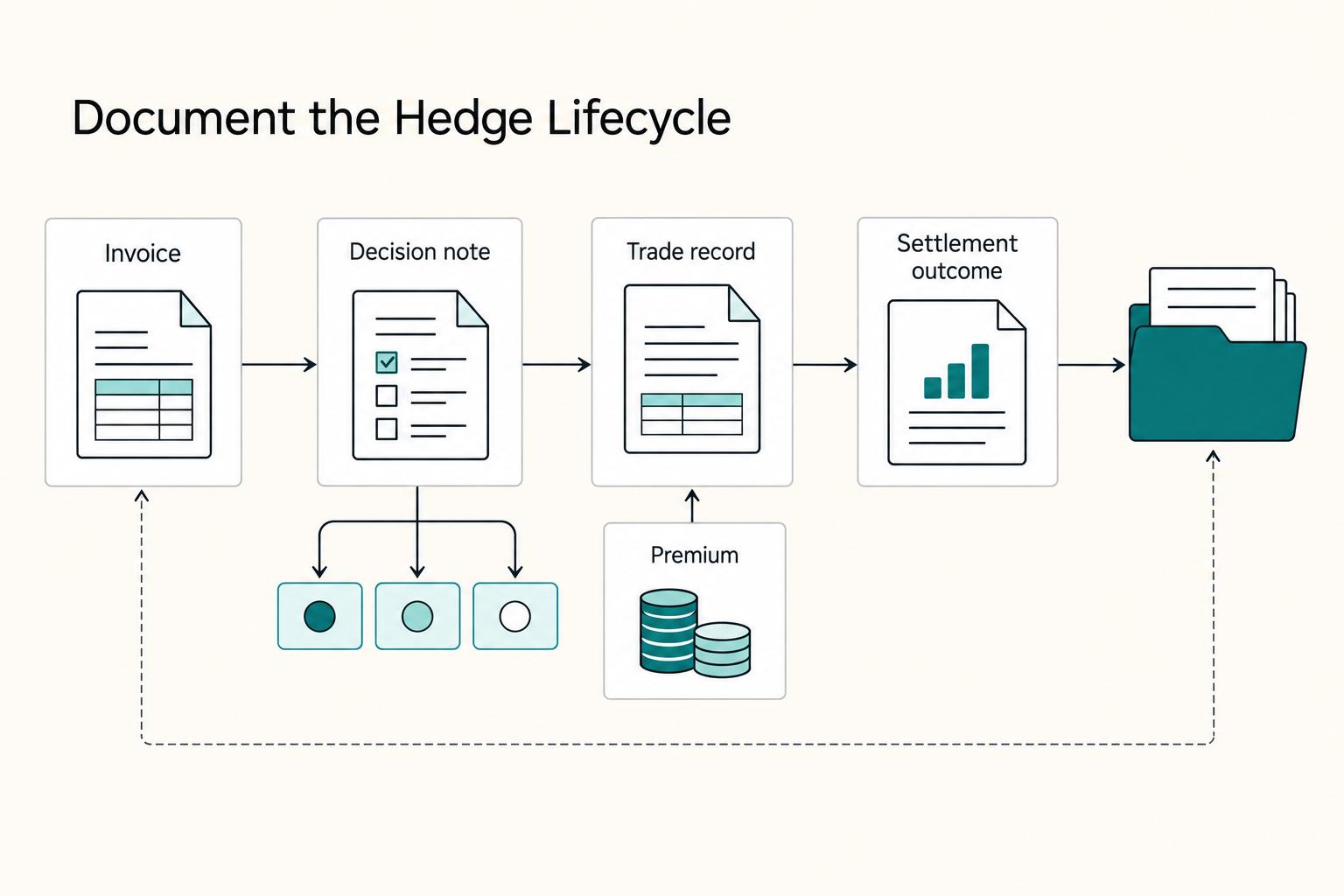
Before placing the order, save a small record: invoice copy, expected payment window, hedge reason, chosen strike, and trade confirmation with premium and fees. This makes reconciliation easier. It also gives you a basis for comparing this hedge with alternatives like a forward contract. For a broader overview, see A Guide to Currency Hedging for Freelancers.
Accounting and Tax: Document the Hedge From Entry to Outcome#
The trade itself is only half the job. After you place it, treat documentation as part of the hedge. Your goal is simple: be able to show what contract you bought, what exposure it covered, and what happened from entry to final outcome.
Step 1. Create a dated hedge record at trade entry#
Do this on trade day, using broker-confirmed terms. Because an option is a right rather than an obligation, your file should clearly tie that right to a specific exposure. Use this repeatable template, adapted to your process:
- Invoice ID
- Exposure currency
- Hedge instrument
- Business purpose
- Trade date
- Expected settlement window
- Strike price
- Expiration date
- Exercise method
- Premium paid
- Broker confirmation or ticket ID
Use one quick control before filing: match your internal record to the broker confirm. Common issues include mismatched expiry, pair, or invoice timing.
Step 2. Book the option by lifecycle stage#
Do not book this as one blended event. Track each stage separately so month-end reconciliation stays clean.
- Trade entry: Save the confirm and record strike, expiration, and exercise method from the executed contract.
- Premium booking: Record the upfront premium at contract entry, including amount, date, account, and fees.
- Period-end valuation if applicable: Follow your accounting policy and advisor guidance, and retain the exact rate source and timestamp used.
- Settlement, expiry, or close-out: Record the final outcome with cash movement and supporting documents. An option can end with zero intrinsic value, so expiry without intrinsic value can be a normal outcome.
Step 3. Retain outcome-specific evidence#
Treatment may vary by jurisdiction, so keep treatment notes separate from evidence collection. The practical move is to standardize the evidence pack now.
| Outcome | What to retain | Treatment note |
|---|---|---|
| Expires | Expiry notice, original trade confirm, premium record, linked invoice or exposure record, related conversion or settlement records | Confirm local treatment with your advisor |
| Exercised | Exercise notice, original trade confirm, premium record, settlement statement, linked invoice or exposure record, final conversion support | Confirm local treatment with your advisor |
| Closed early | Closing trade confirm, original trade confirm, premium record, broker realized P/L report, linked invoice or exposure record | Confirm local treatment with your advisor |
Use this month-end controls checklist:
- Broker confirms saved and matched to your hedge log
- Journal entries, if used in your process, prepared and reviewed against confirms
- Bank, broker, and invoice reconciliations completed
- Advisor review requested for new or unusual outcomes
If anything is missing, fix it immediately while records are still easy to retrieve. A common risk is an incomplete audit trail.
If you want a deeper dive, read Separating Business and Personal Finances: An Important Step for LLCs.
Use the Same Assess, Execute, and Comply Routine Every Time#
If you want this to stay manageable, use the same routine every time. Assess the exposure, execute only when the instrument terms match it, and keep records that explain the trade later. With currency options, your edge is control and consistency, not prediction.
| Stage | Inputs | Decision | Artifact |
|---|---|---|---|
| Assess | invoice amount, billing currency, expected payment timing, budget exposure in your home currency, and the governance checkpoint for approval | hedge now, wait, or leave it unhedged | a short hedge decision note with invoice ID, currency pair, expected receipt date, and your rationale |
| Execute | currency pair, strike, expiration, settlement terms, premium, and notional coverage versus the invoice | execute only when contract terms match the exposure you documented | trade confirmation and provider statement, stored with the invoice and hedge decision note |
| Comply | invoice, hedge decision note, trade confirmation, premium payment record, and settlement or expiration outcome | confirm the file shows a clear end-to-end business purpose and outcome | accounting support that ties the transaction lifecycle together |
Assess#
The first decision is whether this specific receivable needs protection at all. Review the exposure details, expected payment timing, business impact in your home currency, and the governance checkpoint for who approves the hedge decision.
- Inputs to review: invoice amount, billing currency, expected payment timing, budget exposure in your home currency, and the governance checkpoint for approval
- Decision to make: hedge now, wait, or leave it unhedged
- Artifact to save: a short hedge decision note with invoice ID, currency pair, expected receipt date, and your rationale
This checkpoint helps you avoid selective hedging. The real point is consistency: one clear reason for hedging this invoice and the same logic applied to the next one.
Execute#
When you need flexibility, use an option structure. You pay an upfront premium for the right, not the obligation, to exchange at the locked rate. If rates move in your favor, you can let the option expire.
- Inputs to verify before order: currency pair, strike, expiration, settlement terms, premium, and notional coverage versus the invoice
- Decision to make: execute only when contract terms match the exposure you documented
- Artifact to save: trade confirmation and provider statement, stored with the invoice and hedge decision note
Comply#
Recordkeeping is part of the hedge, not an admin afterthought. Collect the invoice, hedge decision note, trade confirmation, premium payment record, and settlement or expiration outcome so the file shows a clear end-to-end business purpose and result.
- Inputs to collect: invoice, hedge decision note, trade confirmation, premium payment record, and settlement or expiration outcome
- Decision to make: confirm the file shows a clear end-to-end business purpose and outcome
- Artifact to save: accounting support that ties the transaction lifecycle together
The common failure mode is weak discipline: ad hoc trades, missing files, and no consistent reason for why one invoice was hedged and another was not. Use the same folder structure and naming convention each cycle so the process stays audit-ready.
Use this checklist before each invoice:
- Review exposure and write the hedge decision note.
- Decide hedge now, wait, or no hedge using the same scorecard logic.
- Verify option contract terms against the receivable before execution.
- Save the full evidence pack immediately after trade activity.
- If you are comparing option hedging with other hedge structures, read How to Use a Forward Contract to Hedge Against Currency Fluctuations.
We covered this in detail in A Guide to Foreign Exchange (Forex) Risk for Freelancers.
If you want your post-invoice flow to stay operational and traceable from conversion decisions through disbursement, review how Gruv Payouts can fit your process.
Frequently Asked Questions
Are a currency option and a forex option different?
In this context, they mean the same thing: an option on foreign-currency exposure. Both labels refer to the same core contract. Focus on the contract details, not the label, and confirm the pair, strike, expiration, and settlement terms before you trade.
What are you actually buying when you buy one?
You are buying a right, not an obligation, to transact at a fixed price by a set date. That matters when payment timing is uncertain, because you keep a choice instead of taking a mandatory exchange. Tie the option to a specific exposure and confirm the expiration still fits your expected payment window.
What does the premium mean in practice?
The premium is paid upfront, is nonrefundable, and for a buyer it defines your maximum loss on the option itself. If the option expires unused, you can lose the full premium. Treat the premium as an immediate cash outflow and decide in advance whether that cost is acceptable for the protection you are buying.
How do you get access to these contracts without relying on one specific platform?
In the U.S., use a regulated provider, complete options approval, then set up settlement operations. The firm must approve you before accepting an options order and must collect due-diligence and suitability information. Verify registration status, confirm you received the current Options Disclosure Document at or before approval, and review the provider’s settlement and account process in the contract documents.
Are options better than a forward contract for you?
Not by default. Choose based on the flexibility you need versus the commitment you can accept. Use a forward when you want a fixed contractual exchange outcome, and use an option when you want protection with a choice at execution. Compare the structure you are considering against this checklist, then decide from obligations and cash impact rather than marketing language. | Decision point | Forward contract | Currency option | |---|---|---| | Commitment type | Obligation to exchange under contract terms | Right, not obligation, to exchange | | Upfront cash impact | No option premium, but margin, collateral, or credit terms can still apply | Upfront premium paid at entry; nonrefundable | | Downside protection | Can lock the exchange outcome if contract terms are met | Can set protected downside for the buyer | | Upside participation | Usually limited after rate is locked | Often retained in a plain purchased option; some structures can cap upside | | Operational complexity | Can appear simpler at entry, but offsetting can leave multiple obligations | Requires approval, premium funding, and expiry or exercise monitoring | | Best-fit use case | You want certainty and can commit | You want protection plus decision flexibility |
How do you decide whether the cost is worth it?
Do not rely on a fixed invoice-size cutoff. Use a repeatable exposure checklist. This matters most when payment timing is uncertain, currency moves could change your operating outcomes, or you have low tolerance for downside variance. Document four items before each hedge decision: exposure amount, expected payment timing, exchange-rate sensitivity, and your acceptable unhedged loss.
So when is hedging worth doing?
It is worth considering when an unhedged move could force a business decision you do not want to make. If currency movement could materially affect your plans, protection is easier to justify. If exposure is small and short-dated, you may leave it open. Set a written internal trigger and apply it consistently each invoice cycle.
What should you expect on tax and compliance?
There is no single global treatment. For U.S. taxpayers, foreign-currency gain or loss in section 988 transactions is generally treated as ordinary income or loss, and certain forward, futures, or option elections require same-day identification. If you are using options to hedge business exposure, document hedge purpose on trade day when needed, retain trade and outcome records from start to finish, and confirm filing treatment with your tax adviser before submission.
Try a related tool
Researched and edited by the Gruv editorial team. Gruv builds cross-border billing, payouts, and finance-operations software for global businesses.
Sources
- bauer.uh.edu/rsusmel/7386/ln7.pdftrusted
- bidenwhitehouse.archives.gov/wp-content/uploads/2021/06/100-day-supply-ch...trusted
- cftc.gov/LearnAndProtect/AdvisoriesAndArticles/Foreig...trusted
- cftc.gov/checktrusted
- ecfr.gov/current/title-26/chapter-I/subchapter-A/part...trusted
- ecfr.gov/current/title-7/subtitle-B/chapter-XVII/part...trusted
- federalreserve.gov/frrs/statutes/conversion-of-foreign-currency...trusted
- federalreserve.gov/pubs/ifdp/2006/858/ifdp858.htmtrusted
Educational content only. Not legal, tax, or financial advice.
Related Posts

How LLC Owners Separate Business and Personal Finances
For an LLC, separating business and personal money is best treated as a weekly habit, not a one-time bank setup. It keeps records cleaner, cuts month-end cleanup, and creates clearer boundaries as the company grows.
Currency Hedging for Freelancers Without Guessing the Market
Treat hedging as a cash-flow control choice, not a bet on FX market movements. The goal is to reduce foreign exchange risk that appears between transaction start and settlement. For freelance work, that means protecting what you keep after payment arrives, conversion happens, and funds are withdrawn.
How to Use a Forward Contract to Hedge a Foreign-Currency Invoice
Use a forward when a foreign-currency invoice matters to near-term cash flow and both the amount and timing are reasonably clear. If either is still loose, do not rush to hedge the full invoice. Start partial, or wait.