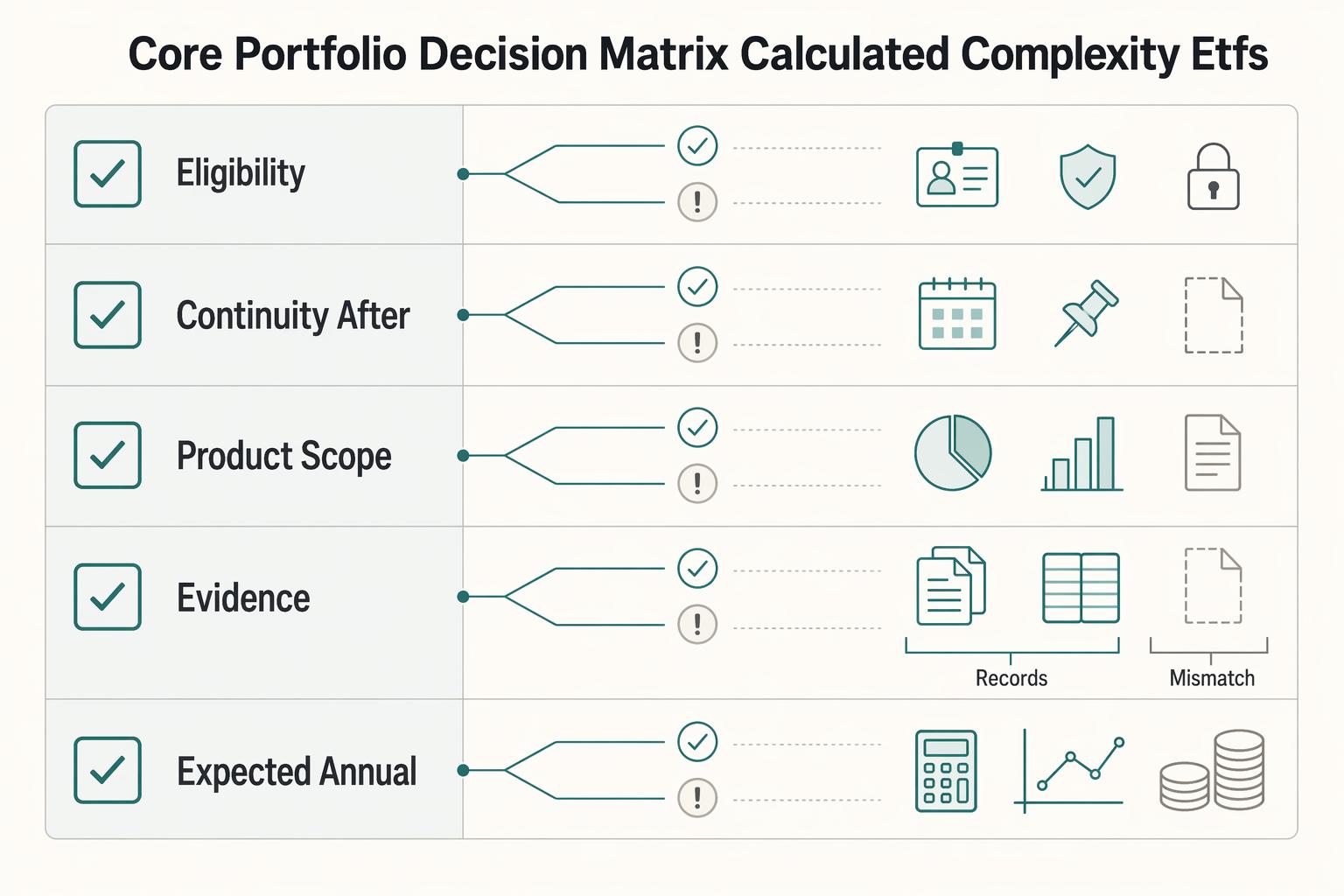
Start by codifying four payout outcomes: release, hold, block, and escalate. Then attach one gate, one accountable owner, and one evidence record to every lifecycle stage so you can reconstruct decisions later without manual guesswork. Keep remediation and risk clearance separate, require complete preconditions before disbursement, and store tax-critical fields such as asset units, fiat value at settlement, invoice reference, transaction identifier, and approval history. Use local legal review when corridor obligations remain uncertain.
Crypto payouts are a compliance decision, not just a payments operations choice. Once digital-asset payouts are in scope, AML oversight, due diligence, tax reporting, and cross-border operations sit inside the same process.
For operators, the test is simple: can you reconstruct each payout decision from start to finish when finance, compliance, or regulators ask? If you cannot show what was approved, what checks were done, and why release was allowed, the process is not ready to scale.
Regulatory pressure is moving in one direction. U.S. policy discussions have explicitly focused on AML and sanctions risk for digital-asset participants, including VASPs, and institutions are increasingly expected to have controls in place. At the same time, business demand is real. Deloitte cited an early-2024 estimate that more than 6,000 businesses accepted bitcoin as payment. The operating reality is a tradeoff between strong incentives and real risk.
Tax reporting is becoming more formal. The OECD-linked Crypto-Asset Reporting Framework, or CARF, includes due-diligence and reporting rules, plus the legal, administrative, and IT work needed to implement them. In practice, payout design, data capture, and recordkeeping decisions shape the quality of downstream reporting.
The same principle applies on the AML side. In Canada, FINTRAC acts as the financial intelligence unit and regulator under the AML/ATF law, and its mandate includes receiving and analyzing transaction reports to produce practical intelligence. The lesson is broader than Canada. Controls should create auditable evidence, not just a pass-or-fail result.
we stay focused on operations. It covers what to enforce now, what should trigger escalation, and what to document before volume grows. Our goal is fewer surprises and better evidence without adding unnecessary friction to legitimate payouts.
For the tax side, see Gig Worker Tax Compliance at Scale: How Platforms Handle 1099s W-8s and DAC7 for 50000+ Contractors.
Define your control stack before procurement, or you will inherit tool defaults that do not match your risk model, evidence standards, or release rules.
In practice, AML/KYC and sanctions controls should determine whether a party can proceed, be blocked, or be escalated.
| Control layer | Treat as baseline | Treat as market-dependent |
|---|---|---|
| Core controls | Verification (KYC), sanctions checks, recordkeeping, clear approval ownership, and reconstructable decision evidence | Licensing scope, data residency, reporting expectations, and tax reporting/withholding obligations |
| Practical implication | Should exist across markets | Must be localized by jurisdiction and operating model |
Do not assume licensing, reporting, or tax-withholding expectations apply the same way in every jurisdiction. In fragmented regimes, these are legal design decisions, not dashboard toggles.
Set a single auditability standard for your process, from request through release decision and post-event review. Before you choose tools, map each control to an owner, a trigger, and an evidence artifact. Then confirm that release dependencies are explicit. In a sample case, you should be able to pull verification results, sanctions-check timing, approval actor, transaction reference, and review notes without major reconstruction work.
IRS IRM 4.26.9 is a useful benchmark for this posture because it focuses on reporting, recordkeeping, AML program requirements, and roles and responsibilities. A common failure mode is assuming embedded AML or KYC features solve multi-jurisdiction compliance on their own.
Related: FATCA and W-8 Tax Compliance for Platforms: When to Release, Hold, or Withhold Foreign Payouts.
Map each payout stage to one control gate, one owner, and one evidence object. If you do not, you will not be able to show why a payout was released, held, or escalated.
Your lifecycle is a design choice, not a universal legal sequence. What matters is that each stage ends in pass, fail, or escalate, with a record you can retrieve later. Below, we use a practical reference model.
| Stage | Control gate | Evidence objects to store |
|---|---|---|
| Onboarding | KYB/KYC completion and risk intake | Verification result, screening record reference, risk score, case ID, reviewer notes if escalated |
| Destination setup | Destination checks | Wallet or account identifier, asset/rail selection, destination-check result, collection timestamp, source record |
| Pre-release decision | Approval to disburse | Approval actor, approval time, screening result timestamp used for decision, hold/escalate reason if not released |
| Execution | Payment sent or failed | Ledger reference, provider reference, blockchain transaction identifier if applicable, webhook/status event, failure code if any |
| Reconciliation and review | Match and investigate exceptions | Reconciliation status, exception queue ID, return/failure event reference, monitoring alert ID, investigation outcome |
AMLA's reporting logic is useful discipline here: report datapoints relevant to the activities you actually perform. If you support multiple rails, keep the selected rail explicit in the record, and treat rail-specific control differences as a design decision until you can evidence them. If a field is not available from your flow or provider, record it as unavailable rather than infer it later.
IRS BSA examination guidance separates reporting requirements from recordkeeping requirements and explicitly identifies transaction-log artifacts. Keep post-payout exceptions, failed deliveries, returns, and monitoring alerts in the same audit trail so they can be traced back to the original payout decision.
For reporting-quality fields, separate stock datapoints from flow datapoints, and make conventions explicit. Use "0" for a true zero. Leave a field blank only when it is not applicable or when data exists but cannot be reported. Also store the identifiers that let you separate records by establishment where required, since AMLA states reporting is at solo level for each separate establishment.
Once you map the lifecycle, decide how much control depth each payout path actually needs. For a deeper dive, read Crypto Payout Compliance: AML KYC and Travel Rule Obligations for Platforms.
Use a risk-tier model so your control depth matches actual risk instead of forcing every payout path through the same heavy process. FATF's risk-based approach supports that structure, and FATF's technology guidance highlights assessing control effectiveness and handling residual risk when using technology-enabled controls.
| Tier | When to use it | Control depth | Evidence to retain |
|---|---|---|---|
| Baseline | Lower-risk flows with no clear risk signal, as defined in your risk assessment | Minimum required controls from your policy and standard release checks | Decision outcome, release timestamp, core screening/verification record references, approver |
| Expanded | Flows with elevated risk indicators or unusual activity that needs a second look | Additional review steps before release and closer monitoring through execution/reconciliation | Trigger reason, reviewer notes, refreshed check results, case/disposition record |
| Enhanced | Clear high-risk signals or unresolved concerns that baseline/expanded checks do not resolve | Escalated diligence and senior compliance decisioning; include additional targeted diligence only when the risk signal justifies it | Escalation rationale, requested/received diligence records, decision owner, final hold/release rationale |
Keep enhanced review tied to explicit triggers. If you cannot point to a concrete signal that justifies extra friction, you may be adding delay without clearly improving control quality.
If false positives are overwhelming your operations, tune monitoring logic before removing core controls. FATF's technology guidance emphasizes effectiveness assessment and residual-risk handling, so fixes can start with scenario quality, routing, and review design before removing foundational gates.
Separate policy obligations from tool features. Your policy defines what must happen, who can approve exceptions, and what evidence is mandatory by tier. Tools only implement part of that design. The same point applies to tax transparency readiness. CARF implementation is split across legal, administrative and IT, and due-diligence and reporting tracks, so readiness should be checked across those tracks rather than inferred from vendor defaults alone.
Related reading: Does Your Non-EU Marketplace Owe DAC7 Tax Reporting in Europe?.
Write your payout rules so the same facts lead to the same outcome every time: release, hold for review, block, or escalate. If required preconditions are incomplete, the payout does not move.
Ad hoc release logic driven by ticket comments or SLA pressure creates inconsistent overrides and weak records. Your policy should define what triggers each outcome, who can clear it, and what evidence must exist before funds move.
Use concrete trigger categories, but keep them defined in your policy by jurisdiction and risk context. Examples include KYC/KYB identity mismatch, sanctions screening hits, missing tax profile, contradictory SoW evidence, or abnormal chain activity.
| Output | Typical trigger examples | Who may clear it | Evidence to retain |
|---|---|---|---|
| Release | Required onboarding, screening, and tax preconditions are complete; no unresolved alert | Standard approver under policy | Decision timestamp, approver, screening references, payout record ID |
| Hold for review | Document gap, unresolved KYC/KYB mismatch, missing tax profile, or explainable data inconsistency | Operations for document remediation, then recheck under policy | Reason code, requested documents, resubmission record, refreshed check result |
| Block | Confirmed prohibited-party match, policy-defined prohibition, or unresolved issue treated as non-payable under policy | Compliance or legal, per policy | Block rationale, case record, supporting analysis, final owner |
| Escalate | Unresolved transaction-monitoring alert, contradictory SoW evidence, abnormal chain activity, or facts needing higher-risk review | Compliance or legal, per policy | Escalation note, reviewed documents, analyst reasoning, disposition decision |
Two operating rules prevent drift. If preconditions are incomplete, the payout stays put. Alerts and scores should route cases, not replace human judgment on high-impact decisions.
Keep remediation and risk clearance separate. Operations can usually resolve document gaps and rerun checks. Compliance or legal should own sanctions decisions and elevated transaction-monitoring decisions under your policy.
Write this ownership split into your Compliance Program, not just in tooling. NY DFS states it examines licensed entities for regulatory compliance. Its enforcement record shows what can happen when controls break down during growth.
Require evidence of cure, not free-text closure. If a hold was due to a KYC mismatch, keep the exact artifact that resolved it. If a tax profile was missing, keep the submitted profile or form evidence and the rerun result of the blocking rule.
Escalation should mean a named queue, a named owner, and a required disposition record. "Needs compliance review" is not enough if the case file cannot show why it escalated, what was reviewed, and who made the final decision.
Capacity is part of the control design. NY DFS described a substantial backlog of unreviewed transaction monitoring alerts. It said that backlog exposed the platform to criminal exploitation risk, and it also described the compliance function as overwhelmed by the end of 2021. A hold or escalation queue is not neutral storage once review demand exceeds staffing.
Build each disposition as an examiner-ready record. The IRS BSA examination manual explicitly covers reporting, recordkeeping, AML program, and evidence sections, so your case file should retain the trigger, timestamp, reviewer, reviewed documents, check references, and final rationale.
For releases after review, keep proof that the blocking condition was actually cured. If you enforce only one hard rule, make it this: no payout moves while required preconditions are incomplete, even under SLA pressure.
This pairs well with our guide on Creator Platform Tax Reporting for 1099 and W-8 Expansion Decisions.
Turn your release, hold, block, and escalate matrix into enforceable payout states and audit trails with this implementation reference: Explore Gruv Payouts.
If a missing tax profile can stop release, build your tax evidence pack once and reuse it every cycle. The practical test is simple: months later, can finance or compliance reconstruct the payout from the record itself without digging through inboxes, tickets, or chain explorers?
Use a small internal field set for every payout in your system, even when legal obligations differ by country. These are not presented as universally mandated fields. For this article, we treat them as a minimum pack for consistent tax review, accounting, and filing decisions.
| Field to retain | Why it matters | Verification checkpoint |
|---|---|---|
| Asset type | Distinguishes what was paid and how it should be valued and reconciled | Match the recorded asset to the payout rail used |
| Units | Preserves the exact quantity transferred | Reconcile units to the execution record with no manual edits |
| Fiat value at settlement | Supports reporting and accounting when the payout asset is volatile | Store the settlement timestamp and valuation source used at that moment |
| Invoice reference | Links the payout to the underlying obligation | Confirm the invoice resolves to the same payee and amount basis |
| Wallet or transaction identifier | Connects the payout record to the transfer event | Check that the identifier points to the executed payout, not just a requested address |
| Approval trail | Shows who cleared the payout and under which rule | Retain approver, timestamp, and any post-review release note |
A practical failure mode is being able to prove asset movement but not tax basis. When settlement value, invoice context, and tax-form evidence are split across tools, reporting turns into manual reconstruction.
For W-8, W-9, and 1099 workflows, keep three statuses in your record: collected, validated, and filed or queued for filing. A received form is not the same as a reviewed form, and a reviewed form is not the same as a filing outcome.
| Status | What to keep | Key distinction |
|---|---|---|
| Collected | Which form was requested and what was received | A received form is not the same as a reviewed form |
| Validated | When it was reviewed and whether validation passed | A reviewed form is not the same as a filing outcome |
| Filed or queued for filing | Which payouts or tax-year records it supports | Record filing outcome or queue status |
These sources do not define exact responsibility splits for those workflows, so set ownership in policy and document it. At minimum, keep which form was requested, what was received, when it was reviewed, whether validation passed, and which payouts or tax-year records it supports. If a payout was held for a missing tax profile, retain the remediation trail that cleared the hold.
Treat FEIE as a reporting checkpoint, not a shortcut. Income is still reported on a U.S. tax return even when foreign earned income is excluded.
| Signal | What to capture | Key note |
|---|---|---|
| FEIE | Claimed basis, day-count support, and whether Form 2555 is part of the file | Physical presence test requires 330 full days during any period of 12 consecutive months; tax year 2026 maximum exclusion is $132,900 per person, subject to the earned-income limit |
| FBAR | Flag when the question is raised and who reviewed it | A U.S. person with a financial interest in or signature authority over foreign financial accounts must file an FBAR |
| VAT validation | Keep a dependency flag and evidence link on cross-border payouts | Route the determination to finance or local counsel; country-level VAT rules are outside these sources |
If a payee is a U.S. citizen or U.S. resident using the physical presence test, capture the claimed basis, day-count support, and whether Form 2555 is part of the file. If 330 full days during any period of 12 consecutive months is not met, the test is not met.
Time abroad in violation of U.S. law does not count, and qualifying-day counts affect the allowable exclusion. For tax year 2026, the stated maximum exclusion is $132,900 per person, subject to the earned-income limit.
Include FBAR in early review. A U.S. person with a financial interest in or signature authority over foreign financial accounts must file an FBAR. Your payout file can flag when that question is raised and who reviewed it, but do not assume wallet addresses or on-chain transaction IDs resolve FBAR status based on these sources.
For VAT validation, keep a dependency flag and evidence link on cross-border payouts, then route the determination to finance or local counsel. Country-level VAT rules are outside these sources.
Keep raw artifacts and normalized data together: submitted forms, validation notes, payout fields, approval history, and FEIE and FBAR review flags. Then make sure you can export them reproducibly by payout ID, payee, and tax year in one package. If your audit response still depends on manual reconstruction, the evidence pack is incomplete.
Related: Bitcoin and Ethereum Payouts for Gig Workers: Tax Reporting and Volatility Management.
A single global policy may not be enough for every payout corridor. Your decision layer should separate what is verified, what is conditional, and what stays blocked pending counsel.
In the sources here, only the European Union includes concrete reporting mechanics. For the United States, United Arab Emirates, and Singapore, treat jurisdiction-specific obligations as documented unknowns until local advice is in hand.
| Jurisdiction | What is known from the sources here | What is conditional in operations | What requires counsel |
|---|---|---|---|
| European Union | For the 2025 reference period, if AMLR definitions were not yet applicable or conflict with law in force, use AMLD IV/V as transposed into national law. Reporting is at solo level for each separate establishment, and cross-border branch data may need to be excluded to avoid double counting. Templates distinguish stock vs flow datapoints. | Map payout activity to the correct establishment and reporting basis before launch. Treat blank as different from zero, and report 0 explicitly where applicable. | National transposition interpretation, establishment mapping decisions, and local licensing, retention, or filing obligations outside these reporting mechanics. |
| United States | These sources do not provide payout-corridor mechanics beyond the general AML, recordkeeping, and tax-evidence points already noted above. | Keep baseline onboarding, screening, recordkeeping, and tax evidence controls in place, then treat jurisdiction-specific release conditions as unresolved until confirmed. | Jurisdiction-specific licensing, reporting, withholding, retention, and release conditions for the operating model. |
| United Arab Emirates | These sources do not provide payout-corridor mechanics beyond the general control design discussed above. | Keep the same baseline control stack and do not infer local release conditions from tool defaults. | Jurisdiction-specific licensing, reporting, withholding, retention, and release conditions for the operating model. |
| Singapore | These sources do not provide payout-corridor mechanics beyond the general control design discussed above. | Keep the same baseline control stack and do not infer local release conditions from tool defaults. | Jurisdiction-specific licensing, reporting, withholding, retention, and release conditions for the operating model. |
Our point is not to stop launches. It is to label uncertainty correctly so teams do not silently convert missing legal answers into release approvals.
Once you have the matrix, turn it into a short list of release buckets so your operations team is not interpreting legal uncertainty one case at a time.
| Release bucket | What it means | Operational posture | Evidence to retain |
|---|---|---|---|
| Verified | Jurisdiction-specific conditions for the payout path are documented and mapped to controls | Standard release path can be used when required preconditions are complete | Policy mapping, control references, payout decision record |
| Conditional | Core controls are in place, but a market-dependent point remains open | Hold or escalate when the open point affects release | Open issue note, reviewer decision, temporary rule under policy |
| Blocked pending counsel | A required jurisdiction decision is missing, conflicted, or not yet approved for launch | Do not release | Block rationale, owner, counsel request or case record |
This keeps legal uncertainty visible in the same system that holds release logic.
If a payout starts in one currency and settles in another, do not bury that conversion inside execution logs. Treat it as part of your release evidence because it affects the recorded fiat value at settlement and later tax review.
| FX or valuation decision point | What to store | Why it matters |
|---|---|---|
| Asset pricing at settlement | Settlement timestamp and valuation source used at that moment | Supports reporting and accounting when the payout asset is volatile |
| Conversion path, if any | Asset or rail selected and the execution reference tied to that path | Keeps reconciliation tied to what was actually paid |
| Post-conversion exception handling | Failure code, return event, or investigation outcome | Prevents manual reconstruction later |
If the record only shows the final transfer and not the valuation basis used at release, the file is weaker than it looks.
Use on-chain intelligence the same way you use any other alerting input: as a routing aid, not a self-executing verdict.
| On-chain input | Good use | Do not use it as |
|---|---|---|
| Abnormal chain activity | A reason to hold or escalate for review | A final block or release decision on its own |
| Wallet screening result | An input to pre-release routing and case creation | A substitute for KYC/KYB, sanctions, tax profile, or approval ownership |
| Risk score | Prioritization and case triage | Human judgment on high-impact decisions |
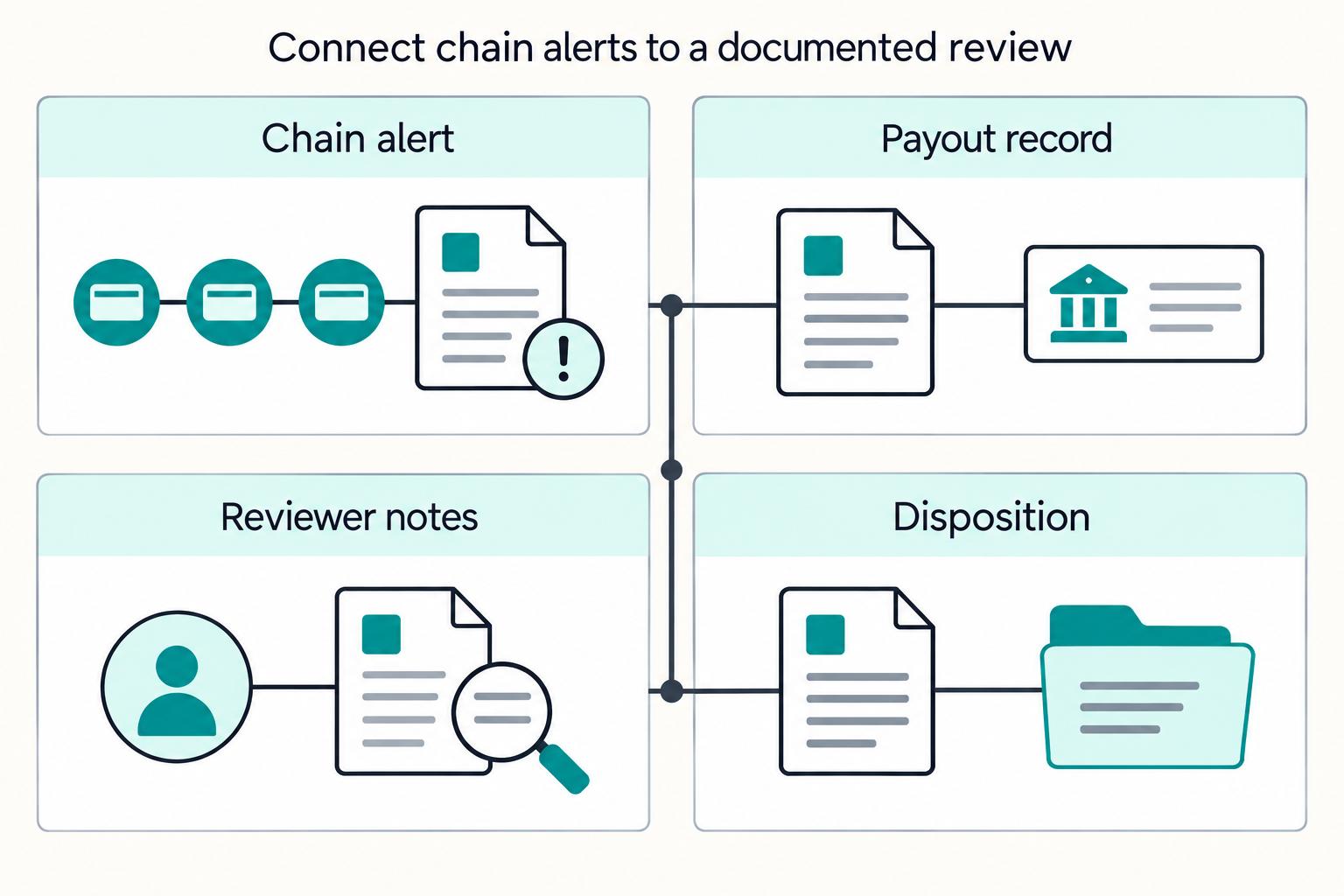
Alerts and scores should route cases, not replace human judgment. If abnormal chain activity appears, connect it to the payout record, reviewer notes, and final disposition. Do not let a provider score become the only explanation for why funds moved or did not move.
Ownership should follow the control, not the org chart. If a team can change a payout outcome, that team should leave evidence in the record.
| Team | Primary ownership | What it should not clear alone | Evidence to retain |
|---|---|---|---|
| Operations | Document remediation, rerun checks, and queue handling for remediable gaps | Sanctions decisions and elevated transaction-monitoring decisions | Reason code, requested documents, resubmission record, refreshed check result |
| Compliance or legal | Sanctions decisions, escalations, and final block or elevated review disposition | Execution retries or data-pipeline fixes | Case record, supporting analysis, final owner, final rationale |
| Finance | Tax evidence pack integrity, form status tracking, and filing or queue visibility | Sanctions clearance and higher-risk monitoring decisions | Collected, validated, filed or queued status, evidence link, export package |
| Engineering | Control integrity for retries, traceability, and reproducible exports | Policy exceptions or legal clearances | Event history, identifier mapping, export integrity record |
This split keeps remediation, risk clearance, tax evidence, and system integrity from collapsing into one overloaded queue.
If reporting is at solo level for each separate establishment, the owner of that reporting basis should be named in writing. The same applies to tax form status and export readiness. Otherwise accountability drifts between finance, operations, and compliance.
| Reporting artifact | Named accountable owner | What the record should show |
|---|---|---|
| Establishment-level reporting basis | The person accountable for the reporting basis used | Establishment used, basis applied, and approval record |
| Tax form status set | The person accountable for collected, validated, and filed or queued status | Current status, review timing, and supported payout or tax-year records |
| Export package | The person accountable for examiner-ready output | Payout ID, payee, tax year, and export timestamp |
A named owner does not replace controls, but it makes missing evidence harder to ignore.
Engineering should own whether retries preserve the original decision state, whether webhook and failure events stay attached to the payout record, and whether ledger references, provider references, and blockchain transaction identifiers can be retrieved without manual joins.
| Engineering control | Must preserve | Failure if missing |
|---|---|---|
| Retries | Original decision state and approval trail | A payout can be resent or reprocessed without proof of the same approval basis |
| Event capture | Webhook or status event and failure code | Execution cannot be tied back to the case file |
| Identifier traceability | Ledger reference, provider reference, and blockchain transaction identifier | Manual reconstruction is required to explain what happened |
Tooling can automate movement, but it should not weaken traceability.
Run sample-based reviews on a set cadence. Pull cases from release, hold, block, escalate, failed execution, and reconciliation exceptions. The question is simple: can another reviewer reconstruct the decision from the record alone?
| Test area | What to inspect | Failure signal |
|---|---|---|
| Standard release | Screening timestamp used, approver, and payout record ID | Missing decision evidence for a released payout |
| Hold and remediation | Reason code, requested documents, and refreshed check result | Free-text closure without artifact of cure |
| Escalation queue | Named owner, reviewed documents, analyst reasoning, and disposition | Case cannot show why it escalated or who decided it |
| Failed execution and reconciliation | Failure code, return or failure event reference, and investigation outcome | Exception is disconnected from the original payout decision |
If operating effectiveness testing only confirms that a tool ran, it is too shallow. The test should confirm that the evidence is reconstructable.
The same failure patterns repeat. They usually start as convenience and end as weak evidence.
| Failure pattern | What it looks like | Better control |
|---|---|---|
| Tool defaults become policy | Embedded settings are treated as legal design | Define the control stack before procurement and map each control to an owner, trigger, and evidence artifact |
| Incomplete preconditions are bypassed under SLA pressure | A payout moves before KYC, screening, or tax prerequisites are complete | Keep the hard rule that no payout moves while required preconditions are incomplete |
| Backlog is treated like control coverage | Holds and escalations accumulate without timely review | Name the queue owner, measure capacity, and require a disposition record |
| Evidence of cure is missing | A hold is closed with comments instead of the exact resolving artifact | Retain the exact document or form evidence and the rerun result of the blocking rule |
| Tax form handling is collapsed into one status | Collected, reviewed, and filing outcomes are blended together | Split form handling into collected, validated, and filed or queued for filing |
| Blank and zero are mixed | Reporting exports cannot distinguish not applicable from a true zero | Keep explicit conventions and report 0 where applicable |
| On-chain scores are treated as verdicts | A provider score silently becomes the release decision | Use alerts and scores for routing, then require human review on high-impact decisions |
| Execution and tax records live in different systems with no joined export | Teams can prove asset movement but not tax basis | Keep raw artifacts and normalized data together and export by payout ID, payee, and tax year |
NY DFS's description of alert backlogs is the practical warning here. A queue is not a control if the queue itself is unmanageable.
Crypto payouts do not fail at scale because teams forgot a wallet address. They fail because release logic, tax evidence, AML controls, and ownership were never forced into one reconstructable record.
The standard we would apply is straightforward. Define the control stack before tool selection, map the payout lifecycle, tie control depth to risk, write release, hold, block, and escalate outcomes into policy, and build the tax evidence pack so each payout record stands on its own. Then add a jurisdiction decision layer, use on-chain intelligence as an input rather than a verdict, and keep ownership explicit across operations, compliance, finance, and engineering.
If you can reconstruct the decision months later from the payout file itself, the process is getting stronger. If you still need inbox searches, ticket archaeology, or manual chain review to explain a release, the control design is not finished.
Treat this as a jurisdiction-specific legal question, not a global yes or no. The available grounding does not support country-by-country legal conclusions or a blanket 2026 legality claim. If you are entering a new jurisdiction or local requirements are unclear, get local legal advice before launch.
There is no single global minimum set you can safely apply everywhere. A practical baseline is controls that are evidenceable and reconstructable after the fact, so you can show how and why a payout was approved. If you cannot reconcile payroll registers to payout execution cleanly, the control set is not ready.
The grounding here does not support a universal block-versus-hold trigger matrix. Set those rules in jurisdiction-specific policy, then make sure each decision is evidenceable after the fact. If your team cannot clearly explain why a payout was approved, held, or blocked, the process needs tightening.
Keep records that let you reconstruct who was paid, when, in what asset, and how approval and execution were linked. For U.S. federal income tax context, the IRS says virtual currency is treated as property (Notice 2014-21, issued in 2014), while the cited IRS FAQs generally apply to transactions completed before Jan. 1, 2025 and are generally limited to taxpayers holding virtual currency as a capital asset. For reporting readiness, align legal, operational (administrative/IT), and reporting-rule implementation, and confirm you can reconcile payroll registers to payout execution records.
The main operational difference is usually predictability in settlement and reconciliation. One industry guide describes most crypto payroll as stablecoin-led for predictable settlement and audit-ready reporting. Do not treat that as a legal shortcut, because stablecoins, Bitcoin, and Ethereum should not be assumed to have identical treatment across jurisdictions.
No. Use on-chain scoring as an input to prioritize review, not as a replacement for broader compliance checks and human judgment. If you cannot later explain why a payout was approved, denied, or overridden, your process is not audit-ready.
Get local advice when entering a new jurisdiction or when local obligations are unclear. The available grounding does not support country-by-country legal conclusions from a global policy alone. If your global policy cannot answer those points with explicit local assumptions, use counsel and document the sign-off, or start with a narrower launch using a checklist like this cross-border compliance guide.
Rina focuses on the UK’s residency rules, freelancer tax planning fundamentals, and the documentation habits that reduce audit anxiety for high earners.
With a Ph.D. in Economics and over 15 years of experience in cross-border tax advisory, Alistair specializes in demystifying cross-border tax law for independent professionals. He focuses on risk mitigation and long-term financial planning.
Educational content only. Not legal, tax, or financial advice.

**Start with the business decision, not the feature.** For a contractor platform, the real question is whether embedded insurance removes onboarding friction, proof-of-insurance chasing, and claims confusion, or simply adds more support, finance, and exception handling. Insurance is truly embedded only when quote, bind, document delivery, and servicing happen inside workflows your team already owns.
Treat Italy as a lane choice, not a generic freelancer signup market. If you cannot separate **Regime Forfettario** eligibility, VAT treatment, and payout controls, delay launch.

**Freelance contract templates are useful only when you treat them as a control, not a file you download and forget.** A template gives you reusable language. The real protection comes from how you use it: who approves it, what has to be defined before work starts, which clauses can change, and what record you keep when the Hiring Party and Freelance Worker sign.