
Quick Answer
Start by using a contractor classification tool as an intake step, then require a release decision backed by evidence before any payout batch. The article’s standard is practical: classify as likely independent contractor, likely employee, or escalate, and store rationale using IRS control factors plus approver identity. If facts are mixed, keep funds on hold. For cross-border programs or frequent role changes, move from score-only flows to expert review so payment status and audit records stay defensible.
How Platform Operators Use a Classification Tool#
Treat a contractor classification tool as a payment control, not a one-time legal checkbox. If your team cannot show why a worker was treated as an independent contractor or employee before the first payout batch runs, you do not just have a policy gap. You have a release-control problem that can create downstream tax reporting, reconciliation, and audit-defense risk.
| Source | Grounded point | Why it matters |
|---|---|---|
| IRS view | Core question is who controls the work and how it is done; analysis grouped around behavioral control, financial control, and the relationship of the parties | Useful output is whether you can activate payout eligibility, what evidence supports it, and who approved the risk |
| California's ABC test | Starts from the assumption that all workers are employees | US federal guidance is not the only rule that matters |
| DOL rule under the FLSA | Rule effective March 11, 2024 revised the guidance; DOL noted current litigation; new NPRM announced February 26, 2026, with comments due by April 28, 2026 at 11:59 ET | Process needs a reassessment path because the legal context can move |
That framing matters because classification turns on the real worker-business relationship, not whatever a questionnaire happens to return. In the IRS view, the core question is who controls the work and how it is done, with the analysis grouped around behavioral control, financial control, and the relationship of the parties. An employee is generally someone whose work the business can control, while an independent contractor is usually operating an independent trade or business and offering services to the public. For platform operators, the useful output is not simply "contractor" or "employee." It is "can we activate payout eligibility, what evidence supports it, and who approved the risk."
For finance and ops teams, quiz speed or interface quality is not enough. When a classification analyzer returns a result, the real question is whether that result can drive onboarding status, keep a ledger event in review, and open the right exception path when facts are unclear. A fast self-serve answer only helps if it creates a decision record your team can store, revisit, and use when a payout is challenged later.
You also cannot treat US federal guidance as the only rule that matters. IRS analysis matters, but it does not replace state tests such as California's ABC test, which starts from the assumption that all workers are employees.
Under federal wage-and-hour rules, the Department of Labor rule effective March 11, 2024 revised the guidance for analyzing employee versus independent contractor status under the FLSA. The DOL has also noted current litigation around that rule. It announced a new NPRM on February 26, 2026, with comments due by April 28, 2026 at 11:59 ET. The operator takeaway is simple: your process needs a reassessment path, because the legal context can move even when your product flow does not.
So this is not just quiz versus quiz. It is score-only tools versus tools and review paths that help you control payouts, log approvers, and preserve evidence. If you work in one low-complexity jurisdiction, a self-serve analyzer may be enough as an intake step. If facts are mixed, roles change often, or you pay across jurisdictions, escalate before funds move. Misclassification can lead to substantial payroll taxes and penalties, and failures can start earlier, with a missing checkpoint, a weak evidence pack, or a payout batch released before the classification decision was ready. Related: Contractor Misclassification Risk Assessment for Platforms.
At a glance comparison of tool options for platform operators#
For payout operations, treat all four options as intake-only until you confirm decision logic, evidence standards, and escalation behavior in writing.
| Criteria | Tax1099 | Withum | Rippling | Papaya Global |
|---|---|---|---|---|
| Methodology transparency | Not established. Confirm factor-level reasoning, not only a label. | Not established. Request decision output, notes, and timestamped rationale. | Not established. Confirm whether outcome logic is visible and reassessable. | Not established. Confirm country-level rationale, not a generic status. |
| Jurisdiction handling under global employment regulations | No verified detail on country coverage or non-US rule handling. | No verified detail on country-by-country analysis or conflicting local standards. | No verified detail on multi-jurisdiction handling, worker moves, or role drift. | No verified detail on country-specific rule evaluation or update approach. |
| Legal review access | No verified detail on legal review access, escalation, or reviewer qualifications. | No verified detail on access model, handoff path, or approval artifacts. | No verified detail on routing unresolved cases to legal or expert review. | No verified detail on whether expert review is included, optional, or documented. |
| Turnaround expectations | No verified SLA or turnaround detail in the excerpts. | No verified SLA or response-time detail in the excerpts. | No verified SLA or review timing detail in the excerpts. | No verified SLA or review timing detail in the excerpts. |
| Operator impact (payout gating, AML/KYC checks, reconciliation readiness) | Do not assume outputs can drive payout gating, AML/KYC sequencing, or reconciliation readiness. Verify worker status, tax-form status, hold state, and audit-history fields. | Same caution. Confirm results map to hold/release rules and leave records tied to reporting and close. | Same caution. If results cannot map to onboarding state, approver identity, and ledger-facing status, use as intake only. | Same caution. For cross-border payouts, confirm linkage to country, payee record, tax documents, and exception routing before first disbursement. |
| Known vs unknown | Known: included for comparison. Unknown: scoring depth, evidence standards, legal escalation, global-rule coverage, operational outputs. | Known: included for comparison. Unknown: scoring depth, evidence standards, legal escalation, global-rule coverage, operational outputs. | Known: included for comparison. Unknown: scoring depth, evidence standards, legal escalation, global-rule coverage, operational outputs. | Known: included for comparison. Unknown: scoring depth, evidence standards, legal escalation, global-rule coverage, operational outputs. |
How to read the gaps#
The table is intentionally cautious. Published guidance supports broad buying criteria such as transparent pricing, compliance support, scalability, accounting integrations, and centralized handling of contracts, compliance, and payments. It does not support vendor-level claims in this article about classification-logic depth or review quality.
Before you shortlist, ask each vendor for one real case file: questionnaire inputs, jurisdiction used in analysis, final determination, reviewer identity (if any), timestamps, and export/API fields that can place a worker in review. If you only get a score screen or a generic summary, treat that as weak evidence for payout control and audit defense.
A common failure pattern looks like this: a tool outputs "contractor," ops activates payout, and later there is no stored rationale tied to the real working relationship. Then cleanup spills into tax-document handling, 1099 readiness, and reconciliation.
One useful signal is whether a provider can explain its review method clearly. You should be able to see which facts drive determinations, how mixed facts are handled, and when escalation overrides auto-labeling.
If you run high-volume cross-border payouts, prioritize documented rationale and clear escalation over a quiz score. If a vendor cannot confirm review, storage, and payment-status linkage, keep it intake-only and require manual approval before funds move.
For a step-by-step walkthrough, see IRS Form 1042-S for Platform Operators: How to Report and Withhold on Foreign Contractor Payments.
What a contractor classification tool should decide before money moves#
Before any payout is released, a useful tool should return one of three outcomes: likely independent contractor, likely employee, or escalate for legal review. A binary label is not enough for payment control because classification depends on the worker-business relationship and all relevant facts, not one factor.
Your record should also show why the outcome was reached, including behavioral control, financial control, and overall relationship signals.
| Decision output | What the result should mean | Operational action before payout |
|---|---|---|
| Likely independent contractor | Facts indicate the business controls the result of the work, not how the work is done | Route to your contractor workflow, complete required checks, and keep payout pending until the tax profile and review record are complete |
| Likely employee | Facts indicate the business can control what is done and how it is done | Do not use contractor payout rails; route to employment/legal handling and employee tax reporting flow (including Form W-2) |
| Escalate for legal review | Facts are mixed, incomplete, or changed enough that the tool should not decide alone | Hold payout, collect missing evidence, and require named reviewer approval before first disbursement |
Tax forms come after a defensible status decision. For U.S. handling, independent contractor payments are generally reported on Form 1099-NEC, while employee compensation is reported on Form W-2. Form 1099-MISC covers other payment types with separate thresholds, including $10 or more for certain royalties and $600 (rising to $2,000 after December 31, 2025) for specified payments; those thresholds do not classify the worker.
What to verify before first payout#
Use one shared checkpoint across finance, ops, and product. Confirm the decision record includes:
| Checkpoint | Article wording |
|---|---|
| Underlying facts | complete underlying facts and evidence pack |
| Stored decision | stored final status and rationale with timestamp |
| Approver log | logged approver identity, especially for escalations or overrides |
| Uncertain case | route it for formal review instead of forcing an auto-label |
Where teams get this wrong#
Do not treat IRS-oriented outputs as a global determination. For non-U.S. workers, treat the IRS result as a U.S. tax-handling input, not as a substitute for country-specific analysis. The common failure is releasing payout on a "contractor" result before jurisdiction-specific review is complete.
Keep the split clear: the tool sets status bands, and your operations process controls release. Payout should move only when status, tax-document branching (such as Form W-8/Form W-9 collection in your own workflow), KYC completion, and named approval are aligned in one record.
When to choose self-serve quizzes versus managed expert review#
Choose based on defensibility, not form speed. Use self-serve when facts are stable and your team can review the result; move to expert-backed review when country coverage, role changes, or legal exposure make a quiz too thin. Fast completion helps, but a fast result without a defensible record usually creates follow-up work before payout.
Self-serve options such as Tax1099, Withum, Rippling intake flows, or a Typeform-based questionnaire can work for narrower programs. If you operate in one primary jurisdiction, use repeatable scopes, and have an internal reviewer for borderline cases, lightweight intake can be enough. The key checkpoint is record quality: named jurisdiction, answers tied to control factors, contract or scope summary, and the approver or escalation owner.
Managed expert review, including services like Papaya Global, is a better fit when your program is less repetitive. Rippling's 2025 Contractor of Record RFP template highlights what matters beyond a simple label: worker classification and risk assessment, misclassification indemnification, compliance guardrails, legal support and regulatory updates, global coverage, and payments, invoicing, and deposits.
Where self-serve is enough and where it breaks#
Use a simple operating rule: for one primary jurisdiction with low complexity, start with self-serve plus internal review. For multi-country hiring or frequent scope changes, route to expert-backed review before first payout.
That rule reflects two practical realities: every country defines independent contractor status differently, and global hiring can scale quickly while increasing risk without guardrails. A short questionnaire can still collect useful facts, but it does not replace country-specific interpretation.
The cost tradeoff is operational follow-through. Lower-friction quiz intake can look cheaper up front, then create extra handling when cases need reassessment, records are incomplete, or payout must be held pending review. If the output does not clearly drive hold/release and downstream payment operations, you are buying intake, not a usable control.
Decision checkpoint matrix#
| Checkpoint | Self-serve plus internal review | Expert-backed review |
|---|---|---|
| Jurisdiction count | Primarily one jurisdiction | Multiple jurisdictions |
| Role variability | Scope and control patterns stay consistent | Scope/control patterns change often |
| Legal risk tolerance | Team accepts limited complexity with internal review | Team needs stronger defensibility and escalation support |
| Internal legal bandwidth | Reviewer capacity exists for edge cases | Limited reviewer capacity or need for external support |
Before you choose, pressure-test those four checkpoints together. If risk is rising across more than one, do not let a quiz decide alone.
One practical verification step beats a long demo: ask for a sample determination record. You should see the jurisdiction, supporting documentation, rationale, escalation path, and reassessment trigger. If a vendor can show only a polished questionnaire, treat that as a control gap.
We covered a related workflow question in Proforma Invoice Controls for Contractor Platform Pre-Payment Workflows.
Who owns the decision and who can block payout#
Treat classification as a control, not an advisory step: assign clear owners, and give one named authority the power to block payout batches when status is unresolved, contradictory, or overridden.
| Owner | Owns | Key control mentioned |
|---|---|---|
| Finance | employment tax exposure | confirms the record supports contractor treatment before payout |
| Operations | execution controls | hold/release status for payout batches and evidence-pack completeness |
| Product or engineering | status logic | classification outcomes change payout eligibility in-system |
| Legal or a named compliance approver | escalation standards | borderline or conflicting cases |
Use the IRS decision basis as your review checkpoint: behavioral control, financial control, and relationship of the parties. Since IRS guidance says no single fact determines status, do not release payout based on one completed check alone. If facts conflict, keep payout blocked until a reviewer resolves the case or records escalation, including whether Form SS-8 should be considered.
Avoid split-brain approvals by keeping one system of record for decisions, overrides, reviewer identity, timestamps, and audit exports. If KYC, AML, or VAT checks clear before classification does, keep the worker onboarding-complete but payout-ineligible until status is resolved.
You might also find this useful: Independent Contractor Status: The Most Important Clause for Avoiding Misclassification.
Evidence pack every classification decision must store#
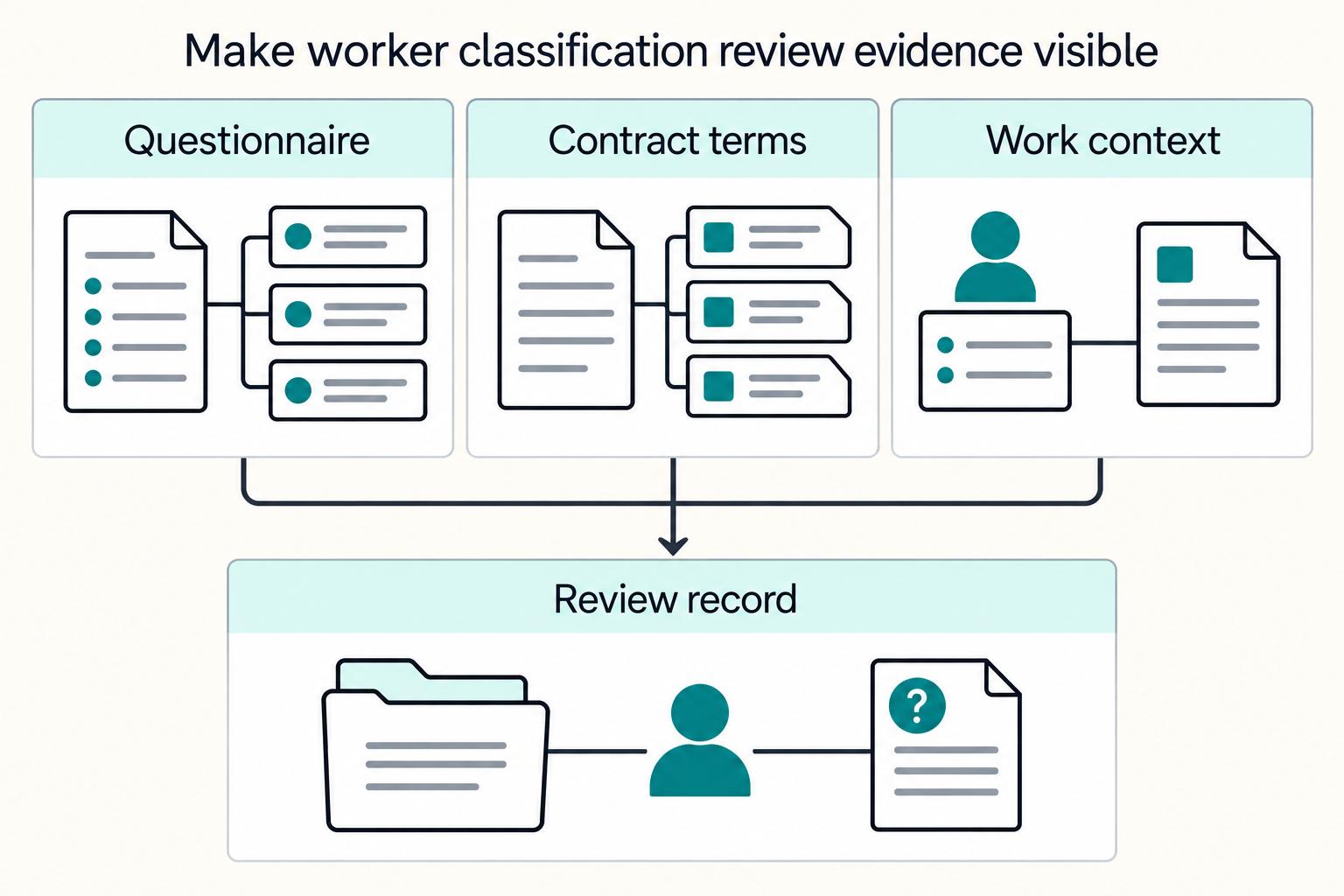
Your evidence pack should be treated as a payout gate: if the file cannot show the facts, reviewer, and determination, payout stays inactive.
| Evidence layer | What to store | How to use it operationally |
|---|---|---|
| Core classification record | Questionnaire responses, contract terms relevant to independent contractor status, jurisdiction rationale, reviewer notes, final determination | Minimum file required to explain contractor, employee, or escalated treatment based on facts, not just a tool label |
| Tax record layer | Relevant Form W-8 or Form W-9, plus whether reporting is expected on Form 1099-NEC or Form 1099-MISC | Supports onboarding, payment setup, and reporting readiness; it does not determine status by itself |
| Cross-border review layer | FATCA, FinCEN, FBAR, and Form 8938 review flags and notes where applicable | Keep these as review indicators, not automatic classification conclusions |
When Form 8938 is relevant, document it precisely. IRS materials say Form 8938 reports specified foreign financial assets when value exceeds the applicable threshold and is attached to the taxpayer's tax return. They also say certain specified domestic entities may need to file when total value exceeds $50,000 on the last day of the tax year or $75,000 at any time during the tax year, and that if no income tax return is required for the year, Form 8938 is not required.
Set those governance controls as explicit policy. If you use masked PII, immutable timestamps, and reassessment version history, enforce them consistently so you can export the exact evidence-pack version tied to payout activation.
Escalate before payout if any of these appear:
- questionnaire responses conflict with contract terms or reviewer conclusion
- no jurisdiction rationale is recorded for the actual work location
- reviewer notes are missing, generic, or not attributable to a reviewer
- applicable Form W-8 or Form W-9 status is unresolved
- a FATCA, FinCEN, FBAR, or Form 8938 flag exists without documented next-step review
Fail closed in the tool: no final determination, no reviewer identity, no usable evidence pack, or unresolved applicable tax-document status should mean no payout release.
This pairs well with our guide on Accounts Payable vs Notes Payable for Platforms and Contractor Obligations.
How to wire classification outputs into Gruv payment operations#
Use a hybrid flow: webhooks for fast status movement, APIs for final verification before irreversible steps like payout release or batch inclusion.
Keep the order fixed: onboarding intake -> classification decision -> compliance checks (such as KYC/AML, where enabled) -> payout eligibility -> payout batches -> ledger posting and reconciliation. If classification is checked after eligibility, you lose the main control point before money moves.
| Integration pattern | Best use | Timing behavior from source | Main risk | Practical use |
|---|---|---|---|---|
| API polling | Scheduled checks, backfills, and read-after-write verification | At a 30-second poll interval, detection can average ~15 seconds and be as high as 29 seconds if an event is just missed | Acting on stale status | Use as a verifier, not your only trigger |
| Webhook push | Fast change notification | Downstream systems can be notified within seconds | Missed, duplicated, or out-of-order events | Use for near-real-time state changes |
| Hybrid | Webhook triggers, API confirms latest record before irreversible actions | Combines fast notification with explicit record confirmation | More implementation work | Strong fit for control + auditability |
For status mapping, tie one classification outcome to one operational payout status, and apply it consistently across Virtual Accounts, payout flows, and ledger records. Your labels can vary, but each transition should remain auditable in MoR or direct payout setups: who changed it, when it changed, and which evidence-pack version supported it.
Before batch inclusion, fetch the latest classification record via API, confirm it is current, and attach that version ID to the payout instruction and downstream ledger trail. If you cannot tie a payout to the exact decision record used at release time, route it to exceptions.
Auto-route exceptions for stale decisions, missing required tax-document status, or material profile changes (such as scope-of-work or work-location changes after approval). These conditions can invalidate the prior rationale and should pause batch pickup until re-review.
For implementation, consume webhooks for speed, store raw event payloads with timestamps, then call the REST API to confirm current state before release actions. That split reflects the core tradeoff: neither APIs nor webhooks are universally better, but together they improve both responsiveness and traceability.
Need the full breakdown? Read Accrued Expenses vs. Accounts Payable: How Platform Finance Teams Classify Contractor Liabilities.
Failure modes competitors gloss over and how to prevent them#
Most classification failures happen after the quiz, when a label is treated as payment-ready without a review-ready record behind it.
| Failure mode | What competitors often gloss over | What you should verify before first disbursement | Prevention rule |
|---|---|---|---|
| Quiz says contractor, but no evidence pack exists | A status is shown, but the decision rationale is not documented in a way finance, tax, or legal can review later | Confirm there is a documented rationale, reviewer identity, timestamp, and versioned decision record tied to the engagement | No documentation, no release. Treat undocumented results as unresolved |
| Country drift | The worker's location or scope changes, but the original decision stays active | Reconfirm current location and actual services against the approved decision record | Any material location or scope change should trigger reassessment; cross-border setups increase legal and regulatory complexity |
| Tax mismatch | Payments start before classification and tax reporting treatment are aligned | Confirm the status is still current and that tax handling matches the worker type before money moves | Do not let disbursement outrun tax setup; cleanup later can force W-2/1099-NEC reporting rework and reconciliation |
Use a simple audit test: at first payment, can you show the exact decision record and its supporting rationale? If not, you have an audit gap, not a completed classification.
The IRS is explicit that correct worker-status determination is critical, and tax treatment differs materially between employees and independent contractors. When status is stale, unclear, or unsupported, stop and re-review before it turns into downstream reporting and ledger repair work.
Conclusion#
The right approach is to treat a contractor classification tool as a control point before money moves, not a quiz that produces a label and disappears. If a result cannot drive a clear hold, release, or escalate decision with supporting records attached, it is too weak for real payment operations.
The reason is simple: classification only works when the legal standard matches the facts and jurisdiction. California is the clearest example. Under the ABC test, a worker is treated as an employee unless the hiring entity satisfies all three conditions, and one of those conditions is that the work is outside the usual course of the hiring entity's business. That should shape your buying decision. Any tool that smooths this into one generic global answer is giving you convenience at the cost of precision.
The same caution applies when a tool points to federal materials. The Wage and Hour Division rule posted on FederalRegister.gov on 01/10/2024 is useful for orientation, but that page also says it remains an unofficial informational resource and that legal research should be verified against an official edition of the Federal Register. So do not stop at "did we get a score?" Ask which rule set the result relied on and whether you can verify it. If the tool cannot show that, treat the output as provisional and require review before first payout.
Where operators actually feel the difference is in execution. The better setup ties the decision to clear policy gates, payout eligibility checks, and evidence retention. Before activation, you want a file that includes questionnaire responses, contract terms, jurisdiction rationale, reviewer identity, and timestamps. If any of that is missing, the risk is not theoretical. It can show up later as payout exceptions, stale decisions, and painful cleanup when finance asks why a person was paid as a contractor under the facts that existed at the time.
A common failure mode is that the contract says "independent contractor," but day-to-day practice says something else. Another is country or scope drift: the worker changes location, reporting line, or services, and nobody reopens the record. In both cases, the original conclusion may no longer match reality, even if the first review was careful.
So the next step is practical: implement the comparison criteria and the evidence checklist first, then choose the tool model that matches your jurisdiction mix and risk tolerance. If you operate in one primary jurisdiction and can verify facts internally, a lighter approach may work. If you handle cross-border payouts, California exposure, or frequent role changes, choose the option that gives you documented reasoning and a real escalation path, not just a fast answer. Related reading: ACH vs Wire Transfer for Contractor Payouts When Platform Teams Should Use Each.
Frequently Asked Questions
Is a contractor classification tool legally binding?
No. Treat it as decision support, not a legal shield. The IRS says worker status depends on the relationship between the worker and the business, so a quiz result is useful only if the underlying facts reflect how the work is actually being done.
Can one classification tool cover every country where we pay contractors?
Not reliably on its own. Jurisdiction rules differ, and even within the U.S. you can hit different standards, such as the U.S. Department of Labor's rule under the FLSA and California AB 5's ABC test for specified state law purposes. If you pay across multiple countries, do not rely on one global score alone.
What data should we collect before running a classification decision?
Collect facts that show how the relationship operates in practice. At minimum, capture who controls what work is done and how it is done (behavioral control), and who controls financial and business terms such as payment structure and expenses (financial control). If those facts are missing or vague, the result will be weak no matter how polished the tool looks.
How often should contractor status be reassessed after onboarding?
The grounded sources do not set a fixed annual or quarterly cadence, so do not invent one. Reassess when the underlying relationship facts change, especially around behavioral or financial control.
When should we escalate from a self-serve tool to legal or expert review?
Escalate when the facts are mixed or unclear, or when your operating model conflicts with the contract. California work is an obvious checkpoint because AB 5 can change treatment under California law. You should also escalate if the tool says "contractor" but your team directs day-to-day work or controls key financial terms in ways that look employee-like.
How do classification outcomes affect payout release timing and exceptions?
The grounded sources here do not define payout-release rules or exception SLAs. Set those rules through your internal policy and legal/compliance guidance rather than treating a classification result as sufficient on its own.
Which tax and compliance records should we retain for audits and reporting?
The grounded sources here do not provide a required retention checklist or time limits. Keep a decision record that shows the relationship facts and the behavioral and financial control analysis used at the time of classification.
Try a related tool
Researched and edited by the Gruv editorial team. Gruv builds cross-border billing, payouts, and finance-operations software for global businesses.
Sources
Educational content only. Not legal, tax, or financial advice.
Related Posts
How to Handle Termination of an International Contractor
When you terminate an international contractor, treat it as a controlled legal and operational event, not a one-off conversation. A messy exit can trigger five risks at once:

Contractor Misclassification Risk Assessment for Platforms
For platforms, contractor misclassification risk assessment is a recurring control, not a one-time legal task. When your work model, oversight, or market footprint changes, classification risk can change with it.

Independent Contractor Status for Cross-Border Freelancer Contracts
A label helps, but it does not decide status on its own. What matters in practice is control: who decides the method, the sequence, and the day-to-day execution of the work.