
Quick Answer
Yes - use cash advance programs contractors pros cons analysis only after mapping repayment to your real inflows. The article’s direct rule is to treat a merchant cash advance as a short bridge for a known timing gap, then stress-test total payback, fee burden, and withdrawal cadence against weaker collections. If the margin fails in that downside case, move to invoice financing or factoring and do not approve on speed alone.
How to Evaluate Cash Advance Programs for Contractors#
A contractor cash advance is not automatically reckless or automatically useful. The real question is whether the funding structure fits your cash-conversion cycle closely enough to solve a timing problem without turning routine revenue into expensive repayment pressure.
That framing matters because merchant cash advances sit inside the broader small-business credit market, not outside it. Federal Reserve reporting says 37 percent of small employer firms applied for a loan, line of credit, or merchant cash advance in the prior 12 months in 2023. The Small Business Credit Survey, a Federal Reserve survey program for firms with fewer than 500 employees, also gives useful context for why these decisions are live right now. In the 2024 survey, fielded from September to November 2024 and reaching more than 7,600 small employer firms, rising costs of goods, services, and wages were the most cited financial challenge.
For founders, revenue teams, product teams, and finance operators, the decision is rarely abstract. Payroll, supplier terms, subcontractor payouts, and customer payment lag all hit the same cash pool. A short-term advance may be workable when timing is the real problem and the repayment path is visible. Risk rises when the business is using expensive capital to cover a deeper mismatch between collections and pricing.
You also need to treat MCA offers with the same seriousness you would give any other business credit product. In the CFPB's small-business lending rule context, covered credit transactions include loans, lines of credit, credit cards, merchant cash advances, and other credit products. Treat that as a reminder: do not let a provider's label do your analysis for you. Start with a simple checkpoint. Verify what actually drives repayment, what the total dollar cost is, and how long payback lasts under slower-than-expected receipts, not just under the sales forecast everyone hopes will happen.
There is another reason to stay disciplined here: term clarity is not guaranteed. FTC enforcement history includes MCA actors accused of misrepresenting terms to small businesses. So the failure mode is not only that the product was expensive. It can also be that your team approved something it could not clearly explain, model, or monitor.
This article takes a practical angle. You will see where MCA-style funding can make sense, how invoice-linked options compare, what to model before signing, and which operating checks belong in the approval file. Before any comparison is useful, though, the funding options need clean definitions.
For a step-by-step walkthrough, see Cash Pickup Payouts for Unbanked Contractors in Cash-Preferred Markets.
Define the funding options before you compare them#
Define the repayment mechanics first, because similar labels can hide different economics. If you do not confirm what cash flow repays the advance, you are comparing names, not risk.
| Option | What it usually means | What repayment follows | First verification point |
|---|---|---|---|
| Merchant cash advance (MCA) | Alternative financing, contrasted with a traditional small business loan | Future receivables, often credit card sales | Ask whether remittance is tied to card sales, general receivables, or a fixed withdrawal |
| Cash advance program | Broad market label, not a single statutory product name | Depends on the product inside the label | Get the agreement and classify it before modeling cost |
| Invoice financing | Advance on unpaid invoices | Specific invoices; customers still pay your business | Confirm the borrowing base is invoice-backed, not broad sales-backed |
| Factoring | Accounts receivable purchase transaction between businesses | Purchased invoices; customer payment is directed to the factor | Check who owns the receivable and who handles collections |
The key split is sales-based funding versus invoice-based funding. MCA repayment comes from future receivables and is often linked to credit card sales. Invoice financing advances against unpaid invoices, while factoring is a receivables purchase where customer payments are directed to the factor. In CFPB Regulation B small-business lending context, factoring is excluded from covered credit transactions, while merchant cash advances are listed among covered credit transactions.
Use one cost baseline across all four labels: total dollars repaid, timing, fees, and an implied APR view. APR captures the interest rate plus additional fees and depends on the amount borrowed and days outstanding. In practice, require the contract, repayment trigger, fee schedule, and payment-routing detail in the approval file before you compare offers.
Related: Embedded Working Capital for Platforms: Invoice Financing Factoring and Cash Advance Compared.
Where contractor cash advances solve real problems and where they backfire#
A contractor cash advance is most defensible as a short bridge over a known timing gap, not as ongoing operating funding. If the gap is recurring, hard to predict, or paired with thin margin, the same product can turn growth into a liquidity problem.
The core fit test is simple:
| Use it when | Avoid it when |
|---|---|
| Payroll or another near-term obligation is due now, repayment cash is visible, and you need a fast bridge. | Collections are uneven, remittance pressure is frequent, and margin is already tight. |
| You can tie payoff to specific incoming receivables you can date and track. | You cannot identify the inflow that will retire the balance. |
| You cannot obtain desired credit on reasonable terms in the needed timeframe. | The advance is becoming a repeat habit rather than an exception. |
That distinction matters because MCA-style funding is repaid from business revenue, and providers commonly make daily withdrawals from the business bank account until the obligation is met. In businesses with uneven pay cycles, daily or weekly withdrawals can strain liquidity. Reported owner experiences also reflect this timing pressure when payroll and other bills come due before cash arrives.
Before signing, require a concrete repayment map: named receivables, expected timing, and a clear path to zero balance. If you cannot map that path, you are financing uncertainty.
If the cash gap is short and predictable, a short-term advance can be rational. If timing volatility is structural, move toward receivable-linked design instead: invoice financing borrows against outstanding invoices, while factoring sells invoices at a discount. Both tie repayment or collection more directly to invoices than to broad sales flow.
Related: The Pros and Cons of Work-Study Programs.
Price, repayment, and margin impact you need to model before signing#
Model the offer against your real cash-conversion cycle before you sign, not against an average-case repayment story. Merchant cash advances can fund fast, but total repayment is often higher than many business-loan options, so fit depends on timing and cash-flow tolerance.
Put every offer on one page#
Do not compare offers from memory or headline pricing. MCA pricing is often shown as a factor rate, so normalize each term sheet into one view.
| Field to capture | What to record from the offer | Why it matters |
|---|---|---|
| Repayment basis | Percentage of credit card sales, or automated daily/weekly bank withdrawals | Shows whether repayment truly flexes with sales or keeps pulling cash on a fixed cadence |
| Total payback | Funded amount and total repayment obligation | Shows real dollars leaving the business |
| Effective APR | Implied annualized cost from total payback and expected payoff period | Helps leadership compare options on a common basis |
| Expected payback period | Provider estimate and your internal estimate | Tests whether payoff timing matches your collections reality |
| Fees | Any origination, processing, or add-on charges | Changes all-in cost, especially on short durations |
| Prepayment terms | Whether early payoff lowers cost or total payback stays largely fixed | Avoids false savings assumptions |
Use factor-rate math directly. If an offer funds $50,000 at a 1.3 factor rate, total repayment is $65,000. Then test that against contractor collections that may take weeks or months, with retainage potentially much longer.
Stress remittance mechanics against actual collections#
Sales-linked remittance can feel flexible, but it can still strain cash when receipts slow or arrive in lumps. Repayment tied to card sales, daily ACH, or weekly withdrawals should be mapped to when your jobs actually pay.
Model at least three cases:
- Best case: customer payments land on time and repayment clears quickly.
- Base case: normal delays and project variability.
- Worst case: receipts slip, retainage stays outstanding, and repayment draws cash before the next meaningful inflow.
If repayment cadence is faster than your inflow cadence, the risk is not just price. It is the timing mismatch that can pressure payroll, materials, and other recurring outflows.
Require finance sign-off on stressed contribution margin#
Before signing, have finance or accounting review current business health against the proposed structure. The decision test is simple: after repayment, does contribution margin still hold in the stress case, not only the base case?
Keep the review pack practical: signed term sheet, repayment method, funded amount, total repayment, expected payoff window, receivables timing, and stressed margin view. If that package does not show acceptable post-repayment margin under slower collections, treat the offer as unresolved risk rather than a clean bridge.
Related: The Pros and Cons of an All-in-One ETF Portfolio.
Compare MCA against invoice financing and factoring on operational fit#
If your receivables are strong, documentable, and tied to specific invoices, start with invoice-linked products before an MCA. Repayment is usually easier to map to unit economics.
| Option | Speed to funds | Cost clarity | Collections burden | Customer relationship impact | Underwriting depth | Need for collateral | What repayment or cash tracking follows |
|---|---|---|---|---|---|---|---|
| Merchant cash advance (MCA) | Varies by provider, so confirm approval-to-funding timing | Harder to compare unless total payback and fees are translated into implied APR | Less invoice admin, but finance must monitor remittance pulls against actual cash flow | Usually less direct customer contact because collection is tied to sales flow, not a specific invoice | Usually based on business sales activity rather than named invoices; depth varies by provider | Provider-specific; confirm any guarantee or other security term in writing | Broad sales activity, card receivables, or bank withdrawals |
| Invoice financing | Varies by provider and invoice review process | Usually easier to tie costs to identified invoices, but still compare fees and implied APR | You keep billing and collections, so your team keeps follow-up and exception work | Usually lower direct customer visibility because you remain the collector | Usually focused on outstanding invoices and collectability; depth varies by provider | Provider-specific; confirm any collateral or guarantee requirement | Specific outstanding invoices |
| Factoring | Can be fast, sometimes within 24 to 48 hours after invoice verification | Can cost more than invoice financing because collections and processing are included | Lower internal collections work because the factor collects from customers | Higher customer visibility because the factor is involved in payment collection; impact depends on execution | Usually centered on invoice verification and customer payment quality; depth varies by provider | Provider-specific; confirm any guarantee or other security term | Purchased invoices and customer payment collection |
The practical split is invoice-anchored repayment versus broad sales-anchored repayment. Invoice financing means borrowing against outstanding invoices while keeping collections in house. Factoring is an accounts-receivable purchase transaction between businesses, and CFPB Regulation B treats it differently from covered credit transactions such as MCA-style business credit.
For contractors, use this rule. If invoice quality is strong and documentation is clean, prioritize invoice financing first for predictability. Consider factoring when outsourced collections or post-verification speed matters more. Use an MCA when invoice-linked funding is not workable and you have already tested whether sales-based remittance still holds margin in slower collection periods.
Execution friction should be priced in with the rate. Confirm what starts the funding clock, who owns disputes and payment exceptions, and what reporting is required after funding. If those mechanics are vague, operating cost is still unknown even if headline pricing looks acceptable.
Related: The Pros and Cons of Using a Virtual Company Service Like Xolo Go.
Decision rules by contractor scenario#
Match the funding tool to the cash-flow problem, not the fastest sales pitch. If the gap is tied to collectible invoices, start with invoice financing; if cash is uneven and margins are thin, treat broad sales-based advances as high risk; if this is a temporary growth gap, use time-boxed support with a written exit trigger. If you cannot write the exit trigger, do not launch.
| Scenario | Cash-flow situation | Suggested funding approach |
|---|---|---|
| A | Receivables are high confidence and payment lag is short | Invoice financing is usually the first choice; factoring is also positioned as a cash-flow tool for B2B firms managing unpaid invoices |
| B | Inflows are inconsistent and margin is already thin | Treat broad cash advance program use as high risk and prioritize cost control and better payment terms first |
| C | Temporary growth push | Use short-term working capital only with a defined entry trigger, dated exit trigger, and conditions that stop new draws |
Scenario A#
When receivables are high confidence and payment lag is short, invoice financing is usually the first choice. If you are comparing invoice-linked options, factoring is also positioned as a cash-flow tool for B2B firms managing unpaid invoices.
Use an MCA here only when the speed premium is clearly worth the cost and control tradeoff. If the timing edge is small, broad sales-based repayment is usually harder to justify than financing tied to specific invoices.
Scenario B#
If inflows are inconsistent and margin is already thin, broad cash advance use is high risk. MCA structures commonly use frequent automatic withdrawals from the business bank account, which can intensify pressure when collections are uneven.
This risk profile is common, not rare. In the 2024 SBCS (published March 27, 2025), 56% of firms cited paying operating expenses as a challenge, 51% cited uneven cash flow, and firms were more likely to report revenue declines than increases. In that environment, frequent withdrawals can turn a timing issue into a margin issue.
Prioritize cost control and better payment terms first. If a provider cannot clearly show total payback, withdrawal cadence, and weak-month impact in writing, do not proceed.
Scenario C#
A temporary growth push is the narrow case where short-term working capital can make sense. The same 2024 SBCS shows this is a real use case: 46% of applicants sought financing for expansion or a new opportunity.
Keep it explicitly temporary. Define the trigger for entry, the dated trigger for exit, and the conditions that stop new draws. Then run a weekly variance review against expected receipts and actual repayment behavior; if the exit trigger is no longer credible, pause and re-underwrite.
Related: The Pros and Cons of Short-Term vs. Long-Term Rentals.
How to operationalize a contractor funding offer inside your product and finance stack#
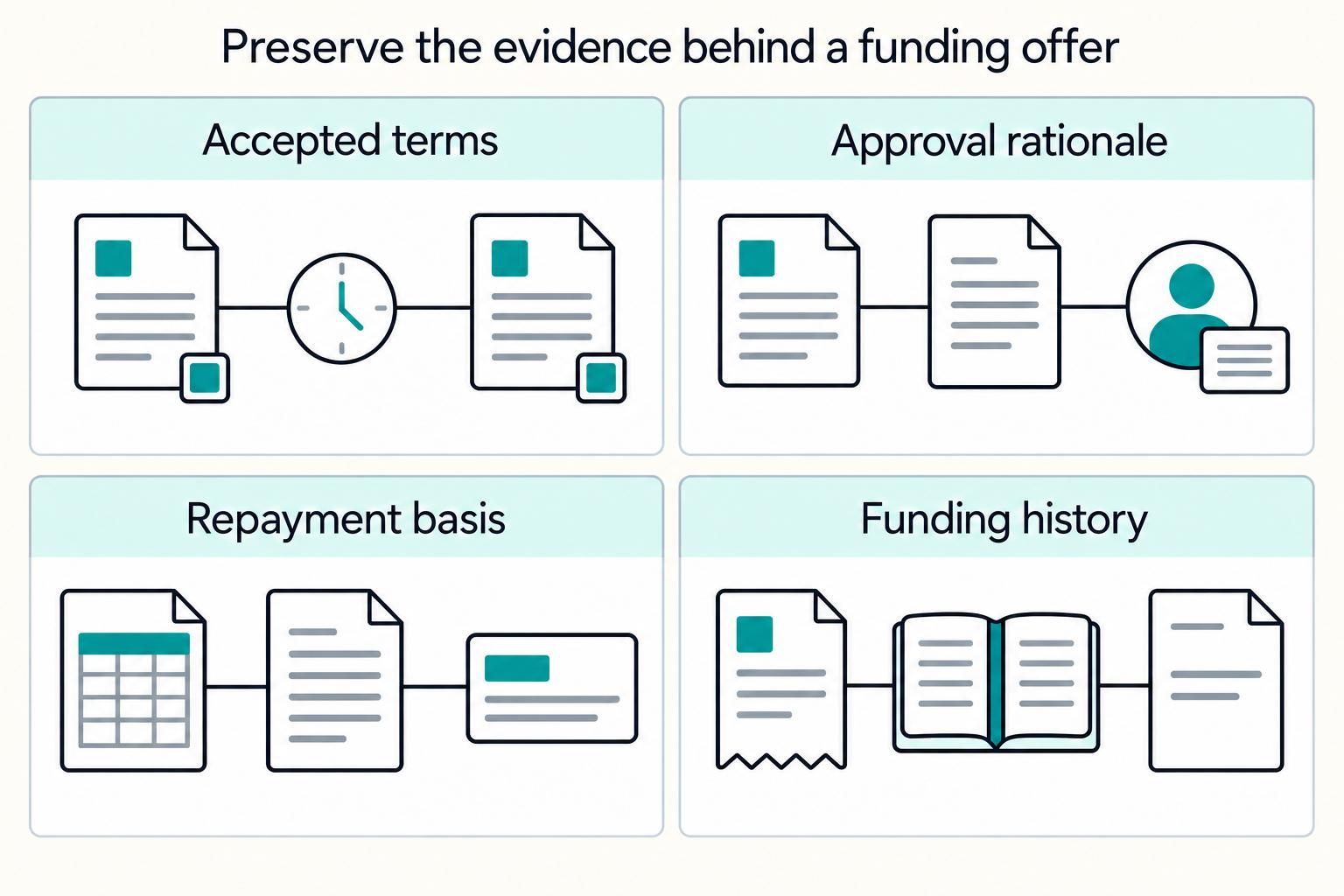
Treat funding operations as underwriting controls, not back-office cleanup: no funds should move until identity checks, accepted terms, and event-level traceability are in place. A practical flow is intake, eligibility, pricing disclosure, acceptance logging, funding, repayment tracking, and exception handling.
| Stage | Required control | Record or timing |
|---|---|---|
| Intake | Collect the minimum identity and business data your policy requires before account opening or payout enablement | Keep CIP inside your AML program from day one |
| Verification and approval | Keep a clear record of who was verified, who approved the offer, and the exact terms accepted | Identity collection and verification is the first hard gate |
| Acceptance logging | Lock acceptance to the exact terms version shown at approval | Keep pricing disclosure, repayment basis, schedule assumptions, and acceptance timestamp together |
| ACH authorization | Retain written authorization evidence if repayment uses ACH debits | Keep it for 2 years from termination or revocation |
| Post-funding tracking | Use a ledger-backed record of disbursements, balances, and repayments and reconcile at the transaction level | Pull payout records automatically on events like payout.paid or payout.reconciliation_completed |
| Evidence pack and retention | Keep product terms and disclosure, approval rationale and eligibility outcome, repayment schedule assumptions and payment rail details, and post-funding checkpoints | CIP identifying records carry a 5-year retention requirement after account closure |
Start intake by collecting the minimum identity and business data your policy requires before account opening or payout enablement. If your program moves money, keep CIP inside your AML program from day one rather than treating it as a later add-on. Otherwise, product may approve offers that finance cannot fund because verification or payout eligibility is incomplete.
Put policy gates before speed promises#
Identity collection and verification is the first hard gate. Provider tooling helps, but your platform still owns fraud monitoring. On each offer, keep a clear record of who was verified, who approved the offer, and the exact terms accepted.
Lock acceptance to the exact terms version shown at approval. Keep the pricing disclosure, repayment basis, schedule assumptions, and acceptance timestamp together. If repayment uses ACH debits, retain written authorization evidence for 2 years from termination or revocation so disputes can be resolved from records, not memory.
Use ledger-backed tracking, not side files#
After funding, operate from a ledger-backed record of disbursements, balances, and repayments. Spreadsheets can support analysis, but spreadsheet-only monitoring is fragile for contractor portfolios because it weakens event-level traceability. Each funding and repayment event should tie back to underlying balance transactions and payouts.
For platforms, reconcile at the transaction level, not only by batch totals. If your provider supports payout-to-transaction mapping, use it and pull payout records automatically on events like payout.paid or payout.reconciliation_completed so finance can explain balance changes and repayment settlement status.
Define the minimum evidence pack#
For each approved offer, keep one evidence pack with at least:
- product terms and disclosure shown at acceptance
- approval rationale and eligibility outcome
- repayment schedule assumptions and payment rail details
- post-funding checkpoints such as first repayment status, delinquency flags, and manual review notes
Set retention windows up front. CIP identifying records carry a 5-year retention requirement after account closure. Defining this early prevents expensive cleanup later.
Related: The Pros and Cons of a C-Corp for a Freelance Business.
Red flags that signal a program design problem#
If your team cannot explain an offer in lender-neutral cost terms and operating rules, the design is not ready for approval.
| Red flag | What to check | Why it matters |
|---|---|---|
| Opaque pricing mechanics | Verify finance can map the offer to an effective APR, the finance charge, and the actual repayment trigger without vendor interpretation | If it cannot, treat it as a design risk |
| Disclosure fields are too vague to complete | Use New York Article 8, Section 803 as a sanity test for covered sales-based financing offers up to $2,500,000, including finance charge and estimated APR | If terms cannot be expressed that clearly, pricing transparency is likely too weak |
| "Flexible repayment" with no downside case | Ask for one written stress scenario before approval | If the answer stays vague, assume the flexibility claim is incomplete |
| Brand narrative instead of internal controls | Require internal pass/fail rules for margin under stress, disallowed servicing behavior, and exit paths to lower-cost capital | Provider references are not controls by themselves |
| Repeat refinancing in the same subcontractor cohort | Check whether advances keep rolling with no path to lower-cost capital | You may be masking a broken cash cycle rather than fixing it |
Related: The Pros and Cons of Accepting Cryptocurrency Payments.
Conclusion#
The right call is rarely merchant cash advance yes or no. It is choosing the funding design that matches your cash-conversion cycle, keeps unit economics intact, and can be operated with controls strong enough to catch problems before they turn into a liquidity event.
Speed is not a sufficient approval reason by itself. If a contractor needs funds fast, you should still require a cash flow projection and a simple money-in versus money-out stress case before signing. SBA finance guidance supports both points: project future cash flow, and look closely at money in and money out to keep profit and loss sustainable. If your margin does not survive a weaker collection month, the answer is not fund now and fix later. It is to tighten terms and operating discipline first.
The practical test is simple. Ask finance to verify three things in writing: expected cash in during the repayment window, total dollars out including fees, and post-repayment contribution margin under a downside case. Then match that to the actual collection method. If the product uses daily automatic payments or daily bank withdrawals, do not let sales-linked language create false comfort. Daily collection can still drain operating cash before receivables land, which is why downside liquidity testing matters more than headline speed.
One failure mode deserves extra attention: servicing drift after funding. FTC enforcement actions around MCA providers did not prove every provider behaves the same way, but they did show a real risk pattern. Businesses were allegedly hit with withdrawals that continued beyond expected repayment, leaving them without needed cash. For you, the operator takeaway is concrete: reconcile withdrawals against the contracted obligation, assign ownership for exception review, and keep an evidence pack for every approval. At minimum, that pack should include the contract, repayment formula, collection method, expected payoff timing, approval rationale, and a post-funding review point.
If receivables are documentable and timing is the main issue, prioritize funding structures where the cash source and repayment logic are easy to trace. If they are not documentable, or inflows are erratic, treat any advance as temporary and attach an explicit exit trigger. No exit trigger usually means you are financing a structural cash problem, not bridging a short gap.
The conclusion is simple: fund the gap only when the economics still work after stress, the repayment mechanics are transparent, and your team can monitor collections with discipline. If any one of those breaks, do not scale the program yet.
Frequently Asked Questions
Are contractor cash advances the same thing as a merchant cash advance?
Not always. A cash advance program can be a broader label, while a merchant cash advance is a specific product where the provider advances funds and takes repayment from a share of business revenue, often through daily withdrawals. In CFPB guidance, MCA sits under the wider sales-based financing umbrella.
How expensive can an MCA be compared with a small business loan?
Assume the comparison is hard unless finance converts everything into the same cost view. The Federal Reserve notes that MCA and factoring-style offers often do not show cost as an interest rate or APR, and SBA guidance says a business line of credit can be more economical than an MCA. If a provider will not give you enough detail to normalize cost, treat that as pricing risk, not a minor paperwork gap.
When does sales-linked repayment actually help cash flow, and when does it make things worse?
It can help when your cash gap is short, your incoming revenue is visible, and repayment actually moves with weaker sales. It gets worse when the practical collection method is still a daily bank withdrawal during a soft period, because that can drain operating cash before receivables land. The checkpoint is simple: ask for a written downside example using a weak-sales month, not just the average case.
What is the fastest way to compare MCA, invoice financing, and factoring without missing hidden costs?
Build a one-page comparison sheet with the same fields for each offer: funds received, total dollars repaid, all fees, repayment trigger, expected payoff timeline, collection method, and prepayment treatment. Also mark who owns collections and what documents the provider needs up front. If you skip collection mechanics or payoff timing, you will miss real cost even if the headline fee looks manageable.
Which contractor profiles should avoid cash advance programs entirely?
There is no single profile that should always avoid them, but extra caution is warranted for thin-margin contractors, businesses with highly inconsistent inflows, and repeat refinancers who keep plugging the same cash hole every cycle. The same caution applies when there is no credible path to more stable financing once the immediate crunch passes. If you cannot state an exit trigger in writing, you may be financing structural weakness.
What evidence should finance require before approving a cash advance offer?
At minimum, require the contract, the repayment formula, the collection method, total expected payback, all fees, and a normalized annualized cost estimate even if the provider does not call it APR. Add a stress case showing what happens if receipts slow and a post-funding checkpoint for margin after repayment. For U.S. programs, it also helps to remember that CFPB Regulation B section 1002.104 includes merchant cash advances within covered business-credit transactions. Factoring is treated separately, so the review memo should not treat them as identical products.
How should operators handle country and program differences safely when rolling out funding features?
Do not assume legal treatment, disclosure expectations, or servicing norms transfer cleanly across countries or even product variants. Keep one internal comparison template, but require jurisdiction-specific legal and compliance review before launch. A good failure mode to guard against is copying an MCA approval checklist into a factoring rollout and missing product-specific review points.
Try a related tool
Researched and edited by the Gruv editorial team. Gruv builds cross-border billing, payouts, and finance-operations software for global businesses.
Sources
- ag.ny.gov/press-release/2025/attorney-general-james-an...trusted
- consumerfinance.gov/rules-policy/regulations/1002/104trusted
- consumerfinance.gov/compliance/compliance-resources/small-busine...trusted
- dfs.ny.gov/reports_and_publications/press_releases/pr20...trusted
- ecfr.gov/current/title-31/subtitle-B/chapter-X/part-1...trusted
- federalreserve.gov/publications/files/consumer-community-contex...trusted
- federalreserve.gov/publications/2025-march-consumer-community-c...trusted
- files.consumerfinance.gov/f/documents/cfpb_small-business-lending-freq...trusted
Educational content only. Not legal, tax, or financial advice.
Related Posts
Federal Work-Study Pros and Cons: Is It a Good Fit This Semester?
Federal Work-Study can be a strong fit if you want part-time income and relevant work experience during school and can move early. It may be a weaker fit if you need guaranteed income every year or if even modest job pressure is likely to cut into your coursework. That is the practical answer to the **pros and cons of work-study**.
Embedded Working Capital: Factoring, Financing, or Cash Advance
Treat this as a product design choice first and a funding feature second. The model you pick changes who controls the invoice asset, who collects repayment, what your support team has to explain, and how the economics hold up once disputes and exceptions show up. That is the real lens for embedded working capital.
All-in-One ETF Portfolio: Pros, Cons, and Tax Checks for Global Professionals
If your priority is broad diversification with less day-to-day portfolio admin, an **all-in-one ETF portfolio** can be a practical default. It is a weaker fit when you need custom asset weights, detailed tax positioning, or a specific fund domicile for your filing situation.