
Quick Answer
Federal Work-Study is a good option when you want part-time income and useful experience during school and can act early. It is less appealing if you need guaranteed income every year or if even light job pressure is likely to hurt your coursework. Because jobs are limited and paid through regular payroll, the best choice depends on eligibility, timing, schedule fit, and how reliable the role looks for the term.
How to decide whether work-study fits your semester#
Federal Work-Study can be a strong fit if you want part-time income and relevant work experience during school and can move early. It may be a weaker fit if you need guaranteed income every year or if even modest job pressure is likely to cut into your coursework. That is the practical answer to the pros and cons of work-study.
The decision gets easier when you treat it less like a label and more like a semester plan. If you want a job that can sit alongside classes, help with day-to-day expenses, and give you experience you can use later, work-study can make a lot of sense. If you need certainty, either about getting a job at all or about having the same income setup every year, the tradeoff is harder. Work-study can be a good tool, but it still comes with constraints.
At its core, Federal Work-Study is a federal aid program that lets you earn money through part-time work while you are in school. Unlike a federal student loan, that money is not repaid. Two gates matter most at the start. First, you need to submit the FAFSA® or you will not be considered. Second, timing matters because jobs are limited, and late action can mean fewer choices.
Those two gates matter more than most students expect. The FAFSA requirement is not just a formality. If it is not in, the process does not start. Timing is not just about being organized. It affects the range of roles you can consider and how much choice you have in matching a job to your class schedule, your energy, and the type of experience you want.
If you move late, you may still find something, but you are more likely to be choosing from what is left instead of choosing from what fits.
The mechanics are simple.
- Work-study funds are paid through regular payroll, not as an automatic tuition credit. Think of it as earned income that arrives through the normal pay process, not as money that automatically lowers a bill before the term starts.
- The program is generally meant for day-to-day expenses. In practice, that makes work-study most useful when you match it to recurring living and school costs rather than expecting it to solve larger costs all at once.
- Jobs are part time. That is part of the appeal if you want work to stay in proportion to school. It also means you should not evaluate it as if it were built to function like full-time income.
- Work-study earnings are stated not to reduce your future student aid. That is one reason the program stands apart from a standard part-time job comparison and why the aid interaction belongs in your decision.
- Funding and job availability are not guaranteed each year. Treat each year as its own decision cycle rather than assuming that one good setup automatically repeats.
That last point is easy to underestimate. A good experience this term does not remove the need to check eligibility, postings, and timing again later. If you build your whole school-year budget around the idea that work-study will always be there in the same form, you are relying on something the program does not promise.
A better approach is to treat work-study as a strong semester-by-semester option when the conditions line up: eligibility is confirmed, openings exist, and the role fits around the academic load you actually have.
This is also why students who handle work-study well often think about the week, not just the label. They do not just ask, "Do I have work-study?" They ask, "What will this look like as a weekly system?" When does money arrive? What does the job ask of me during a normal week? How much management does the role require once classes get busy?
If the answers to those questions are clear early, work-study can be steady and useful. If they stay vague, the stress tends to show up later, when changing course is harder.
How should you compare the real options?#
The right comparison is not just work-study versus no work-study. It is which option gives you the best mix of schedule control, useful experience, and dependable income for this semester.
That means comparing the actual path in front of you, not the label. A work-study role is not automatically the right answer just because it is work-study. A non-work-study campus role is not automatically worse because it sits outside the program. An off-campus role is not automatically too rigid or too inconvenient. The better question is simpler: which path fits the constraints of your semester and returns something useful beyond the paycheck?
Use the table below as a planning framework. Details outside work-study can vary by school and employer.
| Path | Flexibility | Skill growth | Income reliability | Aid interaction | Admin burden |
|---|---|---|---|---|---|
| Work-study role | Part time by program design; schedule depends on department and supervisor | Depends on the posting and team | Depends on role availability, hours, and year-to-year funding | Work-study earnings are stated not to reduce future student aid | FAFSA, job search, school hiring steps, payroll setup |
| Non-work-study campus role | Varies by role and supervisor | Varies by posting | Varies by available hours and hiring demand | This section does not assume the same aid treatment as work-study | Employer application, onboarding, and payroll setup |
| Off-campus role | Varies by employer needs | Varies by role | Varies by employer schedules and local openings | This section does not assume the same aid treatment as work-study | Standard hiring, onboarding, and payroll setup; schedule/commute coordination can apply |
If your priority is the work-study aid treatment, start there. If openings are thin, compare campus and off-campus jobs next, but do not assume the aid impact is the same across all three paths.
Use the table to avoid making a one-factor decision. Students often focus on the first visible advantage and stop there. If a role is on campus, they assume the schedule will be manageable. If a job looks convenient, they assume the income will be dependable. If a posting sounds relevant to future plans, they assume the day-to-day work will be worth the time. The better move is to compare across all five columns at once.
Start with flexibility, because schedule friction is often what turns a decent job into a bad semester fit. A role can be part time by design and still be awkward in practice if the supervisor expects you to fill scattered gaps throughout the week. A campus role can still conflict with your academic life if you have to stay available during the very windows you need for labs, study blocks, or transit between classes.
An off-campus job may be workable if the schedule is predictable, but the commute and coordination become part of the real cost.
Next, look at skill growth with a hard eye. "Relevant experience" only helps if the posting gives you work you can later describe clearly. Ask whether you will be doing concrete tasks, learning a system, supporting a team in a visible way, or building a routine you can explain. If the role is so vague that you cannot tell what you will actually do, the skill-growth upside is mostly theoretical.
This matters because one strong reason to choose work-study is that it can do more than produce income. If it only gives you a paycheck and constant scheduling friction, the advantage narrows quickly.
Income reliability deserves its own line because a lot of disappointment starts here. A work-study label does not remove the fact that jobs depend on role availability, hours, and year-to-year funding. A campus job outside work-study still depends on hours and hiring demand. An off-campus job may offer better or worse schedule consistency depending on the employer.
In all three paths, what matters is the actual pattern of hours and the likelihood that those hours continue in a way you can count on for the term. If your budget only works when a job is highly dependable, evaluate reliability first and the label second.
Aid interaction is where work-study has a specific advantage in the comparison laid out here. This article does not assume that other job types carry the same aid treatment, so do not flatten them into one category. If that distinction matters to your broader aid picture, it belongs in the decision from the beginning rather than as an afterthought.
Then there is admin burden, which is not glamorous but does affect how smooth the semester feels. Work-study has more moving parts up front: FAFSA, job search, school hiring steps, and payroll setup. That does not make it a bad option. It just means the setup work is real, and it pays off most when you do it early and cleanly.
A standard campus role or off-campus job may involve different aid and onboarding steps, but they still involve applications, onboarding, and payroll. The difference is that work-study combines the job decision with aid timing, so waiting can cost you both choice and momentum.
A practical way to compare the three paths is to run the same questions across each one:
- What will my week actually look like if I take this role?
- How fixed or flexible are the hours?
- Can I describe the work clearly to someone else?
- How likely is it that the hours I expect are the hours I actually get?
- What setup work do I need to complete before the first paycheck arrives?
This comparison also helps if your first-choice path is not available. If you start with work-study and find limited openings, you do not need to restart your thinking from zero. Use the same criteria on the next option. Compare the available campus role. Compare the off-campus role. Keep the standard the same.
That keeps you from accepting a poor fit just because it is the fastest open door.
The most common decision mistake here is overvaluing convenience at the moment of application and undervaluing friction that repeats every week. A role that looks easy to get can become expensive in time and attention if the schedule moves around, the responsibilities stay unclear, or the approval process for hours is sloppy. A slightly slower application process for a clearer job often wins over the course of a semester.
A better decision rule is this: choose the option that protects your academic schedule, gives you work you can understand and explain, and has an income pattern you can live with this term. If work-study meets those conditions, it is usually a strong choice. If it does not, the fact that it is work-study does not fix the mismatch.
Which postings return more than a paycheck?#
A weak posting can get worse once the semester gets busy. A strong one gives you predictable work, a manager who can explain expectations, and experience you can describe clearly later.
| Check | What to confirm | What it tells you |
|---|---|---|
| Actual work | What you will actually do each shift | Whether the work is clear, repeatable, and understandable from day one |
| Supervision | Who supervises you and what good performance looks like | Whether there is a real point of contact when expectations are unclear |
| Schedule | How fixed or flexible the schedule is | Whether your weekly windows are dependable and you can protect class blocks and study time |
| Hours and approval | How hours are submitted and approved | Whether the path from your hours to your paycheck is clear |
That difference matters more than most students expect. Early in the process, almost any job can look acceptable because the pressure is still abstract. You are imagining the income, the title, or the convenience of staying on campus. The test comes later, when classes intensify and every unclear part of the job starts costing you time.
A role with vague responsibilities, unclear supervision, or unstable scheduling can become harder to manage, not easier, once your semester fills up.
Treat each posting as a decision, not just an opening. Before you apply, confirm four things:
- What you will actually do each shift.
- Who supervises you and what good performance looks like.
- How fixed or flexible the schedule is.
- How hours are submitted and approved.
Those four checks sound basic, but together they tell you whether a role is likely to stay manageable. Start with the actual work. "What will I do each shift?" is a stronger question than "What is the job?" because it forces the role into concrete terms.
You are trying to learn whether the work is clear, repeatable, and understandable from day one. A strong answer gives you a usable picture of the shift. A weak answer leaves everything open-ended. If the role depends on figuring it out as you go without a clear baseline, that uncertainty will not feel smaller in the middle of the term.
This is also where you separate helpful experience from thin experience. A role does not have to be complicated to be useful. It does need to be clear enough that you can explain what you did, what you were responsible for, and how you contributed. If the posting can only be described in broad, fuzzy terms, it may still pay you, but it is doing less of the developmental work that makes part-time school-year jobs worth the effort.
Next, look at supervision. Knowing who supervises you is not just about hierarchy. It tells you whether there is a real point of contact when expectations are unclear, your schedule needs adjusting, or your time entry gets stuck. It also tells you whether "good performance" has any shape to it.
If the manager can explain what matters, the role is easier to succeed in. If even that is vague before you start, there is a good chance feedback will be inconsistent later.
The schedule question is where a lot of attractive postings split into good fits and bad fits. Flexible can mean genuinely adaptable, or it can mean undefined until the week begins. Fixed can mean stable, or it can mean rigid in ways that collide with classes. What you want is not the most flattering description. You want the actual pattern.
Are your weekly windows dependable? Will exam periods create pressure? Can you protect the class blocks and study time that matter most? The stronger posting is the one that makes those answers clear.
The final check, how hours are submitted and approved, sounds administrative, but it affects whether the job works in real life. A role can be manageable on paper and still become frustrating if the time-entry process is confusing, approval is slow, or no one is clear on how payroll moves from your hours to your paycheck. You do not need to overcomplicate this. You just need to know the path.
Who approves the hours? When do you enter them? What step tends to cause delays? Clarity here saves avoidable stress later.
If a role is vague before you start, it can become harder to manage once classes intensify. Favor clear responsibilities, clear supervision, and predictable scheduling over roles that rely on "we'll figure it out."
That advice is less about caution and more about protecting future bandwidth. During a light week, you can absorb some ambiguity. During a heavy week, ambiguity becomes extra labor. You spend time clarifying tasks, fixing assumptions, following up on hours, and renegotiating availability. None of that improves your coursework or your pay. It is just drag.
A useful way to read postings is to ask what could go wrong if nothing becomes clearer after you apply. If the answer is "not much, because the role already makes sense," that is a good sign. If the answer is "I still will not know what I am doing, who I report to, or when I am expected," the posting is warning you already.
When you talk to a supervisor, try to get the role into plain language. What does a normal shift involve? What does someone in this role need to do well? How much of the schedule is settled in advance? What is the process for entering hours? You are not trying to sound difficult. You are trying to remove ambiguity before it starts costing you time.
There is also a career value angle here that is easy to miss when you are focused on immediate income. A strong posting gives you material you can use later because the work is defined. You can describe your tasks. You can explain your responsibility. You can point to how you worked with a supervisor or team.
Vague roles do the opposite. They consume hours without giving you much to say about them afterward.
So when two postings look similar on the surface, choose the one that is easier to understand operationally. Clear beats glamorous. Predictable beats murky. A role that still makes sense on a tired week in the middle of the semester is usually the better asset.
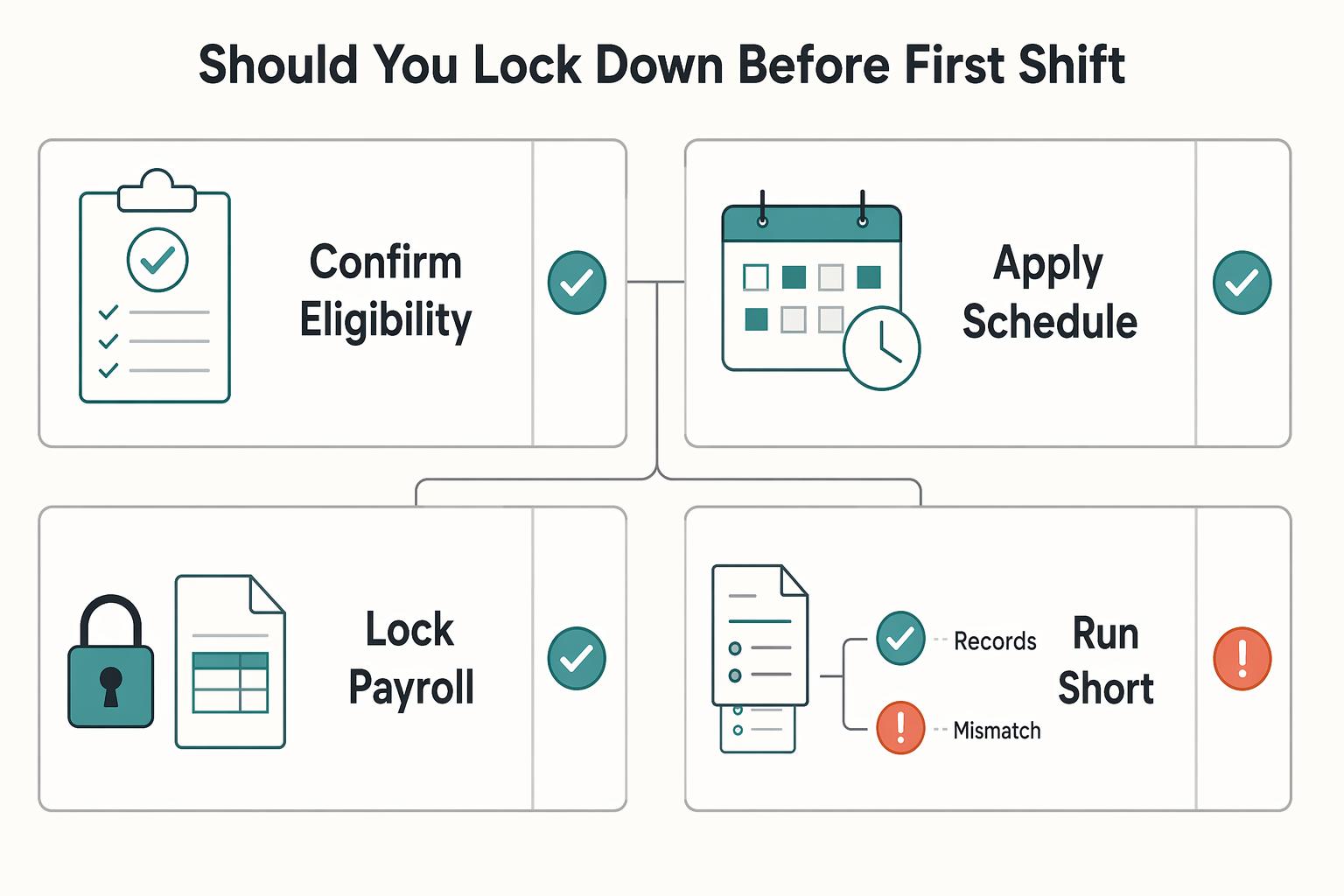
What should you lock down before the first shift?#
The payoff comes from doing the basics in order. If you handle eligibility, hiring, and payroll details early, you are far less likely to run into preventable problems mid-semester.
| Step | What to do | Why it matters |
|---|---|---|
| Confirm eligibility and openings now | Confirm work-study eligibility and where current openings are posted | Removes uncertainty at the front of the process |
| Apply with schedule constraints up front | Tell supervisors your dependable weekly windows and flag heavy exam periods early | Protects both the job and your coursework |
| Lock payroll details during onboarding | Confirm pay schedule, time-entry process, approver, and payment setup deadlines | The setup details are the path to getting paid |
| Run a short check-in early in the term, then again before major exam periods | Ask whether the job still fits around classes, gives useful experience, and covers the day-to-day costs you planned for | Keeps the job aligned with reality |
This is where many decent opportunities turn into avoidable messes. Not because the job itself is wrong, but because the setup is incomplete. Students often do the visible part first, applying for the role, and assume the rest will sort itself out. Work-study works best when the operational pieces are handled in sequence and checked as you go.
You are trying to prevent simple failures: missing an eligibility confirmation, misunderstanding where openings are listed, discovering too late that your schedule does not fit the role, or realizing after you start that payroll setup is still unfinished.
Move in sequence and verify each step.
- Confirm eligibility and openings now.
Use a direct message to financial aid or student employment: "I submitted my FAFSA and want to confirm work-study eligibility and where current openings are posted."
Do not stop at sending the message. Make sure you actually receive the confirmation you need. The point of this step is to remove uncertainty at the front of the process. Are you eligible? Where are the current openings? What do you need to do next? Once you have those answers, save them somewhere easy to find.
A small record here helps later if you need to retrace what you were told or confirm that you followed the process in the right order.
This first step also protects your time. Without it, you can end up browsing roles or assuming you are in the pipeline without knowing whether the gate has really been cleared. Work-study already depends on limited jobs and timing. You do not want to lose days to avoidable ambiguity at the start.
- Apply with schedule constraints up front.
Tell supervisors your dependable weekly windows and flag heavy exam periods early.
This is one of the simplest ways to protect both the job and your coursework. It is better to present your real availability before you are hired than to accept a role based on fuzzy assumptions and renegotiate after the semester gets crowded. "Dependable weekly windows" is the key phrase here. You are not trying to offer every possible open hour. You are trying to show the hours you can actually sustain.
Flagging heavy exam periods early matters for the same reason. It sets a realistic baseline before pressure arrives. If a supervisor understands your constraints from the beginning, the role is easier to run when the academic calendar gets demanding. If those constraints only appear after you start, even reasonable adjustments can feel like surprises.
This step also tells you something about the role. A supervisor who can work with clearly stated constraints is often running a more manageable job. A role that only works if your schedule stays loose all term may not be the right fit, even if the posting looked fine at first.
- Lock payroll details during onboarding.
Confirm pay schedule, time-entry process, approver, and payment setup deadlines. Keep the posting, offer message, and onboarding notes together.
This is the step students most regret skipping. Because work-study funds are paid through regular payroll, the setup details are not a side issue. They are the path to getting paid. Confirm the pay schedule. Confirm exactly how time is entered. Confirm who approves it. Confirm what must be completed for payment setup and by when. Then keep the key documents and messages together so you are not reconstructing the process later from memory.
A simple document pack is enough:
- the original posting
- the offer message
- your onboarding notes
- the payroll instructions you received
- the name or role of the approver
- any schedule agreement you made with the supervisor
You do not need a complicated system. You just need a reliable one. Keeping these pieces together lets you solve small problems quickly. If there is confusion about duties, you have the posting. If there is confusion about what was offered, you have the offer message. If time entry is unclear, you have your onboarding notes. When you are balancing classes, reducing search time is part of reducing stress.
The failure mode here is predictable. You start work, assume payroll is handled, then discover a missing step only after expecting your first paycheck. That kind of problem is rarely dramatic, but it is disruptive. It can turn an otherwise useful job into a source of avoidable financial pressure. Getting organized early is how you avoid it.
- Run a short check-in early in the term, then again before major exam periods.
Ask: Is this still fitting around classes? Am I gaining useful experience? Is the paycheck covering the day-to-day costs I planned for?
This step keeps the job aligned with reality. A role can look good on paper and still drift once the term gets moving. Maybe the schedule is starting to sprawl. Maybe the tasks are much thinner than expected. Maybe the income is fine, but only at the cost of academic time you cannot spare. A short check-in catches those issues while they are still small.
The three questions above work because they force the core tradeoff back into view:
- Is the job still fitting around classes, or is it starting to compete with them?
- Are you gaining useful experience, or only clocking hours?
- Is the paycheck doing the day-to-day job you expected, or are your assumptions off?
You do not need a formal review process to do this. A brief self-check is enough. If something is off, address it early. Clarify expectations. Reconfirm the schedule. Make sure the job is still serving the purpose you chose it for.
This is where the pros and cons of work-study become clear in practice. It can be a strong option when you confirm eligibility, move early, and choose a role that protects your academic priorities. It becomes weaker when you skip those checks and expect the label to carry the whole decision.
Work-study is not valuable because it sounds official. It is valuable when the setup is clean, the role is clear, the schedule is sustainable, and the paycheck supports the day-to-day expenses you planned it to cover.
If you want the shortest version of the playbook, it is this. Clear the gate, move early, compare the real options, choose a posting with defined work and defined supervision, and lock payroll before the first shift. Then check whether the job still fits once the semester gets busy. That sequence does not make every role perfect, but it gives you a much better shot at turning work-study into a genuine asset instead of just another source of friction.
If you want a deeper dive, read Should Your Freelance Business Accept Credit Cards?. If you are weighing campus payroll work against freelance side gigs, run the tradeoff through the W-2 vs 1099 calculator before you decide. If you take on client work while in school, keep your payment records organized from the start with the free invoice generator.
For official details, review the Federal Student Aid overview at 8 Things to Know About Federal Work-Study, the program page at Federal Work-Study, and the FAFSA entry point at Apply for Federal Student Aid.
Frequently Asked Questions
How do you decide whether work-study is worth it?
Compare schedule fit, task clarity, income reliability, and aid interaction for this semester before you accept a role.
What should you verify before your first shift?
Confirm eligibility, job posting source, schedule windows, payroll setup, and your time-entry approval process.
Can work-study be a poor fit?
Yes. It can be a poor fit when you need guaranteed year-round income or when job demands conflict with coursework and exam periods.
Researched and edited by the Gruv editorial team. Gruv builds cross-border billing, payouts, and finance-operations software for global businesses.
Sources
Educational content only. Not legal, tax, or financial advice.
Related Posts
Should Your Freelance Business Accept Credit Cards?
Offer card payments, but stay in control of how money reaches you. The goal is not a smoother checkout screen. It is predictable cash you can use to run the business.
Managing Student Loans Abroad With FEIE and Reliable Payments
Before you change a repayment plan, make extra payments, or refinance, build one complete loan inventory. Open `StudentAid.gov` for your federal overview, each servicer dashboard for billing and status, and your latest statements for rate terms and capitalization language.
Summer Jobs for High School Students That Build Career Capital
If you are choosing among **summer jobs for high school students**, pay should be one filter, not the whole decision. The better lens is career capital: the proof, people, and skills you can carry forward after the summer ends.