
Quick Answer
Start with usage events, agreed rating, invoicing, collection and settlement to your business. Choose current billing products for your contract needs; Stripe recommends Metronome for most new usage integrations. Preserve finalized invoices and use supported linked corrections. Add separately funded contractor payouts only for actual third-party payables.
Build the AI billing loop before adding money-movement products#
An AI startup needs a reliable way to measure what the customer used, apply the agreed price, issue an invoice and collect payment. The resulting seller proceeds then settle to your business. Paying contractors, model suppliers or revenue-share partners is a separate accounts-payable obligation, funded and approved on its own terms.
Choose tools for those jobs explicitly. A billing engine is not automatically a processor, a processor is not automatically a Merchant of Record, and a Merchant of Record’s payment to your bank is not a mass-payout product for your contractors. Revenue size alone does not tell you which component to add.
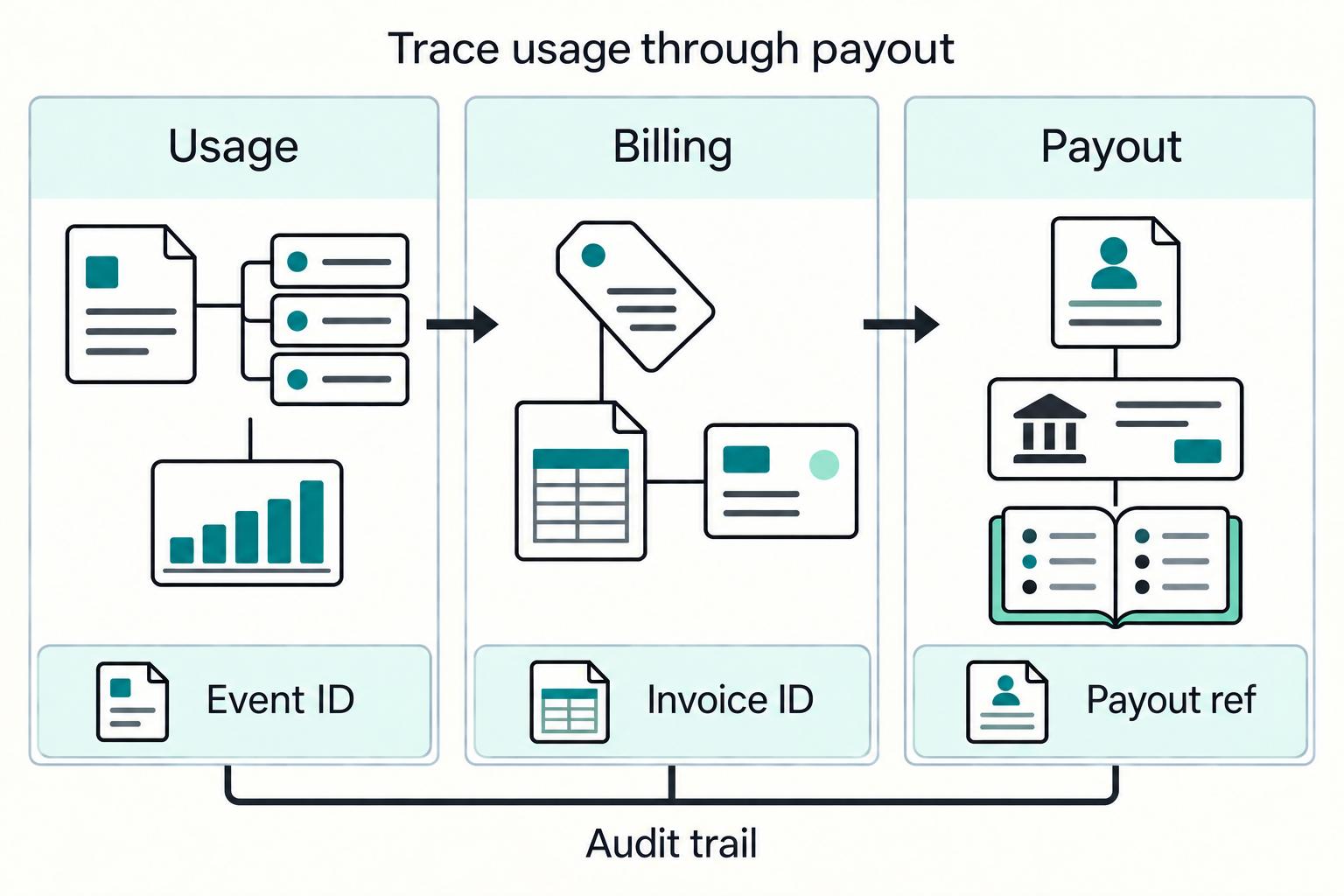
The records and money paths#
| Stage | Record or movement | Completion means |
|---|---|---|
| Meter | Customer usage events with units and timestamps | Accepted events aggregate under the intended metric |
| Rate | Quantity × applicable price version, including agreed allowances | Explainable customer charges, not cash |
| Invoice | Billing-period obligation and adjustments | Finalized customer document, not necessarily collected |
| Collect | Customer payment against the invoice | Confirmed payment outcome; preserve later refunds/disputes |
| Settle seller proceeds | Provider balance to your business bank account | Actual bank receipt after relevant deductions |
| Pay third parties, if needed | Your separately funded obligation to an eligible recipient | Confirmed outcome for that distinct payable |
The diagram links usage, billing and a payout reference through an audit trail. Here, the seller payout means settlement of customer proceeds to your business. If you also pay third parties, track a separate obligation and transfer history; do not assume each customer invoice authorizes a contractor transfer.
Define the usage unit customers can verify#
Choose billable input/output tokens, requests, GPU time or completed tasks according to the product promise. Define cached inputs, failed requests, cancelled jobs, tool calls and provider-side retries. One user request can trigger several model calls, so the customer’s unit and your supplier’s cost unit need not match.
- Give each billable event a durable identity, customer, occurrence time, unit, quantity and relevant model or feature dimension.
- Separate occurrence time from arrival time so a delayed event goes through the right period policy.
- Retain the price version and contract effective dates; a new rate should not silently rerate closed periods.
- Record supplier usage and cost separately from customer billable usage.
- Keep promotional credits, paid credits and contract allowances distinct.
If a job retries internally, decide whether the contract bills the successful job once or each permitted consumed unit. Deduplicate duplicated delivery of the same usage event. That is different from suppressing genuine additional usage caused by the job. Explain the distinction on the customer’s usage statement.
An illustrative hybrid plan and its cost#
Suppose an invented monthly plan charges $20 plus $3 per million input tokens and $12 per million output tokens. A customer uses 1,000,000 input and 250,000 output tokens. Usage charges are $3 + $3 = $6; the invoice subtotal is $26 before tax, discounts or credits. These are hypothetical product prices, not a model-provider quote.
For that same customer, assume supplier cost of $1 per million input and $4 per million output tokens, plus $3 allocated hosting cost. Selected delivery cost is $1 + $1 + $3 = $5, leaving $21 before payment fees, support, other overhead and accounting adjustments. Keep supplier rate versions and cached-token treatment explicit. This example does not establish an industry gross-margin benchmark.
A postpaid model exposes you to unpaid consumed service. Prepaid credits can reduce that exposure, but delayed metering and concurrent jobs can still exceed a displayed balance. If you promise a hard spend limit, your application needs admission control or reservations with a defined overage policy. Invoice-time credits alone are not a real-time authorization service.
Use current billing product boundaries#
| Product or configuration | Documented role | What remains separate |
|---|---|---|
| Stripe Billing Meters | Existing basic meter-event billing; asynchronous aggregation | Application spend enforcement, collection configuration and settlement |
| Stripe-recommended Metronome route | Usage ingestion, pricing and continuous usage/balance visibility for new use cases | Your product admission rules and selected collection/tax setup |
| Orb | Usage rating and invoice lifecycle with a configurable grace period | Selected processor and external invoice reconciliation |
| Eligible Merchant of Record flow | Seller responsibility for covered customer transactions | Metering fit, unsupported operations and third-party payables |
| Airwallex Transfers, where approved | Funded beneficiary payments | Customer usage rating and contract invoicing |
As checked on October 3, 2026, Stripe’s usage-recording guide recommends Metronome for most new usage-based integrations and describes Billing Meters as appropriate for existing Meter users. It says basic meter events are processed asynchronously. Do not assume a new startup must begin with basic Meters and upgrade only at a particular ARR.
For existing Meters, the API guide requires timestamps within the past 35 calendar days and no more than five minutes in the future. It supports event identifiers and reports asynchronous errors. An accepted API response or an allowed timestamp does not establish that late usage has altered a finalized invoice.
Orb’s invoice lifecycle describes a configurable grace period for late events before issuance. Its external invoice sync is one-way: subsequent paid, edited or voided states do not automatically return to Orb. If you pair Orb with another invoicing system, designate which system is authoritative for each state and reconcile that boundary explicitly.
For MoR evaluation, compare the eligible product, seller entity, customer markets, supported usage invoicing and contractual tax/dispute scope. Stripe Managed Payments supports eligible direct digital-product flows with specific Checkout/Billing limits and does not support Connect platforms. It is a distinct configuration, not a replacement for every metering or supplier-payment need.
Credits are a billing resource, not third-party money#
Stripe billing credits apply to eligible metered subscription lines at invoice finalization. They are intended for your own products and services, not stored value or payments to third parties. Scope, currency, expiry and invoice ordering affect what can apply. A preview balance can change before finalization.
Keep the credit ledger and cash receipts separate. A promotional grant adds no customer cash; a paid grant needs its own funding record. Do not label credit consumption as another payment to your bank or use it to fund a contractor balance. Refund or restore credits through the provider’s supported operations rather than rewriting prior transactions.
Late usage and corrections after invoice finalization#
Before closing a period, reconcile source totals, successfully ingested events, meter errors and rated charges. Set a documented cutoff or supported grace period. If an event arrives late while the invoice is still editable, apply it through the supported process and check the resulting total before finalization.
After finalization, preserve the invoice and its payment history. For missing billable usage, use an approved supplemental invoice or next-period adjustment if the contract and billing product permit it; otherwise escalate or write off the amount under policy. Do not backfill and assume the customer’s old paid invoice increased automatically.
In the invented $26 example, a valid additional 50,000 output tokens would add $0.60 at the agreed rate. If they arrive after finalization, link a permitted $0.60 adjustment to that period and event; the original $26 receipt remains $26. If the additional usage was already invoiced under another event, deduplicate it rather than issuing another charge.
For overbilling, use a supported correction such as a Stripe credit note. Credit notes decrease open or paid invoices and do not themselves record a new payment. They cannot increase the bill for missed usage. A $0.60 overcharge needs the appropriate decrease and refund or credit treatment, not a new positive usage charge.
Correct usage, invoice liability, cash and billing credits as distinct records. Stripe’s billing-credit guide says a credit note does not automatically refund applied credit grants. Restore credits through a supported grant operation when required and retain the correction link. Avoid treating a cash refund and restored service credit as interchangeable.
Collect and settle without confusing the two#
Retain the invoice ID, payment attempt, confirmed payment, provider balance entry and bank payout reference. An invoice can reach paid status through credits or accounting actions as well as cash collection. Determine the actual payment evidence before calculating available proceeds.
Model processing, Billing, MoR, currency conversion and settlement fees only for the enabled products and relevant fee bases. Customer indirect tax is not freely available operating revenue. Keep refunds, disputes and reserves visible when forecasting usable funds. Adding a second provider adds a reconciliation boundary even if it improves one capability.
Authenticate payment notifications and persist them durably before applying local effects. Deduplicate locally and update the invoice/ledger atomically where practical. If a payment has happened, record it even if a later local validation fails. Route the validation issue to an exception owner without deleting money movement or charging again.
Add global contractor payouts only when you owe them#
A contractor invoice, supplier bill or revenue-share agreement creates the outbound obligation. Confirm permitted funding, recipient eligibility, amount, due date, tax treatment and receiving instructions independently from a customer invoice’s status. Your business can owe a supplier before a customer pays, or retain customer cash without owing that supplier a matching share.
Airwallex’s transfer guide describes beneficiary transfers, including contractor payments and supported connected-account calls. Use the approved funding and destination route for your actual account. A seller’s bank payout from a MoR is a different service.
Persist each outbound attempt and provider reference. Resolve a timeout through lookup before retrying, changing providers or creating another FX trade. Reuse a provider key only within its documented operation, account and retention scope with unchanged parameters. Maintain durable local obligation controls beyond that window.
Record actual sent, received, held, failed and returned states according to provider meaning. An expired quote before submission calls for a new quote; an unknown executed attempt first calls for lookup. Preserve actual movement and append later returns. Reconcile returned funds before deciding whether and how to reissue.
Scale by observed billing requirements#
| Observed problem | Next decision |
|---|---|
| Customers cannot reproduce usage totals | Fix event identity, definitions and ingestion errors |
| Negotiated pricing exceeds the current configuration | Evaluate a billing layer that represents those contracts |
| Late events or external invoice states drift | Define cutoff, correction and reconciliation ownership |
| Actual supplier payables need wider coverage | Evaluate a separate eligible funded payout route |
| A new market needs different seller/tax treatment | Assess that market and MoR or merchant configuration |
At first revenue, trace a complete billing period and bank settlement. At greater scale, examine ingestion volume, contract complexity, delayed data and correction workload. At $10M ARR, those same controls still matter, but there is no documented revenue threshold that automatically dictates a particular vendor count or a contractor-payout product.
Choose one explainable billing loop#
Select the current products that support your actual usage contract and seller flow. Reconcile usage to invoices, payments and bank receipts, then handle corrections through explicit linked operations. Add funded third-party payouts when the business obligation needs them, with their own records and recovery path.
Frequently Asked Questions
What is the minimum payment stack an AI startup needs?
You need traceable usage, agreed rating, invoices, customer collection and seller settlement. Add a separate funded payout workflow only for obligations your company owes third parties.
When should we use prepaid credits rather than postpaid usage?
Use them when upfront funding and a clear consumption allowance fit the customer agreement. Retain metering and credit rules, and implement application spend controls if you promise a hard limit. Invoice-time credits alone do not stop concurrent usage.
How should we compare Merchant of Record and modular billing?
Check the eligible seller/product flow and actual usage invoicing requirements. MoR handles covered sale responsibilities; a modular billing layer represents usage and contracts. Neither label establishes a third-party payout product.
What does international expansion require?
Confirm customer collection and tax treatment separately from seller settlement and supplier payments. Match the actual account, country, currency, product and commercial purpose rather than inferring global capability from one checkout.
How should we design contractor and vendor payouts?
Start with the separate payable, permitted funding and eligible recipient. Persist attempts, resolve unknown status before replacement and reconcile actual receipt or return. A customer invoice marked paid does not by itself authorize that transfer.
Can product teams change pricing without engineering work?
They can change supported configuration within approved contract boundaries. Changes to billable units, event meaning or hard spend controls can require engineering. Keep effective dates and historical price versions so finance can explain each invoice.
When should we evaluate Metronome or Orb?
Evaluate current product fit from ingestion, pricing, contracts and invoice reconciliation. Stripe now recommends Metronome for most new usage integrations; do not assume a fixed ARR upgrade threshold. Orb’s grace-period and external sync behaviour need explicit state ownership.
Where Gruv fits
Researched and edited by the Gruv editorial team. Gruv builds cross-border billing, payouts, and finance-operations software for global businesses.
Sources
Includes 2 external sources outside the trusted-domain allowlist.
Educational content only. Not legal, tax, or financial advice.
Related Posts

The Freelance Payment Penalty: A Modeled Audit of Platform Fees, FX Spreads, and Payout Delays
The money rarely disappears through a single, easy-to-spot fee. The real loss is stacked. A marketplace takes its commission, a processor adds a charge for international cards, a bank or payment company converts the currency at a spread, a platform holds the funds before release, and a wire sheds a little to intermediaries on the way in. Each layer looks defensible on its own, but the worker feels the combined result as a smaller deposit and a later payday.

How to Respond to a Subpoena for Business Records
Move fast, but do not produce records on instinct. If you need to **respond to a subpoena for business records**, your immediate job is to control deadlines, preserve records, and make any later production defensible.
A US Expat's Guide to Investing in UCITS ETFs to Avoid PFIC Issues
The real problem is a two-system conflict. U.S. tax treatment can punish the wrong fund choice, while local product-access constraints can block the funds you want to buy in the first place. For **us expat ucits etfs**, the practical question is not "Which product is best?" It is "What can I access, report, and keep doing every year without guessing?" Use this four-part filter before any trade: