
Quick Answer
Choose usage-based billing when customers can audit the meter, finance can model consumption and serving costs, and operations can trace invoices and corrections to source events. Compare pure usage with a base-plus-usage model, including allowance and cap rules. Use a phased shadow-billing rollout to verify account-level accuracy, collection outcomes and margin before expanding.
How Usage-Based Billing Works for Platform Operators#
Choosing between usage-based billing and subscription pricing is less about pricing fashion than about what you are actually selling: access or measurable consumption. If your product's value shows up in units customers already understand, charging on usage can tighten the link between price and value. If demand is lumpy, budgets are fixed, or your meter is hard to explain, the same move can create revenue volatility and trust issues.
This guide stays practical. The goal is not to argue that metered billing is better by default. It is to help you decide when it produces better economics, when a hybrid pricing model is the smarter middle ground, and what needs to be in place before you ask customers to pay this way. In SaaS, the shift has become more common. Stripe cites adoption of usage-based pricing rising from 27% to 46% between 2018 and 2022. That trend matters, but it does not prove the model fits your product.
The real work starts with the meter. Consumption-based billing means customers pay for actual usage instead of a flat monthly fee, but the rate logic behind the invoice still has to feel fair. A simple example shows the mechanics. If you charge $0.01 per API call, then 15,000 calls in a month becomes a $150 bill. That sounds clean until you ask the questions operators actually have to answer. What counts as a billable call? What happens to retries, failed events, or duplicates? Can a customer see the same numbers you will invoice against?
That is often where implementation gets hard. It can determine whether the model scales cleanly or turns into a dispute queue. A basic checkpoint is whether product, billing, and finance can trace an invoice line back to the underlying usage records. If you cannot reconcile those records quickly, a pricing issue can first look like a support issue and then become a collections and trust issue.
Margin changes shape too. With fixed subscriptions, teams often absorb more variability. With metered charging, some of that variability moves to the customer, but cost risk does not disappear. In AI products especially, per-query serving cost can make margin control central to monetization design. BVP notes that AI companies may see 50 to 60% gross margins versus 80 to 90% for classic SaaS, which is a useful warning, not a universal benchmark.
The sections that follow walk through three decisions in order. First, whether this model fits your buyer and cost structure. Second, what metric customers will accept as fair. Third, how to launch without bill shock or forecast chaos. If uncertainty is high, do not force a pure pay-as-you-go model on day one. A base subscription plus a usage component is often the more defensible place to start.
What usage-based billing actually changes in your business#
Usage-based billing changes the commercial unit of what you sell, not just how you invoice. Instead of charging for access through seats or licenses, you charge for measured consumption such as API calls, storage, transactions, or workflows.
The upside is tighter price-to-value alignment when customers already understand the usage unit. Charging in proportion to actual consumption can fit better than flat access pricing when usage varies widely across customers.
The tradeoff is higher exposure to variability. You shift from mostly fixed access revenue to demand-linked revenue, so customers may face less fixed commitment but more bill uncertainty, and your forecasts become more sensitive to spikes, seasonality, and uneven adoption.
Execution quality depends on whether the meter is customer-verifiable. Use a simple test before rollout: can customers match their product usage view to the invoice total and get the same number? Set terminology early, too, because vendors do not always define metered billing, usage-based billing, and pay-as-you-go the same way, and those definitions can affect implementation and customer outcomes.
If you want a deeper dive, read A Guide to Usage-Based Pricing for SaaS.
Choose the pricing structure that fits your buyer and your risk tolerance#
If consumption is highly variable but buyer budgets are fixed, compare a hybrid pricing model with committed allowances, a spend cap or a fixed-price package. A base fee gives you a revenue floor, but uncapped overages can still produce a large bill. Budget predictability comes from the allowance and limit rules, not from the base fee alone.
This decision is mostly about where uncertainty sits. Buyers optimize for a stable budget number; you optimize for margin protection, forecastability, and clean usage-to-cash operations.
| model type | best-fit product pattern | forecastability impact | customer trust risk | operational complexity |
|---|---|---|---|---|
| tiered pricing | Usage grows in bands and customers can usually estimate their range | Bands make rate changes explainable; spend remains variable unless a cap or fixed package is included | Moderate if thresholds or overage rules feel arbitrary | Moderate |
| dynamic pricing | Cost or demand can shift materially by workload or timing | Weakest for both buyer and vendor | Highest when charge movement is hard to predict | High |
| per-feature pricing | Value is tied more to capability access than volume consumed | Stronger because charges are mostly fixed | Lower when packaging is clear; higher if gates feel forced | Low to moderate |
| hybrid pricing model | Core value is stable, but usage or outcomes can expand unevenly | Committed base creates a revenue floor; overage exposure depends on allowance and limit rules | Lower only if included usage, overage rates and limits are clear | Moderate to high |
Match the model to buyer budget behavior#
Tiered pricing fits customers who can estimate their normal usage band. Define whether rates are graduated by band or one volume rate applies to the whole quantity. Dynamic pricing changes the unit rate with demand, time or workload; higher quantity at an unchanged rate is simply higher consumption. For an illustrative AI workflow, one ticket might need 30 calls while another needs 3,000: both can have very different bills even at the same per-call price. Per-feature pricing is easier to approve when capability access drives value, but heavy usage within a feature can compress margin. Hybrid adds a revenue floor; customer budget protection still needs allowance and limit rules.
Infrastructure-like versus app-style patterns#
Use AWS, Snowflake, and Google Cloud Storage as infrastructure-like reference points, and Zendesk, HubSpot, and Dropbox as app-style reference points. These are about buying context, not assumed vendor packaging details.
If the product feels like capacity, buyers are usually more open to variable spend. If it feels like a business application, they usually ask for the monthly number before they ask how the meter works.
Margin profile should also guide structure choice. In AI-heavy products, Bessemer notes gross margins can be around 50 to 60% versus 80 to 90% for classic SaaS, so pricing errors in variable models can erode profit quickly.
Before finalizing any variable component, run one hard check: can product usage, invoice lines, CRM terms, and ERP posting reconcile without manual cleanup? Without automated integration across metering, rating, billing, CRM, and ERP, teams risk manual reconciliation and revenue leakage.
Select a value metric customers will accept as fair#
Choose a metric customers can verify in-product; fairness usually fails when charges rely on internal cost proxies they cannot inspect. A variable model is easier to defend when buyers can match invoice lines to their own usage records.
Start with units customers already track, then pressure-test whether they can predict the next invoice from the usage view alone. If they cannot, simplify the metric before launch.
Pick a meter customers can verify#
Use transparent fee logic as the benchmark. The following is a US Stripe standard card-processing example, checked October 4, 2026, rather than a global tariff or the total cost of Stripe Billing. Country pricing and additional products can change the total.
| component | fee |
|---|---|
| domestic cards | 2.9% + 30¢ |
| manually entered cards (add-on) | 0.5% |
| international cards (add-on) | 1.5% |
| currency conversion (add-on) | 1% |
Customers may not like every charge, but they can audit what changed. That is the standard to copy: visible mechanics, not hidden math.
Write the meter spec before launch#
Define meter boundaries explicitly so product, billing, support, and finance use the same rules. At minimum, document:
- what counts as billable
- what is excluded
- how retries are handled
- how failed events are handled
- how duplicates are detected and reversed
- when usage is final for invoicing
Specific definitions prevent ambiguity. Stripe Connect's definition of a monthly active account is a clear model: an account is active in any month when payouts are sent to its bank account or debit card.
For an illustrative base-plus-usage plan, charge $100 per month including 10,000 successful logical API calls, then $0.01 for each additional call. At 15,000 calls the total is $150: $100 + (15,000 − 10,000) × $0.01. Apply the allowance once to the period total, not once per batch. If one request is retried three times, keep its logical action ID so transport attempts do not consume four units unless the contract explicitly bills attempts.
Keep source-event identity and provider transport identity separate. Persist the action ID, account, event time and pricing version before export; a repeated export should recover the same result rather than create a second charge. Record late events and corrections explicitly after the cutoff. For example, a disputed $150 invoice reduced by a $20 credit note has $130 still due if no payment has been received; the credit is a correction, not a $20 cash receipt.
Add trust controls before the first invoice#
Trust controls should ship with the meter. Show usage and rated spend with an explicit freshness timestamp, send threshold alerts, and use the same terms on dashboards and invoices. An alert reports a threshold crossing; it does not stop spending. If you promise a hard cap, enforce it in request admission and reserve capacity for in-flight work.
Use a provider integration that fits your current product and account, then validate the customer view against your own meter. Stripe currently recommends Metronome for most new usage-billing integrations; existing Billing Meters process events asynchronously, so recent events may not appear immediately in upcoming invoice totals. Build the freshness and finalization checks around the chosen integration.
Forecast revenue and gross margin before launch#
If finance cannot absorb downside variance, do not launch pure usage pricing at scale yet. Add a minimum commit, a platform fee, or use a hybrid pricing model so you keep usage upside with a clearer revenue floor.
Usage-linked revenue can improve value alignment, but it also increases forecasting variability and finance complexity. Static forecasts are less reliable when customer behavior drives revenue month to month, so planning needs tighter alignment across product, sales, and finance.
Model the three cases before you announce pricing#
Run low, base, and high consumption scenarios for the same segment, then compare pure usage, subscription pricing, and hybrid pricing side by side.
| Model | Low consumption scenario | Base consumption scenario | High consumption scenario | Finance read |
|---|---|---|---|---|
| Pure usage | Revenue drops with consumption and has a weaker floor | Revenue follows realized demand | Revenue can rise quickly, with higher invoice volatility | Strong value alignment, weaker predictability |
| Subscription pricing | Revenue stays steadier in light-usage periods | Stable planning profile | Can under-monetize heavy users | Strong predictability, weaker consumption capture |
| Hybrid pricing model | Base fee protects downside | Mix of committed revenue and expansion | Usage upside remains with more floor protection | Tradeoff between stability and upside |
Build this at least twice: once for a typical customer and once for a heavy-user cohort. Then reconcile events to billable units, billable units to invoice lines, and invoice lines to scenario-level gross margin so finance can see where the model breaks.
Pressure test the failure modes#
Test these three failure modes directly instead of assuming the average case will hold.
| Failure mode | Article description |
|---|---|
| Bill shock | spend rises faster than customers expect, which can hurt trust and renewals |
| Under-monetized heavy users | consumption grows faster than what your contract captures |
| Forecast instability | variable usage makes fixed-target planning less reliable |
For forward visibility, use indicators that fit usage models: committed usage where applicable, Remaining Performance Obligations (RPO) when contracts support it, and expansion signals like NRR or DBNER tied to increased consumption by existing customers.
Report contracted recurring commitments separately from realized variable usage. If you annualize a recent usage month for planning, label it as a run-rate estimate and state the period and seasonality assumptions. Do not present an optimistic consumption forecast as already committed revenue.
Unknowns to validate#
Keep a short assumptions block in the forecast model and review it monthly:
- Meter integrity: do product logs, customer-visible usage, and invoice totals still match after retries, reversals, and corrections?
- Discount behavior: do discounts apply to fixed fees, variable fees, or both, and how does that change gross margin?
- Expansion timing: does consumption actually expand on the timeline assumed in your model?
- Segment mix: do larger accounts, such as cohorts over a
$100Kor$1M ARRthreshold, require separate scenarios?
If the low case breaks your plan, add a revenue floor before broad rollout rather than assuming volatility will self-correct.
You might also find this useful: Usage-Based Billing for Platforms: How to Meter and Charge for API Calls Storage and Seats.
Design billing operations for disputes, exceptions, and corrections#
For usage-based billing, make disputes and corrections part of the billing flow before cycle close, not a cleanup step after escalation. A revenue floor can absorb variance, but it cannot fix invoices your team cannot explain.
A common failure point is converting usage to charges only at the end of the cycle. That delay is where surprise invoices, manual fixes, and missed revenue can start. Your billing layer should keep usage capture, pricing rules, limits, and invoice logic connected so charges reflect actual consumption.
Set the order of operations up front#
Document one shared sequence and run support, finance, and product on the same version:
| Order | Step | What happens |
|---|---|---|
| 1 | Usage capture and rating | Validate events, deduplicate billable actions, and apply the effective pricing version to billable units. |
| 2 | Draft invoice | Aggregate period usage; apply allowances, discounts and eligible credits; keep the result editable. |
| 3 | Exception and tax review | Resolve missing batches, pricing mismatches, over-limit cases and tax treatment before finalization. |
| 4 | Review and correction | Complete the promised customer review window and approved corrections while preserving the evidence. |
| 5 | Finalization and collection | Finalize once checks pass, then track collection attempts, receipts, fees and open balances separately. |
Keep draft preparation distinct from invoice finalization. Complete the applicable tax and exception checks before issuing the final invoice. After finalization, use linked correction documents rather than silently rewriting charge history.
Make dispute evidence boring and complete#
When a charge is challenged, finance and support should use the same evidence pack every time: billing period, account identifier, event IDs, metering logs with timestamps, pricing rule version, and invoice mapping from raw events to billable units to invoice lines.
That traceability is the core control. If one disputed line cannot be traced back to its event set, the charge is not operationally defensible yet.
Keep corrections auditable#
Handle overages, credits, and rebills as explicit correction entries linked to the original invoice, not overwritten totals. Keep a reason code, preserve the original charge, and tie the correction to the evidence pack so customer fixes do not create reconciliation problems later.
Before each cycle close, run a short verification pass:
- confirm sampled source events reconcile to billable usage for high-value and high-variance accounts
- confirm invoice lines reconcile to applied pricing rules and usage limits
- confirm unresolved exceptions, credits, rebills, and tax issues are cleared or intentionally held back from close
If these checks happen only after invoices go out, the billing design is still incomplete.
Related: Usage-Based Billing Explained: How Consumption Pricing Works for B2B SaaS Platforms.
Connect monetization logic to money movement and compliance reality#
A billed charge should be traceable to its source usage, invoice and accounting treatment. It may still be unpaid: recognition, invoicing, collection and bank receipt are distinct events. Keep the outstanding receivable and collection status visible instead of requiring a successful payment to explain every charge.
This becomes non-negotiable in usage-based billing and tiered models. Variable charges raise the bar for reconciliation, invoice clarity, and auditability, so finance must be able to show how measured consumption became an invoice, how that invoice moved toward cash, and how exceptions were handled.
Make the ledger the anchor#
Use the accounting ledger as the financial record, linked to the usage evidence in product systems. Follow billable usage through invoice lines, any receivable or deferred-revenue treatment, collection attempts, receipts and linked credits. Apply your revenue-recognition policy; neither an invoice nor a bank receipt alone determines when revenue is earned.
Design for replay safety. If ingestion or billing reruns after a timeout, the same event should not create duplicate charges or duplicate ledger postings. Stable event IDs and clear deduplication rules across usage and billing events are the baseline.
Disconnected tools and spreadsheet bridges usually break this chain as complexity grows. They can slow finance and increase reconciliation risk, especially when usage fluctuates, credits expire, or pricing tiers change.
Verify money movement by market and program#
For global flows, treat compliance and payout behavior as market- and program-specific. Coverage can differ across KYC/KYB/AML gates, payout eligibility, settlement constraints, and tax document handling, so do not assume one approved flow will transfer cleanly everywhere.
Before rollout, maintain a simple market-program matrix that answers:
- Which verification gates apply for this customer or partner type?
- What can delay or block settlement, refunds, or payouts in this route?
- Which tax or compliance documents must be collected and retrievable for audit workflows?
Put evidence into the operating rhythm#
Keep finance and compliance artifacts in your regular close process, not as cleanup work. Retain audit-trail exports, reconciliation packs, and policy-gate logs that show when holds or reviews were triggered and resolved.
If your ERP or finance stack cannot reliably handle fluctuating usage, expiring credits, or shifting tiers, resolve that before broad rollout. Metered models scale only when the money trail is as explainable as the product meter.
Need the full breakdown? Read The Best Tools for Managing Subscription Billing.
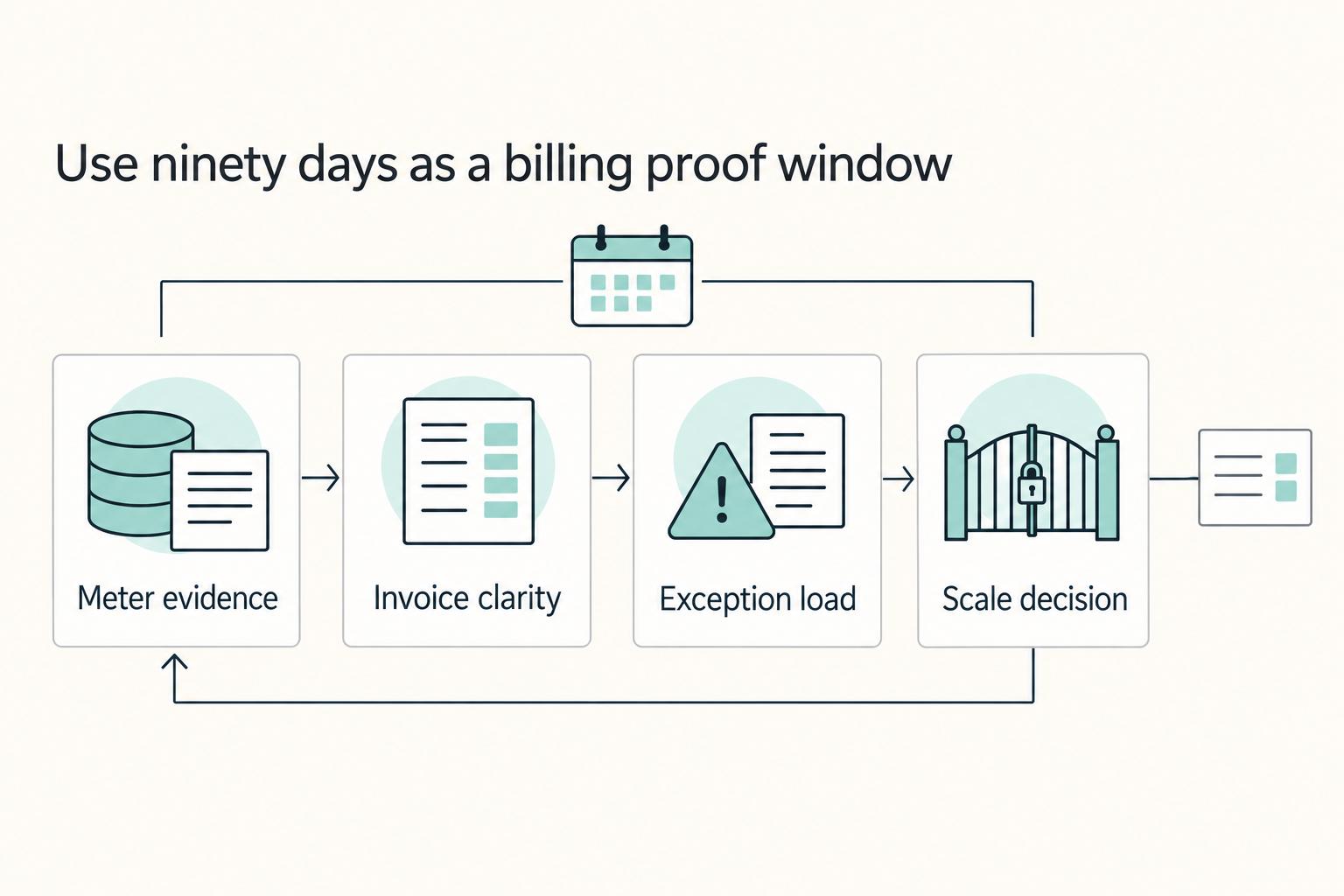
Rollout checklist for the first 90 days#
Use the first 90 days as a proof window: validate that charges are understandable and traceable before you optimize for expansion.
| Window | Focus | Key check |
|---|---|---|
| Week 1-2 | Define exactly how usage is counted, how retries are handled, and how corrections appear on invoices | Align product, support and finance on event-to-aggregate mapping, effective pricing, invoice lines and the corresponding accounting treatment |
| Week 3-6 | Run shadow billing and compare expected vs. observed invoices across different usage levels | Treat aggregate accuracy as insufficient if account-level invoices still show drift, rounding surprises, or credit interactions that hide counting errors |
| Week 7-10 | Launch to a controlled cohort and monitor usage spikes, disputes, and margin anomalies | Track invoice accuracy, collection failures, realized serving costs and unresolved exceptions against agreed rollout thresholds |
| Week 11-13 | Decide whether to expand, adjust, or roll back using thresholds you defined before launch | Expand only when billing is trusted without manual rescue and observed outcomes stay aligned with your finance expectations |
Conclusion#
The right call on usage-based billing is not ideological. It is whether your pricing structure fits how customers experience value, how much invoice variability they can tolerate, and how much forecast range your finance team can absorb.
If buyer budgets are fixed and usage can spike, compare a hybrid plan with an enforceable cap, a fixed package or an approval step for extra consumption. The base fee gives you committed revenue but does not protect a buyer from uncapped overages. Where customers already track a fair consumption metric, usage pricing can still align price with value; the decision turns on tolerable variability as well as value alignment.
Teams that get this right do not treat pricing, metering, billing ops, and money movement as separate projects. Billing behavior depends on configuration choices and operating assumptions, so the commercial model and the service setup have to agree. In practice, that means your meter definition, retry treatment, invoice mapping, alerting, and correction policy all need to tell the same story. If support cannot trace a disputed event ID from product log to invoice line, you are not ready to widen rollout.
That is the practical recommendation: do not scale the model just because the pricing page looks clean. Scale it only after you can pass a few operator checks under live conditions. You want evidence that customers can see their usage before invoicing, that finance can forecast a low, base, and high range without hand-waving, and that billing exceptions can be corrected without breaking revenue reporting. A useful checkpoint is a shadow-billing review where product, finance, and support each inspect the same sample invoice and reach the same conclusion about what counted, what did not, and why.
A common failure mode is launching a technically valid meter that customers do not trust, then trying to solve that trust gap with policy documents after the first surprise invoice lands. Another common miss is underestimating how quickly configuration details can change billing outcomes when traffic patterns or autoscaling assumptions shift. If those settings change, your commercial promise may change with them unless you review the impact.
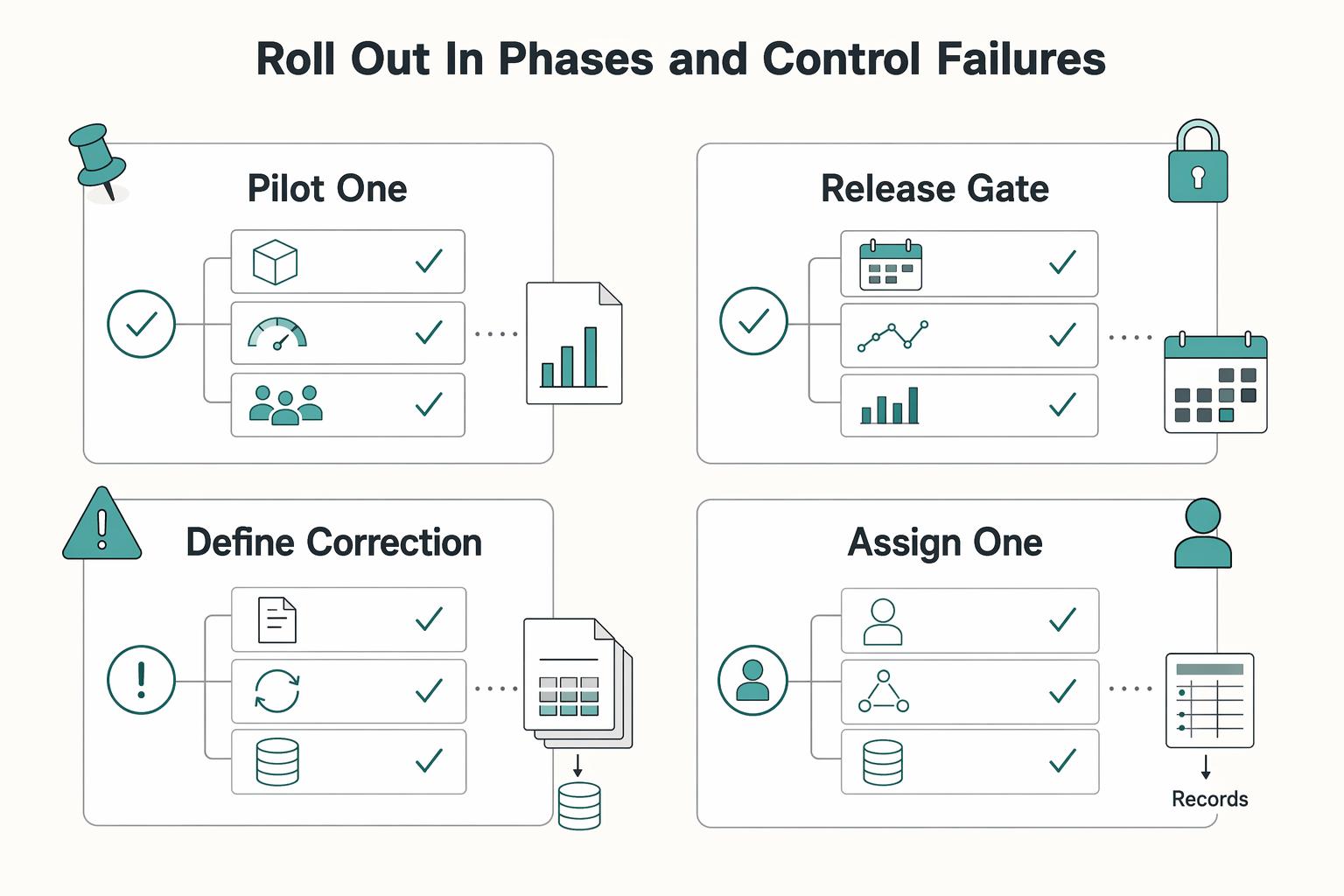
So the next move is simple and disciplined: run a phased rollout checklist with explicit go or no-go decisions at each stage. Keep the first cohort tight, compare expected versus observed invoices, and expand only when trust, forecast control, and operational traceability hold up together. That is often what separates a pricing change that compounds from one that creates avoidable churn and internal rework.
Related reading: Building Subscription Revenue on a Marketplace Without Billing Gaps.
Frequently Asked Questions
What is the practical difference between usage-based billing and subscription pricing for B2B SaaS?
The practical split is simple: usage-based billing charges for actual consumption, while subscription pricing typically charges a recurring amount for access. Usage pricing can align revenue more closely to delivered value, but it can bring less invoice certainty. If your buyers prioritize budget stability over precise value matching, a subscription structure can still be a better fit.
When should a platform choose a hybrid pricing model instead of pure pay-as-you-go pricing?
Choose hybrid when a base commitment matches ongoing value and a variable component tracks extra consumption. Define included usage, overage rates and what happens at the limit. A base fee protects the vendor’s revenue floor; it does not cap customer spend. For a buyer with a fixed budget, include an enforceable cap, a fixed package or an approval step for additional usage.
How do we choose between tiered pricing and dynamic pricing without confusing customers?
Start with the structure customers can explain back to you in one sentence. Good usage metrics should be understandable, measurable, outcome-linked, and transparent, so if the logic feels hard to audit, you are already creating support load. In practice, choose the option that keeps price movement legible on dashboards and invoices, not the one that looks smartest in a spreadsheet.
What are the biggest risks in metering API calls, and how do we prevent billing disputes?
A key risk is usage the customer cannot verify, especially when bill shock is possible. Prevent disputes with clear billable-event definitions, usage dashboards that state their freshness and pending events, threshold alerts, enforced limits where promised and forecasts before invoicing. Support and finance should be able to explain the same event set and charges.
How can finance teams forecast revenue reliably when usage is volatile?
Do not force a single-number forecast when the model is inherently variable. Build low, base, and high consumption cases, then separate what is committed from what is usage-driven if you have a hybrid structure. Forecasting gets more credible when finance can monitor current usage trends and when customers have alerts, limits, and visibility that reduce surprise spikes.
Which indicators show that seat-based pricing is now a poor fit for our product value model?
Seat-based pricing can become a weaker fit when customer value is experienced through consumption, not headcount. If your best customer-facing metric is usage, and seats are mostly an internal packaging choice, you are probably charging against the wrong signal. Another red flag is when customers can see and manage their usage, but the main price driver does not map clearly to that value.
Try a related tool
Researched and edited by the Gruv editorial team. Gruv builds cross-border billing, payouts, and finance-operations software for global businesses.
Sources
Includes 3 external sources outside the trusted-domain allowlist.
- docs.stripe.com/billing/subscriptions/usage-based/recording-...trusted
- docs.stripe.com/invoicing/overviewtrusted
- stripe.com/resources/more/usage-based-billing-explained...trusted
- stripe.com/resources/more/usage-based-billing-pros-and-...trusted
- support.stripe.com/questions/managed-payments-pricingtrusted
- bvp.com/atlas/the-ai-pricing-and-monetization-playbookexternal
- docs.nalpeiron.com/education-and-training/licensing-education/u...external
- metronome.com/blog/usage-based-billingexternal
Educational content only. Not legal, tax, or financial advice.
Related Posts

SaaS Usage-Based Pricing for Predictable Cashflow and Fewer Disputes
If you are considering **saas usage-based pricing**, treat it as an operations and collections decision first. Pricing works best when the usage unit can be measured, shown on the invoice, and explained by someone outside your product team.

Usage-Based Billing for B2B SaaS Platforms That Teams Can Operate
Usage-based billing works best when customer value rises with measurable consumption rather than with a fixed license. It can improve pricing fit, but only if pricing logic, billing data, and finance controls are designed together from the start.
Usage-Based Billing for Platforms That Holds Up at Month-End Close
Usage-based billing connects measured consumption to a price and an invoice. The difficult cases are specific: a retry counted twice, storage sampled with the wrong unit, an allowance deducted in two places, or a late event arriving after the invoice is final. This guide shows how to define API-call, storage and seat charges, then reconcile their different records at month-end.