
Quick Answer
Make payout flows more defensibly WCAG 2.1 Level AA aligned by treating accessibility as a release requirement across every payout stage, not as final UI polish. Map submit, approval, execution, reconciliation, and exception handling to named owners, testing gates, and retrievable evidence. Then test user-facing and internal tools for status visibility, keyboard support, error recovery, retries, and secure fallback paths.
Why accessibility matters in payout flows#
If you operate payout flows, accessibility is an execution issue, not visual polish. It affects submission, approval, status checks, failure recovery, and reconciliation. When accessibility is weak, risk shows up in the same flow where money movement already leaves little room for error.
Treat payout accessibility as an execution issue#
Treat accessibility as a payout execution requirement from the start, not as a final design review. Digital accessibility means people with disabilities can use and interact with digital products effectively. This can apply to internal approval and exception tools as much as beneficiary-facing forms.
Payout issues can happen after initial submission. A user may submit successfully but miss a status change that is shown only visually. An operator may open an exception and struggle to resolve it without full keyboard support during peak volume. One gap is testing only the external payout screens and skipping the internal views where approvals, holds, and retries are actually resolved.
Anchor on WCAG 2.1 Level AA, but separate law from practice#
Use W3C WCAG guidance as the working baseline for design reviews, fixes, and release decisions. Treat it as an operating standard, not as a blanket legal conclusion for every private platform in every market.
In the U.S., legal framing needs precision. The Regulations.gov docket and the related Federal Register notice make clear that the cited item is a Proposed Rule, not final regulatory text for every private payout experience. Its title is Accessibility of Web Information and Services of State and Local Government Entities, it was posted on Aug 4, 2023, and the comment period ended on Oct 3, 2023 at 11:59 PM EDT.
Carry that distinction through implementation. Whether requirements are mandatory depends on entity type, jurisdiction, or contract terms. Other expectations may be commercial or risk-management driven. Product guidance, such as Adyen's accessibility notes, can help teams think through live payment surfaces, but it is still implementation guidance rather than legal authority.
Build around ownership, release gates, and evidence#
Map controls to each payout stage, assign owners, define release gates, and keep clear test evidence for procurement, compliance, and internal review.
Start with a complete in-scope surface list before remediation. For payout programs, that can include submission UI, approval screens, status pages, notification content, and exception-handling views. If a surface has no owner, or tested flows are not tied to release tickets, gaps can reach production.
Do not remove controls just to simplify accessibility work. Keep core checks, holds, and recovery paths in place. Then improve focus handling, instruction clarity, announced status changes, and dead-end recovery so users and operators can complete the flow reliably.
Related reading: SAP Integration for Payment Platforms: How to Connect Your Payout Infrastructure to SAP ERP.
Set your compliance baseline before you touch the UI#
Freeze the baseline in writing before remediation starts. If you do not separate confirmed requirements from open questions up front, design and legal teams can end up untangling them in the middle of the project.
Freeze a documented baseline for this workstream#
Use a one-page baseline memo attached to the initiative or release ticket. List the in-scope payout surfaces, jurisdictions, and unresolved legal items. Keep unresolved items marked as unresolved until counsel confirms them.
- in-scope payout surfaces and user groups
- jurisdictions and entity types under review
- named owner for legal or policy questions
- release cadence and evidence location
Confirm accessibility authority requirements with legal counsel#
Confirm WCAG 2.1 Level AA checkpoints, ADA Title II applicability, U.S. Department of Justice or Federal Register accessibility language, and European Accessibility Act duties for payout flows with qualified legal counsel before presenting them as confirmed obligations.
Keep source hygiene explicit for EU references#
For EU references, verify that official materials are on the europa.eu domain. Keep VAT OSS and VAT CBR materials in tax workflows only. They are not accessibility authority for payout interfaces.
For a step-by-step walkthrough, see ERP Integration for Payment Platforms: How to Connect NetSuite, SAP, and Microsoft Dynamics 365 to Your Payout System.
Prepare the inputs your team needs before remediation starts#
Do not start fixing screens until your team has one reviewable input set with scope, ownership, and evidence expectations. That packet becomes the reference point for the whole remediation effort.
Assemble one prerequisite packet#
Create one packet linked to the initiative or release ticket. Include your payout journey map, current defect backlog, recent payout-related support tickets, and current system or network documentation. If a VPAT exists, include it; if not, state that clearly.
Treat this as a decision aid, not a document dump. A reviewer should be able to see quickly what is failing, where it fails, and whether it is already tracked.
- current payout journey map
- defect backlog with owners
- recent payout-related support tickets
- release ticket or initiative record
- existing VPAT or a clear note that none exists yet
Define the exact surfaces in scope#
List the surfaces you will remediate and keep that list explicit. You might include payout submission UI, approval console, status pages, notification templates, and exception queues.
- payout submission flow
- approval console
- status page
- notification templates
- exception queue or retry surface
Map every issue to one named surface and one task. Keep internal operator tooling in scope where it affects escalation or resolution, especially if support coverage is 24x7.
Lock your testing stack before the first fix ships#
Pick your testing approach before remediation starts and record it in the packet. If your team uses Axe, Siteimprove Accessibility Checker, and manual checks guided by the A11y Project, treat those as team choices.
Define what evidence is required per task and where it is stored. "Tool ran" is not enough without task-level results and review notes.
Assign owners and evidence retention#
Set ownership before work begins and document the model you choose. No specific split across product, engineering, ops, or compliance is mandated here.
What does need to be explicit is escalation and resolution accountability. Define the objectives up front and check that remediation actually meets them. If remediation touches core systems, include checks for related disaster recovery and business continuity plans, since those plans are expected to be maintained and regularly tested.
Map the payout lifecycle and assign control owners#
Turn the remediation packet into a stage map with explicit owners and evidence for each stage. When submit, approval, or exception ownership is vague, defects can be found late and handled manually.
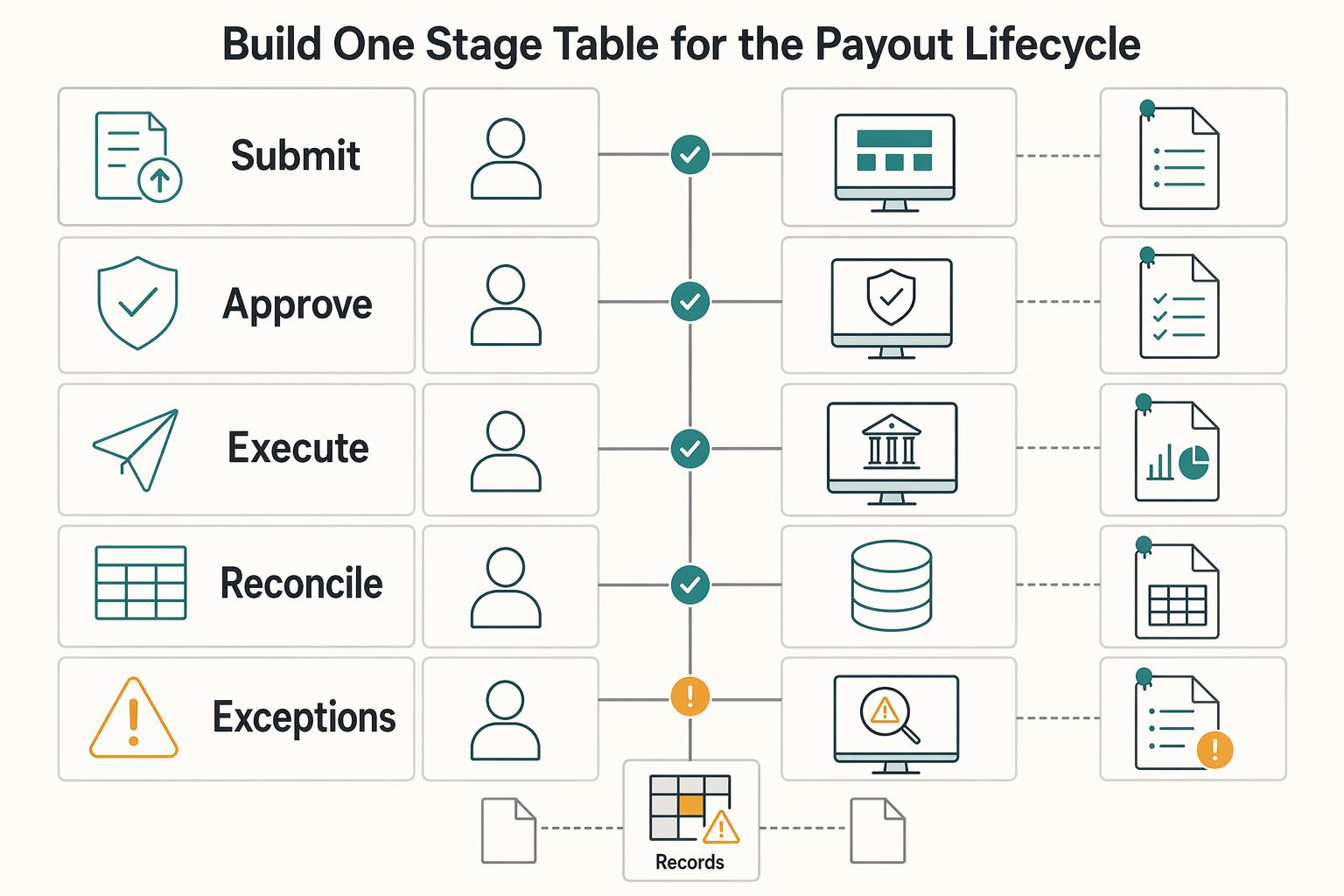
Build one stage table for the payout lifecycle#
Map stages in payout order, and require one owner, one system or surface, and one retrievable evidence artifact for each row. That way, every row points to a named person, a real system, and something you can retrieve later.
Use a real table, not a loose paragraph copy, so reviewers can compare ownership and evidence quickly.
| Stage | Primary owner | System or surface | Expected evidence artifact |
|---|---|---|---|
| Submit | Product or payout operations | User-facing payout submission UI | Task result with pass or fail notes and confirmation-state evidence |
| Approve | Finance ops or risk ops | Internal approval console | Approval-path test record and reviewer notes |
| Execute | Engineering or payments ops | Payout engine, status page, notifications | Execution-status evidence, user-visible state change, and release notes |
| Reconcile | Finance ops | Reconciliation screens, exports, ledger views | Reconciliation sample, export check, and mismatch linkage if needed |
| Resolve exceptions | Support ops or payments ops | Exception queue, retry tools, case-management surface | Exception-resolution record, retry outcome, and closure notes |
Keep this table in the same release ticket or initiative packet. Each row should point to evidence you can retrieve later, not a generic note like "tested."
Tie each stage to payout-specific risk points#
Call out payout risks stage by stage, especially visibility gaps and exception-handling gaps. In practice, these can show up as "submitted, but unclear what happened" or "failed, but no usable recovery path."
Use lifecycle coverage, not page-by-page checks. End-to-end processing depends on workflow, visibility, reporting, and exception management. If visibility fails, the payout experience can fail even when transaction processing succeeds.
Add friction gates where failures are most likely#
Include high-friction checkpoints where users or operators can get blocked. Treat these as testing decisions for your flow, not as requirements established by the DOJ proposed rule materials, which are scoped to state and local government entities.
For each stage, mark whether the gate is user-facing, internal, or both. Then verify completion when the gate appears, fails, or routes to recovery.
Separate user-facing and internal checkpoints, then add reviewer independence#
Track user-facing and internal tooling separately, because they can fail differently. Review status messaging, confirmations, retries, approvals, and exception queues in both paths.
If one team owns both approvals and exception queues, consider a second reviewer before production signoff. Record two confirmations: evidence exists for both user-facing and internal surfaces, and exception handling is not masking an upstream defect.
Translate WCAG controls into release gates for each stage#
Accessibility gates can still drive release decisions, but the cited DOJ/Federal Register excerpts do not define a payout-stage block rule, remediation SLA format, or ticket-level evidence checklist. Treat those as internal policy choices and document them explicitly.
Build a stage-by-stage control matrix#
Use one matrix across submit, approve, execute, reconcile, and exception resolution so each stage has explicit checks and evidence expectations. Define the exact control checks, blocking thresholds, and required artifacts internally.
Keep the release matrix equally explicit so each stage has a blocking rule and a named evidence artifact.
| Stage | Controls to verify | Blocking example | Evidence to attach |
|---|---|---|---|
| Submit | Labels, instructions, keyboard path, error recovery | User cannot complete the submission task or recover from an error | Manual task script, scan result, and defect record |
| Approve | Readable status, focus order, reviewer confirmation path | Approver cannot understand the blocking reason or complete the review | Approval-path script, screenshots, and reviewer notes |
| Execute | Visible status updates, notification clarity, async announcements | Status changes happen without usable text or traceable logs | Status-history sample, notification evidence, and release note |
| Reconcile | Export readability, filter usability, mismatch explanation path | Finance cannot inspect or resolve a mismatch without ad hoc help | Reconciliation sample, export check, and owner note |
| Resolve exceptions | Queue navigation, retry clarity, fallback visibility | Operator cannot recover a failed payout without losing context | Exception-queue script, retry outcome, and remediation note |
Define pass or fail before testing starts#
Define pass or fail criteria before testing starts. The cited excerpts do not provide control-level pass/fail thresholds (including contrast ratios) or stage-specific release logic, so record your internal criteria and test evidence clearly.
Use reference patterns as inputs, not proof#
Reference patterns can speed implementation, but they do not prove your flow passes in context. The cited excerpts do not provide product-specific component guidance, so validate your own modal, queue, and async status behavior in the live stage flow.
Make signoff evidence auditable#
If legal framing is included, keep the regulatory record explicit: the FederalRegister.gov page for 88 FR 51948 says it is not an official legal edition and says legal research should be verified against an official Federal Register edition. That page also points to the corresponding official PDF on govinfo.gov. The cited scope is accessibility of web information and services of state and local government entities; it does not by itself establish private-platform payout release obligations.
Need a reference point while turning accessibility checks into operational release gates? Use the Gruv docs to align status handling, retries, and audit-ready payout records.
Make KYC and MFA steps accessible without weakening controls#
KYC and MFA steps can become hard failures when accessibility gaps appear. Keep controls intact, then make instructions, error handling, and fallback paths clear enough that users can recover without weakening security.
Before you start#
Use the same accessibility release gate you already apply in similar high-risk flows. Document the security rules for this stage in the ticket: what can trigger step-up verification, what counts as a failed attempt, when the session expires, and who owns fallback handling. If verification depends on necessary session state, say that clearly up front. If users opt out of necessary cookies or related session aids, state that the experience may degrade and provide an alternate route.
Show requirements before the user can fail#
Make requirements explicit before input starts. Progressive disclosure works best when the same four questions are answered every time.
- What is required?
- What format or action is accepted?
- What happens next?
- What should the user do if completion fails?
When errors happen, be specific. State what failed in plain language, keep the user on the same task with the failed field clearly identified, and place the next recovery action directly under the error. This helps keep security strict while reducing avoidable retries.
Keep context stable through validation#
Validation should stay predictable. Avoid flows where state changes strip out context, such as opening a verification step without clear instructions or showing an error without an obvious next action.
When a verification step opens, keep the heading and instructions easy to find. After a failed attempt, return the user to the error and relevant input so they can recover without restarting the journey.
Add an accessible fallback before retries become a trap#
If failures start looping, provide an accessible fallback instead of forcing the same retry pattern repeatedly. The fallback can remain fully secure, but it needs a clear entry point, plain instructions, and confirmation that the request moved forward.
Preserve non-sensitive state where appropriate, such as consent or disclosure acknowledgments, so returning users do not have to restart from zero.
Document tradeoffs and evidence#
Document this stage as a balance of security, compliance, and user rights. If opting out of some cookies or session aids can degrade verification, state that plainly and provide a usable alternate path.
In release evidence, attach at least one capture of a failed verification state and one capture of the fallback entry point, with owner and remediation notes where needed.
Design status, retries, and exception recovery for real payout failures#
Status ambiguity can turn a normal payout issue into a support problem. Use a consistent status vocabulary across the payout view, notifications, support replies, and ops queues so users and operators are working from the same record.
Fix the status vocabulary before you tune the UI#
Define statuses as workflow checkpoints, not just labels on a screen. A practical structure is to separate what is caught before money moves from what is handled after execution starts. That lines up with prepayment and post-payment control points.
A post-payment-first approach can add administrative burden, so include prepayment checks in the workflow where possible.
If your team uses multiple status labels, keep the wording stable everywhere those states appear. For each state change, align the user-facing status, the activity log, and the internal exception view.
- Needs attention before submission
- Submitted and under review
- Sent to provider
- Needs user action
- Needs operator action
Pair async changes with visible text and log evidence#
Pair visual state changes with clear text updates. Record the same event in the activity log with core context so recovery work is traceable.
Keep systems aligned during updates. When status and logs drift across disconnected sources, analysis and recovery can get slower and harder.
Define retry behavior with traceable records#
Retries benefit from clear handling rules before launch. Document how retry events are recorded so operators can reconstruct what happened.
Before enabling retry actions, confirm your records capture enough context to investigate failures and outcomes. Without that trail, recurring errors are harder to diagnose and teams may fall back to manual workarounds.
Validate exception recovery in the real ops workflow#
Test exception handling in the queue view your ops team actually uses under time pressure. Focus on whether operators can filter, inspect, act, and return to the right place without losing context.
Capture those results in the same release evidence used for payout changes. Treat gaps in queue usability or status-history readability as operational risks, not cosmetic issues.
Related: FedNow vs. RTP: What Real-Time Payment Rails Mean for Gig Platforms and Contractor Payouts.
Test like an operations team, not just a QA team#
Once status and retry rules are stable, test them under the same conditions your ops team handles every day. Automated scans catch obvious defects quickly, but they do not prove a person can complete or recover a critical task when interruptions happen.
Start with automated checks, then treat results as triage#
Use repeatable automated accessibility scans early in each release-candidate cycle to catch common issues. This is the fastest way to catch broad regressions.
Do not treat a clean scan as completion evidence. Use scan output as triage, then validate task completion with manual scenarios. If the same defect appears across candidates, track it as a process or component issue, not as a one-off bug.
Script the interruption scenarios your operators rely on#
Run controlled manual scripts for interruption paths that usually create support load. These are often the points where completion breaks even when a page appears technically valid.
Where relevant, test completion and recovery with keyboard navigation and assistive technology. Confirm focus behavior, status announcements, and recovery instructions are clear enough for a user to continue without losing context.
Use feedback tools as input, not proof#
Feedback tools can surface recurring confusion after release. That feedback is useful for spotting patterns.
Keep it separate from scripted test evidence. Feedback widgets are helpful signals, but they are not controlled verification of critical tasks.
Keep one explicit release evidence record#
Before signoff, keep a compact evidence pack in the release record: scan reports, manual scripts, pass or fail notes, and linked defects. Treat it like an explicit artifact set, and define artifact precedence when results conflict so decisions stay consistent.
A clear order of precedence is a practical control when automated findings and manual findings disagree. The same discipline helps teams resolve conflicts quickly instead of shipping with unresolved ambiguity.
Vendor litigation trackers can help teams spot market pressure, but they should not substitute for your own release evidence or for official accessibility sources. The operational takeaway is simple: verify real task completion, not only page-level scan results.
Build the evidence pack procurement and auditors actually ask for#
After release testing, lock the evidence in one place that non-engineers can use. Procurement, compliance, and audit should be able to see what you tested, what failed, and what is still open without rebuilding the story from chat or scattered tickets.
Maintain a living VPAT tied to real releases#
If you use a Voluntary Product Accessibility Template (VPAT), keep it current and versioned by release rather than as a one-time artifact. Each update can point to the payout flows tested, the test date, the product version, and known limitations that are still open.
If your team uses WCAG 2.1 Level AA as an internal benchmark, map tested flows to that benchmark in the same record. Finance ops should be able to open the latest accessibility record and quickly confirm which approval, exception, and status flows were covered.
Package a compact evidence bundle with it#
Keep the VPAT with a compact bundle so reviewers do not have to rebuild context manually. A practical bundle may include:
- control matrix used for signoff
- current defect log and owners
- remediation targets for open non-blocking issues
- test artifacts such as scan output, manual scripts, and pass or fail notes
- release approvals
Keeping this material together can reduce manual rework. The provided payment-integrity evidence also notes that manual solutions can introduce errors and consume time, and that post-payment approaches can increase administrative burden.
Add legal framing notes as context, not proof#
Keep a short legal-framing note next to the evidence pack. For U.S. public-sector context, you can reference the U.S. Department of Justice rulemaking record for state and local government web information and services, listed on Regulations.gov as a Proposed Rule under docket DOJ-CRT-2023-0007 (posted Aug 4, 2023; comments closed Oct 3, 2023 at 11:59 PM EDT).
If additional jurisdictions are relevant, capture them as assumptions for counsel review rather than blanket applicability.
Store it where ops and compliance can retrieve it directly#
Store the package in a governed repository with read access for finance ops, procurement, compliance, and internal audit. The practical check is simple: those teams can retrieve the latest accessibility record, approvals, and DOJ rulemaking artifact set, including downloaded files, without engineering intervention.
Connect accessibility checks to Gruv payout operations#
The point of all this is to make accessibility evidence usable inside release governance, not to keep it separate from how payout operations already work. Treat accessibility as a release control anywhere a surface can change money movement or records.
Map evidence to the four payout surfaces in scope#
Apply the same evidence standard to payout creation, batch approvals, provider status updates, and reconciliation exports. For each surface, record the operator action, the state change, and the exact test artifact tied to that release so finance ops and compliance can verify coverage without digging through tickets.
Make compliance gates understandable at the point of block#
Where your Gruv program has compliance gates, test those moments as first-class user paths. A pass should show that users can understand what is blocking progress and what action to take next. Specific KYC, policy-hold, or MFA control requirements are not defined here.
Keep status changes traceable and resolve conflicts by precedence#
Make sure user-visible status, operator logs, and release artifacts can be reconciled end to end. When records conflict, use a predefined order of precedence so teams know which artifact controls the decision. Webhook-specific traceability controls are not defined here.
Align accessibility QA with existing operational governance#
Align accessibility QA with formal governance artifacts so one control does not break another. Use your service-level governance pattern, for example an Exhibit K-style SLA artifact. Require named Principal Representatives for release ownership, and keep signed-and-dated approval as the validity gate before release.
Common mistakes that break compliant payout flows and how to recover#
Accessibility failures often show up at governance boundaries where scope, evidence, legal framing, or ownership is weak.
| Mistake | Recovery |
|---|---|
| Test only checkout or money-in screens | Cover release-critical workflows in release evidence and attach each workflow to a named artifact |
| Treat an automated scan pass as done | Pair scan results with documented completion checks and use dated remediation for non-blocking fixes |
| Copy legal language without scope labels | Separate confirmed facts from unknowns and state jurisdiction assumptions |
| Log defects without a named owner or governance deadline | Assign an accountable owner and enforce SLA-based remediation in release governance |
Do not test only checkout or money-in screens#
Recovery: cover release-critical workflows in release evidence.
Map each workflow to a named artifact so both users and operators can complete critical tasks without losing context, and attach that evidence to the artifact instead of relying on a generic QA pass note.
Do not treat an automated scan pass as done#
Recovery: do not use a scan result as the only release artifact.
It is not established that scan-only evidence is a complete release gate. Pair scan results with documented completion checks, then classify blocking defects as release blockers and time-box non-blocking fixes with dated remediation.
Do not copy legal language without scope labels#
Recovery: separate confirmed facts from unknowns and state your jurisdiction assumptions.
For example, the DOJ entry posted on Aug 4, 2023 is a Proposed Rule on accessibility of web information and services for state and local government entities, and its comment period ended on Oct 3, 2023 at 11:59 PM EDT. Treat that as a concrete checkpoint, not as a blanket answer for every private-platform obligation.
Do not log defects without a named owner or governance deadline#
Recovery: assign an accountable owner and enforce SLA-based remediation in release governance.
Mirror a formal artifact structure, such as an Exhibit K-style Service Level Agreements document. Require signed-and-dated approval as the release validity gate, and use a defined order of precedence when QA, product, and compliance records conflict.
Conclusion#
The practical win here is operational, not cosmetic: tie WCAG-based checks to each payout stage, a named owner, and a release decision you can defend. If you can prove task completion, failure recovery, and audit evidence, your accessibility posture is stronger for both compliance review and scale.
Start with scope, not assumptions. The ADA does not set specific web technical rules, and expectations can vary by jurisdiction when federal web standards are unclear. Use WCAG as your operating benchmark. Document where legal treatment is still unsettled, and keep a concrete legal-tracking anchor on file: the DOJ proposed rule for state and local government entities posted on Aug 4, 2023, with comments closed on Oct 3, 2023 at 11:59 PM EDT. It does not settle every private-platform question, but it does explain how you set scope.
- Confirm legal scope assumptions and market caveats. Document products, jurisdictions, and entity types in scope, plus what is confirmed and what is still uncertain.
- Build a stage-by-stage control matrix with owners. Cover the payout flow stages and define the evidence artifact expected for each one.
- Run automated and manual payout-path tests. Validate real task completion and recovery, not only isolated screen checks.
- Verify high-friction recovery flows. Test real friction points so users can understand failures, recover, and continue without weakening controls.
- Attach the evidence pack to release decisions. Include tested controls, defects, remediation dates, open issues, and approval records.
- Re-check post-release defects and remediation SLAs. Track production issues, keep ownership clear, and maintain dated remediation commitments for non-blocking gaps.
Hold that standard: an operationally defensible accessibility process, not a polished statement.
If you want to pressure-test your accessibility rollout against real payout operations, talk with Gruv about policy gates, traceability, and market-specific constraints.
Frequently Asked Questions
Is WCAG 2.1 Level AA legally required for every payment platform, or does it depend on jurisdiction and entity type?
It depends on jurisdiction and entity type, so it should not be treated as a universal rule. The DOJ item posted on Aug 4, 2023 is a Proposed Rule for state and local government entities, not blanket proof for every private platform. For private platforms, use WCAG 2.1 Level AA as a practical operating target while legal scope is confirmed for your markets.
What is the minimum set of checks that makes a payout flow credibly WCAG 2.1 compliant?
Do not assume a universal minimum checklist applies. A credible bar is proving that critical payout tasks can be completed and recovered from across the real flow, not just on a single screen. A stage-by-stage control matrix and release evidence make that standard clearer.
Which payout stages usually fail first in audits: submit, approval, execution, or exception handling?
There is no grounded global ranking in these materials for which stage fails first. Treat it as a risk-mapping exercise across submit, approval, execution, and exception handling. Prioritize the stages where loss of context or failed recovery creates the biggest operational impact.
How should we prioritize fixes when accessibility issues conflict with release timelines?
Prioritize high-risk blockers first, especially issues that prevent task completion or recovery in payout-critical paths. Then set dated remediation timelines and reporting checkpoints for non-blocking gaps. Keep those decisions explicit in release governance.
What evidence should we keep ready for procurement reviews and enterprise security questionnaires?
Keep an evidence pack that shows what was tested, what failed, what was fixed, and what remains open. Include the control matrix, defect log and owners, scan output, manual scripts, pass or fail notes, and release approvals. If you use a VPAT, keep it current and versioned by release, and include remediation timelines, reporting artifacts, and internal accessibility training records where applicable.
How do we test KYC and MFA steps without weakening fraud and compliance controls?
There are no KYC- or MFA-specific testing requirements to copy here. A practical approach is to test those steps in realistic flows, document the security rules, and confirm users can complete tasks and recover from errors without bypassing core controls. Clear instructions, stable validation, and an accessible fallback help preserve both usability and security.
What remains unclear today about private-platform obligations across different markets?
Legal scope for private-platform obligations across different markets is still not fully settled. The DOJ item discussed here does not establish a final, universal rule for private payment programs, and concrete EAA requirements should be confirmed with qualified legal counsel. State your market assumptions clearly and avoid overclaiming certainty in external compliance statements.
Researched and edited by the Gruv editorial team. Gruv builds cross-border billing, payouts, and finance-operations software for global businesses.
Sources
Includes 3 external sources outside the trusted-domain allowlist.
- ada.gov/assets/pdfs/web-accessibility-NPRM.pdftrusted
- comptroller.nyc.gov/wp-content/uploads/documents/RFP_NYC-Comptro...trusted
- dcrb.dc.gov/sites/default/files/dc/sites/dcrb/publicatio...trusted
- federalregister.gov/documents/2023/08/04/2023-15823/nondiscrimin...trusted
- regulations.gov/document/DOJ-CRT-2023-0007-0001trusted
- docs.adyen.com/online-payments/accessibilityexternal
- g3ict.org/index.php/actions/assetCount/downloadexternal
- w3.org/WAI/standards-guidelines/wcagexternal
Educational content only. Not legal, tax, or financial advice.
Related Posts

The Freelance Payment Penalty: A Modeled Audit of Platform Fees, FX Spreads, and Payout Delays
The money rarely disappears through a single, easy-to-spot fee. The real loss is stacked. A marketplace takes its commission, a processor adds a charge for international cards, a bank or payment company converts the currency at a spread, a platform holds the funds before release, and a wire sheds a little to intermediaries on the way in. Each layer looks defensible on its own, but the worker feels the combined result as a smaller deposit and a later payday.

How to Respond to a Subpoena for Business Records
Move fast, but do not produce records on instinct. If you need to **respond to a subpoena for business records**, your immediate job is to control deadlines, preserve records, and make any later production defensible.

A US Expat's Guide to Investing in UCITS ETFs to Avoid PFIC Issues
The real problem is a two-system conflict. U.S. tax treatment can punish the wrong fund choice, while local product-access constraints can block the funds you want to buy in the first place. For **us expat ucits etfs**, the practical question is not "Which product is best?" It is "What can I access, report, and keep doing every year without guessing?" Use this four-part filter before any trade: