
Quick Answer
Start by locking filing ownership per rail before thresholds: decide whether each stream belongs in Form 1099-NEC, Form 1099-MISC, or a Form 1099-K lane handled by a payment settlement entity. Then enforce document gates with valid Form W-9 or Form W-8, hold unresolved exceptions before recipient delivery, and treat e-filing as mandatory once you aggregate 10 or more information returns. Use this 1099 contractor payment guide platforms rules thresholds filing deadlines framework as an operating model, then escalate non-U.S. and treaty-sensitive cases for specialist review.
1099 reporting gets risky at platform scale for different reasons than small business filing#
At platform scale, 1099 risk is usually an ownership and evidence problem before it is a threshold problem. If you run payouts across multiple programs, entities, or payment rails, the question is not just whether a payment triggers a form. It is who owns the filing, what records support that decision, and how exceptions get handled when the facts are messy.
- Scope the right operating audience
This section is for compliance, legal, finance, and risk owners managing Independent Contractor, seller, or creator payouts at volume. Once you have multiple payout types or payer paths, small-business workflows may no longer be enough because information return reporting includes both IRS filing and recipient furnishing. Your process has to cover IRS submission and Recipient Copy delivery, not just a tax-team handoff. At platform scale, you need end-to-end accountability across product, payments, ops, and tax.
- Centralize repeat decisions early
Centralize form-selection rules, payee document checks, filing deadlines, and rail-level ownership before filing season pressure starts. Keep explicit decision rules for Form 1099-NEC, Form 1099-MISC, and cases that may fall outside domestic 1099 handling. Form 1099-NEC is due to the IRS by January 31, and its recipient copy is also due January 31. Form 1099-MISC is due February 28 on paper or March 31 electronically. These deadlines are not interchangeable, and at 10 or more information returns, IRS e-filing is required.
- Escalate unclear filing ownership, especially for 1099-K rails
Do not improvise when Form 1099-K may apply. IRS instructions assign card and third-party network reporting to the payment settlement entity, and those payments are not reported again on Form 1099-MISC or Form 1099-NEC. When processors or marketplaces are involved, treat ownership as unresolved until you have written confirmation of the PSE, covered flows, and data handoff. Duplicate reporting creates avoidable risk alongside missed reporting.
- Build exception evidence before you file
The goal is fewer IRS surprises, cleaner payee statements, and records you can defend when exceptions happen. Maintain an evidence pack with payee tax-document status, form decisions, filing method, acknowledgments, and correction history. Keep Form W-9 name and TIN matching in scope, since mismatch risk can trigger backup withholding. Exceptions should be provable from records, not memory. If a payee may be non-U.S., escalate before filing, because nonresident nonemployee compensation may move to Form 1042-S. For that edge case, involve specialist review and use Non-Resident Withholding on Contractor Payments: Platform Guide to the 30% Rule and Treaty Reductions.
Final checkpoint: treat Form 1099-K thresholds as tax-year specific and validate current IRS guidance before issuing recipient statements. IRS transition messaging referenced $5,000 for tax year 2024, while later IRS FAQ language states TPSOs are not required to file unless payments exceed $20,000 and 200 transactions.
For a deeper dive, read Gig Worker Tax Compliance at Scale: How Platforms Handle 1099s W-8s and DAC7 for 50000+ Contractors.
How to choose the right 1099 operating model for your platform#
Choose the model that makes four decisions clear before filing season: what triggers reporting, who files, what evidence supports the decision, and how exceptions are remediated. If you own policy gates or reconciliation for Form 1099-NEC and Form 1099-MISC, use the simplest model that can meet Form 1099-NEC January 31 filing and recipient-copy obligations and the aggregated IRS e-file threshold at 10 returns.
| Model | Use when | Key control point | Specific fact |
|---|---|---|---|
| Direct service-payer model | Your entity pays for services and you can document payer-of-record status | Confirm service coding before approval | Form 1099-NEC filing and recipient copy are both due January 31 |
| Mixed-income model | One payee can receive service payments and amounts that belong on Form 1099-MISC, such as rents or royalties | Classify at transaction creation, not after close | Form 1099-MISC is due February 28 on paper or March 31 electronically |
| Processor-dependent ownership model | Card or third-party network rails sit between you and the payee | Require written confirmation of covered rails and form issuer | Those transactions are assigned to Form 1099-K reporting by the payment settlement entity, not Form 1099-NEC or Form 1099-MISC |
| Split U.S. and non-U.S. model | Onboarding separates U.S. and non-U.S. payee documentation and captures Form W-8 where needed | Resolve status early and keep foreign-payee cases out of a domestic 1099 queue | Treaty treatment needs Form W-8BEN or Form W-8BEN-E; without valid support, many U.S.-source payments to foreign persons default to 30% withholding with Form 1042/1042-S reporting |
This is not stand-alone legal advice for Tax Treaty claims, Non-Resident Withholding, or worker-status disputes. These issues can be fact-specific, so if teams disagree on form choice, use documented rules and escalation instead of deadline-driven judgment.
- Direct service-payer model
Use this when your entity pays for services and you can document payer-of-record status. It aligns with Form 1099-NEC for nonemployee compensation and works best when payee tax documentation is complete before payout. Reporting triggers are usually clearest here. Confirm service coding before approval, because IRS filing and recipient furnishing for Form 1099-NEC are both due January 31.
- Mixed-income model
Use this when one payee can receive service payments and amounts that belong on Form 1099-MISC, such as rents or royalties. It requires stronger transaction coding and helps reduce year-end reclassification risk. Classify at transaction creation, not after close. Form 1099-MISC deadlines differ from NEC: February 28 for paper and March 31 for electronic filing.
- Processor-dependent ownership model
Use this when card or third-party network rails sit between you and the payee. IRS instructions assign those transactions to Form 1099-K reporting by the payment settlement entity, not Form 1099-NEC or Form 1099-MISC. Filing ownership is the control point. Require written confirmation of covered rails and form issuer to avoid duplicate reporting.
- Split U.S. and non-U.S. model
Use this when onboarding separates U.S. and non-U.S. payee documentation and captures Form W-8 documentation where needed. It adds upfront friction but keeps foreign-payee cases out of a domestic 1099 queue. Evidence quality is usually better when status is resolved early. If treaty treatment is claimed, the withholding agent needs Form W-8BEN or Form W-8BEN-E. Without valid support, do not assume a U.S. 1099 path, because many U.S.-source payments to foreign persons default to 30% withholding with Form 1042/1042-S reporting.
For a step-by-step walkthrough, see A Guide to Form 1099-K for Freelancers Using Payment Apps.
Compare the main 1099 decision points before you build controls#
Before you automate, lock one decision per payment lane: who owes both the IRS filing and the recipient statement, and when that duty shifts to a third party or a different form family.
Filing and recipient delivery are paired obligations, so ownership has to cover both. Confirm filing method early too. As of tax year 2023, filers with 10 or more information returns must file electronically.
| Form | Best for | Common confusion | Owner | Internal filing responsibility vs third-party dependency | Verification before approval | Evidence needed |
|---|---|---|---|---|---|---|
Form 1099-NEC | Nonemployee compensation for services in a trade or business | Teams route all contractor-like payouts here, even when paid by card or third-party network rails | Usually your entity when it is payer of record | Internal when you directly paid for services. Recipient copy due January 31 | Payment is for services, payee is reportable in your 1099 process, and reporting status is complete | Payee tax documentation, service-coded transactions, payer-of-record support, approval record |
Form 1099-MISC | Miscellaneous categories such as rents, royalties, prizes, and other listed income | Teams classify late at year-end instead of at transaction creation | Usually your entity when it made the reportable payment | Internal when you made the payment. IRS filing dates: February 28 paper, March 31 electronic | Payment maps to a MISC category, not NEC services. Threshold logic matches the box, for example $10 royalties or $600 for listed categories | Transaction detail, category mapping, payee tax form, box-selection review sign-off |
Form 1099-K | Payment card and third-party network transactions | Teams also file NEC or MISC on the same transactions, creating duplicate-reporting risk | Payment settlement entity (section 6050W) | Usually third-party dependent unless your entity is the settlement entity. Payee statement must match IRS filing. Electronic delivery requires taxpayer consent | Rail is confirmed as card or third-party network, threshold condition is met ($20,000 and 200 transactions), and issuer is identified | Processor agreement, rail mapping, issuer confirmation, payee statement method, e-delivery consent record |
Form 1099-INT | Interest income | Teams treat credits or adjustments as contractor payouts without confirming interest treatment | Entity that is the interest payer | Not a standard contractor lane. Escalate until ownership is explicit | Records show the amount is interest income and identify the correct paying entity | Product terms, ledger treatment, classification memo, payee tax data |
Form 1099-DIV | Dividends and other distributions | Teams treat distributions as contractor compensation | Usually banks, financial institutions, or the distributing filer | Commonly outside contractor-payment controls unless your entity is the distributing filer | Records show distribution or dividend treatment, not compensation or royalties | Distribution records, corporate action support, tax classification approval |
Two controls should be non-negotiable before approval:
- For card and third-party network rails, resolve
1099-Kownership before issuing recipient copies. Those transactions are reported onForm 1099-Kby the payment settlement entity and are not subject toForm 1099-NECorForm 1099-MISC. - If you paper-file across multiple 1099 types, prepare a separate
Form 1096for each type.Form 1096is not required for electronic filing.
Low-frequency forms that should trigger escalation#
When these forms appear, escalate instead of reusing contractor controls.
| Form | Best for | Common confusion | Owner | Internal filing responsibility vs third-party dependency | Verification before approval | Evidence needed |
|---|---|---|---|---|---|---|
Form 1099-B | Broker or barter proceeds, and in some cases basis | Teams force brokerage-like activity into contractor controls | Broker or barter exchange lane | Outside normal contractor logic. Escalate to specialized ownership | Activity is brokerage or barter in records. Lane owner is assigned | Product flow docs, transaction classification, owner assignment |
Form 1099-R | Distributions from pensions, annuities, retirement or profit-sharing plans, IRAs, insurance contracts | Teams reuse contractor controls for benefit-like distributions | Retirement or insurance distribution lane | Separate compliance lane. Escalate early | Distribution type is documented and mapped to the correct lane | Plan or product documentation, distribution records, tax classification approval |
Form 1099-S | Sale or exchange of real estate | Marketplace teams treat real-estate flows as contractor payouts | Real-estate reporting lane | Outside contractor logic. Escalate | Records show real-estate sale or exchange. Lane owner is assigned | Transaction and legal records, classification memo, owner assignment |
For Form 1099-B and Form 1099-S, IRS general instructions call out a recipient-statement due date of February 17, 2026, with the listed exceptions.
What compliance and finance should require before approval#
Approve only when the record proves three things: what the payment was, who the filer is, and what recipient-statement obligation follows.
Use a payee-level trace test for each lane. If you cannot prove service coding (NEC), box-level category support (MISC), or rail ownership (1099-K), fix classification upstream before you finalize filing controls.
You might also find this useful: State 1099 Filing Requirements for Multi-State Platforms.
When you finalize your form-ownership matrix, map each decision gate to the exact event and status fields your team will rely on in ops. Start with Gruv docs.
Best when you pay for services directly to contractors#
This is usually the clearest lane to own internally. If you paid a nonemployee directly for services in your trade or business and Form W-9 data is complete, start by checking whether Form 1099-NEC applies.
IRS guidance ties this lane to specific conditions, not labels alone. The payment must be for services, the worker must not be your employee, and Form 1099-NEC is used when nonemployee compensation is reportable.
Best fit#
Use this lane when your records show all of the following and you can tie each point back to the payment record:
- Service purpose is clear: the transaction is coded as services in your trade or business.
- Payee status is complete: the worker is confirmed as not an employee, with complete
Form W-9name and TIN data. - Payment path is direct: your entity made the payment, without unresolved card or third-party network overlap that could fall under
Form 1099-K.
Why this lane is easier to control#
Direct service payouts are easier to test because the evidence chain is tight: a service-coded payment record, a payee tax profile, then one form family in many cases. That makes late reclassification between Form 1099-NEC, Form 1099-MISC, or non-contractor forms less likely.
For reportable nonemployee compensation in box 1, keep timing controls explicit. Filing and recipient furnishing are tied to January 31. For filing method, also account for the reduced e-file threshold of 10 aggregated information returns, effective for returns required on or after January 1, 2024.
The tradeoff you accept#
The upside is cleaner ownership. The cost is that missing TINs, legal-name mismatches, and late classification fixes stay in your lane.
Keep two stop rules in place so you do not treat every direct contractor payment as NEC:
- A completed W-9 is necessary, but it does not by itself prove
Form 1099-NECis the right form. - Do not hard-code one universal NEC threshold across years. Validate current-year IRS instructions and FAQ updates before locking filing logic.
Concrete use case#
A creator marketplace paying U.S.-based editors from platform-ledgered batches is a strong Form 1099-NEC lane when each payment is tied to completed editing services, the editor is not an employee, and Form W-9 data is complete.
In practice, failures can come from operations as much as from rule interpretation. If some payouts move onto processor rails or service work is miscoded, duplicate-reporting risk and late reclassification can follow. Pause recipient-copy prep until rail ownership and service-coding evidence are corrected.
This pairs well with our guide on HMRC Reporting Rules for Platforms for UK Marketplace Operators.
Best when your payouts mix services rent and royalties#
When the same payee can receive different income types, one annual label may not be enough. Do not force everything into Form 1099-NEC. Code each payout by category so Nonemployee Compensation is separated from Form 1099-MISC items before year-end.
Form 1099-NEC is tied to payments for services performed for your trade or business, while Form 1099-MISC covers categories including rents and royalties. In mixed-flow products, payment-purpose data is often more reliable than a single payee label.
| Payment category | Likely form | Grounded trigger to watch |
|---|---|---|
| Nonemployee service payments | Form 1099-NEC | IRS FAQ language includes $600 generally, with $2,000 for payments made after December 31, 2025 |
| Royalties | Form 1099-MISC | $10 |
| Rents | Form 1099-MISC | $600 |
| Interest income | Form 1099-INT | $10 for amounts reportable in boxes 1, 3, and 8 |
| Ordinary dividends | Form 1099-DIV | $10 or more in dividends or other distributions |
Best fit#
This fits platforms where one creator, vendor, or rights holder can be paid for services and also receive rights-based income under the same account. If you collapse those streams into one bucket, form accuracy can get worse.
Classify at transaction creation as an operating control. The cited IRS materials do not require that exact timing, but early classification is a practical way to preserve why a payment was treated as services, rent, royalties, interest, or dividends.
What to build into the record#
The record has to support the split later, not just at the time of payment. Keep explicit mapping fields in each payment record, not just memo text. At minimum, capture payment-purpose code, contract or rights basis, payee tax-document status, and settlement rail.
If your product supports more than contractor services, reserve fields for Interest Income and Ordinary Dividends so those payouts are not forced into generic miscellaneous coding later.
The tradeoff you accept#
The benefit is better accuracy across Form 1099-NEC, Form 1099-MISC, Form 1099-INT, and Form 1099-DIV when those categories apply. The cost is operational complexity: more coding branches, more exception handling, and more month-end cleanup.
A common failure mode is letting one contractor label drive all later reporting. That can break as soon as the same payee also receives royalties or rents. Keep rail ownership clear too. If a payment is reportable under Form 1099-K by a payment settlement entity, it is not also reported on Form 1099-NEC or Form 1099-MISC.
Concrete use case#
A platform pays one creator for editing work and also pays usage-based royalties when that content is relicensed. The service payments follow the nonemployee compensation lane when the service conditions are met, while the royalty stream may trigger Form 1099-MISC at the $10 royalty threshold.
To defend mixed reporting later, keep service-side and rights-side evidence together in one record set: completed-work support, contract terms, ledger classification, and mapped form category.
Best when payment processors may issue reporting and you must avoid duplicate reporting#
If a payment stream falls within Form 1099-K scope, do not also auto-issue Form 1099-NEC or Form 1099-MISC for that same stream. IRS instructions state that payments made with a credit card or payment card, and certain third-party network transactions, are reported on Form 1099-K and are not subject to reporting on Form 1099-MISC or Form 1099-NEC.
This lane fits processor-mediated flows where form ownership is easy to assume and easy to get wrong. The upside is lower duplicate-reporting risk. The cost is tighter contracts, clearer settlement-data mapping, and earlier legal or tax review.
The decision rule that matters#
Treat ownership as unresolved until you have documented evidence that a payment settlement entity, or PSE, is responsible for Form 1099-K on that rail. Processor involvement alone is not enough. You need rail-level proof.
Before Recipient Copy production, confirm whether each stream is card or payment-card activity, or certain third-party network activity. If status is missing or conflicting, escalate before January 31 for any stream that might enter Form 1099-NEC, since both filing and recipient copy for Form 1099-NEC box 1 are due January 31.
Use a rail ownership table, not a narrative memo#
A short table is easier to operate than a narrative memo because it lets you see ownership gaps before statements go out.
| Payment rail | Likely form owner | Likely form path | Evidence that confirms assignment | If evidence is missing |
|---|---|---|---|---|
| Credit card or payment card settlement | PSE | Form 1099-K | Contract terms assign reporting responsibility, settlement data shows card-based transactions, tax or legal signoff confirms Form 1099-K treatment | Hold internal Form 1099-NEC or Form 1099-MISC output for that rail and escalate |
| Certain third-party network transactions | PSE | Form 1099-K | Network or processor terms and transaction metadata support third-party network settlement | Mark unresolved and hold payee delivery until cleared |
Rail not documented as Form 1099-K scope | Your entity, if otherwise reportable | Form 1099-NEC or Form 1099-MISC review | No evidence assigning Form 1099-K ownership. Payment classification supports NEC or MISC treatment | Route to exception review before release |
| Mixed or unknown rail | Unresolved | Hold | Conflicting or incomplete rail evidence | Stop form generation and assign an owner for resolution |
What usually goes wrong#
A common miss is letting payee type decide the form on its own. A contractor paid through a reportable card or certain third-party network flow can still be in the Form 1099-K lane, and those payments are not reported again on Form 1099-NEC or Form 1099-MISC.
Another miss is timing. Teams may queue Form 1099-NEC first and investigate rails later, which can leave too little time before January 31. Lock ownership before Recipient Copy production.
What to keep in the evidence pack#
Keep processor terms that address reporting responsibility, settlement outputs that show the rail, internal rail-to-form mapping, and tax or legal approvals for ambiguous rails.
Also track your remaining filing workload. Even with processor-owned Form 1099-K streams, your entity may still reach the 10-return aggregation threshold that requires electronic filing. If ownership is unproven, hold, escalate, and resolve before filing or payee delivery.
Best when your payee base includes both US and non-US counterparties#
For mixed U.S. and non-U.S. payee populations, make routing document-first. Confirm a valid Form W-9 or Form W-8 before assigning year-end reporting paths. This helps keep domestic information reporting separate from cross-border withholding work.
The tradeoff is operational, not theoretical: more onboarding friction, more front-end document review, and more exception handling when payee facts change.
The document gate to enforce#
For U.S. persons, use Form W-9 to request a TIN, and generally a U.S. non-exempt recipient must provide that TIN on Form W-9. For foreign-status treatment, the payer or withholding agent requests the relevant Form W-8.
Route by valid documentation, not by profile hints alone. If the record does not have valid tax documentation, treat it as unresolved until review.
| Documentation status | What it supports | What you should do |
|---|---|---|
Valid Form W-9 on file | U.S. person documentation for domestic information-reporting review | Proceed with domestic reporting classification once payment purpose and rail are confirmed |
Valid Form W-8 on file | Foreign-status review and possible nonresident withholding path | Keep separate from default U.S. information-reporting queues. Assess whether the payment is subject to withholding and reporting on Form 1042-S and Form 1042 |
Missing, expired, or contradicted Form W-8 or Form W-9 | Nothing reliable yet | Treat as unresolved and route for tax review before finalizing the reporting path |
The control most teams miss#
Form W-8 is generally valid from signature date through the last day of the third succeeding calendar year, unless a change in circumstances makes the form information incorrect earlier. Build that validity and change-in-circumstances check into your controls.
If a withholding agent or payor fails to obtain a valid Form W-8 or Form W-9, and also fails to withhold as required under presumption rules, IRS instructions note potential assessment at 30% under chapter 3 or 4. They also note potential 24% backup withholding under section 3406.
Where reporting paths diverge#
Once documentation is in place, the next decision is whether the payment stays in a U.S. information-reporting lane or moves into a nonresident withholding lane.
When payments are subject to NRA withholding, the reporting path is Form 1042-S and Form 1042, not a default U.S. information-reporting queue. Keep your evidence pack tied to the final routing decision: signed form, validity check, any change-in-circumstances notes, and the assigned reporting path.
For a deeper handoff model, see Non-Resident Withholding on Contractor Payments: Platform Guide to the 30% Rule and Treaty Reductions.
Best when filing deadlines are fixed and your data quality is not#
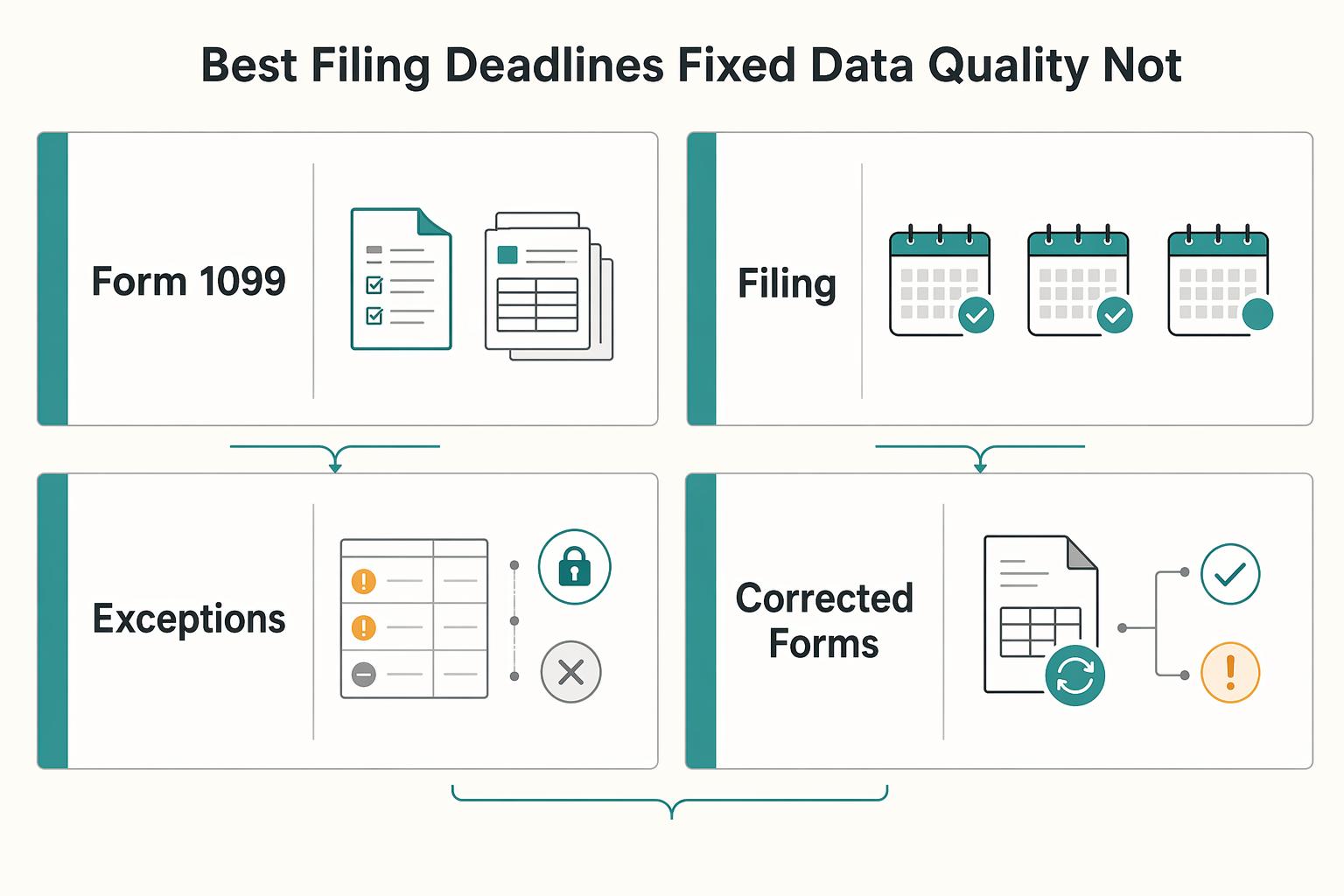
When deadlines are fixed and record quality is uneven, use a hard no unresolved exceptions gate before transmit and require explicit risk sign-off for any late override.
IRS timing does not bend to cleanup backlog. For Form 1099-NEC, IRS filing and Recipient Copy delivery are both due January 31. For Form 1099-MISC, IRS filing is due February 28 on paper and March 31 electronically. If a due date falls on a weekend or holiday, it moves to the next business day. There is also no single recipient-statement date across all 1099 variants. Current instructions list February 17, 2026 for Form 1099-B, Form 1099-DA, Form 1099-S, and Form 1099-MISC when amounts are in boxes 8 or 10.
| Deliverable or checkpoint | IRS date or rule | Internal cutoff to define | Primary owner | Dependency | Fallback if blocked |
|---|---|---|---|---|---|
Form 1099-NEC IRS submission and Recipient Copy delivery | January 31 (next business day if weekend/holiday) | Freeze and approval gate before due date | Tax or compliance ops | Final payee classification, valid Form W-9, TIN check, payout totals | Hold transmit, escalate exceptions, risk sign-off for override |
Form 1099-MISC paper filing | February 28 (next business day if weekend/holiday) | Print and mail cutoff before due date | Tax ops | Form mapping, address quality, print vendor readiness | Shift to electronic filing if approved |
Form 1099-MISC electronic filing | March 31 (next business day if weekend/holiday) | E-file package approval before due date | Tax ops or filing vendor | Complete file build, channel readiness | Move post-file issues to correction path |
| Rejected electronic file | Replacement within 60 days preserves original transmission date for penalty determination | Same-day rejection triage | Filing owner | Error log, corrected data, retransmission approval | Replace within 60 days. After that, late-filing penalty risk rises |
| Corrected forms | Correct once issue is confirmed | Correction queue with named SLA | Compliance and finance | Root cause, corrected record, payee communication plan | Use IRIS where applicable. On corrected paper 1099s, do not check VOID |
At 10 or more information returns, electronic filing is mandatory, and that count includes Forms W-2. For most platforms, treat Electronic Filing as the default path and work from a short sequence, not a long checklist:
- Freeze reporting population and totals.
- Re-run document and TIN validation for records approved near cutoff.
- Resolve or formally escalate exceptions before approval.
- Generate
Recipient Copyoutput only after the filing population is locked. - Submit electronically, monitor rejections, and route post-file issues to corrections.
That second step can reduce expensive rework. A valid Form W-9 must contain the payee name and TIN. If either is missing after approval, the filing record is not reliable.
The failure mode to treat as a stop sign#
A missing or obviously incorrect TIN discovered after approval is a stop-sign issue. If no TIN is provided, backup withholding must begin immediately, and the applicable backup withholding rate is 24% when required TIN conditions fail.
That can force rework across compliance, finance, and filing queues, and it can turn clean originals into corrections. Before final approval, require a checkpoint confirming complete Form W-9 data, TIN presence, and no unresolved exception state.
What late overrides must document#
Late overrides should be rare and fully documented. Record what failed, who approved the exception, whether backup withholding obligations were triggered, whether a payee statement was already produced, and who owns correction handling.
IRIS (Information Returns Intake System) supports corrections and automatic extension requests. It is a recovery channel, not a substitute for upstream controls. Rejection handling is also a penalty-control function. Replacing an invalid file within 60 days helps preserve the original transmission date for penalty determination, while missed timing can increase late-filing exposure.
Best when compliance leadership needs defensible evidence after filing#
If leadership may need to defend filing decisions after submission to the Internal Revenue Service, optimize for reconstruction, not just throughput. You should be able to trace any filed information return from the original ledger event to IRS status. The record should show why the form was selected, which tax document was on file, and what changed after filing.
| Evidence item | Keep | Why it matters |
|---|---|---|
| Form-routing record | Why a payout was assigned to Form 1099-NEC, Form 1099-MISC, or excluded; payment rail; processor role; rule used at decision time | Transactions reportable on Form 1099-K by the payment settlement entity are not subject to Form 1099-MISC or Form 1099-NEC |
| Tax-document review status | Form W-9 or Form W-8 status, version, received date, reviewer or approval event, and any issue that affected withholding or form routing | Evidence should show more than received and can be tied to the same party identifier used in KYC, KYB, or AML workflows |
| IRS acknowledgment and status | Submission confirmation, IRS status, and disposition owner | In IRIS, Accepted with Errors requires a correction transmission, while Rejected requires a replacement transmission |
| Correction history | Original filing artifact, corrected records, correction triggers, and any recipient communication trail when statements change | Keep filed information returns, or the ability to reconstruct them, for at least 3 years from the due date |
- Store form-selection logic with payment-rail evidence
A filed PDF is not enough. Keep the routing record showing why a payout was assigned to Form 1099-NEC, Form 1099-MISC, or excluded from that path. This matters because transactions reportable on Form 1099-K by the payment settlement entity are not subject to Form 1099-MISC or Form 1099-NEC, so retain the payment rail, processor role, and rule used at decision time. That turns duplicate-reporting disputes into a records check instead of a memory test.
- Keep tax-document status as a reviewed control artifact
For U.S. payees, retain Form W-9 status tied to the filed record. For non-U.S. onboarding, retain Form W-8 status and review outcome, because IRS instructions require review of completed Form W-8 for completeness and accuracy with respect to claims on the form. Evidence should show more than "received": version, received date, reviewer or approval event, and any issue that affected withholding or form routing. If your organization uses Know Your Customer, Know Your Business, or Anti-Money Laundering workflows, tie this to the same party identifier so sampling is testable across systems.
- Preserve IRS acknowledgments and status outcomes, including error states
Post-filing evidence should include submission confirmation, IRS status, and disposition owner. In IRIS (Information Returns Intake System), Accepted with Errors still requires a correction transmission, while Rejected requires a replacement transmission. That distinction tells you whether the work is complete or still in remediation. As of tax year 2023, if you file 10 or more information returns, electronic filing is required, so acknowledgment records are core evidence, not optional admin detail.
- Retain correction history for control testing and audits
Keep the original filing artifact, corrected records, correction triggers, and any recipient communication trail when statements change. IRS guidance supports formal correction channels, including IRIS, and says to keep filed information returns, or the ability to reconstruct them, for at least 3 years from the due date. On corrected paper 1099s, checking VOID incorrectly prevents the correction from being entered into IRS records. If you cannot show what changed, why it changed, and which version is final, control testing will likely fail.
A practical test is to sample quarterly payouts and trace each one from ledger event to payee record, tax-document review, form-routing decision, IRS acknowledgment, and any correction entry. If any link relies on email or memory, this model is the better fit.
Related: Music Royalty Tax Compliance: How Platforms Handle 1099-MISC vs. 1099-NEC for Artist Payments.
Best when your 1099 process sits inside broader cross-border tax obligations#
Use this model when 1099 controls must coexist with DAC7, FATCA, and FBAR or FinCEN duties. Keep the 1099 lane narrow, and make handoffs explicit. Keep Form 1099-NEC and Form 1099-MISC controls focused on U.S. information reporting, then route withholding, treaty, and foreign-account obligations to named owners. This reduces contradictory controls across teams, but only if ownership boundaries are written clearly.
| Regime or lane | When it applies | Handoff or filing path |
|---|---|---|
| U.S. information-return gate | Decide whether a payment belongs on a U.S. information return such as Form 1099-NEC or Form 1099-MISC | Require reviewed payee documentation status before final form assignment so unresolved non-U.S. cases do not get forced into the domestic lane |
| Treaty-rate review | Treaty-rate withholding is a separate decision from domestic 1099 form routing | Reduced treaty rate claims require Form W-8BEN or Form W-8BEN-E and should be handed off to the Non-Resident Withholding owner |
| DAC7 reporting | DAC7 entered into force on 1 January 2023, covers cross-border and non-cross-border activity, and can apply to Non-Union Platform Operators | Keep DAC7 separate from U.S. contractor-reporting logic and use its own registration and reporting path |
| FBAR / FATCA chapter 4 | FBAR applies when aggregate foreign account value exceeds $10,000; certain withholdable payments to an FFI can require 30% withholding | FBAR is filed electronically with FinCEN on FinCEN Form 114, due April 15 with an automatic extension to October 15; document treasury or international tax ownership where applicable |
- Keep the U.S. form gate narrow
Your 1099 queue should answer one question: does this payment belong on a U.S. information return such as Form 1099-NEC or Form 1099-MISC? Nonemployee compensation paid to nonresident aliens goes to Form 1042-S, and when Form 1042-S is required, Form 1042 is also required. Require reviewed payee documentation status before final form assignment so unresolved non-U.S. cases do not get forced into the domestic lane.
- Treat treaty-rate requests as a specialist handoff
Treaty-rate withholding is a separate decision from domestic 1099 form routing. Form W-8BEN or Form W-8BEN-E must be provided to the withholding agent to claim a reduced treaty rate, and if a claim is known to be invalid, the treaty rate must not be applied. In practice, your 1099 team should flag treaty review and hand off to the Non-Resident Withholding owner. For deeper implementation detail, use Non-Resident Withholding on Contractor Payments: Platform Guide to the 30% Rule and Treaty Reductions.
- Keep DAC7 reporting separate from U.S. income-form logic
DAC7 is a platform-operator reporting regime, not a substitute for U.S. contractor reporting. It entered into force on 1 January 2023, covers cross-border and non-cross-border activity, and can apply to Non-Union Platform Operators through single-country EU registration and reporting. A seller can be in DAC7 scope and still require separate U.S. form analysis, or neither, depending on the facts.
- Do not fold FBAR and FATCA chapter 4 into a domestic 1099 checklist
FBAR is filed electronically with FinCEN on FinCEN Form 114, separate from the federal income-tax return, when aggregate foreign account value exceeds $10,000. It is due April 15 with an automatic extension to October 15. Under FATCA chapter 4, withholding-agent status can apply to U.S. or foreign persons, and certain withholdable payments to an FFI can require 30% withholding. If these duties are owned by treasury or international tax, document that ownership directly instead of embedding them in domestic 1099 operations.
A practical policy artifact is a one-page boundary map with four fields per regime: owner, trigger, required documents, and filing destination or handoff. If operators cannot tell when a payee leaves the 1099 lane for Form 1042-S, treaty review, DAC7, or FinCEN Form 114, your controls are still overlapping.
A calendar is only as good as the data waiting behind it. The gaps that turn a January filing into a scramble are visible in October: a seller with no tax identification number, a quarter left blank where a zero was meant, a rented property rolled up instead of reported per listing. DAC7 and DPI reporting for platforms sets out what the filing carries and how each element is required, and the DAC7 seller data checker returns the list of what is still missing.
We covered this in detail in When Platforms File 1099-K and 1099-NEC.
Mistakes that cause missed filings or unnecessary filings#
Missed filings and unnecessary filings usually come from four preventable process mistakes: reusing thresholds, classifying payments late, sending Recipient Copy too early, and assuming processor ownership without proof.
- Using one threshold across every form
There is no universal trigger across Form 1099-NEC, Form 1099-MISC, and Form 1099-K. Even within Form 1099-MISC, royalties can start at $10 while rents and several other categories use $600. IRS materials also conflict on some later-year Form 1099-K and Form 1099-NEC thresholds, so use a tax-year-specific threshold table reviewed before filing season.
- Waiting until year-end to decide what the payment was
Classify payment type at transaction time, not during January cleanup. Form 1099-NEC is for Nonemployee Compensation, while Form 1099-MISC covers categories such as rents and Royalties. If you delay coding, year-end teams have to reconstruct intent from ledger text and contracts, which increases misclassification risk.
- Sending Recipient Copy messages before the exception queue is closed
Close exceptions before issuing recipient statements. If you file an information return, you must also furnish a statement to the recipient, and Form 1099-NEC has a January 31 recipient deadline. IRS provides a correction workflow after a Form 1099-MISC or Form 1099-NEC is sent, and incorrect VOID handling can prevent the correction from being entered into IRS records.
- Assuming the processor handles reporting without written evidence
Do not treat processor involvement as automatic filing transfer. Card payments and certain third-party network transactions are in the Form 1099-K lane and are not reportable on Form 1099-MISC or Form 1099-NEC, but ownership still needs written evidence. Keep contract terms, payment-rail mapping, and a named escalation path when documentation is missing or rails change mid-year.
Related reading: 1099-NEC Automation for Platforms to File at Scale Without Manual Errors.
The practical next step is to choose controls you can actually operate under pressure#
The next step is not to build the most elaborate process. It is to choose the smallest control set that still gives you clear ownership for form selection, filing, exceptions, and post-filing evidence. If ownership is unclear for Form 1099-K or treatment of non-U.S. payees, pause automation and escalate early.
- Assign one owner for first-pass form lane decisions.
Start with transaction classification and payee document lane. If a payment is for services performed for your trade or business and the payee is in the Form W-9 lane, route it to Form 1099-NEC review first. If payment is card-based or settled through a third-party network, resolve Form 1099-K ownership before year-end because those transactions are not subject to reporting on Form 1099-NEC or Form 1099-MISC.
- Treat
Form 1099-Koverlap as an evidence check, not a threshold shortcut.
Confirm who the payment settlement entity is, which rail was used, and who sends the recipient copy. A payment app or marketplace acting as a TPSO may have Form 1099-K filing responsibility, and the recipient copy is due by January 31. Do not assume no 1099-K means no risk. A form may still be issued at lower amounts, and income reporting obligations still exist.
- Split U.S. and non-U.S. payees at onboarding and keep that split active.
U.S.-source nonemployee compensation to a nonresident is reportable on Form 1042-S for any amount, with 30% withholding unless a treaty rate applies, so do not default those cases into a domestic 1099-NEC path. Keep document controls current: Form W-9 name and TIN matching matters for 24% backup withholding exposure, and Form W-8BEN generally runs through the last day of the third succeeding calendar year absent a change in circumstances. If this is routine in your mix, route escalations to Non-Resident Withholding on Contractor Payments: Platform Guide to the 30% Rule and Treaty Reductions.
- Implement controls in sequence, then standardize evidence packaging.
Sequence matters: classification rules, then data gates, then deadline controls, then evidence packaging. Lock deadlines to actual filing obligations: Form 1099-NEC by January 31; Form 1099-MISC by February 28 for paper or March 31 for electronic filing; and electronic filing when you have 10 or more information returns in aggregate. Package evidence consistently: form-lane decision record, Form W-9 or Form W-8 status at payment time, filing acknowledgments, recipient-copy delivery records where applicable, and correction history.
Related reading: S-Corp ERC Guide: Eligibility, Owner Wages, Filing Deadlines, and Audit Readiness.
Before rollout, confirm market and program coverage for your tax-document, payout, and control requirements so your policy stays enforceable under load. If you need help scoping that, talk with Gruv.
Frequently Asked Questions
What threshold trigger should teams use for contractor reporting on `Form 1099-NEC`?
For Form 1099-NEC service payments, IRS FAQ language includes a $600 trigger and also references $2,000 for payments made after December 31, 2025. Treat this as a tax-year validation issue, not a one-time threshold decision. First confirm the payment is for services and that the payee is in the correct documentation lane (Form W-9 vs. Form W-8), then apply your reviewed tax-year threshold table.
Is there one universal 1099 threshold across all forms and income types?
No. There is no universal 1099 threshold across all forms and payment types. On Form 1099-MISC, royalties can start at $10, while rents, prizes, and other income categories use $600 on the IRS About page. IRS FAQ language also references $2,000 after December 31, 2025 for later-year reporting, so a single flat threshold policy is a control failure.
What filing and recipient-delivery deadlines should platform teams lock into their internal calendar?
Anchor your calendar on Form 1099-NEC: file by January 31 and furnish the recipient copy by January 31. For Form 1099-MISC, file by February 28 on paper or March 31 electronically, with recipient statements generally due January 31. If you file 10 or more information returns, plan for electronic filing and set internal cutoffs early enough to handle rejects and corrections.
How should platforms prevent over-filing when `Form 1099-K` may apply?
Start with payment-rail mapping before form selection. IRS instructions say certain payment-card and third-party network transactions are not reportable on Form 1099-NEC or Form 1099-MISC when they fall in the Form 1099-K lane. Keep written processor terms, rail-level ownership, and a named escalation owner in place before any recipient statement is sent.
What is the minimum control set to avoid both under-reporting and duplicate reporting?
Use a small, strict control set: transaction-time payment classification, onboarding Form W-9 or Form W-8 status, a tax-year threshold table, and a rail-by-rail filing ownership matrix. Add a hard stop for unresolved exceptions before filing, then retain acknowledgments and correction history after filing. If Form W-9 or TIN requirements are unresolved for reportable payments, account for 24% backup withholding.
When should a platform escalate to tax counsel instead of relying on internal policy?
Escalate when the outcome depends on facts your policy cannot standardize safely. IRS language says worker classification can be complex and depends on facts and circumstances, so classification disputes should not be resolved as last-minute operations calls. Escalate the same way when 1099-K ownership is unclear, when IRS threshold language conflicts for the applicable year, or when non-U.S. payee status changes the reporting form.
How should mixed `Form W-9` and `Form W-8` populations change 1099 decisioning?
Split Form W-9 and Form W-8 populations at onboarding, not at year-end. Form W-9 is for providing a correct TIN to a requester filing information returns, and IRS Form W-9 instructions direct foreign persons to the appropriate Form W-8 or Form 8233. For nonresident nonemployee compensation, route to Form 1042-S handling rather than defaulting to 1099-NEC.
Try a related tool
Researched and edited by the Gruv editorial team. Gruv builds cross-border billing, payouts, and finance-operations software for global businesses.
Sources
Educational content only. Not legal, tax, or financial advice.
Related Posts
Non-Resident Withholding on Contractor Payments: Platform Guide to the 30% Rule and Treaty Reductions
Start with the default. If a payment is in scope for NRA withholding and you cannot support reduced treatment, withhold 30% and escalate unresolved cases before release.

Gig Worker Tax Compliance at Scale: How Platforms Handle 1099s W-8s and DAC7 for 50000+ Contractors
At scale, the hard part is not the acronyms. It is deciding sequence, ownership, and evidence when Form 1099-K, Form 1099-NEC, Form W-8BEN/W-8BEN-E, and DAC7 do not line up cleanly. If you run a high-volume marketplace, put controls in the right order and define clear stop points where legal or tax takes over.
Music Royalty Tax Compliance: How Platforms Handle 1099-MISC vs. 1099-NEC for Artist Payments
This is an operating-model decision, not a year-end form choice. A team can ship quickly and still end up with misclassified payouts, correction cycles, and filing risk if the classification logic is weak. If you run creator payouts, you need the classification rule before your first batch, not after your first correction cycle.