
Quick Answer
Start by building an evidence-led control path, not a broad compliance program. For hmrc reporting rules for platforms, this article supports three immediate actions: confirm account access early, document whether a 5 October notification duty applies in your scenario, and retain records that support the filed return. It also warns that key platform specifics such as required report fields, XML checks, seller-copy timing, and cross-border scope need direct HMRC confirmation and tax/legal escalation.
HMRC platform reporting in one decision path#
If you own this area, start by separating what HM Revenue and Customs (HMRC) and GOV.UK clearly say from what your team is only assuming. This guide helps you make those calls in order. The goal here is to anchor decisions in evidenced Self Assessment registration and filing rules, and to mark where platform-reporting specifics require direct confirmation.
- Start with a narrow scope
This section is for compliance, legal, finance, and risk owners who need an initial decision path for UK reporting work. It covers when to tell HMRC for Self Assessment, key dates, filing-route limits, and record-keeping expectations. It does not establish digital platform reporting fields, XML requirements, seller-copy duties, or cross-border reportable-jurisdiction rules.
The key discipline is scope. HMRC guidance often sits alongside other tax administration pages, and that is where teams lose time. Use an early checkpoint to confirm each date, form, and filing rule belongs to the exact process you are implementing.
- Use GOV.UK references, but do not overread them
The working principle for the rest of this piece is evidence first. Where GOV.UK clearly states a duty, timeline, or submission limit, treat that as the baseline. Where the guidance does not settle a point, say so plainly rather than filling the gap with guesswork.
GOV.UK registration guidance states that you must tell HMRC by 5 October 2025 in the referenced scenario and that telling HMRC after that date could lead to a penalty. It also states the previous tax year window 6 April 2024 to 5 April 2025 and says you can file the return from 6 April 2025. Those dates are useful because they give you one concrete operational calendar even when broader platform-reporting specifics still need confirmation.
- Build only the process you can defend
The usual first failure is not underbuilding. It is building a confident process around unsupported assumptions. The safer move is to keep a short evidence file for each decision: source link, quoted wording, owner, and any open question that still needs specialist review.
Keep that evidence standard high from day one. HMRC Self Assessment guidance also says to keep records such as bank statements or receipts, and warns a return may be delayed if filed without reactivating an existing account. Use those as proven operational controls for this process, and escalate anything beyond them to tax or legal review rather than treating it as settled.
Who this list is for and how to choose the right depth of controls#
Use this list if you are accountable for reporting decisions and can defend them later with evidence. Choose control depth based on remediation pain: if something fails late, how hard is it to fix, and how much decision evidence will you need?
- Accountable owner
This section is for the person who owns verification checkpoints, filing readiness, and escalation to tax or legal review. Keep a decision trail, not just a task list. As an operational checkpoint, confirm account status and access before filing work starts, because an existing account may need reactivation and filing without that step may delay the return.
- Not a substitute for legal interpretation
Do not use this list to resolve disputed interpretation under Finance (No.2) Act 2023, uncertain exemptions, or unresolved scope. If the core question is still “do we report at all?”, pause execution, capture the source text you do have, assign the decision owner, and get specialist advice.
- Set control depth with four filters
Use four filters across this article: regulatory impact, failure likelihood, remediation time, and audit evidence burden. For lower-complexity, single-market operations, start with minimum viable controls: clear ownership, record retention, and pre-filing access checks. Use wider HMRC administrative signals as process discipline only: keep records (for example bank statements or receipts), and treat dates such as 6 April, 5 October, and 31 January as reminders that late fixes can become costly.
Related: Beneficial Ownership Verification: How Platforms Comply with FinCEN UBO Rules.
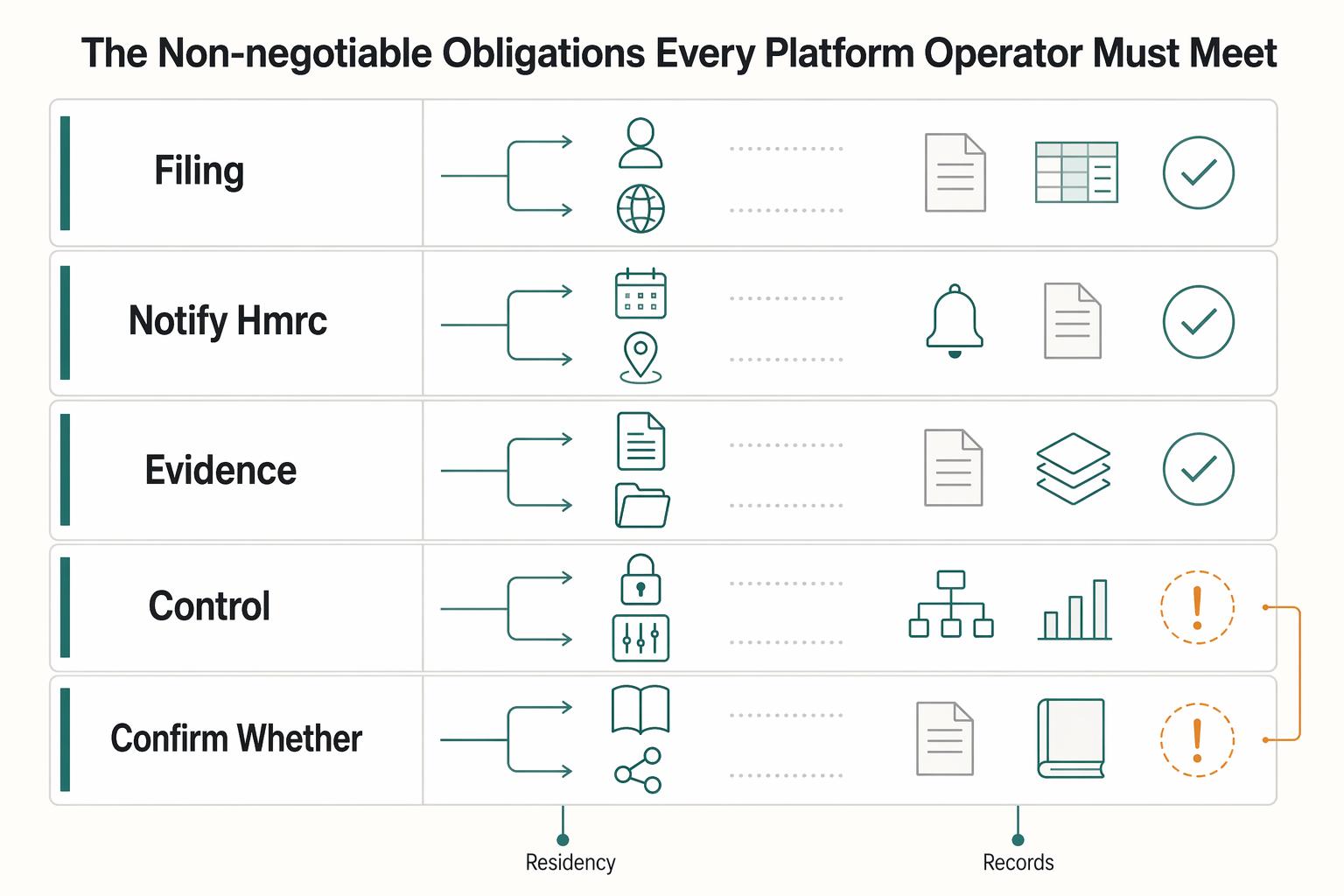
The non-negotiable obligations every platform operator must meet#
The obligations you can treat as proven now are account readiness, timely HMRC notification where the first-time or previously inactive filer scenario applies, and record retention. Platform-specific reporting controls should be treated as required-to-verify items until you confirm the current HMRC platform guidance and manual text directly.
| Obligation | Legal or guidance anchor | Internal owner | Evidence retained | Failure consequence |
|---|---|---|---|---|
| Confirm HMRC account status and access before filing work starts | GOV.UK Self Assessment registration guidance | Compliance ops or tax operations | Login test, account status confirmation, reactivation ticket if needed | Filing can be delayed if an existing account was not reactivated before submission work |
| Notify HMRC by 5 October where the first-time or previously inactive filer scenario applies | GOV.UK registration pages | Tax owner | Registration confirmation, dated notification record | HMRC says late notification could result in a penalty |
| Keep records needed to complete the return correctly | GOV.UK registration guidance | Finance data owner with compliance oversight | Record retention schedule, source extracts, bank statements or receipts where relevant | Weak support for the return and poor audit defence |
| Confirm whether you must identify in-scope sellers, submit a digital platform report, and provide seller copies before building controls | Current GOV.UK platform guidance and the International Exchange of Information Manual, including IEIM904500 where relevant | Compliance lead with tax review | Requirement memo, scope decision log, seller communication proof | If you assume obligations without confirming source text, you can build the wrong process |
| Confirm whether XML, schema/business-rule checks, and residency checkpoints apply before final submission | Current HMRC platform technical guidance and the International Exchange of Information Manual, including IEIM906100 where relevant | Engineering plus tax | Validation outputs, business-rule results, residency determination notes | Unverified assumptions can create late-stage rejection or challenge risk |
- Treat access and timing as day-one controls. Confirm the account works before data assembly starts, and document the 5 October 2025 notification rule where it applies.
- Do not treat platform-specific duties as settled until you have the exact source text in your evidence file. Build from a short requirement note tied to current HMRC guidance and manual paragraphs.
- Use technical and residency checks as explicit gates only after source confirmation. Keep each gate mapped to the rule you are relying on.
For a step-by-step walkthrough, see Beneficial Ownership Reporting in 2026 for FinCEN BOI Decisions.
Best ownership model for reporting operations across compliance, tax, and engineering#
There is no single evidence-backed "best" internal owner. The practical choice is to align ownership to your main failure risk and make one accountable owner responsible for three confirmed checkpoints: account access works before filing, any required HMRC notification is made by 5 October 2025 in the relevant case, and records are retained to support the return.
1. Compliance led with tax counsel escalation#
Use this when interpretation risk is your main concern. Compliance can own calendar control, evidence retention, and go/no-go decisions, with tax providing written positions on exceptions before submission.
The strength is defensibility and traceability. This model supports clear proof that login/access was tested, reactivation was handled where needed, notification was completed on time in the applicable case, and supporting records were kept.
The tradeoff is slower change cycles if every edge case waits on formal review. To avoid drift, require a short written exception note and store it with the filing evidence.
2. Tax led with engineering data steward#
Use this when data integrity risk is the main issue. Tax owns rule application and filing accountability, while engineering owns source data quality, transformation controls, and pre-submit checks in your confirmed filing process.
The strength is better quality at source. Use the HMRC online filing window as a planning anchor: filing is available on or after 6 April following the end of the tax year, so access checks and data stability should both be ready before the submission period opens.
The tradeoff is blurred incident ownership during failures. Keep one explicit tax sign-off on reporting logic and one engineering sign-off on data readiness and access status.
3. Risk led central control tower#
Use this when consistency across multiple entities is your main concern. A central risk function sets one evidence standard and escalation route, while local teams execute filings.
The strength is consistency. Each entity can be held to the same minimum evidence: tested access, dated notification proof where applicable, and retained records that support reported figures.
The tradeoff is governance overhead and distance from local blockers. Keep a named local owner per entity and a regular status checkpoint through the filing cycle.
If your primary risk is bad data, put engineering QA in the critical path. If your primary risk is interpretation, require written tax or legal sign-off before submission to HMRC. If uncertain, use your last near-miss pattern to decide.
If you want a deeper dive, read FATCA Compliance for Marketplace Platforms: Identifying and Reporting Foreign Account Holders.
Best pre-submission evidence pack to survive audit and internal challenge#
The control that most improves audit defensibility is a single, locked evidence pack for each submission. Do not spread proof across inboxes, tickets, and ad hoc exports.
- Freeze one filing packet per submission.
Keep one signed-off packet with the source extract used, dated verification logs, proof account access worked, and reactivation evidence if an existing account needed reactivation. Include the records used to complete the return (for example, bank statements or receipts), and keep proof of any required HMRC notification in scope. If your filing route also generates schema-validation output, business-rules-check output, or a final digital platform report file, retain those outputs with a version ID or hash and a clear preparer/reviewer trail.
Main failure mode: the extract or file changes after approval, so submitted output no longer matches the evidence file.
- Keep seller-notice proof at recipient level.
A generic "email sent" status is not enough for internal challenge. Store the template version, recipient list, send timestamp, bounce/suppression logs, and resend history so one seller's notice trail is reconstructable. The outline references IEIM904500, but its content should be verified separately before finalizing controls.
- Use a short memo for disputed or changed residence cases.
When residence is unclear or changes late, keep a dated decision memo with facts considered, conflicting indicators, conclusion, and approver, plus the documents actually used. The outline references IEIM906100 and reportable-jurisdiction rules, but those are not substantiated, so do not rely on memory.
- Create a third-party reliance file for outsourced steps.
If a vendor handles extracts, notices, or technical checks, retain scope, control attestations, vendor check outputs, and your review note of what was accepted or challenged. The accountability position for outsourced platform reporting should be confirmed separately, and evidence should be kept as if you will need to reproduce it yourself.
Best incident triage when filing is on time but fails HMRC checks#
If your filing is on time but fails a check, protect the deadline and traceability first: contain one failing artifact, confirm account and filing-channel prerequisites, then make the smallest possible correction.
A compact incident matrix keeps ownership and escalation clear while time is tight. GOV.UK is clear that missing the filing deadline can trigger a penalty, and it also notes filing can be delayed if an existing account was not reactivated, with some filing types excluded from the online service.
| Failure type | Immediate containment | Root-cause owner | Resubmission path | Escalation trigger |
|---|---|---|---|---|
| Structural file defect (for example, a schema or mapping issue in your process) | Freeze transforms, input extract, and mapping version; do not rerun a broad refresh | Engineering or data owner | Patch the transform or mapping, regenerate from the same frozen extract, retain before/after outputs | Escalate if the failure may be account status or filing-channel eligibility, not file structure |
| Logic-level check failure (for example, a business-rule failure in your process) | Group failed records by rule family and volume before editing | Reporting operations with compliance review | Correct highest-impact blockers first and keep a record-level change log | Escalate when resolution depends on policy interpretation, not only data correction |
| Incomplete verification near cutoff | Ring-fence affected records and stop broad profile overwrites | Compliance owner with legal review | Run targeted outreach, then document inclusion/exclusion and rationale | Escalate to governance when gaps are widespread or risk acceptance is needed |
Schema validation failure#
Treat structural rejects as a controlled transform incident, not a full data-refresh incident. Reproduce the rejected file from the frozen extract, patch only the mapping or structure issue, and regenerate from the same baseline so your audit trail stays intact.
Business rules checks failure#
Treat logic failures as pattern triage, not ad hoc record edits. Group by failure family, clear the highest-impact blockers first, and preserve a record-level history of what changed, why, and who approved it.
Incomplete seller verification near cutoff#
Handle late verification gaps as a documented governance decision, not an informal rush fix. Use targeted outreach when gaps are concentrated; if they are broad, escalate quickly and document the rationale for any risk-based decision.
Best cross-border control choices for UK platforms with non-UK sellers#
Use one verified seller identity and tax profile, then map outputs by regime. For most platforms, that is the lowest-friction way to reduce reconciliation drift across UK, EU, and U.S. obligations.
GOV.UK describes a consultation (announced at Budget 2021) on implementing the Organisation for Economic Co-operation and Development (OECD) Model Reporting Rules for Digital Platforms, including reporting and exchange mechanics. That is useful context, but it is not the same as a final platform-filing specification.
| Seller mix | Control depth | Exception handling |
|---|---|---|
| UK-resident dominant base with a smaller non-UK segment | Keep baseline collection proportionate, then deepen review where cross-border facts are present | Use a defined review path and documented reason codes for incomplete or disputed records |
| Mixed-residency base | Collect deeper profile data earlier so reportability decisions are consistent | Keep clear evidence and change history so exceptions can be explained and defended |
Add overlap checkpoints early. If your population also touches DAC7, compare field definitions and residency logic before building a separate extract; this section does not provide DAC7 filing detail, so treat that step as legal and mapping review. If useful, see DAC7 Compliance for Platforms: Reporting Rules Deadlines and Implementation.
The UK rules use the same OECD reporting format as DAC7, so the structural traps are shared: an empty quarter where a zero was meant, an amount carrying decimals where the element takes whole units, a rented property reported once for the seller instead of once for each listing. DAC7 and DPI reporting for platforms sets out the elements and the requirement level of each, and the seller data checker runs those structural checks over a CSV export in the browser.
Keep U.S. FATCA analysis in its own lane. IRS guidance says some taxpayers may need Form 8938, the FBAR, or both, and Form 8938 materials reference thresholds such as $50,000 in general and $50,000 / $75,000 for some specified domestic entities, with possible exceptions under the instructions. Those are not UK platform-reporting thresholds.
Where guidance is clear and where specialist advice is mandatory#
Use published GOV.UK/HMRC process guidance for routine filing operations, and treat interpretation-heavy cases as legal/compliance decisions, not workflow tweaks. The GOV.UK item referenced here is explicitly a consultation, so it sets direction but does not settle every edge case.
Just as important, several areas remain unresolved. An exhaustive UK exemptions map, complete UK penalty mechanics, and a complete required-field definition for every scenario are not provided here, so those gaps should be tracked in a formal issue log with an owner and sign-off date.
Specialist advice is mandatory when classification is arguable, residency indicators conflict, or UK treatment appears to diverge from DAC7 or FATCA analysis. IRS FATCA guidance itself says to check Form 8938 instructions for possible exceptions and notes that some exemptions do not change section 6038D obligations; if a case also touches U.S. penalty exposure ($10,000, up to $50,000, or 40 percent), escalate before applying that logic to UK reporting.
Related reading: Form 8621 PFIC Reporting for US Expats Without Guesswork.
What operators should do next#
Keep the next step proportionate: implement a small control set that prevents missed submissions, bad data, and weak evidence, then escalate unresolved legal edge cases early.
- Write an obligation map and assign named owners. Track each current duty in a short register: requirement, source on GOV.UK or HMRC guidance, internal owner, retained evidence, and escalation path if submission is blocked. Assign explicit accountability for data readiness, filing access, and final sign-off.
Before any filing window, confirm the account or service path can still access the relevant HMRC channel. In Self Assessment guidance, HMRC warns a return may be delayed if an existing account is not reactivated; treat that as an operational warning for submission readiness, not as a platform-rule definition.
- Prioritize data verification and controlled file validation. Verify high-risk seller data at source, freeze mapping changes close to submission, and run a pre-submit validation step on the XML file before treating it as filing-ready. Retain the source extract, validation output, final file version or hash, and any rejection messages.
If a file fails, preserve the first attempt and the full resubmission trail so you can show what changed, when, and why.
- Keep scope honest and escalate early. Use what GOV.UK and available HMRC material clearly require now, and do not import rules from unrelated processes to fill gaps. The Self Assessment dates 5 October, 31 January, and online filing from 6 April are real for that regime, but they are not a substitute calendar for platform reporting obligations.
For unresolved classification, residency, or third-party responsibility questions, route to specialist review while there is still time to adjust data collection, seller outreach, or filing decisions.
Retain records as if you may need to defend the submission later. HMRC is explicit in Self Assessment guidance that records are needed to complete returns correctly; apply that same evidence discipline here with a complete submission packet, not just a "file sent" status.
Frequently Asked Questions
Who must report to HMRC under the reporting rules for digital platforms?
Do not assume who is in scope for platform reporting, and do not rely on assumptions to make an operator-scope decision. One easy mistake is borrowing unrelated thresholds such as the £1,000 sole trader threshold, which is about a person registering for tax in a tax year running 6 April to 5 April, not about whether a platform operator must report.
What exactly has to be submitted in a digital platform report?
These materials do not list the required fields for a digital platform report, so you would need the current HMRC platform specification rather than using Self Assessment pages as a proxy. As a control, keep a versioned field map and note which source document supports each field.
What must be sent to sellers, and when?
This guide does not specify seller-copy content or timing for platform reporting. That means you should not import dates from other HMRC processes, such as 5 October 2025 or 31 January, because those belong to Self Assessment obligations and payment timing, not seller notices under this regime.
What happens if we submit on time but our XML file fails checks?
Do not assume a timely upload equals a valid filing without checking platform XML schema validation and business-rules failures. A relevant HMRC lesson does exist: with Self Assessment, HMRC says a return "may be delayed" if you file without reactivating an existing account. If your platform file fails, preserve the original file, error output, and resubmission trail rather than treating the first upload as the end of the issue.
If we use a third-party reporter, who is still legally responsible?
This guide does not resolve legal responsibility where a third party prepares or transmits the report. Treat responsibility as unresolved here, and keep the contract scope, control attestations, and named internal sign-off ready for review.
How should we handle sellers in other reportable jurisdictions?
Cross-border handling is not detailed here, so avoid making residency calls from partial evidence alone. If seller indicators conflict, hold a short decision memo with the data you relied on and escalate the case.
How does this relate to DAC7 and other cross-border reporting obligations?
Do not assume DAC7 or other cross-border platform rules are equivalent to the reporting rules for platforms. Treat them as separate obligations until you map the rules side by side. If that is your current problem, read DAC7 Compliance for Platforms: Reporting Rules Deadlines and Implementation.
Try a related tool
Researched and edited by the Gruv editorial team. Gruv builds cross-border billing, payouts, and finance-operations software for global businesses.
Sources
Includes 2 external sources outside the trusted-domain allowlist.
Educational content only. Not legal, tax, or financial advice.
Related Posts

Choosing DAC7 Compliance Platforms Without Overbuilding
Start with operating reality, not feature grids. This section is for compliance, legal, finance, and risk owners who need a defensible decision, not a generic explainer. The goal is practical: make a faster scope call, choose an approach that fits your entity and data setup, and get through reporting with fewer surprises.

FATCA Compliance for Marketplace Platforms: Identifying and Reporting Foreign Account Holders
For marketplace teams handling cross-border payouts, FATCA work is mostly a control-design problem. You need to decide what to implement first, what evidence to keep, and what to escalate before a payout creates avoidable reporting or withholding risk. The practical question is not whether FATCA exists, but which controls actually reduce reporting errors and potential 30% withholding outcomes.
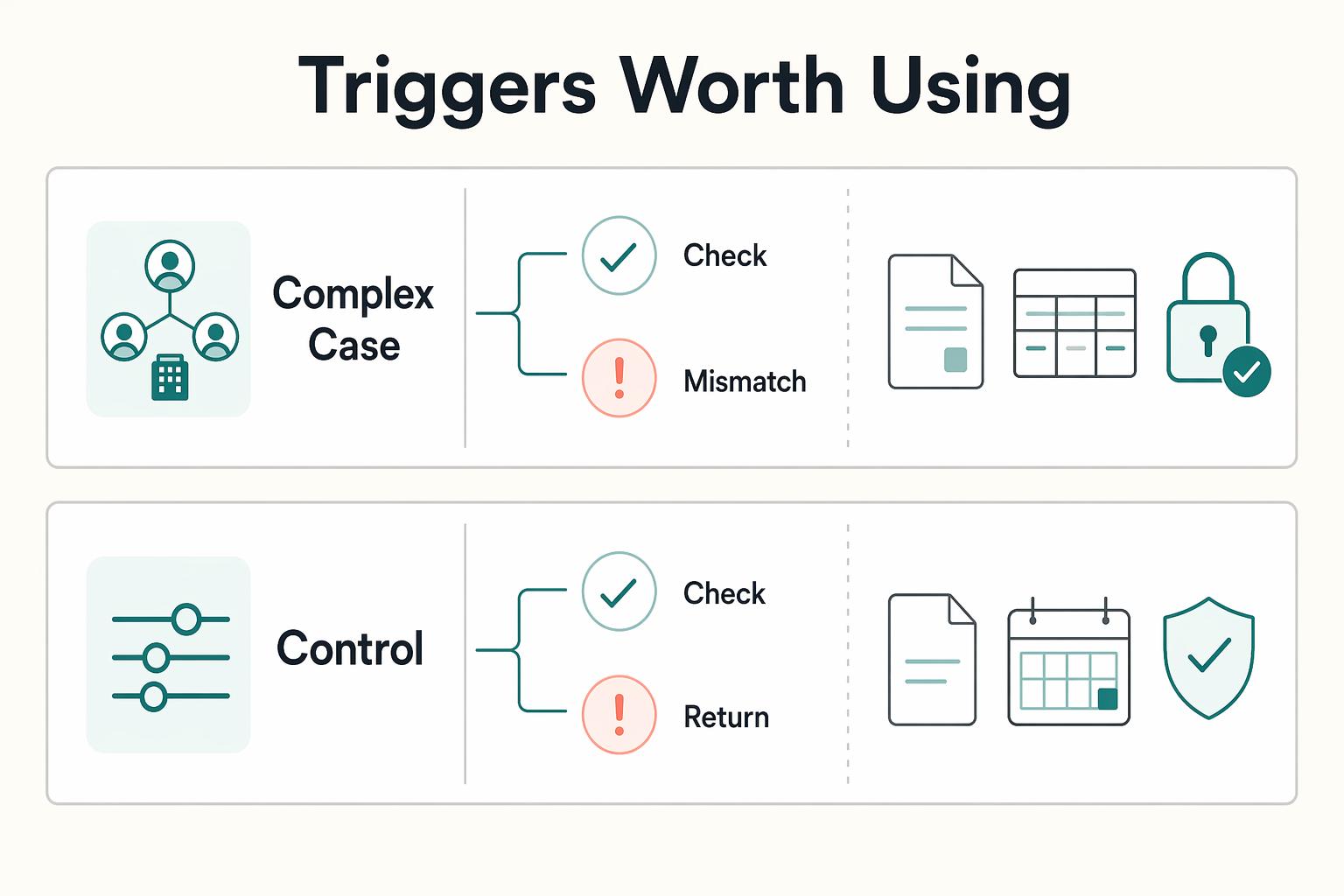
Beneficial Ownership Verification for Platforms Under FinCEN UBO Rules
In 2026, the practical approach is to separate BOI filing scope from ownership-risk controls. Many entities created in the United States are exempt from BOI reporting, but that does not automatically remove ownership-review controls in risk-based onboarding.