
Quick Answer
An S-Corp can claim the ERC only for quarters it can document and defend, and owner wages are not automatically includible. For each quarter, verify either a specific government-order suspension or the applicable gross-receipts decline, confirm the claim is still timely, and keep quarter-level payroll, ownership, and calculation records. If owner-wage treatment or documentation is unclear, pause and get qualified tax review.
The S-Corp Owner's Guide to the ERC: From Eligibility to Audit-Proofing Your Claim#
If you own an S-Corp, your first decision is not how much you might claim. It is whether you can defend an ERC claim quarter by quarter with records that will hold up under IRS review. This is a compliance exercise, not a windfall play. That posture matters because the IRS says ERC claims are under close review.
This guide is for S-Corp owners and business-of-one operators who ran payroll through their corporation during the covered COVID period. It is not about claiming ERC as an individual, because ERC is not available to individuals directly. It is also not enough on its own if your facts involve majority ownership, family attribution, related-individual wage treatment, or an IRS disallowance letter.
Your job is straightforward. Confirm whether a claim is still viable, separate entity-level eligibility from owner-wage eligibility, and build a file you can stand behind before you file, withdraw, or dispute. For most employers, the ERC period ended September 30, 2021. Recovery startup businesses may run through December 31, 2021, and Q3/Q4 2021 late-file limits can control whether a claim is payable.
| Decision point | What to verify | Evidence to prepare | When to escalate |
|---|---|---|---|
| Are you eligible for any quarter? | Government-order suspension impact or required gross-receipts decline for each quarter | Quarterly financial statements, the specific government orders, notes showing operational impact | If the order impact is partial, indirect, or hard to connect to your operations |
| Can your own wages count? | Whether related-individual and majority-owner attribution rules make wages nonqualified | Ownership records, family relationship map, payroll reports, related wage documentation | If majority ownership or family relationships may trigger Section 152(d)(2) related-individual treatment |
| Is the claim still timely and legally payable? | Whether the quarter is within ERC timing and whether Q3/Q4 2021 was filed after January 31, 2024 | Filing timeline, submission proof, IRS correspondence | If Q3/Q4 2021 is involved, because IRS says certain late claims cannot be allowed or refunded after July 4, 2025, even if otherwise eligible |
| What if you already filed or were denied? | Whether to withdraw an unpaid claim or respond to a disallowance like Letter 105-C | Claim copy, proof of nonpayment, disallowance letter, support file | If you received Letter 105-C, want Appeals review, or need to dispute within the 30-day window IRS generally requests |
Use this checkpoint before you move on. If you cannot identify the exact quarter, the exact eligibility path, and the exact records you would provide in an audit, pause and bring in a trusted tax professional.
If you want a deeper dive, read our guide to a defensible 2026 filing plan.
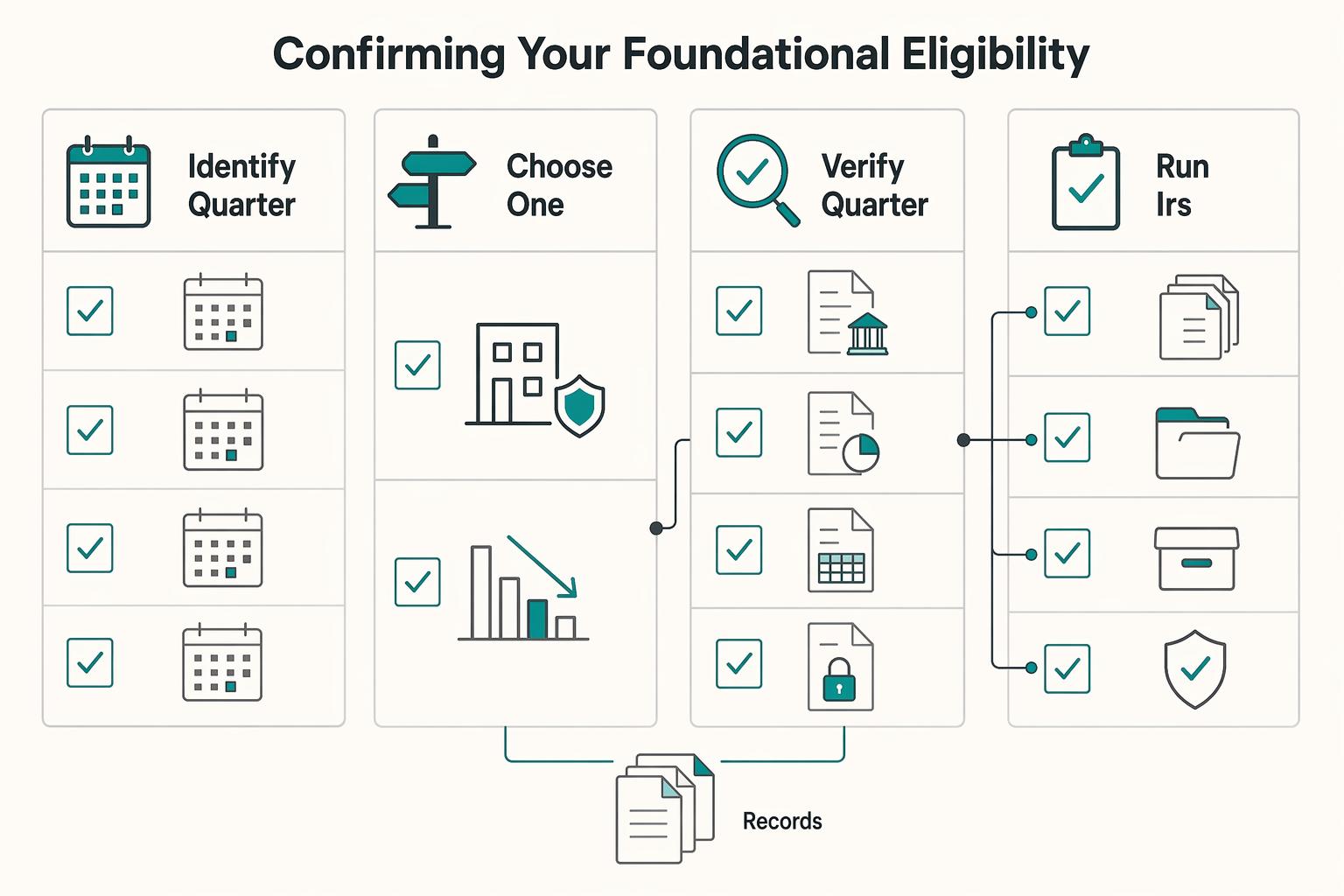
The 5-Minute Self-Audit: Confirming Your Foundational Eligibility#
Start here before you do any wage math. If you cannot tie a quarter to one clear eligibility path and one complete evidence file, pause.
For each quarter, run this review in order:
- Identify the quarter you want to claim.
- Choose one primary path to test first: government-order suspension or decline in gross receipts.
- Verify that quarter using the rules that apply to that period, because ERC requirements differ over time.
- Run the IRS ERC Eligibility Checklist as a first screen, then confirm technical points in the applicable notices, forms, and instructions.
| Period you are testing | Eligibility path | What you need to confirm | Threshold or rule to verify |
|---|---|---|---|
| Quarter under review | Suspension path | A qualifying government order applied to your business and affected operations in that quarter | The period-specific suspension rule that applies to that quarter |
| Quarter under review | Gross receipts path | Your receipts for the quarter were tested against the correct baseline period | The period-specific gross-receipts test that applies to that quarter |
Using the suspension path#
This path depends on connecting a qualifying order to an operational impact. Build a file that can show:
| File element | What to include |
|---|---|
| Governing order | The actual order, issuing authority, and effective dates |
| Operational impact narrative | A short memo explaining what changed in your operations during the quarter |
| Business records | Records that connect the order period to disruption in delivery, revenue activity, scheduling, or operations |
If your story relies mostly on broad economic conditions rather than a specific order's effect on your operations, pause.
Using the gross receipts path#
When your books are reliable, this can be a cleaner path. Keep quarter-by-quarter statements, use one consistent comparison method, and document the exact report and baseline used for each quarter.
Treat technical edge cases as escalation triggers#
If your file involves interactions or special situations, do not rely on this quick screen alone. Confirm treatment in current technical guidance before filing.
That extra review matters. IRS and Taxpayer Advocate materials flag improper-claim risk. Processing has also been slow since the September 14, 2023 moratorium, with nearly 1.2 million claims remaining as of October 26, 2024 and average processing times of more than a year for claims closed in 2024.
If the facts are borderline or the documentation is incomplete, stop the self-review and route the file to a qualified tax advisor for validation.
Related: Do I Have to Pay State Taxes While Living Abroad as a Digital Nomad?.
The Million-Dollar Question: Can You Claim the ERC for Your Own Salary?#
Resolve this before you run any wage calculations. The real issue is not just whether you paid yourself through payroll. It is whether your owner-wage position is clearly supportable for the specific quarter you are claiming. If it is not, pause there.
Use the IRS FAQ and ERC Eligibility Checklist as a first screen. Then validate technical points in current notices, forms, and instructions. That extra step matters because the IRS flags incorrect claims, and ERC requirements differ depending on the time period claimed.
A plain-language decision tree for each quarter#
- Confirm your ownership and payroll facts for the quarter you want to claim.
- Use the IRS ERC Eligibility Checklist as an initial screen.
- Validate technical points in current notices, forms, and instructions for that same quarter.
- If treatment is still unclear, do not include your wages yet.
- Keep quarter-specific records of your analysis, then move to qualified wage calculations and filing prep.
Common owner scenarios#
Use this table to set your risk posture, not to force an answer. Your ownership analysis and payroll support should match the same quarter.
| Owner scenario | Likely treatment posture | Required validation before including your wages | Documentation to keep |
|---|---|---|---|
| Owner-wage treatment is unclear for the claim quarter | Unclear; not an automatic yes or no | Whether current technical guidance supports your treatment for that quarter | Quarter-specific ownership records, payroll records, and written analysis tied to current guidance |
| Facts appear straightforward, but you have not validated against current technical guidance | Still verification-dependent | Whether notices, forms, and instructions support your approach | Quarter-specific ownership and payroll records, plus notes showing what guidance you used |
| Facts were reviewed for a prior period, but not for this quarter | Quarter-specific re-check required | Whether period-specific ERC requirements change your result | Quarter-specific records and a short memo of your period-by-period review |
Treat any "exception" as conditional, not as a loophole#
You may hear about owner-wage "exceptions." Treat any such claim as conditional and verification-dependent, not as a shortcut.
Before filing, keep one clean file with the claim quarter, ownership records, payroll amounts included, and a short written explanation of your conclusion. If you later think your owner-wage treatment may be wrong, use IRS correction pathways, such as withdrawal or amendment, rather than leaving the claim uncorrected. If treatment is ambiguous, pause and seek written tax advice before filing.
For a step-by-step walkthrough, see A Guide to Handling an ERC Audit.
Maximizing Your Claim: A Framework for Capital Recovery#
The strongest claim is not the biggest number on paper. It is the one you can recalculate by quarter, reconcile to records, and explain clearly if reviewed. Start with defensibility, then do the math.
What counts and what does not#
Keep ownership analysis separate from wage math, and do not include any compensation position that is still unresolved.
| Component | Treatment in calculation | What to retain |
|---|---|---|
| Payroll compensation already validated for the claim quarter | Include | Quarter payroll detail and your eligibility support for that wage bucket |
| Employer-paid health plan amounts | Potentially includable only after period-specific ERC verification | Plan-cost support and your verification notes for that period |
| Owner draws, distributions, and other non-payroll transfers | Keep separate from payroll wage totals; only treat as qualified wages if ERC-specific authority supports it | Ledger/payroll separation showing how these items were classified |
| Wages that may overlap with other relief or payroll-based credits | Hold out until allocation is documented | Allocation worksheet and supporting program records |
Compute quarter by quarter#
Use one worksheet per claim period and apply only inputs you have already verified.
| Claim quarter | Credit rate to apply | Wage cap to apply | Period rule set used |
|---|---|---|---|
| Claim quarter pending review | Verified rate for that quarter | Verified cap for that quarter | Verified rules for that quarter |
Use this calculation sequence:
- Pull quarter payroll totals.
- Remove nonqualified or unresolved amounts.
- Add only verified includable health-plan amounts.
- Apply the verified period wage cap.
- Apply the verified period credit rate.
- Reconcile the result to payroll and filing support.
Handle overlap before filing#
Before you send the amended return, do this:
- Write a short allocation memo stating which wage dollars were assigned to which program and why.
- Segregate wage buckets so the same dollar is not used twice.
- Retain the underlying support files, including payroll detail, period labels, and related program records.
Your calculation only holds up if the file does. Keep one complete package with quarter worksheets, the allocation memo, the submission copy, proof of filing or mailing, and a notice log. That matters because IRS business notice handling follows formal notice-review procedures and checkpoints. Amended-return refund delays and unclear disallowance notices can harm taxpayers and jeopardize administrative or judicial review rights, so complete records matter.
For related tax-planning context, see A Guide to the Lifetime Learning Credit for Freelancers.
The Audit Shield: Bulletproofing Your Claim Against IRS Scrutiny#
Treat ERC as an audit workflow, not just a filing workflow. Before you submit anything, build a quarter-by-quarter file that shows two things: why you qualified and how you calculated the claim.
The IRS says it is closely reviewing ERC-claiming returns because of many improper claims. Plan around close review and potentially slow timelines, not a quick refund cycle. The Taxpayer Advocate reported average processing time of more than a year for ERC claims closed through September 2024.
For any 2021 Q3 or Q4 claim, verify whether the OBBB section 70605(d) limitation applies, especially for certain new claims filed after January 31, 2024. Also treat FS-2025-07 (Oct. 22, 2025) as context, not binding authority for case resolution.
Build the audit file before filing#
Organize the file by quarter and by evidence type, with each item tied to what it proves:
| File item | What to keep | What it shows |
|---|---|---|
| Filed returns and amendments | Copies of what you filed for each claim quarter | Exactly what was submitted and how claim amounts reconcile to your quarter worksheets |
| Payroll support | The payroll records used in your wage calculation | Wages were paid in the ERC window, from March 13, 2020, to Dec. 31, 2021, and your math ties to the filed claim |
| Eligibility proof | Records for the path used in each quarter | Either the required gross-receipts decline in the relevant 2020/2021 period or shutdown due to a government order |
| Government-order impact narrative | A short narrative linking the exact order to affected operations and dates | Specific, order-based impact rather than general pandemic conditions |
Match the evidence to the path#
Do not mix methods loosely. Each quarter should rest on a clearly documented path with its own support.
| Eligibility path | What to include | Common weak point | How to strengthen it |
|---|---|---|---|
| Gross receipts decline | Quarter-level records for the claim period and the comparison period used in your analysis | Claim numbers do not reconcile to the comparison period | Reconcile quarter totals before filing and keep the comparison logic in the file |
| Government order impact | The specific federal, state, or local order plus your business-impact narrative | Reliance on general COVID disruption without a specific order | Identify the exact order, dates, and affected operations, then connect them directly in writing |
If the receipts path does not reconcile, fix that first. If the order path does not start with a specific government order, do not use that path.
Screen advisors before you engage#
This is a real risk area. The IRS has warned about promoters who oversimplify or misrepresent ERC eligibility and push ineligible claims. Prioritize advisors who document method, assumptions, and defense steps. Ask these three questions up front:
- Which eligibility path applies to each quarter, and what evidence do you need before any calculation?
- Will you provide written assumptions, including key inclusion and exclusion decisions?
- If the IRS questions or disallows the claim, what is the response plan and which file components support it?
If you later determine the claim is incorrect, the IRS says withdrawal can help reduce future exposure to audits, repayment, penalties, and interest. That relief is only available if the claim has not been paid or a received check has not been cashed or deposited. If the IRS disallows the claim with Letter 105-C, you may request an administrative appeal, review by the IRS Independent Office of Appeals, or file suit.
You might also find this useful: What to Do If You've Been Misclassified as an Independent Contractor.
Before you file, turn your checklist into a working process so eligibility support and payroll records stay consistent in one place. Start with Gruv Docs.
Three checkpoints that must pass before you file each quarter#
You are filing-ready only when three checkpoints pass for each quarter: eligibility path, owner-wage treatment, and documentation readiness. If one checkpoint fails, pause that quarter.
| Checkpoint | What to verify | Action if it fails |
|---|---|---|
| Eligibility path | Documented gross-receipts decline or a specific government order tied to a real operational impact in that quarter | If you cannot show that chain with records, mark the quarter fail and stop calculations for it |
| Owner wages and wage overlap | Whether majority-owner and family-member wage treatment makes wages nonqualified, and whether wages used for PPP forgiveness were also used for ERC | If ownership attribution or related-party facts are not clear, escalate that quarter to a qualified tax professional before including owner compensation |
| Documentation readiness | Payroll records, quarter-level wage workpapers, eligibility support, and a short memo showing eligibility logic and wage exclusions | If you already filed and later find the claim is ineligible, check whether withdrawal is still available |
Checkpoint 1. Eligibility path (pass/fail)#
Work quarter by quarter and force a yes or no decision. For most employers, you need either documented gross-receipts decline or a specific government order tied to a real operational impact in that quarter. If you cannot show that chain with records, mark the quarter fail and stop calculations for it. If you are relying on recovery-startup treatment for late-2021 quarters, verify that path separately before proceeding.
Form 941-X is still the retroactive claim path, but only if the limitations period is open for that quarter. Confirm the filing status and timing for each quarter before you prepare the amendment. Treat 2021 Q3 and Q4 with extra care: after July 4, 2025, refunds for those quarters are limited when claims were filed after January 31, 2024.
Checkpoint 2. Owner wages and wage overlap (pass/fail)#
Do not assume your own W-2 wages qualify. Majority-owner and family-member wage treatment can make wages nonqualified, and family wage inclusion is a known IRS error signal. If ownership attribution or related-party facts are not clear, escalate that quarter to a qualified tax professional before including owner compensation.
Run a separate check for PPP overlap. Wages used for PPP forgiveness cannot also be used for ERC.
Checkpoint 3. Documentation readiness (pass/fail)#
Your file should let another reviewer reproduce the claim without guesswork. Keep payroll records, quarter-level wage workpapers, eligibility support (gross-receipts records or the specific government order), and a short memo showing eligibility logic and wage exclusions. If you already filed and later find the claim is ineligible, check whether withdrawal is still available.
Use this decision framework:
- Proceed: all three checkpoints pass for the quarter.
- Pause: timing, wage treatment, or support is incomplete.
- Escalate: owner wages, family wages, PPP allocation, or partial-suspension facts are involved.
Take these next actions now:
- Mark each quarter as pass or fail on eligibility.
- Note any quarter whose filing status still needs review.
- Get written owner-wage review where needed.
- Reconcile ERC wages against PPP-forgiveness wages.
- Assemble the quarter file before preparing Form 941-X.
- File only when the record is complete enough to defend.
This pairs well with our guide on A Guide to Employee Handbooks for a Remote-First Company.
If you want help reviewing your compliance workflow for cross-border payments and audit-ready recordkeeping, talk to Gruv.
Frequently Asked Questions
Can you claim the ERC on your own S Corp wages?
Do not assume your own shareholder wages qualify just because you ran payroll. Owner-wage treatment is fact specific, so include those wages only after a qualified tax professional reviews your exact structure. If wages are includible for specific quarters, keep that written analysis in your quarter file before you file.
What is the filing deadline?
The filing deadline is quarter specific, so verify the window for each quarter before preparing Form 941-X. Section 70605(d) adds a separate limit for certain 2021 Q3/Q4 claims, including a July 4, 2025 limit on allowing or refunding claims filed after January 31, 2024. Check the current window for each quarter before you calculate wages or prepare Form 941-X.
How do you prove a partial suspension of operations?
Use this path only when you can connect a specific government order to a specific operational impact during a specific period. Keep the order, its dates, records showing what operations were affected, and quarter-level workpapers. If you cannot show that order-to-impact chain, use a different path or escalate for review.
Is it safe to claim now?
Claim only when your eligibility path, wage treatment, and documentation all reconcile for each quarter. Increased scrutiny and delays mean your support file needs to be clean before submission. If you already filed and later determine you were not eligible, promptly check whether withdrawal is still available.
How do you actually claim it?
Claim the credit retroactively by filing an amended payroll return for each eligible quarter, typically Form 941-X. Keep each quarter separate so your calculations, evidence, and filings stay aligned. Retain filed copies, mailing or submission proof, and IRS follow-up correspondence, and remember ERC is issued by Treasury check, not direct deposit.
Try a related tool
Researched and edited by the Gruv editorial team. Gruv builds cross-border billing, payouts, and finance-operations software for global businesses.
Sources
Educational content only. Not legal, tax, or financial advice.
Related Posts

Digital Nomad Taxes in 2026 With a Defensible Filing Plan
With digital nomad taxes, the first move is not optimization. It is figuring out where you may be taxable, where filings may be required, and what proof supports that position.

Do I Have to Pay State Taxes While Living Abroad as a Digital Nomad?
Living abroad does not end `state income tax` exposure by itself. The first decision is practical: choose a filing position your facts can support, then build records that support the same story all year.

What to Do If You've Been Misclassified as an Independent Contractor
If a business calls you an independent contractor but directs your work like an employee, check the rules for the rights you need to recover. A contract label, LLC or Form 1099 does not decide every legal status. Federal wage law, federal employment taxes and state employment laws can use different tests and provide different remedies.