
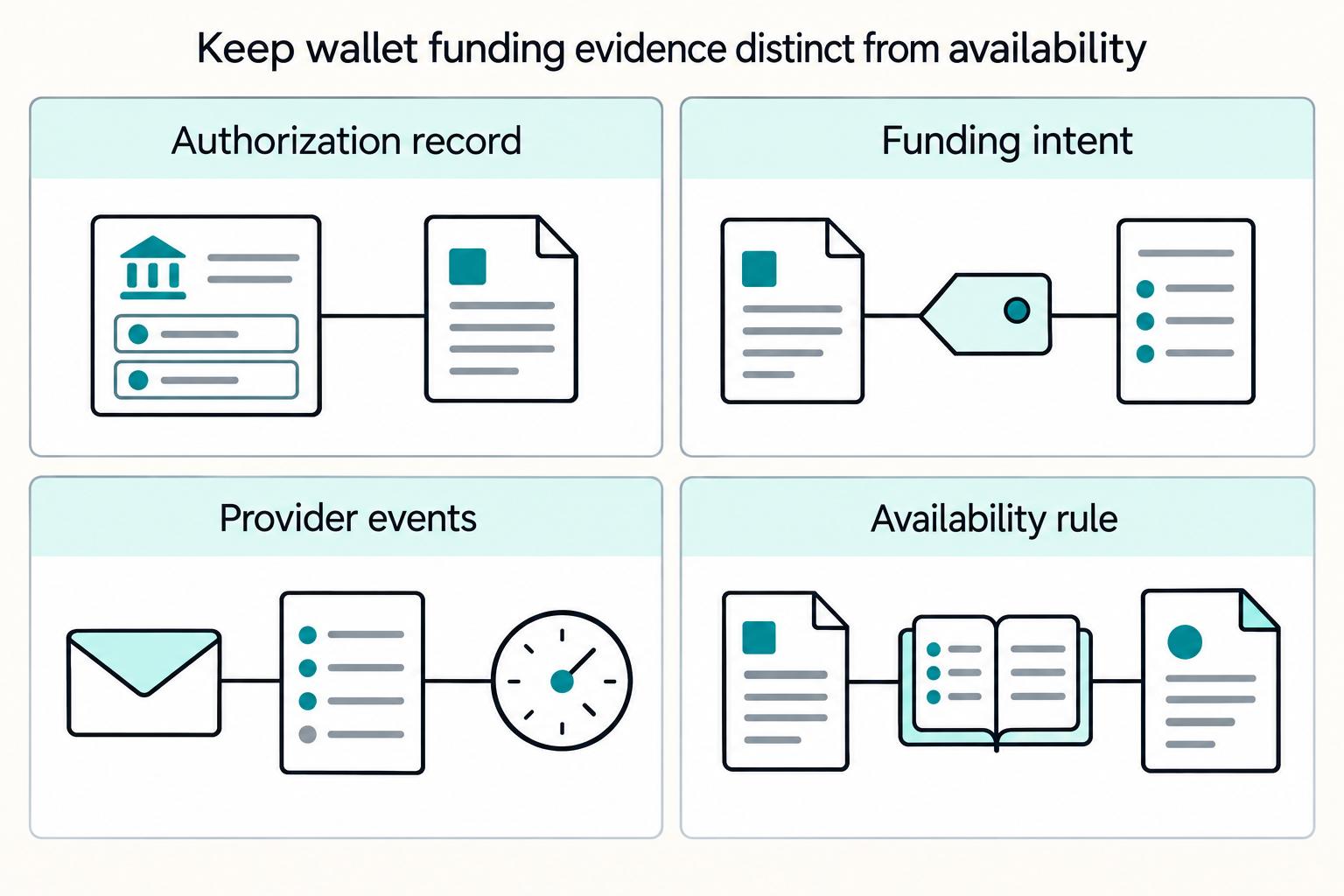
Quick Answer
Use ACH debit for planned bank-linked loads, compare a wire for urgent prefunding within confirmed bank cutoffs, and offer debit-card top-ups only where the funding program supports them. Choose by total fees, actual availability, and return or dispute exposure. Keep initiation separate from spendable balance and preserve each funding attempt and its later adjustments.
How ACH, Wires, and Debit Cards Differ for Wallet Funding#
Choosing between ACH, wire transfer, and debit card for wallet funding is usually an operations decision before it is a speed or unit-cost decision. The rail changes who initiates the movement, how retries behave, and how much cleanup lands on payments ops, finance, and support when something goes wrong.
This article stays focused on practical cases: stored balances, contractor wallets, and treasury workflows where funds move into a wallet or balance ledger and need to be traced later. In plain terms, ACH is a U.S. network where depository institutions exchange batched electronic credit and debit transfers. A domestic wire transfer moves funds between two U.S. bank accounts or similar financial services accounts. Debit card funding can use card rails when the wallet program supports it, and that support is program-specific rather than universal.
That difference matters because customer intent and system design are not the same thing. A one-time treasury top-up, a recurring ACH direct debit, and a card-based wallet load can all look like "add funds" in your product. But they create different requirements for authorization capture, reconciliation, status handling, and support messaging. If your use case is recurring and bank-linked, you will care about debit behavior. If it is urgent treasury prefunding, you will care more about bank-initiated movement and exact payment instructions.
So the useful comparison is not "which one is fastest and cheapest?" It is "what breaks, who owns it, and what proves the wallet should be credited?" Two checkpoints help early. First, verify that the rail is actually enabled in your target program and market, especially for debit card loading. Second, define the minimum evidence required before posting to stored balances, such as a provider reference, your internal transaction ID, and a clear completion signal instead of a simple initiation event.
Persist a funding intent and deduplicate provider attempts and incoming events. Use provider idempotency keys where supported, but also prevent duplicate wallet journals internally; a key on the API request alone does not protect repeated webhook processing.
This pairs well with our guide on FFC vs FBO vs FAO Wire Transfer Instructions for Platform Teams.
Start with the funding rail mental model#
Choose the rail as a control decision first, then optimize for speed and cost. ACH is bank-to-bank movement on the ACH network, wire transfer is bank-transfer movement with immediate, final, and irrevocable processing once processed on Fedwire, and debit card funding is a card-rail wallet top-up only where the program supports eligible cards or accounts.
The same in-product action, "add funds," can represent different operating models:
- Recurring ACH direct debit: you are pulling from a linked bank account, and authorization must exist before the initial ACH submission.
- One-time ACH funding: ACH can also support one-time debit flows, but you still need rail-specific posting and exception controls.
- Urgent treasury top-up: compare a wire and any supported Same Day ACH option against bank cutoffs and provider availability holds.
For wallet funding, "fastest and cheapest" is incomplete without lifecycle controls. Define, per rail, what evidence allows wallet credit posting, such as a completed or settled signal rather than just initiation, what can be retried safely, and how late status updates are reconciled.
Most teams run multiple rails instead of forcing one method across all intents. In practice, ACH usually handles routine bank-linked flows, wire handles urgency, and debit card funding supports specific UX and coverage needs where enabled. Before you expose card loading in product, confirm program enablement, eligible cards or accounts, and your reconciliation evidence trail.
Compare ACH, wire transfer, and debit card on the decisions that matter#
Use one decision grid before you choose a rail: speed matters, but posting proof, reversibility, and ops load usually decide whether the implementation holds up.
| Decision | ACH | Wire transfer | Debit card |
|---|---|---|---|
| Initiation path | bank-to-bank transfer over the ACH network; direct debit typically requires prior authorization. | bank-initiated transfer, commonly used for urgent treasury movement. | card-rail Account Funding Transaction (AFT) can fund another account or wallet where supported. |
| Expected speed category | Standard and Same Day ACH options; availability also depends on submission time and provider holds. | Fedwire supports same-day settlement; bank cutoffs and wallet matching determine usable balance timing. | can support wallet top-ups where enabled. consistent ACH-vs-wire-style timing benchmarks are limited. |
| Cost pattern | no universal all-in benchmark; include provider fees plus return and exception handling. | fee tables alone are incomplete; include bank fees plus approval and exception handling. no single benchmark fits all banks or account types. | economics depend on program setup and eligibility. broad comparable benchmarks are limited. |
| Reversibility/dispute profile | explicit return and reversal pathways exist and should be modeled. | strong finality once processed on Fedwire. | wallet funding support exists in some programs. reversal or dispute handling varies by implementation. |
| Operational overhead | async outcomes and return handling require disciplined status and evidence tracking. | fewer lifecycle branches than ACH, but instruction accuracy and reference matching are critical. | enablement and provider-specific constraints are often the main effort. no single standard operating model across programs. |
| Implementation burden | ACH | Wire transfer | Debit card |
|---|---|---|---|
| Required data | bank account and routing number are common; direct debit also needs authorization records. | beneficiary and bank instruction data is required; field sets vary by bank. | eligible Visa or Mastercard account plus program enablement. exact field requirements vary by provider and wallet model. |
| Webhook/event complexity | usually multi-stage outcomes: initiation, completion, return, or reversal. | often simpler status trees, sometimes relying on bank confirmation flows. | provider event models differ. standardized wallet-funding lifecycle coverage is limited. |
| Reconciliation effort | tie authorization, initiation, completion, and return or reversal evidence to one ledger story. | accurate reference matching is the control point before wallet credit. | keep network and provider references tied to wallet credit. matching rules vary by provider or program. |
| Support workload | returns and authorization issues create recurring follow-up work. | Instruction errors can be difficult to recover; measure support workload in your own program. | declines and eligibility questions are common implementation concerns. rate and shape of support burden varies by rollout. |
A useful operating rule: define posting proof before launch. For ACH, do not treat "request created" as spendable funds; wait for the completion signal you trust and keep authorization, provider reference, and internal transaction ID together.
For wire, control moves upstream to instruction quality and reference matching. With Fedwire finality, the bigger risk is misapplied internal credit from bad or ambiguous matching, not ACH-style return paths.
For debit card funding, treat availability as program-specific. Wallet funding support exists, but it is not universal, and eligibility guidance can change. Confirm supported cards, regions, and decline handling before you promise the feature.
In practice, a new rail has to deliver operational value, not just look innovative.
Who each rail fits most often:
- ACH: subscription flows and recurring bank-linked loading; can fit contractor ecosystems that can absorb asynchronous outcomes.
- Wire transfer: time-sensitive prefunding after bank cutoffs, receipt, and matching are confirmed.
- Debit card: top-up UX use cases where enablement and eligibility are already confirmed.
If you want a deeper dive, read Debit Card Push Payouts: How Platforms Deliver Funds Directly to Any Visa or Mastercard Debit Card.
Pick the rail with scenario-based decision rules#
Use ACH direct debit for planned bank-linked funding, compare a wire for urgent prefunding after confirming cutoffs, and offer debit-card funding only after program enablement checks.
| Scenario | Rail | Key condition |
|---|---|---|
| Recurring, bank-linked funding in the US | ACH direct debit | Start with ACH when wallet loads are scheduled and repeatable from known bank accounts |
| Same-day, mission-critical funding | Wire transfer | Confirm sending-bank cutoff, receipt, and wallet matching; compare supported Same Day ACH availability. |
| Card top-up experience | Debit card funding | Launch only where Visa or Mastercard setup is confirmed |
| European recurring bank debit flows | SEPA Direct Debit | Use the SEPA branch; euro-only and requires accounts located in SEPA |
Recurring funding versus urgent funding#
If wallet loads are scheduled and repeatable from known bank accounts, start with ACH. Nacha positions ACH for large volumes of scheduled and recurring payments between known counterparties, so it aligns with routine wallet loading patterns.
Fedwire supports mission-critical, same-day transfers, but that does not guarantee same-day wallet availability. Confirm the sending bank’s cutoff, receiving-bank processing, and internal matching. Compare Same Day ACH as well when its limits and your provider’s holds fit the deadline.
Card UX only after enablement is proven#
Confirm the card-funding capability separately from card payouts. Visa Direct distinguishes the Account Funding Transaction used to pull funds from the Original Credit Transaction used to push funds. Enable the supported funding flow with your acquirer or processor, including card, region, limits, and dispute handling.
For high-value wallet loading, bank rails are usually the more predictable base path. Card-rail behavior can vary by market and configuration, so do not treat card funding as a universal fallback for large, operationally critical loads.
Do not force a US pattern into Europe#
Branch by region instead of reusing one domestic pattern globally. US ACH is a U.S. bank-account rail, while SEPA Direct Debit is separate, euro-only, and requires accounts located in SEPA. For European recurring bank debit flows, use the SEPA branch: SEPA Direct Debit.
For each market, compare the actual funding and availability estimates for supported bank and card paths. A familiar network name is not enough to promise the same timing or lifecycle across programs.
You might also find this useful: Embedded Wallet Design Patterns for In-App Balance and Spend Features.
Implement wallet funding in the right order#
Implementation order matters: if request creation runs ahead of linking, authorization, retry rules, and ledger logic, you create duplicate credits and messy exceptions.
Use this sequence as your build baseline, not as a universal provider rule:
- Enable the funding method.
- Complete account or link setup.
- Capture the required authorization.
- Create the funding request.
- Handle status changes asynchronously.
- Post to stored balances only when your availability rule is met.
Start with enablement, then link and authorize#
For bank-debit flows, verify account details and ownership through the method supported by your provider. In a Plaid Link integration, completing Link supplies account access; it does not replace the customer’s debit authorization or guarantee that a transfer is approved.
Keep authorization capture as a separate checkpoint before the first live funding attempt. If you cannot prove authorization or match incoming bank activity reliably, stop before you expose the request path.
Make retries and status changes boring#
Define idempotency before launch. Use an idempotency key so retries do not create duplicate operations, and apply the rule consistently across your relevant payment rails.
Keep one funding intent with a history of attempts and ledger effects, including any late return. Provider idempotency retention is limited; for example, Stripe may remove keys after they are at least 24 hours old. Use durable internal identifiers to deduplicate beyond that window and resolve uncertain attempts before creating another.
Provider event names are not universal. In Plaid Transfer, posted means submission to the network; funds_available identifies release into the Plaid Ledger. Map the equivalent states explicitly for each provider.
Build exception and audit paths before scale#
Handle these exception classes from day one:
- Unmatched bank credits that cannot be tied cleanly to an expected funding record.
- Returned or reversed funds that arrive after initial posting.
- Held/review states that require ops decisions before funds become usable.
Separate provider observation time from the network return deadline. Common ACH returns are due within two banking days of settlement, while certain unauthorized consumer-debit returns use a 60-calendar-day window from settlement. Your provider may deliver the notification later; define late-return handling before launch.
Make each funding event audit-ready by storing provider reference data, your internal transaction ID, and reconciliation export identifiers. Where available, tie movements to balance transaction records so finance can reconcile account-balance changes without manual reconstruction.
Handle failure modes before they hit support queues#
Set one hard rule first: treat "request accepted" as pending, not usable balance. ACH, wire transfer, and debit card failures behave differently, so retries and escalation paths should be rail-specific.
| Rail | Failure class to expect | What the user should hear | Retry or manual action |
|---|---|---|---|
| ACH direct debit | Return after posting, including insufficient funds or unauthorized claims | "Your bank debit is pending review" or "This bank debit was returned" | Do not auto-post to spendable balance at initiation. Review the return reason first. Insufficient-funds cases may be reattempt candidates; unauthorized claims should move to manual review with stored debit authorization. |
| Wire transfer | Misroute or mismatch in identifying details | "We received your wire details and are reviewing the transfer" | Route to manual investigation, not automated retry. Fedwire can rely on the identifying number even if names conflict, and there is no duty to detect that inconsistency for you. |
| Debit card | Issuer decline | "Card declined. Try another card or contact your bank" | Follow processor and network decline guidance. Do not retry a prohibited decline. If guidance is missing, investigate the reason and any uncertain prior outcome before a new attempt. |
An ACH debit can be returned after funds have become available. Consumer and non-consumer accounts have different unauthorized-return rules, and some disputes or warranty claims have separate timelines. Classify the account and return code before deciding whether a debit may be retried.
Put clear ownership on each failure path#
Engineering should own event ingestion, state transitions, and duplicate protection. Payments ops should own manual queues for ACH authorization disputes, wire investigations, and debit-card cases that need issuer-response interpretation. For cross-team handoffs, include the provider reference, internal funding ID, latest status, any return or decline code, and the original ACH authorization record.
For wires, add a second review whenever beneficiary instructions or identifying numbers change. A name match in your UI is not enough when routing can follow numeric identifiers.
Only release balances on availability signals#
Use the selected provider’s availability signal as one input to your release policy. For Plaid Transfer, funds_available means funds are usable in the Plaid Ledger; it does not mean an ACH debit can no longer return. Keep reserves, exposure limits, and negative-balance recovery for post-release returns.
The expensive mistake in contractor wallets is marking "successful initiation" as funded, then allowing payouts before funds are actually available. Tie payout eligibility to availability-level status, not submission status.
Cover compliance and market-coverage constraints without overpromising#
Do not promise universal coverage: funding and withdrawal paths are market- and program-specific. ACH is a U.S. network governed by Nacha, while EFT is a broad label for electronic transfers, not one global rail. Card funding and withdrawal support also depends on provider, country, and institution, so describe availability as "where supported" and "when enabled."
| Checkpoint | What to confirm | Requirement |
|---|---|---|
| Legal and compliance sign-off | Target jurisdictions, entity types, and the AML/KYC path | Keep written approval with any conditions |
| Provider capability confirmation | Country coverage, required capabilities, and local-currency constraints | Verify in production, not only sandbox |
| Production-readiness proof | Capability is enabled and a verified account can fund and withdraw | Missing verification correctly blocks access |
In most launches, the real gate is verification and capability status, not core payment logic. Connected accounts can be blocked from charges or payouts when required verification or capabilities are missing, and requirements vary by country, business type, and requested capabilities. If CIP applies in your program, treat it as part of AML controls and avoid "wallet ready" messaging before KYC or CIP checks are complete.
Before broad rollout, require a short evidence pack and keep it attached to the launch decision. Related reading: Handle ACH Returns and NOCs with One Deterministic Event Pipeline.
Use a launch checklist that finance, ops, and engineering can all sign off#
Use one shared, rail-specific launch checklist with evidence. A generic "payments ready" sign-off is where reconciliation and incident handling usually break.
Capture exact rail requirements first#
Document each funding path you are enabling, including required inputs and required customer actions.
| Rail | Required inputs/actions | Launch note |
|---|---|---|
| ACH or bank debit | Account number, routing number, authorization step | Define when funds post to the wallet versus stay pending |
| Wire | Who initiates, exact instruction format, cutoff handling | Define who validates incoming credits before wallet posting |
| Debit card funding | Acceptance scope by provider and region, required cardholder actions | Define fallback when funding is unavailable or declined |
Keep a small evidence pack per rail: one successful enrollment, one negative path, and the provider reference or transaction ID finance will need for treasury workflows. If bank-debit scope is still open, use GoCardless vs Stripe ACH vs Plaid as the deeper comparison.
Make observability and reconciliation part of launch scope#
Require status visibility that finance and ops can read without engineering log access: initiated, pending, succeeded, returned, declined, and manually reviewed.
For async rails, validate retry and backfill behavior in production. In Stripe's flow, undelivered webhooks can be retried for up to three days, and event retrieval is limited to the last 30 days. Build deduplication for retried events and keep reconciliation exports complete enough for backfills. For retryable API calls, use idempotency keys; Stripe notes keys can be up to 255 characters and may be pruned once they are at least 24 hours old.
Pre-approve bad-day runbooks and rollback controls#
Set internal SLA targets by rail and name escalation contacts. There is no universal return or decline timeline across institutions, so ownership has to be explicit.
For ACH returns, define balance adjustments and who investigates the return code before retrying. For Fedwire-dependent flows, validate the bank’s current customer cutoff and escalation path. Disable new funding on a failing rail while continuing to ingest events and reconcile existing attempts.
For implementation detail, see ACH API Integration to Programmatically Initiate and Track Transfers in Your Platform.
Conclusion#
Use a mix that fits the funding intent, deadline, and exception workload. ACH, wires, and debit cards bring different authorization, availability, and recovery requirements; the right choice is the one your team can operate and reconcile at the required cost.
A bank account can fund the wallet through a debit pull or a customer-initiated credit, wire, or other supported bank transfer. A card-funded load uses the processor’s supported funding flow. Capture that distinction in the product and ledger rather than inferring the rail from the account type alone.
The stronger comparison is the one that makes tradeoffs and failure handling explicit, not the one that stops at definitions. You should be able to explain the speed and cost tradeoffs for wire and ACH, and when debit card funding stays conditional because market or program support still needs confirmation. If you cannot explain who owns exceptions across clearing, settlement, and recording activities, you are not ready to call the rail production-ready.
A practical next move is to make the decision visible and auditable:
- Build a side-by-side matrix for ACH, wire transfer, and debit card with intent, routing path, expected timing category, reversibility profile, and support burden
- Run the launch checklist with product, payments ops, finance, and compliance in the same review so governance is part of the decision, not a last-minute approval step
- Confirm market and program constraints before scale. If card support, limits, or posting behavior are still unclear, keep that rail narrow until you have real production evidence
That is the real takeaway from comparing wallet funding methods across ACH, wire transfer, and debit card. The winning design is the one you can explain, reconcile, and govern when volumes rise and edge cases stop being edge cases.
Frequently Asked Questions
What is the practical difference between ACH and wire transfer for wallet funding?
ACH runs on a batch bank network, so it fits planned, routine funding where you can tolerate asynchronous status changes. In the U.S., a Fedwire transfer is immediate, final, and irrevocable once processed, which is why teams often use it for urgent treasury top-ups. A common mistake is treating an initiated ACH pull like settled money and crediting a wallet too early.
When should a platform use ACH direct debit instead of manual pre-funding?
Use ACH direct debit when the business should pull funds from a linked bank account on a recurring or repeat basis and you have the customer's permission to do that. Manual pre-funding can be a better fit when the customer initiates the transfer themselves or the amount is one-off. If you choose ACH debit, keep authorization evidence and define when funds stay pending versus when they can post to the wallet.
Is debit card funding a good default for contractor wallets?
Confirm card-funding support, eligible cards, limits, availability policy, and dispute handling for the selected program before making it a default. Keep a bank option for recipients or funding accounts the card program does not support.
Which method is usually cheapest to operate end to end, not just at transaction initiation?
There is no universal winner. Routine bank-linked flows are often tested first because they align with repeat funding. Wires may still be the right choice for mission-critical, same-day funding. Card funding can look simple at initiation, but conditional coverage and timing can reduce predictability across programs and regions.
What operational checks are required before enabling each funding rail in production?
For ACH, confirm the exact account and routing data you need, capture permission clearly, and check compliance against the Nacha Operating Rules, which are the foundation for ACH payments. For wires, validate your bank instruction and operational handling before wallet posting. For debit card funding, verify market and program support in production, not just sales materials.
How should teams handle unknowns when provider timelines, fees, or limits are not clearly documented?
Treat undocumented behavior as a launch blocker, not a footnote. Get written confirmation from the provider or bank, run a limited live pilot, and keep the rail behind a feature flag until you have real evidence for timing, limits, and failure states. If the docs are vague, do not promise instant availability, broad regional support, or lowest-cost operation to users or internal stakeholders.
Try a related tool
Researched and edited by the Gruv editorial team. Gruv builds cross-border billing, payouts, and finance-operations software for global businesses.
Sources
- consumerfinance.gov/ask-cfpb/what-is-a-wire-transfer-en-1163trusted
- consumerfinance.gov/consumer-tools/money-transfers-revisions-sep...trusted
- docs.stripe.com/webhookstrusted
- docs.stripe.com/api/idempotent_requeststrusted
- ecfr.gov/current/title-12/chapter-II/subchapter-A/par...trusted
- ecfr.gov/current/title-12/chapter-II/subchapter-A/par...trusted
- federalreserve.gov/paymentsystems/fedach_about.htmtrusted
- federalreserve.gov/econres/notes/feds-notes/pay-by-bank-and-the...trusted
Educational content only. Not legal, tax, or financial advice.
Related Posts
GoCardless vs Stripe ACH vs Plaid for Subscription Platform Rails
This is not a brand pick. It is an operating-model decision for recurring payments on bank rails. At the role level, these options are not interchangeable:
Choosing Visa Direct or Mastercard Send for Debit Card Push Payouts
The core decision is usually not "Visa Direct or Mastercard Send?" in isolation. Start with your recipient card mix, your tolerance for payout exceptions, and how much integration and operational complexity your team can absorb right now.
SEPA Direct Debit for European Subscriptions With Clear Approval and Rollout Checks
**SEPA Direct Debit can support subscriptions, but only if your mandate flow, country scope, and async handling are solid.** It is easy to treat it like just another European checkout option. That is where expansion plans start to drift. For subscriptions, it is an operating model built around prior customer approval, mandate capture, delayed payment status, and post-initiation exception handling.