
Quick Answer
Start with the funding and custody model, then design a ledger and spend controls that match it. A ledger-first balance, provider orchestration and user-controlled onchain wallet can coexist. Choose the combination your team can reconcile and support, with explicit signing, recovery and incident responsibilities.
The Core Design Choices Behind Embedded Wallets#
Choosing an embedded wallet is not just a UX call. It is an operating model choice. The moment you keep wallet actions inside your product instead of sending users to a separate interface, you are also deciding how compliance handling, balance accuracy, and payout timing will work when a spend succeeds in one place and fails in another.
| Decision point | What to decide | Why it matters |
|---|---|---|
| Control ownership | Who owns access, recovery, and signing responsibility | The more control you keep, the more support and compliance edge cases land on your team |
| Failure handling | Where truth lives for in-app balance or spend and whether the balance view is a controlled projection or an optimistic display | You need a visible status chain from user request to provider or chain reference to ledger posting so approved, pending, settled, reversed, or failed states are explainable |
| Launch complexity | Whether you can support retries, duplicate prevention, and incident triage after launch | Faster money movement can raise expectations for timely balance updates and payout visibility |
That is the lens for this guide. Embedded wallets keep users inside the product, which can help completion and continuity, but the backend burden does not disappear. As wallet infrastructure scales, teams still have to handle regulatory pressure, transactional accuracy, and support for multiple currencies or asset types.
Settlement confirmation, bank arrival and chain finality are different events. Match the product promise to the selected rail and asset, and show when a pending amount becomes spendable rather than assuming every real-time confirmation is final.
To make the choice practical, evaluate each pattern against three decision points:
- Control ownership
Separate authentication from transaction authorization. Passkeys authenticate with public-key credentials; OAuth grants access to resources, while OpenID Connect supplies an identity layer. Neither decides who may sign a wallet transfer or recover a key. Name those owners and test the recovery flow.
- Failure handling
Decide where truth lives before you launch in-app balance or spend. If the wallet UI says funds are available but your ledger, payout provider, or rail disagrees, your support queue will feel that immediately. A good checkpoint is to require a visible status chain for each money movement, from user request to provider or chain reference to ledger posting, so you can explain approved, pending, settled, reversed, or failed states without guessing. What matters here is whether your balance view is a controlled projection or an optimistic display that can drift.
- Launch complexity
Before launch, test duplicate requests, rejected transfers, delayed confirmations and support recovery. Delivery speed is useful only if the team can explain the resulting balance and recover without executing the same obligation twice.
This article is meant to help you choose in one pass. We compare the main embedded wallet design patterns for platforms adding in-app balance and spend features using concrete tradeoffs on control, failure paths, and launch effort. The goal is simple: pick a design that matches your operating capacity rather than a vendor story.
Who this list is for and how to choose#
Use this list if you are adding wallet and spend flows inside an existing product, not building a wallet product as the business. Before you compare options, decide who owns user access, who resolves failed or delayed money movement, and which system is your balance source of truth.
- Platform teams embedding wallet flows in their product
This is for product, payments ops, and engineering teams supporting contractor payouts, marketplace balances, or treasury movement. Embedded wallets keep users in your interface rather than pushing them to a separate wallet surface. That usually improves continuity, but it also shifts more support and reconciliation responsibility to your team.
- Not for standalone wallet products
If you are launching a standalone wallet app, extension, or hardware-first wallet experience, use a different decision lens. Those products center on private-key management itself, and wallet type choices change user control, security profile, network support, and feature scope.
- Score ownership and operating model before vendor comparison
Start with three checks: your control model, your key-management approach, and the balance scope your product needs to present. If you need audit-ready reconciliation from day one, favor patterns where the ledger is the source of truth and wallet views are derived projections.
For each payout or spend, make the status chain explainable from user action to external reference to ledger posting. When UI availability gets ahead of that chain, support disputes usually follow.
Embedded wallet design patterns compared#
For mixed fiat and crypto, show separate asset amounts and their pending, reserved and spendable portions. A combined display valuation may aid navigation, but it is not a pool of interchangeable spendable funds. These patterns can coexist: ledger design, provider orchestration and custody answer different questions.
| Pattern | Best for | Custody model | Implementation complexity | Main operational risk | Onboarding dependency | Spend controls | Incident visibility | Chain or rail fit |
|---|---|---|---|---|---|---|---|---|
| 1. Ledger-first embedded balance | Teams that need one in-app balance surface across fiat + crypto | Determined separately; an internal ledger is not a custody model | Medium | User-visible balance and movement state can drift if ledger and execution are not aligned | Existing app authentication or OpenID Connect identity; Passkeys where supported | Strong fit for app-level allowlists and rate limits | Linked ledger, provider and chain evidence | Unified fiat + crypto view; rail/network coverage depends on provider support |
| 2. Orchestration-led embedded wallet | Teams prioritizing faster launch by reusing current onboarding/compliance stack | Determine actual user/service signing and recovery authority | Low to medium | Ownership gaps during incidents if provider/app responsibilities are unclear | OpenID Connect identity, social sign-in, email or Passkeys where supported | Varies by provider and app policy layer | Good if provider and app states are both visible to users/support | EVM, Solana, and fiat-connected paths only where supported |
| 3. Crypto-native in-app wallet | Products where onchain actions are core to the user journey | User-controlled only if signing/export/recovery design establishes it | High | Signing, session, and recovery edge cases can overwhelm support if states are unclear | Passkeys, social, or email auth where supported | Usually requires explicit app-level controls | Depends on how clearly you surface pending/failed/retried/completed states | Primarily onchain flows (for example EVM/Solana) where supported |
1. Ledger-first embedded balance#
A ledger-first approach gives the app a consistent record of balances, reservations and obligations. Reconcile it with the provider or chain; an internal ledger cannot create external funds or override custody and finality.
Set service targets from your own flow and measure creation time, approval success, rejection recovery and reconciliation lag. Keep product targets separate from legal or provider requirements.
2. Orchestration-led embedded wallet#
This is the speed path when you want embedded capability without building every wallet component yourself. It can still keep users in your app and reuse existing onboarding and compliance infrastructure.
Before you commit, lock down incident ownership: who handles retries, reversals, and user-facing status explanations inside your product surface.
3. Crypto-native in-app wallet#
Use this emphasis where onchain actions are central. Test the supported chains, signing prompts, fees and recovery rather than assuming every wallet must offer the same authentication or gas-sponsorship features.
This pattern needs clear in-app status visibility to stay supportable. If users cannot quickly see what happened to an action, incident load rises even when the underlying wallet infrastructure is functioning.
Pattern 1 ledger-first embedded balance with controlled spend#
Use ledger-first design when the product needs explainable obligations, available balances and reserved spend. This complements the custody and execution model rather than replacing either.
- Best fit: control over flexibility
Use this when finance, support, and operations all need the same answer to what changed, when, and why. A ledger-first approach is better suited to that than treating wallet state as the primary record.
Separate balances by owner, asset and currency; keep the external account or wallet reference alongside each entry. Reconcile funding, reservations, spend and corrections so a new product or asset does not silently change an existing balance rule.
- Core design: ledger-first ownership
The differentiator is not wallet UI polish. It is operational ownership of money state in one place your team can inspect and explain.
Test a hypothetical $100 settled balance with a $30 reserved payout: the app should show $70 available and $30 reserved. A concurrent $80 spend must not pass the same availability check. If the $30 payout definitively fails before value moves, release its reservation; if the outcome is unknown, keep it reserved while reconciling. A completed payout reduces the balance to $70 and clears the reservation once, even if its confirmation is delivered twice.
- Tradeoff: more backend discipline
The main cost is ongoing discipline as scope expands. If the ledger is treated like a secondary table instead of the financial record, teams often face avoidable rework later.
Make the reservation and request record atomic in your ledger. Store transfer attempts separately from the original obligation, and use compensating entries for corrections rather than rewriting financial history.
Pattern 2 orchestration-led embedded wallet for faster rollout#
Use this pattern when you need wallet capabilities quickly and do not want to own every signing and key-management layer on day one.
- Best fit: speed over full infrastructure ownership
This is a practical fit when you are adding a crypto tab inside an existing product while keeping your current onboarding, compliance flow, and app surfaces. The wallet layer moves faster when orchestration handles wallet-side mechanics, but your team should still own identity, user status visibility, support flow, and spend or withdrawal rules.
- Core design: orchestration for wallet mechanics, your stack for control clarity
Connect the selected wallet provider to your internal request and ledger records. Keep each operation traceable across user approval, request ID, provider reference, applicable screening result and final ledger effect. Evaluate the provider’s supported signing and export controls directly; an orchestration label does not establish custody.
- Tradeoff: faster rollout, but shared-control boundaries must be explicit
The upside is less in-house burden on cryptography-adjacent operations. The risk is architecture ambiguity: who holds funds, who is liable when something breaks, and whether your roadmap can outgrow a single vendor. Treat those boundaries as a pre-launch requirement in both contracts and system design, and keep spend policy, reconciliation logic, and user-facing status ownership in your stack.
For a broader platform evaluation lens, see Choosing Embedded Finance for Freelance Platforms With an Operations-First Scorecard.
Pattern 3 crypto-native non-custodial experience inside your app#
Choose this pattern when direct onchain interaction is core to the product and happens repeatedly in-session. An in-app non-custodial wallet can reduce MetaMask or Phantom handoff friction, but it also increases your security and support load.
- Best fit: wallet semantics are part of the product, not an edge feature
If your app touches onchain functionality, it is already operating on top of wallet behavior. This pattern makes that explicit in your product surface by keeping signing, account context, and asset actions in-app instead of hiding everything behind a simple balance view. The benefit is continuity across flows like deposit, payout, and rewards.
- Core design: key protection first, signing UX second
Check the exact key type and signing architecture rather than assuming a phone’s secure hardware signs every chain transaction. Apple’s Secure Enclave supports NIST P-256 keys, which differs from the secp256k1 curve used by Ethereum externally owned accounts. It may protect an authentication or authorization key while a separate component performs chain signing. Match hardware, chain and recovery support before choosing the flow.
Keep the implementation scope explicit: wallet provisioning, user and device binding, and understandable signing prompts come first. Additional transaction-flow abstractions can be evaluated later, but should not replace core key and session controls.
- Tradeoff: richer in-app actions, harder incident triage
Native onchain actions bring chain-specific failure handling and security responsibilities: approval scope, compromised sessions, contract behavior, transaction replacement and recovery. Assign the owner of each before exposing repeated in-app signing.
Record request ID, wallet address, chain, transaction hash or operation reference, approved payload and final execution result. Preserve only the session evidence needed for audit and security; never put private keys, recovery secrets or raw authentication tokens in the event trail.
This emphasis fits an app where users repeatedly deposit, receive payouts or claim rewards onchain. Limit unsupported actions until the team or contracted provider can cover the required security and incident work. A ledger or orchestration provider can complement that flow, but neither removes its signing and recovery responsibilities.
Build in-house or buy orchestration decision rules#
Consider buying wallet infrastructure where it removes a measured build or security burden. Compare policy enforcement, export and recovery controls, provider outages and migration before deciding. Existing identity records may support onboarding, but they must meet the requirements of the new activity and provider.
This is not all-or-nothing: you can buy wallet primitives while keeping product-critical controls in-house.
| Criteria | Build in-house | Buy orchestration first |
|---|---|---|
| Control ownership | You own wallet provisioning, signing flows, lifecycle behavior, and interfaces end to end. | The provider owns more of the wallet primitive layer; you own product experience and control boundaries. |
Security obligations (MPC/HSM operations) | You run or directly supervise sensitive key and signing operations, controls, and incident handling. | The provider operates more of the MPC/HSM burden, while you retain governance and oversight duties. |
| Time-to-launch | Longer path, because core wallet infrastructure and reliability paths are built internally. | Shorter path in many cases, because you integrate a centralized layer instead of building every component. |
| Staffing profile | Better fit if you can sustain security-heavy infrastructure ownership and incident operations. | Better fit if your team is stronger in integration, policy logic, and product controls. |
| Migration risk | Less provider dependency later, but higher cost if early architecture choices are wrong. | Faster start, with higher migration friction if provider models become deeply embedded. |
Three decision rules that hold up in production#
| Decision rule | Use when | Guidance |
|---|---|---|
| Buy orchestration when wallet ops are not the differentiator | Your advantage is product flow, treasury behavior, or balance UX | Use orchestration for wallet primitives and focus your team on user-facing controls |
| Keep policy and reconciliation in-house even when you buy | Policy logic, compliance decisioning, or spend gating are strategic | Keep them in your own systems while outsourcing lower-level wallet operations |
| Build only after a specific bottleneck is proven | You can name the exact blocker that orchestration cannot solve in your environment | Move in-house only when that blocker is proven, not because ownership feels cleaner in theory |
- Buy orchestration when wallet ops are not the differentiator
If your advantage is product flow, treasury behavior, or balance UX, use orchestration for wallet primitives and focus your team on user-facing controls.
- Keep policy and reconciliation in-house even when you buy
If policy logic, compliance decisioning, or spend gating are strategic, keep them in your own systems while outsourcing lower-level wallet operations. This also preserves your control over how unified balances and actions appear in your app. See Reserve Policy Design for Platforms: Rolling Reserves Minimum Balances and Release Triggers.
- Build only after a specific bottleneck is proven
Move in-house only when you can name the exact blocker that orchestration cannot solve in your environment, not because ownership feels cleaner in theory.
Related: Gateway Routing for Platforms: How to Use Multiple Payment Gateways to Maximize Approval Rates.
Launch checklist and failure modes teams miss#
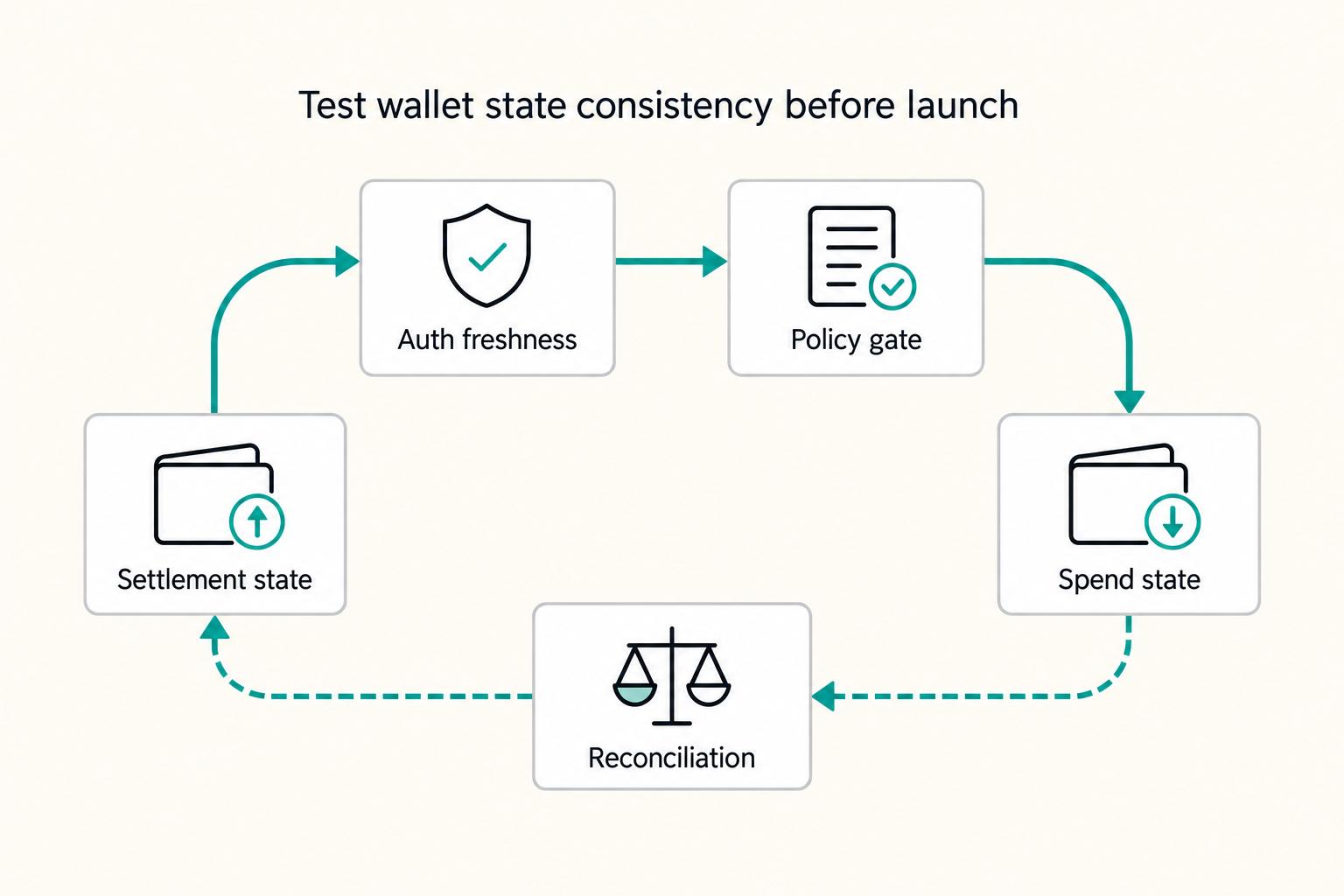
After you pick a custody model, launch risk usually comes down to sequence control and state consistency across auth, policy, spend, and settlement.
| Checkpoint | Required handling | Key detail |
|---|---|---|
| Auth freshness | Establish authenticated identity and separate transaction authorization | Treat sign-in and spend approval as separate moments; before high-risk actions, verify the session, device, or authenticator used for approval is still valid |
| Identity and transaction monitoring | Keep KYC for onboarding identity and KYT for transaction-level screening | Requirements depend on activity, provider and local rules; define pending handling and ownership |
| Spend authorization | Reserve against the authoritative spendable amount per owner and asset | Publish explicit statuses such as pending review, approved, submitted, failed, reversed, and settled |
| Reconciliation | Build idempotent retries, duplicate-prevention keys, async webhook handling, and an evidence pack | Test duplicate submits, delayed webhooks, and each rail or chain path; block or mark unsupported paths unavailable before approval |
- Start with auth freshness, not just sign-in
Use a suitable authentication mechanism and treat sign-in and spend approval as separate moments. NIST SP 800-63B-4 covers authentication and authenticator management. For high-risk actions, validate the current session and require the appropriate fresh approval; log a safe event reference, never an authentication secret.
- Keep KYC and KYT as two gates
Identity checks and transaction monitoring answer different questions. Define their requirements from the actual activity, provider and jurisdiction; FATF guidance is a risk-based framework implemented through local rules, not a universal requirement for a named KYT product or subsecond response. If a required check cannot complete, show a pending state with an owner and resolution path.
- Design spend authorization around settleable balance and clear status states
Authorize against the authoritative spendable balance for that owner, asset and execution path, with an atomic reservation. A combined fiat/crypto display valuation is insufficient. Show pending review, approved, submitted, failed and completed states, and distinguish bank settlement from chain finality or provider status.
- Treat reconciliation as a launch checkpoint, not cleanup
Build idempotent retries, duplicate-prevention keys, async webhook handling, and an evidence pack that links internal request ID -> provider reference -> final result -> ledger posting. Before launch, test duplicate submits, delayed webhooks, and each rail or chain path you expose by market, including EVM or Solana paths. If a path is unsupported, block it or mark it unavailable before approval instead of failing after approval.
For a step-by-step walkthrough, see Choose Freelance Platforms by Failure Mode, Not Features.
Conclusion#
The decision is not whether an embedded wallet is a yes or no. It is whether the pattern you choose matches your control boundary, compliance burden, and ability to explain every balance and status change when something goes wrong.
- Choose for control, not surface polish
Define who owns wallet creation, key storage, signing, recovery and balance records. The interface can remain in-app while those responsibilities sit across the user, platform and provider; make that split explicit in the design and support plan.
- Sequence depth by the bottleneck you actually have
For many platform teams, one workable approach is to start with the pattern that keeps balance ownership and status visibility closest to your own product, then add outside orchestration only where it removes a real operational burden. Treat that as a heuristic, not doctrine. Add crypto-native depth when the user action clearly needs it, not just because the market is noisy.
Volume growth makes reconciliation and recovery more consequential. Test the chosen design at the concurrency and event-delay levels your product expects.
- Verify before you commit architecture
Compare the plan with the design table and launch checklist, then confirm market and program coverage before locking providers or custody assumptions. Trace each request through the provider or chain result and ledger entry. Authorize against the owner’s spendable amount in the actual asset and execution path; keep a combined display valuation separate.
A good final red flag is cross-channel inconsistency. If the wallet behaves one way in mobile, another on web, and a third in any adjacent loyalty or in-store surface, you will spend more time explaining state than moving money. That failure mode matters more than feature count, especially when embedded wallet patterns for platforms adding in-app balance and spend features start crossing product boundaries.
If you are still split between patterns, use a simpler tiebreaker. Pick the option that gives you the clearest ownership of status changes, retries, reversals, and audit evidence on day one. Everything else gets easier once that foundation is real.
Frequently Asked Questions
What is the practical difference between an Embedded wallet and a Standalone wallet for platform teams?
Embedded means the wallet flow is integrated into your app; standalone means a separate wallet interface. Neither label determines custody, signing authority, compliance obligations or recovery. Define those boundaries independently.
When should a platform choose a Non-custodial wallet model over a simpler internal balance system?
Choose a user-controlled onchain wallet when users need to authorize and control asset transactions themselves and the supported recovery model fits the product. An internal balance records product obligations; it does not give a user private-key control. Determine who can sign, recover or export the wallet before applying a custody label.
What minimum features must exist before launching in-app balance and spend safely?
For this design, require owner- and asset-specific balances, atomic reservations, transaction authorization, safe retries, visible failures and reconciliation. Add the activity’s required legal/provider controls and test unknown outcomes, duplicate confirmations and account recovery.
How do Passkeys or WebAuthn compare with MPC or HSM models in day-to-day operations?
Passkeys/WebAuthn authenticate users. MPC distributes signing computation across parties; an HSM protects keys and performs controlled cryptographic operations. They may work together. Compare actual signing authority, supported key types, recovery, export and incident handling rather than treating them as interchangeable custody models.
When does a Wallet orchestration platform make more sense than building wallet infrastructure in-house?
Buy when the provider demonstrably meets your signing, recovery and execution requirements with less total implementation and support work. Retain clear product-policy and reconciliation ownership, and price migration and outage handling as part of that decision.
How should teams handle Fiat balance and Crypto balance consistency in one Unified balance view?
Keep fiat and each crypto asset in separate ledger accounts with pending, reserved and spendable amounts. Reconcile provider records and chain results before updating availability. Any combined valuation should identify rates and valuation time; conversion needs its own funded and approved transaction.
Which account-abstraction parts matter now versus later?
For an ERC-4337 smart-account flow, a UserOperation expresses the requested action and a bundler submits it through the EntryPoint. A paymaster can sponsor gas subject to its policy and funding. Decide whether that flow is needed at launch; test signatures, nonces, sponsorship limits and execution results together. A relayer is a broader transaction-submission role, not a substitute term for every component.
Try a related tool
Researched and edited by the Gruv editorial team. Gruv builds cross-border billing, payouts, and finance-operations software for global businesses.
Sources
Includes 6 external sources outside the trusted-domain allowlist.
- nvlpubs.nist.gov/nistpubs/SpecialPublications/NIST.SP.800-63B...trusted
- developer.apple.com/documentation/security/protecting-keys-with-...external
- docs.mangopay.com/guides/e-wallet-systemexternal
- docs.privy.io/security/wallet-infrastructure/policy-and-co...external
- ercs.ethereum.org/ERCS/erc-4337external
- fatf-gafi.org/en/publications/Fatfrecommendations/Guidance...external
- fidoalliance.org/passkeysexternal
Educational content only. Not legal, tax, or financial advice.
Related Posts
Reserve Policy Design for Platforms with Rolling Holds and Release Controls
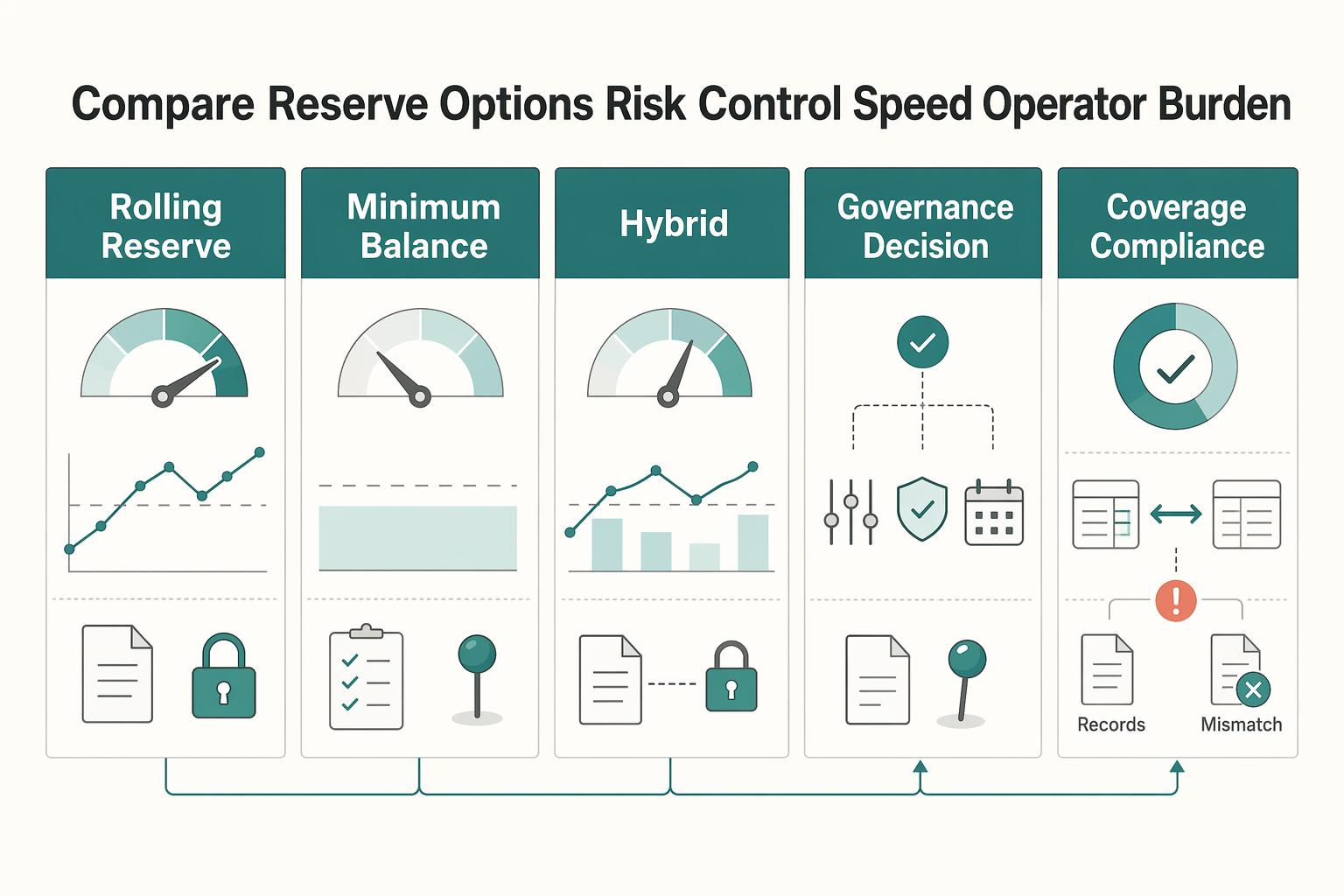
Reserve policy for a platform comes down to three things: decide what gets held, when it gets released, and how you will prove later that the release was justified. For embedded payments, that is usually the hard part. A good reserve policy is less about abstract risk theory and more about controls your finance, ops, and engineering teams can verify from event history and payout records.

Microservices Architecture for SaaS Without Finance and Compliance Surprises
Choose your operating model before you choose your decomposition pattern. For most early products, that means a modular monolith with clear domain boundaries, not a full microservices setup on day one. The reason is practical. Every new service adds cognitive load, failure points, and maintenance cost, so the split pays off only when your team and controls are ready.
Gateway Routing for Platforms: How to Use Multiple Payment Gateways to Maximize Approval Rates
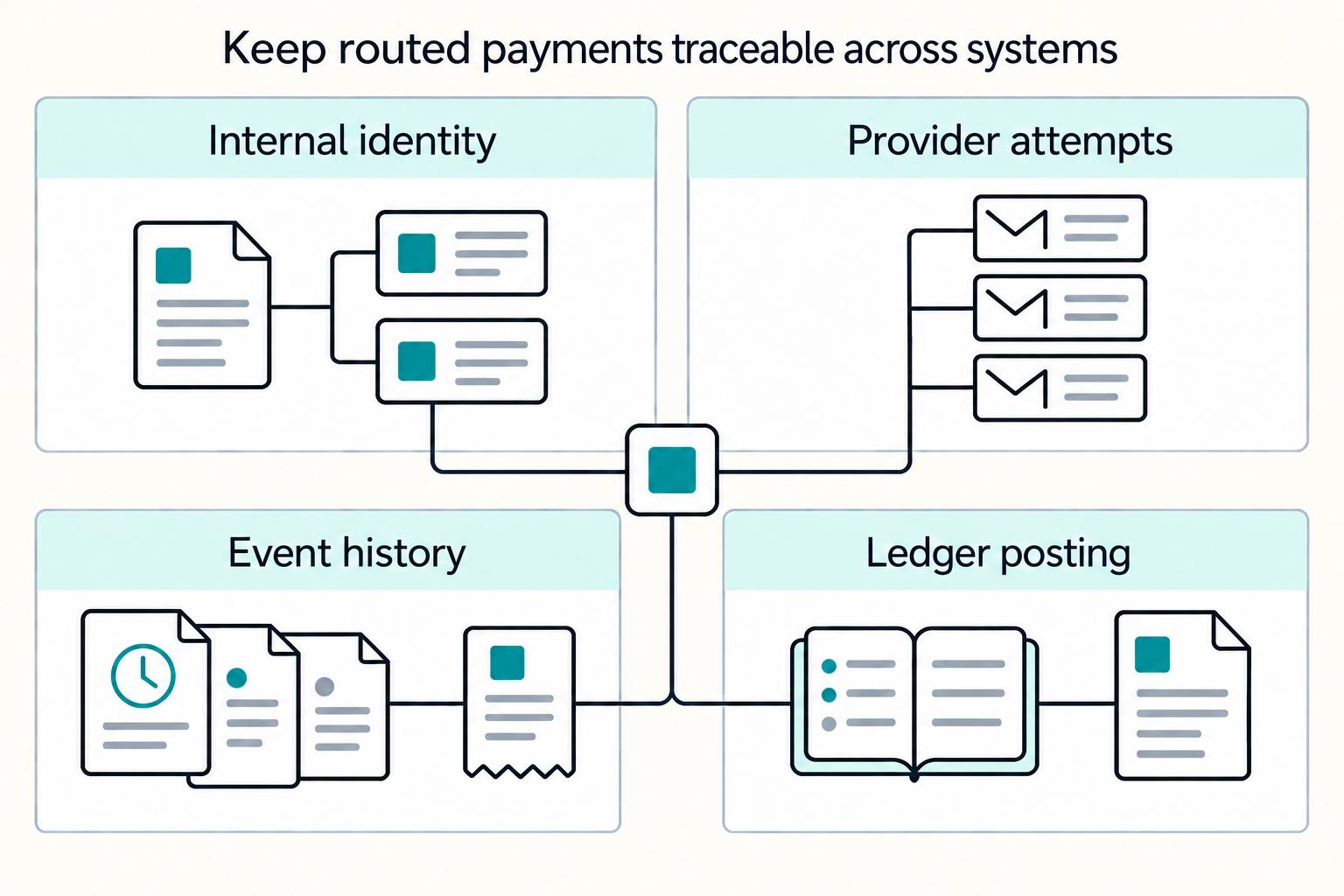
Adding a second payment gateway is not the win. The win is routing each payment on purpose, then proving approvals improved without creating new latency, cost, or reconciliation problems.