
Quick Answer
Compare eligibility, holds and reserves, collection-to-bank timing, export rights and recovery support before making a platform central. Retain permitted records outside it and test the actual route safely. A lawful backup supports accessible funds or future payments; it does not release a held balance, permit marketplace circumvention or prove future reliability.
Find the dependencies that can interrupt cash or records#
Compare platforms by what happens when payment is delayed, account access is restricted or you need to leave. Features still matter, but a convenient tool can become a costly dependency if it controls all incoming funds and the only copy of your records.
PayPal’s U.S. agreement describes risk-based payment holds generally lasting up to 21 days, with other hold and legal-process rules that can last longer. Upwork requires compliance with its payment and non-circumvention terms; an unauthorized off-platform route can risk account loss. Fiverr also enforces restrictions and suspensions. Check the actual provider entity, jurisdiction and account terms rather than applying one company’s timing to every platform.
Three decision mistakes usually sit behind the search for alternatives:
- Confusing governance with payment control. A community-governed product still needs clear custody, dispute and withdrawal terms. Decentralization does not resolve applicable tax documentation or 24% U.S. backup withholding.
- Using the wrong account type. Verify business use, country and activity eligibility, record exports and payer requirements rather than assuming consumer convenience makes an account suitable.
- Copying enterprise onboarding into a solo workflow. Upwork’s optional Enterprise Compliance classification process typically takes about three business days after hiring, depending on the engagement and responsiveness. The buyer’s actual onboarding and billing terms govern your case.
| Decision lens | Alternative hunting | Risk-first stack design |
|---|---|---|
| Cash access | Swap apps, keep one payout dependency | Add redundancy and check hold and restriction policies first |
| Compliance | Hope the platform handles it | Prepare the applicable tax certification and identifiers, invoice, and payer evidence up front |
| Client AP fit | Assume all buyers pay the same way | Match your setup to marketplace, direct, or enterprise billing realities |
The shift is simple: stop evaluating standalone apps and start designing for failure. The next section turns that into a practical stack. If you want a marketplace comparison after that, see 7 Upwork Alternatives for High-Earning Freelancers.
Check compliance, cash access and records together#
Review the three layers in parallel, starting with the biggest exposure: required eligibility and documentation, cash-access mechanics, and records you can retain. Optional improvements do not need to delay ordinary invoicing or obligations already due. Do not use a prohibited account or omit a legally required step because another layer looks strong.
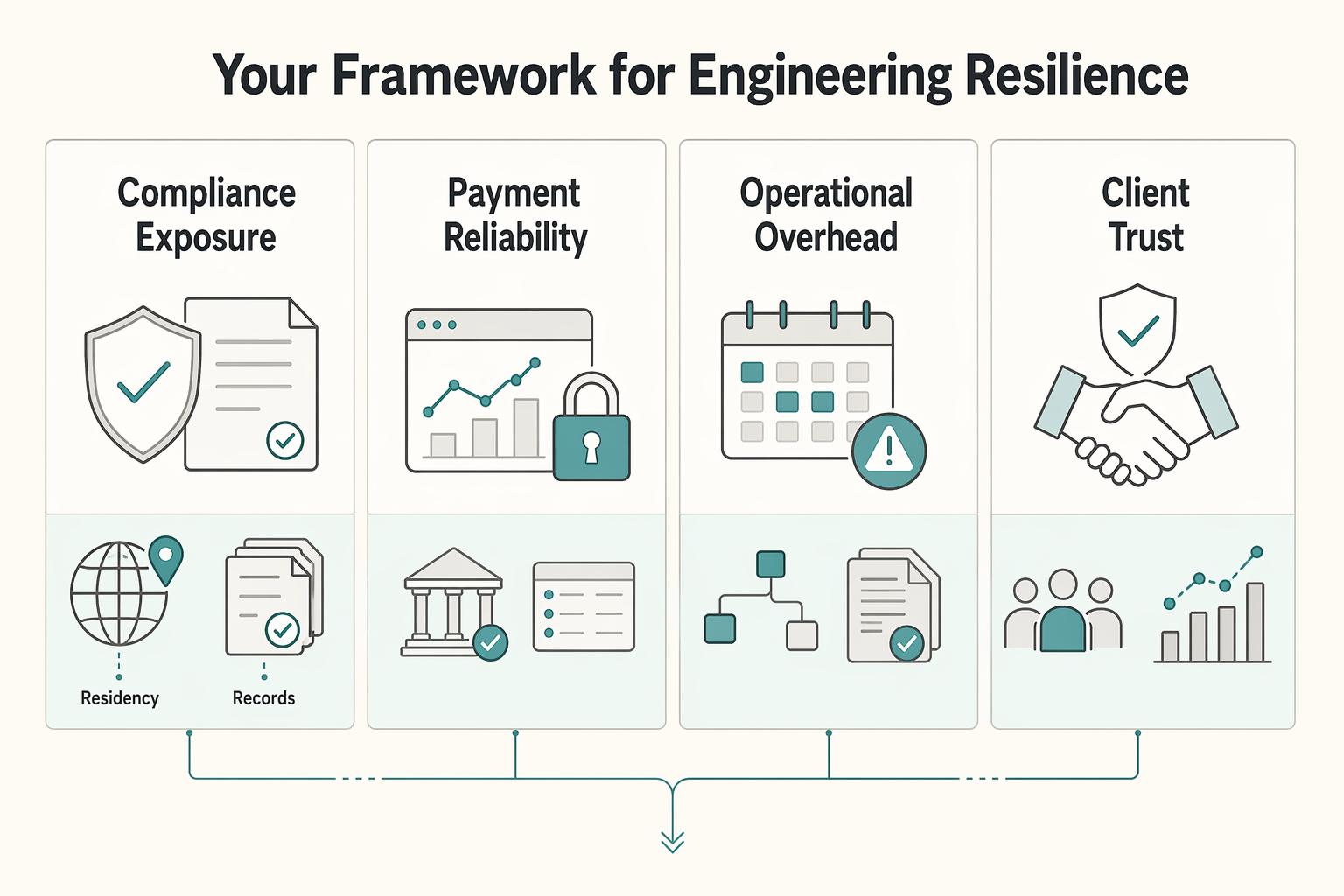
| Control area | Scattered records and unchecked terms | Connected, verified controls |
|---|---|---|
| Compliance exposure | Day counts, tax forms, and account thresholds are scattered and checked late | Residency tracking, cross-border tax documentation, and account monitoring are checked before invoicing |
| Payment reliability | You learn hold rules and release windows after revenue is earned | You select channels based on reserve terms, payout timing, and who is legally processing payment |
| Operational overhead | Re-entry across contracts, invoices, tax docs, and receipts | One client record ties scope, tax docs, invoice status, payment status, and evidence |
| Client trust signals | Buyer has to chase missing forms or verify details manually | You can provide a clean vendor packet with form status, VAT check result, and records on request |
Build the compliance foundation#
Check what applies to the person, business, customer and transaction. A platform cannot establish tax residency, decide every tax form or eliminate a filing duty. Resolve required onboarding items early while preparing cash and record controls in parallel.
| Checkpoint | Rule or date | Notes |
|---|---|---|
| U.S. FEIE physical presence | 330 full foreign-country days in 12 consecutive months | One FEIE qualification route for relevant U.S. taxpayers; foreign tax home and other requirements still apply. Not a general residency test. |
| UK first automatic overseas test | Fewer than 16 UK days in the relevant tax year | Requires UK residence in at least one of the prior three tax years; does not apply in the year of death. Other SRT tests differ. |
| FBAR scope and threshold | Aggregate reportable foreign financial accounts exceeds $10,000 at any time in the year | Applies to U.S. persons with relevant financial interest or signature/other authority, subject to reporting exceptions; not every foreign payment triggers it. |
| FBAR annual deadline | April 15, with automatic extension to October 15 | Separate from invoice or provider onboarding; identify the actual reporting year and any applicable special relief. |
The IRS physical presence test uses at least 330 full days in foreign countries over 12 consecutive months. Full days run midnight to midnight and need not be consecutive. It is a foreign-earned-income-exclusion test, with a foreign tax home and other conditions; it does not prove that you are nonresident everywhere or exempt your whole business from tax.
Under HMRC’s first automatic overseas test, the fewer-than-16-days rule requires residence in at least one of the prior three tax years and does not apply in a year of death. Other SRT tests and country rules differ. Record dates and work facts rather than applying a universal day threshold.
Action checks:
- Use Form W-9 for an applicable U.S.-person tax certification. W-8BEN is for a foreign individual where appropriate; entity and income situations can require other forms. Provide tax identifiers securely to authorized recipients.
- For a relevant U.S. person, identify actual reportable foreign financial accounts and whether their combined value exceeds $10,000 at any time. Account location and authority matter, not merely receiving a foreign client payment.
- Keep tax deadlines and provider-document deadlines separate; missing documentation may create lawful withholding or onboarding restrictions, not an automatic right to freeze every owed payment.
Resolve required documentation while evaluating the same account’s cash-access and export limits.
Protect the financial core#
This layer reduces the risk that earned revenue is delayed or restricted. It changes how you choose channels: by reserve policy, release timing, invoice acceptance, and legal payment responsibility.
| Provider or check | Published rule or role | What to verify for your account |
|---|---|---|
| Upwork standard hourly | Normally available 10 days after the weekly billing period ends Sunday | Eligible faster-payment arrangements differ; withdrawal and bank-arrival time is additional. |
| Upwork fixed-price | Normally a five-day security period after milestone approval/release | Client review, disputes and withdrawal timing can add time; submission is not immediate availability. |
| PayPal U.S. agreement | Some risk/violation holds can be up to 180 days; legal-process holds can exceed that | Different from the usual up-to-21-day risk-based payment hold; check your jurisdiction and actual notice. |
| EU VIES check | Valid/invalid VAT information from national databases; service errors can occur | Retain relevant validation evidence and verify exceptions; it does not decide all VAT treatment. |
| Merchant of record | Contractual seller/payment and relevant indirect-tax responsibilities for supported transactions | Eligibility, refunds, reserves, payout terms and your remaining tax duties. |
Before you agree to delivery and payment terms, check:
- Review reserve language; reserves are a common practice and can temporarily hold part of funds.
- Check payout windows by channel and contract type.
- Confirm restriction clauses that can limit access to funds in policy-violation contexts.
Upwork’s payout guidance distinguishes standard hourly availability after the billing week from fixed-price availability after milestone approval and the security period. These are availability rules, not promised bank-deposit dates. Plan using the actual contract and withdrawal route.
For transactions where EU VAT-ID evidence is relevant, VIES can return valid or invalid information from national databases. An invalid result may reflect missing intra-EU activation or incomplete registration; an unavailable service is a separate issue. Keep the result and verify with the customer or national authority where needed. Determine VAT treatment from the actual supply and rules; VIES alone does not establish it.
A merchant of record acts as the seller for its supported transactions and handles the agreed payment and indirect-tax duties. Confirm that your actual service or product is eligible; many offers are limited to specified digital products. Read payout, refund, dispute and reserve terms. Your income tax, business registration, contractual delivery and other duties do not disappear because a MoR is involved.
Keep those legal and cash facts linked to the operational record, so a clean invoice does not hide an unavailable balance.
Tighten the operational edge#
This layer reduces avoidable friction. It changes the decision from "add another tool" to "keep one traceable record from onboarding through payout."
Use a consistent client file checklist:
- Approved scope and relevant contract
- Required tax-form status and supporting classification
- VAT validation and treatment record, where relevant
- Invoice, client payment and processor fee records
- Payout reference, status and actual bank receipt
- Refund/dispute history and supporting correspondence you may lawfully retain
This is not optional admin. IRS recordkeeping requires you to keep records long enough to prove income or deductions on a return. When records are split across inboxes, chat threads, and separate apps, the cost is slower AP approval, weaker review responses, and harder tax close.
Retain the approved scope, gross collection, deductions and net bank receipt under connected references. That lets you explain both what the client paid and what became usable cash.
Worked example: a held balance and a separate cash buffer#
Illustrative stress test: Provider A shows USD 6,000 collected but unavailable. Your independently accessible bank balance is USD 3,000. In the next 14 days, agreed contractor payments are USD 1,200, business bills USD 500 and a tax allocation USD 600. Accessible cash after those obligations is USD 700: 3,000 minus 1,200 minus 500 minus 600. The held USD 6,000 cannot fund that plan, and sending a payout instruction does not make it available.
If another USD 900 bill falls due before release, the shortfall is USD 200. Arrange permitted financing, reduce genuinely optional spending or agree changed dates with the relevant creditor; do not silently delay owed contractor pay. A separately approved future client payment could use a tested backup route if contracts and platform rules permit it. First confirm the original attempt’s outcome so the client is not charged twice. This drill reveals cash exposure, not a guarantee that either provider will remain available.
Compare operating choices and their tradeoffs#
| Old way | More resilient option | Risk reduced | Operational tradeoff | Who controls funds and data |
|---|---|---|---|---|
| Using a personal finance app for business | Separate business invoicing, payout, and archive tools | Can improve record separation | More setup and more vendors to review | Varies by provider, so verify export rights and hold language |
| Manually creating invoices in a document editor | Use invoicing tools that produce exportable records | Can reduce manual errors if exports are reliable | You still need to test the exports yourself | You control only what you can export and archive outside the tool |
| Leaving money inside a platform or wallet by default | Prefer payment paths that end in an account you control, if the provider offers that | Can lower concentration and access risk | You may lose some convenience or platform-only features | Confirm who can delay release, pause access, or change terms |
| Treating one marketplace as your only operating layer | Keep permitted client, invoice and payment records in an independent archive, while honoring marketplace rules. | Can reduce single-point dependency | More vendor management and more diligence upfront | A marketplace may control more until you move records out |
Run Three Decision Tests Before You Adopt Any Tool#
Use control, compliance and cash-flow tests to identify material weaknesses before adoption. A failure in required eligibility or funds protection can rule out an option. A missing optional convenience feature may instead justify a documented workaround. Match the decision to the consequence, rather than treating every gap as a blanket stop.
A scheduling app is usually an operational choice. A payout stack that can pause or cancel disbursements is a cash-flow choice. A client portal with weak export and retention behavior is a compliance choice. Keep those categories separate so you do not underprice the real risk.
| Option pattern | Control | Compliance readiness | Integration depth | Failure-mode impact |
|---|---|---|---|---|
| Marketplace with platform-enforced payments | Lower. Platform terms may prohibit off-platform payments, and violations can lead to account loss | Export and archive records lawfully; Upwork makes invoices downloadable for five years, after which they are deleted. | Often strong inside the platform, weaker when moving records out | Restrictions can limit where and how you get paid |
| Payment app or stored wallet balance | Lower to moderate. Access is not the same as full control of held funds | Check business-use eligibility, record access and actual balance protection for the account and jurisdiction. | Moderate for payment activity, often weak across full client-to-reconciliation workflow | Holds/reserves remain possible. U.S. payment-app balances generally lack FDIC protection unless relevant additional services and conditions apply. |
| Processor stack with exportable ledger reporting | Direct account access and exports may improve control; the provider still controls restrictions and settlement. | Stronger when itemized exports and reconciliation reporting are available | Stronger when client, invoice, payout, and reconciliation data stay connected | Still exposed to payout pauses, failed payout handling, and portability limits if not checked upfront |
Reduce the biggest risk first#
Start with the risk that can break your business, not the feature that saves a few clicks. If a tool touches tax forms, invoicing, client identity, or income records, test whether it helps you keep evidence that substantiates income and deductions.
Use a sandbox or fictitious records where available to test the client/invoice/export structure. Export permitted records and open them outside the tool: check invoice IDs, dates, amounts, currencies, fees and payout references. A separate small legitimate live collection, if appropriate and authorized, can check the actual route and bank arrival; do not create fake self-payments to evade platform rules. A sandbox does not prove live eligibility, holds or settlement reliability.
Check who actually controls money and records#
Treat this as a hard gate. For each option, confirm the points below.
| Control point | What to confirm | Practical implication |
|---|---|---|
| Pending funds | Which entity holds them, who can restrict them, and whether they are settled or merely expected | Do not count an invoice or pending balance as usable cash. |
| Payout blocks | Who controls the payout schedule and what the relevant cancellation/release conditions are | Get the actual reason, status and support owner; do not assume a universal timer. |
| Export rights | Which invoices, ledger data, client files and correspondence you may retain | Exports do not transfer intellectual-property ownership or remove confidentiality/privacy obligations. |
| Failed payouts | The provider’s failure reason, returned balance and recipient-account remediation | For Stripe Connect, a failed payout can disable that external account until the platform updates its details. |
| Balance protection | Protection for the actual product, institution and jurisdiction | Bank-deposit insurance and payment-app safeguarding are different; neither guarantees continuous access. |
Stripe Connect payout documentation explains that control depends on the account configuration. A platform may schedule payouts or manage external accounts; a failed payout can disable the affected external account until details are updated. The recipient should contact the platform for payout status. Verify your provider’s actual rules instead of applying a generic ten-day cancellation claim to every system.
PayPal and other providers can revise terms, impose reserves or restrict balances. Keep the dated agreement and actual account notice. The CFPB says U.S. payment-app balances generally lack FDIC insurance unless qualifying additional services apply. Verify the specific account’s protection, and distinguish bank failure coverage from a provider’s operational hold.
Follow the path from intake to reconciliation#
Trace intake, approved scope, required tax status, invoice, client collection, fees/reserves, payout and actual bank receipt. A payout is movement of funds from the provider to your account; it is not the same event as the client paying the invoice.
Feature depth in one tool is not enough if records do not travel cleanly across the full path. Prioritize systems that support ledger-level exports and payout-to-transaction reconciliation so month-end close and reviews are straightforward.
Use one normal collection and one failed/pending scenario to test whether the records explain the invoice-to-bank path. Timely exports and an independent archive improve recovery. Outsourcing an activity changes the agreed responsibilities, but does not remove your remaining contractual, tax or recordkeeping duties.
If a transfer’s outcome is unknown, inspect the original reference with the provider before retrying or asking the client to pay again. Keep a duplicate-payment recovery step and a refund owner in the runbook.
Conclusion: Choose Terms, Payout Mechanics, and Records You Can Verify#
Choose a setup whose terms, collection-to-bank timing and records you can explain. Keep a lawful recovery route for the failure that would cause the largest cash shortfall.
The practical shifts are simple:
- Keep usable records: export invoices, fees, payout references and permitted correspondence before access expires. Upwork’s invoice-download window is five years. Retention depends on your obligations; the IRS’s four-year employment-tax rule is not a universal retention period for all freelance records.
- Use the current account terms: Upwork publishes a 0%–15% freelancer service fee per contract, with the offered rate shown before commitment. Fiverr’s standard clearing period is 14 days after an order is marked complete, with shorter periods in specified cases. Withdrawal arrival adds time. Check the actual contract and account.
- Document responsibility: show who invoices, what the client pays, where net funds settle, who resolves holds or disputes and what evidence you retain. This makes the route reviewable without implying guaranteed payment.
The three layers support the same decision: eligible use, cash you can access and records you can recover. Choose tools that meet those needs, then compare their convenience and cost.
For your first pass, keep it narrow:
- List the platform, processor and bank dependencies that can restrict payment or account access.
- Verify account eligibility, payout timing, hold/reserve terms, permitted backup routes and export rights.
- Test the record chain with safe sample data; use a legitimate, permitted live transaction only where needed to check the real payout route.
- Document failure recovery, support ownership and accessible cash for obligations due during a delay.
Recheck when providers change terms, your account changes country or product, or client payment patterns change. Keep the last successful export and a dated recovery plan; more vendors are useful only if they reduce the dependency that matters.
Frequently Asked Questions
What are the best platform alternatives for international professionals?
There is no universal winner. Compare actual eligibility, permissible payment routes, held-fund treatment, bank-arrival timing, export rights and recovery support. A backup must be independently accessible and allowed by the client and platform agreements, rather than simply a second logo using the same restricted payment dependency.
If you are considering a merchant of record, treat it as one more contract to audit, not an automatic upgrade. A practical checkpoint is to verify eligibility rules, payout path, export rights, and the legal operating entity.
How can a solo professional build trust with enterprise clients?
Ask the enterprise buyer for its actual vendor requirements and provide relevant evidence: the contracting legal identity, authorized contact, supported payment details, required tax information, scope and proportionate security answers. A solo professional can identify themselves as the responsible owner; inventing corporate leadership titles does not create assurance.
Check the date, legal entity and scope of provider documents against your account. Retain documents relevant to the buyer’s request without sending unrelated sensitive records or treating an unrelated governance FAQ timestamp as proof of your controls.
What is a "trust stack" for a global professional?
Use that phrase as shorthand, not as a certification label. The useful test is whether you can answer four questions for every provider you depend on: Are there eligibility gates, how hard is the offering to evaluate, when can you get out or get paid, and who governs changes?
Treat labels like direct settlement or compliance-ready invoicing the same way. Use them as prompts to verify who holds funds, what records you can export, and whether your buyer or accountant can review those records without reconstruction by hand.
Is decentralization the future for freelance platforms?
Decentralized governance can influence decision rights and dispute design, but it does not guarantee safe custody, prompt payouts or effective redress. Check the legal entity, contract, fund-control mechanism, jurisdiction and withdrawal conditions of the particular service. Investment-fund tender windows are not ordinary freelance-marketplace payout rules.
If a provider sells a community-governed story, ask for concrete proof. Verify whether there is a formal legal entity running it, whether stakeholders can attend meetings or submit views before decisions, and whether those rights are written down or just implied.
How do I protect my income from being frozen by platforms like PayPal?
Reduce concentration before volume grows. If one provider can limit access to incoming cash, make sure it is not also your only archive, your only invoice trail, and your only payout route.
Read the governing account agreement and actual hold notice, contact the provider through verified support, and prepare requested evidence. Test exports and permitted payout routes before core revenue depends on them. One successful payout does not prove the platform will never restrict funds. A backup handles accessible funds or permitted future payments; it cannot release money already held or bypass sanctions, lawful restrictions or marketplace payment rules.
Try a related tool
Researched and edited by the Gruv editorial team. Gruv builds cross-border billing, payouts, and finance-operations software for global businesses.
Sources
Includes 1 external source outside the trusted-domain allowlist.
- consumerfinance.gov/ask-cfpb/is-the-money-i-keep-in-my-payment-a...trusted
- docs.stripe.com/connect/payouts-connected-accounts.mdtrusted
- europa.eu/youreurope/business/finance-and-tax/vat/chec...trusted
- irs.gov/individuals/international-taxpayers/foreign-...trusted
- irs.gov/businesses/small-businesses-self-employed/re...trusted
- paypal.com/us/legalhub/paypal/useragreement-fulltrusted
- stripe.com/resources/more/merchant-of-recordtrusted
- fiverr.com/legal-portal/legal-terms/payment-terms-of-se...external
Educational content only. Not legal, tax, or financial advice.
Related Posts

7 Upwork Alternatives for High-Earning Freelancers
If you are looking at **upwork alternatives**, the real decision is not which platform has the loudest reputation or the longest comparison list. It is where your margin can hold up, where lead quality can improve, where deals can close with less drag, and where admin work does not eat the gain you thought you were buying. That matters even more if you already charge meaningful rates or run a small delivery team, because weak-fit clients and messy operations get expensive fast.

The Freelance Payment Penalty: A Modeled Audit of Platform Fees, FX Spreads, and Payout Delays
The money rarely disappears through a single, easy-to-spot fee. The real loss is stacked. A marketplace takes its commission, a processor adds a charge for international cards, a bank or payment company converts the currency at a spread, a platform holds the funds before release, and a wire sheds a little to intermediaries on the way in. Each layer looks defensible on its own, but the worker feels the combined result as a smaller deposit and a later payday.

How to Respond to a Subpoena for Business Records
Move fast, but do not produce records on instinct. If you need to **respond to a subpoena for business records**, your immediate job is to control deadlines, preserve records, and make any later production defensible.