
Quick Answer
Choose by product role: GoCardless and Stripe ACH execute recurring debits; Plaid Link/Auth links and verifies accounts, while Plaid Transfer separately executes supported US flows with recurring-product limitations. Stripe Financial Connections also supports bank linking. Test authorization, delayed outcomes, later returns, retries, and reconciliation for the exact scheme and subscription model.
How to compare GoCardless, Stripe ACH, and Plaid#
This is not a brand pick. It is an operating-model decision for recurring payments on bank rails. At the role level, these options are not interchangeable:
- GoCardless is built around recurring and one-off bank-debit collection, including ACH debit in the US.
- Plaid Link is the account-connection layer, and Plaid Auth verifies account and routing details, but Auth still needs a payment processor to move money.
- Stripe ACH Direct Debit is a US bank-debit rail, but it is a delayed-notification method with required account verification before debit, non-guaranteed outcomes, and settlement that typically takes 4 business days.
That makes the core decision simpler than it first appears. Do you need a recurring collection engine, an account-linking layer, or both? If subscription collection is the main job, account linking alone is not a substitute for debit execution.
If you are evaluating Stripe ACH, validate operations early, not just the signup flow. Confirm:
- how account verification happens before the first debit
- billing and ledger states while payment outcomes are still pending, including failed payments or disputes
This guide stays at the operator level. It covers what each product actually does, where evidence is strong, and where public detail is thin. That includes where like-for-like pricing comparisons are thin in public sources and what to test before procurement. Vendor docs are the primary signal. Directory pages and forum threads can help frame questions, but they are not decision-grade evidence on their own.
At a Glance Comparison for Subscription Platforms#
Start with role, not feature count. GoCardless and Stripe ACH are debit-execution options; Plaid Link/Auth supplies linking and verification, while Plaid Transfer is a separate execution product. Stripe Financial Connections and eligible GoCardless verification features also belong in a bank-linking comparison.
| Criteria | GoCardless | Stripe ACH | Plaid | Confidence level | Operator note |
|---|---|---|---|---|---|
| Rail role | Bank-payment collector for recurring and one-off payments | US bank-debit option within Stripe's broader US bank-payment setup | Account-linking and bank-account verification layer | High | Do not treat Link/Auth as equivalent to debit execution. |
| Can initiate debit | Yes, including recurring ACH pull collection | Yes, via ACH Direct Debit for US customers | Auth alone does not move money; Plaid Transfer separately executes supported US ACH flows | High | Separate "collects money" from "links account." |
| Can link accounts | Hosted mandate setup; instant bank verification available with eligible plans/features | Financial Connections can link and instantly verify supported bank accounts; manual entry and microdeposit paths also exist | Yes, Plaid Link connects accounts and Plaid Auth verifies account/routing details | High for documented capabilities; comparative conversion not established | Compare supported banks, fallback paths, conversion, and integration fit rather than declaring one universal linking winner. |
| Recurring collection support | Yes, explicitly recurring and one-off | Reusable for subscriptions, but outcome notification is delayed | Link/Auth alone does not collect; Transfer supports fixed recurring ACH with restrictions | High | For Stripe ACH, design billing and retries for pending outcomes. |
| Onboarding friction | Role is collection-focused | Docs here focus on the payment rail; delayed outcome notification affects ops flow | Linking flow is clear, but execution still needs a processor path | Partial | No like-for-like public benchmark across all three. |
| Payment method breadth | Broad multi-scheme signal: ACH, SEPA, Bacs, BECS, PAD, Autogiro, Betalingsservice, PayTo | ACH plus Stripe's separate Instant Bank Payments path for US bank payments | Connectivity layer, not a debit-method catalog | High (role-level) | If multi-scheme bank debit matters, GoCardless has the strongest public signal in this set. |
| Regional fit | Multi-region signal, including 30+ countries and multiple debit schemes | ACH docs are tied to US customer locations | Available in US, Canada, and Europe; product coverage varies by country | High | For Oceania, confirm exact product or scheme eligibility directly with vendors. Do not assume parity. |
| Pricing transparency | Public US Standard headline: 0.5% + $0.05, capped at $5 | Public headline: 0.8% with $5.00 cap; ACH docs refer out for detailed fee context | Docs say no price list in documentation; pricing page notes first 200 API calls free | High for headline numbers, partial for apples-to-apples comparison | Headline pricing alone is not a full cost comparison across these roles. |
GoCardless and Stripe ACH Direct Debit both execute recurring bank debits. Plaid Link/Auth supplies linking and verification, while Plaid Transfer separately executes supported US transfers. Stripe also offers Financial Connections for bank linking and verification. Choose between these combinations using scheme coverage, subscription requirements, and tested operating fit; the docs do not establish one universal UX winner.
The evidence quality differs too. Vendor docs should carry the most weight here. Directory sources like PaymentProviders.io and SourceForge are useful for discovery and question framing, but they are lower-confidence sources for settling pricing, regional fit, or operational disputes.
Role Clarity Before You Compare Features#
Get role clarity first. For subscription collection, treat debit execution and bank-account linking as separate jobs unless you have already validated an end-to-end collection path.
| Item | Role | Grounded detail |
|---|---|---|
| GoCardless | Debit execution / recurring collection | Built around recurring and one-off bank-debit collection, including ACH debit in the US |
| Stripe ACH Direct Debit | Debit execution / recurring collection | Reusable payment method with success or failure acknowledgement that can take up to 4 business days |
| Plaid Link | Bank account linking | Connects a user's financial account in-app |
| Plaid Auth | Bank verification | Verifies account and routing details and must be used with a payment processor to move money |
In this comparison, the split is:
- Debit execution / recurring collection: initiating authorized bank debits and running the ongoing collection lifecycle. GoCardless is positioned around recurring payment plans, and Stripe describes ACH Direct Debit as a reusable payment method.
- Bank account linking: connecting a user's financial account in-app with Plaid Link.
- Bank verification: verifying account and routing details for payment setup with Plaid Auth.
This matters operationally because ownership changes with the role. Someone has to handle failed debits, retries, pending payment communication, and billing-state transitions. Stripe is explicit that ACH collection can take up to 4 business days for success or failure acknowledgement, and that it is not guaranteed, with failed-payment and dispute risk.
The hard rule is simple. If your core need is subscription collection, do not treat Plaid Link or Plaid Auth as a full substitute for a debit rail. Plaid states that Auth must be used with a payment processor to move money, and its own payments comparison says Auth does not process ACH transfers while Transfer does.
Plaid Transfer supports fixed-amount recurring ACH schedules, but its recurring-transfer endpoints cannot be used with Platform payments. Transfer UI captures one-time authorizations and cannot capture standing authorizations required for variable recurring payments. Check these product boundaries against your exact subscription model; a successful Link session does not establish recurring debit authority.
Choose the collector first, then add linking and verification where they reduce onboarding friction.
Related reading: FX Spread Comparison for Platform Teams Using Wise, Airwallex, Stripe, and Local Rails.
What the Market Data Confirms and What It Does Not#
The market data is useful for role fit, but weak for final buying decisions. It confirms what each product is for. It does not give you a clean, like-for-like benchmark across all three.
| Source type | What you can trust it for | What to watch |
|---|---|---|
| Vendor docs and product pages | Product role, rail support, stated constraints | Often do not provide full pricing detail or full implementation effort |
| Structured comparison pages (for example, SourceForge or directory pages) | Fast feature scanning and shortlist building | Some explicitly warn pricing/features may be stale or incomplete |
| r/smallbusiness and similar threads | Real buyer concerns and anecdotal experiences | Community Q&A is anecdotal, not procurement evidence |
The confirmed signals are straightforward. GoCardless explicitly positions ACH Debit for automated recurring collection and recurring-payment use cases. Plaid's ACH execution product is Plaid Transfer, while Link is an account-linking interface, and Plaid Transfer is documented as US only. Stripe supports subscription charging with ACH Direct Debit and documents delayed acknowledgement of up to 4 business days, along with explicit failed-payment and dispute risk.
Just as important is what is not confirmed. Stripe's ACH docs point to pricing details instead of listing full fee specifics inline, and Plaid docs state that a full price list is not available in documentation. Treat directory fee tables as provisional until the vendor confirms them.
That gap changes the next step. Treat it as a procurement task, not something to guess at. Get three things in writing: pricing for your expected ACH volume, the exact return or failure handling path for recurring debits, and the implementation evidence pack. That pack can include webhook events, status timing, and reconciliation exports. If a vendor cannot answer those cleanly, treat that as a decision signal.
Subscription Fit by Business Model and Payment Mix#
Choose by collection rail coverage and geography, not generic feature count. If non-US bank debit is on your near-term roadmap, prioritize vendors with documented multi-scheme support over broader marketing language.
| Business model | Rail need that matters most | GoCardless fit | Stripe ACH fit | Plaid fit |
|---|---|---|---|---|
| SaaS subscriptions billed from customer bank accounts | Recurring pull collection with debit execution | Strong fit for recurring collection, with ACH plus additional schemes documented | Strong US fit: ACH subscription guidance is explicitly for charging subscriptions from US bank accounts | Link/Auth supports account connection and data; money movement still requires a payment processor |
| Contractor payouts funded by pulling customer or client funds first | Dependable inbound collection before outbound disbursement | Good fit when bank debit is core, especially if you may expand beyond US ACH | Viable when collection is US bank-account ACH | Useful for linking or verification, not the collection rail itself |
| Marketplace collections using Bank Transfer plus fallback rails | Blend of transfer flows and automated debit fallback | Better fit when scheduled pull collection may span multiple debit schemes | More naturally a US ACH choice than a multi-region debit choice | Best treated as connectivity, not standalone debit execution |
For US-only subscriptions, ACH can be a practical starting point. Stripe documents two US bank-payment options, ACH Direct Debit and Instant Bank Payments, and its subscription ACH guidance is focused on US bank accounts. GoCardless also supports ACH in the US, while positioning more broadly around recurring bank-debit collection across schemes.
The tradeoff shows up quickly once you move beyond a US-only plan. SEPA Direct Debit is explicitly recurring-friendly, Bacs Direct Debit supports authorized variable collections, and BECS is Australia's direct entry system. If your roadmap includes schemes like SEPA Direct Debit, Bg Autogiro, or Betalingsservice, GoCardless publicly lists multi-scheme coverage, including collection in more than 30 countries.
Do two operator checks early:
- Design onboarding around verification requirements. Stripe states that ACH collection requires bank-account verification before you can debit.
- Request scheme-level operating evidence from each vendor: authorization or mandate flow, event timing, return handling, and reconciliation exports.
The decision rule is simple. If non-US bank debit expansion is a near-term priority, favor documented multi-scheme coverage. If you are strictly focused on US bank-account subscriptions today, compare recurring collection strength against your stack constraints. Do not treat Plaid Link or Auth as execution on its own.
Related: The Best Tools for Managing Subscription Billing.
Hidden Costs and Failure Modes Directory Pages Skip#
The biggest mistake in this comparison is optimizing for headline fees instead of failure-path operating cost. In practice, the money often goes to exception handling, support, retries, and reconciliation. When you compare GoCardless, Stripe ACH, and Plaid, press on delayed outcomes, return-code ownership, and auditability before you compare rate cards.
Where the real cost lands#
Plaid is the clearest example of why directory summaries are incomplete. Plaid Link is the account-linking UI, and Plaid Auth returns bank account and routing details, but Plaid says Auth must be used with a payment processor to move money. So a successful bank link is not a successful debit, and teams can end up carrying dual integrations, dual event streams, and dual support workflows.
Stripe ACH Direct Debit is delayed notification and not guaranteed. Standard settlement makes funds available in the Stripe balance at T+4 business days, with T+2 available to eligible users. Payout to your bank follows the configured payout schedule, which is a separate clock. A success notification or balance settlement also does not eliminate later return or dispute exposure; model those states explicitly.
For GoCardless, failure overhead still matters. Its pricing page shows $5 failure fees on listed plans and says chargeback fees apply only above more than 15 chargebacks per month. Operationally, GoCardless says failure reports usually arrive one working day after charge date, and SEPA late failures can arrive several business days later. It also states that failed payments can be marked as a negative balance on the merchant account, which affects finance close.
| Option or layer | Hidden cost driver | Grounded signal | What to verify |
|---|---|---|---|
| GoCardless | Failure fees, retries, late-failure balance impact | $5 failure fees shown on pricing; failure reports usually one working day after charge date; SEPA late failures can arrive several business days later | Which failure reasons are retryable, how negative balances appear in exports, and who owns customer messaging after late failures |
| Stripe ACH | Delayed outcomes, non-guaranteed collection, duplicate event handling | Up to 4 business days for success or failure acknowledgement; ACH collection is not guaranteed; webhook endpoints can receive the same event more than once | Event sequence, retry timing, idempotency requirements, and who maps ACH return codes to support actions |
| Plaid Link/Auth | Link success can hide payment failure; added integration surface with processor | Link is client-side linking; Auth must be used with a processor; Auth can generate a Stripe bank account token; free trial signal is up to 200 API calls | Which layer owns bank verification, which owns debit status, and how audit trails join across Plaid and the processor |
Failure modes that hurt subscription teams#
A common error is treating "account linked" as "payment ready." With Plaid, Link can succeed while failure happens later at debit initiation or return handling. In a Plaid-plus-processor setup, your internal states need to reflect that split or customers will get the wrong status updates.
Return handling is another common failure point because timing and reason codes drive action. Stripe describes ACH return codes as standardized failure reasons and notes that returns increase administrative workload and delay revenue. GoCardless likewise says failed payments receive bank-supplied reason codes. A single retry policy across all failures can increase support load.
Retries also break down when customer messaging is out of sync with real status. If billing emails say "retry tomorrow" before the return reason is confirmed, teams can end up chasing payments that should not be retried yet. That creates avoidable trust and retention risk.
The breakpoints that force rework#
You are in expensive territory when one failed payment requires checking multiple systems for a single answer. In a Plaid-plus-processor stack, support may need to confirm link status, check processor debit outcome, then verify invoice and ledger state with finance. If that pattern is routine, labor cost is already compounding.
Month-end risk shows up when status visibility is weak. If finance cannot reliably classify a debit as pending, failed, returned, retried, or settled from internal records, close gets delayed or corrected later. Stripe ACH delayed confirmation and GoCardless late-failure behavior make this a design-time concern, not a cleanup task.
Use one unhappy-path test before launch: link an account, attempt a debit, receive a failed outcome and reason code, retry if applicable, then confirm the final reconciliation entry. Replay a webhook event and confirm there is no duplicate ledger movement or customer email, since Stripe states that duplicate webhook events can occur.
Procurement red flags#
- No explicit owner for ACH return codes or GoCardless failure reason codes
- No concrete answer on duplicate webhook events and de-duplication handling
- No export or API example joining bank verification, debit attempts, failures, retries, and settlement
- Retry policy described broadly, without reason-code-level rules and messaging logic
- Pricing discussion limited to transaction fees, with no treatment of failure fees, support overhead, or multi-vendor integration cost
The practical decision rule is simple: choose the option whose failure path your team can operate reliably. Clear state transitions, reason-code handling, idempotent event processing, and end-to-end audit trail quality matter more than the lowest headline rate.
Need the full breakdown? Read Subscription Billing Platforms for Plans, Add-Ons, Coupons, and Dunning.
Integration Order That Prevents Rework#
Set rail semantics before you polish UI. A low-rework sequence is to define billing states first, wire asynchronous provider events second, and then lock retries and dunning. Otherwise your product can promise outcomes the rails have not confirmed.
| Provider | Event guidance | Safe retry note |
|---|---|---|
| Stripe | Subscription activity is managed through webhooks, and handlers may run multiple times | Ignore already processed webhook events while returning success; use Stripe idempotency keys |
| Plaid | Uses webhooks for operational actions and should handle duplicate and out-of-order webhooks | Make webhook-triggered actions idempotent and test recovery when webhook loss occurs after extended downtime |
| GoCardless | Uses webhooks for operational actions; dashboard webhook scenario tools can test retry and mandate-cancellation paths | Use idempotent payment creation behavior so safe retries do not create duplicate effects |
Stripe makes this sequencing practical: ACH Direct Debit is a delayed-notification method, and subscription activity is managed through webhooks. Plaid and GoCardless also use webhooks for operational actions, so state tracking should be in place early.
Build the event layer before you build dunning#
Reliable retries depend on reliable event intake. Stripe notes that handlers may run multiple times and recommends ignoring already processed webhook events while still returning success. Plaid says to handle duplicate and out-of-order webhooks and to make webhook-triggered actions idempotent.
Apply that pattern across Stripe ACH, GoCardless, and Plaid-linked flows. Deduplicate first, record one durable state transition, then trigger downstream effects like emails, retries, invoice actions, or ledger updates. On the request side, use idempotency protections, such as Stripe idempotency keys and GoCardless idempotent payment creation behavior, so safe retries do not create duplicate effects.
Write down ownership before launch#
Name explicit owners for three handoffs before go-live:
- Mandate or authorization capture: who owns customer-facing capture and where authorization details are stored with the payment record
- Return or failure handling: who maps provider events into internal states and who decides retry versus restriction versus manual review
- Customer notifications: who sends operational messages; GoCardless supports integrator-owned notification handling if you want your app to own this path
This matters most when Plaid handles account authentication and tokenization while a processor executes ACH collection. Without clear ownership, split-brain behavior is easy to create.
Use one launch gate that proves the unhappy path#
Do not launch on happy-path tests alone. Run one end-to-end flow that covers signup, first debit, retry, return, and cancellation, then confirm there is no duplicate ledger effect and no conflicting customer message under replayed events.
For Stripe, use Stripe CLI webhook triggers and verify deduplication under repeated delivery. For GoCardless, use dashboard webhook scenario tools to test retry and mandate-cancellation paths. For Plaid, test duplicate and out-of-order webhooks, plus your recovery behavior when webhook loss occurs after extended downtime.
Finance Ops Checks Before Launch Day#
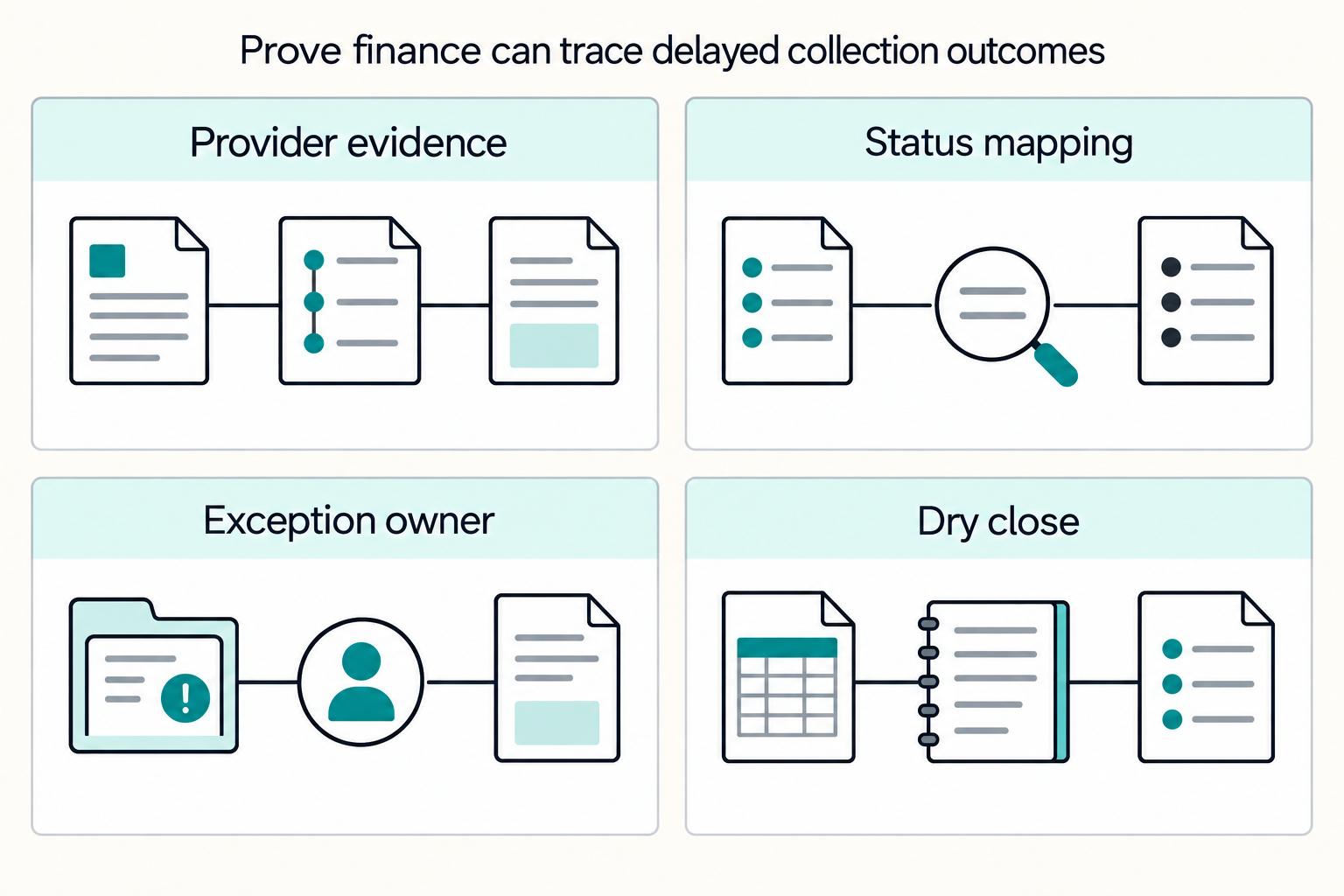
Before launch, finance should reconcile raw provider records to the close report. Require an evidence pack, explicit mappings for each relevant object and lifecycle, and a named exception owner. A payout, balance transaction, debit, and invoice can have different states at the same time. Trace a settled debit, a failed collection, and a refund end to end without forcing them into one status field.
Minimum evidence pack by provider#
For ACH and Bank Transfer flows, screenshots are not enough. The minimum pack is a payout or settlement artifact, status history for retries and failures, return or failure reasons where available, and a documented mapping from provider statuses to internal ledger states. If you use Plaid Auth for account linking, keep the boundary clear: Auth must be used with a payment processor to move money.
| Provider / flow | Minimum finance artifact | Timing or failure risk to plan for | Verification check |
|---|---|---|---|
| Stripe ACH Direct Debit | Automatic-payout reconciliation report plus balance report. Manual payouts use Balance reporting; instant payouts require your own transaction attribution. | Standard ACH settlement is T+4 business days in the Stripe balance; eligible users can use T+2, followed by a separate payout schedule and later-return exposure. | Confirm each debit in your "paid" state ties to a payout batch or an explicit timing bucket, and review failed payouts before close. |
| GoCardless Direct Debit / ACH | Payout Items API output or exported payout transaction details, including status, arrival date, and refund identifiers. | Failure reports are usually received 1 working day after charge date, but some arrive more than one business day later, including late failures after initial confirmation. | Validate payout-level mapping, since a payout may include transactions beyond one integration. |
| Plaid Transfer / Bank Transfer | Transfer events, dashboard transfer details, including refunds, and exportable reports. Plaid creates a transfer event whenever transfer.status changes. | Funds can be held for 2 to 5 days after settlement before availability. | Verify each transfer event and refund maps to one internal payment record. Do not treat account-link success as proof of money movement. |
A standing red flag is ambiguous status language. "Confirmed," "settled," "returned," and "refunded" are not interchangeable across providers.
Exception ownership and weekly controls#
Finance should own the exception queue for delayed debit outcomes, failed payouts, returned transfers, and refunds posted after billing cutoffs. Close risk appears whenever billing timing and cash timing diverge.
Use a recurring control, often weekly, that compares:
- provider-side failed collections, returns, refunds, and payout exceptions
- internal ledger states such as paid, failed, reversed, and refunded
- finance report totals used for close and cash reconciliation
Stripe balance reporting helps because it includes refunds and disputes. GoCardless payout exports include arrival dates and refund identifiers. Plaid Transfer dashboard views include events, statuses, and associated refunds.
Go-live gate for finance#
Run one dry close from raw events to the finance summary before launch. Gate criteria:
- no unresolved status-mapping gaps
- documented mappings by provider object and lifecycle, with rules for related states that differ legitimately
- one tested failure or return scenario and one tested refund scenario
- one tested reconciliation from provider API or export data into the report finance will use
If that dry close fails, launch is not ready. For this decision, the winning rail is the one finance can reconcile under delay, failure, and refund pressure.
Compliance and Trust Controls That Change Vendor Fit#
For this decision, compliance fit is operational, not just legal. Pick the option that makes authorization, verification, and audit evidence clearest for the exact rail and market you are launching first.
These controls can affect activation speed, support load, and dispute handling. If mandate or authorization steps are unclear, you can end up with failed onboarding, payment disputes, and reconciliation friction.
| Option | What the documented control surface clearly covers | What you still need to verify operationally | Regional caveat |
|---|---|---|---|
| Stripe ACH Direct Debit | Customer authorization is required, and bank accounts must be verified. Stripe also separates ACH Direct Debit from Instant Bank Payments, so method scope matters. | Where payment terms are presented, how verification is completed, and what audit artifact you retain when bank details were pre-collected. | US ACH requirements are not the same as SEPA or Canada PAD requirements. |
| GoCardless Direct Debit | Bank-debit collection relies on customer authorization, and SEPA mandate setup is rules-driven with strict content requirements. | Which scheme you are launching first, how mandate capture is stored, and how quickly support can retrieve scheme-specific authorization evidence. | Requirements vary by scheme and region, including ACH for US accounts and SEPA for EUR accounts in the Eurozone. |
| Plaid Auth / Identity Verification | Plaid Auth is an account and routing verification layer that can be used with an external processor. Plaid Identity Verification adds KYC and anti-fraud signals, including watchlist and PEP checks. | Whether you still need a separate debit processor and where the debit authorization artifact is stored. | Broad verification coverage does not mean identical payment-rail coverage across North America and SEPA markets. |
What changes day to day#
Activation messaging should distinguish instant verification from fallback verification. Stripe Financial Connections can verify supported accounts instantly; microdeposit verification can take one to two business days. Confirm the actual flow and communicate any pending verification before attempting the debit.
GoCardless is mandate-centered. A Direct Debit Instruction authorizes future collections, and SEPA mandate setup follows strict rules. Before launch, confirm where mandates are presented, how they are stored, and how support retrieves them during authorization disputes.
Plaid's role is different. Auth verifies account details, and Identity Verification strengthens KYC and fraud checks, but that is not the same as debit execution authority. Do not treat successful account linking as proof that you can collect recurring funds.
North America and SEPA are different jobs#
Rollout plans need jurisdiction-specific controls. US ACH focuses on authorization plus bank-account verification. Canada PAD follows a separate authorization framework designed to ensure proper authorization and protect against improper withdrawals. SEPA requires payer-signed authorization, with scheme-specific mandate expectations.
If phase one is North America, document US ACH and Canada PAD as separate onboarding tracks. If SEPA is near term, treat mandate capture as a core product requirement from day one.
Decision rule#
If your risk team needs clearer verification and audit evidence, prioritize the option with clearer rail-specific control surfaces for your launch market, not broader marketing claims. A practical check is whether your team can show who verified the account, where future debits were authorized, and which artifact supports a US ACH, PAD, or SEPA challenge.
Scenario Recommendations for Founders Product and Finance Leads#
Choose based on your bottleneck and tested product combination. GoCardless and Stripe ACH execute recurring collections; Plaid Link/Auth, Stripe Financial Connections, and eligible GoCardless verification features belong in the bank-linking shortlist. Compare the combinations against required banks, authorization, failure handling, and integration fit.
| Scenario | Recommended starting point | Why it fits | What you must verify before committing |
|---|---|---|---|
| Subscription platform that wants recurring bank debit fast | GoCardless | GoCardless explicitly positions bank-debit collection for recurring payments and publicly lists schemes tied to expansion, including Bacs, SEPA Direct Debit, Bg Autogiro, Betalingsservice, and BECS | Confirm the first schemes you need, where mandate capture is stored, and how support retrieves authorization evidence |
| Product with onboarding drop-off around bank connection or account verification | Compare Plaid Link/Auth plus execution, Stripe Financial Connections plus ACH, and eligible GoCardless verification | Each supplies a supported linking or verification path; the strongest fit depends on your banks, fallback requirements, tested conversion, and existing stack | Test bank coverage, verification fallback, conversion, and integration effort. Assign debit execution and recurring authorization separately; confirm product and regional eligibility |
| Team already invested in Stripe Billing or Connect-adjacent primitives | Stripe ACH Direct Debit | Stripe Billing manages subscription lifecycles, and Stripe Financial Accounts for platforms can matter if you already use broader Stripe platform services | Test delayed outcomes, failed-payment handling, dispute paths, and duplicate-safe webhook processing before moving live volume |
| Roadmap includes near-term expansion beyond US ACH | Usually GoCardless first | GoCardless publicly exposes broader bank-debit scheme coverage, including Bacs, SEPA, Autogiro, Betalingsservice, and BECS, which can reduce future rail replacement work | Map the schemes you will actually launch in phase two, not just roadmap intent |
When GoCardless is the cleanest starting point#
For pure subscription collection, GoCardless is usually the most direct fit in this comparison. Its recurring collection positioning and publicly named scheme coverage, including Bacs, SEPA Direct Debit, Bg Autogiro, Betalingsservice, and BECS, line up with expansion paths.
Your main checkpoint is operational: show the exact authorization artifact for your first scheme and how support retrieves it. A practical risk to avoid is weak mandate evidence.
When bank linking and verification are the bottleneck#
If bank connection or verification causes onboarding drop-off, compare Plaid Link/Auth, Stripe Financial Connections, and eligible GoCardless verification features. Test supported banks, fallback paths, completion rates, and integration effort with representative users. Product documentation establishes capabilities; your own evidence should decide which combination improves the onboarding flow.
For every linking option, name the debit-execution product and confirm where recurring authorization is captured and retained. Plaid Auth still needs an execution path; Financial Connections and GoCardless verification must also be paired with the appropriate collection and authorization flow. Successful account linking alone does not establish recurring collection authority.
When Stripe ACH is the right hold-and-test choice#
Stripe ACH Direct Debit is a practical path when your stack is already centered on Stripe Billing and platform primitives. The tradeoff is operational: ACH Direct Debit is delayed notification, and acknowledgement of success or failure can take up to 4 business days.
Before full rollout, test reconciliation for late outcomes, validate failed-payment and dispute handling, and keep webhook processing idempotent since Stripe can retry undelivered events for up to three days. If finance cannot clearly trace pending, settled, failed, and disputed states, delay migration.
Multi-region verdict#
If expansion across ACH, BECS, and Autogiro is already planned, favor the option that reduces future scheme swaps. In this comparison, that usually points to GoCardless because of its publicly listed multi-scheme coverage.
If you are US-first and onboarding UX is the priority, shortlist supported linking and collection combinations and select using tested coverage, fallback, conversion, and integration fit. If you are already committed to Stripe, include Financial Connections in that comparison and prove asynchronous collection failure handling before scaling.
For a step-by-step walkthrough, see How Dunning Works for Subscription Platforms.
A 30 Day Decision Checklist You Can Use Immediately#
If you want a cleaner decision in 30 days, run this as a proof cycle, not a demo tour. The goal is to confirm role fit, close the key unknowns, and end Week 4 with evidence that product, engineering, and finance can all sign off on.
| Week | Main task | Grounded checks |
|---|---|---|
| Week 1 | Set roles and success metrics | Document who owns recurring debit execution, who handles bank account linking, which regions are non-negotiable, and track signup completion, first-debit success visibility, and reconciliation completeness |
| Week 2 | Resolve vendor unknowns in writing | Confirm account pricing, Link/Auth versus Transfer ownership, fixed recurring versus Platform payments constraints, and Transfer UI one-time authorization scope |
| Week 3 | Test the full debit lifecycle in sandbox | For Stripe, test delayed outcomes, retries, and pending-state messaging; for Plaid Transfer, use /sandbox/transfer/fire_webhook; for GoCardless, verify payout transaction exports covering Customers, Payments, Refunds, Payouts, and Payout Items |
| Week 4 | Run a cross-functional go or no-go | Require final role definitions, regional fit, pricing clarifications, webhook and retry behavior, and a reconciliation export finance can trace end to end |
Week 1. Decide rail roles before comparing features#
Decide rail roles first, then compare features. Document which vendor owns recurring debit execution, which handles bank account linking, and which regions are non-negotiable for launch. GoCardless can narrow options quickly if you need listed recurring schemes such as Bacs, SEPA, ACH, PAD, BECS, BECS NZ, Betalingsservice, and Autogiro. The same applies if its stated 30+ country coverage matters to your plan.
Set three recurring-payments success metrics now: signup completion, first-debit success visibility, and reconciliation completeness. Do not treat a connected bank account as payment readiness when Plaid Auth still requires a separate payment processor to move money.
Week 2. Resolve what public docs do not settle#
Use vendor Q&A to resolve what public docs do not settle. For Stripe ACH, confirm your account-level pricing path, not only the public Stripe Billing reference of 0.8% per ACH direct debit with a $5.00 cap. Stripe also offers custom pricing for larger volume or unique models.
For Plaid, document the specific products in the design. Auth supplies account details; Transfer is the separate US money-movement product. Its recurring endpoints support fixed schedules but not Platform payments, and Transfer UI cannot capture standing authorizations for variable recurring payments. Verify who captures the authorization your subscription model requires.
Week 3. Test the full debit lifecycle in sandbox#
Test the full debit lifecycle in sandbox, not just happy-path setup. Stripe sandbox transactions do not move funds, and ACH collection can take up to 4 business days for success or failure acknowledgement, so test delayed outcomes, retries, and pending-state messaging.
For Plaid Transfer, include explicit webhook simulation: sandbox events are not automatic, and /sandbox/transfer/fire_webhook is required to send a Transfer webhook. For GoCardless, verify that finance can use payout transaction exports covering Customers, Payments, Refunds, Payouts, and Payout Items.
Week 4. Run one cross-functional go or no-go#
Run one cross-functional go or no-go with product, engineering, and finance together. Minimum evidence: final role definitions, regional fit, pricing clarifications, webhook and retry behavior, and a reconciliation export finance can trace end to end.
Do not approve an option if duplicate-safe retry handling is still unclear, especially where Stripe idempotency has not been designed into request retries. If the team still cannot clearly explain where recurring authorization lives, how debit outcomes surface, and how reconciliation works from raw events, the decision is not ready.
Related reading: 7 Revenue Leak Points in Subscription Platforms You Can Verify in 30 Days.
Ready to pressure-test Week 2-4 assumptions against real integration constraints? Review Gruv docs.
Conclusion#
The winning choice is the one that matches how your team will actually collect, verify, retry, reconcile, and explain bank debits when payments fail or are returned in production. In gocardless vs stripe ach vs plaid subscription platforms, the deciding factor is not feature count. It is fit across product ownership, engineering complexity, and finance controls.
GoCardless is positioned as a recurring bank-debit collection layer, including ACH in the US, with stated coverage across 30+ countries and 8 currencies. Stripe ACH is a reusable, delayed-notification method, with success or failure acknowledgement that can take up to 4 business days, plus authorization and bank-account verification requirements before debiting. Plaid Auth supports account and routing setup, but money movement requires a processor partner or third party. Plaid Transfer is the separate all-in-one option, and it is US-only.
Before procurement closes, align product, engineering, and finance on the same operating facts:
- Product: who owns customer messaging for failed or returned debits
- Engineering: idempotent webhook and event handling across first debit, retry, return, and cancellation
- Finance: settled-transaction-to-payout reconciliation and clear exception-queue ownership
The next step is straightforward: run your internal 30-day checklist, document unknowns, and force each item into yes, no, or needs-test. Validate Stripe ACH timing and verification in your actual flow, confirm where Plaid ends and your processor begins, and verify GoCardless coverage against your next target regions. Then choose the rail strategy that reduces future rework while still supporting growth.
If coverage, reconciliation controls, or rollout risk is still unclear, talk through your operating model with Gruv.
Frequently Asked Questions
Is Plaid a replacement for a recurring debit processor in subscription products?
Plaid Link/Auth alone is not a recurring debit processor. Plaid Transfer is a separate US money-movement product that supports fixed-amount recurring ACH schedules, with recurring endpoints unavailable for Platform payments. Variable recurring authorization and billing orchestration require an explicitly supported design. Compare that scope with your subscription model rather than treating all Plaid products as linking only.
When is GoCardless a better fit than Stripe ACH for subscription collections?
GoCardless is often a better fit when recurring bank debit collection is the core job and you need coverage beyond US ACH. It explicitly lists ACH in the US, SEPA Direct Debit in the Eurozone, and BECS in Australia, and states coverage across 30+ countries. It also documents webhook handling for failed payments and subscription-related events, which helps with retry and support operations.
Can ACH support alone decide which platform we should choose?
No. Two vendors can both support ACH but still differ in verification requirements, outcome timing, and failure handling. Stripe describes ACH Direct Debit as delayed notification and notes that acknowledgement of success or failure can take up to 4 business days, so operating-model fit matters as much as rail availability.
What is the difference between Bank Account Linking and debit collection rails in practical terms?
Bank account linking connects the account and can support verification. A debit collection rail is what actually originates the bank debit, and that flow depends on customer permission, usually through a mandate. In practice, a linked account is not yet a payment-ready subscription method until authorization, debit initiation, and outcome handling are in place.
Which unknowns about Stripe ACH should we validate before procurement?
Validate your actual pricing path, not only the published Stripe Billing line item of 0.8% per ACH direct debit with a $5.00 cap. Confirm your verification method, since Stripe requires account verification before debiting. Then test asynchronous failure behavior, because Stripe Billing notes subscriptions can remain active if a later ACH failure voids the invoice, and review payout reconciliation reporting early.
How should we weigh regional schemes like SEPA Direct Debit or BECS against US-first priorities?
Prioritize the next region you cannot miss, not only the rail your team already knows. If you are truly US-only in the near term, a US ACH path may be enough for phase one. If SEPA Direct Debit or BECS is on the near roadmap, weight that now because GoCardless explicitly supports EUR collection in the Eurozone and AUD collection in Australia.
What evidence should finance ops require before approving go-live?
Require linked collection, balance, payout or settlement, and accounting evidence, plus tested failures, returns, refunds, and authorization capture. For Stripe, use automatic-payout attribution where supported and your own mapping for manual or instant payouts. For Plaid Transfer, ingest later returned events; for GoCardless, test its payout-item and failure evidence. Initial settlement does not erase applicable return rights; verify scheme-specific windows and exceptions with the provider.
Try a related tool
Researched and edited by the Gruv editorial team. Gruv builds cross-border billing, payouts, and finance-operations software for global businesses.
Sources
Includes 6 external sources outside the trusted-domain allowlist.
- docs.stripe.com/payments/ach-direct-debittrusted
- docs.stripe.com/payments/ach-direct-debit/accept-a-paymenttrusted
- gocardless.com/features/recurring-paymentsexternal
- gocardless.com/en-us/pricingexternal
- nacha.orgexternal
- nacha.org/rules/differentiating-unauthorized-return-re...external
- plaid.com/docs/authexternal
- plaid.com/docs/linkexternal
Educational content only. Not legal, tax, or financial advice.
Related Posts
AI Fraud Detection for Subscription Platforms Beyond Rules-Based Approaches
An **AI fraud detection subscription platform** is not just a model score. For a subscription business, it should help you manage fraud risk and compliance exposure across onboarding, recurring payments, and payouts or withdrawals. It should also give your risk, finance, legal, and compliance teams decisions they can defend.

Seven Subscription Billing Tools: Features and Pricing
The best subscription billing tool depends on what you sell, how you charge and who acts as seller to the customer. Start with those choices, then compare recovery, finance exports, implementation effort and price. A recurring invoice engine, a payment processor and a merchant of record perform different jobs; their headline fees cover different costs.

Paying Unbanked Contractors in Developing Markets: Best Payout Routes for Platforms
If your team needs to send money to contractors, creators, freelancers, marketplace sellers, or other non-payroll recipients across borders, the payout decision can look deceptively simple at first. On paper, you are choosing a payment rail. In practice, you are choosing an operating model that affects onboarding, compliance, support load, engineering effort, treasury visibility, failure recovery, and the degree of legal risk your company is willing to carry.