
Quick Answer
Compare one completed funds flow end to end for fx spread comparison platforms wise airwallex stripe, then choose the option your team can execute and reconcile reliably. The article’s core rule is to use same-shape, same-time executable quotes with route and beneficiary details attached, because ACH paths, fee stacking, and quote expiry can change real outcomes. A provider that looks cheaper on a headline rate can lose once payout handling, retries, and close-cycle reporting are tested.
Comparing FX Spread on Wise, Airwallex, Stripe, and Local Rails Starts With Route-Level Evidence#
The wrong way to choose between Wise Business, Airwallex, Stripe, and local payment rails is to compare a headline FX rate and stop there. For most platform teams, margin risk often shows up in execution and operations. Quotes expire before you book, fees stack across collection and payout, route selection can be suboptimal, and finance teams may struggle to tie bank movements back to transactions cleanly.
That matters even more in the United States, where "local rails" often means ACH, the Automated Clearing House network banks use to send batched electronic credit and debit transfers. ACH can be a useful cost and settlement option, but it is not automatically the right route for every corridor or payout pattern. If your vendor review does not include the actual rail used, the beneficiary type, and the settlement path, your price comparison is incomplete before procurement even starts.
A few public facts show why headline pricing misleads. Stripe is explicitly built for SaaS platforms and marketplaces through Connect, so it is a serious contender when product integration matters. But Stripe's public pricing also shows how costs can stack: 2.9% + 30¢ for domestic cards, plus 1.5% for international cards, plus 1% if currency conversion is required. Airwallex's documentation points to the same issue from a different angle, listing multiple FX-related fee types such as conversion fees, foreign currency settlement fees, refund FX markup, and shopper-side FX.
Quote timing is the other trap teams miss early. Wise defines a guaranteed rate as one it locks for a specific period, and that lock window can range from 2 to 48 hours depending on the currency. Airwallex quote responses include indicative rates and prospective transaction amounts, so teams need to confirm when a quote is executable and how long it remains valid. If you compare one vendor's indicative quote to another vendor's locked rate, or your retry happens after the quote window closes, your spreadsheet becomes a stale assumption.
The last hidden cost is reconciliation. Stripe offers a payout reconciliation report to help match bank payouts to the underlying payment batches, and Wise supports direct connectivity to accounting software. That can sound like back-office detail, but it is often where an apparent FX win disappears. If references are inconsistent, exports are incomplete, or finance cannot map activity into your ledger at month-end, you will pay for the difference in manual effort and exception handling.
Compare executable corridor quotes, not marketing rates. Test landed cost using the real collection and payout route. Then verify that the reporting artifacts hold up at close, not just in a demo. If a provider cannot give you quote timing rules, fee stacking visibility, and finance-ready reconciliation evidence up front, treat that as a red flag before you build anything.
At-a-glance comparison for platform operators#
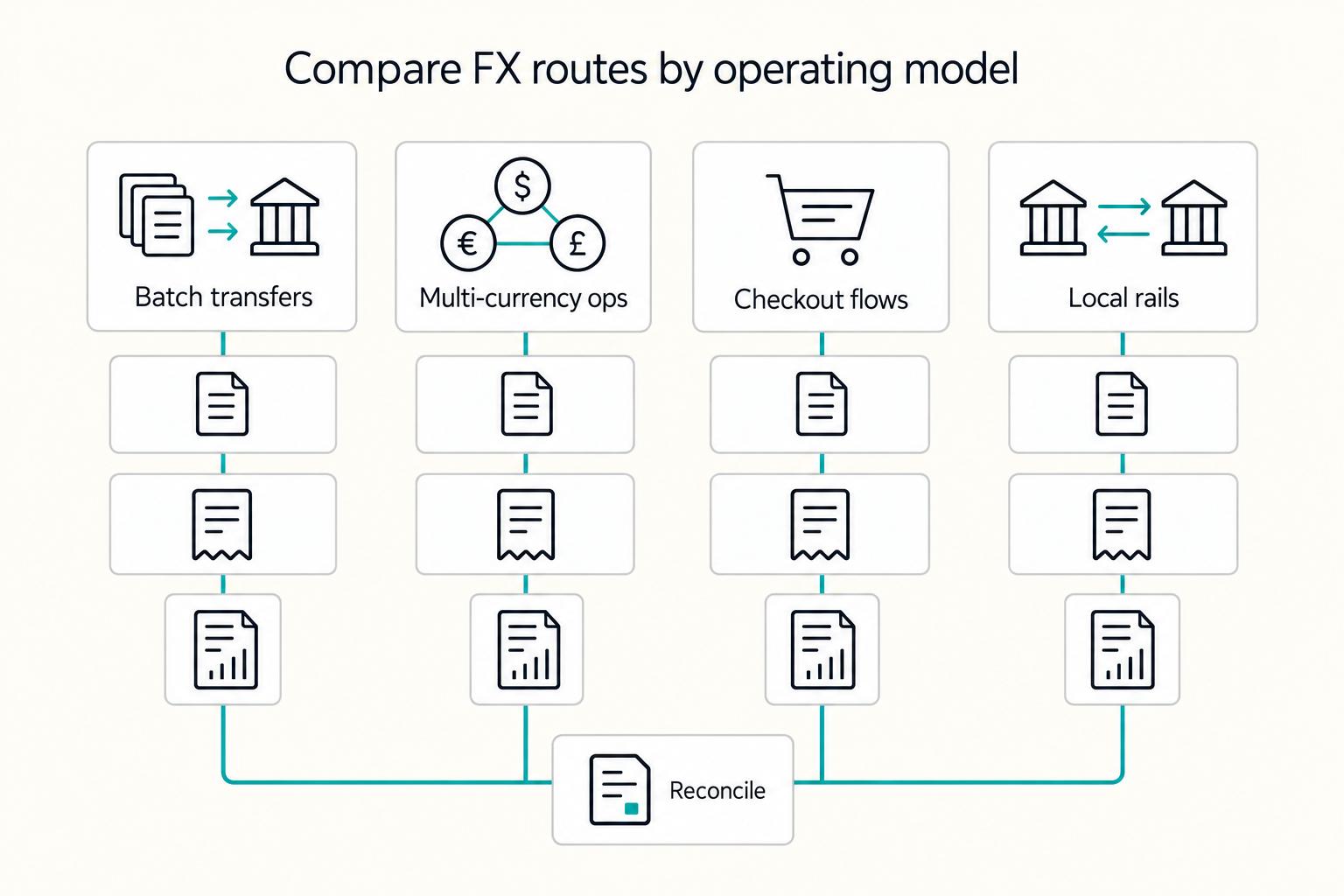
Start with the operating model, then validate cost: Stripe for checkout-heavy SaaS and marketplace flows, Wise Business for treasury-style cross-border batch transfers, Airwallex for multi-currency operations, and local rails (including ACH in US contexts) for concentrated high-volume corridors you can actively manage.
| Criteria | Wise Business | Airwallex | Stripe | Local payment rails |
|---|---|---|---|---|
| Best for | Treasury-style cross-border batch sends | Multi-currency collection plus payout operations | Checkout-heavy platform flows | Corridor-level optimization at sustained volume |
| All-in landed cost | Evaluate as fee plus exchange rate, then validate the executable route and quote. | Compare only executable quotes; treat indicative values as non-final. | Model full landed cost across your payment and conversion flow, not FX alone. | Can be efficient on stable routes; in US use cases, ACH is an efficient, low-cost batched rail when paths are predictable. |
| Integration depth | Strong for payment operations and batch transfers. | Broad operating model with global accounts and payout-network coverage. | Deep checkout surface; Checkout supports 100+ local payment methods. | Varies by bank/processor and your build depth; lowest abstraction. |
| Payout control | Supports treasury-style batch operations, including up to 1,000 international payments in one transfer. | Broad local and SWIFT payout coverage across 200+ countries/regions and 90+ currencies. | Manual payouts give timing control, with added reconciliation responsibility for your team. | Highest direct control if you own routing, cutoffs, and exceptions. |
| Reconciliation exports | Shows accounting connections (QuickBooks, Xero, Sage); verify field-level fit. | Reconciliation reports downloadable in .xlsx and .csv. | Payout reconciliation report data downloadable as .csv. | Depends on bank file standards and remittance detail; request sample files early. |
| Compliance gating | Confirm onboarding, beneficiary type, and corridor eligibility early. | Check entity and corridor access across accounts, balances, and routes. | Platform tooling does not remove onboarding and payout review requirements. | Usually the highest internal control burden across bank policy, rail rules, and internal controls. |
| Unknowns to clear before procurement | Executable corridor quote, validity window, beneficiary route, return handling | Same, plus whether each payout is local or SWIFT by corridor | Same, plus full cost shape for your payment+payout path | Same, plus batch cutoffs, file standards, and exception ownership |
| Confidence level | Medium-high after real transfer and export testing; medium from product pages alone | Medium when quote responses include guaranteed validity periods; lower at benchmark-only level | Medium for integration and payout-control fit; lower until cost is modeled end-to-end | Low until you have timestamped corridor tests and sample reconciliation files |
Use this as a filter, not a verdict. Before signing, require two proofs from each finalist: a same-time executable quote test and a reconciliation-file test mapped to your ledger process. If either proof fails, the apparent FX advantage is not decision-ready.
How to measure all-in landed FX cost without fooling yourself#
Measure one thing: the all-in landed cost of one completed funds flow, not a headline mid-market or "interbank" snapshot. Mid-market is a baseline; decision-grade cost is the executable FX outcome plus collection, transfer, and payout charges on the actual route used.
| Quote source | Type | Article detail |
|---|---|---|
| Public benchmark rates | Indicative only | Use as baseline context, not decision-grade cost |
| Wise authenticated quotes | Executable | Typically valid for about 30 minutes |
| Stripe FX quotes | Executable | 5-minute, 1-hour, or 24-hour locks |
Run a strict like-for-like test across Wise Business, Airwallex, and Stripe with the same corridor, amount, timestamp window, transaction shape, funding method, and beneficiary type. This matters because FX can occur at different points in the flow (payments, transfers, payouts, application fees, and more), and timing differences can change the result.
Keep indicative and executable values separate in your evidence. Public benchmark rates are indicative only, while executable quotes have validity windows and expiry behavior. In practice, check quote type and timing every time (for example: Wise authenticated quotes are typically valid for about 30 minutes; Stripe supports 5-minute, 1-hour, or 24-hour FX quotes) so you do not compare stale executable pricing against fresh benchmark pricing.
Final gate: can finance actually close from the data? Require exports or connector output that finance can reconcile in QuickBooks, Xero, or Sage, with enough detail to tie conversion and fee lines back to payouts. Wise states direct QuickBooks/Xero connections are available; for Stripe outputs and any Sage mapping, validate real files before approval. If finance cannot close cleanly from the data, the FX claim is not decision-ready.
We covered this in detail in Automating Your Freelance Finances: A Zapier Workflow for Connecting Stripe, QuickBooks, and Wise.
Where each option wins by platform business model#
Once you have a like-for-like quote test, the right choice is usually driven by operating model, not one headline FX number.
| Option | Wins when | Why it tends to fit | Main tradeoff to watch |
|---|---|---|---|
| Stripe | You monetize checkout and need deep commerce integration | Official Adobe Commerce (Magento 2) app path, direct WooCommerce connection, and Global Payouts for sending funds to third parties in local currency | Strong checkout infrastructure does not automatically mean lowest all-in FX outcome once conversions, payouts, and fees are combined |
| Airwallex | You run multi-currency collections and payouts across entities | Global Accounts support receiving bank transfers and authorizing direct debit payouts from the Wallet; payout network coverage includes over 200 countries/regions and over 90 currencies, with local clearing in over 120 countries/regions | Fit depends on whether your entity setup and highest-volume corridors can use the local routes you need |
| Wise Business | Your priority is transparent cross-border pay-ins/pay-outs with clear pricing | Wise positions business pricing as transparent, with fees shown upfront and no subscription fee | It can feel transfer-first if you need deeper commerce-surface integration or more complex platform routing |
| Local payment rails plus ACH | Your volume is concentrated in repeat corridors, especially for US domestic legs | ACH is a batch network with same-day and next-day settlement options, which can be efficient for recurring flows | ACH is not real time, so performance depends on your corridor-level operating model and settlement needs |
Use corridor-level evidence before you commit: executable quote behavior, payout route availability, and settlement pattern on your actual transaction shape.
For a step-by-step walkthrough, see Paddle vs. Stripe: A Comparison for SaaS Founders.
Hidden costs and failure modes that change the real spread#
Your real spread is the executed total cost, not the headline quote. Quote expiry, payout failures and returns, and reconciliation effort can turn a better-looking rate into a more expensive production flow.
When options are close on corridor pricing, pick the one your team can execute and reconcile cleanly, not the one with the prettiest indicative quote.
| Platform | What changes the real spread | What to verify before signing |
|---|---|---|
| Stripe | Quote timing is variable (5 minute, 1 hour, or 24 hour windows). Repeated requests with the same idempotency key return the first result, including 500 errors. Returned payouts are typically back in 2-3 business days. | Test with the same quote window you will use in production. Confirm retry behavior for expired quotes and reused idempotency keys. Review sample accounting exports with payments, refunds, fees, and payouts, not only dashboard views. |
| Airwallex | Multiple FX-related fees can apply (conversion, foreign currency settlement, refund FX markup, shopper-side FX). Transfers can still end in FAILED after prior progress if local clearing or the recipient bank rejects them. Failure reasons are provided in Transfer details. | Run corridor tests that include conversion, settlement, refunds, and returns. Validate status handling for the API version you plan to use (this model applies to 2025-06-30 or later). Ensure ops can act on transfer-level failure reasons. |
| Wise Business | Quotes expose rateExpirationTime, and the referenced quote resource says rates are locked for 30 minutes. Costs can change after recipient details are attached because payment options, prices, and delivery estimates may change. Route choice can also change cost (for example, USD sent outside the US can use international instead of domestic networks). | Compare only fully specified transactions: recipient, payout method, and funding path attached. Log quote time, expiry time, and execution time. Re-test corridors where route changes after beneficiary details are added. |
Quote timing is a real cost variable#
Short quote windows create execution variance, not just pricing noise. Wise exposes this with rateExpirationTime, and Stripe exposes it through 5 minute, 1 hour, and 24 hour quote durations. If approvals, recipient checks, or retries often outlast your lock window, treat that quote as indicative rather than decision-grade.
For Wise, Airwallex, and Stripe comparisons, keep one evidence pack format: quote timestamp, expiry timestamp, recipient ID, payout method, and final executed amount. Without that, you are comparing different transactions.
Failure handling is where operations can quietly lose margin#
Exception handling quality directly affects landed cost. Airwallex states transfers can fail after earlier progress and provides failure reasons in Transfer details, so your monitoring cannot stop at a sent-style milestone.
| Item | Detail | Related note |
|---|---|---|
| Airwallex transfer failures | Transfers can fail after earlier progress | Failure reasons are provided in Transfer details |
| Stripe payout states | processing, posted, failed, returned, canceled | posted should not be treated as guaranteed completion |
| Stripe idempotency retries | Retry with the same Stripe idempotency key is not a new attempt | Returns the first result, including prior 500 responses |
Stripe payout states (processing, posted, failed, returned, canceled) help operational triage, but posted should not be treated as guaranteed completion. Also, a retry with the same Stripe idempotency key is not a new attempt; it returns the first result, including prior 500 responses.
Reconciliation drag can erase small FX gains#
Reconciliation friction is part of total cost. Stripe provides accounting exports covering payments, refunds, fees, and payouts (including QuickBooks Desktop-compatible IIF), while Airwallex documentation shows integration syncs can still fail in Xero.
Before you close procurement, have finance test a production-like export sample in your accounting workflow. If the reference chain across collection, conversion, fees, and payouts is not clean, some quoted FX savings will likely be absorbed by close-cycle cleanup. Related: our 2026 Stripe, PayPal, and Wise comparison for freelancers.
When local payment rails are the right answer and when they are not#
Local payment rails are the right answer when your volume is concentrated in repeat corridors, beneficiary details are consistently clean, and your team can run route governance. If payout geographies change often or operational controls are still maturing, a local-rail-first design usually adds more exceptions than it removes.
Airwallex's network shows why local rails can win in the right setup: local clearing connections in over 120 countries/regions, and local plus SWIFT payouts across over 200 countries/regions and over 90 currencies. But coverage and destination requirements vary, so treat this as a corridor-by-corridor decision, not a global default.
When local rails are worth the effort#
Choose local rails when all of these are true:
- Your payout volume is concentrated in repeat corridors with predictable beneficiary types.
- Your ops team can maintain destination-specific routing and beneficiary-detail controls.
- You need tighter control of conversion and payout timing more than the fastest checkout expansion path.
If checkout expansion is the priority, Stripe can be faster to activate local-market acceptance in specific regions, including cases like Nigerian local payment methods without a local entity.
When to avoid local-rail-first#
Avoid local-rail-first when corridor mix shifts frequently or exception handling is not yet disciplined.
| Risk | Detail |
|---|---|
| Beneficiary data quality | Incorrect destination information causes most returned payouts |
| Cutoff timing | Requests after cutoff move to the next business day |
| Same-day ACH timing | Same-day ACH depends on submitting before cutoff; otherwise ACH outbound timing is typically one to two business days, and ACH funding can take up to 4 days in some flows |
| Posted status | "Posted" status is not final receipt; recipient-bank release can still delay funds |
Set a practical go/no-go gate#
Before you commit, define corridor-level go/no-go criteria and test them in production-like conditions:
- Consistent beneficiary success and return behavior from your own runs.
- Exception volume your team can absorb without manual-firefighting growth.
- Settlement timing that stays predictable across cutoff windows and retry patterns.
- Transfer-level failure telemetry your team can act on (for example, fields like
failure_reason).
If those checks are unstable, keep Stripe or Airwallex as your broad default and apply local rails only where your own corridor evidence is consistently better.
Integration and reconciliation checkpoints before you sign#
Before you sign, make sure engineering and finance can both run the workflow from the same evidence, not just a sales demo. The minimum bar is clear webhook handling, usable payout-status visibility, and reconciliation outputs your close process can trust.
| Checkpoint | Stripe | Airwallex | Wise Business |
|---|---|---|---|
| Status update baseline | Connect integrations should establish a webhook endpoint for Connect events | Webhook events are available for transfer and batch-transfer status changes | Wise recommends subscribing to the transfer state change webhook |
| Retry behavior to inspect | Automatically resends undelivered webhook events for up to three days | Confirm delivery and retry behavior during solution review | Confirm delivery and retry behavior during solution review |
| Reconciliation artifact in docs | Payout reconciliation report helps match bank payouts to settled transaction batches | Accounting integrations include Sage sync; Airwallex also states transactions can be reconciled every hour | Direct setup is documented for QuickBooks, Xero, and Exact Online |
| Accounting connections called out | QuickBooks Online and Xero | Sage | QuickBooks and Xero |
| Commerce integration check | Confirm plugin depth vs custom API effort for your stack | Plugin-first path with "no coding required," plus pre-launch testing guidance | Do not assume native commerce plugins; verify implementation effort |
Your highest-risk checkpoint is event handling. Stripe is explicit that Connect setups should run with webhooks, and its redelivery window means retry handling must be designed deliberately. Wise is explicit about using transfer state-change webhooks to keep status current. Airwallex exposes transfer and batch-transfer status events, which is useful if payouts are grouped operationally.
For finance, require proof artifacts before signature. Ask for a sample sync/export that preserves payout references, fee lines, and settlement matching. Stripe provides a named artifact (the Payout reconciliation report) and accounting integrations for QuickBooks Online and Xero; Wise documents direct QuickBooks/Xero setup; Airwallex documents Sage sync and hourly reconciliation. Match this to your actual close process, not a generic "integration available" claim.
Run one production-like dry run before contract signature with explicit pass/fail gates:
- Status changes reach your internal ledger from webhook events.
- A simulated payout failure and exception path reaches finance with usable references.
- Payout/transfer exports match back to transactions without manual spreadsheet repair.
For Stripe, use sandbox webhook triggers to force the event paths you care about. If a vendor cannot demonstrate this end to end, treat that as a signing risk.
Compliance and tax gates that can block rollout late#
Late rollout risk is usually ownership risk: lock down who handles KYC, KYB, AML, tax-form collection, and MoR implications before contract signature.
| Gate | Stripe | Airwallex | Wise Business | Local payment rails |
|---|---|---|---|---|
| Documented onboarding responsibility | Platform is responsible for collecting required KYC and KYB information during onboarding and passing it to Stripe | KYB screening is documented as required if the customer will be onboarded as Merchant-Of-Record for gateway acceptance | Confirm with the relevant authority | Confirm with the relevant authority |
| Documented AML signal | Verification checks are used to flag potential money laundering or fraud risk | Confirm with the relevant authority | Confirm with the relevant authority | Confirm with the relevant authority |
| Documented MoR touchpoint | Stripe Connect ties merchant-of-record outcome to charge type; for direct charges, the connected account is the merchant of record | Airwallex documentation ties KYB screening to MoR onboarding for gateway acceptance | Confirm with the relevant authority | Confirm with the relevant authority |
Use this table to identify responsibility boundaries, not to crown a universal winner. Stripe and Airwallex at least document where responsibilities sit; your review should still require evidence of required fields, exception states, remediation ownership, and onboarding failure handling.
Tax-doc handling should be validated as a workflow, not a feature checkbox. For U.S. entities paying global contractors, confirm classification logic for W-9 (correct TIN), W-8BEN (foreign individual status), and W-8BEN-E (foreign entity status), plus year-end data outputs for reporting.
Do not hard-code one 1099 threshold without tax-year context. The IRS FAQ cited here references $600, with wording that changes to $2,000 for payments made after December 31, 2025, so require exports that include payee type, tax form on file, TIN or foreign-status flag, and gross paid by tax year.
For U.S.-based entities with global users, treat FBAR and FEIE as support-data requirements, not provider-automated outcomes. FBAR is filed on FinCEN Form 114 when aggregate foreign account values exceed $10,000 during the calendar year, and FEIE may apply if requirements are met (2026 maximum exclusion: $132,900 per person), so your practical gate is whether finance can pull the account and recipient data advisers will request.
If MoR is on your roadmap, resolve it now or budget for re-architecture later. Stripe Connect ties MoR outcome to charge type (direct charges make the connected account the merchant of record), and Airwallex documents KYB requirements for Merchant-Of-Record onboarding for gateway acceptance; if a vendor cannot explain how MoR changes onboarding, legal responsibility, and tax-document flows, treat that as a decision risk. Related reading: Stripe vs. PayPal for International Freelancers.
Conclusion#
Pick the option that wins on all-in landed cost and operational control in your real corridors, not the one with the prettiest FX headline. For many platform teams, that means running a same-shape corridor test across Wise Business, Airwallex, Stripe, and any local rail option. Then disqualify anything that looks cheap on paper but creates execution, reconciliation, or compliance friction.
The practical reason is simple: total remittance cost is not just rate. It includes the transaction fee, the exchange-rate margin, and service speed, and FX can show up across payments, transfers, payouts, application fees, and other transaction types. A provider can look competitive on a single conversion screen and still lose once you include payout fees, route choice, or retries after a quote expires. That is why public comparisons are useful context, not proof. Even the World Bank pricing data is a snapshot, and actual costs vary over time.
Your decision should rest on a compact evidence pack from a production-like test. Capture the corridor, timestamp, amount, beneficiary type, quoted exchange rate, fee stack, estimated delivery time, quote-expiry rule, and expected delivered amount. If your team cannot reproduce the result later, you do not yet have a procurement-grade comparison. For example, Wise documents quotes that typically remain valid for 30 minutes, while Stripe documents 5 minute, 1 hour, and 24 hour lock windows. If your test ignores those windows, you are comparing stale execution paths, not real cost.
A strong go-or-no-go screen usually looks like this:
- Go forward only if the vendor can provide executable quote outputs that include the exchange rate and delivery context, not just an indicative conversion figure.
- Go forward only if engineering can validate event handling in a test lane first. Stripe is explicit that Connect integrations should establish a webhook endpoint to listen for events, and similar event readiness matters anywhere payouts can fail, reverse, or arrive late.
- Stop and re-check if routing is unclear. If you cannot tell whether a main corridor uses local payment rails or a higher-friction path, your pricing model is incomplete.
If you need tighter control across collection, conversion, and payout as volume grows, evaluate a modular path rather than locking yourself into a single narrow use case. That is especially relevant when you want one API surface to support multiple financial capabilities over time, such as accounts, payment acceptance, and spend controls. The right end state is not "lowest spread." It is the option your finance, ops, and engineering teams can actually run, with less risk of expensive rework six months later.
Frequently Asked Questions
What does FX spread comparison mean for platforms versus simple transfer businesses?
For a platform, FX spread is only one line item, not the whole decision. The comparison unit should be all-in remittance cost: transfer fee, exchange-rate margin, and service speed, because those can change the delivered amount even when a headline rate looks strong. That matters in platform flows because a stale quote, an extra payout fee, or a slower route can change margin and delivered outcomes.
Is “interbank rate access” enough to decide between Wise Business, Airwallex, and Stripe?
No. Public methodology on remittance pricing is explicit that total cost is not always clear because several variables shape it, so "interbank" positioning by itself is not enough. Treat "access to interbank rates" as marketing until you see the exact rate used, the fees charged, and the amount expected to be delivered on the same corridor at the same time.
How should we compare quoted rates when execution times and quote expiry rules differ?
Use executable quotes, not just indicative screens, and capture the expiry window with the rate. Wise documents quote expiry if the quote is not used to create a transfer within 30 minutes of creation. Stripe documents 5 minute, 1 hour, and 24 hour FX quote locks, and it also says the lock expires if the exchange rate moves by more than 3.5%. A practical red flag is comparing one provider's locked quote against another provider's stale screenshot and calling that a pricing test.
When do local payment rails beat global platforms on real landed cost?
They can win in some corridors when local-bank-transfer routes are available. Airwallex's own documentation notes SWIFT transfers involve longer processing times and higher fees than local bank transfers. They are not automatically cheaper or faster in every corridor, so verify route by route. If a vendor cannot tell you whether funds move locally or over SWIFT for your main payout paths, you do not yet have a real cost comparison.
What are the top questions procurement should ask before signing a cross-border payments contract?
Ask for the exact exchange rate, the amount of certain fees, and the amount expected to be delivered, since those are the disclosure elements called out in remittance rules. Then ask whether the rate is indicative or executable, how long the quote stays valid, and what happens if the quote expires or the market moves sharply before execution. If the vendor will not provide sample disclosures or quote responses for your priority corridors, treat that as a procurement risk, not a documentation gap.
What data is still missing from most public Wise vs Airwallex vs Stripe comparisons?
Usually, the missing piece is same-time, corridor-specific executable evidence. Public pricing studies are collected in limited time windows to control for fluctuations, which means they are useful context but not proof of your own landed cost. For this kind of comparison, you still need your own capture pack: timestamp, corridor, amount, beneficiary type, quoted rate, fee stack, expiry rule, and delivered amount.
Try a related tool
Researched and edited by the Gruv editorial team. Gruv builds cross-border billing, payouts, and finance-operations software for global businesses.
Sources
- consumerfinance.gov/about-us/newsroom/cfpb-issues-final-remittan...trusted
- docs.stripe.com/reports/payout-reconciliationtrusted
- docs.stripe.com/payments/currencies/localize-prices/fx-quote...trusted
- federalreserve.gov/paymentsystems/fedach_about.htmtrusted
- federalreserve.gov/publications/2023-ar-payment-system-and-rese...trusted
- irs.gov/businesses/small-businesses-self-employed/re...trusted
- irs.gov/faqs/small-business-self-employed-other-busi...trusted
- remittanceprices.worldbank.org/methodologytrusted
Educational content only. Not legal, tax, or financial advice.
Related Posts

When Stripe Identity for Platforms Is Enough and When to Add More Controls
If you are building platform payments with connected accounts, the first step is to separate what is known from what is not.

Stripe vs PayPal vs Wise for Freelancers in 2026
Cashflow reliability matters more than brand familiarity. If money arrives later than expected, gets reduced by fees, or loses value during conversion, margin disappears even when the client technically paid on time.

High-Earners vs. Low-Earners: A Breakdown of Platform Choices for Indian Freelancers
Stop searching for the "best platform" and build a two-rail system, with one primary rail and one backup, that protects cashflow, FX, and reversals. As a freelancer, you're running a business of one. Getting paid is a core ops system, not a preference.