

Quick Answer
Compare eligible receiving products using net INR proceeds for the same gross invoice and quote time. Keep a tested backup for future payments, check actual hold and dispute deadlines, and map invoices to gross payments, fees, remittance records and bank credits. Income alone does not establish the best provider.
Choose payment routes by invoice size and cashflow needs#
For Indian freelance invoices, choose a primary payment route and a usable backup after checking eligibility, total INR proceeds and the consequences of a hold or reversal. Income alone does not determine the right provider: a high earner can send many small invoices, and a lower earner can have one large project.
Separate the client-facing way to pay from the final Indian bank credit. A foreign account detail, card checkout and direct international bank wire have different funding, conversion and documentation steps.
Design around the failures that show up at the worst time, right before payroll, taxes, or a big vendor bill:
- Holds and reserves: distinguish ordinary payment holds, dispute holds and account reserves; use the displayed account status.
- Conversion cost: compare net INR proceeds with a timestamped reference rate.
- Bank-chain deductions: sender, intermediary and receiving charges can affect wire proceeds.
- Reversals: card disputes and some bank returns can reduce receipts after payment; keep reason-specific evidence.
Your income-based framework (low / mid / high) without fake thresholds#
Use invoice size, frequency and how long you can wait for cash. The bands below are operating patterns rather than researched income-group preferences or fixed INR thresholds.
| Band | Invoice pattern | Rail approach |
|---|---|---|
| Small invoices | Any income level; many small bills or one small project | Compare eligible routes for fixed/minimum costs and client acceptance. |
| Mixed invoices | Different amounts, currencies or billing frequencies | Use live quotes for each common invoice pattern and an approved backup. |
| Large invoices | Any income level; larger projects or retainers | Compare net proceeds, limits, documentation and recovery as well as percentage cost. |
Break-even math you can do in 60 seconds#
Run this quick "effective fee" check per client:
- Convert all comparison amounts into the same currency at the same benchmark time.
- Record fixed charges, percentage charges and minimums separately.
- Calculate the combined cost from benchmark gross value to net proceeds, without adding the FX difference twice.
Select a primary route for your actual invoice pattern and a backup with a different failure dependency where possible. Two brands using the same bank or approval process may fail together. For the FX calculation, see Financial Analysis of Foreign Currency Transactions for the Indian Freelancer Economy.
Compare eligibility, cost and recovery before choosing a platform#
Check that the exact product accepts your Indian business form, service category, client country, currency and invoice amount. A provider available somewhere else may not offer the same account or receiving method in India.
A few definitions to keep you sharp while you scan:
- Mid-market rate: a comparison benchmark, not the amount you necessarily receive after fees.
- Conversion spread: the difference embedded in an offered exchange rate.
- Correspondent fees: possible deductions by banks in an international wire chain.
- Card dispute: a challenge through the issuer that can debit funds; delivery records do not guarantee a win.
Use the table as a quick filter, then turn it into defaults in the next section.
| Criteria (what actually matters) | Wise | PayPal | Payoneer | SWIFT wire to bank account | Stripe (card checkout) | Upwork (and similar marketplaces) | Skydo / EximPe / Xflow / Razorpay (IN-focused options) |
|---|---|---|---|---|---|---|---|
| Common fit (operator shorthand) | When you care about FX transparency against a benchmark | When a client insists on PayPal | When a client wants this rail | When a client mandates bank wires | When you need card acceptance and can run a dispute workflow | When you're using a marketplace that bundles discovery + payments | Varies by provider; validate capabilities before you depend on it |
| Effective cost drivers | Fees + FX vs mid-market rate benchmark | Published India international commercial rate: 4.4% plus currency-specific fixed fee; conversion may add cost. Recheck account terms. | Payment-method and receiving/withdrawal fees; inspect your account quote and any account fees. | Sending bank fees + correspondent fees that can be deducted during processing | Processing fees + disputes (which can reverse payments and pull dispute fees) | Platform take-rate (Upwork says 0% to 15% per contract) plus payout/withdrawal costs (where applicable) | Obtain the specific product quote, funding route, settlement estimate and inward-remittance documentation. |
| Cashflow reliability (what breaks first) | Timing can depend on bank processing and any account verification steps | Risk-based holds, dispute holds and daily automatic bank transfers have different timelines. | Documentation requests. Payoneer says account holders may need to submit documentation | Net received can change if fees get deducted mid-chain | Card disputes can reverse funds | Payment collection is handled by the platform; timing and rules vary | Varies by provider and setup |
| Biggest hidden cost | You underprice if you ignore FX and only look at the headline fee | Holds plus FX spread, which may be larger than the visible fee | Conversion, receiving, withdrawal and any account fees beyond the advertised payment rate | Fee arrangement surprises; fees can get deducted at any stage | Chargebacks; disputes can reverse the payment and pull dispute fees | Service fees that reduce net earnings | Details vary; don't assume fees, settlement timing, or documentation requirements without verifying |
| Risk profile (operator view) | FX benchmark is clear; other operational requirements can still apply | Hold risk (funds availability) | Verification and route-specific fee exposure | Ops complexity + potential deductions in transit | Dispute risk: disputes can immediately reverse the payment and can pull dispute fees | Margin compression from platform fees | Varies by provider-treat as "verify first," not "set-and-forget" |
| Best "backup rail" role | Strong backup to card and wallet rails | Backup for clients who won't use anything else | Backup if the client already uses it | Backup for clients that mandate wires | Available only if already invited, approved and enabled in India; not an instant backup | Not a backup rail. It is a business model | Potential backup if your primary option is blocked (confirm details first) |
Shortlist two eligible routes and request live quotes for equivalent payments. Wise’s India receiving product converts receipts into INR and provides eFIRC; it is not a promise that every global Wise account feature is available in India. Stripe India is invite-only and supports selected businesses, so an unopened Stripe account cannot serve as an immediate backup.
Set a primary and backup route for your invoice pattern#
Pick your band by operating load, then set one default rail and one backup rail that keep receipts predictable. This turns a shortlist into a weekly system.
Define your band with triggers (not ego)#
Use these operating triggers:
- Invoice count: Do you send a few invoices per month, or dozens?
- Average invoice size: Mostly small tickets, or chunky retainers?
- Document requirements: which inward-remittance record does the specific bank/provider issue, and what do your filings require?
- Verification: prepare the exact identity and business documents requested; further checks can occur during receipts.
Safe defaults by operational band (and why)#
Use this as a working decision table. It stays consistent even as clients change.
| Your operational reality | Default rail (optimize for) | Backup rail (optimize for) | Controls to add |
|---|---|---|---|
| Many small invoices | Compare eligible routes using actual small-invoice quotes | A second approved route the client can use | Consolidate only when contract and billing requirements allow; prepare requested verification securely. |
| Repeat clients, monthly closes (retainers, predictable billing) | Choose an eligible route with repeatable instructions and receipt records | Bank wire transfer for clients who only pay wires | Set one billing cadence per client inside your SOW and payment terms. Ask clients to include the invoice number in the transfer reference. Store any remittance advice alongside the invoice. |
| Multiple clients, currencies, exceptions (you spend time "chasing payments") | A consistent reconciliation workflow for the eligible receiving products | Dual rail: one account-based rail plus one wire option | Keep invoice, receipt, inward-remittance evidence and payout mapping. Provide current verification securely when requested. |
Document the accepted route, invoice currency, due date and responsibility for fees in the agreement. Maintain a tested backup the client is allowed to use, subject to provider and marketplace rules. See How to Write a Master Service Agreement (MSA).
Calculate total cost at $200 and $10,000#
Compare the net INR you expect from the same gross foreign-currency amount. Small fixed charges and percentage charges behave differently as invoice size changes; actual quotes can also include minimums, taxes or receiving-bank charges.
Use one consistent metric (and log it like an operator)#
Define a consistent metric before comparing providers:
Estimated total cost % = (gross invoice converted at a timestamped reference rate − net INR proceeds) ÷ gross invoice converted at that reference rate × 100. Use the same reference and quote time for each comparison. This captures the combined difference; do not add a spread again after calculating it from net proceeds.
Capture four buckets in your ledger notes, or a simple spreadsheet, every time money lands:
- Platform fees: what the provider charged, or what the client paid if you reimburse.
- FX record: source and timestamp of benchmark, actual rate, converted amount; avoid adding it twice to a net-proceeds cost measure.
- Bank and intermediary fees: wires can pick up intermediary bank fees, and those fees may be deducted "along the route," creating a short receipt.
- Withdrawal fees: anything charged to move funds out to your bank.
Operational detail that saves you later: log the invoice number and any reference codes your bank/regulator requires (rules vary by jurisdiction). Store the FX-rate record you used, with timestamp + reference, alongside the payment confirmation for traceability.
Copy/paste scenario table (model $200 to $10,000)#
Keep the original quote table below as a worksheet for your last three payments. Record whether sender-paid charges, applicable taxes and annual account costs are included. A fee paid by the client is their cost rather than your deduction unless you reimburse it.
| Scenario | Provider | Stated fee (flat/%/min) | FX spread vs reference rate (estimate) | Withdrawal/receiving fee | Intermediary/SWIFT fee risk | Effective fee % (calc) |
|---|---|---|---|---|---|---|
| $200 | Wise / Payoneer / PayPal / SWIFT | Note min + % | Note rate gap | Note payout fee | For SWIFT: possible deductions | INR cost difference ÷ benchmark gross INR × 100 |
| $1,000 | Wise / Payoneer / PayPal / SWIFT | INR cost difference ÷ benchmark gross INR × 100 | ||||
| $5,000 | Wise / Payoneer / PayPal / SWIFT | INR cost difference ÷ benchmark gross INR × 100 | ||||
| $10,000 | Wise / Payoneer / PayPal / SWIFT | INR cost difference ÷ benchmark gross INR × 100 |
A hypothetical break-even calculation:
- Fixed charges take a larger percentage of a small invoice.
- A percentage charge takes the same proportion at each amount, but a larger absolute sum as the invoice grows.
With Route A priced at $10 plus 0.5% and Route B at $0.30 plus 3%, equal costs occur at $388: $10 + 0.005x = $0.30 + 0.03x. At $200, A costs $11 (5.5%) and B costs $6.30 (3.15%). At $10,000, A costs $60 (0.6%) and B costs $300.30 (3.003%). These are invented routes, with no additional FX, tax, withdrawal or intermediary charges; live provider terms may change the result. Choose among eligible routes using total proceeds and recovery risk, not price alone.
Compare payment failures and recovery paths#
Choose a route whose failure you can investigate. Pre-verification reduces avoidable delays but does not eliminate later compliance requests or guarantee settlement.
The reliability comparison that matters: failure modes + recovery path#
Verification checks can occur at onboarding or during a transaction. A completed signup is not proof that the next receipt will clear without questions.
Keep identity, business and service records current, and submit additional information through the provider’s secure channel when requested. Use the transfer’s displayed estimate rather than assuming a universal verification turnaround.
PayPal can hold or restrict funds for risk and dispute reasons. Its India agreement describes ordinary risk-based holds of up to 21 days, with separate provisions for longer dispute holds and reserves. That is not a guarantee that every held payment releases on day 21.
For a bank wire, incorrect beneficiary details, missing information or a bank review can delay or reject the payment. Ask which bank currently has the transfer before changing the instructions.
Ask the sender’s bank for a payment confirmation, UETR and relevant message or trace details. The bank may provide an ISO 20022 pacs.008 record or an MT103-style confirmation; the document proves instruction, not that the recipient has been credited.
| Rail | What "breaks" looks like | What you control | What you need to recover fast |
|---|---|---|---|
| Wise | Transfer cannot send until verification finishes | Complete verification early | Identity and business details ready before first invoice |
| PayPal | Ordinary risk holds, separate dispute holds or account restrictions | Reduce disputes with clear acceptance | Signed SOW, delivery proof, client confirmation trail |
| Payoneer | Requests for additional info after you start receiving | Keep profile consistent and current | Fast response to questionnaires and document requests |
| SWIFT wire | Rejection due to incorrect or missing wire info | Tight wire instructions | Bank confirmation, UETR and available pacs.008 or MT103-style details |
Operator defaults (cost-conscious and resilient)#
- Prebuild a "verification pack" (KYC or KYB basics): ID, address proof, and a one-paragraph description of the services you sell. Do it before you need it.
- If you accept card payments (or PayPal), treat disputes as a system risk. Stripe defines it cleanly: "A dispute (also known as a chargeback) occurs when a cardholder questions your payment with their card issuer." Tighten your scope and sign-off language, and store evidence per client. Use How to Write a Master Service Agreement (MSA) for Long-Term Client Engagements.
- Keep two eligible routes. Test the backup where feasible, verify beneficiary changes through a trusted channel, and check shared bank dependencies.
Keep a tested second route available for future payments. A backup does not release a held transaction on the first route. Before requesting replacement payment, confirm whether the first payment was cancelled, returned or still pending to avoid double payment.
Keep Indian inward-remittance records traceable#
Build a repeatable evidence packet per payment, so your bank, your CA, and your future self can trace one invoice from contract to INR credit fast.
Your audit-ready packet (a practical baseline)#
FIRC and FIRA are inward-remittance records with different issuers and formats; do not assume every advice is interchangeable with a certificate. Ask the authorized dealer bank and your CA what evidence is needed for the actual receipt and filing. Wise’s India receiving product describes automatic eFIRC; other products may require a request or provide advice for the bank to use.
Treat those as outputs. Your job is to keep the inputs consistent.
Use a folder per invoice, because it reduces searching, not because any rule forces it. Name it like: ClientName_Invoice123_USD_2026-03. Store:
- Invoice PDF (final version you sent)
- MSA / SOW / PO (whatever governs scope and pricing)
- Payment confirmation (platform receipt, remittance advice, or email from client)
- Any available FX record (platform conversion details, rate, fees)
- Bank credit proof (the statement line item that shows the inward credit)
Then add one file called README_Recon.txt with the platform reference number and the matching bank statement date. That single text file prevents hours of "which receipt matches which credit?"
Purpose Code hygiene + reconciliation mapping (the part that stops back-and-forth)#
Select the inward-remittance purpose code that matches the actual service and transaction, with the provider or authorized dealer bank and your CA. Keep the underlying description accurate; do not copy another freelancer’s code or change an invoice solely to force provider eligibility.
Consistency doesn't guarantee zero questions, but mismatches do create them.
Run a single reconciliation table for all clients:
| Field | What to record | Example |
|---|---|---|
| Invoice # | Your internal ID | INV-123 |
| Amount/Currency | As invoiced | 2,000 USD |
| Platform ref | Transfer ID (if applicable) | TFR-XXXX |
| Bank statement line | Date + UTR/narration (if available) | 2026-03-18 NEFT/UTR... |
| FX reference | Rate, fees, converted amount | 1 USD = X INR, fee Y |
| Settlement INR | Net INR received | 1,64,000 INR |
If the bank issues FIRA while the filing requires another certificate, resolve the evidence requirement with the bank and CA. A neat folder helps traceability but does not by itself satisfy every export, foreign-exchange or tax requirement.
Stripe’s India guidance describes payment advice for export receipts and using it with your bank for FIRC. Confirm the documents actually available from your account, including the transaction, sender and purpose details.
Read next for the FX math behind payment optimization: Financial Analysis of Foreign Currency Transactions for the Indian Freelancer Economy.
Investigate a delayed or reversed payment#
Capture the transaction’s current state, preserve the original records and contact the provider or bank responsible for the delayed leg. Follow any response deadline immediately; a support escalation schedule does not extend a dispute deadline.
Day 0: freeze variables before you escalate (quick, no drama)#
On the first day, make the payment state and recipient details clear before arranging a retry.
- Check verification and deadlines. Supply requested documents through the provider’s secure channel; escalate a missed estimate without delaying a dispute response.
- Capture the current state. Save the transaction ID, status text, timestamps, and any remittance advice or transfer confirmation you can download.
- Check the send details. Preserve the original amount, currency and recipient instructions. Contact the responsible provider or bank promptly about a mismatch and ask for its amendment, trace or recall process; do not alter completed-payment evidence.
Evidence pack to attach to every ticket (reduces ping-pong)#
Provide the relevant documents through the provider’s accepted secure channel. Send the requested evidence and redact unrelated account activity; a public folder or blanket zip of identity documents is not appropriate for every ticket.
- Invoice PDF
- SOW or written acceptance proof (email approval works)
- Client proof of payment initiation (platform confirmation or bank receipt)
- Your bank statement snippet showing missing or partial credit
- For SWIFT, ask the sender’s bank for payment confirmation and available message details, such as pacs.008 or an MT103-style record.
- Keep the UETR when available for the banks’ trace; a payment instruction is not proof of final bank credit.
Escalation path that actually works (by rail)
| Rail | Start here | What to provide | Next escalation |
|---|---|---|---|
| Wise | Wise support ticket | Transfer ID + what you've already completed for verification + invoice | If verification is pending, complete docs first, then re-open with the same ID |
| PayPal | Resolution Center | Transaction ID + the documents PayPal requests (as listed in the Resolution Center) | If "limited," PayPal says it may ask for documentation "to help us confirm you or your business" |
| SWIFT (bank wire) | Your client | Ask for MT103 and any UETR (if their bank provides it) | Client asks their bank to trace the payment using the available SWIFT tracking references |
| Payoneer | Payoneer support | Transaction reference + any relevant documentation you have | Ask what information or documents they need to move it forward |
Common failure modes and prevention (build once)
- Verification delays: Pre-complete KYC before sending larger amounts (Wise notes it may need additional documents showing how you got the money).
- Digital-service disputes: preserve authentic delivery/access evidence, check Seller Protection conditions and respond by the actual deadline.
- Partial payments: apply each gross payment to the client balance and record net fees separately. Negotiate deposits or stages where useful; check whether installment payments affect provider protection.
For a future invoice, agree use of the backup if it is eligible and permitted. Keep the original transaction under investigation until it is confirmed paid, cancelled or returned. Do not tell the client to resend the same invoice while the first payment could still arrive.
When additional finance controls become useful#
Add shared controls when invoice matching, documentation requests or approvals repeatedly consume time. Complexity, rather than a specific income milestone, is the reason to upgrade.
The 3 scaling pain points that signal "ad-hoc" broke#
You don't need a specific revenue milestone to feel this. You'll recognize it by friction:
| Pain point | What it looks like | Why it matters |
|---|---|---|
| Multi-client, multi-currency chaos | You collect via Wise, PayPal, SWIFT, maybe Payoneer, then manually match receipts to invoices and hunt FX rates | Payment reconciliation means matching and comparing transaction records, and accuracy does not scale with copy-paste |
| Recurring compliance questions | Platforms and banks can ask KYB and AML-style questions as part of due diligence | If you answer the same questions across vendors, you are paying the vendor-sprawl tax |
| More hands touching money | A VA sends invoices, a teammate triggers payouts, and you approve in DMs | Separate initiation, approval and review where feasible; use an independent reconciliation review when staffing limits separation |
Those are the common failure points. Here's what each one means in practice:
- Many currencies: map gross receipts, conversions, fees and bank credits to invoices.
- Documentation requests: keep current business records while recognizing each provider may need its own review.
- Shared access: give each person appropriate permissions, approve beneficiary changes and review bank reconciliations.
Design the stack as modules (collection, FX, payout, ledger)#
Think in modules so you can swap rails without breaking your books:
| Module | Solo-tool behavior | Money-ops behavior (safe default) | Where Gruv can fit (where supported) |
|---|---|---|---|
| Collection | Each client uses a different rail | Standardize intake via virtual accounts where available | Gruv Virtual Accounts can sit here when enabled |
| FX | Convert whenever, note rates manually | Convert with auditable quotes and references | Gruv can support FX workflows depending on program |
| Payout | One-off sends, no batching | Batch payouts with approvals and status tracking | Gruv Payouts can sit here where enabled |
| Ledger | Spreadsheet as "truth" | A single source of truth tied to invoice IDs | Gruv can help centralize logs and exports |
Use approvals for changes to bank details and outgoing payments, stable invoice IDs and an exception queue for held or returned receipts. In a small business where duties overlap, use an independent review of the bank reconciliation rather than an impossible rule that nobody may perform adjacent tasks.
If you automate payments, preserve one business-operation ID and use the provider’s idempotency rules for retries. Stripe keys can be pruned after at least 24 hours; a reused key after pruning can create a new request. Keep your own durable duplicate protection. For webhooks, verify the signature, persist the event and deduplicate both delivery IDs and the underlying business action before applying ledger changes. Acknowledge safely accepted events promptly; repeated delivery alone is not a second payment.
Reconciliation exports (audit-friendly): export a pack that ties each receipt to an invoice, keeps conversion references, and preserves an audit trail of who approved what. Keep it structured enough that you can reuse it for audits and documentation requests (requirements vary). For deeper cost and FX thinking, pair this with Financial Analysis of Foreign Currency Transactions for the Indian Freelancer Economy.
For a solo operator, a pair of eligible routes and consistent records may be enough. For a team, evaluate collection, approvals, reconciliation and exports against the corridors and permissions actually offered. Confirm Gruv program availability before making it part of an India receiving workflow.
A reusable payment selection checklist#
Use this as your default selection workflow. Start with the rail your client can actually send, then optimize for effective cost and risk controls. Finally, store an audit pack you can reuse. This is how you stay consistent as clients and corridors change.
The 10-minute decision flow (copy into Notion)#
1) Client constraints (non-negotiables first) Start with what the client can do, not what you prefer.
| Step | Focus | What to capture |
|---|---|---|
| 1 | Client constraints | Check whether bank transfer is possible, whether the client is card-only, or whether payment must go by SWIFT; for SWIFT, ask for the fee charge code in writing (OUR/SHA/BEN) |
| 2 | Invoice profile | Compare benchmark gross INR value to net INR proceeds; explain fee components without double counting. |
| 3 | Risk controls | Agree appropriate billing triggers, due dates, acceptance and lawful remedies; prepare verification before the first receipt. |
| 4 | Compliance pack | Store invoice, MSA/SOW/NDA, payment confirmation, FX record, bank statement line item, and RBI Purpose Code mapping |
| 5 | Resilience rule | Maintain two rails: a primary and a backup; if feasible, run a small test payment on the backup rail when onboarding a new client or changing bank details |
A few practical notes under that flow:
- US local bank funding: ACH can reach supported US account details supplied by an eligible receiving provider; it does not directly credit a standard Indian bank account. Check final conversion and INR payout.
- Card only? Expect chargeback exposure if you take card payments. Stripe explains that chargebacks function as a consumer protection mechanism for disputes or fraud on card transactions. That should change your terms (see controls below).
- SWIFT only? Ask for the fee charge code in writing (OUR/SHA/BEN). Banks can charge at multiple points (initiating, intermediary, receiving), so you need to control who eats surprise deductions.
2) Invoice profile. Compare total INR proceeds against the same timestamped benchmark, record explicit fees separately for explanation, and avoid counting them twice in the combined net-proceeds difference.
- Small invoices: fixed charges can dominate.
- Large invoices: percentage costs can become the larger absolute cost; confirm with the actual quote.
- Multi-currency: you need clean FX records every time.
3) Risk controls. Agree relevant terms before the engagement; they do not remove provider holds or guarantee dispute protection.
- Negotiate an upfront amount or stages if appropriate for this engagement.
- If lawful and agreed, define suspension notice, cure period and delivery effects.
- Write acceptance criteria (what counts as "delivered").
- Require the invoice number in the payment reference.
- Prepare KYC documents before invoice #1 so you don't scramble mid-payment (KYC means verifying identity via baseline identity attributes).
4) Compliance pack (store this every time) Create one folder per client per month:
- Invoice
- MSA/SOW/NDA (as relevant)
- Payment confirmation
- FX record (rate, date, reference)
- Bank statement line item
- RBI Purpose Code mapping (for inbound transfers to India-these codes categorize the reason for an inbound transfer)
If you want a deeper workflow for FX documentation, keep this handy: Financial Analysis of Foreign Currency Transactions for the Indian Freelancer Economy.
5) Resilience rule (no single point of failure) Consider maintaining two rails: a primary and a backup (for example, a platform payout option plus a direct bank wire option). If feasible, run a small test payment on the backup rail when you onboard a new client or change bank details.
Quick comparison grid (use for "which rail should I use?" decisions)#
| Decision factor | Supported foreign local collection via provider | Card payments | Platform-mediated transfers | SWIFT bank transfer |
|---|---|---|---|---|
| Client can pay via | Provider-issued eligible local receiving details | Card rails | Provider's available transfer routes | Bank-to-bank international wire |
| Main risk to plan for | FX spread plus process variance | Chargebacks and disputes | Compliance checks and process variance | Multi-bank fees and deductions |
| Best use in your system | Bank-rail default when the client can send it | When the client insists on card | When the client already uses the platform | Backup rail and procurement-heavy clients |
| What you must collect | KYC plus FX record | Evidence for disputes | KYC plus payout proof | Fee code (OUR/SHA/BEN) plus payment trace |
Choose a route the client can execute and you are eligible to receive through. Compare total proceeds, documentation and recovery, then record the agreed primary and backup instructions.
Want a quick next step? Try the free invoice generator.
Keep two eligible routes, a cost model and receipt records#
A backup improves your options for future payments. It does not eliminate shared-bank failures, release current holds or make a payment irreversible. Track each invoice through gross payment, conversion, fees and net bank credit.
The safe default system (what to standardize)#
Use this table as a consistent operating procedure:
| Component | Your rule | Why it survives real life |
|---|---|---|
| Primary rail | Pick the rail you want clients to use most of the time | Consistency reduces reconciliation errors and "where did the money go?" loops |
| Backup rail | Set up a second route you can switch to quickly | An eligible backup can take future invoices; existing holds require their own resolution. |
| One fee model | Track your "effective fee" per common invoice size using the same method every time | A reference-to-net calculation captures the combined cost without duplicating fees or spread. |
| One audit pack | Store the same proof bundle per payment | Traceability supports review; the bank and filing requirements determine which certificate or advice is needed. |
Your "audit pack" checklist (copy/paste)#
Create a folder per invoice, then drop in:
- Invoice (PDF) plus your client's PO or SOW reference if you have one.
- Payment proof (platform receipt, bank credit advice, or transfer confirmation).
- FX record (conversion confirmation, rate used, and date).
- FIRC/FIRA (when you obtain it) or any inward remittance advice your bank/platform provides.
- SWIFT details, if relevant: bank confirmation, UETR, fee arrangement and available pacs.008 or MT103-style record.
If you want a deeper lens on payment optimization and FX math, keep one internal reference handy: Financial Analysis of Foreign Currency Transactions for the Indian Freelancer Economy.
Compare costs, keep an eligible backup and file the same core receipt records each time. Recheck availability, limits and pricing when the client, service, business form or provider terms change.
Frequently Asked Questions
What is the best payment platform for Indian freelancers based on income?
Choose by invoice amount, frequency, client capability and cashflow tolerance. There is no verified low-income versus high-income preference ranking here. Small fixed charges can matter on small invoices; FX differences can matter at any size. Check country-specific eligibility before comparing cost.
Wise vs PayPal for Indian freelancers: which is cheaper and safer?
Compare live quotes for the same gross amount, funding method and final INR receipt. Wise’s India receiving product converts into INR and advertises eFIRC; PayPal supports international receipts in India and automatically transfers the balance to the linked Indian bank. PayPal fees, conversion and potential holds can affect both proceeds and timing. Neither route is risk-free.
How can Indian freelancers reduce international payment fees (FX spread, minimum fees, bank charges)?
Compare the reference-rate gross INR value with net INR received using the same quote time. Record processing, conversion and bank costs without adding the same spread twice. For wires, agree the fee arrangement and check the actual bank quote; OUR/SHA/BEN does not make every intermediary outcome predictable.
What documents do I need for foreign remittance receipts in India (FIRC / e-FIRA)?
Keep the invoice, authentic agreement, transaction reference, conversion/fee record and bank credit, plus the inward-remittance record issued for that payment. FIRC, eFIRC and FIRA formats and acceptance can differ. Confirm the correct purpose code and any filing-specific evidence with the authorized dealer bank and your CA.
Is PayPal safe for receiving freelance payments in India?
PayPal is an international receiving option for India, with fee, hold and reversal risk. Digital-service Seller Protection depends on eligibility and delivery evidence; it does not cover every dispute. In particular, significantly-not-as-described claims, card-issuer item-not-received claims and partial/installment purchase payments are excluded under the India terms checked for this review. Keep records and check the actual transaction’s eligibility.
Should I use SWIFT wire transfers or a platform like Wise/Payoneer?
Compare eligible platform receiving routes with your bank’s wire quote and documentation process. SWIFT may suit clients who mandate wires; it is not always the cheaper backup. Check sender, intermediary and receiving charges and the trace process before choosing.
What's the best way to get paid from US/UK/EU clients in India (ACH vs SWIFT vs card)?
A US client’s ACH payment can fund a provider’s supported US receiving details; it does not send ACH directly to an ordinary Indian bank account. GBP or EUR local collection similarly needs an eligible supported provider route. Final INR conversion and inward-remittance records remain separate steps.
Try a related tool
Researched and edited by the Gruv editorial team. Gruv builds cross-border billing, payouts, and finance-operations software for global businesses.
Sources
Includes 2 external sources outside the trusted-domain allowlist.
- docs.stripe.com/india-accept-international-paymentstrusted
- docs.stripe.com/api/idempotent_requeststrusted
- paypal.com/in/business/paypal-business-feestrusted
- paypal.com/in/cshelp/article/how-do-i-transfer-funds-to...trusted
- wise.com/in/business/receive-moneytrusted
- payoneer.com/pricingexternal
- support.upwork.com/hc/en-us/articles/211062538-Learn-about-the-...external
Educational content only. Not legal, tax, or financial advice.
Related Posts

Indian Freelancer Payment Analysis That Protects Net INR
A USD 1,000 invoice can produce several partial payments and a bank credit reduced by fees. Track three amounts separately: the invoice balance, what the client paid, and net INR available in your bank. The last number helps cash planning; it is not automatically your profit or taxable income.
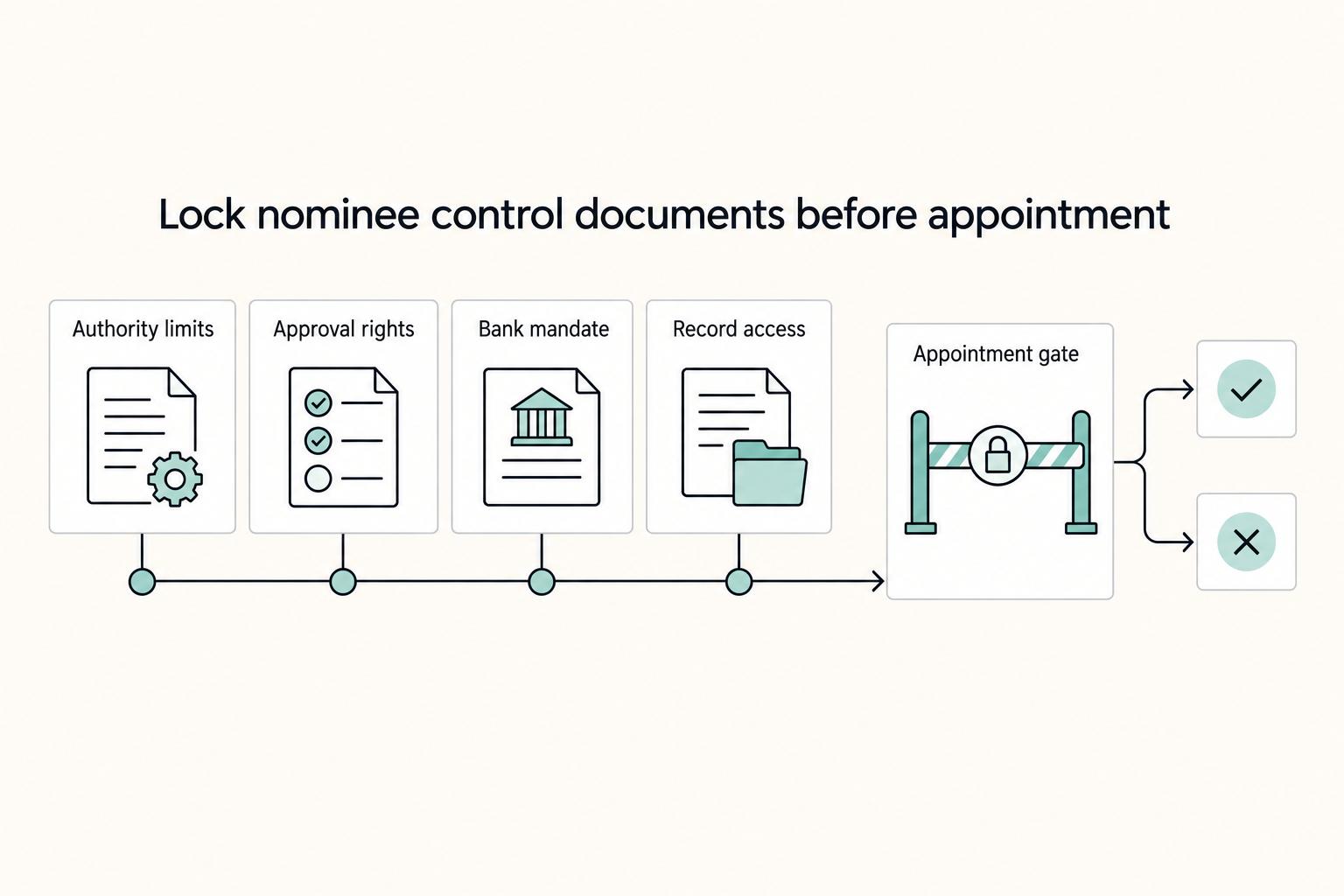
How to Use a Nominee Director in an Offshore Company Without Losing Control
Privacy and cleaner operations are valid goals, but control and compliance come first. A structure only helps if authority, approvals, and records are clear enough to survive outside review.

Master Service Agreement for Freelancers in Long-Term Client Engagements
If you expect repeat work with the same client, set the contract architecture first: one reusable MSA for standing terms, then project documents for each engagement. The point is not just speed. It is making sure your baseline terms are set before they repeat across future projects. Treat each document as a separate layer: