
Quick Answer
Audit two exceptions first and trace each from approved terms through billing, payment and accounting records. Check seven areas: failed recovery, collections follow-up, contract handoffs, billable usage, renewal drift, accounting reconciliation and payout delays. Separate confirmed missed billing or collection loss from timing, liquidity and reporting differences before estimating leakage.
Revenue leakage in subscription platforms is usually a systems failure, not one bad invoice#
Subscription exceptions can arise when signed terms do not reach billing, billable usage is missed, collections fail or records disagree. Investigate the exception before calling it lost revenue: an approved discount, a grace period or a payout still in transit may explain the difference.
Compare payment, invoice and entitlement records against your approved access policy. Continued access during a contractual grace period is not automatically leakage, and an active subscription does not prove every invoice is paid. Stripe documents these distinctions in its subscription lifecycle guide.
For each leak point, you will see three things: who should own it first, what evidence confirms it, and what fix to try before you start shopping for new tooling. That matters because the right response to failed-payment handling is not the same as the right response to broken usage tracking or a sales-to-finance handoff. If you can name the owner, the system of record, and the checkpoint, you can usually stop a lot of slippage before a replatform discussion starts.
The examples here are most useful for subscription models where recurring billing depends on multiple systems and asynchronous events. The controls will vary by stack, market, and compliance program, so do not treat any single vendor, integration, or policy as a universal fix. A practical starting point is to build a small evidence pack for each suspected leak: contract state, billing outcome, access state, usage record or payout status, and the named owner of the exception. The red flag is when one team can explain only its own data, but no one can reconcile the end-to-end outcome.
If you want one rule before reading the rest, fix ownership and verification before automation. Leakage usually persists because repeated small errors look harmless in isolation while revenue erodes through accumulation. The sections that follow break those errors into seven concrete leak points so you can decide what to fix first, what to monitor weekly, and what is noise versus confirmed loss.
For the metric side, see How to Calculate Net Revenue Retention (NRR) for a Subscription Platform.
Who this list is for and how to prioritize fixes#
Use this list if recurring revenue depends on multiple systems agreeing and you need to prioritize frequent, visible exceptions you can actually control first. It fits platforms where CRM, subscription management, accounting, and product usage events all affect what gets billed, collected, or recognized.
Use this if you handle recurring complexity like custom quotes, seat counts, usage tiers, long contracts, failed payments, or proration on plan changes. In that setup, leakage usually comes from handoffs between systems, not one invoice screen. Start by checking one recent contract or amendment across CRM, billing output, product entitlement or usage records, and accounting entries to confirm they reflect the same customer state.
If you are an early SaaS team with one simple plan and little multi-system handoff, start with baseline subscription management hygiene before adding tooling. Make sure invoice jobs run on time, failed payments have clear ownership, and proration is applied correctly when plans change.
Rank fixes by impact and controllability: start where leakage is frequent, visible in revenue operations data, and fixable without a full replatform. If the root cause is a process gap, fix ownership, checkpoints, and exception handling first. If the root cause is tooling limits around quoting, usage, or billing logic, run a revenue assurance evaluation next. For planning context, see Subscription Revenue Forecasting: How Platforms Model MRR Growth Churn and Expansion. If you want a quick next step, try the free invoice generator.
Compare the 7 leakage points before you choose tooling#
Classify the leak before you buy tooling, because each leak point has a different fix lane. Dunning failures usually sit in subscription management, usage gaps usually start with product event integrity, and CRM-to-accounting breaks usually need reconciliation rules and ownership before a vendor change.
| Leak point | Leading indicator | Primary owner | System of record | Verification checkpoint | Likely fix lane | Best for | Worst fit | Confidence |
|---|---|---|---|---|---|---|---|---|
| 1. Failed payment recovery | Rising failed charges, flat recovery after retries, involuntary churn pressure | Finance ops or billing ops | Subscription Management | Pull last 20 failed renewals: retry attempts, payment status, and final account state should match | Subscription management tuning; vendor support if retry logic is opaque in Recurly, Chargebee, or Zuora | Teams with stable demand but worsening collections | Teams blaming pricing before checking recovery mechanics | Strong when billing attempt logs and churn outcomes agree |
| 2. Collections follow-up gap | Open past-due accounts with no next action, manual chase lists, aging exceptions | Revenue ops with finance | CRM or collections queue | Match past-due invoices to owner, contact attempt, and closure status | Process redesign first; then queue automation or exception handling | Sales-assisted motions where someone must close the loop after billing events | Self-serve models with very low manual touch | Medium because queue hygiene can hide the real collection rate |
| 3. Contract handoff errors | Signed terms not reflected in invoice setup, discount or amendment mismatches | Revenue ops or deal desk | CRM for contract state | Compare one signed contract or amendment to billing rules and first invoice output | CRM-to-billing integration cleanup; mapping changes; vendor support if object sync is brittle | Teams with custom quotes, amendments, approvals | Simple one-plan catalogs with little contracting | Strong when signed terms and invoice config clearly diverge |
| 4. Unbilled usage | Product activity without invoice lines, delayed usage close, disputed overages | Product and engineering with billing ops | Usage Tracking source plus billing output | Reconcile event counts, billable transformations, and posted invoice lines for one billing period | Event contract fixes first; then rating or billing config; assurance support if reconciliation is hard | Usage-based or hybrid pricing | Flat recurring plans with no metered component | Strong after billable usage rules, allowances and invoice period are verified |
| 5. Renewal and amendment drift | Renewed deals not invoiced on time, term dates differ across tools | Revenue ops and sales ops | CRM for renewal intent, billing for schedule | Monthly sample of renewals and amendments against billing schedule before quarter close | Process redesign and approval checkpoints; subscription schedule changes | Sales-assisted growth with frequent term changes | Pure monthly self-serve books | Medium because apparent drift can be timing, not leakage |
| 6. CRM to billing to accounting break | Booked in CRM, billed in platform, missing or delayed in ledger export | Finance controller or accounting ops | Accounting System for posted entries | Build an evidence pack: CRM contract state, invoice, ledger entry, exception owner, and due date | Reconciliation controls, source-of-truth rules, contract-to-cash support | Teams closing books with many manual exports | Anyone expecting one native integration to eliminate review | Strong evidence of a reporting exception; not proof of lost cash |
| 7. Payout or review exception | Held or delayed funds; unresolved review states | Payments ops or platform ops | Payout provider or compliance case tracker | Check payout status, hold reason, retry history, and internal ledger trail for delayed funds | Vendor support plus observability; routing and exception ownership before new rails | Marketplaces, contractor, creator, and cross-border flows | Standard SaaS with no downstream payout obligation | Confirm delay versus permanent loss; track beneficiary obligations separately |
Use the contrast between rows to avoid false fixes. Failed recovery (row 1) is usually testable inside billing attempt logs. Unbilled usage (row 4) usually needs event-definition and data-integrity work before more automation.
Treat CRM-to-accounting breaks (row 6) separately. If CRM contract state and billing invoice both exist but the ledger entry is missing or delayed, this is a reconciliation and ownership issue, not a dunning or usage issue.
Use confidence as a gating rule for tool decisions:
Strong: two systems agree on the exception and a record check confirms it.Medium: the pattern repeats, but timing or queue hygiene may explain part of it.Inferred: dashboard trend only; useful for triage, weak for replatform decisions.
Use billing and contract controls for rows1,3 and5; involve product engineering for usage gaps and payments operations for payout exceptions. For row6, establish which record owns each fact and reconcile the missing accounting entry before evaluating new tools.
For billing configuration and dunning controls, see Subscription Billing Platforms for Plans, Add-Ons, Coupons, and Dunning.
Leak 1 and Leak 2 fail collections and weak dunning#
For rows1 and2, separate the amount still due from the amount ultimately written off. Failed collection is an exposure to investigate, not proof that every affected customer or recurring charge is lost.
- Leak 1: failed payment recovery
Review failed renewals by invoice: actual attempts, decline reasons, customer-action requirements, recovery and final disposition. Some failures need updated payment details or authentication rather than another automatic retry. Stripe's retry guidance explains when retries can execute. Do not run an independent collection job that can duplicate the billing provider's attempts.
- Leak 2: collections follow-up that never closes the loop
This leak starts after the billing event: a charge fails or an invoice goes past due, but ownership does not carry through to closure. The result is open past-due accounts, manual chase lists, and unclear account disposition. Validate queue hygiene by matching past-due invoices to an owner, a contact attempt, and a closure status. When billing events and collections records do not line up, recovery and churn tagging become noisy.
Reconcile billing attempts, collections and your defined MRR movements on a consistent cadence. Track recovered cash separately from recurring-revenue metrics and accounting revenue recognition; they answer different questions.
Then go deeper with Revenue Leakage from Payment Failures: How Much Are Failed Transactions Really Costing Your Platform?.
Leak 3 and Leak 4 contract handoff errors and unbilled usage#
After you rule out collections issues, the next check is simple: are contract terms and billable events reaching invoice logic correctly? If contract records or product events are unreliable, do not add more automation first. Fix the handoff and the reconciliation.
- Leak 3: Contract-to-Cash translation errors
Leak 3 is a translation problem: booked terms in CRM do not become correct billable terms in subscription management and billing. Common patterns are discounts that linger, amendments that live in email or spreadsheets, and entitlements billing cannot interpret from unstructured records.
Compare the signed contract, effective dates, subscription configuration and issued invoice. A PDF contract or manual handoff can work if an owner checks the approved terms against billing and records the review. The defect is an unverified mismatch, not the file format.
- Leak 4: Unbilled usage and stranded events
Leak 4 is an event integrity problem: usage happens, but invoice lines are missing, delayed, or mapped to the wrong period. It often appears when product owns telemetry, finance owns invoicing, and no team owns reconciliation between them.
Reconcile raw events, the contract's billable transformations and invoice lines for the same customer and period. Deduct included allowances, free usage and valid adjustments before estimating missed billing. Delayed processing alone does not establish stranded revenue.
| Leak pattern | Symptom | Root cause | Affected systems | Rollback risk | Fastest containment action |
|---|---|---|---|---|---|
| Leak 3 contract handoff | Active customer, wrong invoice amount or discount behavior | CRM terms, amendments, or entitlements do not sync cleanly into billing rules | CRM, subscription management, recurring billing | Medium, since rebilling and credit notes may be needed | Pause manual exceptions, review recent amendments, and compare signed terms to live subscription records |
| Leak 4 unbilled usage | Usage appears in product logs but not on invoices, or appears late | Event capture, rating, or period mapping is incomplete | Product telemetry, usage tracking, billing engine | High, since delayed catch-up billing can trigger disputes | Reconcile one closed billing period account by account and track missed usage in a temporary exception file |
| Cross-system disconnect | Long unbilled periods or missing invoices across accounts | Contract and usage data are fragmented and integrations are weak | CRM, product logs, billing, accounting system | High, because remediation can touch historical records | Set one source of truth per object and run a daily exception queue with owner and resolution status |
The tradeoff that actually matters#
Stricter pre-bill validation usually reduces leakage before invoices go out, but it can delay invoicing when contract or usage checks fail. Looser controls speed billing, but typically push cost downstream as credit notes, disputes, and manual cleanup.
Choose strict checks when contracts are amendment-heavy and errors are expensive. Choose more throughput only if your post-bill reconciliation and exception handling are disciplined. Loose controls plus weak review is where temporary discounts become permanent and usage overages stay unbilled.
What to fix first#
Start with an evidence pack, not a vendor search. For Leak 3, pull signed terms, CRM records, subscription records, and recent invoices for a small sample. For Leak 4, pull raw product events, rated usage totals, and invoice lines for the same window.
If those records cannot be matched quickly, the blocker is not missing automation. It is weak source-data contracts and weak reconciliation between product logs and billing outputs. In this part of the stack, leakage is primarily a systems architecture issue that shows up in finance outcomes.
Leak 5 renewal and amendment drift#
This leak is usually a data-sync problem, not a collections problem. When renewals, term changes, or expansion amendments are marked complete in CRM but recurring billing still runs on older terms, billing and forecasting drift from what was actually signed.
It shows up most in sales-assisted motions with manual approvals and handoffs. In that setup, partial writes, delayed syncs, and fragile field mappings can push renewal and amendment records out of step across CRM, subscription management, and billing. Finance often sees this later as invoice cleanup, but the failure happened earlier when signed terms did not reach billing configuration cleanly.
Run one renewal exception queue and treat it as a system, not a report. Track, at minimum:
- owner
- aging
- contract status
- invoice status
- effective date of the renewal or amendment
- source record link in CRM and billing
Review small mismatches before they accumulate. A controlled spreadsheet can support billing; an unowned schedule with no version, approval or reconciliation is the problem.
Set a monthly checkpoint before quarter-close forecasting. Sample recently amended contracts and compare signed terms, effective dates, billing schedules, and first billed outcomes. If a closed expansion amendment in CRM is still billed on prior terms, treat the forecast as unreliable until the exception queue is resolved.
Leak 6 reconciliation breaks across CRM billing and accounting#
A missing accounting entry is a reporting or integration exception. It does not by itself prove lost cash or lost economic revenue. Trace the approved contract, invoice, payment and required accounting treatment separately to identify what actually failed.
| Component | Include |
|---|---|
| CRM contract state | current term; price; effective date; amendment status; whether the record is closed and approved |
| Billing output | invoice; credit note (if any); billing schedule; first billed outcome against signed terms |
| Accounting system entries | posted transaction or journal tied to the billing event; export/import status |
| Exception log | one queue with owner; due date; current status; links to the CRM and billing records |
Finance does not need a massive audit file. It needs the minimum evidence pack above to trace one contract from approval to posted entry without guesswork.
A valid invoice can fail to reach the accounting system because of a rejected export, partial write or mapping error. Confirm whether the entry is missing, queued, posted elsewhere or subject to a legitimate timing difference before correcting it.
Set one authoritative record per object. Link approved contract terms, billing output and accounting entries with stable identifiers. Permit controlled manual adjustments when necessary, with approval, a reason and a reconciliation back to the source.
Revenue operations and engineering also need explicit handoffs, not implied ones. Define who investigates failed syncs, who confirms re-export, and who closes the exception. Then sample recently billed contracts in sequence: signed CRM state, invoice created in billing, matching entry posted in accounting.
Each connector needs reconciliation and failure handling. An integrated product also needs these controls. Judge a supporting spreadsheet by ownership, access, review and traceability rather than assume its use proves leakage.
For the accounting side, see Deferred Revenue Accounting for Client Prepayments.
Leak7: payout delays and unresolved review exceptions#
A paid customer invoice and an available bank balance are different facts. Provider holds or payout delays can affect liquidity, while a marketplace's downstream beneficiary payout is a separate obligation. Track these exceptions without treating delayed cash or seller money as additional subscription-revenue loss.
| Bottleneck | What to check |
|---|---|
| Status visibility gaps across systems | Can revenue operations, CRM, billing, and accounting all show the same current state for the same payout case without log digging? |
| Messy upstream process feeding sync tools | If the source workflow is inconsistent, automation can spread errors faster rather than reduce them. |
| Unresolved review queues | A named owner, permitted hold reason and next review action make a delayed-funds case actionable; accounting recognition is assessed separately. |
When a transfer status is uncertain, investigate the existing provider reference before retrying or using another route. A timeout, an overdue estimate or a missing bank line does not establish failure. Authorize a replacement only after confirming that the original cannot still complete and checking the obligation for duplicates.
Review those three bottlenecks on a consistent cadence rather than waiting for a month-end surprise.
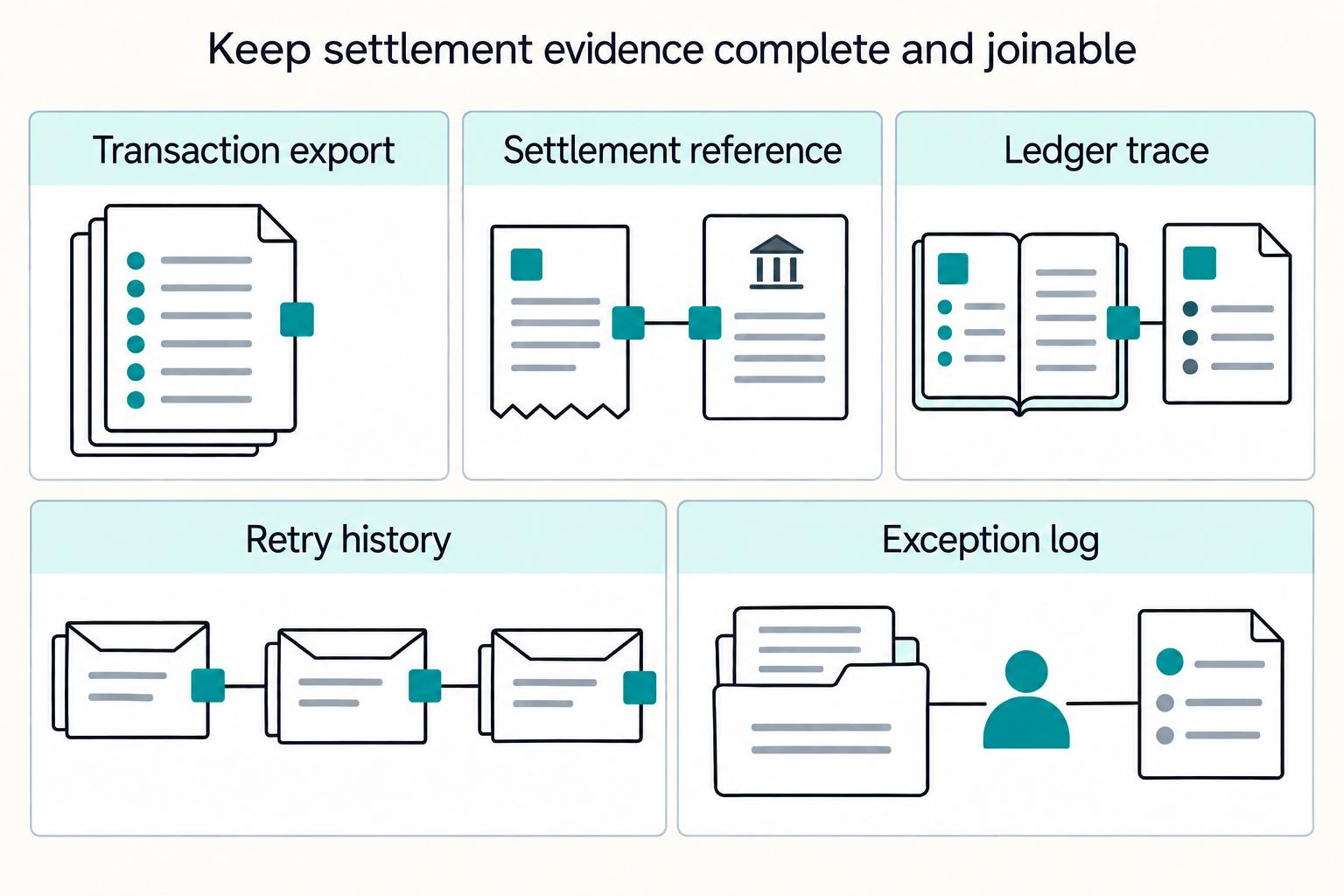
Your first control is a minimum exception evidence pack: payment or invoice reference, beneficiary record, provider transfer identifier (if available), current status, hold/review reason (if present), owner, and last update time. If those fields are incomplete, escalation quality is weak by default.
This is where revenue assurance-style monitoring helps in practice: surface issues as they occur in orders, invoices, renewals, and integrations, then route exceptions immediately to the right owner. Use automation to reduce manual error, but pair it with regular process reviews across contracts, billing, and customer data so you are not automating broken inputs.
A blunt decision rule: if payout status visibility is weak, fix observability and exception routing first. Do not add more payout paths or connector complexity until every team can see where a case is stuck and who owns the next step.
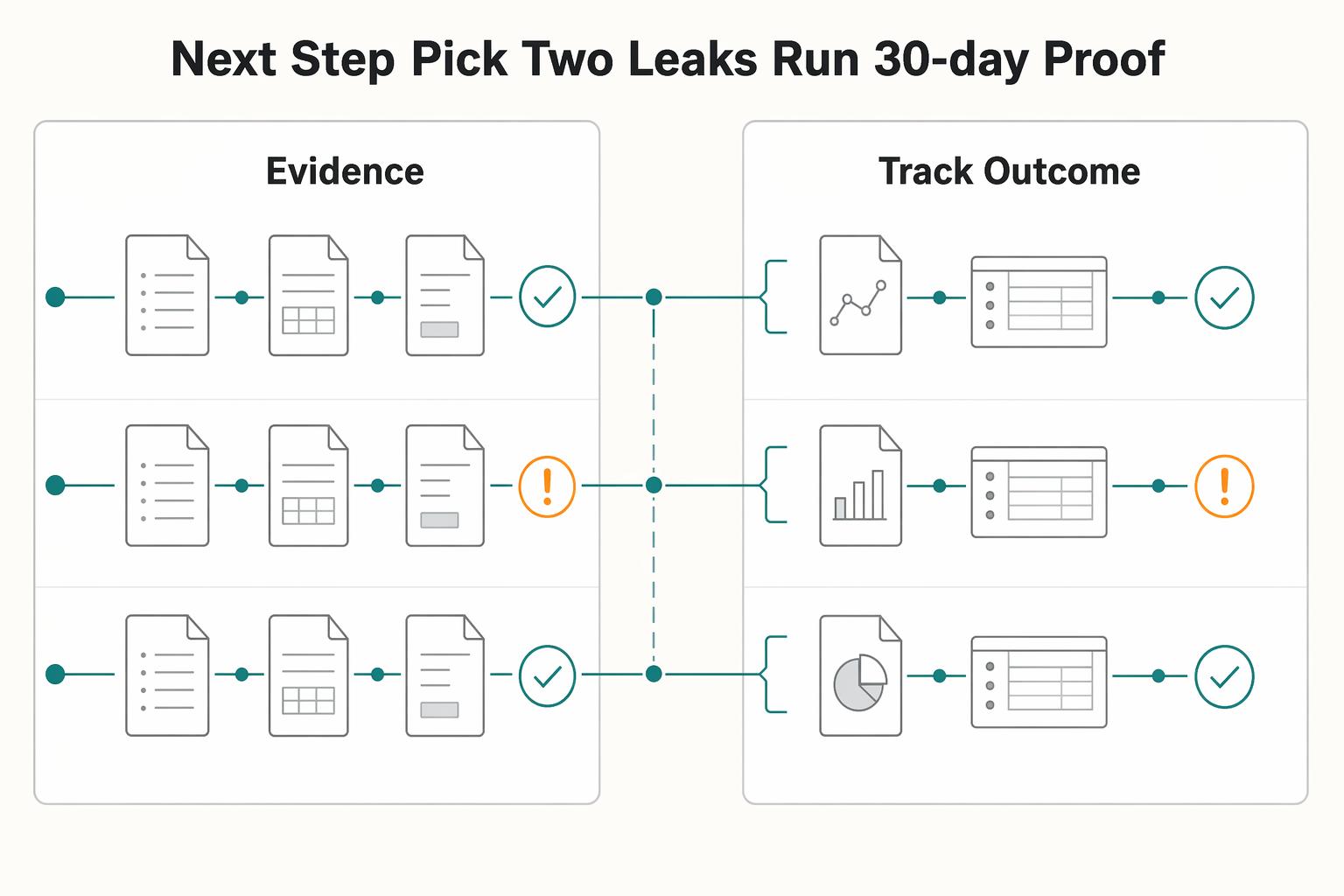
The next step is to pick two leaks and run a 30-day proof#
Do not try to fix all seven leak points at once. Run a 30-day proof on two high-confidence leaks where you can trace what happened in real records and assign clear ownership.
| Step | Action | Measure |
|---|---|---|
| Pick two leaks with the clearest evidence path | Choose issues you can verify from systems you already trust, not anecdotes. | Trace the money path from commercial event to billing output to accounting or ledger entry. |
| Set one accountable owner and one evidence pack per leak | Give each leak a single owner, even when multiple teams touch it. | Keep source state, billing output, accounting or ledger result, and an exception log. |
| Track outcome movement, not tool activity | Use weekly checks rather than judging dashboards or alerts alone. | Watch for reduced exception backlog, faster reconciliation, improved recovery, and cleaner MRR reporting. |
Keep confirmed missed billing, outstanding collections, reporting errors and delayed liquidity separate. Validate the cause and affected period before estimating loss or changing customer invoices.
Keep the proof narrow enough to inspect real records each week. If one leak depends on contract data spread across PDFs, email threads, and spreadsheets, clean that control first. If a leak crosses multiple systems and keeps generating repeat exceptions, a platform review is usually worth the effort.
Before a full rollout, validate coverage and integration fit against your stack so you can reconcile real Quote-to-Cash or Contract-to-Cash handoffs, not just report them. For related reading, see Choosing Creator Platform Monetization Models for Real-World Operations.
Frequently Asked Questions
What is revenue leakage in a subscription platform, in one operator-level definition?
Revenue leakage is a confirmed shortfall against an amount the business was entitled to bill or collect under the applicable terms. Investigate exceptions separately: missed usage billing, failed collection, a missing ledger entry and a payout delay are different problems. A reporting gap or timing difference is not automatically an economic loss.
What are the seven leak points I should audit first if my team has limited bandwidth?
Check failed payment recovery, collections follow-up, contract-to-billing handoffs, unbilled usage, renewal or amendment drift, accounting reconciliation and payout or review delays. Pick two with traceable records and clear owners. Confirm whether each is lost billing, collection exposure, a reporting error or delayed liquidity.
How do I estimate material leakage without relying on inconsistent external benchmarks from Baremetrics, MGI Research, or vendor blogs?
Compare like periods and like measures. For example, in a hypothetical USD usage-only account with no tax or credit adjustments,12,000 eligible units less2,000 contractually included units leaves10,000 billable units. At$0.10 each, expected billing is$1,000. An$800 invoice leaves a$200 billing variance to investigate; if$600 has been paid, another$200 remains receivable. Neither amount establishes recognized revenue or a write-off. Confirm the missed units and approved terms before corrective billing, and keep any ledger or payout gap out of the total to avoid counting the same shortfall twice.
When should I use a Revenue Assurance platform instead of fixing controls in-house?
Fix identifiable control gaps first: assign owners, check approved terms and reconcile exceptions. Consider assurance tooling when recurring exceptions span several systems and the volume exceeds a controlled manual review. PDFs and spreadsheets alone do not establish the need to replatform.
What should engineering implement first to reduce leakage risk in Quote-to-Cash flows?
Define the authoritative record for each object and stable identifiers linking contract, usage, invoice, payment and accounting records. Reconcile the same customer and period. Use durable duplicate guards for event processing and corrective billing, and route incomplete or contradictory records to an owner before applying changes.
What can go wrong if we over-automate dunning, usage billing, or exception handling?
Bad source data just fails faster. Dunning can recover failed recurring payments, but only when billing and customer records are reliable. Apply the same rule to usage billing and exception handling: if inputs and reconciliation are weak, automation can scale the problem instead of fixing it.
How often should finance and product review leakage indicators to protect MRR and EBITA?
There is no universal review cadence. Set frequency by transaction volume and risk, and keep it regular enough to catch failed payment recovery issues, billing exceptions, renewals, sticky discounts, and unbilled usage before they compound. Because not all leakage is fully preventable, the goal is to minimize and control loss over time.
Try a related tool
Researched and edited by the Gruv editorial team. Gruv builds cross-border billing, payouts, and finance-operations software for global businesses.
Sources
Educational content only. Not legal, tax, or financial advice.
Related Posts

Calculate NRR for a Subscription Platform Without Reconciliation Gaps
The formula is the easy part. In practice, the hard part is producing a single Net Revenue Retention number that finance, ops, and product can all trace to the same recurring revenue base and the same set of in-period movements.
Subscription Revenue Forecasting for Platform Teams Modeling MRR Churn and Expansion
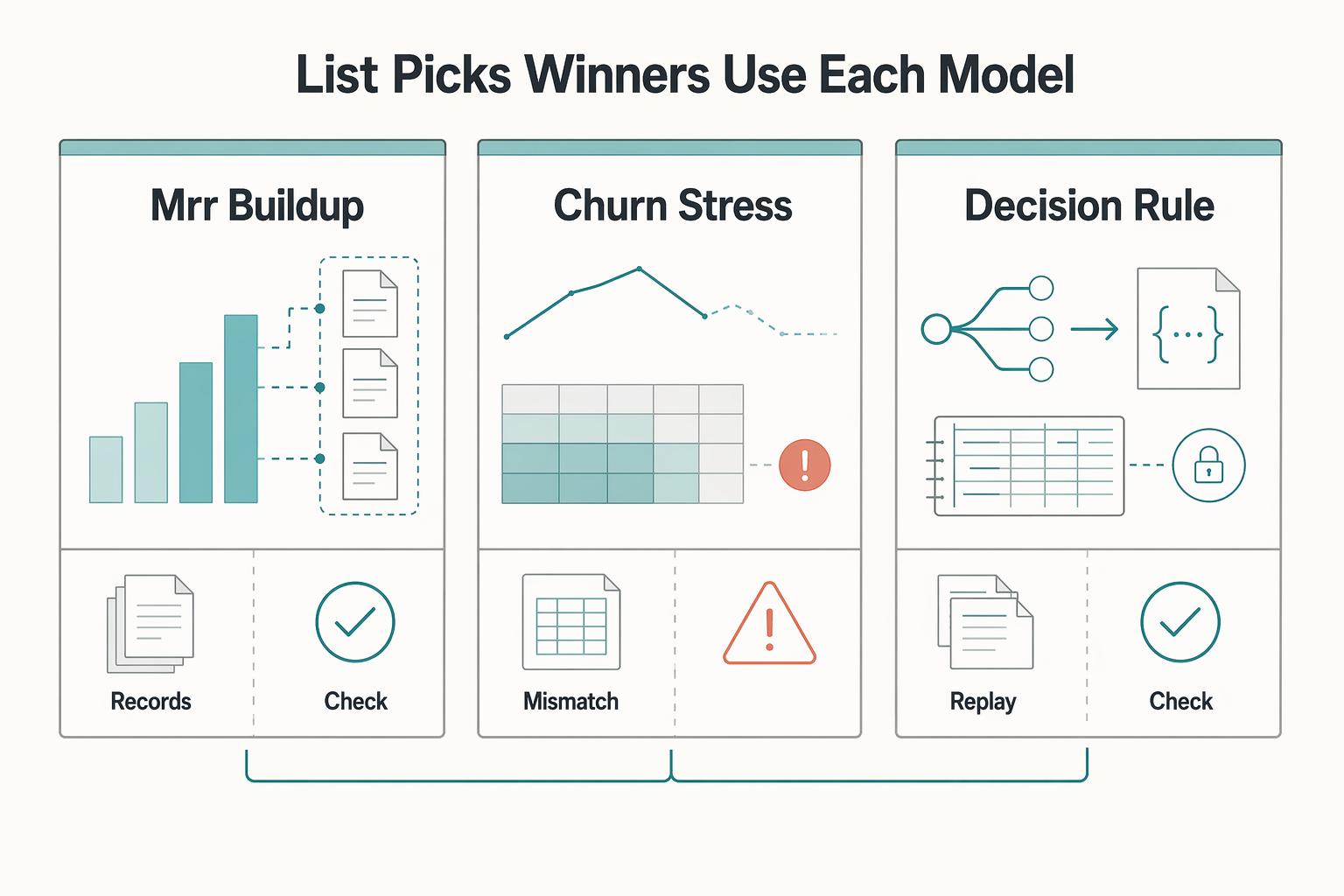
A usable forecast starts with shared definitions, not sharper formulas. If finance, ops, and product define MRR, Expansion MRR, or churn differently, the model can look precise and still fail the first serious review.
Revenue Leakage from Payment Failures: How Much Are Failed Transactions Really Costing Your Platform?
Payment failures can be recoverable and still drain platform margin. Teams can track yesterday's declines and still miss the full cost when failures combine with under-billing, delayed recovery, reconciliation drag, and payout timing. The practical goal is simple: quantify the real cost, then map each failure point to a weekly checkpoint finance, ops, and product can actually run.