
Quick Answer
Start by fixing the contract boundary first: contract limit, included allowance, billing-period cutoff, and the exact event that triggers overage. Next, make metering traceable from raw record to rated usage, then issue invoices with distinct line items for base charges, excess usage, credits, and minimum adjustments. Finish each cycle by matching billed lines to ledger postings and settlement outputs, and handle disputes through a defined notice window plus documented true-up or credit-and-rebill approvals.
What Defensible Usage Overage Terms Need to Cover#
Treat overage billing as one continuous chain, not a set of handoffs. If your contract limit, meter logic, invoice lines, and ledger entries define usage differently, close risk shows up fast. Make those decisions upfront, before finance is asked to explain a bill it cannot fully trace.
A subscription overage is an extra fee when customer usage exceeds what the plan includes. The working sequence is simple: define the commercial boundary, measure usage, calculate invoices, reconcile to the ledger, then handle disputes and corrections with evidence. The examples here are operational patterns, not legal advice. Validate contract wording for your governing law and jurisdiction. Governing law determines which law applies. Jurisdiction is the court's power to hear the case.
Step 1 Define the commercial boundary first#
Start with the commercial facts, not polished language. Set the contract limit, included usage allowance, billing period, and overage trigger before drafting the clause.
Variable usage charges can be variable consideration. Under IFRS 15, finance estimates the amount to which the entity expects to be entitled and applies the constraint on significant revenue reversal. Recognition follows the service and accounting requirements, rather than the invoice date alone. Keep late usage and corrections visible to finance so billing totals are not mistaken for recognized revenue.
Use one practical checkpoint: every charge term in the deal should map to a real meter or source event your product and billing teams can produce on demand. One failure mode is selling "usage" as one concept while the platform tracks multiple event types with different timestamps, rounding rules, or adjustment paths.
Step 2 Make usage metering audit-ready#
The next job is not just capturing events; it is proving billed event accuracy. Ofcom regulates billing accuracy for electronic communications providers and highlights event measurement, including call duration, as a testing focus when new technologies or equipment are introduced. Use that as a practical control standard for your own process.
Before invoice cutoff, run one pass for completeness and one for lineage. Can you show the raw event, the rated usage record, and the invoice line it became? If not, disputes become judgment calls instead of evidence review. Late events and double-counted events can drive avoidable true-ups if you do not catch them early.
Step 3 Build invoices customers can understand#
A technically correct bill can still create avoidable disputes if it is hard to read. In US telecom, 47 CFR § 64.2401 requires telephone bills to be clearly organized and to use brief, clear, non-misleading plain-language service descriptions. In practice, separate base subscription charges from overage lines and avoid vague labels that force support teams to interpret bills after the fact.
Oracle's communications billing documentation describes the sequence directly. Charging determines what to charge for usage and recurring fees. Billing compiles those balance impacts into a bill, usually every month. Use a sample invoice review with two checks: customer readability and internal traceability.
Step 4 Reconcile from invoice to ledger to settlement#
Once invoices go out, finance still needs proof that billed amounts posted correctly. Account reconciliation means matching financial-system transaction data to source documents so records are accurate and complete. For overage, your evidence pack should include the contract version, rated usage extract, invoice ID, journal posting, and settlement reporting output used at close.
If one link is missing, do not hide it behind a dashboard total. That can turn a small usage discrepancy into an unresolved revenue break at month-end.
Step 5 Set dispute handling and legal scope before go-live#
Disputes often resolve faster when contract terms and evidence files match. Keep references exact: the clause, the invoice, and the meter record. Governing law tells you which law applies in a dispute. Jurisdiction tells you where the dispute can be heard.
Process design also varies by regulator. New York utility complaint guidance tells customers to contact the utility first for billing issues. The Texas PUCT says formal complaints can involve a judge, hearings, evidence, and written testimony, and notes a 15-day company response window to the PUCT. If your process cannot produce a defensible evidence file quickly, dispute handling can spill into close.
Choose the overage model before you draft contract language#
Pick the charging model first, then draft the clause around it. Contract language should follow settled pricing mechanics so product, billing, and finance are all working from the same definition of "usage."
Step 1 Match the model to cost shape and bill predictability#
Choose the model through three lenses: your cost profile, customer tolerance for variable bills, and how clearly your team can explain charges after invoicing.
| Model | Margin stability | Customer bill shock risk | Operational burden for invoice true-up |
|---|---|---|---|
| Flat-rate plan | Depends on whether the bundled price matches expected usage and cost. | Lower bill variability when charges stay fixed and terms are clear. | Define what is included (and any exceptions) clearly so invoices can be reproduced. |
| Tiered pricing | Depends on whether tier thresholds match actual usage patterns. | Depends on whether customers can see tier thresholds and prices before charges apply. | Show total usage, threshold crossings, and applied tier rates on invoices. |
| Pay-as-you-go | Charges rise with consumption by design. | Allowance overruns or extra usage can lead to bigger-than-expected bills. | Use accurate usage records and clear unit pricing so billed amounts map to metered events. |
Keep this comparison qualitative. Utility rate structures can include both usage and peak demand, so model fit depends on what your meters capture and what your customers expect to approve.
Step 2 Define the trigger as an exact event, not a sales concept#
Write the overage trigger in operational terms before anyone drafts the clause. In telecom, triggers can be explicit: usage above allocated monthly minutes or usage outside offer parameters. Freeze these three items first, and make sure product, billing, and finance can all point to the same source event and reproduce the same trigger date.
- Unit pricing model
State whether pricing is flat-rate, tiered, or pay-as-you-go, and how excess usage is handled.
- Billing period boundary
State exactly when included usage resets, for example at the next billing period boundary.
- Overage trigger
Name the exact meter event or condition that starts charging.
Step 3 Choose with dispute exposure in mind#
The right model is the one your team can explain and prove on an invoice. Keep trigger, unit price, and timing explicit so customers can predict charges and your team can show exactly why the charge started.
For new UK telecom contracts from 17 January 2025, Ofcom requires contract-embedded price rises to be stated prominently in pounds and pence at the point of sale, with clear timing. That concerns scheduled price changes; the separate usage-rate terms still need to explain what consumption is billable.
Step 4 Dry-run pricing logic before final contract drafting#
Before legal text is final, run one sample billing period. Use a small evidence pack: proposed allowance, sample usage records, rated outputs under your chosen model, and the invoice line description customers will see.
This catches ambiguity early, before it becomes a contract or dispute problem. If you are considering mixed subscription and usage mechanics, see Hybrid Billing Models: How to Combine Subscriptions with Usage-Based and One-Time Charges. Keep the sequence the same: lock charging mechanics first, then draft terms. You may also want Hybrid Billing: Combining Subscriptions with Usage Fees on a Single Invoice.
Prepare the inputs before legal drafting starts#
Finish the input pack before legal drafting starts. Otherwise you risk signing terms your billing system cannot prove.
Step 1 Build a prerequisites pack from billable facts#
Define billable usage first. Treat usage as a chargeable business event, then document each event's unit, meter name, and billing-period reset point. Keep these in one working pack:
- product meter definitions
- proposed usage allowance
- planned rollover terms (if offered)
- monthly minimum fee policy
- sample invoice line descriptions customers will see
Keep fixed-fee entitlement and end-of-period overage separate in that pack. Also lock minimum-charge behavior before drafting. Depending on configuration, unused minimum can be billed at period end, or the full minimum can be charged on the first usage transaction. For one sample customer and one period, you should be able to show how raw usage becomes included usage, overage, and any minimum-fee adjustment.
Step 2 Name owners and approval points#
Assign owners now so contract terms stay controllable in operations. Confirm clear ownership across the teams involved, including who approves change-control clause updates.
For change-controlled items like meter definitions, unit pricing, and minimum-charge behavior, record who can approve or reject revisions. Without that control, contract-impacting changes become hard to audit.
Red flag: if product can rename a meter or change a threshold without finance sign-off, you can end up with avoidable billing cleanup later.
Step 3 Freeze authoritative usage and invoice sources#
Pick the authoritative source or sources for usage events and invoicing in this contract flow, then freeze that mapping. Contract language needs to map to real system outputs. If "usage" is calculated from multiple ad hoc exports, the legal text and invoice behavior will drift.
Lock charge descriptions early too. US telecom billing rules require brief, clear, non-misleading plain-language charge descriptions so customers can verify billed services match what they requested and received. Billing ops and finance should also be able to trace any invoice line back to its exact source event set without manual reinterpretation.
For a step-by-step walkthrough, see AI Billing Infrastructure for Startups Using Credits Tokens and Metered Usage.
Draft contract terms that survive real billing cycles#
Once the input pack is frozen, draft the billing clause before legal boilerplate. If the agreement does not state when usage becomes billable, how disputes are raised, and who can approve corrections, invoice disputes get harder to resolve.
Step 1 Write charge mechanics in billable language#
Write terms your invoice engine can execute without interpretation: contract limit, included usage allowance, overage trigger, rounding rules, and billing-period boundaries. They should read like operating instructions, not marketing copy.
Be explicit about cycle boundaries. If unused allowance does not carry over, say so directly. Telecom agreements can define this precisely, including language that unused allotments do not carry from one billing cycle to another. If rollover is allowed, tie it to the exact meter and reset point in your prerequisites pack.
If usage is rounded, state the unit and direction. One telecom example rounds usage up to the nearest MB, which shows the level of specificity needed even if your own unit differs. Avoid vague language that leaves rounding implied.
For example, suppose a hypothetical plan includes 100 GB and charges $2 per additional GB, rounding excess usage up to a whole GB once per cycle. Raw usage of 112.4 GB leaves 12.4 GB beyond the allowance, rounded to 13 GB, producing a $26 overage line. A rule that rounds each event separately can produce a different bill, so specify both the rounding unit and when rounding happens.
Step 2 Add legal sections that match billing risk#
The legal sections should match the billing risks you expect to manage. Add explicit sections for Termination, Limitation of Liability, Indemnification, Governing Law, Jurisdiction, and Dispute Resolution. Telecom agreements often pair payment, credits, liability limits, and dispute handling because those terms shape what happens when billing fails.
Define the dispute window with concrete timing and method. Do not use terms like "promptly." Provider terms include fixed timing requirements. For example, some processes use written notice within 60 days or require notice 60 days before arbitration. Use that as a drafting pattern, not a universal rule.
Keep governing law and jurisdiction separate. Governing law selects which law applies, while jurisdiction addresses where disputes can be heard. For Termination, state treatment of already incurred charges and any surviving obligations. For Dispute Resolution, define the sequence: notice, internal review period, then mediation, arbitration, litigation, or another approved route. In utility contexts, account for possible escalation to formal regulator complaint channels.
Step 3 Control amendments with a real change-control clause#
Treat pricing, meter definitions, and the unit pricing model as contract facts, not minor settings. Your change-control clause should explicitly cover them.
State four items in the clause: what can change, who approves, how notice or acceptance occurs, and when the change takes effect. Require version tracking so you can explain billing differences across periods. That helps prevent silent drift, where product or pricing behavior changes but the signed agreement still reflects older billing triggers.
Implement usage metering and trigger controls#
A billing clause is only as good as the event stream behind it. Treat this as an operating rule: map each chargeable event to one meter definition, and route late, duplicate, or untraceable records before they become invoiceable.
Step 1 Map each billable event to one meter definition#
Start from the contract terms and enforce a one-to-one mapping between each billable event and a usage metering definition. In telecom, that can be a CDR moving through mediation and rating. In utilities, it can be an interval or scalar read.
Document the mapping in operating terms. Include the source event type, customer or service identifier, event timestamp, unit of measure, billing-period assignment, and the condition that moves usage into included allowance or subscription overage. If an event can be reclassified later, handle that through change control, not ad hoc processing.
Sample a completed period and confirm that each usage charge traces to its rated source-event set. An invoice line may aggregate many calls or meter readings; preserve that many-to-one mapping rather than requiring one raw record per line.
Step 2 Test retry-safe ingestion before trusting totals#
Do not trust usage totals until retries are safe. Use idempotent ingestion so repeated submissions do not perform the same operation twice, and so a repeated idempotency key returns the prior result instead of re-executing.
Replay the same source events and verify that rated quantity does not increase. Provider request keys can expire: Stripe, for example, permits pruning after at least 24 hours. Preserve your own durable source-event identifiers for the full late-data and correction window so a later replay cannot become new usage after the API key expires.
Step 3 Add pre-bill checks for gaps, late data, and outliers#
Before invoice generation, validate completeness and plausibility, not just schema. Utility validation patterns are useful here: duplicate detection, missing-data gaps, high or low usage versus history, and spike checks. Use three pre-bill gates:
| Pre-bill gate | What to flag |
|---|---|
| Missing events or gaps | Active services in the current billing period |
| Late-arriving events | Belong to a closed period but missed cutoff |
| Outlier consumption | Compared with prior-period history or expected demand bands |
Checkpoint: generate one exception report with account, meter or event source, failed rule, and billing impact so finance can review it in one place.
Step 4 Set a late-data policy and keep audit-grade lineage#
If metering data misses invoice cutoff, make the treatment explicit in both policy and contract. Policy options include holding invoicing for affected accounts or issuing a clearly marked estimated bill with a true-up path. Do not estimate silently.
Utility practice is a good model here: estimated reads are marked on the bill and adjusted when an actual read arrives. Because back-billing and estimation rules are jurisdiction- and contract-specific, keep your contract language aligned with your operating policy.
For dispute resolution, retain a full chronology: source event ID, payload or hash, ingest timestamp, validation result, estimation flag, rating version, invoice ID, and correction approvals. The goal is an audit trail that can reconstruct the event sequence end to end. For a related example, see Media Subscription Billing Decisions for Paywalls, Metering, and Bundling.
Build invoice and true-up logic finance can defend#
Build invoices so each amount is traceable. Apply included units first, then price only excess usage under the selected unit pricing model and overage trigger.
Step 1 Calculate included usage before any overage#
Start from the contract line, not the invoice template. For each service and billing period, consume bundled or included units first, then calculate subscription overage on the remainder. Overage pricing applies to usage after included units are exceeded, so avoid blended math across the full period.
Keep calculations service-specific when pricing is service-specific. Commitment and overage can be tied to explicit subscription lines. They can also be calculated at the individual usage-line level by service price plan, so do not collapse differently rated services into one excess-usage total. For one invoice, recompute rated usage and confirm included-unit burn plus overage quantity matches billed quantities exactly.
Step 2 Present each commercial component on its own line#
If you want disputes to stay narrow, keep each commercial component on its own line. Base subscription, overage, and any applicable prepaid credit application or monthly minimum fee adjustment should not be netted into one generic monthly total.
| Invoice line | What to show |
|---|---|
| Base subscription | Covered period |
| Overage | Quantity, unit rate, and amount |
| Prepaid credit application | A distinct reduction, where applicable |
| Minimum-fee adjustment | A separate catch-up line, where applicable |
In U.S. telecom, Truth-in-Billing rules require clear, plain-language charge descriptions, separate subtotals for distinct sections, and separation by provider when multiple carriers appear on one bill. In utilities, Washington rules show a similar detail pattern by requiring usage and billing-rate detail plus disclosure of the basic charge or minimum bill. Use line design that is independently explainable. A dispute on one line should be explainable without reopening the full invoice.
Step 3 Control post-issue corrections with a true-up window#
Keep finalized invoices immutable and use linked correction records. Credit and rebill can replace an erroneous invoice, while a planned true-up balances an amount the contract expects to settle later. Preserve the reason for each adjustment; an invoice error and a minimum-commitment shortfall are different events.
Set correction timing from contract terms and governing rules, not from a universal window. For example, one Washington utility rule requires corrected bills within sixty days of discovery, while some commercial terms use thirty (30) days for invoice payment. Define your window, approval path, and required evidence in operating policy.
A correction evidence packet can include the original invoice ID, affected invoice line ID, source usage record IDs or hashes, rating version, correction reason, and customer notice record.
Step 4 Export line-level detail that supports reconciliation#
Export line-item detail for ledger reconciliation, not just invoice totals. Include invoice ID, invoice line ID, service or meter identifier, billing period, quantity, unit rate, included-units offset, overage amount, credit amount where applicable, and minimum-fee adjustment amount where applicable.
This mirrors settlement practice: line-level billable guidance and downloadable reports are used to reconcile statements. Use that standard for your billing exports, then pair it with close controls so each invoice line maps to the expected ledger posting.
This pairs well with our guide on How to Build a Subscription Billing Engine for Your B2B Platform.
Reconcile overage from invoice to ledger to settlement#
Use two related reconciliations. First, link rated usage and invoice lines to receivables and revenue postings. Then match customer receipts, processor fees, and bank deposits to cash and cleared receivables. A bank deposit may combine several invoices or partial payments, so preserve an allocation bridge instead of expecting every usage line to appear on the bank statement.
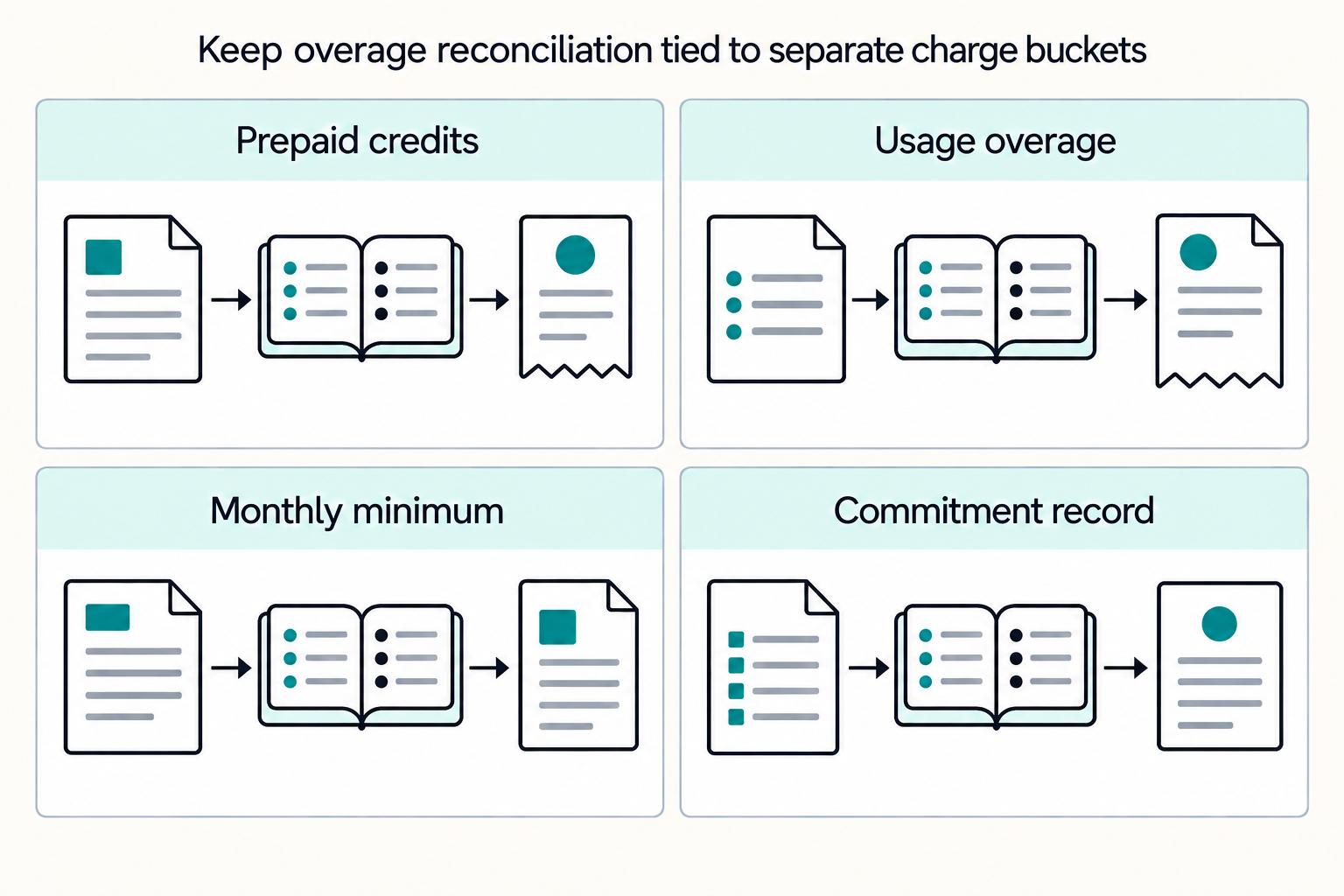
If subscription overage, prepaid credits, and monthly minimum adjustments are separated on the invoice, reconcile them in separate buckets. That keeps root-cause analysis clear instead of burying differences in one blended variance total.
Step 1 Verify period readiness before reconciliation#
Do not start reconciliation on moving targets. Confirm the period is ready first: subledger transactions should be imported and period journals posted.
Trace invoice ID and line ID to the relevant journal entries, account, amount, and posting period. Separately connect receipts and any processor fees to the invoices they settle. A partial payment can leave receivables open even when every usage line was billed and posted correctly.
Step 2 Reconcile in commercial buckets#
Do not reconcile all usage charges in one pool. Keep separate buckets for subscription overage, prepaid-credit drawdown, minimum commitment consumption where used, and monthly minimum true-ups.
| Bucket | Check |
|---|---|
| Prepaid credits | Track beginning balance, funded amount, applied drawdown, and ending balance |
| Subscription overage | Billed excess units align with rated usage records for the same period |
| Monthly minimum fee | Any catch-up amount follows documented contractual minimum logic |
| Minimum commitment | Committed value or units follow commitment logic, not overage logic |
Prepaid credits usually require multi-step handling: determine current credit balance, then apply the period drawdown. Monthly minimum logic also has extra steps, so keep it out of standard overage variance analysis.
Step 3 Tie billed determinants to settlement reporting#
Where wholesale market settlement applies, reconcile its charges and credits to the relevant market records using service identifiers, period, quantity, and rate. Keep that separate from retail customer collections; they can use different determinants and settlement dates.
If invoice lines, journals, and wholesale settlement exports group data differently, define an explicit mapping. Match the same obligations before comparing totals, and retain timing differences as identified exceptions rather than forcing unrelated lines to balance.
Step 4 Track controls and close with documented exceptions#
Track a small set of operating controls each close to spot drift early, such as variance trends, correction volume, and unresolved exceptions. These are management controls, not universal legal requirements.
Investigate differences, resolve them where possible, and document the rest. At close, unresolved items should be recorded in an exception log with clear ownership and next action.
For Gruv-style operations, use the posted ledger as the sign-off baseline and derived balance views for day-to-day monitoring. That keeps close decisions tied to audit-ready records.
If your close checklist still depends on manual joins, use the technical references in Gruv Docs to map invoice, ledger, and settlement events into one traceable flow.
Manage disputes and corrections without revenue leakage#
Once reconciliation is clean, keep it clean with a dispute process that is explicit, time-bounded, and evidence-led. Unstructured intake and one-off credits create revenue leakage and hide root causes.
Step 1 Publish a dispute window and an evidence list#
Set a clear dispute process without using the contract to narrow mandatory customer rights. Ofgem’s supplier complaint route, for example, allows ombudsman escalation after eight weeks or earlier with a deadlock letter. That escalation rule is different from an invoice notice deadline or a court limitation period; record each applicable clock separately.
Use one required intake pack for every dispute so triage stays consistent. A practical internal pack includes:
- invoice ID and invoice line ID
- billing period and service or meter identifier
- disputed quantity, rate, or charge type
- cited contract clause or order form term
- supporting meter logs, usage export, or settlement reference
Treat this as your operating standard, not a universal legal mandate. The checkpoint is simple: a reviewer should be able to trace the dispute to the billed determinant and contract language without repeated clarification.
Step 2 Standardize correction paths and reason codes#
Separate the claim from the fix. Dispute intake identifies the issue, and the correction method resolves it. Use structured reason codes so you can measure why adjustments, disputes, or settlements were granted and compare trends over time.
Use credit and rebill when the billing system’s correction process requires replacing an erroneous invoice. Link the original invoice, credit, and corrected bill so the customer and ledger can follow the change. Some errors can be corrected with a partial credit or line adjustment; choose the method that preserves the audit trail and meets applicable invoicing rules.
Avoid free-text-only reasons such as "billing error." They often do not tell you whether the root cause was metering timing, contract language, rate setup, or service mapping.
Step 3 Preserve bill clarity in the correction record#
A correction record should be as clear as the corrected invoice. In telecom contexts, bill descriptions are expected to be brief, clear, and non-misleading.
For each correction, retain the original description, corrected description, reason code, approver, and supporting evidence. Someone outside the case should be able to read the invoice pair and understand what changed and why. If not, the balance may be fixed, but the audit trail is weaker.
Step 4 Trigger contract revision when a pattern repeats#
Repeated disputes can point to a design problem, not just bad luck. If the same dispute pattern appears twice in a quarter, open a contract-language review through your change-control clause. This is an internal operating rule, not a legal threshold.
Use a standard review pack and force a decision: keep clause wording and fix implementation, or revise clause wording and update billing logic. Include reason-code counts, credited amount, affected clause references, product or meter version, and whether credit and rebill was used. Repeated disputes should be treated as trend signals, not isolated exceptions.
Decide when to keep overage billing and when to move customers#
Use overage billing when it behaves like an exception around a clear allowance. Move customers when overage has become the normal bill pattern.
Step 1 Check whether overage is seasonal or persistent#
Start with recent billing periods and map usage against the included allowance. Keep overage billing when higher-usage months are limited, follow recognizable seasonal patterns, and return to baseline. This is especially relevant where demand is seasonal and interval data is available, such as utility contexts with summer and winter demand spikes and hourly or 15-minute metering intervals.
If usage is above allowance in ordinary months, treat that as a persistent mismatch, not seasonal overflow.
Step 2 Move customers when overage is recurring#
When recurring overage creates ongoing bill volatility, review whether the account should move to a better-fit structure. In telecom, plan changes for customers who need more high-speed data before cycle end are already an established model, and the same operational logic can inform your own plan design. Common options are:
- Move to a higher plan with a larger allowance.
- Move to a rate design that better reflects peak-driven cost patterns.
- Where your commercial model is centered on reserved capability, use a structure that prices availability separately from consumed units.
Keep the contract language explicit about what is being paid for: consumed units, reserved capability, or both.
Step 3 Use rollover allowance narrowly#
Use rollover for occasional overage, not as a long-term workaround for an allowance that is consistently too low. If carried-forward units are consumed every cycle, reprice or move plans instead of layering on more rollover.
Under the Canadian Wireless Code, data overage charges must stop at CAD $50 and data roaming charges at CAD $100 within one monthly billing cycle unless the account holder or authorized user expressly consents to more. These are account-level wireless protections, including shared plans, rather than general caps on utility charges.
Step 4 Require account-level evidence for move decisions#
Do not treat plan exceptions as judgment-only decisions. Record the current plan, included allowance, observed usage pattern, overage behavior, and recommended action so finance and commercial teams are working from the same evidence.
If you operate broadband or similar services, make sure customer-facing plan descriptions match the included-data logic you actually bill, since included data disclosure is required in broadband label rules.
Prevent common failure modes before they hit month-end#
Month-end overage failures often come from control gaps, not just pricing logic. The four joints to tighten early are trigger wording, meter-lag handling, correction governance, and legal-term alignment.
Step 1 Align the overage trigger with the meter event name#
Make the contract trigger match the exact event names your meter and rating systems use. If the contract says a customer is charged after they "exceed included usage," but billing runs on a different boundary or rounding rule, you create ambiguity before the first invoice.
In US telecom, this also supports Truth-in-Billing requirements under 47 CFR 64.2401 for clear, non-misleading bill presentation. Your overage line should trace cleanly from contract term to metered event to invoice description. For one account and one period, verify that contract limit, allowance, event name, rounding rule, and invoice wording all align.
Step 2 Add pre-bill latency checks and a dispute fallback#
Treat silent meter lag as a billing risk before invoice generation. Compare event time, ingestion time, and invoice cutoff for each billable meter, then apply your documented fallback when lag exceeds your internal tolerance.
If charges are estimated, label them and document how actual readings will replace the estimate. Ofgem’s back-billing guidance protects qualifying domestic and microbusiness customers from specified unbilled energy charges older than 12 months, with exceptions for obstructive or manifestly unreasonable behavior. Do not treat that as a blanket limit for every utility contract.
Define dispute flow the same way: provider first, regulator escalation if unresolved, as reflected in cited New York utility guidance. Keep an evidence pack with meter logs, invoice ID, cutoff time, and the rule used to estimate or defer.
Step 3 Separate credit and rebill from invoice true-up#
Do not mix correction methods ad hoc. Set a default method by error type and require consistent approvals. For example:
- Use credit and rebill when an erroneous invoice needs replacement under the applicable correction process.
- Use a planned true-up for later balancing required by the contract, such as a minimum-commitment shortfall. Keep billing-error adjustments separately identified.
Maintain a documented approval chain for each method you use, with required evidence, so reconciliation can explain the final balance.
Step 4 Review termination and liability terms during billing design#
Review legal terms during billing design, not after launch. Termination procedures affect how you handle failed metering, unresolved disputes, and repeated payment breaches. Ofcom contract guidance explicitly includes termination procedures, and revised C1 guidance applies to new contracts from 17 January 2025.
Also test liability language in operational scenarios. In utility contexts, tariff provisions may limit liability for interruption or cessation of service, subject to filing requirements. Before go-live, confirm from contract terms how you may estimate, defer, or route disputes in each scenario.
Roll out in a controlled sequence#
Use a gated rollout. Do not expose customers until contract text, metering, invoicing, and reconciliation all align on the same usage event.
Step 1 Finalize the commercial and legal shape#
Lock the usage-based billing model first, then draft clauses to match it. The contract should reflect the overage trigger, billing-period boundary, dispute path, and the separate roles of governing law and jurisdiction.
Verification point: for one sample account, confirm the contract limit, invoice description, and metered event name match in meaning. If dispute wording is still changing while invoice logic is being configured, pause and resolve it before build-out.
Step 2 Finish billing and finance testing#
Complete usage metering tests, invoice calculation QA, and ledger reconciliation before go-live. At minimum, receivables should reconcile to the general ledger.
Expected outcome: test cycles meet exit criteria and are signed off by business stakeholders.
Step 3 Run shadow billing#
Before customer exposure, run parallel billing cycles for a scoped launch and compare invoice outputs and exception counts. Extend the shadow period if unresolved breaks remain. One utility implementation ran six bill cycles in parallel to analyze accuracy and identify billing exceptions before go-live.
Keep evidence for the shadow run: meter logs, invoice outputs, journal entries, and exception list. If breaks are unexplained, do not cut over.
Step 4 Launch with controlled reviews#
Launch only after go-live checklist controls are complete and cutover activities are closed. That includes completing cutover-period operational activity, such as meter reads and payments, and reconciling overall accounts receivable balances to the general ledger.
Use a post-launch review cadence as an internal control to catch drift between contract language and billing behavior.
Final checklist for your next billing cycle#
Use this checklist to align contract terms, billing logic, and close controls before sign-off.
- Confirm contract terms match billing behavior.
Make sure the signed contract clearly defines the usage allowance, overage trigger, and billing-period boundary your meter events can support. Confirm key legal and risk clauses, for example Termination, Indemnification, and Limitation of Liability, where applicable, are present and current, and keep written change approvals under your change-control clause with the contract record.
- Verify
usage meteringcompleteness and latency before invoice generation.
Confirm every expected event source has posted and that processed usage reached invoice aggregates before cutoff. Treat ingested and invoice-ready as separate states. For a late or incorrect event, follow the selected platform’s documented adjustment limits and preserve a correction record even when its cancellation window has closed.
- Validate invoice lines for overage,
prepaid credits, andmonthly minimum feelogic.
Check line construction, not just totals: included usage first, then overage only after usage exceeds plan allotment. Keep base service, overage, prepaid credits, and minimum-commitment true-up on separate lines, with section subtotals where your invoice format supports them. Apply credits only where eligible, for example usage-based line items tied to a meter price, and keep minimum true-up separate from overage.
- Complete
ledger reconciliationandsettlement reportingbefore close sign-off.
Compare subledger balances to the general ledger, with separate buckets for overage, credits, and minimum true-ups. Verify the supporting line items and adjustment records. Resolve reconciliation breaks where possible; retain remaining items with an owner, quantified impact, and approved disposition under the close policy.
- Review disputes,
credit and rebillvolume, and clause updates before the next cycle.
Review open disputes and correction patterns, including why credit and rebill was used. Correct an erroneous invoice through the documented replacement, partial-credit, or line-adjustment process, and link any later postings. Route recurring problems through written change control so billing logic and contract terms remain aligned.
Related guide: Subscription Billing Platforms for Plans, Add-Ons, Coupons, and Dunning.
When you are ready to pressure-test your overage workflow against your own controls and edge cases, talk with Gruv.
Frequently Asked Questions
What is the difference between `subscription overage` and a plan upgrade?
Subscription overage is usage beyond included units that is billed per unit on the current plan. A plan upgrade is a plan change before cycle end when the customer needs a different allowance or pricing structure. If allowance or rates change prospectively, handle it as a plan change rather than an overage event.
How do tiered pricing and prepayment affect utility usage billing?
Tiered pricing and prepayment answer different questions. Tiers set the rate applied to quantities; prepayment sets when the customer funds consumption. A service can use both. Choose rates that reflect the tariff or contract, then decide whether usage draws down an advance balance or is billed afterward.
How do `prepaid credits` and a `monthly minimum fee` change overage invoicing?
Prepaid credits change settlement order because usage can be applied against an upfront balance before additional cash billing. A monthly minimum commitment can add an automatic true-up charge when actual usage or spend is below the contracted minimum for the service period. Keep base charges, overage, credit application, and minimum true-up on separate invoice lines so finance can reconcile each bucket cleanly.
What should a minimum overage clause include besides price and `contract limit`?
Include the allowance, overage trigger, measured unit, billing-period boundary, and any rounding rule. Also define dispute window, required evidence, and correction method, including when true-up applies versus a full correction. Avoid vague wording like "excess usage" unless it is tied to a defined usage event.
What causes most overage disputes and how should `dispute resolution` be structured?
Start with the disputed invoice line, quantity, rate, period, and supporting usage records. Publish how customers can raise an issue and when they can expect a response, while preserving applicable regulator and consumer rights. Credit-card billing-error deadlines are not a general timetable for telecom or utility invoice disputes.
When should finance choose `credit and rebill` instead of an `invoice true-up` adjustment?
Use credit and rebill when the issued invoice is wrong and you need a corrected audit trail for all or part of that bill. Use true-up when the contract expects later balancing, such as minimum-commitment shortfall charging at period end. Using true-up to fix a billing error may obscure the reason code and complicate reconciliation.
How do `governing law` and `jurisdiction` affect cross-border overage enforcement?
Governing law concerns which law applies; a forum clause concerns where a dispute is heard. Contract wording does not by itself establish that a court has jurisdiction or that an award will be enforceable. Match the dispute route to the parties, countries, and mandatory consumer or tariff rules instead of assuming one cross-border clause works everywhere.
Try a related tool
Researched and edited by the Gruv editorial team. Gruv builds cross-border billing, payouts, and finance-operations software for global businesses.
Sources
- app.leg.wa.gov/wac/default.aspxtrusted
- consumercomplaints.fcc.gov/hc/en-ustrusted
- crtc.gc.ca/eng/phone/mobile/codesimpl.htmtrusted
- csrc.nist.gov/glossary/term/audit_trailtrusted
- department.va.gov/financial-policy-documents/financial-documen...trusted
- docs.stripe.com/api/idempotent_requeststrusted
- documents.dps.ny.gov/public/Common/ViewDoc.aspxtrusted
- dps.ny.gov/file-complainttrusted
Educational content only. Not legal, tax, or financial advice.
Related Posts

The Freelance Payment Penalty: A Modeled Audit of Platform Fees, FX Spreads, and Payout Delays
The money rarely disappears through a single, easy-to-spot fee. The real loss is stacked. A marketplace takes its commission, a processor adds a charge for international cards, a bank or payment company converts the currency at a spread, a platform holds the funds before release, and a wire sheds a little to intermediaries on the way in. Each layer looks defensible on its own, but the worker feels the combined result as a smaller deposit and a later payday.

How to Respond to a Subpoena for Business Records
Move fast, but do not produce records on instinct. If you need to **respond to a subpoena for business records**, your immediate job is to control deadlines, preserve records, and make any later production defensible.
A US Expat's Guide to Investing in UCITS ETFs to Avoid PFIC Issues
The real problem is a two-system conflict. U.S. tax treatment can punish the wrong fund choice, while local product-access constraints can block the funds you want to buy in the first place. For **us expat ucits etfs**, the practical question is not "Which product is best?" It is "What can I access, report, and keep doing every year without guessing?" Use this four-part filter before any trade: