
Quick Answer
For a free promotional draw, separate promotion eligibility from payment execution. Approve the market and official rules first, preserve the winner-selection evidence, determine applicable reporting and withholding, and resolve each external attempt before issuing another payment.
A prize promotion needs an accountable path from the official rules to the money a winner receives. Automating a transfer is the last part of that path: it cannot establish whether the promotion is lawful, whether the selected entrant is eligible or which tax treatment applies.
This guide proposes a consumer-brand promotion limited to adult New York residents who are US persons for federal tax purposes. Entry is free, requires no purchase or wager and uses no virtual currency. One random draw awards a $10,000 cash prize. The amounts and workflow are illustrative; the sponsor must obtain approval of the actual rules and mechanics before accepting entries.
Identify the promotion before approving the market#
Do not combine this model with a casino-style redemption business. New York’s current Racing, Pari-Mutuel Wagering and Breeding Law section 912 prohibits defined online sweepstakes games and support for their operation. Its definition involves a dual-currency payment system with cash or cash-equivalent prizes or chances, together with simulated casino-style gaming. The published revision is dated December 12, 2025. Source: New York section 912.
A no-purchase label does not override the substance of that prohibition. The proposed brand draw has neither paid entry nor a dual-currency casino mechanic; counsel must still assess its actual operation under applicable promotion, advertising and consumer rules. A payment provider accepting a transfer does not constitute legal approval of the promotion.
Complete New York registration and prize funding#
General Business Law section 369-e covers specified chance-based consumer-product or service promotions without consideration when total announced prizes exceed $5,000. It requires filing at least 30 days before commencement, a $100 filing fee, and a special trust account or qualifying bond supporting the prize value. It also addresses rules disclosures, certification for prize-fund withdrawals and post-promotion winner records. Source: New York section 369-e.
For the proposed $10,000 promotion, assign a legal owner to the filing, funding arrangement and required disclosures. Preserve evidence of completion before opening entry. The payout operator must follow the applicable trust or bond procedure; an ordinary provider balance is not automatically the required trust account.
Set exact entry dates and times with a named time zone, residency and age requirements, employee exclusions, the random-selection method, notification and claim deadlines, alternate-winner procedure and payment timing. Keep a versioned copy of the rules that each entry was accepted under. A deadline changed after selection can affect the winner’s rights.
Create an auditable award record#
Preserve the eligible entry population, its cutoff, the selection method and the selected entry identifier. Record the person who approved the result and any independent verification of the draw. Prevent a support agent from replacing the winner by editing a payment field.
Notify the potential winner using the agreed channel. Confirm identity, residency, age and any exclusions specified in the rules with proportionate evidence. If evidence conflicts, give the case an owner and a deadline tied to the rules. Distinguish a pending claim from an approved award; do not describe every entrant as having a withdrawable balance.
| Record | Required link | Owner |
|---|---|---|
| Promotion | Approved rules, registration and prize funding | Legal and sponsor |
| Draw | Eligible population and selection evidence | Promotion operations |
| Award | Selected entrant, eligibility decision and gross prize | Authorized approver |
| Tax decision | US-person evidence, annual totals and withholding basis | Tax owner |
| Payment | Approved award, beneficiary and external attempt | Payments |
| Close | Cash, tax liability and award reconciliation | Finance |
Classify reporting and withholding for the award year#
IRS instructions place prizes not for services, including sweepstakes winnings without a wager, in Form 1099-MISC box 3. Wagering winnings follow Form W-2G rules; paying a prize does not make it contractor service compensation. Identify the reporting payer even when another company handles disbursement. Source: IRS form instructions.
The statutory threshold for covered section 6041 business payments increased from $600 to $2,000 for payments after December 31, 2025. The IRS explains that change in its 2026 bulletin. Configure the 2026 award-year rule and applicable annual aggregation rather than copying an old $600 trigger. Future years require a current-rule check. Source: IRS 2026 threshold explanation.
The example $10,000 prize exceeds that threshold. Obtain the appropriate winner tax information, normally using Form W-9 for this US-person population, with restricted access and a record of the reporting decision. A recipient’s personal foreign-account or foreign-earned-income filing is not an award-release condition in this model.
The IRS describes 24% backup withholding for applicable reportable payments when conditions such as failure to furnish a correct TIN apply. A missing form requires the tax owner to decide which rule applies, whether withholding is required and how payment can proceed under the prize obligation. Internal tax-data policy is not a blanket legal reason to withhold the entire prize indefinitely. Source: IRS backup withholding.
Calculate gross prize, recipient payment and sponsor cost#
Assume the winner supplies valid required tax information and no withholding applies. The award obligation is $10,000, the recipient receives $10,000, and a hypothetical $5 platform-borne transfer fee makes sponsor payment funding $10,005. The fee is separate from the announced prize and does not reduce it.
If the tax owner establishes that 24% backup withholding applies to the full $10,000 reportable payment, the split is $2,400 federal withholding and $7,600 to the winner. The sponsor must remit and report the withholding under the applicable process; it is not a provider fee or sponsor revenue. A hypothetical $5 transfer fee would remain an additional sponsor expense. This is conditional arithmetic, not a claim that every prize requires withholding.
Record the gross award, withholding basis and amount, net recipient amount and fee separately. Explain the split to the winner. Do not promise a $10,000 take-home amount if the official rules and approved tax treatment describe a gross prize.
Implement one payment obligation with controlled transitions#
After award approval and the tax decision, create a stable obligation identifier linked to the draw and winner. Store the beneficiary version, currency, gross award, withheld amount, net due and payment deadline. Check provider support for this exact prize-promotion use case and winner population before a live campaign.
| State | Meaning | Next action |
|---|---|---|
| Approved | Award and tax calculation authorized | Create one attempt |
| Submitted | Provider received the instruction | Track original attempt |
| Unresolved | No reliable external outcome | Retrieve and reconcile original status |
| Confirmed paid | Required payment evidence received | Match cash and award records |
| Terminal failure | Evidence establishes no successful payment | Correct cause and authorize linked replacement |
| Returned | Previously sent funds returned | Restore outstanding amount and investigate |
Reserve the net due amount once and use a durable request record plus provider-scoped idempotency where supported. Save the external identifier before processing later callbacks. Validate callback authenticity, persist the event and deduplicate its financial effect. Out-of-order events must not move a paid award back into an automatic send queue.
Recover failures without paying the prize twice#
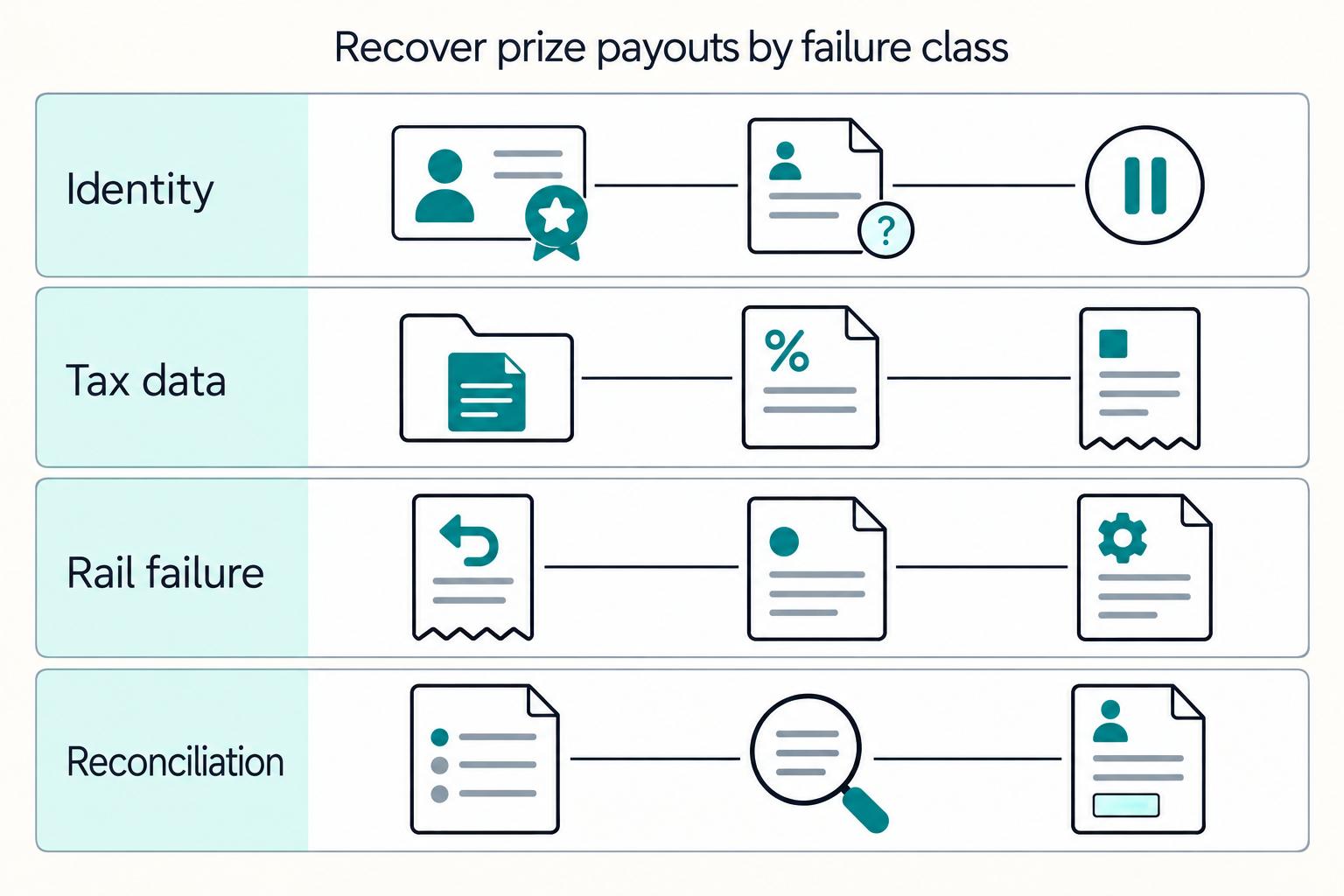
A timeout does not establish failure. Retrieve the original attempt and examine provider and reconciliation records. Hold a replacement while the original could still pay. Moving to another rail is safe only after a documented original outcome or cancellation prevents duplicate payment.
A confirmed beneficiary error requires a verified correction, a new beneficiary version and approved replacement linked to the failed attempt. A return requires evidence that the funds actually returned before re-disbursement. Keep the winner’s award intact unless an authorized eligibility or legal decision changes it under the rules.
For every exception, show the affected amount, reason, owner, evidence requested and next update date. Escalate approaching prize deadlines to the sponsor and legal owner. Do not silently invent a new claim deadline because the provider is slow.
Close the promotion and authorize expansion#
Reconcile approved gross prizes to recipient cash, tax withheld, amounts still outstanding and provider fees. Keep prize principal separate from operating expense analysis. Complete the New York winner reporting and record obligations on the required schedule, with the filing owner tracking completion independently from transfer status.
Before adding another market, obtain a separate legal and provider decision for the same mechanics. Exercise eligibility disputes, applicable withholding, duplicate callbacks, unknown outcomes and returned payments in a controlled nonlive environment. Expansion depends on those completed decisions and functioning controls, rather than entry volume.
Track awards paid by the promised date, unresolved prize principal and age, returns, duplicate-payment incidents and required filings completed. Use approved awards as the denominator, keep pending claims separate, and report any missing evidence. A successful provider submission rate cannot substitute for paid winners.
Frequently Asked Questions
Does a free entry route make a casino-style sweepstakes lawful?
No. New York’s current prohibition addresses defined dual-currency online casino-style games. The actual mechanics require legal analysis; a free-entry label does not establish permission.
Is the example prize a contractor payment?
No. It is an award from a draw without services or a wager. The tax owner should use the applicable prize-reporting treatment and award-year rules.
What happens if the original transfer times out?
Keep the attempt unresolved, retrieve its original status and reconcile evidence. Authorize a replacement only when the original outcome or documented cancellation prevents a duplicate payment.
Where Gruv fits
Researched and edited by the Gruv editorial team. Gruv builds cross-border billing, payouts, and finance-operations software for global businesses.
Sources
Educational content only. Not legal, tax, or financial advice.
Related Posts

The Freelance Payment Penalty: A Modeled Audit of Platform Fees, FX Spreads, and Payout Delays
The money rarely disappears through a single, easy-to-spot fee. The real loss is stacked. A marketplace takes its commission, a processor adds a charge for international cards, a bank or payment company converts the currency at a spread, a platform holds the funds before release, and a wire sheds a little to intermediaries on the way in. Each layer looks defensible on its own, but the worker feels the combined result as a smaller deposit and a later payday.

How to Respond to a Subpoena for Business Records
Move fast, but do not produce records on instinct. If you need to **respond to a subpoena for business records**, your immediate job is to control deadlines, preserve records, and make any later production defensible.
A US Expat's Guide to Investing in UCITS ETFs to Avoid PFIC Issues
The real problem is a two-system conflict. U.S. tax treatment can punish the wrong fund choice, while local product-access constraints can block the funds you want to buy in the first place. For **us expat ucits etfs**, the practical question is not "Which product is best?" It is "What can I access, report, and keep doing every year without guessing?" Use this four-part filter before any trade: