
Quick Answer
Connect affiliate enrollment and agreed commission rules to approved payables, authorized payout attempts and reconciliation. Test one market and route first. Expand when required checks are owned, review capacity meets demand and finance can explain each paid, held, failed or returned result.
Where Payout Automation Changes Affiliate Network Decisions#
Affiliate network payout automation only works if you define it as the full commission-to-cash path, not the moment a transfer succeeds. In practice, that path starts with affiliate onboarding, runs through commission logic and contract terms, and ends only when payouts are recorded in a way your team can reconcile.
That distinction matters because affiliate programs create more than payout files. You are expected to track leads, calls, downloads, and sales across channels, along with the contracts and payouts tied to partner performance. At small scale, teams often patch that together with manual checks. As volume grows, those workarounds lead to inefficiencies, errors, and missed opportunities, with month-end close still dependent on spreadsheet stitching.
For founders, the better question is not, "How do we pay affiliates faster?" Ask instead, "Which markets and commission models can we operate cleanly, with control and transparency for both finance and partner teams?" That is the real scope here. The transfer step matters, but it is only one layer. The harder work is keeping partner enrollment, payout instructions, commission approvals, and records connected well enough that you can explain each payment after the fact.
A practical early checkpoint is simple. Can you trace one paid commission from the affiliate's onboarding record to the agreed payout terms and final payout record without rebuilding the story by hand? If that chain breaks anywhere, you do not yet have reliable automation. You have partial automation wrapped around manual risk.
As you add markets, operational complexity usually rises before demand catches up. Processes that look straightforward in one setup can become harder to track and reconcile in another. A common failure mode is treating instant or embedded payouts as the goal, then discovering required partner data is incomplete and the payout cannot clear cleanly.
So the decision lens here is deliberately conservative. Expand where your payout path is visible and repeatable. If a market looks attractive but your team cannot reliably onboard partners, validate payee data, generate the right payout records, and reconcile disbursements back to source activity, that market is not launch-ready yet.
If you are evaluating payout network structure and compliance boundaries, see How to Build a Payout Network Without a Money Transmitter License for Platforms.
What affiliate network payout automation actually includes#
At an operating level, this is end-to-end work, not just a successful transfer. In practice, it starts when a partner enrolls and submits payout details, and it is only complete when finance can match the payable, payment result, and close records without rebuilding the trail manually.
The clearest operating model is three layers:
- Partner-facing layer: collect beneficiary details and required partner information with appropriate consent and access controls.
- Commission layer: apply the agreed attribution, validation and reversal rules to source events; retain the reason for each approved or adjusted payable.
- Execution and finance layer: release approved payables on the agreed cadence, submit the authorized payout and reconcile each attempt and any return.
Apply the identity, business, tax and payout-detail checks required for the actual payee, provider and jurisdiction. Keep each result separate from the commission balance and contractual payment date. A missing document may require withholding, remediation or a lawful release hold; it does not by itself make an earned commission disappear.
For a more detailed look at operational payout design, read Affiliate Network Payouts: How to Pay Publishers and Partners Automatically at Scale.
Match commission structures to payout operations before market entry#
Choose the commission model your payout operations can support, not just the one you want to test. That choice changes dispute handling, invoicing flow, retry risk, and close effort.
PPC pays for eligible clicks; PPA pays for a defined action such as a qualified lead or sale. Monthly payment is a cadence that can apply to either model. Event volume and approval workload depend on your traffic, attribution rules and validation window, rather than the model name alone.
Modern affiliate platforms can support flexible commission models, fraud detection, and automated invoicing. That flexibility helps only if each payable can be traced cleanly from source event to approval, invoice, payout instruction, and ledger outcome.
| Commission structure | Payout workload shape | Likely exception pattern | Reconciliation load | Automation priority |
|---|---|---|---|---|
| PPC (click-based) | Eligible click events, using the agreed validation window | Invalid clicks, duplicates and attribution disputes | Depends on event volume and batching | Validate events and preserve the commission calculation |
| PPA (lead/sale-based) | Defined qualified actions or sales | Qualification, attribution, refund and approval disputes | Depends on event volume and approval lag | Record approval and adjustment reasons against source events |
| Payment cadence: monthly or more frequent | Can apply to either commission model | Cutoff timing, minimum balances and payout exceptions | More transfers may add matching work without changing commission volume | Define earned, approved and payable balances and cutoff rules separately |
If you raise payout frequency, deepen controls before launch. Weak controls make unauthorized or duplicate activity harder to catch.
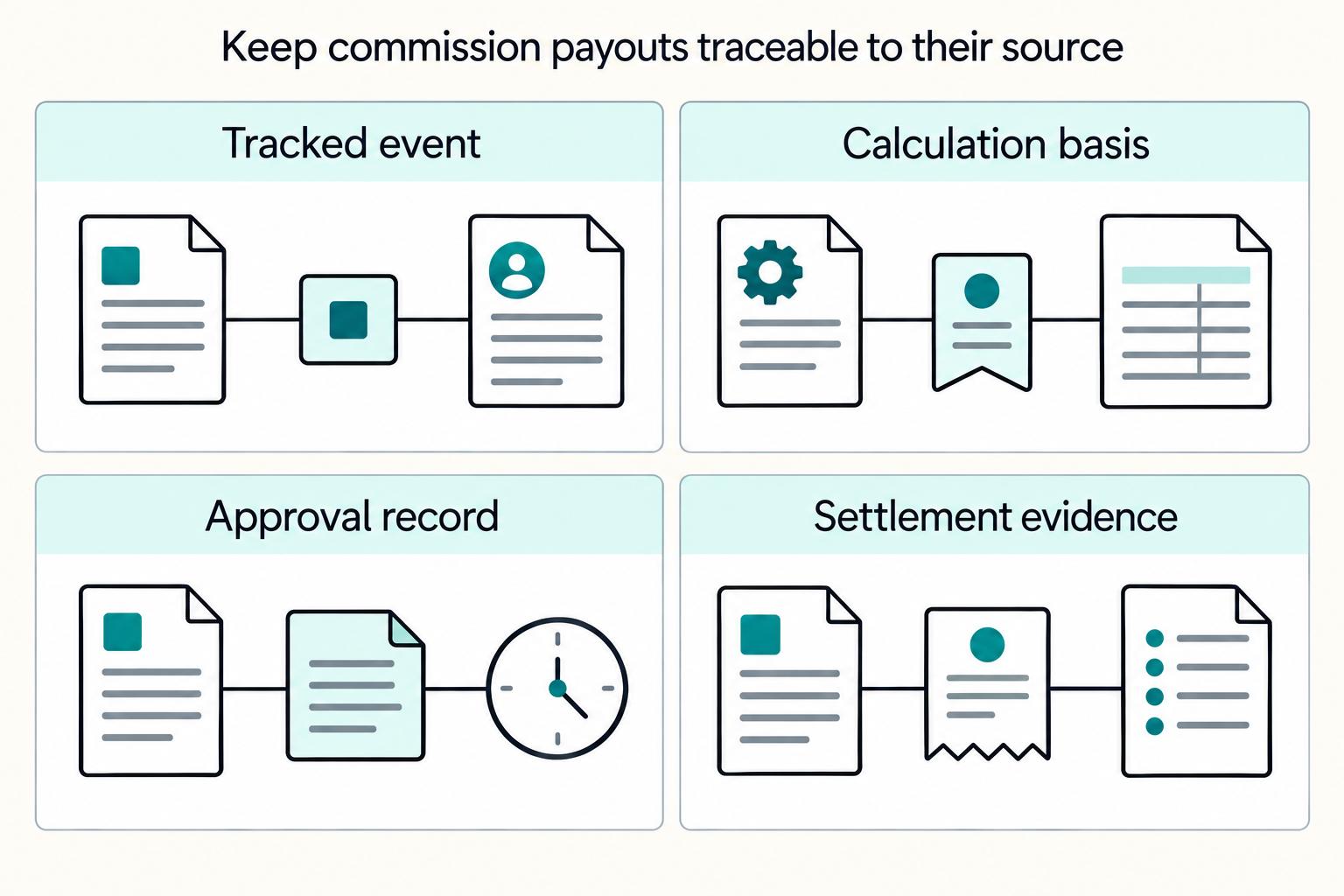
Use one full-path prelaunch check with realistic records. You should be able to trace each payable through:
- source event record (click, lead, or sale)
- approval decision, including hold/reversal status
- commission calculation and approval record, plus an invoice or self-billing record where required
- payout request identifier and provider reference
- final settlement or failure status tied to ledger posting
Give manual approvals and exceptions named owners, service targets and capacity limits. Automation should remove repeated data entry while preserving the human decisions your policy actually requires.
Related: Mass Payouts for Affiliate Networks: How to Pay Publishers Partners and Creators at Scale.
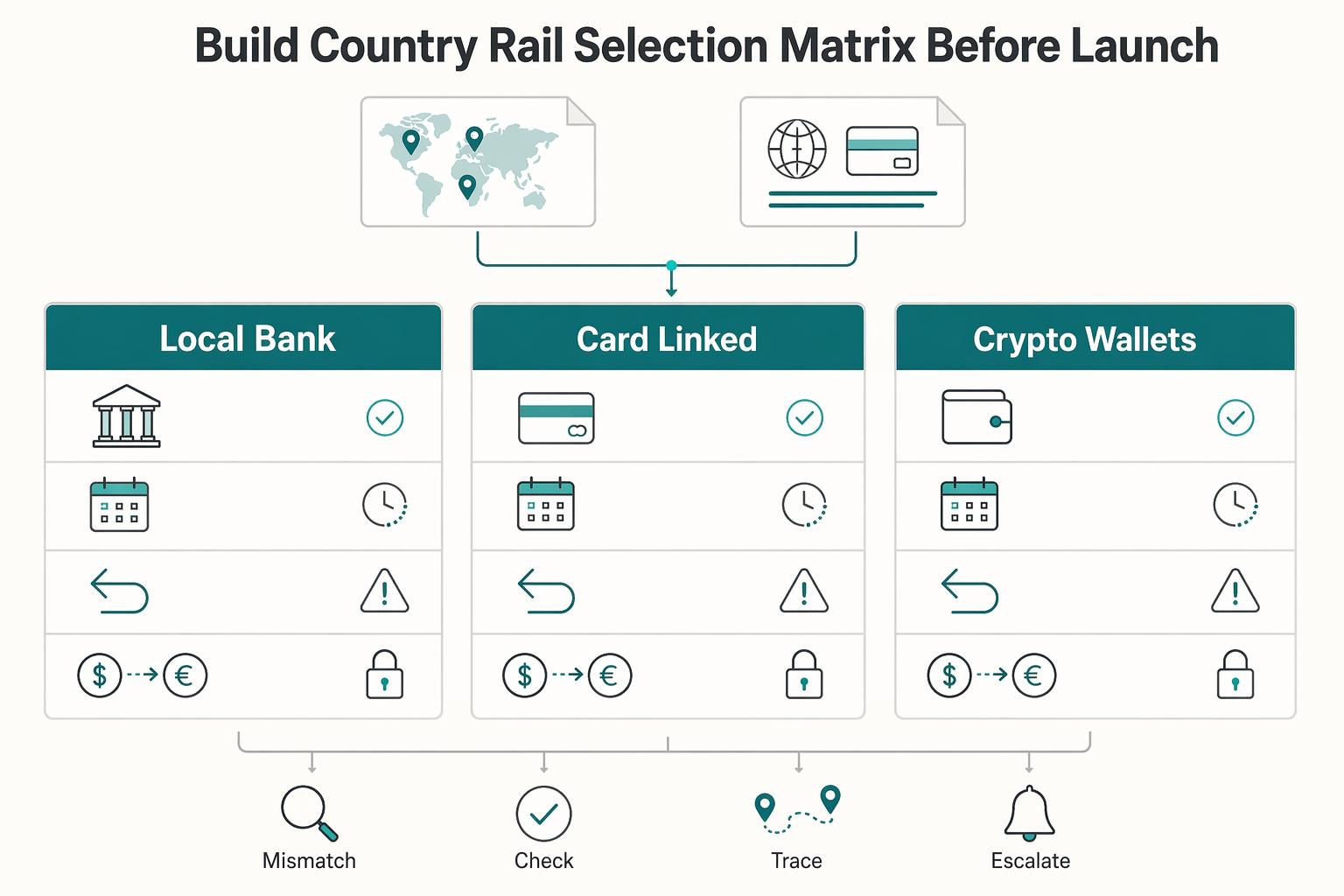
Build a country and rail selection matrix before launch#
For each intended country, use the selected provider’s current coverage and method requirements to separate route availability from operational readiness. Record eligible payees, funding and destination currencies, fees, arrival estimates and return handling before committing to launch.
For each target market, compare four items side by side: available payout rails, expected settlement behavior, return behavior, and currency-conversion requirements. Some cross-border routes may support same-day or next-day settlement, but treat that as a route characteristic to validate, not a launch promise.
| Route option | What to verify before launch | Main failure mode to plan for | When it usually makes sense |
|---|---|---|---|
| Local bank transfer via bank portals | corridor availability, beneficiary data requirements, funding currency vs. local currency, return-handling path | returned payouts that require rework | default route for repeat publisher payouts when bank data is validated early |
| Card-linked payout | corridor support, settlement predictability, conversion steps when currencies differ | failed payouts when the card or corridor is not eligible | useful when partners prioritize faster access and corridor support is clear |
| Crypto wallets where supported and compliant | provider support, policy approval, accounting and tax handling, conversion path back to fiat when needed | compliance or reconciliation gaps if launched without explicit controls | only where this path is approved end to end |
Add policy columns, not just payment columns#
Add the onboarding, document and release requirements that apply to each actual payee and market. Evaluate those alongside route eligibility, engineering effort and operating cost; keep earned liabilities visible even when payment requires remediation or withholding.
For each country and route, document what permits release, what can lawfully block it, and how missing documentation affects withholding, reporting or remediation. Run an end-to-end sample covering onboarding, payable approval, submission and a return.
Use a hard defer rule#
Defer a market if a critical step has no accountable owner, adequate capacity or reliable evidence. Manual onboarding review and manual repair of returns can be appropriate when they are controlled and staffed; the number of manual steps alone is not a launch criterion.
Design onboarding, compliance, and tax document flows that scale#
After market and rail decisions, make payout eligibility a controlled gate: standardize onboarding intake, validate in order, and keep policy ownership internal. That is the fastest way to reduce avoidable exceptions and keep decisions auditable as volume grows.
Standardize the intake record while selecting checks for the actual payee, provider and jurisdiction. Keep earned balances, required tax treatment and payout release status separate so a document issue does not silently cancel a liability.
Set the validation order before payout eligibility#
A practical sequence is:
- Create the payee record and capture information needed for the actual program.
- Select and perform the identity, compliance and destination checks applicable to this payee and route.
- Determine the required tax documentation and approved withholding/reporting or remediation treatment.
- Record release eligibility and any lawful hold separately from the earned commission liability.
Record the applicable compliance and tax decisions with their owners and reasons. When required documentation is missing, apply the legally required withholding, remediation or hold treatment and retain the earned liability and payment deadline.
Keep the policy logic in house#
Vendor onboarding, tax, and payout modules can automate workflow steps, but they should execute your rules rather than replace them. Keep one internal eligibility status model as the source of truth, with explicit review checkpoints and reason codes.
For each approved partner, you should be able to retrieve the onboarding submission state, compliance/tax status, payout method, and eligibility-change timestamp from one place.
Be strict about sensitive data handling#
Keep sensitive-data controls explicit across onboarding and payouts: masked views, encrypted storage, and minimal PII in logs and events. Automation helps reduce manual operations, but governance still depends on your internal controls and traceability.
Instrument reconciliation and status visibility from API to ledger#
Traceability is the requirement: you should be able to follow one payout from the Payouts API request through provider response, final status, and ledger posting. If that chain breaks, close drifts back to manual matching and spreadsheet repair.
This gets harder with multiple rails or providers because report formats, identifiers, and timing differ. Without one internal record that survives those differences, finance can spend hours or days matching entries across systems. In practice, that anchor should be your own payout object rather than any single vendor response.
Build one auditable event trail#
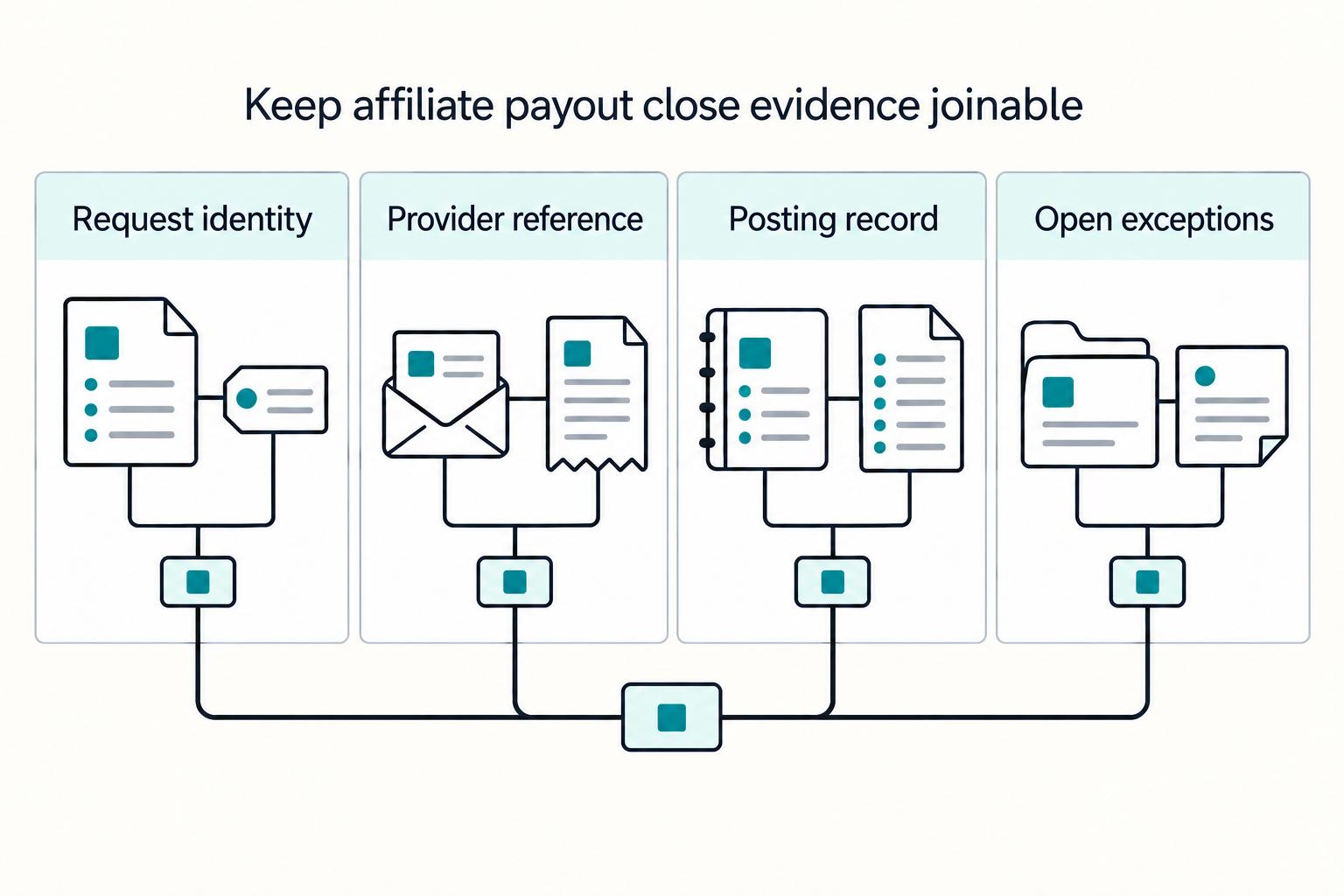
Keep a durable business payout ID linked to source commissions, each provider attempt, event history and ledger entries. Provider acceptance, bank posting and recipient receipt are distinct milestones. Finance should be able to explain the current state while preserving every earlier payment and return record.
A simple check is whether finance can answer, "Why was this publisher paid, not paid, or reversed?" without stitching exports across systems. If you run multiple programs or entities, a ledger hierarchy helps keep balances and postings attributable at the right level instead of pooling liability into one opaque bucket.
Treat Commission Reconciliation like a shipped feature#
Commission Reconciliation should run as a daily close process, not month-end cleanup. Define explicit checks, mismatch buckets, and named owners so exceptions are routed and aged in queues instead of hiding in inboxes.
A workable daily close usually checks:
- commissions approved vs payouts created
- payouts created vs provider-accepted transactions
- provider-accepted transactions vs settled or failed outcomes
- settled payouts vs ledger postings or reversals
Define mismatch categories before launch (for example: amount mismatch, missing provider reference, status timing lag, duplicate-submission suspicion, posted-to-ledger-before-final-outcome), then assign each to finance, payments ops, or engineering.
Make retries safe and status visible#
Claim an approved payable atomically before submission and link every attempt to its durable payout ID. Where supported, persist the provider idempotency key and exact payload before sending. An unknown outcome needs lookup or investigation of the original attempt; an internal key alone cannot prevent a provider from paying again. Authorize a replacement only after the original cannot still pay and funding or return movements reconcile.
Expose one shared operational status view for finance and ops, including API status and the underlying event log. A single status trail keeps incident triage evidence-based instead of split across teams.
For a step-by-step walkthrough, see Stopping Affiliate Payout Abuse From Fake Clicks and Fake Signups.
Set payout cadence, instant payout, and exception rules by segment#
Use segmented payout rules, not one global cadence, and treat instant payout as an earned state based on control reliability. Segment partners by volume, dispute or reversal risk, onboarding completeness, and payout-detail quality, then set approval depth by segment before cash moves.
Keep the decision path auditable in one payout record: segment label, approver, qualification reason, and final outcome. If you cannot show those fields together, keep the slower cadence for that segment.
Offer faster payout only on a confirmed eligible route, with its actual fees and arrival estimate. If beneficiary validation is failing or outcomes are not reliably reflected in your records, faster submission compresses the time between error and loss.
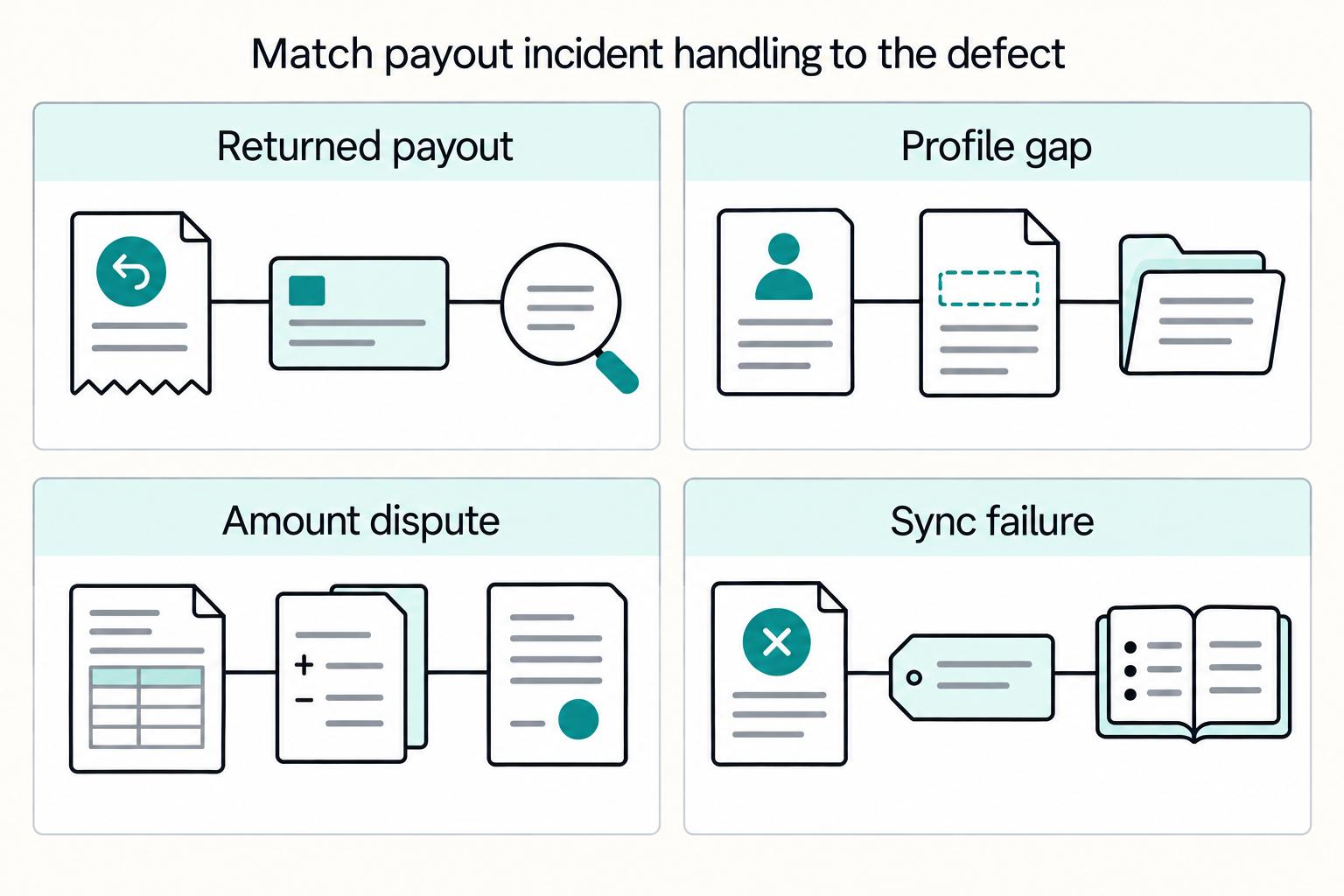
Define exception handling before rollout:
- Stale FX quote: obtain the eligible current quote for a new authorized attempt and log the rate decision; recover an unknown original outcome before replacing it.
- Failed beneficiary details: stop automatic new submissions on hard validation failures and route to verified correction.
- Returned payout: preserve the original paid/returned history, reconcile returned funds and residual fees, and approve a linked replacement only when no original attempt remains payable.
As a governance baseline, review segment rules and provider performance at least annually, including commission rates and each provider's ability to fulfill commitments.
Execute a 90-day rollout with hard verification checkpoints#
Run this as a gated 90-day rollout: each phase should stay narrow, measured, and easy to stop if verification quality drops.
| Phase | Scope | Verification focus |
|---|---|---|
| Days 1 to 30 | Pilot one commission model in one market with one onboarding flow, one approval path, and one payout route | Check completion, payout outcomes and close together; confirm each automated or manual step has an owner, capacity and evidence. |
| Days 31 to 60 | Add only one new variable: a new rail or a new currency path | Check routing and close at the tested load; pause if exceptions exceed owned capacity or age beyond agreed targets. |
| Days 61 to 90 | Expand market coverage only after predefined go/no-go checks pass for accuracy, exception aging, and close-cycle reliability | Keep vendor evaluation evidence side by side with live operating metrics and prioritize pilot evidence before scaling |
Days 1 to 30#
Pilot one commission model in one market with one onboarding flow, one approval path, and one payout route. The goal is to prove that onboarding completion, payout success, and reconciliation close align in your payout telemetry, even when execution spans onboarding tools, a CRM, banking APIs, and compliance systems.
Check whether a partner can move from enrollment to payout eligibility through an owned, documented process. If bank verification is in scope, choose a supported method based on account type, consent and the control it establishes. Measure completion and false rejection in your own pilot rather than assuming one method always reduces abandonment. Keep human review for exceptions.
Do not call the pilot healthy just because transfers went out. Review every held or failed payout and confirm the reason is clear, assigned, and traceable to the partner record.
Days 31 to 60#
Add only one new variable: a new rail or a new currency path. Do not add both at once.
Check conditional routing and finance close at the intended volume. If review queues exceed staffed capacity or unresolved exceptions age beyond agreed targets, stop adding markets until the process can absorb the load.
Days 61 to 90#
Expand market coverage only after your predefined go/no-go checks pass for accuracy, exception aging, and close-cycle reliability. Define those checks before rollout and keep them tied to your own operating evidence.
Keep vendor evaluation evidence side by side with live operating metrics for every option (for example, Payouts.com, i-payout, Dots, Affise Pay), using the same evidence pack each time:
- market and rail assumptions tested
- pilot telemetry for onboarding completion, payout success, and exception volume
- finance close notes showing where manual intervention was still required
- failed-case examples and resolution path
Prioritize pilot evidence when a proposal looks strong but the process has unowned repair work or cannot meet exception targets. A staffed manual lane with traceable decisions can remain part of the design.
Conclusion#
Choose the mix of markets, commission rules and controls your team can verify, govern and reconcile at the expected volume.
Expand when the full path from onboarding to approved commission, payment outcome and close is traceable and has enough operating capacity. A controlled spreadsheet or manual reconciliation step can be suitable; conflicting parallel records and reconstruction from memory are the risks.
That matters more as you scale. The case for automation is not just speed. It is that managing hundreds or thousands of affiliate relationships manually creates inefficiencies, errors, and missed opportunities. Good automation improves onboarding, tracking, communication, and performance analysis, but those gains only matter if your controls hold up under volume. In practice, the most useful checkpoint is not a dashboard screenshot. It is whether finance and ops can trace one payout from request ID to provider reference to final posting without guessing. A strong launch decision should pass three tests:
- Clear eligibility rules
You should be able to show what makes a partner payable, what documents or reviews can block payout, and who owns exceptions.
- Traceable payout states
Pending, held, failed, returned, and paid should mean something operationally, not just look clean in a UI.
- Repeatable close with low exception drag
Month-end needs a repeatable reconciliation process, including documented manual matching where appropriate, with owners and traceable adjustments.
Treat unowned or overloaded manual review as a launch risk. Review capacity, decision quality and exception age rather than counting manual steps. Likewise, confirm that higher payout frequency does not bypass contractual approval windows or leave returns unreconciled.
Start with the market and model matrix, then test one market and commission model. Use evidence of onboarding quality, payment outcomes, exception age and a repeatable close to decide whether the team can support more volume.
If you want a deeper compare of commission choices before you pilot, this breakdown on Affiliate Network Payout Structures: Performance-Based Commission Models for Publisher Partners is the right next read.
Frequently Asked Questions
What is affiliate network payout automation in practical terms?
It is the operating layer between partner signup, commission calculation and a reconciled payout. It connects approved source events to payables, authorized payment attempts and finance records. Human review can remain part of the process when its decisions, ownership and capacity are clear.
What should founders evaluate before expanding affiliate payouts to a new country?
Check whether you can support the full path in that market: onboarding evidence, payment-detail quality, payout route, and finance verification readiness. A good test is whether a partner can move from enrollment to payout eligibility without hidden manual steps. If manual verification in your current process is still taking too long, adding a new country can add delay before it adds revenue.
How do commission structures change payout complexity and reconciliation workload?
PPC and action-based models define what earns commission; payout cadence defines when approved balances are paid. More frequent transfers can add reconciliation work, but event volume and approval effort depend on the actual program. Preserve the source calculation, approval window and any adjustment before releasing the payable.
When is instant payout worth the added compliance and control overhead?
Instant payout is worth it only when your eligibility gates already work cleanly and your status visibility is reliable in real time. Fast disbursement does not remove compliance, KYC or KYB, fraud checks, or finance review where policy requires it. If you cannot quickly explain why a payout is pending, held, failed, or returned, adding instant payout usually turns a trust feature into an ops problem.
What are the most common payout failure points in affiliate networks?
Check incomplete onboarding, incorrect destination details, approval queues and unmatched payment or return records. Use your own exception counts to establish which causes are most frequent. A provider failure code helps separate a destination correction from an unresolved payment outcome.
What can be fully automated, and what usually remains policy-gated or manual?
You can automate much of the routine work: data capture, payout scheduling, status updates, and parts of the payout flow itself. Some stacks also expose real-time system status, which helps ops and finance triage from the same event trail. What usually stays gated is document review, compliance decisions, edge-case exceptions, and any payout that fails validation or needs human approval.
Try a related tool
Where Gruv fits
Researched and edited by the Gruv editorial team. Gruv builds cross-border billing, payouts, and finance-operations software for global businesses.
Sources
Includes 8 external sources outside the trusted-domain allowlist.
- lumanu.com/blog/top-5-payment-api-solutions-for-influen...external
- nuvei.com/posts/nuvei-taps-stablecoin-rails-to-power-p...external
- payouts.com/implementing-payout-automation-in-affiliate-...external
- payquicker.com/mlm-payout-solutionsexternal
- rewardful.com/articles/how-to-automate-affiliate-marketing...external
- support.thrivecart.com/help/automated-affiliate-commissions-payoutsexternal
- tipalti.com/resources/learn/affiliate-paymentsexternal
- usedots.com/blog/best-payment-apis-affiliate-networksexternal
Educational content only. Not legal, tax, or financial advice.
Related Posts
Affiliate Network Payout Structures for Publisher Commissions
Commission design is an operating decision, not a pricing footnote. The structure you choose affects what behavior you reward and the economics of the program. It is easy to announce rates. It is much harder to define a model that still holds up once reversals, edge cases, and partner questions start showing up.
Automating Affiliate Network Payouts for Publishers and Partners at Scale
Automating affiliate payouts is worth doing, but only after you decide what has to stay controlled. As programs grow, payouts become a real operational burden, and payout reliability affects whether partners stay engaged. If you automate the payment motion before you clean up approvals, tax data, and reconciliation, you usually do not remove work. You just move it into exceptions that are harder to unwind.
Mass Payouts for Affiliate Networks Paying Publishers, Partners, and Creators at Scale
Treat affiliate payouts as infrastructure, not as a payment feature. Once you are paying publishers, partners, and creators in volume, the hard part is often not the send button. It is everything around it: commission calculation, recipient onboarding, approval controls, rail selection, status handling, reconciliation, and close.