
Quick Answer
Classify the payable event and trace attribution and commission math. Confirm holds stop release in the paying system, assign owners and resolve cases before actual provider deadlines. Keep final evidence and distinguish commission reversal from recovery of paid funds.
Why fake clicks and fake signups still get paid#
Affiliate fraud often looks like a marketing problem at first. It becomes a finance and compliance problem the moment an invalid event can produce a commission payment. In a performance-based commission model, affiliates are rewarded for measured outcomes such as customer actions or sales. That makes fake clicks, fake leads, and false attribution claims payout-eligibility questions, not just traffic-quality defects.
That framing matters because the control point is not the click alone. It is the chain from event to commission to release of funds. If someone can fabricate clicks, generate fake leads, or claim credit for sales they did not actually drive, the practical risk is undeserved commissions. Your job is to break that chain where the evidence no longer supports payment. You also need to do it in a way another team can review later without guesswork.
The document that matters most from the start is the audit trail. An audit trail is the documented flow of a transaction, which is what you need when a payout decision is challenged. As you work through this guide, assume every hold, release, or reversal decision should be explainable through traceable records, not just a fraud score or a Slack message. A good first checkpoint is simple: can you trace a commission back to the source event, the attribution record, and the payout calculation without stitching together evidence by hand?
Get three basics in place before you tighten controls#
- A plain definition of what counts as an invalid event in your program, including fake clicks, fake leads, and deceptive attribution claims.
- A named decision owner for payout holds and releases, so marketing is not making finance-impacting calls alone.
- One case record or evidence file where the event history, attribution data, payout math, and final decision can be reviewed together.
If you do not have those basics, adding more detection rules can create review noise without improving payout decisions. That is the tradeoff to keep in view throughout this piece. Stronger controls can reduce payout abuse, but weak ownership and weak records can turn valid partner disputes into a second problem.
This guide stays practical. It focuses on how invalid events become commissions, where to stop that progression, and how to assign decisions people can actually execute under pressure. Where legal posture differs by market or by the facts of a partner relationship, treat the structure here as an operating model, not a universal legal answer. Context matters, so confirm your thresholds, dispute posture, and materiality rules with counsel before you lock them into policy.
Define the fraud events that should block money movement#
Do not use one generic "fraud" label to decide whether money can move. Classify the event first, because fake clicks, fake leads, fake conversions, and cookie stuffing point to different evidence and different payout decisions.
Classify the event before you discuss payout#
Treat payout abuse as the end state, not the event itself. The finance risk starts when an invalid event becomes an undeserved commission.
| Event type | What it signals | What your team should verify before payout review |
|---|---|---|
| Fake clicks | Invalid or bot-driven traffic activity | For cost-per-click programs, verify the payable click itself. For lead/sale programs, verify the downstream commissionable event and attribution. |
| Fake leads | Fabricated signups or submissions | Whether the lead passed your normal validation checks and maps to a commission record |
| Fake conversions | Falsified sales or installs | Whether the conversion is supported by underlying transaction or install evidence |
| Cookie stuffing / forced clicks | Attribution manipulation | Whether the affiliate received credit for a sale they did not legitimately drive |
Use a simple logging standard: each investigation entry should record one event type, one affected commission, and one current payout status (hold, pending review, or cleared). If a case note only says "suspected affiliate fraud," it is not yet reviewable.
Separate bad traffic from bad attribution#
Keep traffic-quality findings separate from attribution manipulation findings. Fake clicks and fabricated leads question whether the activity was real; cookie stuffing and link hijacking question who should get credit, even when a real customer and real sale exist.
If the issue is not yet classified and payment is imminent, use a bounded protective hold under your program rules, then gather evidence. An unclear allegation is not grounds for final rejection. Confirm the hold prevents release in the system that pays the commission.
Prepare the minimum controls and owners before you tune detection#
Before you tune detection rules, lock down who can stop, release, and reverse money. If ownership is unclear, better detection usually creates more disputes, slower reviews, and weaker records.
Name the decision owners and split the powers#
Assign three named authorities for affiliate marketing fraud cases: who can place a hold, who can approve release, and who can authorize a reversal. Keep these rights separate where possible so one person cannot both approve a payout action and conceal why it happened.
Map those rights to formal governance roles, not whoever is available in chat. Marketing can raise the case, but finance, risk, or compliance should own money-movement decisions under your internal governance. For any held commission, you should be able to see one named case owner, one named payout decision owner, and a timestamped approval path.
Red flag: if one affiliate manager can place a hold, release it, and edit case notes alone, you have a concealment risk as well as a fraud risk.
Define the evidence pack and a bounded emergency hold#
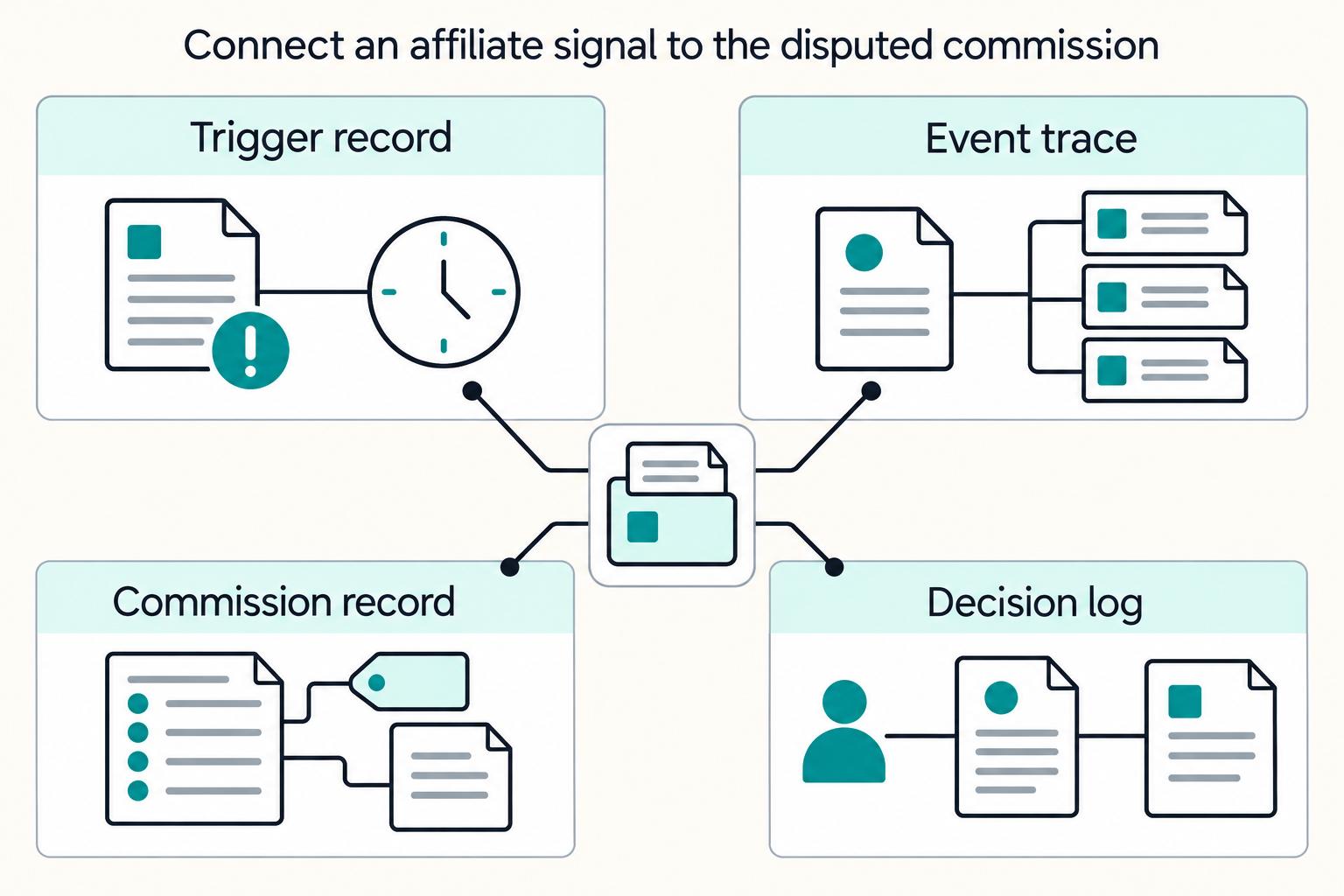
A temporary protective hold can start with a documented trigger, affected commission ID, named owner and next-review deadline while missing records are gathered. Before final release, decline or reversal, require the following evidence pack:
| Evidence item | What it shows |
|---|---|
| Event trace | What happened and when |
| Attribution record | Why the affiliate received credit |
| Payout calculation record | How the commission amount was derived |
| Audit trail extract | Who changed status, who approved action, and when |
This is not a universal legal template, but it gives you one reviewable record. The event trace shows what happened and when. The attribution record shows why the affiliate received credit. The payout calculation record shows how the commission amount was derived. The audit trail extract shows who changed status, who approved action, and when.
Checkpoint: if any of the four items is missing, the case is not ready for final disposition.
Set legal and recordkeeping boundaries before disputes get expensive#
Decide upfront what compliance can close internally and what must go to legal when disputed undeserved commissions are material under your policy. There is no universal threshold, so use a risk-based rule tied to your exposure, markets, counterparties, and dispute posture.
Keep one operating record for each case so logs support investigation and analysis, not just storage. If reviews are split across spreadsheets, inboxes, and ad hoc chat threads, teams lose sequence, approvals, and rationale. If you cannot reconstruct the full decision from one record, do not release or reverse the commission yet.
Related: Affiliate Marketing Fraud: How Platforms Detect and Eliminate Invalid Traffic and Fake Conversions.
Step 1 map the path from click to commission before setting rules#
Map each affiliate path from click to payout before you tune detection rules. If you cannot trace a commission back to validated source events in one reviewable view, do not automate release for that path.
Draw the base path exactly as money moves#
Map the contracted payable event to commission approval and payout. For cost-per-click, the validated click itself is the payable event; lead, signup or sale programs require the specified downstream qualification. Store that distinction rather than forcing every program through a conversion requirement.
Keep paths separate. Signup, lead, and purchase flows can fail at different points, and one blended map can hide where unearned commission becomes payable.
At each handoff, record the creating system and carried-forward identifier. Include source event ID, affiliate ID, timestamp, contracted event type and the link to the commission outcome. Add conversion/qualification records when the program pays for downstream leads or sales.
Mark the points where attribution can be manipulated#
Then mark where abuse can enter the chain. Fake clicks and fake signups are common, but handoffs are often where attribution risk increases.
Cookie stuffing is a key example: attribution can be injected without genuine user intent, which can route commission to an affiliate that did not generate the sale. Treat manual actions as equal risk points. Mark where someone can reassign attribution, import conversions, edit commission amounts, or approve payout exceptions.
A practical red flag is any step where affiliate credit can change without a preserved reason in the audit trail. Fraud scores can help prioritize reviews, but payout disputes usually depend on whether your underlying data is accurate and reliable.
For a hypothetical $20-per-qualified-signup program, 100 tracked signups create $2,000 of provisional commission. Suppose 20 records repeat an existing event ID and 10 distinct signups fail the written qualification rule. After evidence review, decline those 30 and release 70 × $20 = $1,400. If qualification remains unresolved, use an effective bounded hold rather than treating suspicion as proof. Shared office IP addresses alone do not establish fake users. Compare event IDs, timestamps, account verification and required activation/payment evidence; self-referrals are disallowed only where the program rules say so.
Add release checkpoints before each payment step#
Add four explicit yes/no checkpoints before money moves forward:
| Stage | What you need to verify | Common failure mode |
|---|---|---|
| Event captured | A source event exists with affiliate ID, timestamp, and a traceable record | Source event cannot be tied to genuine activity or its required attribution |
| Payable event validated | The contracted click, qualified lead/signup or sale satisfies program rules | Click-paid programs incorrectly require a sale, or downstream programs accept unqualified events |
| Commission calculated | Amount is derived from validated payable-event records at the agreed rate | Amount is computed from unapproved, edited, or duplicated records |
| Payout approved | A named approver and audit trail exist before payout file creation or release | Balances are exported or paid without a clear approval history |
If these four checkpoints are not visible in one place for a path, keep release manual until traceability is fixed.
Step 2 write hold release and reversal rules that people can execute#
Once the map is clear, define payout states and record actual provider deadlines for each action. A locally pending case can still become payable in an external affiliate system; your case queue is not itself a payment control.
Provider terminology differs. Awin auto-validation approves tracked transactions after the configured period unless they have already been validated or declined. Awin says AVP cannot be disabled; a change requires support and may require a contract addendum. impact.com creator action locking permits modification or reversal during its locking period; use the actual action’s Locking Date. Record provider state, deadline and permitted operations rather than treating AVP and locking as interchangeable.
Set three payout states#
Use one status model that finance, risk, and affiliate ops apply the same way.
| Status | Use when | Required action before timing point |
|---|---|---|
| Auto-release eligible | Validation confirms a genuine, completed transaction and no conflicting attribution signal is open | Approve within the validation window |
| Manual hold | Signals conflict, such as suspected click fraud plus an unusual conversion pattern, or attribution cannot yet be verified | Apply a supported provider hold if available; read back its state and release effect. Assign a decision before the actual deadline. |
| Reverse or decline | Evidence shows the transaction is invalid, not genuinely earned, duplicated, or deceptively attributed | Decline or reverse only using permitted operations and the applicable provider/contract deadline. |
This keeps uncertainty separate from proof: a hold is temporary while validation continues, and a reversal or decline is for cases where evidence shows commission should not be paid.
Write if-then decisions people can use under pressure#
Document short rules so cases do not drift toward auto-approval:
| Condition | Action |
|---|---|
| A click fraud signal appears with a conversion anomaly | Place the action on hold |
| The event trace and attribution record support genuine user action | Release with a logged rationale |
| Validation shows the transaction is not genuine or not commissionable | Decline or reverse before lock |
| The reviewer cannot decide from current evidence | Escalate instead of letting time decide |
Anchor each decision to the action ID so teams can reconstruct what happened: the tracked action, affiliate ID, timestamp, linked conversion record, reviewer, and decision reason.
Define minimum evidence for reversal in advance so reversals are not arbitrary. Require enough record detail to show why the commission was not genuinely earned and who changed status, and when.
A commission reversal changes the commission ledger; it does not prove that previously paid cash was recovered. For locked or paid actions, follow the provider’s supported post-lock process and contractual recovery rights. Record any clawback receivable, permitted future offset or recovered bank amount separately, with approval and partner notice; preserve the original payment and adjustment trail.
Set review windows and exception routing#
Work backward from the actual provider deadline. In a hypothetical 30-day AVP, assign review and escalation earlier; day 30 is not a safe time to begin investigation. Read the deadline from the provider rather than deriving it from internal queue age.
Give each hold an owner and next-review date. Escalate before the provider deadline. An extension is effective only after the provider supports and confirms it; an internal note cannot extend AVP or locking. If no extension is available, the authorized decision maker must resolve the action under the contract before the deadline. Do not assume leaving it pending stops payment.
State the tradeoff clearly: tighter holds reduce payout abuse risk, but if review capacity is weak, valid partners may face delays. Start by holding combined signals and disputed attribution, then expand only when the team can review in time.
Step 3 run ongoing monitoring that detects abuse early without flooding ops#
Run monitoring as a triage system, not an alert dump: categorize incidents by type, then prioritize by likely payout impact and urgency. The goal is better decisions before auto-validation or lock timing, not more raw alerts.
A practical operating model is to keep distinct working queues for click fraud, fake conversions, and payout abuse, then rank cases inside each queue by scope, likely impact, and time criticality.
- Click fraud: suspicious click patterns or other invalid-traffic signals. Treat this as a validation queue first, because invalid activity can include accidental clicks as well as fraudulent behavior.
- Fake conversions: fake leads, fake signups, or conversion records that do not match normal user behavior. These usually need faster review than click-only issues because they sit closer to commission creation.
- Payout abuse: suspicious activity already tied to a tracked action, commission amount, or attribution record. Put commission exposure, action ID, affiliate ID, and days to auto-validation or Locking Date at the top of the case view.
Batch reviews by exposure, not by equality#
Use risk-based batching instead of identical review cadence for every affiliate. Review higher-risk or higher-exposure affiliates more closely and more frequently, while keeping baseline checks for everyone else.
Useful sort keys: commission exposure, disputed attribution history, repeated invalid-traffic alerts, and volume spikes that could become undeserved commission if ignored.
A quick verification check helps: sample cases from each queue and confirm a reviewer can see, within a minute, why the case is in that queue and why it has its current priority.
Use repeated clears to tune rules#
Include one failure-mode check in every cycle: which alert patterns keep clearing as legitimate. If a signal repeatedly clears, refine the threshold, require corroboration, or narrow the rule so ops does not re-review the same low-value pattern.
When signal quality is uncertain, tighten evidence requirements before tightening penalties. Ask for stronger proof before stronger holds, faster reversals, or escalation so weak click-only suspicion is not treated as confirmed conversion or payout abuse.
For a step-by-step walkthrough, see How Platforms Detect Free-Trial Abuse and Card Testing in Subscription Fraud.
Step 4 escalate incidents with a fixed evidence pack and decision log#
For material incidents, use one repeatable escalation path with one case record, one evidence pack, and one dated decision log from trigger to closeout. This keeps decisions reviewable across finance, compliance, and legal instead of forcing teams to reconstruct context from scattered notes.
Use a fixed sequence aligned to detect, respond, recover:
- Record the detection trigger with the exact signal that opened the case.
- Set the immediate payout status: release, temporary hold, or no action pending review.
- Assign the case owner and required approvers.
- Review the evidence pack against the specific allegation.
- Set the final disposition and record internal communication.
- Update controls if the case exposed a gap or noisy rule.
Keep the investigation log contemporaneous, with dated and timed entries. For each material case, record who decided, what evidence was used, and why the payout action was proportionate. Document non-action decisions too, not only holds or reversals.
Use one authoritative audit bundle#
Keep one audit trail bundle per incident so disputes do not trigger rework. Fragmented records increase risk and slow reviews. A practical bundle typically includes:
- the trigger record that opened the incident
- the relevant event trace and attribution record
- the payout calculation or commission record at issue
- the investigation log with timestamped decisions
- the final disposition and any control update at closeout
If the evidence pack does not connect the signal to the affected commission record, do not treat suspicion as proof. Define scope early, maintain one decision log per case, and close with a clear disposition note.
Related reading: Transaction Monitoring for Platforms: How to Detect Fraud Without Blocking Legitimate Payments.
Common mistakes that create more risk and how to recover#
The biggest failures are usually governance failures, not missed alerts. If detection improves but payout decisions stay unclear, you increase inconsistency and make disputes harder to defend.
| Mistake | Recovery |
|---|---|
| Use one generic rule for all fraud events | Use distinct payout-eligibility rules for clicks, fake leads, and attribution abuse |
| Let marketing make hold, release, and reversal decisions alone | Add finance approval for payout impact, and involve compliance or legal when endorsement-related misrepresentation is in scope |
| Close an escalation with a thin case file | Require a complete investigation log before closeout, including who decided, what evidence they used, and when |
| Set controls from unverified social-summary stats | Use external benchmark claims only as prompts, not as thresholds or clawback justification, unless you can substantiate them |
Use the table as a recovery map, then pressure-test your process against the same four failure modes.
If you are using one generic rule for all fraud events, a reviewer should still be able to see exactly which event failed and why that changed commission eligibility. Clicks, fake leads, and attribution abuse should not collapse into one label if they lead to different payout actions.
If marketing can place holds, release funds, and approve reversals alone, add second-line approval before payout impact is finalized. A high-risk pattern is a fast reversal approved in a chat thread without second-line review.
If an escalation closes with a thin case file, require a complete investigation log before closeout, including who decided, what evidence they used, and when. Dated, timed decision entries are the core control.
If controls are being set from unverified social-summary stats, use those claims only as prompts. Anchor decisions in your own audit trail: trigger record, event trace, attribution record, payout calculation, and final rationale.
Conclusion#
The practical win here is not a smarter fraud label. It is your ability to stop money movement before commission release, then explain every exception from source event to final payout action. If a disputed commission cannot be traced through an audit trail, attribution record, payout calculation record, and investigation log entry, keep that path out of auto-release.
That is the standard to aim for. Fabricated clicks, fake leads, and false attribution only become a finance problem when they survive your checks and turn into payable commission. A stronger program intercepts invalid events before confirmation and payout, not after the money is already gone. Just as important, the decision has to be reviewable by someone outside the original team. If marketing detects the issue, finance should still be able to reconstruct why a hold, release, or reversal happened.
Ownership is where many programs still break. Named owners for hold, release, reversal, and escalation are not admin detail. They are a control requirement. The same goes for segregation of duties: the person pushing for affiliate growth should not be the only person able to approve disputed commission release. That separation is one of the simplest ways to help prevent fraud and control breakdowns.
You also need a feedback loop. Periodic review matters because rules drift. False positives that clear again and again can indicate your thresholds or evidence requirements need adjustment. NIST's incident response guidance makes the same point: improve detection, response, and recovery over time, not just close one case at a time. Your affiliate reviews should work the same way.
Use this closeout checklist as an operating test, not a paper exercise. Each item should be verifiable from real case records:
- Confirm your fraud taxonomy is shared across marketing, risk, finance, and compliance, so fabricated clicks, fake signups, false attribution, and payout abuse do not get mixed together.
- Confirm named owners and delegated authority for hold, release, reversal, and escalation, with segregation of duties where money can move.
- Confirm payout eligibility rules are written as if-then decisions people can execute under pressure.
- Confirm every material case requires the same evidence pack: trigger record, event trace, attribution record, payout calculation record, audit trail extract, and investigation log entry.
- Confirm you review false positives, repeated overrides, and rule drift on a recurring basis, then update controls when the evidence says they are no longer fit for purpose.
If you can do those five things consistently, you are more likely to reduce payout abuse and lower the odds of internal or partner challenges. If you cannot, do not solve it with more scoring alone. Fix the decision path first.
Frequently Asked Questions
What is affiliate payout abuse in practical terms?
It is the point where deceptive affiliate activity turns into money movement. In practice, that means commissions are calculated or paid on clicks, leads, installs, or sales that were not legitimately earned. The financial harm is simple: your program pays for worthless traffic or for attribution an affiliate did not actually drive.
How are fake clicks different from fake conversions when deciding payout holds?
In a cost-per-click program, fake clicks can directly create payable commission. In lead or sale programs, click anomalies are an investigation signal until linked to a commissionable event. Verify fabricated signups, leads, sales or installs against source records and program rules; a temporary hold needs an owner, deadline and effective payment-system control.
Why does cookie stuffing lead to undeserved commissions?
Cookie stuffing is a deceptive tactic that manipulates tracking credit, so an affiliate can appear in the attribution path without causing a real referral. That matters because commission is then assigned to tracking data that does not reflect genuine user action. If the affiliate did not truly drive the conversion, the resulting commission is undeserved.
When should a platform hold affiliate payouts instead of releasing automatically?
Hold when the evidence is conflicting or incomplete at the point money would move. A practical rule is simple: if the event trace, attribution record, and payout calculation do not line up cleanly in one case file, pause auto-release for that path pending review. The tradeoff is real because tighter holds reduce leakage but can strain legitimate affiliate relationships if review capacity is weak.
What minimum evidence should be documented before reversing commissions?
You need more than a fraud score or a Slack thread. At minimum, the case record should document what triggered review, the relevant event and attribution records, the payout calculation context, and who decided what, when, and why. The checkpoint that matters most is whether another reviewer could reconstruct the reversal from the case record alone.
Who should own final decisions on disputed affiliate payouts: marketing, risk, finance, or legal?
Assign a final payout decision owner under your internal authority policy, with separate investigation and approval roles where practical. Counsel handles contract, clawback and local-law questions. The FTC Endorsement Guides concern truthful advertising and disclosure; they do not assign commission ownership or create a universal right to reverse payment.
What cannot be decided without program-specific thresholds or legal advice?
You should not invent universal hold thresholds, reversal percentages, or fixed review timelines without your own policy evidence. You also should not make jurisdiction-specific legal calls on commission reversals from general fraud signals alone. If the dispute turns on endorsement conduct, contract language, or local law, get program-specific rules or counsel before making the final call.
Where Gruv fits
Gruv for affiliate payouts
Turn approved commission rows into a payout batch with clear partner references, item status, and exception context.
See reconciliation and mismatch review
Compare ledger entries, provider payment records, and statement rows to see what matches and what finance needs to review.
Researched and edited by the Gruv editorial team. Gruv builds cross-border billing, payouts, and finance-operations software for global businesses.
Sources
Includes 2 external sources outside the trusted-domain allowlist.
- csrc.nist.gov/projects/incident-responsetrusted
- ftc.gov/business-guidance/resources/ftcs-endorsement...trusted
- guides.gaoinnovations.gov/greenbook/2025/principle-3-establish-structu...trusted
- justice.gov/usao-sdal/pr/cookie-stuffing-internet-fraud-...trusted
- creatorsupport.freshdesk.com/support/solutions/articles/155000003011-acti...external
- help.awin.com/advertisers/docs/en/auto-validationexternal
Educational content only. Not legal, tax, or financial advice.
Related Posts
How Platforms Detect and Stop Fake Invoices Before Payment
If you run platform payment operations, fake invoice risk rarely comes from a single failure. More often, you see a chain of small gaps: weak vendor setup, unclear approval ownership, rushed payment timing, disconnected systems, and hold rules that people interpret differently.
How Platforms Stop Affiliate Fraud Before Commissions Are Paid
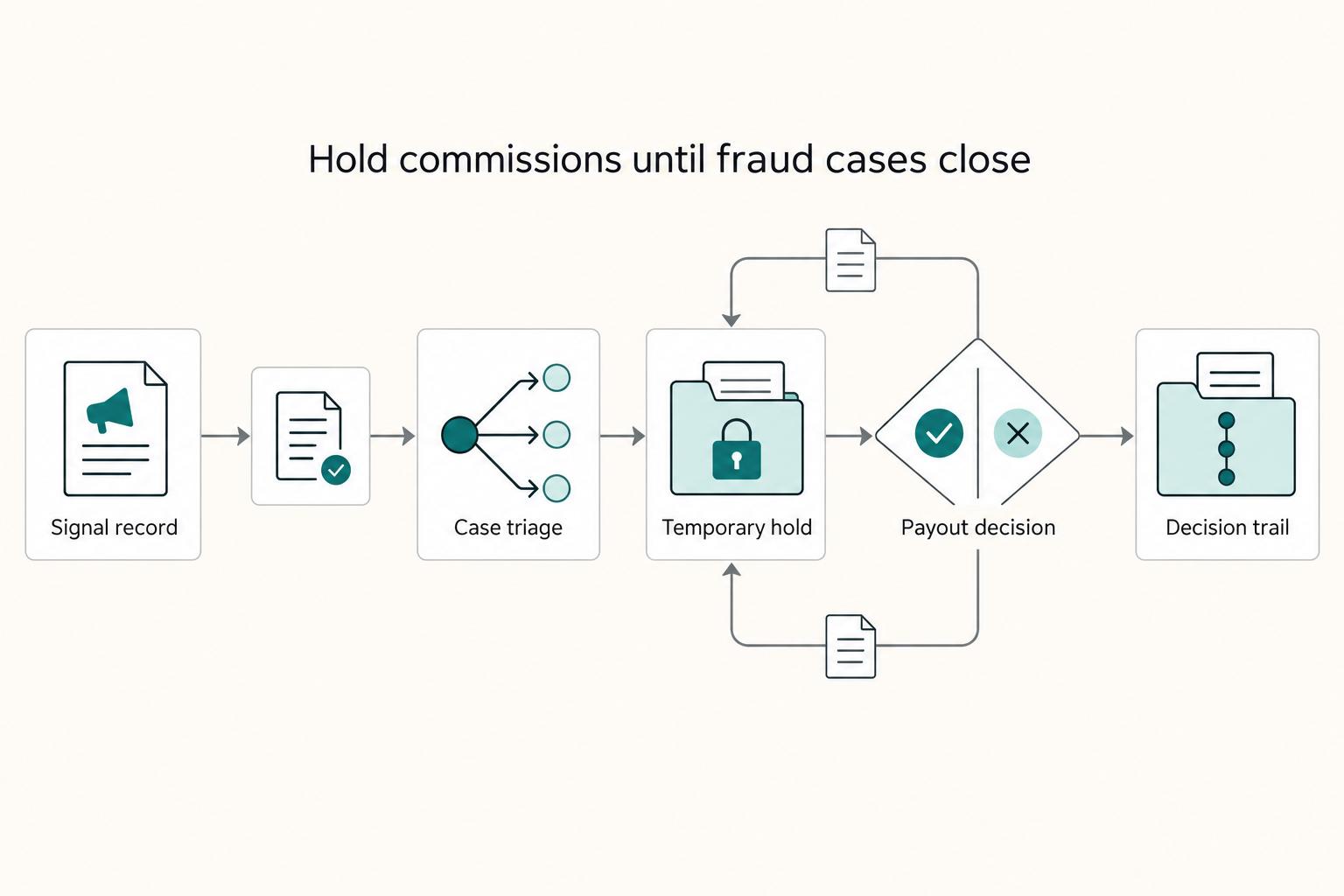
If you approve or challenge affiliate payouts, detection quality matters only when it changes the payout decision and leaves a record you can defend. If you pay partners across markets, vendor claims about speed or AI are not enough. You need controls that catch invalid traffic and fake conversions before commission is released, plus enough evidence to explain why a conversion was approved, held, or denied.
Know Your Artist (KYA): Checks to Reduce Streaming Fraud
Streaming fraud can distort royalty allocations, create payment disputes and expose a distributor to partner action. In a March 2026 guilty plea, DOJ described an operator using AI-generated songs and bot accounts to obtain more than $8 million in royalties. Identity checks can reduce impersonation and account abuse, but a verified person can still manipulate listening activity. Artist onboarding and post-release monitoring must work together.