
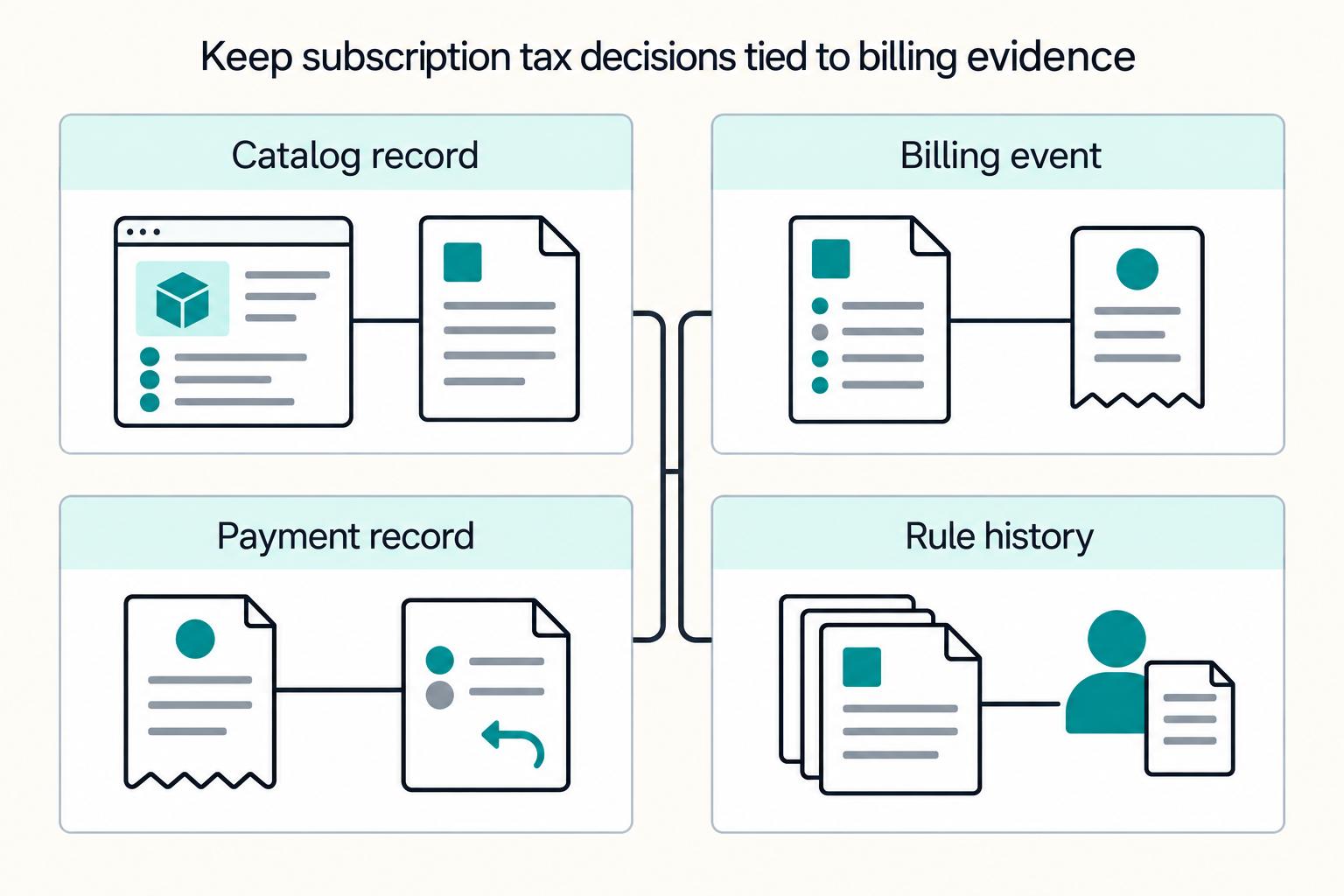
Quick Answer
Start by locking a market-level decision record before changing price or billing logic. For subscription sales tax compliance, recurring charges are not a separate tax class, so cadence alone does not create extra sales-tax treatment. Validate nexus with concrete inputs such as revenue by state, transaction counts, remote employee locations, and inventory footprint, then confirm offer classification and sourcing per jurisdiction. If any high-priority market remains unclear, pause launch and get specialist review.
How Sales Tax Applies to Recurring Digital Goods#
Subscription sales tax compliance starts as an operating decision before it becomes a filing task. If you sell digital subscriptions, getting the tax model wrong can create downstream problems in pricing, billing logic, and expansion plans.
Start by separating four decisions teams often blur together:
- Where do you need to register and collect?
- Is your specific offer taxable there?
- How should tax apply across recurring billing events?
- Do you run this in house or use a Merchant of Record (MoR) model?
One anchor matters from the start. Recurring charges are not a special tax class just because they recur. For sales tax purposes, subscription charges are treated like other one-time charges, and cadence alone does not add an extra layer of sales tax.
Nexus is an early checkpoint. In the US, obligations can come from economic nexus thresholds or physical nexus, and states do not structure thresholds the same way. Some use revenue-only thresholds. Others use transaction counts too, and some require both thresholds to be exceeded. One cited Georgia example is >$100,000 in revenue or 200 transactions, but that is an example, not a national rule. Physical footprint can also trigger obligations, including offices, remote employees, warehouses, or inventory stored in a state.
Before you change pricing or launch plans, run a quick verification check by market. Can you show evidence for your nexus position? Start with your revenue by state, your transaction counts by state, your remote employee locations, and your warehouse or inventory footprint. We treat that evidence pack as the minimum before a pricing change.
Product taxability is the second trap. Digital subscriptions are not always treated the same way, and offer structure can change treatment. California's guidance, for example, defines a digital-only newspaper subscription separately from a mixed print-plus-digital subscription. The practical takeaway is that tax treatment often follows the exact offer definition, not your internal shorthand.
Use this article to make four concrete calls: potential liability markets, offer classification, billing-event handling, and whether an MoR model fits your stage. Where answers are ambiguous, treat that as real risk and get business-specific review from a tax expert.
Build the mental model before you pick tools#
If your specs do not clearly separate nexus, taxability, and sourcing, pause implementation and fix the definitions first. A common failure mode is expecting one tool to answer all three questions.
| Concept | Primary question | Important limit |
|---|---|---|
| Nexus | Where you may need to register and collect | Does not by itself decide whether your subscription is taxable or what rate applies on an invoice |
| Taxability | How the jurisdiction treats your specific digital subscription offer | There is no single universal definition across states |
| Sourcing | Which location controls the tax result for a subscription transaction | Treatment is not uniform, and it gets unreliable when usable customer address data is missing or use spans multiple locations |
Nexus is the registration question#
Nexus is where you may need to register and collect, often shaped by economic and physical nexus rules. Treat it as a jurisdiction-entry decision only. It does not, by itself, decide whether your subscription is taxable or what rate applies on an invoice.
Use a separate status per market in your spec: nexus triggered, not triggered, or unclear - review needed. If finance cannot show evidence for the status, do not automate collection yet.
Taxability is the product question#
Taxability is about how that jurisdiction treats your specific digital subscription offer. There is no single universal definition across states. Some states do not tax digital products because they are intangible, while others treat intangible goods as taxable tangible property analogs. Even across the 24 Streamlined Sales Tax states, standardized definitions do not produce identical tax outcomes.
Do not rely on one catalog label like "SaaS" or "digital subscription" across every market. Classify using the exact customer-facing offer and what is included.
Sourcing is the location-and-rate question#
Sourcing determines which location controls the tax result for a subscription transaction. Many states use destination sourcing, but treatment is not uniform, and sourcing gets unreliable when you lack usable customer address data or when use spans multiple locations.
Model location-data requirements before you pick a tool. Keep nexus, taxability, and sourcing separate, or your billing logic, tax engine settings, and filing posture will drift apart.
Related reading: How to Set Up Automated Tax Collection for Your Subscription Platform: Avalara and TaxJar Integration.
Map where you are liable before you change pricing#
Before you change price, map liability by jurisdiction. If you price first, you can bake in tax assumptions before registration and collection obligations are clear, which creates pricing mistakes as you grow.
Keep United States sales tax, VAT, and edge regimes such as PST in separate lanes. They require different decision records, and one blended sheet can hide risk.
| Jurisdiction lane | What your map should track | Why it stays separate |
|---|---|---|
| United States sales tax | State, nexus status, trigger type, evidence, owner, next review date | State-level differences can change where you register, how you charge, and how you operate as you grow |
| VAT markets | Country, registration status, evidence, filing owner, review date | Keep this as a separate decision record from US state sales tax |
| PST and other edge regions | Province or region, separate registration assessment, evidence, local owner, review date | Keep this separate instead of forcing it into US state sales tax or general VAT logic |
What to put in the map. Do not stop at a yes or no field. For each market, track:
- Jurisdiction
- Regime type
- Nexus status: triggered, not triggered, or unclear
- Trigger category: economic nexus, physical nexus, or manual review
- Evidence note
- Internal owner
- Next review date
- Scenario flags
If a status has no evidence behind it, treat it as provisional. Undocumented assumptions are where pricing mistakes usually start.
A useful checkpoint is a state-by-state matrix with concrete fields, such as taxability plus rate fields like state rate, local rates, and combined rate. The exact columns can differ, but the discipline should be the same.
Track triggers, not just current status#
Track trigger categories in the same map, and assign each one a named owner and review cadence. Use both periodic reviews and event-based checks so new exposure does not sit unnoticed until filings are due.
Add scenario flags before expansion adds risk#
Expansion risk often shows up when operating conditions change. Treat material business changes as mandatory review flags, not automatic nexus conclusions. That keeps the process tied to jurisdiction-specific checks.
Also avoid a single national assumption for digital goods. States define digital goods differently, some still do not clearly define sales and use tax treatment, and even across the 24 Streamlined Sales Tax states, standardized definitions do not guarantee identical outcomes. That is why liability mapping should happen before pricing changes, not after.
Classify your offer correctly or your compliance math breaks#
If the offer model is wrong, the downstream math will be wrong too. Treat classification as a catalog design task first, because most tax tools can only apply the category you map to each offer.
Split the catalog into reviewable offer patterns#
Classify at the SKU level, not at a broad "we sell SaaS" level. Keep unlike items separate so your team can review them consistently. For each sellable item, keep a short record with:
- SKU code and customer-facing plan name
- What the buyer receives, for example access, content, support, setup, advisory, or a mix
- Whether it is standalone, an add-on, or bundled
- Billing shape: recurring, annual prepay, one-time, optional service layer
- Proposed category in Stripe Tax or Avalara (to be validated)
- Reviewer, review date, and open questions for priority markets
Treat ambiguous classifications as launch risk#
If an offer is ambiguous in a priority market, mark it high risk and consider specialist review before launch. This is a risk-management decision, not a taxable/non-taxable determination. A one-page internal memo is enough if it captures:
- Marketed offer language
- What is included
- Sample invoice lines
- Selected tool category
- Approver and date
Verify tax-tool mapping against live customer language#
Do not assume the selected category still matches the live catalog. Compare tool mappings to website copy, checkout labels, invoice line items, and contract or order-form language for the same SKU. Common red flags include:
- One generic category mapped to materially different offers
- Deprecated SKU codes still active in the tax tool
- Add-ons billed under a parent subscription line
- Customer-facing service language paired with a pure software category
Re-check fee assumptions before launch. This is also a margin-control step. Payment gateway fees can materially affect profitability, and the impact grows with transaction volume. If your model already absorbs costs like 2.9% + 30¢ domestic card fees, plus 1.5% for international cards and 1% for currency conversion where applicable, classification rework later can add operational churn and pressure unit economics.
Before launch, re-verify current provider fees and mappings. Published fees can change, and mappings can drift.
Related: How to Expand Your Subscription Platform to Europe: Payment Methods Tax and Compliance.
Set billing timing rules that match the law and your cashflow#
Write your billing-timing policy before you configure invoices, tax logic, or revenue reporting. If you cannot clearly state tax timing for monthly recurring billing, annual subscription plans, or prepaid subscription plans in a priority market, mark timing as unknown. Do not hard-code assumptions.
Define billing event types first, then map a reviewed tax position to each event by jurisdiction. At minimum, separate new sale, renewal, annual prepay, upgrade charge, downgrade credit, cancellation refund, and service credit, so product, finance, and support are working from the same event model.
Do not let cashflow choices silently become tax choices#
Annual and prepaid models change cash timing and can add adjustment complexity when customers cancel early or change tiers mid-cycle. Use annual prepay only when your billing stack can reconcile each adjustment back to the original invoice and tax record.
Run one end-to-end trace for an annual prepay through invoice creation, tax calculation, payment capture, cancellation, refund, and month-end reconciliation. If any step drops the original invoice ID or jurisdiction tag, treat that as a control failure.
Make prorations explicit, not implied#
Mid-cycle upgrades and downgrades can create avoidable exception work when billing logic and tax logic represent the same event differently. Set one house rule for proration representation and keep it consistent across plans.
Choose one method and enforce it:
- Separate debit and credit lines, or
- A single net line only if your tax tool, ERP, and refund reporting all interpret it the same way
Mixed methods by team or plan type increase exception-handling overhead.
Refunds need reason codes and evidence#
Refunds and credits need to be specific, not lumped into a generic "money back" action. Keep internal policy entries for full cancellation, partial refund, downgrade credit, duplicate charge, and service interruption credit.
Even without reading legal rules into them, named billing sections such as Lexington Section 8.4 "Credit for Service Interruption," Section 8.2 "Notification of Rates and Charges," and Section 7.4 "Late Payment" are a practical reminder to log credits, charges, and payment issues as separate events. For each refund or credit, keep a detailed record:
- original invoice number and invoice date
- event type and reason code
- affected service period
- tax amount originally charged and amount adjusted
- approver, approval date, and customer notice sent
If California is in scope, note that the CDTFA Business Taxes Law Guide Article 7 page (Revision 2026) lists Regulation 1584 "Membership Fees." That listing alone is not enough to determine treatment. Avoid improvised timing logic for membership-like offers without a reviewed position.
If you cannot produce this audit trail for refunds and prorations, keep the billing model simpler until automation is in place.
Fix location data quality before rate calculation#
If location data is weak, rate calculation can produce precise-looking errors. Strong compliance starts with sales tax sourcing rules, and those rules work best when customer location data is complete, current, and mapped to the correct jurisdiction.
Treat customer location as a controlled data object, not a billing-form byproduct. Keep one canonical record for place of use, normalized address output, effective date, and confidence level. If CRM, billing, and the tax engine store different address versions, your tax result can look precise and still be wrong.
Use sourcing before taxability when you evaluate a transaction. Washington's digital product rule is organized into 6 parts, and Part 4 asks whether the sale is sourced to Washington before later taxability steps. Wisconsin guidance also shows a concrete sourcing checkpoint tied to where the purchaser receives the product. Because the cited Wisconsin document is labeled proposed guidance, confirm final authority before encoding it into rules.
Do not let simplified location shortcuts become a silent fallback when address quality is weak. Washington also warns that its examples are only a general guide and that tax consequences must be determined after reviewing all facts and circumstances. In live samples, check what your provider received and returned: full address fields plus jurisdiction outcome.
When subscriber location changes are reported, use a tracked change process rather than an informal update. Capture the change date, old and new location, who confirmed it, and which invoice cycle should apply the new location. If the change cannot be tied to the next calculation, route it to review instead of auto-posting.
Consider an exception queue for low-confidence cases such as:
- missing street line or conflicting city and postal code
- normalization output that materially changes the entered address
- move requests without an effective date or support for the new location
Auto-processing these cases can create downstream correction work.
Should you use a Merchant of Record or keep tax in house#
This decision is mostly about control versus transfer. If reducing operational exposure and internal maintenance is the priority, a Merchant of Record (MoR) can be a de-risking path. If your edge is margin control, custom pricing logic, and full ownership of the payment experience, keeping tax in house can be a better fit.
A MoR is the legal entity that sells to the end customer, which can shift key obligations away from your team, including sales-tax collection, PCI compliance, refunds, and chargebacks. Keeping it in house leaves those obligations with your entity, so you need the payment and compliance infrastructure to run them reliably.
| Decision area | MoR | In house |
|---|---|---|
| Liability ownership | Provider can take key payment and tax-related liabilities as seller to the customer | Your entity keeps payment and tax responsibility |
| Implementation speed | Can reduce internal buildout when you want less payment/compliance maintenance | Usually requires more internal buildout because billing, tax, and payment operations stay with your team |
| Margin impact | Operationally simpler, but fee layers can reduce flexibility and margin | More direct margin control, but you absorb processing and operating costs |
| Customer experience control | Can trade some control for outsourced maintenance and liability handling | More control over pricing and billing behavior |
Where liability really sits#
Do not rely on branding or pricing pages to answer this. Confirm liability in the contract language. For any model, verify who is seller of record, who collects and remits taxes, who handles refunds and chargebacks, and who carries PCI responsibility.
Stripe Connect, for example, explicitly frames a tradeoff between offloading maintenance and taking full control of payments. That framing does not, by itself, settle tax liability in every jurisdiction.
The real cost question is margin, not just fees#
Fee design affects profitability, and the impact grows with transaction volume. Compare total economics, not a single headline rate.
| Fee item | Published amount | Applies when |
|---|---|---|
| Monthly active account | $2 per monthly active account | When the platform handles pricing in Stripe Connect |
| Payout sent | 0.25% + 25¢ per payout sent | When the platform handles pricing in Stripe Connect |
| Instant Payouts | 1% of payout volume | For Instant Payouts |
| Domestic card processing | 2.9% + 30¢ per successful transaction | Stripe standard domestic card pricing |
| Managed payments | 3.5% per successful transaction, in addition to standard processing fees | In managed payments setups |
When the platform handles pricing in Stripe Connect, published fees include $2 per monthly active account, 0.25% + 25¢ per payout sent, and 1% of payout volume for Instant Payouts. Stripe's standard domestic card pricing is listed at 2.9% + 30¢ per successful transaction. In managed payments setups, a 3.5% fee per successful transaction can apply in addition to standard processing fees. Country-level pricing can also override listed tables.
Use a transaction-level margin check before launch for your core plans. Include gross price, indirect tax, processing fees, payout fees if relevant, refunds, and chargeback assumptions.
In-house means tighter stack coordination#
In house gives you more control, but it also means your team owns coordination across billing, payment, and tax operations. That coordination has to stay reliable as transactions and refunds move through your systems.
If you keep this in house, assign clear owners for each handoff and reconcile billed tax, collected cash, and filing outputs.
A practical decision rule. Choose MoR when operational transfer matters more than end-to-end control. Keep it in house when custom commercial structure and experience control are core, and your team can own the integration and liability burden.
Before signing either model, verify:
- seller status, tax collection and remittance, refunds, chargebacks, and PCI responsibility in the contract
- market coverage for the countries and programs you actually plan to support
- data access and portability terms for transaction, tax detail, and customer records
For related context, see Gig Worker Tax Compliance at Scale: How Platforms Handle 1099s W-8s and DAC7 for 50000+ Contractors. If your matrix is leaning toward outsourcing liability and tax operations, review the Merchant of Record workflow against your in-house assumptions.
Build the operating system finance and product can actually run#
If you keep tax in house, make the operating model explicit: a shared sequence, clear owners, and controls that catch drift before filing. We recommend assigning one owner to each control so your team can see who approves changes, who tests the billing path, and who signs off on exceptions.
Use this as one control sequence for recurring billing: classify the offer, confirm nexus, calculate tax on the billing event, collect on the invoice, reconcile billed and paid amounts, file by jurisdiction, and retain supporting records. This is not a legal sequence. It is an operating sequence that helps keep filings traceable to catalog, customer location, and invoice data.
Start with the decisions that change the number#
Product taxability and nexus decisions are high-impact. If taxability for a plan, add-on, or bundle is unclear, automation just scales the wrong assumption. If economic nexus monitoring is loose, a jurisdiction can move from "monitor" to "collect" without anyone acting.
Taxability varies by state, and nexus determines whether you should be collecting at all. A common post-2018 benchmark is $100,000 in sales or 200 transactions, but treat that as typical, not universal. Review thresholds on a regular cadence, for example monthly, and trigger immediate review when operating changes like remote hiring could expand your nexus footprint.
Give each team one job that is clearly theirs#
Handoffs can become failure points. Assign one owner per decision type, with finance as final approver when filing exposure or collected cash is affected.
| Area | Primary owner | What they own | Checkpoint |
|---|---|---|---|
| Product taxability mapping | Product with finance approval | SKU definitions, bundles, add-ons, tax category intent | No new SKU launch until tax category is documented and approved |
| Nexus and threshold monitoring | Finance | Economic and physical nexus tracking by jurisdiction | Monthly sales review by jurisdiction, plus event-based review for hires and entity changes |
| Billing and collection logic | Rev ops | Invoice events, recurring timing, prorations, refunds | Sample invoice tests for monthly, annual, upgrade, downgrade, and refund cases |
| Filing and evidence retention | Finance | Return prep, jurisdiction detail, records archive | Reconcile filing totals back to invoice and payment data before submission |
If you run separate billing and tax systems, assign rev ops to own field mapping and finance to approve the mapping logic.
Make reconciliation detailed enough to survive an audit#
Your controls are only as strong as the reconciliation path from invoice totals to filed returns. Many jurisdictions require reporting below the state level, including county, city, and other local layers, and US complexity scales quickly across more than 14,000 taxing jurisdictions.
At minimum, monthly close should answer:
- Do billed tax totals by jurisdiction match collected cash, net of refunds and credits?
- Do filing reports tie back to invoice-level exports?
- Can you show what rule changed, who approved it, and which transactions were affected?
For internal control, keep change logs and approval records durable and simple. This gives you a clear history of tax-category changes, nexus-activation changes, and approvers.
Plan for drift between billing and tax providers#
Integrations can reduce manual work, but mappings can still drift as the catalog and billing logic evolve. Compliance platforms can connect billing, ecommerce, and ERP systems, apply rates, track nexus thresholds, and support return prep and filing, but they do not remove governance.
Use a standing exception review for five change types: new SKU, plan rename, bundle change, proration, and refund. For each, sample an invoice, confirm the mapped tax category and jurisdiction inputs, and compare billing-system tax results to tax-engine output. If results do not match, stop go-live until the mismatch is resolved.
Small errors compound over time. Liabilities and exposures accumulate, and even minor mistakes can turn into audits, penalties, and margin loss if exception handling is treated as cleanup instead of routine operations.
Handle lifecycle exceptions before they hit support and margin#
Lifecycle exceptions need their own controls, or your tax record can drift from your invoice record. Treat cancellation refunds, partial refunds, and credit reissues as distinct transaction types with separate approval and documentation requirements.
Separate refunds from credits in your policy#
Do not use one generic "adjustment" action for every post-sale issue. A cancelled subscription, a partial refund, and a forward-looking service credit can require different handling in your accounting and tax workflow.
Your policy should define which document is allowed for each case, who approves it, and what evidence is required before posting:
- original invoice ID and related refund or credit document ID
- reason code, for example cancellation, billing error, service issue, or misclassification
- amount changed before tax and after tax
- customer request or support record that triggered the adjustment
- approver name and timestamp
Use an audit-style checklist for consistency. CDTFA Audit Manual Chapter 2 includes a named verification item for refund claims, "Claim for Refund Comment" (0206.37), which is a practical model for what each file should clearly document.
Treat subscriber moves as tax-relevant events#
A subscriber move should trigger tax review, not just a CRM update. Define when a new address becomes effective, who verifies it, and how the next billing event is handled.
A practical control is to separate "profile address changed" from "tax location changed." If location changes mid-term, review the next invoice instead of rewriting prior records. Confirm the effective date, the billing address used after the change, and whether finance needs to review registration coverage. CDTFA Chapter 2 includes account-update checkpoints such as mailing address updates, which supports this operating posture.
Location changes can also intersect with nexus review. CDTFA separately lists "Retailer Engaged in Business (Nexus)" (0206.29), which is a useful checkpoint when corrections or rebills touch a new jurisdiction.
Build two dispute paths, not one#
Use one dispute path for billing mistakes and another for tax disputes. Support can route duplicate charges or arithmetic errors for standard adjustment, but cases involving taxability, sourcing, or retroactive correction should go to finance before a tax outcome is promised.
Keep the legal-research trail strict. If a decision relies on Federal Register material, verify it against an official edition or printed PDF. FederalRegister.gov says its XML rendition does not provide legal or judicial notice until officially sanctioned, and legal research should be verified against an official edition.
If an adjustment changes tax treatment, jurisdiction, or filing exposure, route it to finance before money moves.
For a step-by-step walkthrough, see FATCA and W-8 Tax Compliance for Platforms: When to Release, Hold, or Withhold Foreign Payouts.
Use a 90 day implementation checklist for clean rollout#
A clean rollout is mostly sequencing. Lock the core decisions first, configure second, then pressure-test before go-live.
| Window | Focus | Key actions |
|---|---|---|
| Days 1-30 | Lock core inputs | Finalize the product catalog and market coverage map, pricing rules, and a shared billing event taxonomy |
| Days 31-60 | Configure and test | Configure billing and payment logic after those inputs are stable, then test for repeatable outcomes across plan types and billing paths |
| Days 61-90 | Dry run and sign-off | Run dry-run reconciliations and finalize operational sign-off using a fixed sample set: new purchase, renewal, annual prepay, and refund or credit path |
Days 1-30#
Finalize the inputs your system will depend on later: your product catalog and market coverage map, your pricing rules, and a shared billing event taxonomy.
Document event names the same way across product, billing, and finance, for example monthly renewal, annual invoice, prepaid subscription plan, upgrade, and refund. If teams use different labels for the same SKU or event, mapping drift starts before configuration.
Days 31-60#
Configure your billing and payment logic only after those inputs are stable, then test for repeatable outcomes across plan types and billing paths.
Prioritize annual subscription plans and prepaid plans in testing. Also reconcile expected gross, fees, and net in your payment flows. Stripe's published pricing includes 2.9% + 30¢ for domestic cards, with additional +1.5% for international cards and +1% when currency conversion is required.
Days 61-90#
Run dry-run reconciliations and finalize operational sign-off for how transactions and exceptions are reviewed and documented before launch. Use a fixed sample set end to end: new purchase, renewal, annual prepay, and refund or credit path. If finance and legal cannot clear that sample set against your documented setup, delay go-live and fix the configuration first.
Verification checkpoint. Do not launch a market until sample invoices, fee calculations, and refund flows pass finance and legal review.
This pairs well with our guide on Government Subscription Billing Decisions for Public-Sector Platform Compliance.
Conclusion#
The right move is to define your tax operating model before expansion, not after. Your team should be able to show where you have sales tax nexus, where thresholds have been exceeded and registration is required, how each offer is treated for taxability by location, how recurring billing and prepaid plans are handled, and who owns registration, calculation, and filing.
This is ongoing work, not a one-time setup. In a recurring model, setup gaps can repeat across billing cycles and create recurring operational risk.
We recommend keeping one current decision record covering:
- nexus and registration status
- product taxability by offer type and location
- billing treatment for recurring charges and prepaid terms
- ownership for registration, calculation, filing, and exception handling
Before your next launch, verify that your billing system and tax calculation match that record. We recommend checking your invoice samples against your tax engine output before sign-off, because automated tax calculation tied to billing integration can support accurate, scalable compliance only when your tax logic and billing events stay aligned.
Next step: document your current model, rank the gaps by risk, and close the highest-risk issues before any new market, plan type, or major pricing change goes live. When you are ready to turn this plan into implementation tasks and controls, start in the Gruv docs.
Frequently Asked Questions
Are subscriptions taxable in every jurisdiction?
No. SaaS is not taxable in every state, and digital goods are not treated uniformly either. If you sell across states, do not assume one catalog decision applies everywhere.
Do I need to charge tax on every recurring billing cycle?
Not automatically. Whether tax applies on a renewal depends on nexus, product taxability, and the state’s sales tax sourcing rules. Because recurring billing can repeat tax-logic errors, review renewal logic as carefully as first purchases.
What actually triggers sales tax nexus in the United States?
The two core triggers are physical nexus and economic nexus. Physical presence can be as obvious as a warehouse or distribution center, while economic nexus can apply when sales cross a state threshold even without physical presence. Since the 2018 South Dakota v. Wayfair shift, threshold monitoring is a practical control for multistate sellers.
Why does recurring billing create more compliance risk than one-time sales?
Because each billing cycle repeats your tax logic. If tax category, sourcing, or rate mapping is wrong, recurring billing can turn that into a recurring source of sales tax risk instead of a single cleanup event. In multistate models, ongoing rule, rate, and boundary changes add to that exposure.
What should change when a subscriber moves to a new jurisdiction?
This guide does not provide a definitive relocation rulebook. At minimum, treat an address change as a trigger to re-check applicable sourcing rules before upcoming billing events.
Is ZIP code-based tax calculation reliable enough for subscription businesses?
Not by itself in complex states. ZIP code-based solutions rely on postal codes, but sales tax can vary at very fine geographic levels, so ZIP-only logic can create compliance issues.
When is Merchant of Record a better choice than managing tax in house?
Multistate recurring models can strain teams as rules, rates, and boundaries change, and connecting tax calculation to billing is presented as a scalability control.
Try a related tool
Researched and edited by the Gruv editorial team. Gruv builds cross-border billing, payouts, and finance-operations software for global businesses.
Sources
- app.leg.wa.gov/wac/default.aspxtrusted
- cdtfa.ca.gov/lawguides/vol1/sutr/sales-and-use-tax-regula...trusted
- cdtfa.ca.gov/lawguides/vol1/sutr/1590.htmltrusted
- docs.legis.wisconsin.gov/code/register/2020/771a1/register/guidance_d...trusted
- federalregister.gov/documents/2024/04/26/2024-07177/refunds-and-...trusted
- flsenate.gov/Committees/DownloadMeetingDocument/8352trusted
- irs.gov/irb/2025-08_IRBtrusted
- irs.gov/pub/irs-pdf/p1500.pdftrusted
Educational content only. Not legal, tax, or financial advice.
Related Posts

The Freelance Payment Penalty: A Modeled Audit of Platform Fees, FX Spreads, and Payout Delays
The money rarely disappears through a single, easy-to-spot fee. The real loss is stacked. A marketplace takes its commission, a processor adds a charge for international cards, a bank or payment company converts the currency at a spread, a platform holds the funds before release, and a wire sheds a little to intermediaries on the way in. Each layer looks defensible on its own, but the worker feels the combined result as a smaller deposit and a later payday.

How to Respond to a Subpoena for Business Records
Move fast, but do not produce records on instinct. If you need to **respond to a subpoena for business records**, your immediate job is to control deadlines, preserve records, and make any later production defensible.

A US Expat's Guide to Investing in UCITS ETFs to Avoid PFIC Issues
The real problem is a two-system conflict. U.S. tax treatment can punish the wrong fund choice, while local product-access constraints can block the funds you want to buy in the first place. For **us expat ucits etfs**, the practical question is not "Which product is best?" It is "What can I access, report, and keep doing every year without guessing?" Use this four-part filter before any trade: