
Quick Answer
Structure investor due diligence around three separate tracks: financial readiness, compliance readiness, and technical readiness, then back each claim with operating evidence. Build one evidence pack with architecture and data-flow maps, policies, logs, reconciliation samples, owners, and monitoring signals. Use it to test onboarding and KYC/AML workflows, trace money movement, assess vendor and privacy risk, and sequence rollout only where controls are already demonstrable.
What investors need to see in your compliance and tech stack#
Platform expansion is a go or no-go decision across financial durability, compliance-related readiness, and technical readiness. It is not a finance exercise with a technical appendix. If the business case is strong but the platform is brittle or insecure, investors will see execution risk.
Investor diligence now reaches beyond financials and legal paperwork. Technical due diligence helps investors understand technology strengths and weaknesses. It is a practical health check on whether your platform is reliable, secure, and ready to scale. That review should cover architecture, codebase, infrastructure, security, engineering processes, and team structure.
For founders and operators, the better question is not just, "Can we enter this market?" It is, "Can we enter with evidence that the business and technology will hold up?" If you skip that check, major problems can show up after investment decisions are already moving forward.
Before you start#
Use this minimum readiness checkpoint before market comparisons:
- Architecture and infrastructure are clearly mapped and current.
- Codebase, security, and engineering processes are reviewable and consistent.
- Team structure is clear for critical systems.
Expansion tends to expose issues that looked manageable at smaller scale, including outdated systems, security risks, and scalability limits. This guide is for teams deciding where to expand before locking product scope and go-to-market spend. The goal is to build a defensible expansion plan.
Market and implementation constraints may vary. Treat every recommendation here as a decision framework to validate against your current constraints and actual implementation.
Set the decision model before you compare markets#
Set the decision model before market debates start, so execution risk is visible before you commit. The goal is not a polished average score. It is to expose weak control ownership, weak compliance workflow design, and fragile architecture early.
Define the scorecard before you discuss opportunity#
Use separate tracks for financial readiness, compliance readiness, and technical readiness so one strong area cannot hide a weak one. Before you score anything, define the objective, timeline, and exact evaluation items for each market.
That prep is part of technical due diligence. It should surface investor risk across architecture, services, practices, roadmap, and IT staff. Without an explicit plan, important investor-risk checks can be missed.
| Lens | What you are testing | Minimum evidence to collect |
|---|---|---|
| Financial readiness | Whether the market can support launch assumptions and operating load | Revenue and margin assumptions, expected support and compliance effort |
| Compliance readiness | Whether onboarding and financial-crime controls are executable with clear ownership | KYC/AML process map, ownership model, escalation path |
| Technical readiness | Whether the platform can scale without major redesign or avoidable security risk | Current architecture view, dependencies, security controls, failure handling |
As a simple checkpoint, every scored item should have a named owner and review date.
Gate onboarding and financial-crime workflow before softer factors#
Before you score softer factors, confirm how onboarding and KYC/AML will run in practice in that market, who owns each step, and what happens when cases do not auto-clear.
| Workflow point | What to verify |
|---|---|
| Onboarding data collection and verification | Who collects and verifies onboarding data |
| Screening and monitoring | Who runs screening and monitoring steps |
| Exceptions and escalations | Who handles exceptions and escalations |
| Decision evidence | What evidence is retained for decisions |
| Fallback path | What fallback path exists if the primary system fails |
Treat onboarding and KYC/AML as one workflow, not separate handoffs. Splitting those steps across tools or owners creates artificial handoffs, slows closings, and blurs accountability when issues occur. Verify these points before advancing:
- Who collects and verifies onboarding data
- Who runs screening and monitoring steps
- Who handles exceptions and escalations
- What evidence is retained for decisions
- What fallback path exists if the primary system fails
Keep security and compliance exposure explicit in the decision#
Keep privacy, security, and compliance exposure visible instead of burying it inside a blended score. That makes operating-cost and control-risk tradeoffs easier to see.
Technical due diligence should include security controls and compliance standards. At minimum, verify encryption and authentication controls in the actual workflow, not only in policy documents. Weak security is not a theoretical concern. Breaches and regulatory penalties can raise costs and increase investor risk.
Narrow launch scope when control ownership is still unclear#
If key gates are still uncertain, narrow the first launch scope until ownership and evidence are clear and reviewable. A smaller initial scope can be safer than a wide rollout with unresolved control gaps.
End each market review with a short status note: proceed, hold until controls are added, or no-go for now. That keeps comparisons grounded in operating evidence instead of optimism.
For the full breakdown, read How to Generate Financial Reports for Investors from Your Gig Platform.
Prepare the evidence pack investors will actually ask for#
Build one evidence pack that shows how controls work in real operations, not just how they are described in policy. For every control claim, include the system or workflow behavior, the owner, and the monitoring signal. That pack can become the backbone of the market comparisons that follow.
Assemble one folder around real operating evidence#
Start with the artifacts that let a reviewer follow money, data, and decisions through your platform. If you already use architecture diagrams, data-flow maps, policy docs, and operating records, group them in one place and keep labels consistent across that folder.
If you tag sections to GDPR, CCPA, or AML/KYC/KYB topics, use those tags as organization labels rather than as proof that every legal requirement is fully met.
Add operations artifacts that prove traceability#
Prioritize records that show what happened in real cases, especially exceptions and reconciliations, not just policy intent. A practical check is request-to-ledger traceability. You should be able to connect the original request, any review or exception handling, the final decision, and the ledger outcome. If ownership is split or unclear, mark it directly as an open gap.
Include tax and reporting artifacts only where your flow touches them#
Include tax-documentation and reporting procedures only where relevant to the platform's actual payer and payee flows. Show who determines applicability, how exceptions are resolved, and where records are retained. Use redacted samples or a controlled walkthrough rather than placing raw personal tax forms in a broadly accessible data room.
| Artifact | Review question | Sharing control |
|---|---|---|
| Tax-document workflow | Who determines applicable forms, validation, withholding, and reporting? | Share procedures and redacted samples |
| Reconciliation sample | Can an event be linked to its posting and outcome? | Mask personal and account identifiers |
| Architecture evidence | Which controls and owners cover critical paths? | Use approved diagrams and restricted deeper review |
Individual taxpayer filings and personal tax exclusions are separate from platform payment-control evidence. Include them only if a specifically scoped service or diligence question requires that review.
Assign a data-room owner, permission tiers, a sharing log, and a retention or access-removal plan. Keep credentials and unnecessary personal records out of shared artifacts.
Tie every control claim to ownership and monitoring#
Close with a compact control index for each item: claim, evidence file, owner, and monitoring signal. Monitoring can be an alert, reconciliation review, queue, or exception count, but it should be recurring and reviewable. Any control with no owner or no live signal should be marked incomplete.
If you want a deeper dive, read What Investors Look For in Fintech Platform Due Diligence: Payment Infrastructure and Compliance Red Flags.
Filter markets by compliance fit before product buildout#
Use your evidence pack to rule markets out before product buildout. If a market depends on manual, poorly documented compliance work, treat that as a launch risk now, not a fix-later task.
Compare markets by execution load, not pitch quality#
Assess each country-vertical pair on four dimensions: process documentation quality, manual handoff risk, delay risk, and readiness for higher-risk case handling. The goal is operational fit, not a legal memo.
Ask the same questions every time:
- Does entry require new controls, partners, or a narrower scope in your current operating model?
- Will onboarding or review require evidence your current flow does not capture well?
- When alerts fire, is there a defined escalation path with an owner, or manual handoffs?
- For higher-risk cases, is the process documented with visible queue status, or ad hoc?
Tie each answer to artifacts you already run on, such as requirements, queue views, exception logs, and procedures. If feasibility exists only in slides and not in operating records, treat that market as not ready.
Classify each market as blocked, conditional, or expensive#
For your current setup, document how each market behaves under the privacy and compliance obligations relevant to your business. Use three statuses:
- Blocked today: launch depends on controls you do not have or cannot run consistently.
- Launch after controls: launch is possible only after defined control or process changes.
- Operationally expensive: launch is possible, but relies on heavy manual handling that will strain scale.
Keep those labels tied to current operations, not broad legal generalizations.
Stress-test higher-risk case handling against expected volume#
If higher-risk case handling is manual only and expected volume is high for your current team, delay that market or reduce launch scope. Manual handoffs, frequent delays, and weak process documentation are concrete warning signs in diligence.
Use two go or no-go checks:
- Queue visibility: you can see open cases, owners, and aging.
- Decision traceability: for a sampled case, you can follow intake -> review -> outcome.
If either check fails, classify as Launch after controls or Blocked today.
Force a sequencing decision in one table#
Capture each country-vertical pair in one status table so tradeoffs stay explicit across product, compliance, and investor review.
| Country | Vertical | Compliance workflow fit | Higher-risk case readiness | Status | Required change before launch |
|---|---|---|---|---|---|
| Illustrative market A | Contractor payouts | Release checks documented | Manual-review capacity untested | Launch after controls | Run a representative queue and recovery test; attach results |
A market is ready only when you can justify its status with current operating evidence, not planned future fixes.
Related: A Guide to Enhanced Due Diligence (EDD) in FinTech.
Map your money flow to concrete control points#
A market can look attractive on paper and still fail if the money flow is opaque. Your flow is ready for diligence only if you can trace how money moves, where controls apply, and who owns each decision using operating evidence, not memory.
Start by gathering the artifacts you already run on: a current architecture diagram, relevant system repositories and infrastructure configurations, security policies, uptime reports, a recent reconciliation sample, payout exception logs, and the org chart for payments, finance, and compliance. The goal is to map the workflows you cannot afford to break, then show visibility and audit trails across those workflows.
Draw the end-to-end path as state changes#
Map one transaction from collection to ledger posting, FX (if used), payout initiation, provider confirmation, and final completion or return. For each step, record:
- The event that changes state
- The source of truth
- The reference used to match records
- The team that owns review when the item stalls
Include non-happy paths in the same map. Mark where compliance or risk reviews in your process can pause or block progression, and include escalation branches where applicable.
A common diligence weakness is fragmented data across accounts, payments, FX, and spend. If evidence and status live in different systems, show how records connect back to the same transaction and the same customer or business profile.
Trace completed and exception payouts from request to outcome. Record manual steps and their owners; assess their capacity and error risk rather than treating every manual step as a failed control.
Assign ownership by module and tie it to documents#
Module labels alone are not enough. Resolve ownership from signed terms, provider documentation, internal procedures, and team responsibilities, then attach proof.
| Module | Questions to answer | Evidence to attach |
|---|---|---|
| MoR | Which team owns key checks and exception review before release or settlement? How are escalations handled? | Signed agreement, provider control summary, internal exception procedure, sample audit trail |
| VBAs | When does receipt become internal balance? Who matches incoming funds? How are unmatched receipts resolved? | Program terms, reconciliation notes, exception queue view, operations ownership map |
| Payouts | What must be true before release? Who reviews blocked cases and returns? Who monitors status changes after submission? | Processor docs, release criteria, payout exception log, sample status history |
Add async failure handling before calling the flow reliable#
Treat asynchronous events as first-class control points. For each async step, define the confirming event, expected state transition, matching key, and when the item routes to manual review.
Focus on duplicate and missing-event outcomes at posting boundaries. You should be able to explain how retries and exception handling are reviewed and documented.
A ready-for-review checkpoint is to walk through a known exception case and show the audit trail for the event, review, and outcome. If you cannot show this with current logs, queue views, and procedures, classify it as a control gap and sequence launch accordingly. Slow or inconsistent answers in diligence are often read as weak preparedness.
Stress-test the tech stack for investor-grade reliability#
Identify dependencies that can halt critical workflows. Assess exposure, contractual obligations, recovery options, and tested fallback behavior before deciding whether to redesign or narrow expansion.
Review the stack against real recovery points#
Start with inspectable evidence: source repos, infrastructure configurations, security policies, uptime reports, and the org chart for teams that own critical operations. Technical due diligence is an operational-risk review, not just a product review. Financial analysis alone will not show whether the platform is brittle.
Use the transaction map from the previous section to mark where reliability failures would break revenue or compliance, especially at system handoffs. You do not need a perfect benchmark, but you do need proof of behavior when inputs arrive late, confirmations are missing, or downstream status changes pause.
Validate this with one recent incident or near miss traced end to end: detection time, affected service, how teams identified blocked items, who intervened, and how integrity was confirmed. If that evidence lives in one engineer's memory instead of logs, tickets, and incident records, investors will read it as key-person risk.
Isolate SaaS concentration risk before it isolates your business#
SaaS dependencies become structural risk when they sit on multiple critical paths. Review each third-party dependency across critical workflows, then ask one question: if this vendor is degraded for a day, what stops?
Use a clear decision rule. If a single vendor disruption can halt multiple critical workflows, redesign before expansion. You do not need full multi-vendor redundancy everywhere right away, but you do need separation of the most critical dependencies or a documented, tested, owned fallback.
Surface shared dependencies across controls and decisions. Schedule the review around the number of critical paths, evidence availability, and reviewer access rather than adopting a generic diligence duration.
Test the evidence for privacy defensibility#
Reliability is not review-ready if it creates avoidable privacy exposure. Technical diligence should test inherited compliance exposure before closing, not just policy language.
Give reviewers concrete artifacts that show how privacy risk is managed in practice, including data flows, system ownership, and operational controls. If evidence is incomplete or purely narrative, your privacy posture is harder to defend.
Score the result and make the expansion call#
Score three dimensions together: scalability under stress, vendor dependency, and compliance exposure. If one fails, do not advance the market or module based on demand alone.
Make the recommendation explicit: ready now, ready after redesign, or not ready with the current stack. That is more credible than broad reliability claims.
For a step-by-step walkthrough, see How to Build a Finance Tech Stack for a Payment Platform: Accounts Payable, Billing, Treasury, and Reporting.
Model cost-to-operate with compliance overhead included#
Once reliability and vendor risk are mapped, price them directly into your operating model. If cloud and vendor fees are detailed but KYC/AML onboarding and exception handling sit in a vague headcount line, the margin case is probably overstated.
Separate build cost from operating cost before you compare markets#
Separate one-time implementation budget from recurring operations, with compliance labor visible in both where needed. Those planning buckets do not determine CAPEX treatment: capitalization depends on the applicable accounting framework and qualifying costs.
| Cost bucket | What belongs here | What teams often miss |
|---|---|---|
| One-time implementation budget | Initial integration, migration, testing, and tooling work | Whether the spend qualifies for capitalization under the accounting policy |
| Recurring operating budget | Cloud, subscriptions, maintenance, monitoring, support, and data-room administration | Ongoing upkeep and contract minimums |
| Compliance operations labor | Onboarding reviews, escalations, investigations, and quality checks | Staffing needed at forecast and stress volumes |
Be strict with fragmented tooling costs. Small invoices for disconnected tools can hide the larger drag: teams spending more time managing software than running core operations.
Quantify unit economics by market, not as one blended average#
Model unit economics by market and product path. Include verification effort, manual KYC/AML review effort, onboarding escalation effort, and support contacts tied to onboarding delays.
Use operating evidence, not just planning assumptions: case-review logs, onboarding exception logs, support tickets, and onboarding timestamps. Where data is thin, run a manual sample and document method changes in a version-controlled data room.
Model manual onboarding from your own completion times, review effort, and exception rates. Separate customer or payee onboarding from investor checks; their legal scope and workload are different.
Compare MoR-led launch and direct setup as workload scenarios#
If you are deciding between a Merchant of Record (MoR) path and direct setup, compare them as operating scenarios and validate each with evidence.
| Decision lens | MoR-led launch: what to verify | Direct setup: what to verify |
|---|---|---|
| Compliance ownership | Which onboarding and control steps stay with the provider vs your team | Which checks, escalations, and remediation you must run internally |
| Operations load | How exceptions, reviews, and support are routed and resolved | Team capacity for sustained KYC/AML onboarding and exception handling |
| Dependency profile | Where vendor process or tooling becomes a critical path | Where internal process maturity is still a bottleneck |
| Economics and speed | Actual launch and operating impact from your contracts and logs | Actual margin and throughput impact from your own operating data |
Avoid one-size-fits-all conclusions. Choose the path your current evidence can support.
Challenge the base case with a downside model#
Stress-test the model with higher manual-review volumes, more escalations, and heavier support demand. You do not need generic industry averages. You do need assumptions tied to inspectable records.
Use provider invoices, staffing plans, review throughput, exception logs, and onboarding-duration records in a version-controlled model. If a downside case exceeds team capacity or the agreed contribution target, narrow launch scope or fund the missing capacity before expanding.
Pressure-test your downside case and per-market assumptions before locking the rollout plan with the pricing calculator.
Choose the module rollout order that de-risks expansion#
Once the market and cost picture is clear, sequence modules by control maturity, not feature demand. Start with the path where controls are already observable, repeatable, and reconcilable.
Rank modules by what you can prove now#
Before phase one, verify from live records that you can show:
- end-to-end onboarding traceability from submission to approval or escalation
- payment-event-to-ledger reconciliation without manual stitching
- clear ownership and resolution paths for AML alerts and exceptions
- centralized exception logging with timestamps, not fragmented across tools
If a module still depends on siloed tools or manual handoffs, treat that as a sequencing risk, not a minor efficiency issue.
Pick first phase based on the real bottleneck#
- Consider a MoR-first phase when direct setup would expand control ownership before your evidence is stable.
- Prioritize VBAs and Payouts first when collection controls are already demonstrable but payout speed, traceability, and return handling are the constraint.
Neither sequence is universal. Choose the one that reduces early control sprawl in your current operating reality.
For custom payment flows, assess the applicable PCI scope and evidence requirements with the responsible compliance owner. Review deployed behavior and responsibilities; custom software does not create one universal automated-evidence requirement.
Define exit criteria before launch#
Set phase-exit criteria in advance and review them from records, not launch sentiment. At minimum, require:
- audit trail completeness
- stable exception-rate behavior
- onboarding turnaround that stays stable as volume rises
- real-time payment-flow visibility in line with continuous monitoring expectations, not point-in-time audit comfort
Tie each phase to a control question#
Each release should close a known control concern so the sequence is defensible:
| Phase | Control question |
|---|---|
| MoR phase | Is control ownership clear enough to enter without building every onboarding branch internally? |
| VBA phase | Can inbound funds be reconciled end to end with request-to-ledger traceability? |
| Payout phase | Can funds be released only after required checks, with failures and returns resolved clearly? |
This keeps rollout order evidence-backed instead of roadmap-led.
This pairs well with our guide on How to Choose a Tech Stack for Your SaaS Product.
Build the investor narrative around evidence not claims#
A good memo does not just sound confident. It lets a reviewer inspect the basis for every recommendation.
Standardize the market summary format#
Use one consistent structure per market so comparisons are fast. This is a comparability choice, not a claim that one format is universally required.
Point each claim to an approved artifact in the data room. Share diagrams, summaries, and redacted samples first; give qualified reviewers controlled access to code or configurations when justified. Never share credentials or unnecessary personal data as proof of completeness.
Translate controls into investor outcomes#
Do not stop at "the control exists." State what the control changes for an investor audience: risk reduced, timeline impact, and value implications.
Keep the mechanism explicit. For example, clear operating evidence and ownership documentation can reduce integration uncertainty in technical due diligence. A technology narrative can support valuation discussions when it is backed by execution evidence.
Disclose gaps early with mitigation timing#
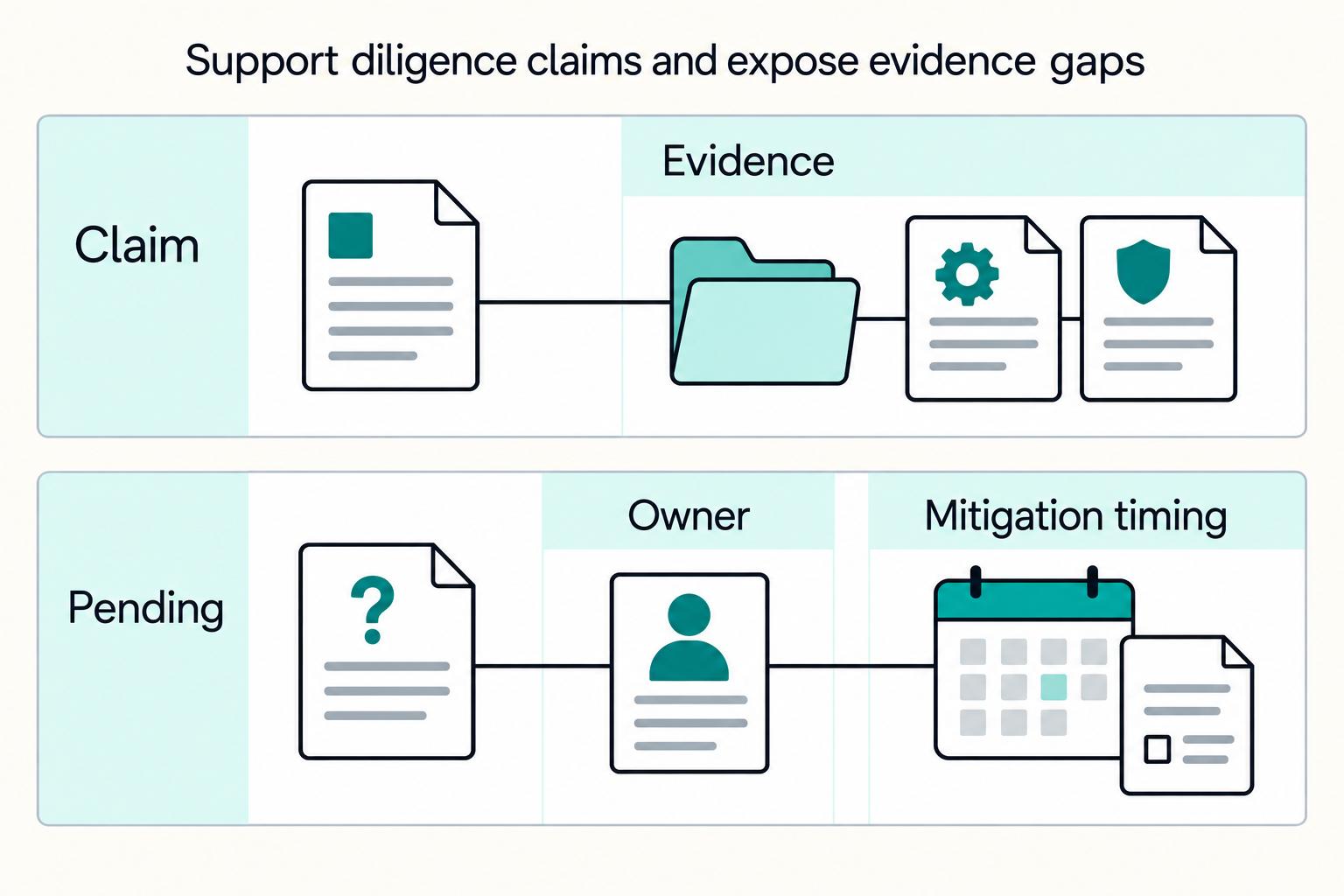
List known gaps early, along with owner and mitigation timing, so uncertainty is visible before conclusions. That is more credible than broad "fully covered" language.
Be explicit about evidence coverage too. Document review and expert input alone can leave key investment questions only partly tested. If your case depends on renewal risk, competitive moat, or growth durability, include an independent customer-evidence layer rather than presenting certainty you cannot support.
Spot no-go signals early and re-scope fast#
When control failures repeat, the right move is to cut scope early. Treat structural failures as expansion blockers, not temporary execution noise.
Classify compliance backlogs as blockers, not temporary noise#
Persistent compliance backlogs and unresolved alerts are scale-readiness signals, not just operational friction. They can indicate that compliance infrastructure is lagging growth, which raises regulatory, financial, and reputational risk.
Use a hard checkpoint: is the program adequately resourced and genuinely effective, not just documented? Review live case-management data, queue ownership, escalation paths, and staffing coverage by market or entity. If alerts are reopening, bouncing between teams, or sitting without a clear decision owner, treat that as a blocker.
Risk is higher in fragmented models. Decentralized structures can hide misconduct in silos, and weak sanctions screening in one acquired or newly added entity can expose the broader platform.
Escalate architecture red alerts before widening scope#
When transaction records are not reliably interpretable, expansion should pause. Treat unresolved traceability gaps and system incompatibilities as structural red alerts until control ownership is clear.
Validate with end-to-end transaction tracing across normal and exception flows: request, system response, ledger treatment, and reconciliation output. You need one canonical outcome per transaction and clear exception handling. If teams cannot agree on the system-of-record outcome for the same transaction, treat it as technical debt and control weakness.
Heavy technical debt, system incompatibility, and non-compliance belong in this same no-go bucket.
Trigger re-scope when privacy obligations conflict with the data model#
If applicable privacy obligations conflict with how your product stores, copies, or logs data, re-scope immediately. Do not treat that gap as a later legal cleanup.
Check actual behavior, not intended architecture. Compare diagrams and data-flow maps against logs, support exports, analytics events, and admin-tool fields. If sensitive data has spread into places it should not, or access is broader than the control design assumes, expansion is ahead of control maturity.
Shrink scope to the area with the strongest controls#
A common recovery path is narrower scope with active remediation, not a forced full rollout. Shrink geography for market-specific control strain, narrow vertical where privacy or risk concentration is the issue, or launch only the module with the strongest controls.
Use explicit decision rules tied to control readiness. If compliance handling is manual and backlogs are accumulating, delay the market driving that load. If sanctions screening is weak in an acquired or newly added entity, do not expand that entity's scope. If one area reconciles cleanly but another does not, release only where audit trails and exception handling are already stable.
Reopen blocked scope only with fresh operating evidence: cleared queues, named owners, updated data-flow maps, reconciliation outputs, and production proof that controls now hold.
Related reading: How to Launch a Legal Compliance Platform for Freelancers and Handle Their Payments.
Avoid common diligence mistakes and recover quickly#
After you re-scope around real blockers, protect that progress by replacing summary-level reassurance with operating evidence. Credibility drops fast when the narrative is clean but the underlying controls and failure handling are still unclear.
Tie every policy to operating evidence#
Policy text is not proof. In technical due diligence, reviewers look past charts and executive summaries and expect direct artifacts such as repositories, configuration records, security policies, uptime reports, and org ownership.
For each policy, attach three anchors: a clear owner, the system behavior that enforces it, and operating output that shows it is active. If a reviewer cannot move from a policy statement to concrete artifacts, you have documentation, not evidence.
Rebuild the diligence plan with compliance work included#
Poor diligence can leave compliance issues undiscovered until after closing. Make compliance review work explicit in the diligence plan, with named owners and clear follow-up steps.
Treat this as a structural part of diligence, not contingency. If known issues must remain open, flag that as downside risk before commitment rather than a base-case assumption.
Run drills before you widen scope#
Run controlled failure drills before expansion. Test realistic breakpoints, record who detects the issue, and confirm the team can recover stable operations.
This avoids false confidence from happy-path demos and executive summaries. Diligence is meant to surface issues, scalability limits, and business-alignment risk before commitment, not after.
Replace the single green score with hard gates#
Do not let one blended status hide a critical blocker. Use explicit no-go gates so unresolved compliance or data-handling issues can stop rollout even when an overall score looks positive.
Set review dates and evidence deadlines from the actual diligence scope. A market must not be marked ready while a defined critical blocker remains unresolved.
Conclusion and copy-paste checklist#
Use one decision rule across every market: if a material risk area is weak, treat it as a blocker until evidence closes the gap. Due diligence is a risk assessment, so rollout order should follow evidence quality and risk exposure, not the strongest growth narrative.
Apply one evaluation structure to each market#
Apply the same evaluation structure to each market and keep outputs comparable. Do not average away a materially weak area with stronger results elsewhere.
Build the evidence pack before launch sequencing#
Build an approved evidence pack before sequencing launch. Include financial and ownership records, liabilities, IP and litigation summaries, architecture decisions, performance evidence, and control owners. Use redacted samples and controlled access for sensitive code, configurations, and personal records; never include credentials.
Prioritize launch where control maturity is already demonstrated#
Prioritize launch where evidence of control maturity is already demonstrated and operating risk is bounded. If ownership or operating readiness is unclear, reduce scope before expanding.
Set no-go triggers before final launch decisions#
Set no-go triggers before final launch decisions. At minimum, pause when key evidence is missing, core diligence issues are unresolved, or concentration risk is high, for example, when a critical area has a bus factor of 1 and the responsible developer has already left.
Copy-paste checklist#
- Use one decision standard across all markets and keep evidence packages comparable
- Treat material weakness in any key area as a launch blocker until resolved
- Build an approved data room with financial and technical summaries, redacted samples, named owners, and controlled access to sensitive evidence
- Include core diligence records (obligations, liabilities, shareholder, IP, litigation)
- Sequence rollout by proven control maturity and bounded operating risk
- Define explicit no-go triggers before final launch calls
Once your checklist is complete, confirm market coverage and control-fit assumptions for your target launch order through contact.
Frequently Asked Questions
How should we structure investor due diligence for a platform business across multiple countries?
Use the same core diligence lenses in each market: financials, legal aspects, and the product's technical state. Tie claims to objective evidence so investors can verify that operating reality matches the deck. If one market still has unresolved legal or technical questions, flag it clearly instead of blending it into stronger markets.
What are the minimum checks before entering a new market with payments and payouts?
Start with the minimum diligence scope: legal items, financials, and the product's technical state. In practice, that means being ready to show core legal documentation, financial review materials, and technical evidence for how the product operates. A basic financial checkpoint is a current balance sheet showing assets and liabilities.
Which matters more in diligence, financial performance or technical and compliance readiness?
Neither should be treated as automatically more important. Diligence is meant to support an informed investment decision across the business, not a single dimension. Financial diligence tests accounts, cash flow, liabilities, revenue model, and forecasts, while technology diligence tests assets, risks, and strategic fit.
What technical red flags most often kill expansion plans after diligence starts?
A common red flag is a gap between operating reality and the story in the deck. Another is when answers become slow, vague, or inconsistent during follow-up, which weakens investor trust. A superficial technology review can also miss operational and regulatory risks that later damage the deal.
How do compliance obligations like GDPR, CCPA, and AML requirements change tech-stack decisions?
Specific obligations vary by market, but diligence still checks whether legal and compliance claims are reflected in real technical operations. Investors are not only reviewing policy language; they are checking whether the business matches its claims in practice. If that link is unclear, risk increases even when the product narrative sounds strong.
What should founders prepare before an investor asks for a technical and compliance review?
Prepare for a full-scope review: financial materials, legal documentation, and technical-state evidence. Include core financial artifacts such as balance-sheet data, plus clear technical documentation that reflects how the product actually runs. Speed and consistency matter, because diligence can take several weeks or even months.
Researched and edited by the Gruv editorial team. Gruv builds cross-border billing, payouts, and finance-operations software for global businesses.
Sources
Includes 1 external source outside the trusted-domain allowlist.
Educational content only. Not legal, tax, or financial advice.
Related Posts

The Freelance Payment Penalty: A Modeled Audit of Platform Fees, FX Spreads, and Payout Delays
The money rarely disappears through a single, easy-to-spot fee. The real loss is stacked. A marketplace takes its commission, a processor adds a charge for international cards, a bank or payment company converts the currency at a spread, a platform holds the funds before release, and a wire sheds a little to intermediaries on the way in. Each layer looks defensible on its own, but the worker feels the combined result as a smaller deposit and a later payday.

How to Respond to a Subpoena for Business Records
Move fast, but do not produce records on instinct. If you need to **respond to a subpoena for business records**, your immediate job is to control deadlines, preserve records, and make any later production defensible.
A US Expat's Guide to Investing in UCITS ETFs to Avoid PFIC Issues
The real problem is a two-system conflict. U.S. tax treatment can punish the wrong fund choice, while local product-access constraints can block the funds you want to buy in the first place. For **us expat ucits etfs**, the practical question is not "Which product is best?" It is "What can I access, report, and keep doing every year without guessing?" Use this four-part filter before any trade: