
Quick Answer
Classify each target market as launch now, launch with conditions, or defer before you allocate roadmap spend. The evidence has to show real operation: onboarding checks, KYC/KYB completion, transaction monitoring, and sanctions screening in live payment paths. Then test contract downside, dependency ownership, and unresolved exception handling against named owners. If legal scope is still unconfirmed in a jurisdiction, keep that market out of launch-now status.
What Investors Look for in Cross-Border Readiness#
Investors are more likely to back expansion when your operating controls can hold under stress, not just when the story sounds strong. In fintech platform due diligence, a key question is whether your payment infrastructure and compliance controls will still work when risk rises.
That matters most in payment and transfer models, where fast, high-volume, cross-border flows increase AML exposure. A market can look attractive, but if onboarding, monitoring, or sanctions controls are still unresolved at go-live, you are asking investors to absorb execution risk that should already be under control.
An early test is simple: can you show AML and KYC readiness with operating detail rather than presentation language? Investors, banking partners, and payment processors increasingly expect strong controls from the start. Weak onboarding, monitoring, and sanctions controls can hurt both partnerships and fundraising. A practical checkpoint is real-time sanctions screening for both customers and payment recipients.
This article uses one scorecard to classify each target market as launch now, launch with conditions, or defer based on operating evidence. The tool is meant to compare decisions consistently across payment infrastructure, compliance controls, technology durability, and concentration risk.
Use the sections ahead with one standard: unknowns are risks to price into the launch decision, not cleanup items for later. AML red flags indicate activity that may require deeper review, and higher-risk customers, transactions, or counterparties may require enhanced due diligence (EDD) beyond basic due diligence. When controls fail, the consequences can include fines and even loss of operating permission. One cited 2025 case involved Estonia's Money Laundering Data Bureau revoking an exchange operating license.
Start with clear red-flag tiers and shared definitions#
Start by aligning on terms, because inconsistent language breaks the scorecard before any real decision is made. In this diligence context, an AML red flag is a warning sign that requires closer review, not proof of criminality and not an automatic rejection.
| Tier | Definition |
|---|---|
| Blocker | No launch until the control gap or legal uncertainty is resolved |
| Conditional | Launch only with dated remediation and a named owner |
| Monitor | Accepted for now, but tracked in ongoing review with a next-check date and evidence trail |
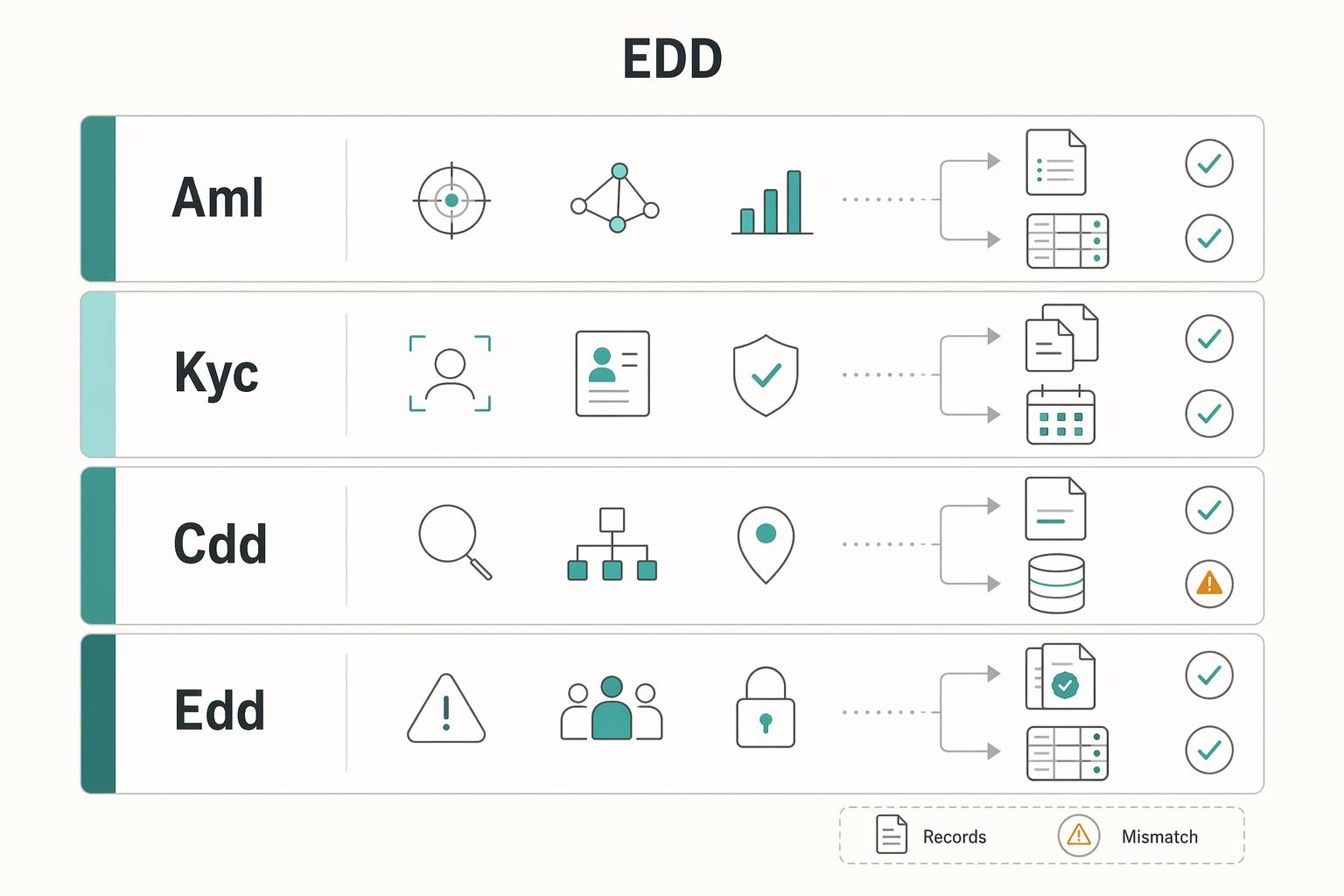
Define Enhanced Due Diligence (EDD) as the deeper review triggered by those warning signs. Apply that trigger consistently across your customer and business due-diligence workflows; in KYB, red flags can appear in onboarding, periodic review, and ongoing monitoring. Your process should also show how investigated suspicious cases are escalated for possible SAR reporting to the relevant FIU under the rules that apply to your program.
For enterprise-wide risk assessment and third-party risk management, do not assume everyone means the same thing. One standard definition is not provided here, so your diligence pack should document each term's scope, owner, and evidence location in one place. Then use the same three-tier labels above so every finding ties to a clear action.
Validate due-diligence expectations by jurisdiction and program before you commit roadmap spend. If a local requirement, review step, or partner expectation is still unclear, mark the market as conditional or defer it.
Build a market comparison scorecard before you allocate roadmap spend#
Build the scorecard before you allocate roadmap capacity. Otherwise, every market starts to look workable once launch pressure builds. Use one evidence-backed scorecard across all target markets so expansion decisions stay tied to operational review and risk management, not optimism.
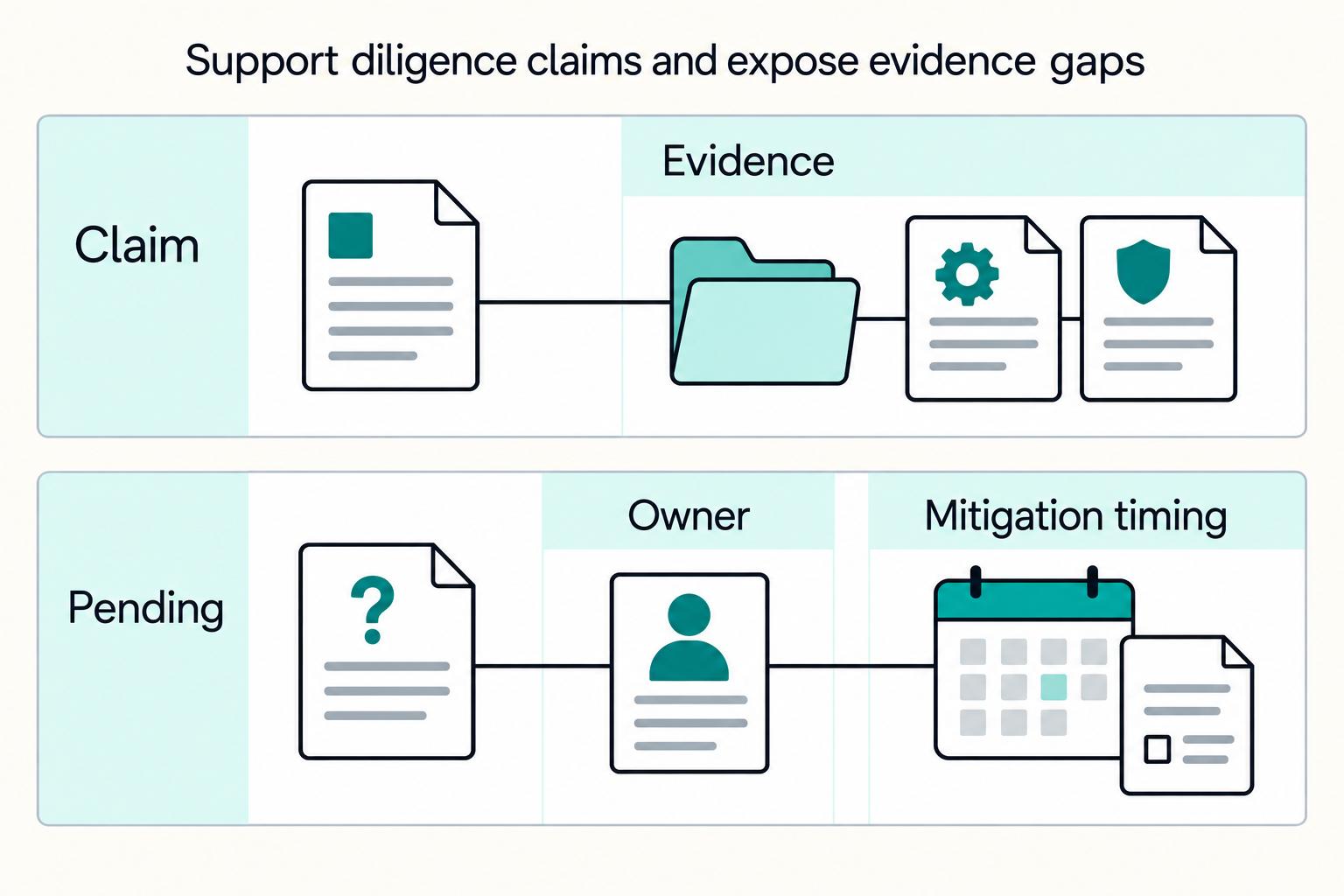
A scorecard should be a working decision tool, not a presentation artifact. If a rating depends on a vendor or partner promise, mark it as pending evidence instead of passing it.
Use one grid for all candidate markets#
Keep the same dimensions for every market so comparisons stay consistent. Require an owner and verification date for each rating.
| Target market | Control maturity | Payment rail reliability | Dependency concentration | Operational lift | Evidence fields |
|---|---|---|---|---|---|
| Market 1 | Rate against documented controls, ownership, testing cadence, and regulatory readiness | Rate against observed payout and settlement stability, incident visibility, and SLA performance | Rate against documented processor, banking, and vendor concentration and lock-in risk | Estimate product, compliance, ops, and support lift | Systems and logs, controls and data-flow artifacts, architecture/API notes, SLA terms, data portability terms, named owners |
| Market 2 | Same method | Same method | Same method | Same method | Same fields |
| Market 3 | Same method | Same method | Same method | Same method | Same fields |
| Program model constraint | Record how the model changes control ownership and partner dependencies | Record model-specific processor and banking dependency concentration | Record concentration and lock-in risk by model | Record onboarding, reporting, support, and finance burden by model | Contract owner, legal owner, unresolved dependency list |
Make evidence quality explicit#
Do not accept labels like "covered" or "compliant" on their own. Require operating evidence you can point to, including systems, logs, controls, data-flow artifacts, named owners, and what is still open.
For reliability scoring, include peak-period behavior such as payout or settlement windows and outage handling. Downtime risk in those windows should lower confidence until the evidence is complete.
Set internal decision rules before scoring#
Set the classification logic before market-by-market debate starts, then apply it consistently:
- Define what conditional means for your team and what proof is required to close it.
- Define what defer means for your team and what proof allows reassessment.
Add a proof required to close field for every conditional item so remediation stays specific and auditable.
Use program model as a risk lever#
Program model choice is not only a commercial decision. It should be part of execution-risk assessment. Base the judgment on documented ownership, dependencies, SLAs, and data portability evidence.
For a step-by-step walkthrough, see Prepare Your Payment Platform for Acquisition: Compliance, Technical, and Financial Readiness.
Validate compliance artifacts investors will ask for first#
Once the market scorecard is in place, the next diligence test is simple: can you show operating evidence quickly, or only policy intent? Package this section as evidence over slides so a reviewer can verify how controls are owned, tested, and maintained.
Start with the smallest packet that still proves control ownership#
Keep the first packet compact and operational. A practical first pass can include:
- your regulatory compliance posture materials
- clear owners for key controls and dependencies
- recent evidence that controls are reviewed or tested
- visibility into open issues and remediation progress
- third-party dependency coverage where vendors support compliance-critical workflows
The point is to connect each document to day-to-day operations, not just filing status.
Make "current" visible instead of implied#
A policy title alone is weak evidence. Investors look for signs that documentation is active, ownership is clear, and open gaps are managed rather than hidden.
Single-person ownership and missing documentation are major red flags. They increase execution risk when volume rises, a key person leaves, or a partner asks for proof on short notice. This is also where incidents, audit findings, and roadmap delays tend to surface later.
Use a simple readiness check: sample a few controls and trace each one end to end. You should be able to quickly find ownership, recent review evidence, and open remediation items without piecing it together across disconnected systems.
Add market-specific legal review where credit-like features create exposure#
If your product includes credit-like decisions, include a market-specific legal or compliance note that states what is confirmed and what is still pending. Do not imply full coverage when interpretation is unresolved.
Where automated decisioning is involved, be ready for questions on model documentation, bias testing, and explainability. If that evidence is not ready, mark the market accordingly instead of presenting a launch-ready narrative.
The standard is not perfection. It is whether a reviewer can quickly see that controls are real, owned, tested, and candid about what remains open. Related: What is a Politically Exposed Person (PEP)? A Compliance Guide.
Stress test payment operations before you promise launch dates#
Before you commit to launch dates, show that money movement still works under non-ideal operating conditions. If you cannot show how funds move, fail, and reconcile across real operating states, the launch plan is not yet operating evidence.
This is where operational and technical due diligence meet. Reviewers are testing whether your architecture, APIs, regulatory readiness, security operations, SLAs, and data portability can support the business plan without creating scaling or control gaps. Teams that optimize only for launch speed often discover those gaps when volume rises.
Put each payment path on one page#
Put each flow on one page so a reviewer can verify states, ownership, dependencies, and reconciliation records quickly. Do not frame any flow as a universal winner. Use the same diligence lens across flows; the matrix below is an internal documentation template, not an evidence-backed ranking of flow types.
| Flow option | What to document | Failure visibility to document | Reconciliation complexity to document | Launch-readiness risk if unresolved |
|---|---|---|---|---|
| Virtual Accounts | State transitions, owners, dependencies, and exception records | How state changes are detected, routed, and owned | How external references map to internal ledger records and unresolved items | Critical control or exception handling remains undefined |
| Card or checkout collection | Lifecycle states, owners, and exception records | How state changes and exceptions are surfaced and triaged | How provider outputs and internal records are matched | Critical handling for unresolved exceptions is still unclear |
| Scheduled payout batches | Batch lifecycle, owners, and exception records | How batch-level and line-level issues are surfaced | How batch and beneficiary records are matched and exceptions resolved | Key controls for unresolved exceptions are still unclear |
Use the blocker column as a practical readiness signal. Unresolved control and exception paths should be treated as launch risk, not cleanup work.
Document ugly states, not just the happy path#
A credible flow map includes failure states your design can produce, not just the ideal sequence. Document how you detect discrepancies, who owns resolution, and what closes each exception.
Be explicit about control mechanics. If your process includes replay or reconciliation steps, define ownership, decision points, and where unresolved items wait for review. Incomplete audit trails are a known diligence weakness because they usually point to process immaturity, not just documentation gaps.
A practical check is to trace sample cases end to end. Confirm that you can show the external event reference, internal state history, ledger impact, operator action (if any), and final customer-visible outcome.
Make compliance controls explicit in the operating flow#
Compliance controls should be visible in the operating flow, not only in policy documents. Show where onboarding checks, KYC/KYB, and transaction monitoring or entity-screening steps apply in your program.
The point is not to claim one universal legal order. It is to show that product state and compliance state are aligned, with documented risk assessments and integration into AML program controls. If any gate is manual, show timestamped ownership and approval evidence. Without that evidence, treat the flow as conditional.
Treat scale questions as launch questions#
A flow that works at current volume can still fail diligence if it cannot support growth. Test whether each path can handle materially higher load without creating reconciliation backlogs or exception queues your team cannot clear.
Investors care because weak scale tolerance can force rebuilds during growth, and platform instability can drive churn. Before committing to launch dates, require one evidence pack per flow: state map, exception handling, reconciliation proof, compliance-control map, and named owners. If critical control paths are still unknown, mark the flow as conditional and adjust rollout scope accordingly.
For a more detailed look at how investors review controls and architecture, see How to Structure Your Platform for Investor Due Diligence: Financial Compliance and Tech Stack.
Price downside in contracts before signing banks and processors#
If a bank or processor contract creates downside you cannot clearly bound, treat that as a potential launch-risk decision, not a legal cleanup item. In diligence, vague terms and unclear accountability are risk signals that can lead to repricing or heavier liability.
A flow can look operationally ready and still be economically fragile if contract risk shifts back to your team. Before signing, review downside clauses against operating proof, not just legal wording.
Find the clauses that can erase margin#
| Clause area | Why it matters | What to verify before signing |
|---|---|---|
| Compliance responsibility allocation | When contracts do not clearly define who handles what, gaps emerge | Which party owns identity verification, transaction monitoring, regulatory reporting, and incident response |
| Third-party oversight and protections | Dependency risk rises when oversight or protections are weak | How vendor oversight is performed, what protections are in the agreement, and who tracks compliance execution |
| Redundancy and disruption planning | Without redundancy planning, a dependency can become a single point of failure | What fallback options exist, when they are used, and who can activate them |
| Evidence and review cadence | Weak or vague terms are treated as a risk signal in diligence | What operating proof supports each obligation and whether regular reviews, including monthly when risk is changing, are scheduled |
The core check is not whether a clause exists. It is whether you can show who owns the obligation and how it is executed. If the agreement assumes identity verification, transaction monitoring, regulatory reporting, or incident response, assign each responsibility explicitly in the contract.
Map direct and downstream dependency ownership#
For each sponsor bank, processor, and critical API provider, assign internal owners for commercial, compliance, and incident coordination. If ownership is unclear, gaps are more likely to emerge when dependencies fail.
Also map material downstream dependencies that affect critical operations and data handling, and document fallback options where they exist. Without oversight, contractual protections, and redundancy planning, dependency risk can become a single point of failure.
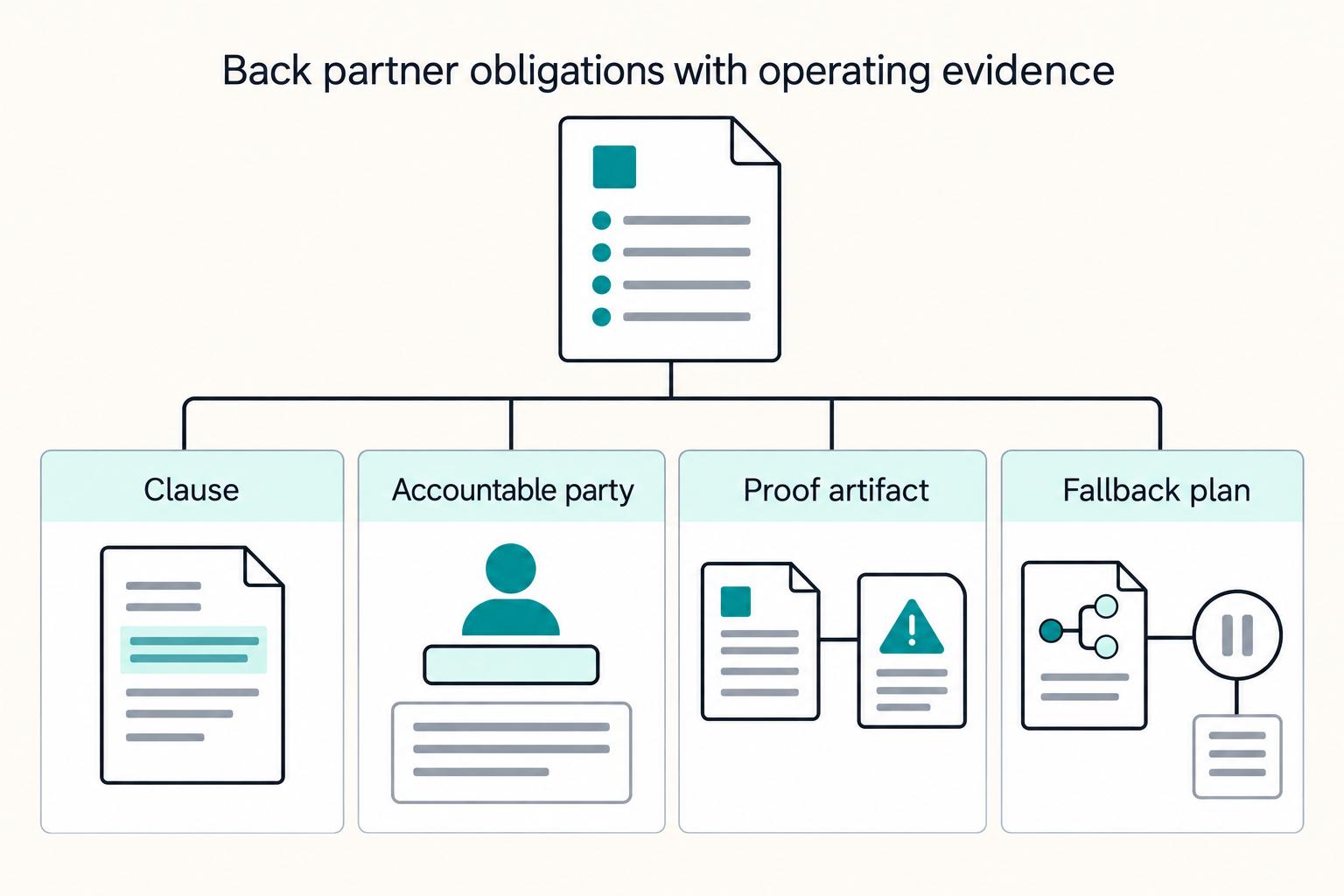
A practical artifact is a one-page risk map per relationship with clause reference, accountable party, proof artifact, and fallback action. Revisit it on a regular cadence, including monthly reviews when the relationship and risk profile are actively changing.
Tie contract promises to operating proof#
Do not leave incident obligations in legal prose alone. Link them to an incident response plan, named escalation owners, and evidence that the process can run under pressure.
Before launch commitments, a minimum evidence pack should include:
- Signed responsibility matrix for compliance and incident duties
- Incident response plan with partner notification path and decision owners
- Contingency plan for partner disruption
- Current proof for controls the contract assumes are already operating
If downside is broad and proof is thin, tighten scope or finish the controls before committing to launch promises.
If you are still building the operating layer behind these controls, see How to Build a Compliance Operations Team for a Scaling Payment Platform.
Test technology durability as part of diligence, not after launch#
If your stack cannot demonstrate scale tolerance, auditability, and incident readiness before go-live, treat expansion as conditional or defer it. Technical debt matters in diligence because it can turn a growth plan into execution risk once volume starts rising.
The core test is whether the technology can support the business plan, not whether the architecture looks current. Ask early: can the platform handle 10x current load while keeping payments and controls stable enough to operate with confidence? If that answer is unclear, diligence is not complete.
Look for debt that blocks scale, not just messy code#
Focus first on debt that stays hidden until volume rises. Hidden weaknesses can look acceptable in low-volume conditions, then fail under operational pressure. That failure mode is commercial, not cosmetic: instability can drive churn, and non-scalable architecture can force a rebuild during growth.
Treat aging or unsupported components as durability risk even when they are not causing today's incidents. If a critical dependency has no clear maintenance path, require a dated replacement plan and a named owner.
A practical checkpoint is tracing one payout from initiation to final state. If you cannot reconstruct key actions, screening and monitoring steps, status changes, and exception handling from system evidence, auditability is weak even when the payment succeeds.
Make compliance claims prove themselves in the stack#
Compliance claims should be accepted only when they are tied to operating evidence. Policies alone are not enough. Investors should be able to connect claims to controls, owners, systems, and production records.
If the company references AML readiness, ask for an evidence map that shows where controls operate and how teams run them day to day. For AML operations, that includes evidence around customer identity verification, transaction monitoring, regulatory reporting, and incident response responsibilities. Each claim should map to proof, not slideware.
A practical evidence pack usually includes:
- Current control list with named owners and linked proof artifacts
- Sample logs or audit records for onboarding, monitoring, incident handling, and regulatory reporting
- Open issues list with remediation dates for known control gaps
Demand a real incident response plan and test it#
Incident response is a diligence requirement, not a post-launch cleanup item. If contracts assign incident duties, require a production-ready plan and evidence that teams can execute it under pressure.
The plan should clearly name who leads incident response, who contacts bank or processor partners, who handles regulatory reporting, and how evidence is preserved. Sponsor-bank accountability for fintech partner actions makes unclear ownership a material risk. In U.S. operations, twenty states now have complete consumer data privacy laws, so generic response language is not enough for data events.
One red flag is a plan that lives only in security documentation and is disconnected from compliance and operations. Another is no continuity path if a banking partnership ends unexpectedly. Close those gaps explicitly, assign owners, and track open items in monthly compliance reviews until the response path is credible.
Quantify concentration risk before it becomes a board-level surprise#
Treat concentration risk as a go or no-go input now, not a note for later. Your diligence output should show where dependence sits, because partner and key-person concentration fail in different ways and need different mitigations.
Separate the exposures up front:
- Partner concentration: one sponsor bank or other compliance gatekeeper controls payment-rail access or other critical controls.
- Key-person concentration: one person is the only one who can deploy core changes.
Use a clear escalation trigger even without a fixed percentage threshold: escalate when a single external partner controls a critical compliance or payout pathway.
A practical checkpoint is cross-checking corporate records, financial health, and litigation or regulatory exposure, then checking that those records match operating reality. If records imply alternatives but operations depend on one partner, that is a control gap.
The common failure mode is learning too late that one person or one partner is the only way money moves. In one key-person case, the company spent eight months in crisis mode after that person left. Before you get comfortable, require credible mitigation evidence for continuity and control; if that evidence is not credible yet, classify the market as conditional or defer.
Set country-specific verification checkpoints and owner gates#
Do not treat market entry as portable. A country should move to launch now only when program-specific checks are evidenced and owned. If legal interpretation, tax handling, or reporting scope is still unconfirmed, mark it conditional or defer.
| Checkpoint | What to verify | Primary owner gate | If missing |
|---|---|---|---|
| Legal interpretation | The country and program model have been reviewed for actual obligations, not assumed from another market. For higher-risk entries, use deeper diligence with additional source verification and analysis. | Compliance | Do not mark launch-ready; unconfirmed legal scope is a defer trigger. |
| Compliance control readiness | Onboarding and monitoring controls fit the market: identity verification, risk-based assessment, ongoing monitoring, and regulatory adherence. | Compliance + Product | At most conditional until controls are mapped to the program and tested. |
| Payment route validation | Funding and payout routes work for this country and program, including exception handling, reconciliation, and critical provider dependencies. | Product + Finance Ops | Hold launch if the route only works in a happy-path demo. |
| Operational support coverage | Named coverage exists for manual review, escalations, returns, payout exceptions, and post-launch customer support. | Finance Ops + Product | Conditional if partial; defer if no one owns day-two operations. |
Tax artifacts are launch inputs, not year-end cleanup#
Tax and reporting readiness belongs in the country gate. For each program, confirm up front which tax details and reporting artifacts must be collected, and whether US information reporting such as Form 1099 could apply.
| Reporting context | Threshold | Article caveat |
|---|---|---|
| Many cases | $600 | Not portable across countries; matters only when the program actually creates IRS reporting obligations |
| Royalties | $10 | Not portable across countries; matters only when the program actually creates IRS reporting obligations |
| Calendar 2026 non-employee compensation reporting | $2,000 | Stated increase; not portable across countries and matters only when the program actually creates IRS reporting obligations |
Keep the evidence pack concrete: where collection happens in the product flow, how data is validated, where records are stored, who handles exceptions, and who owns filing dependencies. If the plan is "finance will handle it later," treat that as execution risk.
In US reporting context, Form 1099 covers certain non-salary income. Those figures are not portable across countries, and they matter only when the program actually creates IRS reporting obligations.
The common failure mode is manual collection at scale#
Manual tax data collection may hold at 100 payees, but it can fail at 5,000 partners. The problem often appears near filing deadlines, when missing or incorrect records are hardest to fix. That is why collecting and validating up front is a launch-readiness control, not admin cleanup.
Apply the same standard to compliance controls: policy text is not enough if execution depends on ad hoc manual detection. If suspicious transaction patterns or structuring are part of the risk profile, the country gate should show who reviews alerts and who can stop payouts.
Make sign-off explicit and dated#
Do not let "everyone agrees" replace ownership. Product signs route and product-gate readiness. Compliance signs legal interpretation and control sufficiency. Finance ops signs tax-document capture, reconciliation support, and reporting dependencies.
This aligns with a three-layer accountability model: first-line ownership in product and operations, second-line compliance oversight, and independent assurance where resourced. If any owner cannot sign because requirements are still unconfirmed, the market is not launch now. It is conditional or defer.
Use a pre-commit checklist before GTM or engineering spend#
Before you commit GTM or engineering spend, use a pre-commit checklist to confirm you have evidence strong enough to support a recommendation, not just momentum to start work.
| Checklist area | What to confirm |
|---|---|
| Legal and compliance evidence | Verify regulatory adherence, IP protections, and potential legal issues for the market and program in scope, with clear ownership for open items |
| Operational durability | Evaluate processes, IT systems, and scalability; ask for a system diagram and have the team explain the last cross-service change they shipped |
| Risk management ownership | Assess internal controls, insurance coverage, and crisis plans, and make sure responsibilities are explicit before expansion |
| Decision output | Compile findings, highlight risks, and document recommendations before committing further GTM or engineering resources |
The operational row deserves one extra stress test: ask for a system diagram and have the team explain the last cross-service change they shipped. If that coordination took more than a week, treat it as a coupling risk signal.
If a checklist item is still unsupported, treat that as a hold before GTM or engineering expansion. For a deeper breakdown of audit trail requirements, read Internal Payment Audit Trail for Platform Compliance.
Conclusion#
The strongest expansion case comes from sequencing, not from doing more diligence in the abstract. Verify what is real, test how it runs, confirm market scope, then decide.
Start by separating proof from narrative. Investors and partners expect strong AML and KYC controls from day one, and a practical checkpoint is whether onboarding flows, transaction monitoring, and sanctions screening are already operating. If those controls are not demonstrably live, compliance readiness is not a messaging gap. It is a go-to-market gap.
Then stress operations before committing to launch dates. In cross-border expansion, standards can overlap or conflict, so controls that work in one market may not transfer cleanly to another. The key question is whether your team can show the full operating path from onboarding through monitoring and sanctions screening, including what happens when cases escalate to Enhanced Due Diligence (EDD).
Treat partner and program coverage differences as a primary decision input. If a provider supports only part of the flow or may apply different requirements by jurisdiction, confirm exact scope before committing engineering or GTM resources.
- Verify evidence that core controls are operational.
- Pressure-test payment operations and exception handling, including EDD escalations.
- Confirm partner and program scope for each target jurisdiction.
- Make a market decision based on confirmed readiness, remediable gaps, and open unknowns.
Weak controls do not just slow execution. They can damage fundraising and partner onboarding, and checklist-style compliance can lead to penalties, reputational damage, or product pullbacks. A defensible expansion plan is built on evidence that holds up under review, market by market.
Related reading: Building Payment Infrastructure In-House: Engineering, Compliance, and Maintenance Costs.
If any target market still has unresolved conditions, pressure-test coverage, compliance gates, and operational ownership with Gruv in a scoped planning review.
Frequently Asked Questions
What red flags do investors check first in fintech platform due diligence?
The first red flags are usually weak AML and KYC readiness and unclear compliance ownership. Missing onboarding controls, weak sanctions screening, and no ongoing transaction monitoring are common confidence breakers in diligence. If your model depends on fast, high-volume, cross-border payments, expect tighter scrutiny because that pattern carries higher AML risk.
Which compliance artifacts must be current before an investor diligence process starts?
This guide does not provide a universal artifact checklist, but it consistently points to current, operational AML and KYC evidence. In practice, that means a named compliance owner and clear proof that CDD, ongoing transaction monitoring, sanctions screening, and FIU reporting, including SARs and STRs, are handled in day-to-day operations. Where required, retention practices such as 5+ year recordkeeping should also be demonstrable.
How should founders evaluate payment infrastructure risk before entering a new country?
Start by verifying that core controls work in the actual payment flow, not just in policy documents. Confirm onboarding controls, ongoing monitoring, and real-time sanctions screening for both customers and recipients. If these controls are incomplete or only partly operational, treat market entry as conditional until the gaps are closed.
What contract terms usually signal dangerous fraud-loss exposure?
Treat fraud-loss contract terms as a diligence gap rather than making assumptions from generic benchmarks. The practical test is whether your team can clearly map each obligation to an owner, an operating process, and evidence you can produce under review.
How do technical debt and end-of-life systems change valuation or deal terms?
Technical debt can increase execution and reliability risk, which can harden diligence outcomes even when growth looks strong. Common warning signs include slower feature delivery, weaker performance under load, and dependence on one senior engineer with thin documentation or backup. In one cited case, cleanup was estimated at 12-18 months just to reach a maintainable state.
What should ongoing third-party and fourth-party monitoring include after launch?
There's no full third-party or fourth-party monitoring framework to point to, so avoid over-claiming precision. At minimum, keep clear ownership and current evidence for partner-dependent controls such as onboarding, sanctions screening, transaction monitoring, and reporting obligations. Keep that evidence current enough to show those controls still operate as intended when dependencies or transaction patterns change.
Try a related tool
Researched and edited by the Gruv editorial team. Gruv builds cross-border billing, payouts, and finance-operations software for global businesses.
Sources
Includes 6 external sources outside the trusted-domain allowlist.
- clame.nyu.edu/index.jsp/E08C82/312399/VentureCapitalDueDil...trusted
- law.duke.edu/sites/default/files/conferences/compliance/P...trusted
- antonioangelino.com/leadership-insights/technical-due-diligence-...external
- arthatech.net/blog-fintech-compliance-mistakes-avoidexternal
- bpm.com/insights/fintech-regulatory-challengesexternal
- cambridge.org/core/elements/fintech-regulation-in-the-unit...external
- dashdevs.com/blog/core-banking-vendor-due-diligence-check...external
- dilisense.com/en/insights/aml-compliance-for-fintechsexternal
Educational content only. Not legal, tax, or financial advice.
Related Posts
Enhanced Due Diligence in FinTech That Holds Up Under Real Case Volume
For a lean team, practical Enhanced Due Diligence (EDD) is what tends to survive weekly volume. The goal is not bigger files. The goal is repeatable judgment that the next analyst can read and defend without guessing what happened.

What Is a Politically Exposed Person and How to Decide Next Steps
Use this guide to make one clear onboarding call each time: proceed with standard checks or escalate before funds move. The goal is simple: cleaner onboarding, fewer payout surprises, and AML records you can defend later.
How to Structure Your Platform for Investor Due Diligence: Financial Compliance and Tech Stack
Platform expansion is a go or no-go decision across financial durability, compliance-related readiness, and technical readiness. It is not a finance exercise with a technical appendix. If the business case is strong but the platform is brittle or insecure, investors will see execution risk.