
Quick Answer
Define the product workflows, required controls and operating owners, then compare two complete candidate stacks. Apply hard requirements before weighted scores. Include a transactional database, authentication, durable background work, hosting, backups and observability; prove safe payment recovery and tenant access before launch.
Choose a stack your team can build, operate and reconcile#
Start with the SaaS workflow and the failures your customers cannot afford. Then compare complete stacks your team can operate: application framework, database, authentication, background processing, hosting and observability. A frontend and a runtime alone do not explain how payments, access or data recovery will work.
For a solo builder, the choice includes who responds to a failed job, restores data and reconciles a payment. Record those responsibilities with the technology decision. The aim is a workable first release and a clear reason to change it later.
A business-first architecture decision starts with goals, not tools. Do not open with React versus Vue, or Node.js versus Python. Start with the business outcome you must protect, then choose the stack and software architecture that can reliably produce it.
Compare release effort and continuing operating cost together. A familiar framework may save development time, but unsupported dependencies, manual recovery or unreliable payment state can make it expensive to run.
Define business constraints first. Write what must work on day one, including core workflows, failure tolerance, and known compliance duties.
Verification point: you can justify each requirement in plain language without naming a framework.
Build a shortlist, not a favorite. Keep two realistic candidates that fit your current SaaS development skills, such as React with Node.js or Python with Django.
Verification point: each candidate earns its place with a specific business reason.
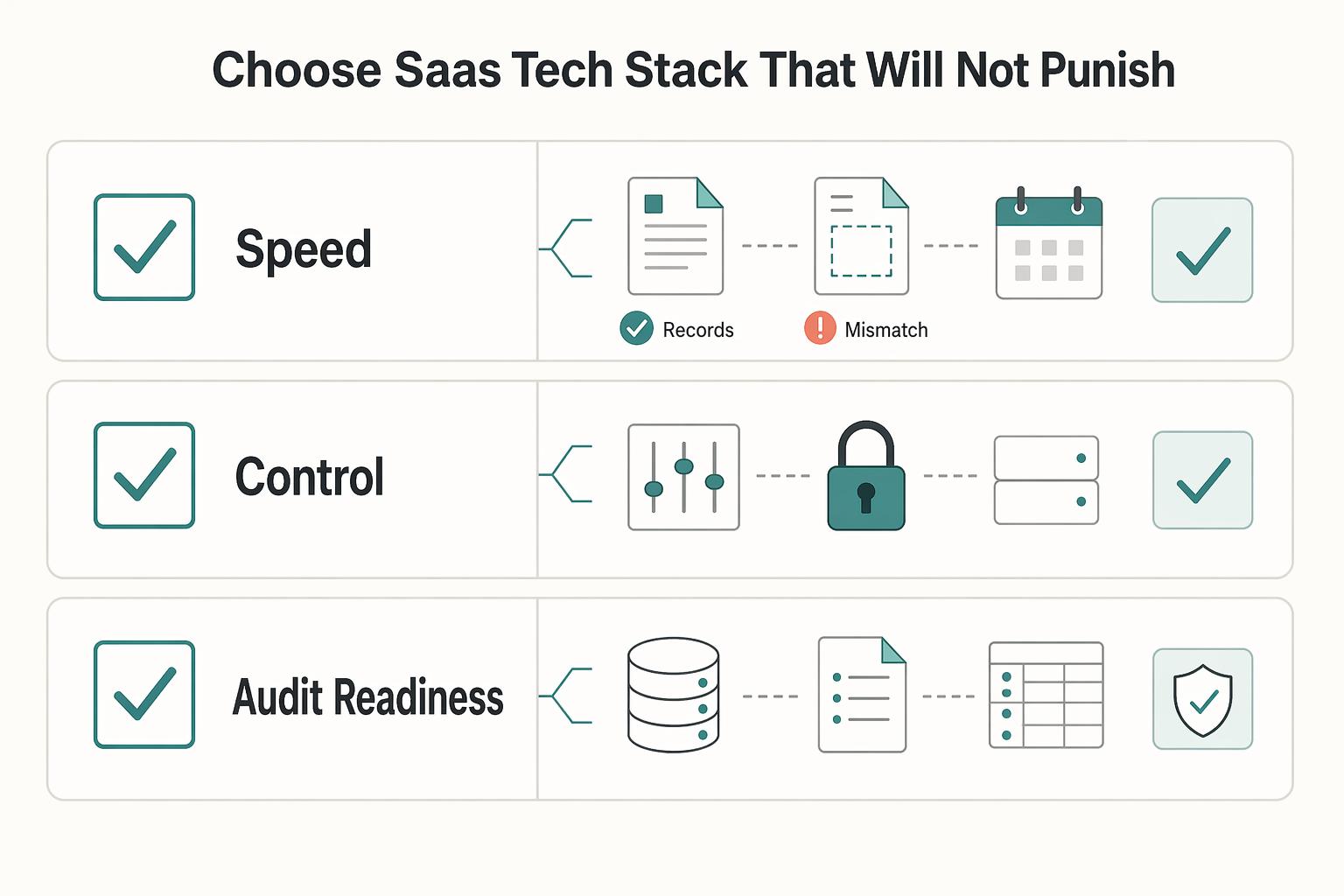
Set go or no-go gates. Score each option for release speed, operational control, and audit traceability before debating polish.
Verification point: one option passes all gates with your current team.
Lock an implementation checklist. Decide what you build now, what you defer, and what conditions would justify a future stack change.
Verification point: your next sprint backlog reflects the decision.
| Decision lens | Key question | Pass signal |
|---|---|---|
| Speed | Can we ship a reliable first release quickly? | Team can execute with current skills |
| Control | Can we debug and change core flows fast? | Clear ownership and maintainable paths |
| Audit readiness | Can we explain critical flow history clearly? | Traceable events and review-ready records |
Prepare the operating inputs#
Prepare an operating brief, team capability map, applicable control requirements and launch boundaries. For each requirement, identify a product workflow, an owner and the evidence that would show it works. Separate mandatory launch requirements from features you can defer.
Write a one-page operating brief. Capture your SaaS model, core workflows, and where money moves through your API, Ledger, and user-facing flows. Include functional goals plus nonfunctional requirements like availability, latency, and expected scale, because those requirements shape software architecture.
Verification point: every major component maps to a clear business need.
Document team reality. List current strengths across your core frontend, backend, and operations stack. Then mark hiring risk for skills you do not have yet. If you pick a stack your team cannot run, manual workarounds creep in and usually fail as volume and complexity grow.
Verification point: your preferred stack matches operators you already have.
Define compliance and data handling gates. Identify where AML/CFT and related verification checks apply, and where they do not. If your model sits inside covered financial institution requirements, include beneficial-owner verification for legal entity customers in your design gates. Add tax-document handling paths for W-8 BEN and W-9 only where those forms belong in the flow.
Verification point: each control maps to a product step and a clear owner.
Set launch boundaries and deferrable decisions. Decide whether you need a Merchant of Record at launch and whether Payout Batches can wait. If payouts matter to early cash flow, plan for providers that may schedule an initial payout after a delay. If batching is in scope, require architecture that can handle large payout batches with audit visibility.
Verification point: you can name what ships now, what waits, and what trigger moves an item forward.
| Prep artifact | Why it matters | Go decision signal |
|---|---|---|
| Operating brief | Anchors decisions to business outcomes | Must-have flows and constraints are explicit |
| Team capability map | Protects operability in real SaaS development | Current team can build and run it |
| Compliance gates | Reduces avoidable regulatory surprises | Required checks appear in system design |
| Launch boundary plan | Prevents premature complexity | Phase scope and deferral triggers are clear |
For the database, require transactions, uniqueness constraints and a documented backup/restore path. Store money as integer minor units or an appropriate exact decimal representation with currency; avoid binary floating-point balance arithmetic. For a ledger, validate balanced postings and append corrections or reversals with references instead of silently overwriting financial history. Define which service owns each record and how a database update reliably reaches the background worker.
Define complete candidate stacks#
Use a modular monolith as a candidate for an early product when one team owns the workflows and can deploy them together. Keep billing, identity, customer data and background jobs behind clear internal interfaces. Separate services when a measured scaling, isolation or ownership need justifies the additional failure modes and operations.
Set migration triggers from observed constraints: for example, sustained queue delay beyond your chosen service target, contention in a specific database workload, or an independently owned module needing separate deployment. Revenue or user count alone does not establish the required architecture.
Set a stage rule. Define what your business needs right now, then choose a monolith-first baseline for this phase. A monolith-first approach lowers early architecture risk and keeps delivery focused.
Verification point: you can name the exact event that would force a change, such as sustained performance pressure, team growth, or a new product surface.
Define two complete candidates. For a Python-skilled team, consider Django with MySQL using a transactional engine, server-rendered pages or a required frontend, and a background worker. For a JavaScript-skilled team, consider React or Vue with a Node.js application framework, a transactional relational database and a worker. Specify authentication, hosting, backup and monitoring for both; Node.js is a runtime, not a full backend framework.
Verification point: each candidate maps to your required workflows and your current operator skill set.
Score for speed and operability. Score each stack on speed to first release, maintainability, CI/CD readiness, and day-to-day DevOps burden. Use staffing risk as a real input, not a hand-wave about popularity.
Verification point: the winning stack supports automated build-and-test workflows for your chosen language and fits your hiring reality. If you need a checklist, use A Guide to Continuous Integration and Continuous Deployment (CI/CD) for SaaS.
Run a durability check. Treat your API as a contract. Confirm the same core contracts can support your next product surface, and evolve backward-compatible changes with disciplined versioning.
Verification point: existing clients should keep working when you ship incremental, backward-compatible changes.
| Candidate | Application and data | Background and deployment | Selection evidence |
|---|---|---|---|
| Python-oriented modular monolith | Django, MySQL/InnoDB, and templates or an optional frontend where the UI needs it. | Durable job processing, managed database backups, application hosting and metrics with named owners. | Good candidate when the team can maintain Django conventions and operate the database and worker. |
| JavaScript-oriented modular monolith | React or Vue, a selected Node.js backend framework and a transactional relational database. | Durable job processing, managed database backups, application hosting and metrics with named owners. | Good candidate when the team can maintain its chosen framework, data layer and worker as one coherent system. |
Score tradeoffs and hard requirements#
Use hard requirements before weighted preferences. Reject a candidate that cannot protect tenant boundaries, recover data or safely process money. Then score the options that pass for delivery effort, operability, reliability, security, performance and total operating cost. A high frontend score cannot offset a missing financial control.
A rubric that reflects real operating risk#
| Decision item | What to compare | Pass signal |
|---|---|---|
| React vs Vue | Written pros, limits, and staffing implications for the current team | Clear reason tied to product and software architecture constraints |
| Node.js vs Python | Written pros, limits, and staffing implications for the current team | Clear reason tied to product and software architecture constraints |
| Webhooks | Support for event-driven webhooks and retry behavior before launch | Handles asynchronous events and retry flows while reducing duplicate business outcomes |
| Idempotency | A stable business-operation ID, atomic local uniqueness and a defined provider retry window. | A timeout or concurrent retry does not create another charge, payout or ledger posting. |
| Reconciliation visibility | Trace status from event intake to reconciliation views, including payout-batch level views when relevant | Team can distinguish provider state, internal ledger state and bank settlement, and investigate differences. |
Set weighted categories. Score each candidate across frontend, backend, database, deployment, and security, then map those scores to your architecture pillars: operational excellence, security, reliability, performance efficiency, cost optimization, and sustainability.
An illustrative weighting is team/delivery fit 30%, operability 25%, reliability 20%, security 15% and cost 10%. On a 1–5 scale, candidate A scoring 5,4,4,4,3 totals 4.20; candidate B scoring 3,3,5,4,4 totals 3.65. These are example judgments, not framework benchmarks. Set your own weights, write the evidence behind every score and test whether a small change in priorities reverses the decision.
Force explicit framework tradeoffs. Compare React versus Vue and Node.js versus Python side by side, with written pros, limits, and staffing implications for your current team.
Verification point: each choice has a clear reason tied to your product and software architecture constraints.
Add integration and operations criteria. Score support for event-driven Webhooks, and test retry behavior before launch. Include Idempotency as a scoring item. Idempotent means repeated identical requests should have the same intended effect.
For the selected design, specify provider signatures, durable event intake, a worker, a retry policy and a failure queue with an owner. Check duplicate and concurrent requests as well as a happy-path payment. Missing or delayed events need a recovery route through provider queries and reconciliation.
Score reconciliation visibility. Require evidence that finance and ops users can trace status from event intake to reconciliation views, including payout-batch level views when relevant.
Use separate identifiers for the internal operation, provider object, webhook event and settlement batch. Display observed status with its source and time. A ledger is your recorded account of movements; it must be reconciled to provider and bank evidence rather than treated as infallible truth because it is internal.
Check who operates each component#
Name who patches dependencies, rotates secrets, watches job failures and restores the database. Include hosting, backups, log storage, payment integration charges and operator time in the cost comparison. Keep alerts and recovery instructions simple enough that the available team can use them during an incident.
| Rubric area | What to ask | Pass signal |
|---|---|---|
| Frontend and backend fit | Can this team ship in our current SaaS development cycle? | Team can deliver without new specialist hires |
| Integration reliability | Do API contracts, webhooks, and retries stay predictable? | Stable contracts and clear retry handling |
| Operability | Can ops and finance trace issues fast? | Transaction and payout reconciliation stay visible |
| Team readiness | Can we run this stack every day without heroics? | Build and run ownership is clear |
Map applicable controls and evidence#
Determine the duties for the actual business model and partner program before turning them into software rules. Selling a SaaS subscription does not itself make every product a covered financial institution. For money movement, identify which checks the regulated provider performs and which decisions or records your product must support.
| Item | Flow or trigger | Rule or artifact |
|---|---|---|
| KYC | Identity checks required by the actual jurisdiction or provider program. | Record the decision, review owner and action it authorizes; block only the action requiring clearance. |
| KYB | Business verification required for the relevant customer and program. | Track business and ownership evidence with appropriately restricted access. |
| AML | Applicable monitoring, review or release decision. | Record the action taken, responsible reviewer and required escalation; not every alert means a universal freeze. |
| Beneficial-owner verification | Covered U.S. financial institution contexts for legal-entity customers | Apply current covered-institution rules and exceptions; FinCEN’s February 2026 relief changes repeat-account-opening verification circumstances. |
| W-9 | Payees who must provide a TIN for information reporting | Collected in the tax-document workflow |
| W-8BEN or appropriate foreign-payee form | Foreign-person withholding workflows when requested | Determine the appropriate form for the payee and payment; W-8BEN is for individuals, not a universal foreign-company form. |
| 1099-NEC | If reporting scope includes it | Determine the reporting party and applicable payments; normally January 31, moving to the next business day when required. |
| FBAR | A relevant U.S. person has reportable foreign financial accounts. | Aggregate value over $10,000 at any time; assess exceptions, separate FinCEN electronic filing, April 15/automatic October 15 extension and five-year records. |
| FEIE | Separate personal tax planning for a potentially eligible person. | Foreign tax home and qualifying foreign earned income plus an applicable residence or physical-presence test; the latter generally requires 330 full days in 12 consecutive months. |
Map scope by market and program. List where your product must run KYC, KYB, and AML checks, then mark where rules differ by jurisdiction and partner program. For covered U.S. financial institution contexts, include beneficial-owner identification and verification for legal-entity customers.
Record the source and review date for each applicable requirement, plus the partner’s responsibilities. Covered U.S. institutions have beneficial-owner duties, but FinCEN’s 2026 relief permits qualifying repeat-account procedures; do not hard-code “verify every new account” from an older rule summary.
Enforce the required action-specific decision. Store the applicable verification or review state and evaluate it at the action that needs clearance. Limit administrative overrides, record their authority and reason, and preserve any required independent approval. Apply normal tenant authorization to every request, even when financial verification is complete.
Test that changing a customer identifier cannot expose another tenant’s records or trigger its payout. Authenticate the user, check permission for the specific resource and action on the server, and apply equivalent checks in background jobs and administrative tools. A successful login or KYC result is not permission to access every record.
Build a traceability chain to the Ledger. Capture request IDs, provider responses, decision outcomes, operator actions, and final Ledger postings in one linked event trail. Add an export flow that gives compliance and finance teams a clean case file for audits or disputes.
Reconstruct a transaction from the authorized request through the provider response, event processing and ledger entry to settlement. Retain the evidence needed for review with a defined access and retention policy; exclude secret keys and unnecessary tax or identity data from general application logs.
Support applicable tax records without making them a universal payment gate. Use W-9 for relevant U.S. TIN/information-reporting requests and the appropriate W-8 form for foreign-payee circumstances. Identify the responsible filer and calendar rule for 1099-NEC where applicable. Restrict document access and record validity/review state. FBAR and FEIE reminders are separate taxpayer obligations, not default conditions for every SaaS payout.
| Compliance area | Technical gate | Audit evidence output |
|---|---|---|
| KYC, KYB, AML | Checks for the specific regulated or partner-required action, with controlled overrides. | Decision logs, timestamps, reviewer trail |
| Tax artifacts | Status-based document requests and deadline rules | Filed-form history and due-date records |
| Ledger traceability | Linked event IDs across providers and internal systems | Exportable transaction timeline |
Design recovery for payment failures#
Define what happens when a provider request times out, an event arrives twice, a worker crashes or a payout has not reached the bank. Keep these cases in the design before selecting libraries or hosting. The required outcome is recoverable state and no unintended duplicate financial action.
| Failure state | Required control | Verification or view |
|---|---|---|
| Delayed webhooks | Retry workers tolerate redelivery windows, including multi-day retries where supported | Event timeline with retry history |
| Duplicate event delivery | Durable event identity plus an atomic guard on the business effect; do not mark work complete before its transaction commits. | Event timeline with retry history |
| Out-of-order payloads | Retrieve current provider state or use supported versions and allowed transitions; an old event must not regress a newer status. | Team can name the control path without improvising |
| Stale FX quotes | Use the actual quote expiry, lock and execution terms; request a new quote or approval before execution when required. | Quote status and expiration alerts |
| Unmatched deposits in virtual accounts | Match by provider/account/transfer references and amount/currency; keep ambiguous matches in an owned exception queue. | One dashboard can answer "what happened" and "what needs action" |
Map failure states before you ship. List delayed webhooks, duplicate event delivery, out-of-order payloads, stale FX quotes, and unmatched deposits in virtual accounts. Treat each failure as a normal operating condition in your software architecture.
Verification point: your team can name the control path for every failure state without improvising.
Make retries safe across the local and provider boundary. Keep a stable operation ID and immutable request parameters; enforce local uniqueness and state changes atomically. Reuse the same provider idempotency key for the same operation within its supported window. After an ambiguous timeout, query or reconcile the existing operation before deciding on a new request. A provider key is not a permanent exactly-once guarantee.
Illustrative recovery: payout P17 for $500 times out after submission. Record it as outcome unknown, not failed. Query the known provider reference or reconcile the request before retrying. If the provider confirms it already succeeded, attach that result to P17; do not create P18 with a new key. Post the intended ledger effect once using a durable unique operation reference.
Use durable intake for events: verify the message, save it or enqueue it durably, then acknowledge receipt quickly. Process it asynchronously and atomically commit the business effect with the completion marker. If saving and queueing are separate systems, use a recoverable handoff such as a transactional outbox; otherwise a crash between the two can lose work. Retries, dead-letter review and provider reconciliation cover failures beyond a single database transaction.
Honor quote and execution terms. Store quote ID, currencies, rate, fees, expiry and any lock condition. If an unexecuted quote expires, obtain a new quote and apply the customer approval rule before sending. Do not silently reprice a transfer already executed under a valid locked quote, and do not assume every provider quote is freely revocable.
The user should see whether a transfer is quoted, submitted, awaiting confirmation or settled. The provider’s actual contract determines validity and execution, while your product decides how to request approval for a changed price.
Build operator-first visibility surfaces. Show payouts by provider-defined status, for example pending, in_transit, paid, failed, canceled where available, surface exception queue counts, and link state changes to reconciliation views. Use unique identifiers in virtual account flows so ops teams can trace each movement cleanly.
Show both provider status and bank reconciliation state. A status labeled paid is evidence from that provider, not a guarantee of irreversibility or a completed bank match. Let operators inspect amounts, currency, fees and references; name the owner and next action for unmatched movements.
| Messy condition | Required control | Operational surface |
|---|---|---|
| Duplicate or delayed webhooks | Durable event intake, atomic business-effect guard, bounded retries and reviewed replay. | Event timeline with retry history |
| Stale FX quote | Quote-expiry guard and fallback pricing path | Quote status and expiration alerts |
| Unmatched payout or deposit | Reference-based matching with explicit handling for ambiguous, partial or fee-adjusted amounts. | Exception queue and reconciliation panel |
Correct the control before replacing the stack#
When a problem appears, identify the missing control before replacing the stack. Slow queries may need indexing; a duplicate charge may need a transaction boundary; a missed job may need durable intake. A framework migration can leave the same defect intact.
| Mistake | Recovery move | Verification point |
|---|---|---|
| Team picks by preference | Re-score React or Vue, Node.js or Python, and MySQL against business constraints | The chosen stack wins on delivery speed, operations, and hiring reality |
| Team treats compliance as later work | Map actual regulatory/partner requirements and tenant authorization to the affected action. | You can show consistent data handling and access controls |
| Team ignores retries and redelivery behavior | Enforce API idempotency keys and durable Webhooks processing | API retries reuse the same key, and redeliveries are handled without unintended duplicate effects |
| Team overbuilds too early | Phase advanced components only when trigger conditions appear | You add complexity without reworking core contracts |
Re-score your stack with a weighted rubric. Force explicit tradeoffs across frontend, backend, and data layers. Score each option on time to release, maintainability, operational burden, and hiring risk. If two stacks tie, pick the one your current team can run without heroics.
Move compliance into your flow design now. SaaS compliance is ongoing operations, not a checklist you bolt on later. Requirements vary by market, so define jurisdiction-aware KYC, KYB, and AML gates before you expand payout or marketplace features. Require an evidence trail for what data you collect, how you protect it, and how access policies stay consistent.
Correct retry and event processing before changing frameworks. Stripe may prune idempotency keys after at least 24 hours; reuse after pruning can start a new request, and a saved error can be replayed. Its live webhook retries can continue up to three days, without guaranteed event order. Verify signatures, persist received work before acknowledging it, and use a durable worker with failed-item recovery. Commit the financial effect and its processed marker together, or use an equivalent recoverable design. Review current state before replay, since event-ID deduplication alone cannot catch every repeated business effect.
Add components when the business role requires them. Decide at launch who is the seller and handles required tax, refunds and payment duties; a Merchant of Record is a commercial/legal choice, not a scaling stage after exceptions grow. Add virtual accounts only for a supported collection/reconciliation need. Separate services or extend deployment controls for measured isolation, workload or release needs, with a migration and recovery plan. For deployment practice, see the CI/CD guide.
Record the choice and the evidence needed before launch#
Keep a decision record with candidate components, hard requirements, weighted scores, operating owners and review triggers. Before launch, verify the chosen design against your actual provider and workload. A decision record explains the choice; production readiness also requires the implementation evidence.
Lock constraints before tools. Define business model, money movement, data sensitivity, and market scope. Then score each candidate tech stack across operational excellence, security, reliability, performance efficiency, cost optimization, and sustainability.
Verification point: you can explain why a stack wins in writing, not just by preference.
Shortlist for team fit and delivery speed. Compare two realistic paths such as React plus Node.js plus MySQL or Django plus Vue plus MySQL. Favor software architecture your current team can ship and operate now, then set migration triggers for later complexity.
Require an owner for the application, database and worker, plus evidence for backup restoration and incident recovery. Keep capacity and operating-cost assumptions with the decision so they can be checked as usage grows.
Insert risk gates into core flows. Treat compliance as ongoing operations. Map KYC and AML gates, plus any KYB requirements, where your program requires them, and keep caveats explicit because rules vary by market and program. For tax workflows, define when to collect W-9 or W-8BEN in relevant paths.
Verification point: you can produce consistent evidence of who accessed data, what changed, and why.
Ship reliability controls before scale. Enforce API idempotency for POST requests so repeated requests with the same key return a consistent prior result. Design Webhooks consumers for duplicate handling and provider retry windows. Run reconciliation and log-management retention as standard operations.
Test duplicate and concurrent requests, reordered events, lost acknowledgements, worker crashes, expired quotes, tenant-access attempts and unmatched settlement. Document expected recovery and check ledger/provider/bank reconciliation after each financial scenario. These are pre-launch checks for the builder to perform, not a claim that they ran for this guide.
- Define business model and money-flow requirements.
- List team strengths in
React,Vue,Node.js,Python,Django,MySQL. - Score two stack candidates with a weighted rubric.
- Validate
API,Webhooks, andIdempotencybehavior. - Confirm
KYC,KYB,AML, and tax-document workflow needs. - Require traceability and reconciliation outputs.
- Set migration triggers and post-launch review dates.
Next action: confirm coverage and obligations for your exact program using the relevant provider documentation and internal requirements. If you need an implementation playbook, use A Guide to Continuous Integration and Continuous Deployment (CI/CD) for SaaS.
Frequently Asked Questions
How do I choose a SaaS tech stack as a solo founder?
Start with a short operating brief that defines product flow, money flow, and required controls. Shortlist two realistic options your team can run, then score them with a weighted rubric so the decision is traceable later. Prioritize team fit, delivery speed, and operability over novelty.
What matters more early on developer familiarity or scalability?
Early on, familiarity usually wins when it still meets product needs. There is no universal user, revenue, or team-size threshold for when scalability must outrank familiarity, so set clear review triggers based on your product and team context. If you cannot name the trigger that forces change, you are guessing.
What should be in a SaaS tech stack checklist before I start building?
Start with product needs, core workflows, data sensitivity, and integration requirements. Add team capability across frontend, backend, database, operations, and framework dependencies so the plan matches execution capacity. Finish with a rubric that makes tradeoffs explicit, then revisit it as you learn.
How do I avoid costly replatforming when my product grows?
You cannot guarantee zero replatforming, but you can reduce costly rewrites by defining clear API boundaries, event semantics, and data ownership early. Keep modules replaceable so you can swap parts without rewriting the whole product. Re-score your stack at planned checkpoints using real incidents, not abstract fears.
How do compliance and audit requirements change stack decisions?
They push traceability and access control into core design instead of leaving them as cleanup work. Map required controls into the flows where they apply, then keep evidence of what data you collect, who can access it, and how changes are reviewed. Because obligations vary by jurisdiction and program, revisit the design as you expand.
What is a practical stack for fast launch without future pain?
For a Python-skilled team, Django with a transactional MySQL database and a worker is a plausible candidate; a JavaScript-skilled team can compare a Node.js framework with a relational database and worker. Include authentication, hosting, backups and monitoring. Choose using actual workflow constraints and team evidence, not an asserted universal winner.
When should I introduce CI/CD and stricter DevOps controls?
Use basic automated checks, dependency maintenance, controlled secrets and recoverable releases from the first production version. Add deployment automation and tighter approval controls as the risk requires. Check migration compatibility, health signals and backup restoration; a successful deploy does not prove money movement is correct. See the CI/CD guide.
Try a related tool
Researched and edited by the Gruv editorial team. Gruv builds cross-border billing, payouts, and finance-operations software for global businesses.
Sources
Includes 2 external sources outside the trusted-domain allowlist.
- docs.stripe.com/api/idempotent_requeststrusted
- docs.stripe.com/webhookstrusted
- fincen.gov/resources/statutes-and-regulations/cdd-final...trusted
- fincen.gov/system/files/2026-02/FinCEN-Order-CCDExcepti...trusted
- irs.gov/forms-pubs/about-form-w-9trusted
- irs.gov/forms-pubs/about-form-w-8-bentrusted
- cheatsheetseries.owasp.org/cheatsheets/Authorization_Cheat_Sheet.htmlexternal
- docs.djangoproject.com/en/5.2/ref/databasesexternal
Educational content only. Not legal, tax, or financial advice.
Related Posts
A Guide to Continuous Integration and Continuous Deployment (CI/CD) for SaaS
You are not choosing between speed and safety. You are choosing how much business risk each release can carry. As the CEO of a business-of-one, your release process is part of your risk strategy.

The Freelance Payment Penalty: A Modeled Audit of Platform Fees, FX Spreads, and Payout Delays
The money rarely disappears through a single, easy-to-spot fee. The real loss is stacked. A marketplace takes its commission, a processor adds a charge for international cards, a bank or payment company converts the currency at a spread, a platform holds the funds before release, and a wire sheds a little to intermediaries on the way in. Each layer looks defensible on its own, but the worker feels the combined result as a smaller deposit and a later payday.

How to Respond to a Subpoena for Business Records
Move fast, but do not produce records on instinct. If you need to **respond to a subpoena for business records**, your immediate job is to control deadlines, preserve records, and make any later production defensible.