
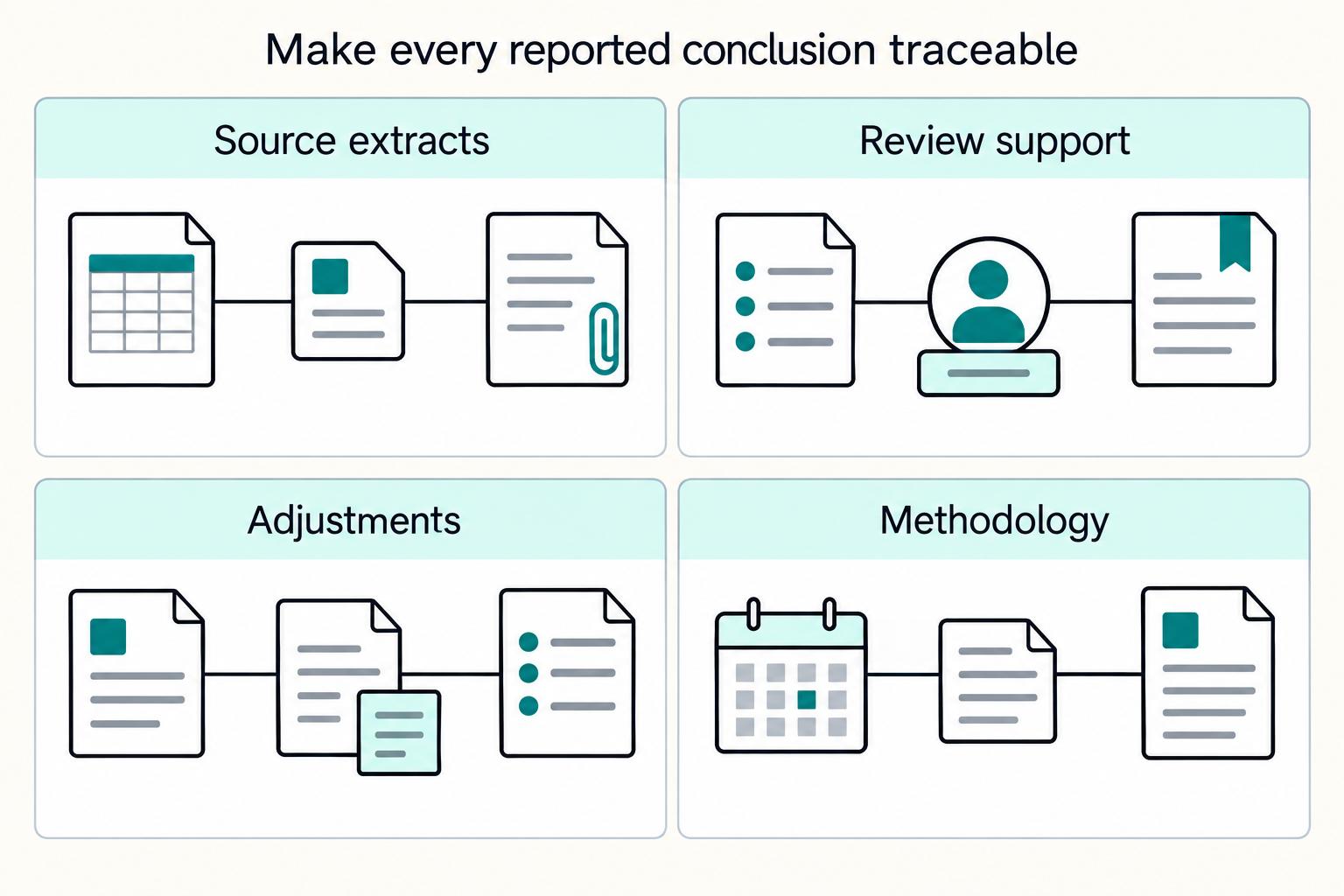
Quick Answer
Use a fixed close cadence: lock scope before day 1, map each payout and return event to ledger journals, and run daily three-way reconciliation by batch status, count, and amount. Treat investor release as blocked until unresolved variance is below policy and approvals are captured in the audit trail. For public-company style discipline, run to Form 10-Q timing standards (40 or 45 days) even when filing is not required, then publish with methodology notes and exception logs.
What Investors Need to See in Your Reports#
You are not building an investor relations document list. You are building a reporting process that can produce repeatable, investor-usable numbers on a disciplined close cadence while collections, settlement, and payout batches keep running.
That distinction matters. Investors need a steady flow of high-quality financial information to make decisions. Your team needs to deliver it without freezing the business at quarter end.
Before You Start#
Use this as an operations design guide, not legal advice. Reporting obligations, onboarding controls, and evidence requirements vary by jurisdiction and program, especially for KYC, KYB, and AML.
AML/CFT controls are risk-based, and countries do not apply them identically. In the U.S., beneficial ownership checks have been a baseline requirement for legal-entity customers at new account opening, but guidance is evolving. NCUA reported FinCEN exceptive relief for credit unions on February 13, 2026. If your process assumes one universal control set, you can end up publishing numbers that look complete but are backed by the wrong evidence.
Keep a short jurisdiction note beside each control you rely on. If a reviewer asks, "Does this apply in all markets?" you should be able to answer in one sentence and point to the policy owner.
Step 1 Set the real target#
Aim for Quarterly Financial Results quality, even if you do not file Form 10-Q. Public issuers work to hard timelines. Those include 40 days after quarter end for large accelerated and accelerated filers, and 45 days for other registrants. That timing discipline is useful even when the filing requirement does not apply.
For a gig platform, investor-ready means more than a polished deck. Your revenue view, cash movement view, payout exceptions, and operational disclosures should trace back to source events and reconciled balances. If one line is challenged, your team should be able to show ledger support, provider references, and approval history without rebuilding the number from scratch.
If you cannot do that yet, do not redesign charts first. Tighten data lineage and close discipline first.
Step 2 Accept the finance and ops tension early#
The main reporting tension is structural. Finance is trying to produce period reporting that stays consistent quarter to quarter. Ops is running live payout activity on schedules that may be daily, weekly, monthly, or manual. Those cadences do not naturally line up.
That mismatch drives most reporting pain. A payout can be initiated in one period, remain pending or in transit, and later become paid, failed, or canceled. Manual payouts can also arrive 1-4 business days after initiation. If your reporting design ignores those states, your close may look clean while still hiding timing risk.
Treat live payout operations and investor reporting as separate views over the same events. One view explains what happened operationally. The other explains how the period should be reported and disclosed.
Step 3 Lock the scope for the rest of this guide#
From here, the guide focuses on producing trustworthy reporting from platform operations: source mapping, ledger traceability, reconciliation, close gates, exception handling, and evidence packaging. It does not provide complete legal coverage for every market.
First checkpoint: document the entities, countries, payout programs, and compliance controls in scope before day 1 of close. If any of those are unclear, fix that first. Everything else depends on this boundary being explicit, not assumed.
Decide what investor-ready means for your platform#
Start with scope, not format. Investor-ready usually means you can publish a consistent set of artifacts each cycle, with numbers that stay consistent across them and hold up under follow-up questions.
Step 1 Define the minimum pack#
Set a baseline pack for every cycle with three parts:
| Artifact | Primary use | Included items |
|---|---|---|
| Management pack | internal review | P&L, cash movement, payout exceptions, major adjustments, and open risks |
| KPI pack | metric discipline | definition, formula, source, owner, and period result for each published KPI |
| Investor-facing summary | annual/quarterly reporting expectations and investor materials | what happened, why it changed, and what risks matter |
You do not need public-company filing volume. You do need a repeatable cycle that explains operating and financial results the same way each time.
Step 2 Assign one owner per artifact#
Ambiguity here slows every review, so assign one accountable owner to each artifact. One workable split is:
- Finance owns final numbers, adjustments, and ties to the general ledger.
- Operations owns reconciliation evidence, provider references, and exception support.
- Product/data owns metric definitions, source-table logic, and Webhooks reliability.
For every page, you should know who can answer "where did this number come from?" on the same day.
Step 3 Apply a publish-or-hold rule#
Use a strict internal rule: if a metric cannot be traced to underlying records and supporting evidence, keep it out of the investor summary for now.
That rule protects metric discipline and avoids a common failure mode in webhook-driven pipelines: publishing clean-looking metrics built from duplicate events.
Related reading: How to Build a Gig Platform Referral Commission Model That Protects Margin.
Gather prerequisites before day 1 of close#
Freeze your inputs before close starts. Reporting usually breaks when perimeter rules, exports, or evidence expectations change after period end.
Step 1 Confirm every close-critical source and export#
Build a short source register and verify that each extract can be pulled consistently without manual rework. Include payment collection, Virtual Accounts if used, payout providers, the general ledger, and warehouse or table snapshots for point-in-time reporting.
| Source | Minimum extract before close | Verification checkpoint |
|---|---|---|
| Payment collection | Transactions, fees, reversals, timestamps, provider references | Records can be traced to ledger journals |
| Virtual Accounts | Account ID, linked legal entity or vendor, balance movement | Each account maps to the correct entity or counterparty |
| Payout provider | Payout ID, component transactions, statuses | Export includes processing, posted, failed, returned, or canceled |
| General ledger | Journal lines, posting dates, entity, currency | Totals tie back to close reporting outputs |
| Warehouse snapshot | Preserved copy of reporting tables | Snapshot timestamp matches cutoff policy |
Do not pull data before provider reporting is complete. For example, if a provider publishes around 2:00 AM CEST, an earlier extract can look clean and still be incomplete.
Step 2 Lock the reporting perimeter and cutoff policy#
Write the perimeter on one page before day 1: in-scope entities, currencies, period cutoffs, and treatment for settlements, failures, returns, and other near-cutoff events.
For multi-currency operations, lock period-end translation treatment for monetary items and keep it consistent. For SEC registrants, the quarterly cadence covers the first three fiscal quarters, and disclosure controls are evaluated at quarter end. If you are not a registrant, use the same discipline anyway. Be explicit about what is in period and what is handled as an event after the reporting period.
If your team cannot explain how a post-cutoff return is handled, hold that external metric until the rule is clear.
Step 3 Document current controls and disclose gaps#
Write down the controls you actually operate. That includes disclosure-control documentation, AML procedures, including beneficial-owner procedures where applicable, idempotent request handling for duplicate-event prevention, and approval gates for manual journals, exceptions, and reporting sign-off.
Call out gaps directly. A control gap is manageable. An undisclosed gap affecting the pack is not.
Step 4 Build the evidence folder before close work starts#
Set up the evidence structure before close work begins so each published number maps to source data, reconciliation work, and conclusion. Keep it simple and consistent: source exports, reconciliations, adjustment register, control evidence, approvals, and final outputs.
Run one checkpoint. Pick a number from the draft investor pack and trace it to the source export, the reconciliation, and any signed-off adjustment. If that chain fails, the process is not repeatable yet.
Related: Real-Time Payment Use Cases for Gig Platforms: When Instant Actually Matters.
Map transactions to ledger postings and reporting lines#
Lock your event mapping before close starts. If one business event can post in multiple ways or hit multiple report lines without an explicit rule, the mapping is likely to fail review.
Step 1 Build one mapping row for each material business event#
Document the recurring events that move cash, liabilities, or reported revenue, and make each rule specific enough that finance, ops, and data interpret it the same way.
Each row should tie the event to the source record, whether from Webhooks or provider files, the posting logic into Ledger journals, the final reporting line, and a gross-versus-net flag. Use the table as a starter, not a complete event list for every platform.
| Business event | Source record to anchor | Ledger posting rule to document | Final reporting line | Gross or net flag |
|---|---|---|---|---|
| Invoice paid | Provider event type, payment ID, internal order or invoice ID | Which accounting definition creates the journal, which entity posts it, and whether fees or taxes are split at posting or later | Revenue, cash or clearing, receivable settlement | Required |
| Payout initiated | Payout batch ID, payout ID, recipient ID, status at initiation | Whether amount moves to payout payable, in transit, or clearing; include reversal rule if initiation is canceled later | Payouts in flight, cash movement, payable movement | Usually not revenue, but still flag |
| Payout failed | Failure event type, payout reference, failure timestamp | Whether the prior posting is reversed, reclassified, or left open pending investigation | Exception or outstanding payout liability view | Required |
| Return received | Return reference, original payout reference, receipt date | Whether return clears an in-transit item, restores available balance, or creates a separate exception item | Returned payouts, cash movement, exception aging | Required |
| Reserve held | Reserve instruction, linked transactions, effective date | Whether amount is held as restricted balance, reserve liability, or contra movement under your approved treatment | Held funds or reserve movement line | Required |
| Reserve released | Reserve release reference, linked hold reference | Whether release reverses prior reserve entry or moves funds into payable or available balance | Reserve release line, cash availability bridge | Required |
Use your chart-of-accounts names and journal codes, but record the exact rule names too. Include the legal entity, currency behavior, and whether the event creates a new journal or reverses a prior one.
Step 2 Tie each row to source IDs that survive review#
A mapping is only useful if you can trace it later. For each row, keep keys that survive review: internal transaction ID, provider reference from Webhooks or statements, and journal or subledger reference in the ledger. Include entity and currency when you report that way.
Store raw payloads or statement extracts when they are received. Historical retrieval is time-limited in some systems. For example, Stripe event retrieval is available for 30 days. If duplicate handling relies on idempotency, note that request.idempotency_key is populated only for events on or after May 23, 2017.
Treat webhook payloads as one anchor, not complete audit evidence. Corroborate them with provider settlement records, internal transaction objects, and the resulting Ledger journals.
Step 3 Add an explicit gross versus net decision to every flow#
Do not leave gross-versus-net treatment implied. Add a required gross_net_flag, or an equivalent field, plus a sign-off field to the mapping. For Merchant of Record (MoR) flows, do not assume gross presentation automatically applies.
Under IFRS 15, principal-versus-agent depends on control before transfer and requires judgment in practice. Tie each gross or net decision to the approved policy memo or controller sign-off so the treatment is explicit and defensible.
Step 4 Run bidirectional tracebacks before close#
Test the mapping both ways before period-end work begins:
- Start from a reporting line and identify its transaction population.
- Pick one transaction and trace it to journal entry, provider reference, and raw event.
- Start from a raw event and confirm it lands in the expected journal and final reporting line.
- Log any broken link as a mapping defect to fix before close.
Also validate status handling in the right provider context. Stripe uses different payout status vocabularies across its docs, so map statuses by product and context instead of assuming one universal list. For returns, 2-3 business days can be typical in some flows, but timing can be longer. Avoid auto-booking a return before it is actually received.
Build the minimum investor report stack#
Keep the investor pack small and repeatable. A compact four-page pack can answer four questions clearly: what you earned, where cash moved, what payout risk is still open, and why the period changed. A practical test is whether the same pack supports close review and external reporting without rebuilding the story each quarter.
Step 1 Define the core pack before you design charts#
Start with a compact stack that ties directly to your ledger and payout operations.
| Page | What it should show | What it must reconcile to |
|---|---|---|
| P&L view | Period revenue, direct costs, key operating expense lines, and the margin view used by management | Ledger journals and approved period adjustments |
| Cash movement view | Cash in from collections, cash out to payouts, fees, returns, reserves, and other material movements | Bank activity, provider settlement records, and cash accounts |
| Payout risk and exception view | Open items by payout status, failed and returned payouts, canceled items, and unresolved exceptions | Provider payout exports, exception log, and related liability or clearing balances |
| Narrative bridge | Material period-over-period movements with the operational reason behind each change | Final reported numbers plus underlying transaction drivers |
Keep P&L and cash movement separate. Income statements show what was made and spent over a period, while cash flow views show money moving between the company and the outside world. If you combine them, timing gaps between recognized revenue and settlement become harder to see.
Verification point: every material line should trace back to the mapping table, then to source IDs and journals. If a line depends on an unsupported spreadsheet adjustment, hold it from external reporting.
Step 2 Write the narrative bridge like an explanation, not a caption#
This page should explain the mechanics behind the numbers, not just restate them.
Use one short block for each major move: the line item, the size of the change, and the operational driver. If cash outflows rose faster than revenue, say whether that came from payout timing, payout exceptions, reserve holds, or settlement-mix changes. If short-term cash needs changed, state that directly for the next 12 months.
Avoid vague labels like "timing differences" or "volume growth" without the mechanism. If the mechanism is unclear, reconciliation is usually incomplete.
Step 3 Add a gig-specific operations page for payout friction#
For a gig platform, this page earns its place. Build it around the payout lifecycle and where funds get stuck.
Track settlement lag as an operating measure: the time between transfer acceptance and final settlement. Do not publish universal targets unless your provider or internal policy defines them. Use a consistent method by provider, country, and rail.
Report exception detail in provider-native statuses. In Stripe Global Payouts, statuses can include processing, posted, failed, returned, and canceled. Keep failed and returned separate. Returned payouts come back in a separate transaction, typically within 2-3 business days, though timing can be longer by recipient country.
Break out reserve movements. Rolling reserves withhold a percentage of processed funds during a period and release it later, so report reserve held and reserve released as distinct lines instead of netting them.
For unresolved exceptions, use fixed aging buckets from your policy and keep the definitions stable within the quarter. The key check is that aging totals reconcile to both the exception log and the related book balance.
Step 4 Separate throughput from financial performance#
Do not let volume stand in for performance. Add one page that separates operational throughput from monetization quality so volume growth is not mistaken for margin improvement.
Define throughput clearly and keep that definition stable. Some platforms report throughput metrics such as GOV alongside revenue and margin for this reason. For example, DoorDash reports Marketplace GOV separately from revenue and net revenue margin. In one period it reported $21.3 billion GOV, $2.9 billion revenue, and 13.5% net revenue margin.
If you publish a volume page, lock the numerator and timing rules and do not let taxes, tips, or applicable consumer fees drift in or out across periods.
The stack is working when a reviewer can move from throughput to revenue to cash to payout exceptions without a side explanation.
Set your KPI dictionary before writing one chart#
Lock each investor KPI definition before anyone builds charts. If finance, ops, and product do not agree on denominator, timing basis, or source table, treat that as a publication risk and resolve it first. A delayed chart is easier to fix than a clean chart built on a drifting metric.
Step 1 Build one metric dictionary for every investor-facing KPI#
Use one shared, versioned metric dictionary, not scattered notes. For every KPI used in your Quarterly Financial Results, Investor Presentation, or Annual Report, keep one row with these fields:
| Field | What to write |
|---|---|
| Metric name | Exact published label |
| Definition | Plain-English business meaning |
| Formula | Numerator, denominator, exclusions, and timing basis |
| Source table | The warehouse or reporting table used to calculate it |
| Owner | Named team or person responsible for sign-off |
| Review cadence | When the definition is checked for drift |
| Management use | How management uses the metric to monitor the business |
Include Management use explicitly. SEC KPI guidance in MD&A calls for a statement indicating how management uses each disclosed metric. If you cannot explain that in one or two clear sentences, the metric is not ready for external reporting.
Verification point: recalculate each KPI for the latest closed period from the named source table and match it to the draft deck number. If a spreadsheet patch is required to tie out, treat the dictionary as incomplete.
Step 2 Standardize the terms that drift first#
Start with the terms that tend to drift: gross volume, net revenue, take rate, payout success rate, settlement lag, and exception rate. There is no universal formula across platforms, so your definitions need to be explicit and stable over time.
| Term | Common drift point |
|---|---|
| Gross volume | tips, taxes, refunds, or pass-through fees move in or out |
| Take rate | revenue basis shifts while the denominator stays on a different basis |
| Payout success rate | retries, reversals, or same-day reissues are counted differently |
| Settlement lag | one report measures acceptance-to-settlement while another uses initiation-to-posting |
| Exception rate | failed, returned, and canceled are grouped differently than on the ops page |
If the denominator or timing is disputed, treat the metric as not publication-ready until the method is resolved. Otherwise, period-over-period movement can reflect method changes instead of business change.
Step 3 Label non-GAAP and platform-specific metrics clearly#
Once a metric moves into the Investor Presentation, label non-GAAP or platform-specific measures clearly. Non-GAAP presentation should not be more prominent than the most directly comparable GAAP measure, and inconsistent presentation across periods can mislead. For European issuers, alternative performance measures should be clearly labeled, reconciled, and explained for relevance and reliability.
If you publish platform-specific metrics like gross volume or a take-rate variant, define them in an appendix or methodology note. State whether the method changed from the prior period and why. If the numerator or denominator is non-GAAP, check whether a comparable GAAP measure or ratio is also needed with equal or greater prominence for that venue.
Keep a change log with the metric name, old method, new method, effective quarter, approver, and reason. That log becomes your audit trail when investors ask why this quarter differs from the last one.
For a step-by-step walkthrough, see How to Launch a Referral Program for Your Gig Platform with Built-In Commission Tracking.
Reconcile money movement every day, not just at month end#
Daily reconciliation is the control that keeps reporting trustworthy between closes. If unresolved payout-value variance is above your internal policy threshold, treat external reporting as at risk and follow your internal incident process before you update your quarterly results, investor materials, or annual reporting.
Step 1 Run a daily three-way check#
Run a daily check across three views of the same flow: provider statements or settlement files, your internal balance view, and Ledger journals. Run this separately for collections, currency conversions, and payouts.
Use one cutoff per check and compare like for like: same currency, same timestamp basis, same totals, or a documented break. Store evidence for each run, including provider file name, export time, internal balance snapshot time, and journal extract ID, so timing mismatches do not get mistaken for value mismatches.
If you operate in an FCA CASS context, this cadence is required each business day, and records must support prompt calculation of client money.
Step 2 Reconcile Payout Batches by status, count, and amount#
Batch grand totals are not enough. Reconcile Payout Batches by lifecycle status with both count parity and amount parity, and map your internal labels to provider-defined states.
Provider status models include intermediate states before final outcomes. Stripe surfaces states such as processing, posted, failed, returned, and canceled, with payouts also appearing in pending or in-transit phases before settlement. PayPal also indicates that batches can begin in PENDING after an initial syntax scan.
For each batch, tie the provider reference, internal batch record, and related Ledger journals. A matched total can still hide breaks from returns, FX handling, fee handling, or cancellation-reversal errors.
Step 3 Age unresolved breaks and assign one owner#
Unowned breaks drift into close and get treated as timing noise. Every break should have an owner, opened date, latest action, and expected resolution date.
Use aging rules that reflect payout behavior. Returned payouts are often visible within 2-3 business days, though timing can vary by country, so classify fresh returns differently from older unexplained gaps. When an item crosses your internal aging threshold, move it to close-risk status under your policy.
Step 4 Gate external reporting when variance remains unresolved#
Before releasing investor materials, compare unresolved payout-value variance against your policy threshold. If it is above threshold, consider delaying release and publishing an internal incident note under your policy with the affected flow, currencies, period, provisional exposure, owner, and next update time.
For SEC registrants, this ties directly into disclosure controls and procedures, which management evaluates each fiscal quarter. If a required periodic report cannot be filed on time, Form 12b-25 must be filed no later than one business day after the due date.
Run a close calendar with explicit go or no-go gates#
Every close stage should end with a clear pass-or-fail decision, not a "mostly ready" judgment. If a gate fails, either delay release or use a clearly labeled accounting estimate with a planned true-up note. Do not mix those paths inside the same close.
Step 1 Freeze the reporting perimeter#
Start by locking the period scope: entities, currencies, event-time basis, and source extracts. The exact sequence is your policy choice, but it should stay fixed across cycles.
One practical internal sequence is cutoff freeze, reconciliation sign-off, adjustments, draft pack, executive review, and investor release prep for your quarterly results or investor presentation. Treat the gate as failed when the freeze memo and evidence folder do not match, including export timestamps and snapshot IDs. Treat it as failed when later data pulls change the basis without documented approval.
Step 2 Define gate criteria before the close starts#
Write pass-or-fail criteria for each stage before the close begins, and capture approvals in your Audit trail. Typical criteria include required reconciliations complete, unresolved exceptions below policy threshold, adjustments reviewed, and owners signed off.
In U.S. issuer contexts, management evaluates disclosure controls and procedures as of the end of each fiscal quarter with principal executive and principal financial officer participation. That means the executive review gate should confirm not only that the numbers look reasonable, but that disclosure-supporting controls were performed and evidenced. If a material weakness is known, treat the gate as failed.
Step 3 Define treatment for late Webhooks and asynchronous returns#
Assume event timing will not be perfectly synchronous at close. Stripe documents asynchronous behavior, possible duplicate webhook deliveries, and retries of undelivered events for up to three days.
Set a written treatment window for late events and returns, then apply a consistent rule for adjustment versus disclosure-only treatment. Under IAS 10, adjust amounts when post-period events provide evidence of conditions that existed at period end. If a non-adjusting event is material, disclose it instead of forcing it into closed numbers. Keep a late-event register with event ID, provider timestamp, receipt timestamp, duplicate-check result, and accounting conclusion. If manual recovery is needed, remember that provider event-listing windows can be limited, for example the last 30 days.
Step 4 Decide openly when a gate fails#
When a gate fails, document one path: delay, or publish with a controlled accounting estimate plus a true-up trigger. Silent blending creates a close that is hard to explain and harder to defend later.
Your evidence pack should show the failed gate, approver, rationale, estimate basis if used, and true-up plan. Keep those records with the rest of the close documentation. In U.S. audit or review contexts, relevant records are retained for seven years.
If your close gate is failing on status ambiguity, use Gruv docs to map webhook events, idempotent retries, and payout batch states into your reconciliation checklist.
Handle the failure modes investors ask about first#
Make exception handling explainable before release. Classify each break, apply a defined recovery path, and decide whether it stays in ops or rises into quarterly reporting or investor materials.
Step 1 Classify the breakpoint before changing numbers#
Do not start with the correction. First label the issue type, affected period, and owner, because each failure mode has a different recovery path.
| Failure mode | What to verify first | Recovery action | Evidence to retain |
|---|---|---|---|
| Duplicate event attempts | Same event ID, session ID, or request key appears more than once; confirm whether the ledger posted once or multiple times | Use idempotent replay, or ignore already-processed events and return success so retries stop | Event ID, idempotency key, processing status, first-seen timestamp, replay decision |
| Stale FX quote usage | FX rate timestamp does not align with the transaction-date basis used for measurement | Post a controlled correcting entry, and a reversal where policy requires it, using the transaction-date spot rate | Transaction timestamp, FX source timestamp, original rate, corrected rate, approver |
Unmatched deposits in Virtual Accounts | Deposit arrived, but remittance reference is missing, incorrect, or incomplete | Log investigation, pause auto-match, resolve ownership, then post a correction if misapplied | Virtual account identifier, remittance reference, provider statement line, investigation notes |
| Return timing mismatch | Return event timestamp and receipt timestamp fall in different periods | Apply close policy consistently; if the timing difference is material, disclose the known uncertainty and true up under policy | Return ID, provider timestamp, receipt timestamp, accounting conclusion, reviewer sign-off |
If another reviewer cannot reproduce the conclusion from the log, the exception is not ready for investor-facing reporting.
Step 2 Recover with replay-safe logic or controlled corrections#
Use replay-safe controls for duplicate processing, because repeated delivery is normal. Keep dedupe state on your side, use idempotency keys for create and update actions, and record when an event was already processed so retries do not keep doing work.
For FX issues, compare the transaction timestamp to the rate timestamp and correct based on the transaction-date spot rate. If the wrong rate was used, keep the original journal, any reversal, corrected entry, and approval together.
For returns and reversals, require reason, formatting, and eligibility checks before posting corrections. Keep internal investigation logs even when provider records exist, so your evidence does not depend on one system.
Step 3 Escalate recurring breaks into investor narrative#
Recurring exceptions are a control signal, not just an ops inconvenience. A control weakness can exist even before a material misstatement, so escalate patterns early with a clear owner path: analyst -> reconciliation lead -> controller/release owner.
- Repeated reconciliation breaks: treat repeat patterns as control risk and track remediation status.
- Unexplained reserve swings: explain material period-to-period changes with the underlying quantitative and qualitative drivers.
- Persistent settlement lag: report the pattern, the affected flow, and the primary driver, whether provider timing, reference-data quality, or internal posting delay.
If a red flag is still open at close and could affect reported or future results, include it in the narrative package instead of leaving it only in an ops ticket.
Add compliance and tax artifacts without leaking sensitive data#
Once exception handling is stable, report compliance and tax operations as control status, not raw identity data. For investor-facing reporting, show that payout gating and tax workflows are complete while excluding names, full TINs, account numbers, and onboarding images.
Step 1 Show gating controls as status evidence#
Show KYC, KYB, and AML outcomes at the decision level where applicable: approved, pending review, rejected, suspended, or payout-blocked, not personal-field detail. If your flow includes CIP-style identity collection or beneficial-owner checks for legal entities, report completion and exception aging only.
Before release, verify that the evidence export is limited to platform IDs, control timestamps, and case status. Follow data-minimization handling, and if you issue payee-facing tax statements, use truncated TINs only where allowed. Do not truncate copies filed with the IRS.
Step 2 Publish tax-operational completeness, not just tax totals#
Investors need to know whether tax reporting operations are under control, so publish completion status by artifact.
| Artifact | What to report | Verification point |
|---|---|---|
Form W-9 | collected, validated, missing, correction requested | TIN request date, validation status, payout gate status |
Form W-8BEN | foreign-status documentation collected and current | document type, receipt date, review or refresh queue |
Form 1099-NEC | recipient prep status and filing readiness | unresolved record count before January 31 |
DAC7 | seller data collection and verification progress where in scope | scope flag, workflow status, exception owner |
Do not mark a form complete when it is only uploaded. Keep a document register with receipt date, validation result, and blocker reason so finance can trace open gaps at close.
Step 3 State cross-border support carefully#
For cross-border workflows, use narrow language: FBAR support data available in-program, where enabled; FEIE support data available in-program, where enabled.
Keep them separate because they may not apply to the same population. FEIE depends on a qualifying individual filing a return. FBAR is an annual FinCEN Form 114 filing due April 15 with an automatic extension to October 15.
If deeper workflow detail is needed, keep it in a separate tax-ops note rather than the main investor reporting pack.
You might also find this useful: Gig Worker Tax Compliance at Scale: How Platforms Handle 1099s W-8s and DAC7 for 50000+ Contractors.
Package an evidence bundle investors and reviewers can trust#
The final pack is not enough on its own. Package the bundle so an external reviewer can trace each published conclusion back to the work, evidence, approvals, and decisions behind it.
Step 1 Assemble support that ties back to each published number#
Start with the final report pack, then include support that shows controlled production, such as reconciliation files, exception logs, adjustment records, approval records, and change history. If you include non-GAAP metrics, pair each one with the most directly comparable GAAP measure and a clear quantitative reconciliation bridge.
Verification point: sample a few figures and trace each one to its source extract, review sign-off, and any manual adjustment. If a figure depends on an offline file with no version trail or no named approver, flag it for remediation before release.
Step 2 Write a short methodology note in plain language#
Add a short methodology note that explains cutoff timing, settlement treatment, late-arriving events, estimate assumptions, and known limitations. Keep it clear and concise so reviewers can understand the judgments without decoding internal shorthand.
Use this note as management-style commentary for the reporting pack. State why period-sensitive decisions were made instead of leaving uncertainty buried in the numbers.
Step 3 Use peer public materials only as a format check#
Peer materials can help with structure, ordering, and narrative depth, but they cannot validate your controls. Use Gaming Innovation Group (GiG) and GiG Software PLC investor materials as a format check, not as evidence.
Your package still needs to show your own reconciliations, management authorization, and follow-up on differences between recorded balances and actual assets. Public comparables are context. Your evidence bundle is the proof.
We covered this in detail in How to Write a Payments and Compliance Policy for Your Gig Platform.
Choose what to automate in your first 30 days#
A practical order for the first 30 days is intake first, reconciliation second, KPI definition control third, and release evidence last. Once the evidence bundle is defined, prioritize the highest-error, highest-latency step before any formatting polish.
| Week | Automation focus | Key check |
|---|---|---|
| Week 1 | Provider event ingestion and Webhooks | Trace the raw webhook payload to the normalized record and the ledger-facing reference |
| Week 2 | Daily reconciliation checks for Payout Batches | Prove count parity and amount parity between the internal payout table and the provider settlement or payout reconciliation report |
| Week 3 | KPI dictionary validation before report generation | Fail when a chart uses an unapproved or changed definition |
| Week 4 | Release gating, approval capture, and evidence export | Reconciliations complete, exceptions within policy, approvals captured in the Audit trail |
Step 1 Automate ingestion and normalization for provider events#
Start Week 1 with provider event ingestion and Webhooks, because every downstream control depends on a normalized source of truth. A webhook is an HTTP endpoint that receives provider events. It becomes a reporting control when you store the raw payload with key references, timestamps, and normalized status together.
Remove manual copy-paste first. If analysts are rekeying data from provider emails, exports, or settlement snapshots, that is a major error surface.
Verification point: sample a handful of provider events and trace each one from the raw webhook payload to the normalized record to the ledger-facing reference. Do not assume one-time, in-order delivery. Stripe notes that undelivered events can be resent for up to three days, so intake needs deduplication and replay handling. If you call provider APIs during recovery, use idempotency where available so retries within 24 hours do not create duplicate side effects.
Step 2 Automate daily reconciliation checks for Payout Batches#
Week 2 should automate daily checks across provider settlement files, internal balances, and ledger journals. Wire the reports that reconcile transactions included in each payout batch, then open exception tickets automatically when counts or amounts break.
Map payout statuses explicitly before reporting. A provider may expose states like paid, pending, in_transit, canceled, or failed. Your internal taxonomy can differ, but each batch and transaction still needs a defined state.
Verification point: for one day of Payout Batches, prove count parity and amount parity between your internal payout table and the provider settlement or payout reconciliation report. If exceptions are still being discovered manually in spreadsheets after the daily run, extraction is automated but the control is not.
Step 3 Automate KPI dictionary validation before report generation#
Week 3 is where you stop metric drift before it reaches the deck. Generate reports only from versioned KPI definitions that clearly state the metric, how it is calculated, and why it matters to investors.
SEC MD&A guidance emphasizes clear metric definition and calculation, so automation should fail when a chart uses an unapproved or changed definition. For non-GAAP or platform-specific metrics shown with financial measures, include the most directly comparable GAAP measure and reconciliation support.
Step 4 Automate release gating, approval capture, and evidence export#
Week 4 should automate the go-or-no-go release controls: reconciliations complete, exceptions within policy, approvals captured in the Audit trail. This is what keeps a fast close verifiable.
Export the report pack with support files, approval records, change history, and the methodology note from the previous section. The package should be clear enough for an experienced reviewer with no prior connection to trace each number. If you report on SEC timelines, this discipline needs to be in place before the 40-day or 45-day quarter-end filing window closes.
Across all four weeks, keep the same rule: automate error and latency risk first, then polish presentation.
Conclusion#
Investor-ready reporting comes from disciplined close operations, not presentation design. When numbers hold up under trace-back testing, exception review, and approval review, quarterly and annual materials become more credible because the process behind them holds up.
Step 1: Make the process repeatable. The goal is not one clean quarter, but consistent reporting quality every cycle across internal reporting and public disclosure. For public issuers, that cadence runs through Form 10-Q for the first three fiscal quarters and Form 10-K annually. Quarter-end management evaluation of disclosure controls is part of that routine.
Step 2: Protect the controls that carry the report. Keep the same core in place each cycle: clear event-to-ledger mappings, reconciliation, explicit close gates, exception recovery, and evidence packaging. If a line item cannot be traced to ledger journals, provider references, and source events without verbal patching, stop publication and fix it.
Avoid blending payout exceptions into net settled totals. Failed, returned, and canceled payouts should be tracked separately with supporting records. In provider flows where returned payouts are tracked by webhook status and can take several business days to book back, either resolve them within the period close or disclose them clearly.
Step 3: Publish proof, not only outputs. Trust comes from the evidence bundle behind the pack. Keep records of work performed, evidence obtained, and conclusions reached, including reconciliations, adjustment support, exception logs, approvals, and change history.
Before release, trace one external KPI and one cash-movement figure from source event to final report. If the chain breaks because of a spreadsheet overwrite, a missing webhook reference, or a manually rebuilt payout batch, fix it first. If you publish non-GAAP or platform-specific metrics, include the most directly comparable GAAP measure and a quantitative historical reconciliation.
Use this final publish checklist:
- Mappings validated: each event type maps to the correct ledger posting and reporting line, including failed, returned, canceled, and held funds.
- KPIs locked: definitions, formulas, source tables, owners, and timing are agreed and unchanged during drafting.
- Reconciliations signed off: provider files, internal balances, and ledger journals match at the required level of detail.
- Exceptions resolved or disclosed: open items have an owner, recovery action, status, and plain-language treatment if unresolved.
- Approvals captured: finance, ops, and required executives approved through an auditable trail.
- Investor pack published: final reports, methodology notes, and support files are archived together for the next cycle.
If you can pass this checklist every cycle, you are running a reporting function investors can rely on.
When you are ready to operationalize this checklist across payout operations and investor reporting, talk with Gruv to confirm coverage for your market and control design.
Frequently Asked Questions
What financial reports should a gig platform send investors each quarter?
If you are a U.S. public reporting company, the quarterly baseline is Form 10-Q for each of the first three fiscal quarters, including unaudited financial statements and MD&A under Item 303. For private investor reporting, use a consistent quarterly structure that makes financial performance and metric logic easy to review. If you disclose non-GAAP or platform-specific metrics publicly, include the most directly comparable GAAP measure and a reconciliation.
How do we reconcile payouts, settlement files, and ledger balances before publishing?
Run a three-way reconciliation across provider settlement output, the payout reconciliation report, and your ledger journals before release. Validate count parity and amount parity by payout batch and status, not only at the total-period level. If batch membership still has to be rebuilt manually from exports, emails, or bank lines, your reconciliation control may still be incomplete.
Which controls prove our numbers are audit-ready?
Audit-ready reporting requires durable documentation of procedures performed, evidence obtained, and conclusions reached. In practice, keep reconciliation evidence, metric-definition ownership, adjustment records, approvals, and report change history together in one traceable package. A strong test is picking one investor-facing number and tracing it back to ledger, provider reference, and source event without filling gaps verbally.
How should we report failed payouts, returns, and held funds?
Do not report failed payouts as settled cash out. In the payout flow described here, failed payouts are voided and funds are returned, while returned payouts come back as separate transactions and are typically returned within 2-3 business days in that system. Present failed payouts, returned payouts, and held or reserve balances separately, with clear support for reversal or reclassification entries.
When should we delay close versus post adjustment entries?
Use the IAS 10 adjusting-versus-non-adjusting test. If post-period information provides evidence about conditions that existed at period end, adjust recognized amounts. If it reflects conditions that arose after period end, do not adjust recognized amounts and disclose if material. Delay close when key support is unresolved, and use adjustment entries when treatment and evidence are clear.
How do we explain gross versus net revenue treatment in a marketplace model?
Explain gross versus net as a principal-versus-agent assessment for each specified good or service, not as a one-time company-wide election. Gross presentation fits when the platform controls the good or service before transfer to the customer. Net presentation fits when the platform arranges for another party to provide it. In your methodology note, state the decision rule and which revenue lines it affects so investors do not confuse gross volume with revenue.
Try a related tool
Researched and edited by the Gruv editorial team. Gruv builds cross-border billing, payouts, and finance-operations software for global businesses.
Sources
- ecfr.gov/current/title-17/chapter-II/part-240/subpart...trusted
- ecfr.gov/current/title-31/subtitle-B/chapter-X/part-1...trusted
- investor.gov/introduction-investing/general-resources/new...trusted
- irs.gov/businesses/small-businesses-self-employed/re...trusted
- irs.gov/businesses/small-businesses-self-employed/in...trusted
- ncua.gov/newsroom/press-release/2026/fincen-issues-ex...trusted
- sec.gov/about/reports-publications/investorpubsbegfi...trusted
- sec.gov/files/rules/interp/2020/33-10751.pdftrusted
Educational content only. Not legal, tax, or financial advice.
Related Posts
Gig Worker Financial Wellness: How Platforms Can Offer Savings and Insurance as Benefits
Benefits in the gig economy are a unit-economics decision, not a branding exercise. Your job is to improve worker stability without creating a cost base you cannot control. For many workers, the goal is steadier cash flow and better protection from shocks. Platforms still have to protect margin, absorb payout volatility, and avoid recurring benefit costs that may outrun retention gains.
When Instant Payout Matters for Gig Platform Payments
Instant payout is a tool, not the goal. The real operating decision is where instant timing creates measurable value, where batch timing is enough, and where both should run side by side.

Gig Worker Tax Compliance at Scale: How Platforms Handle 1099s W-8s and DAC7 for 50000+ Contractors
At scale, the hard part is not the acronyms. It is deciding sequence, ownership, and evidence when Form 1099-K, Form 1099-NEC, Form W-8BEN/W-8BEN-E, and DAC7 do not line up cleanly. If you run a high-volume marketplace, put controls in the right order and define clear stop points where legal or tax takes over.