
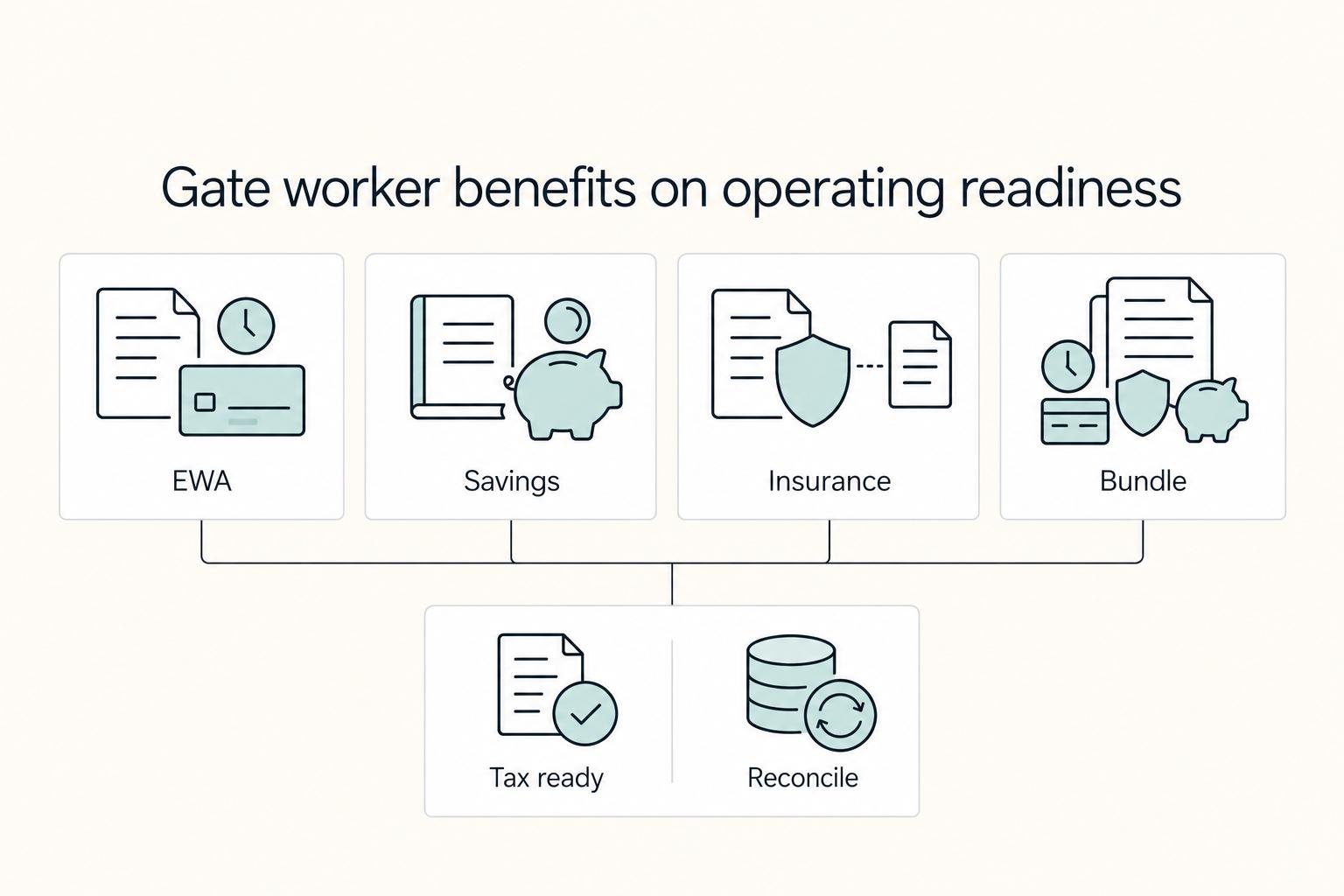
Quick Answer
Platforms should offer financial wellness benefits only when they can measure uptake, per-active-worker cost, and margin impact from their own ledger. A savings-first model is often the safest starting point because it avoids broad advance-funding risk, while EWA needs reliable earnings verification and payout reconciliation. Insurance fits clearer downside-risk cohorts, and bundled offers usually make sense only after single-feature economics and compliance controls are proven.
Benefits Are a Unit-Economics Decision, Not a Branding Exercise#
Benefits in the gig economy are a unit-economics decision, not a branding exercise. Your job is to improve worker stability without creating a cost base you cannot control. For many workers, the goal is steadier cash flow and better protection from shocks. Platforms still have to protect margin, absorb payout volatility, and avoid recurring benefit costs that may outrun retention gains.
That tension is structural. Brookings notes the traditional employer-provided benefits model does not fit gig workers well, especially when people earn across multiple platforms. That is why portable benefits matter. They can follow workers across roles instead of assuming one long-term employer. If your marketplace serves multi-app earners, a benefit that only works inside one closed platform can hit limits early.
Demand is real, but uneven. In the Federal Reserve's 2025 report on 2024 household well-being, 9% of people made money from short-term tasks such as rides, delivery, or odd jobs, and 13% made money selling things. Most gig workers reported flexibility, but smaller shares reported work-life balance. That gap is one place financial products may help, especially if you treat financial well-being in the CFPB sense: security and freedom of choice.
AFCPE-style framing is counselor/client guidance. This article uses a monetization framework: which financial wellness benefits can earn their keep on a gig platform? Evidence suggests platform-linked financial services may improve engagement and retention by reducing churn, but that signal is directional, not proof. Treat it as a testable hypothesis in your own cohorts.
The cost side is just as real. Lyft has stated that insurance, driver pay, and incentives have increased or fluctuated. Uber has also noted it has offered, and may continue to offer, driver incentives in certain markets. So even when a benefit helps workers, the commercial question is whether the behavior change justifies the spend and operating complexity.
If you cannot measure per-active-worker cost, cohort uptake, and margin impact from your own ledger, you are not ready for heavier options. The sections that follow focus on monetization tradeoffs and execution order: what to launch first, what to defer, and what is likely to turn into expensive noise.
Who This List Is For and How to Choose#
This list is for operators making platform decisions, not freelancers looking for personal-finance advice. Use it if you own payouts, reconciliation, onboarding, reporting, or margin performance and need to decide whether these benefits support retention goals without adding uncontrolled cost or compliance risk.
1. Operator fit#
Use this framework when the decision will affect platform economics and operations. If you cannot connect benefit cost per active worker to revenue or cost of sales, defer more complex benefit models.
2. Commercial screen#
Choose models with a realistic adoption path and measurable economics. Screen each option on attach-rate potential, gross-margin impact, operational burden, and exception and support cost.
If a model depends on uncapped subsidies, heavy manual review, or high dispute volume, treat it as high execution risk even if demand looks strong.
3. Compliance and document readiness#
Check identity and tax-document readiness before vendor selection. In U.S.-oriented flows, Form W-9 is used to collect a correct TIN, and Form W-8 BEN is used by foreign individuals to certify foreign status to a payer or withholding agent. For covered U.S. banking contexts, customer identity verification procedures (CIP) are part of AML compliance. For gig platforms, the Form 1099 type depends on work and platform structure, and many cases involve 1099-NEC or 1099-K.
Your go or no-go check is operational. Can you show which workers have valid W-9 or W-8 documentation, which identity verification or tax-document checks failed, and which cohorts become reportable at IRS-stated thresholds for 1099-NEC ($600, and $2,000 for payments made after December 31, 2025)? If not, do not scale payout-linked benefits yet.
4. Evidence standard#
Vendor case studies are directional, not decision-grade proof. Use claims like transparency, trust, or compliance to shortlist partners, then validate outcomes in your own ledger and cohort data.
Require before-and-after reads on activation, repeat use, retention, payout exceptions, support contacts, and gross-margin impact. If you cannot isolate those shifts from baseline, you do not have enough evidence to scale. If contractor records are still unstable, start with tax compliance readiness before adding benefit complexity.
What the Market Already Covers and What It Misses#
The baseline is fairly clear, but decision-grade economics are still thin. Most coverage explains why wellness features can help. What operators still need is guidance on feature mix, cost ownership, and operational risk.
- Table stakes are well covered
Most financial wellness program content emphasizes financial-stress relief and core tools across spending, saving, borrowing, and planning. That is useful baseline coverage, but it is mostly foundational rather than operational.
- EWA is usually positioned as part of a bundle
Earned Wage Access (EWA) is often presented alongside savings tools, goal tracking, credit-building, or guidance instead of as a standalone liquidity feature. That can support adoption, but it can also make it harder to isolate what is driving usage and cost in your model.
- Platform-level tradeoffs are where coverage gets thin
This is the main gap. Available material offers limited guidance on when EWA, savings nudges, or insurance produces better economics for a platform. U.S. EWA coverage also still includes regulatory uncertainty under Regulation Z/TILA, so implementation is not just a product-choice question.
- Evidence quality often lags the language
Human Resource Executive and similar sources are useful for market framing, but accessible excerpts are light on implementation detail. Treat claims about retention or wellness as directional unless they are tied to concrete operating and margin outcomes. For a related policy lens, see Understanding Your Rights Under the EU Platform Work Directive.
Side-by-Side Comparison of Benefit Models#
Do not launch EWA first, or a full bundle, until your tax onboarding, payout reconciliation, and reporting logic are reliable. Your first gate is simple: can you verify earned amounts, fund or recover advances, reconcile payouts, and report contractor payments correctly?
| Model | Brief description | Adoption signal | Margin drag | Compliance load | Implementation effort | Data dependencies | Failure modes | Policy gates | Who pays | Retention and break-even lens |
|---|---|---|---|---|---|---|---|---|---|---|
| EWA-first | Workers access earned income before scheduled payout. | Can gain traction when payout timing is a known pain point. | Can be material if you subsidize fees, prefund advances, or absorb exceptions. CRS cites 82% of employer-partnered EWA transactions with fees. | High and jurisdiction-sensitive; treatment is a state-law patchwork in the U.S., and federal interpretation has shifted, including a CFPB advisory effective December 23, 2025. | Medium to high. | Accurate earnings data, payout timing, reversal logic, funding source, and often Virtual Accounts or equivalent sub-ledgers. | Over-advancing on unsettled earnings, duplicate disbursements, failed reversals, support spikes after exceptions. | CDD and BSA/AML controls, plus beneficial-ownership checks for legal entities where sponsor funding is involved. | Provider, employer, worker (fees), sponsor, or hybrid. | Works when cash-timing pain is a real churn driver and usage can offset funding, support, and subsidy cost. |
| Savings-first | Rule-based set-asides from earnings, often with liquidity guardrails. | Depends on whether workers value automated reserves, such as tax set-asides. | Can be lighter than EWA when no wage pre-funding is required. | Moderate; still requires CDD/BSA-AML controls and reporting discipline when funds move on your rails. | Lower to medium if split payouts already exist. | Split-pay rules, balance visibility, payout timing, and ledger separation. | Misapplied split rules, withdrawal friction, reconciliation gaps. | CDD/BSA-AML controls, plus beneficial-ownership checks for legal entities where partner or sponsor accounts are involved. | Worker-funded, platform-subsidized, sponsor-matched, or mixed. | Works when recurring cash-stress cohorts engage and support remains low because the product is simple. |
| Insurance-first | Coverage for downside events, depending on product and market. | Segment-dependent; adoption depends on whether the covered risk is concrete and clear. | Premium costs may be predictable, but claims and eligibility operations add overhead. | Can be moderate to high, based on product, market, and partner structure. | Medium, with heavy policy and support operations. | Eligibility data, enrollment records, billing logic, document storage, clear status communication. | Denied-claim disputes, misunderstanding exclusions, support load around coverage windows. | CDD/BSA-AML controls where payment rails apply, plus beneficial-ownership checks for legal entities in sponsor arrangements. | Platform-paid, worker-paid, sponsor-paid, or shared. | Can work when covered cohorts are costly to replace and coverage improves trust. |
| Bundled design | Liquidity, savings, and protection in one offer or tiered package. | Varies by cohort; clearer after single-feature signals are known. | Can carry the highest risk of stacked subsidies, fees, and support costs. | Can be highest, because you inherit controls from every included feature. | Highest; requires tight orchestration across ledgers, eligibility, support, and reporting. | All dependencies above, plus cross-product event and entitlement logic; Virtual Accounts become more valuable. | Cost opacity, fragmented support ownership, reconciliation breaks, weak attribution of outcomes. | Full CDD/BSA/AML controls and beneficial-ownership checks as applicable. | Usually hybrid by feature. | Works only when cohorts are segmented and pricing or subsidy is usage-aware. |
| Do not launch yet | Tax onboarding, payout reconciliation, or reporting logic is still unstable. | N/A | Hidden drag is highest: rework, notices, and manual ops. | Already above current control maturity. | Not ready. | Missing Form W-9 or TIN quality controls, unclear Form 1099 branching, incomplete DAC7 screening, weak ledger-to-payout traceability. | Wrong 1099 type, missed reports, failed audits, manual cleanup. | Finish CDD/BSA-AML, beneficial-ownership, and tax-document controls first. | Nobody should pay for a benefit you cannot report or reconcile. | Delay until readiness is provable from source data through year-end reporting. |
Here is the practical read. EWA-first is a funding and regulatory choice, not just a UX choice. If you cannot verify earned amounts before release and trace each advance to payout or recovery events, you increase exception handling and support risk.
Savings-first can be a cleaner starting point when you want lower advance-funding exposure, but only if worker-level balances reconcile consistently. If daily reconciliation is weak, virtual-account-style segmentation is an operational control, not a cosmetic upgrade.
Treat the red-flag row as a launch blocker. Confirm W-9 and TIN collection quality, confirm when flows belong on 1099-K instead of 1099-NEC/1099-MISC, and screen EU-facing activity for DAC7 obligations before pricing or rollout. If those controls are still manual, read Gig Worker Tax Compliance at Scale: How Platforms Handle 1099s W-8s and DAC7 for 50000+ Contractors before making launch decisions.
Option 1 EWA Plus Auto-Savings#
Choose this only if you can verify earned amounts before release and your settlement timing is predictable. Earned Wage Access (EWA) plus auto-savings can fit high-frequency payout models, but it can create support debt quickly when reversals, recovery, and Payout batches exceptions are not tightly controlled.
Demand is real, but treat market data as context, not a promise for your platform. In the CFPB employer-partnered sample, usage grew by over 90% from 2021 to 2022, reaching more than 7 million workers and about $22 billion in 2022. The average transaction was $106, and the average worker used the product 27 times per year.
Why this option can work#
This model works when workers regularly face a pay-timing gap between completed work and usable cash. At least one market provider packages earned wage access with automated savings, which shows the combined model is operationally feasible.
The savings layer can run through Virtual Accounts or equivalent sub-ledgers tied to inflows. That can make split rules and reserve moves easier to enforce and reconcile. Keep the accounting clear: virtual accounts do not hold funds directly, so your ledger must show where funds actually sit and when they become available.
Where teams get burned#
Most failures start with timing and controls, not demand. The first failure mode is confusing payout schedule with fund availability. A faster payout schedule does not make pending balances settle any sooner. With a 3-business-day settlement timing, payouts still depend on funds captured three business days earlier. If you release funds before settlement, treat that as pre-funding risk and price it accordingly.
The second failure mode is using liquidity to paper over unstable earnings. Gig and short-task workers report pay-consistency concerns, so weak savings rails can end up masking volatility instead of reducing it.
The third failure mode is fee reliance. CFPB data shows roughly 90% of workers paid at least one earned wage product-related fee unless employers subsidized costs.
Operator checks that matter most#
Validate controls at worker level, not only in aggregate dashboards. Check these basics:
- Do not advance against batch-level status alone; a completed batch can still contain failed payouts.
- Trigger savings moves and advance recovery from confirmed available-balance or successful-transfer events, not scheduled payout events.
- Keep a full trace per worker: earning event, advance amount, virtual-account posting, payout transfer ID, batch ID, recovery event, and reversal record.
Reversal governance is mandatory. Improper ACH reversals can cause harm, and some non-standard bank account types can have higher payout-failure rates. If exception handling is still mostly manual, this option is not ready.
Recommendation#
Use this model when payout cadence is frequent, settlement lag is stable, and daily reconciliation is already reliable. If those controls are still weak, start savings-first and add EWA later. Get legal review on product structure and fees, because CFPB treatment evolved from its 2024 view that many paycheck advances are TILA loans to a December 23, 2025 advisory addressing Covered EWA under Regulation Z.
Option 2 Savings-First With Guardrailed Liquidity#
Savings-first with guardrails can be a practical entry point when you can reconcile confirmed balances well but do not want broad instant access against unsettled earnings.
- Best for: teams prioritizing confirmed-balance controls and limited appetite for pre-funding risk.
- Pros: builds an emergency buffer from confirmed inflows; supports tax-readiness workflows for contractors who may need to file at $400+ net self-employment earnings and cover 15.3% self-employment tax (12.4% Social Security, 2.9% Medicare).
- Cons: can feel slower than full EWA for workers who need immediate cash access.
- Use case: marketplaces prioritizing resilience features over high-frequency liquidity subsidies.
What makes this option different#
The key difference is the constraint. Liquidity is guardrailed, not open-ended. Workers build reserves from settled or confirmed funds, then access those reserves under narrow rules your ledger can reconcile. That keeps the product focused on shock absorption, which aligns with the Federal Reserve view that emergency savings buffers help households manage income swings and unexpected expenses.
Why the tradeoff is defensible#
The tradeoff is that you give up some immediacy, which can reduce treasury and compliance risk. EWA demand is substantial, but usage patterns also show cost and behavior you should price and govern carefully. CFPB reported employer-partnered earned wage products grew by over 90% from 2021 to 2022, with more than 7 million workers accessing about $22 billion. The same sample showed 27 transactions per worker per year on average, and roughly 90% paid at least one product-related fee.
Where this fits operationally#
This model can fit contractor-heavy platforms, especially where earnings are uneven and tax obligations recur. IRS guidance states gig workers must file when net self-employment earnings are $400 or more. Self-employment tax is 15.3%, split between Social Security and Medicare. SSA also notes self-employed workers pay the combined employee and employer amount.
Use that as a design anchor, not a marketing claim. Your reserve rules should tie to confirmed payouts, and tax-related nudges should appear only when worker profile and document data are reliable.
Operator checks that matter#
A savings-led model is only as good as its event logic. Keep the rules simple and traceable:
- Move money into savings only from confirmed payout or available-balance events.
- Prevent withdrawals that recreate pre-funding risk before funds settle.
- Keep one traceable chain per worker event: reserve transfer, visible balance change, withdrawal, and any reversal.
Recommendation#
Choose this option when you want a practical benefits entry point without centering instant disbursement risk. If you position tax-linked savings as part of your platform benefits, pair it with strong tax ops first. That includes tax document collection and reporting discipline.
Option 3 Insurance-Led Protection for Downside Risk#
Insurance-led support works best when interruption or injury risk is visible, role-linked, and severe enough that savings alone may not cover the downside. For driving, delivery, and logistics-adjacent cohorts, that risk is concrete: BLS reports transportation incidents were 38.2% of all occupational fatalities in 2024, and transportation and material-moving occupations had 1,391 fatal work injuries.
Why this option earns its place#
Use insurance when you need protection against high-severity events, not just short-term cash smoothing. In contractor-heavy models, that gap can be more exposed because independent contractors are not covered by the FLSA.
What makes rollout harder#
Most execution risk shows up in eligibility, exclusions, and claims communication. Plan materials should clearly cover benefits, cost sharing, and coverage limitations and exceptions, and that clarity should carry through copy, eligibility screens, and support workflows. Rollout also varies by market because U.S. insurance regulation is primarily state-based, so one design should not be assumed portable across jurisdictions.
Operator details that actually matter#
A narrow launch is often the practical move here.
- Verification checkpoint: Keep a clear eligibility and disclosure record per worker: market, contractor status, enrollment timestamp, accepted disclosures, and the exact policy summary shown at signup.
- Failure mode to plan for: Workers may read "covered" as universal coverage; exclusions, waiting periods, and interruption triggers need to be clear before enrollment.
Start narrow, validate claims and support behavior, then expand. If pilots require repeated manual claim explanations, fix copy and gating before scaling.
Where FEIE and FBAR fit for cross-border earners#
For U.S. persons earning abroad, insurance education should be paired with conditional tax-readiness prompts. FEIE awareness is relevant because foreign earned income is income from services performed in a foreign country, and treatment depends on meeting either the bona fide residence test or the physical presence test.
FBAR awareness is separate. Foreign financial accounts may require FinCEN Form 114 when aggregate value exceeds $10,000 at any point in the year. The annual due date is April 15, with an automatic extension to October 15.
If you serve cross-border U.S. earners, pair protection messaging with explicitly conditional compliance guidance and route workers to deeper workflows such as tax document collection and reporting discipline.
For a step-by-step walkthrough, see A Financial Planner's Guide to Choosing E&O Insurance.
Option 4 Bundled Financial Wellness Stack#
A bundled stack works better when you structure it as a clear tiered product with explicit eligibility logic, not as a generic wellness add-on. The upside is packaging liquidity, savings, education, and coaching into one offer. The risk is that complexity stacks across eligibility, support, and feature-level economics.
This model usually combines payout-linked features such as Earned Wage Access, savings tools, education content, and optional coaching. Vendor examples show that this product shape exists: DailyPay markets on-demand pay, savings features, and free coaching through CAN, and Payactiv markets goal-based saving plus counseling and financial learning. Treat these as packaging evidence, not proof that your unit economics will work the same way.
Why bundles can outperform single-feature benefits#
One common bundle hypothesis is that one urgent need gets workers in the door, then other features deepen usage over time. Tier mechanics are already common in gig programs. Uber Pro ties status to points over a 3-month period, and higher status unlocks more rewards. Lyft also ties higher tiers to higher cashback and markets savings features, including up to 2.5% interest on Lyft Direct Savings.
A tiered bundle is often easier to explain than a long list of disconnected tools. The test is whether your team can track usage, cost, and support burden by feature, not just by enrollment.
A practical tier shape#
Keep the ladder simple, but design for both unlocks and losses. DoorDash's pilot language explicitly notes workers can lose Silver rewards when they fall below criteria, so your logic and support flows need to handle downgrades cleanly.
| Bundle tier | Included features | Best for | Operational focus |
|---|---|---|---|
| Core | Savings tools, automatic contributions, basic education content | Broad enrollment and low-friction onboarding | Keep qualification and support flows simple and self-serve where possible |
| Plus | Core + payout-linked liquidity (such as EWA) + stronger nudges or education | Workers already using payout-linked features | Add tight funding, reconciliation, and eligibility support controls |
| Premium | Plus + coaching or CAN-style support + richer partner rewards | Cohorts with sustained engagement | Use strict rollout controls and clear cost/support tracking before expansion |
Where documentation and compliance actually fit#
Keep compliance gates separate from tier status. Form W-9 is used to provide a correct TIN to a requester filing information returns, and Form W-8 BEN is given by a foreign beneficial owner to a withholding agent or payer. Those forms support payer and contractor readiness, but they are not evidence that market-standard reward tiers should be unlocked by W-8 or W-9 completion.
Depending on your risk model, you can still require verified document status before enabling specific payout-linked or higher-risk money-movement features. If you need deeper operating patterns, use Gig Worker Tax Compliance at Scale: How Platforms Handle 1099s W-8s and DAC7 for 50000+ Contractors.
Operator details that decide whether this works#
In practice, two controls matter most:
- Verification checkpoint: Keep a record for each unlock or downgrade: worker ID, timestamp, qualification window, enabled features, and policy or disclosure version shown.
- Failure mode: Bundles can look healthy until one component drives support volume, especially around eligibility disputes, tier drops, or payout exceptions.
Also treat EWA policy assumptions as time-bound. The CFPB's 2020 EWA advisory opinion was withdrawn on May 12, 2025, and a newer non-application advisory opinion is listed in the Federal Register with an effective date of December 23, 2025. If your bundle includes advance access to earned but unpaid wages, review structure, disclosures, and jurisdiction before scaling.
Pricing and Monetization Decisions That Hold Up#
Pricing should control cost and trust, not just adoption. If retention uplift is still unproven, start with low-cost savings features and delay subsidized EWA or insurance premiums until you can show measurable behavior change.
| Model | When it is viable | Main upside | Main risk | What to measure first |
|---|---|---|---|---|
| Platform-funded | Margin can absorb subsidy and churn is expensive | Lowest worker friction; cleaner onboarding and testing | Broad subsidy without causal impact | Activation, payout frequency, and 30-90 day retention vs holdout |
| Worker-paid | Optional upgrades with clear, point-of-choice pricing | Immediate revenue from urgent-use features | Fee friction, complaints, and trust erosion | Fee incidence (expedite, subscription, tip-like), complaint rate by cohort |
| Partner-subsidized | Partner economics are durable and contract scope is clear | Lower direct platform spend | Platform still carries operational and compliance load | Support ownership, dispute flow, renewal pricing, country coverage in contract |
| Hybrid | You already know which cohorts respond to which features | Funds high-impact base benefits while charging for optional upgrades | Highest operational complexity | Per-feature unit economics, cohort usage, disclosure and pricing logic by country |
Platform-funded#
Platform-funded can be a clean starting point for savings features when you need evidence before scaling subsidy-heavy products. It lets you remove fee friction and test whether the benefit changes real behavior, not just enrollment. Research on payroll-deduction emergency savings describes that mechanism as potentially cost-effective, which supports this as a lower-risk first step.
Worker-paid#
Worker-paid pricing is the highest-risk lane for paycheck-advance products. CFPB states many paycheck-advance products marketed as earned wage are consumer loans under federal lending-disclosure law. It also reports that when employers do not cover costs, more than 90% of workers paid at least one fee in 2022. The same CFPB release reports average usage of 27 loans per year and a typical APR over 100% in employer-sponsored products.
Use this model only for clearly optional upgrades with explicit pricing at the moment of choice. If workers need support to understand what they paid, the design is already too complex.
Partner-subsidized#
Partner subsidy can work when your margin is thin, but it does not remove your accountability. Cross-border reporting obligations can still stay with the platform: DAC7 entered into force on 1 January 2023 and places reporting obligations on platform operators. Treat this model as contract execution, not just distribution.
Hybrid#
Hybrid can be a durable model once you have cohort-level evidence. Fund a base layer, for example savings and education, then charge only for optional premium speed or protection. This avoids subsidizing everyone equally while preserving a no-cost entry point.
It also creates the most compliance and operations overhead. In the EU, Directive (EU) 2024/2831 dated 23 October 2024 applies to digital labour platforms organizing platform work in the Union, with member-state implementation due by 2 December 2026, so country-level logic and governance matter.
Price around reporting and policy, not just willingness to pay#
Cross-border monetization can fail when teams price first and map obligations later. In the US, Form 1099 surfaces are not uniform: Form 1099-NEC covers certain nonemployee service payments, while IRS instructions note some card or network payments are not reported on Form 1099-NEC or Form 1099-MISC. If your benefit changes payment rails, it can change reporting treatment.
Before launch, lock an evidence pack that includes who pays, payment rail, Form 1099 mapping, DAC7 treatment where relevant, and the worker disclosure version shown. Then scale only after cohort results show measurable activation or payout-behavior impact, not just enrollment lift.
Before you commit to EWA, savings, or bundled benefits, use the pricing calculator to model attach-rate, subsidy level, and break-even by cohort.
Rollout Sequence for the First 90 Days#
Use the first 90 days to prove three things: you can track payout outcomes, enforce eligibility and verification gates, and see enough cohort impact to justify scaling.
| Phase | Timing | Focus | Key details |
|---|---|---|---|
| Instrument payout observability | Weeks 1-2 | Lock baseline metrics and event taxonomy | Keep end-to-end payout traceability; track Payout batches states: processing, posted, failed, returned, canceled; returns can surface within 2-3 business days |
| Pilot one segment | Weeks 3-6 | Hard eligibility and KYC/AML controls | One pilot pattern used 100 deliveries and $1,000 in earnings in a defined period; in US bank-partnered flows, collect required identifying information before account opening under CIP requirements |
| Add savings defaults | Weeks 7-10 | Structured support routing | Automatic enrollment has shown an 86 percent participation lift in a relevant context; track payout status, KYC review, savings changes, and counseling referrals separately |
| Decide keep, kill, or expand | Weeks 11-13 | Use cohort evidence | Judge retention vs control, attach rate, payout failure or return rate, and economics after subsidy, support, and exception costs |
-
Weeks 1-2: instrument payout observability before launch. Lock baseline metrics and event taxonomy before exposure, with end-to-end payout traceability and visible Payout batches states: processing, posted, failed, returned, canceled. Keep exception review open beyond "sent," since returns can surface within 2-3 business days. Prioritize reconciliation visibility over enrollment reporting so reversals do not turn into unresolved "missing money" tickets.
-
Weeks 3-6: pilot one segment with hard eligibility and KYC/AML controls. Start with explicit rules, not broad "active worker" logic; one real pilot pattern used 100 deliveries and $1,000 in earnings in a defined period. Run risk-based identity and AML gates before enabling faster-access features, and in US bank-partnered flows, collect required identifying information before account opening under CIP requirements. If earnings data or payout records are incomplete, delay liquidity features until controls are reliable.
-
Weeks 7-10: add savings defaults and structured support routing. Once payout and identity controls are stable, test savings defaults and route support by issue type. Automatic enrollment has shown an 86 percent participation lift in a relevant context, but treat that as directional, not guaranteed for your cohorts. Pair with coaching or counseling pathways, and track reasons separately: payout status, KYC review, savings changes, counseling referrals. This helps you see what is actually driving support load and resolution outcomes.
-
Weeks 11-13: decide keep, kill, or expand using cohort evidence. Base the decision on retention vs control, attach rate, payout failure or return rate, and economics after subsidy, support, and exception costs. Retention is a valid decision metric because EWA usage has been associated with higher retention, but holdout evidence should drive the call. Scale only when your evidence pack is explainable end to end: cohort definition, worker disclosure version, KYC/AML outcomes, and a clear Payout batches exception report.
Compliance and Operations Checks Before Scaling#
Do not scale on adoption alone. Scale when your team can run compliance and payout operations consistently, with clear ownership and traceability.
| Check | What to confirm | Article note |
|---|---|---|
| Eligibility checks | Each case has a visible status and owner if payout-linked benefits depend on identity or entity verification | Confirm KYC/KYB production requirements with your compliance adviser |
| Tax-document handling | Tax-form records can be tied back to payout and earnings history | Gig workers are treated as self-employed; the threshold is $600 for non-employee compensation |
| Failure handling | Define and test retry, reversal, or idempotency controls before scaling | Confirm standards for payout-linked benefits with your compliance adviser |
| Holds and disputes | Document ownership, evidence expectations, and override logging | Define required escalation workflows with your internal policy team |
-
Make eligibility checks operational before expansion. If payout-linked benefits depend on identity or entity verification in your program, confirm each case has a visible status and owner so eligibility decisions are not managed ad hoc in tickets or spreadsheets.
-
Keep tax-document handling auditable end to end. For tax purposes, gig workers are treated as self-employed, and a 1099 is used for income that is not from a full-time employer. The threshold is $600 for non-employee compensation, and non-employee compensation can include fees, commissions, and benefits; verify current IRS guidance before launch. Operationally, make sure tax-form records can be tied back to payout and earnings history.
-
Stress-test failure handling before volume rises. Define and test your own retry, reversal, and idempotency controls for payout-linked benefits before scaling.
-
Define internal escalation rules for holds and disputes. Document ownership, evidence expectations, and override logging based on your internal policy.
Metrics That Prove Business Value Instead of Feel-Good Adoption#
If you cannot show incremental retention or contribution-margin improvement, adoption is just activity. Treat enrollment as an early signal, then make decisions using cohort retention, payout performance, and contribution margin.
| Metric group | What to track | Key differentiator |
|---|---|---|
| Leading indicators | Enrollment, first-use rate, repeat use, and savings participation by cohort and tenure | Define first use as a completed benefit event, not a click or page visit |
| Outcome indicators | Retention delta, earnings-volatility reduction, payout-failure reduction, and contribution margin after benefit costs | Use a consistent internal evidence set from ledger, payout, and support data so operational cleanups are not misattributed to benefit impact |
| Causality checks | Treatment vs control, or at least holdout cohorts, to estimate lift against a counterfactual | Treat voluntary-signup comparisons and survey inputs as descriptive, not causal proof |
| Quarterly decision checkpoint | Use pre-agreed rules to expand, redesign, or sunset | Require joint business and operations signoff so adoption gains are not accepted while payout exceptions, reversals, or support pressure rise |
- Leading indicators
Start with enrollment, first-use rate, repeat use, and savings participation by cohort and tenure. Cohort retention helps prevent blended averages from hiding whether newer workers engage while longer-tenure workers disengage. In 2024, the Federal Reserve reported that 13% made money by selling things and 9% by doing short-term tasks, and many short-task workers said they wanted more consistent pay. Use that context to segment early usage by payout cadence and earnings stability, not just total signups. Key differentiator: define first use as a completed benefit event, not a click or page visit.
- Outcome indicators
The business test is retention delta, earnings-volatility reduction, payout-failure reduction, and contribution margin after benefit costs. Contribution margin is a strong economic check because it isolates revenue left after variable costs, including subsidy or partner fees. Keep definitions fixed over time: if you report payout-failure reduction, map exactly which exceptions count and apply the same rule each month. Key differentiator: use a consistent internal evidence set from ledger, payout, and support data so operational cleanups are not misattributed to benefit impact.
- Causality checks
Participant success alone does not prove program impact. Evidence on wellness programs shows strong self-selection effects, and large randomized results found some self-reported behavior gains without broader significant spending or health changes over 18 months. One study covered over 12,000 employees, with over 56% treatment-group participation, and still reinforced caution on ROI claims without causal design. Key differentiator: use treatment vs control, or at least holdout cohorts, to estimate lift against a counterfactual. Treat voluntary-signup comparisons and survey inputs like UBS Workplace Voice as descriptive, not causal proof.
- Quarterly decision checkpoint
Use a regular decision checkpoint, often quarterly, with pre-agreed rules to expand, redesign, or sunset. Set the rule before launch: proceed only when leading indicators are healthy, outcome indicators improve for exposed cohorts versus holdouts, and operational risk does not worsen. Key differentiator: require joint business and operations signoff so adoption gains are not accepted while payout exceptions, reversals, or support pressure rise.
Related reading: our guide to the financial metrics that matter.
Conclusion#
The strongest default is the smallest package you can measure and defend, then expand only with evidence. If you cannot show better retention or contribution margin after subsidies, support load, payout exceptions, and reconciliation work, you may be funding a cost center rather than a durable strategy.
- Start narrow and prove it
Begin with one benefit for one segment, then require it to earn expansion. In 2022, more than 10 million workers used earned wage access and paycheck-advance products totaling $32 billion, so demand is clear, but market demand alone does not prove your unit economics. Use a pilot to test feasibility and make a scale-or-no-scale decision.
- Treat execution as part of the product
Feature choice is only half the decision. Sequencing, compliance gates, and reconciliation quality are equally material. Where required, identity verification must be live because CIP is part of AML compliance. For tax readiness, collect Form W-9 when you need a correct TIN, submit Form W-8 BEN when requested by the withholding agent or payer, and account for DAC7 reporting obligations for in-scope platform operators. If you cannot trace what was earned, advanced, reversed, and reported, do not scale.
- Set keep or kill rules before launch
Use one pilot cohort and define explicit thresholds before enrollment: adoption, payout-failure tolerance, support burden, and contribution-margin outcome after fees and subsidies. If a 90-day window matches your payout and repeat-usage cycle, use it. If not, use a window that does. Include operational controls in the gate: if Form 1099-NEC filing is required, recipient statements are also required, and exception handling should be actively monitored and responded to.
Score your current model against the comparison criteria, pick one pilot segment, and launch only after your keep, kill, and expand thresholds are written.
If your 90-day pilot is ready to move into production controls, review Payouts to map status tracking, batch operations, and compliance-gated disbursements.
Frequently Asked Questions
What are the core benefits of a gig worker financial wellness package for workers and platform economics?
For workers, the main value is better cash timing plus tools to build reserves or handle financial shocks. For platforms, the potential upside is lower churn and stronger engagement. That evidence is directional, so impact should be judged through measurable operating outcomes, not enrollment alone.
Which features are table stakes today, and which ones actually differentiate a marketplace?
Credit, savings, and insurance are common enough that feature presence alone rarely differentiates a marketplace. Real differentiation comes from packaging: who gets each feature, when it appears, what workers pay, and how cleanly it fits the payout flow. Segmentation matters more than feature count because there is no single typical gig worker profile.
When should a platform lead with Earned Wage Access (EWA) versus savings or insurance?
Lead with EWA when the main pain point is pay timing and you can verify accrued earnings reliably before releasing funds. Choose savings-first when confirmed-balance controls are stronger and you want less pre-funding risk. Use insurance when the main problem is concrete downside risk that savings alone may not cover.
Can these benefits improve retention enough to justify the cost?
They can, but only as a testable hypothesis. The real decision is whether exposed cohorts improve retention or contribution margin after subsidy, partner fees, support load, and payout exceptions are included. High usage alone is not proof of value.
What are the biggest risks of launching EWA without strong controls?
The biggest risks are cost opacity, fee friction, payout exceptions, failed reversals, and support spikes. If earned amounts, settlement timing, and recovery logic are weak, EWA can turn into manual cleanup and worker harm. Legal and policy treatment has also shifted, so structure and disclosures need review before scaling.
What minimum data and compliance readiness are needed before rollout?
Minimum readiness includes reliable earnings data, traceable payout records, and clear evidence of what has been earned but not yet paid. For contractor programs, start with Form W-9 for U.S. persons, request Form W-8 BEN where relevant for foreign beneficial owners, and make sure reporting can support Form 1099-NEC or, for some nonresident payments, Form 1042-S. If those controls are not ready, postpone rollout and fix compliance first.
Researched and edited by the Gruv editorial team. Gruv builds cross-border billing, payouts, and finance-operations software for global businesses.
Sources
- congress.gov/crs_external_products/IF/PDF/IF12727/IF12727...trusted
- congress.gov/crs_external_products/IF/PDF/IF11896/IF11896...trusted
- consumerfinance.gov/data-research/research-reports/data-spotligh...trusted
- consumerfinance.gov/about-us/newsroom/cfpb-proposes-interpretive...trusted
- ecfr.gov/current/title-31/subtitle-B/chapter-X/part-1...trusted
- federalregister.gov/documents/2025/12/23/2025-23735/truth-in-len...trusted
- federalreserve.gov/publications/2025-economic-well-being-of-us-...trusted
- files.consumerfinance.gov/f/documents/cfpb_earned-wage-access-advisory...trusted
Educational content only. Not legal, tax, or financial advice.
Related Posts

The Freelance Payment Penalty: A Modeled Audit of Platform Fees, FX Spreads, and Payout Delays
The money rarely disappears through a single, easy-to-spot fee. The real loss is stacked. A marketplace takes its commission, a processor adds a charge for international cards, a bank or payment company converts the currency at a spread, a platform holds the funds before release, and a wire sheds a little to intermediaries on the way in. Each layer looks defensible on its own, but the worker feels the combined result as a smaller deposit and a later payday.

How to Respond to a Subpoena for Business Records
Move fast, but do not produce records on instinct. If you need to **respond to a subpoena for business records**, your immediate job is to control deadlines, preserve records, and make any later production defensible.

A US Expat's Guide to Investing in UCITS ETFs to Avoid PFIC Issues
The real problem is a two-system conflict. U.S. tax treatment can punish the wrong fund choice, while local product-access constraints can block the funds you want to buy in the first place. For **us expat ucits etfs**, the practical question is not "Which product is best?" It is "What can I access, report, and keep doing every year without guessing?" Use this four-part filter before any trade: