
Quick Answer
Yes. E&O insurance matters for financial planners, but it works only when your policy language matches your actual advisory services and reporting steps for a claim or potential claim. Check how professional services are defined, then review declarations and endorsements for exclusions and insured-party setup. Back that with dated recommendation rationales, client acknowledgments, and completion logs. Coverage can help with defense costs, settlements, or judgments, but it does not replace disciplined operations.
The Advisor's Shield: Why E&O Insurance Is the Bedrock of a Defensible Practice#
If you advise clients for a living, E&O insurance can be foundational because pressure often starts when an allegation is made, not only after a mistake is proven. A claim or potential claim can create legal and operational pressure before fault is established.
E&O is professional liability insurance. For financial planners, outcomes often depend on policy language and the insurance terms that apply to fiduciary or professional liability situations. In practice, a high-stakes issue is claim readiness. You need to know who to notify, when to report, and what to expect if a claim or potential claim arises.
Disputes can emerge from routine professional interactions and escalate quickly. A complaint can become a claim or a potential claim, so response steps should be clear before an issue appears.
Review the policy against a short comparison grid:
| Key policy check | Terms that can limit response | Risks that may require separate coverage |
|---|---|---|
| How the policy defines professional services | What the policy excludes | Exposures outside professional-liability scope |
| What qualifies as a claim or potential claim | How the insured role is defined in the form | Risks that need separate policy wording |
| How notice and reporting procedures work | Terms that narrow when coverage applies | Standalone non-E&O risk programs |
When you review your policy, use four checks: the professional-services definition, what counts as a claim or potential claim, how defense support is handled, and where exclusions could leave gaps. Keep your policy wording, endorsements, and reporting contacts together so you can act quickly when an issue appears. Related: Liability Insurance for Freelance IT Consultants: Do You Need It?.
Part 1: The Liability Audit - Forging Your Internal Sword#
Your liability audit should answer one question quickly: can a third party reconstruct what you agreed to do, what you recommended, and what the client decided? If not, a major exposure may sit in your records and workflow, not in one dramatic mistake.
Define your controls before you audit files#
Use these internal working definitions for your process. They are not legal standards:
- Scope-of-service boundaries: the written line between what you will do, what the client must do, and what is out of scope.
- Suitability documentation: the record showing how your recommendation connected to the client information you had at the time.
- Defensible record: a file that lets someone reconstruct events from documents, not memory.
Audit onboarding as a risk-control checklist#
Start with onboarding to surface expectation gaps early. This is a practical self-audit, not a regulator-mandated packet, and the checklist below is an internal template rather than a required legal document set.
| Control document | Potential risk it can mitigate | Common failure mode if missing |
|---|---|---|
| Engagement or advisory agreement | Scope and expectation disputes | Client alleges ongoing duties or broader services than intended |
| Client profile or fact-find | Claims that advice ignored client circumstances | You cannot show what information informed the recommendation |
| Fee or compensation disclosure acknowledgement | Billing, incentive, or conflict disputes | Payment disagreement escalates into a broader liability complaint |
| Initial meeting summary or follow-up confirmation | Oral-history conflicts | Competing recollections with no timestamped record |
| Open-items list for missing inputs or unverified assumptions | Blame for decisions based on incomplete inputs | The file does not show what was provisional or still outstanding |
Quick test: sample five active files. If you cannot find scope, recommendation basis, and confirmed client decisions within minutes, fix the recordkeeping before anything else.
Build records for retrieval, not volume#
More paper alone does not necessarily make a file more defensible. A defensible file shows a clear rationale and a clear client response, without forcing anyone to reconstruct the story from memory.
| Control | What good looks like | What to fix now |
|---|---|---|
| Scope boundary | Signed terms clearly state included and excluded services plus client responsibilities. | Update agreements that no longer match current delivery. |
| Recommendation rationale | Notes connect client inputs to the options reviewed and the recommendation made. | Use a standard rationale template for each material recommendation. |
| Post-meeting confirmation | Material calls and meetings are summarized in dated notes. | Require confirmation notes instead of relying on memory or calendar entries. |
| Unified record | Key communications are captured in one retrievable file. | Pull email, text, and portal exchanges into the main client record. |
| Digital content governance | Advice channels and approval steps are documented and followed. | Assign an owner, reviewer, and archive rule for each channel. |
Govern modern liability across digital, AI, and social channels#
If a channel can carry advice, treat it as a channel that should follow your formal recordkeeping controls. Define which channels can carry substantive advice, require capture into the client record, and make those rules visible internally and to clients.
For AI-assisted analysis, consider a human review step before client use or file inclusion. The reviewer can verify inputs, assumptions, calculations, and whether the output overstates certainty.
For social and public educational content, assign a named reviewer and a documented approval step before publishing. Keep the approved language, review date, and owner in your policy set so public content, digital messages, and AI-assisted outputs follow the same control path as client-facing advice.
These controls can also support renewal planning. Aon’s May 12, 2023 market analysis described a buyer-friendly cyber and E&O shift in early 2023 while still warning that underwriting remained rigorous and technology-driven. It also highlighted war, infrastructure, and widespread-event exclusions as terms to review closely, especially when a firm depends on third-party platforms or outsourced security. If you want a broader professional-liability primer, read A Freelancer's Guide to Professional Liability (E&O) Insurance.
Part 2: From Expense to Asset - Optimizing Your External Shield#
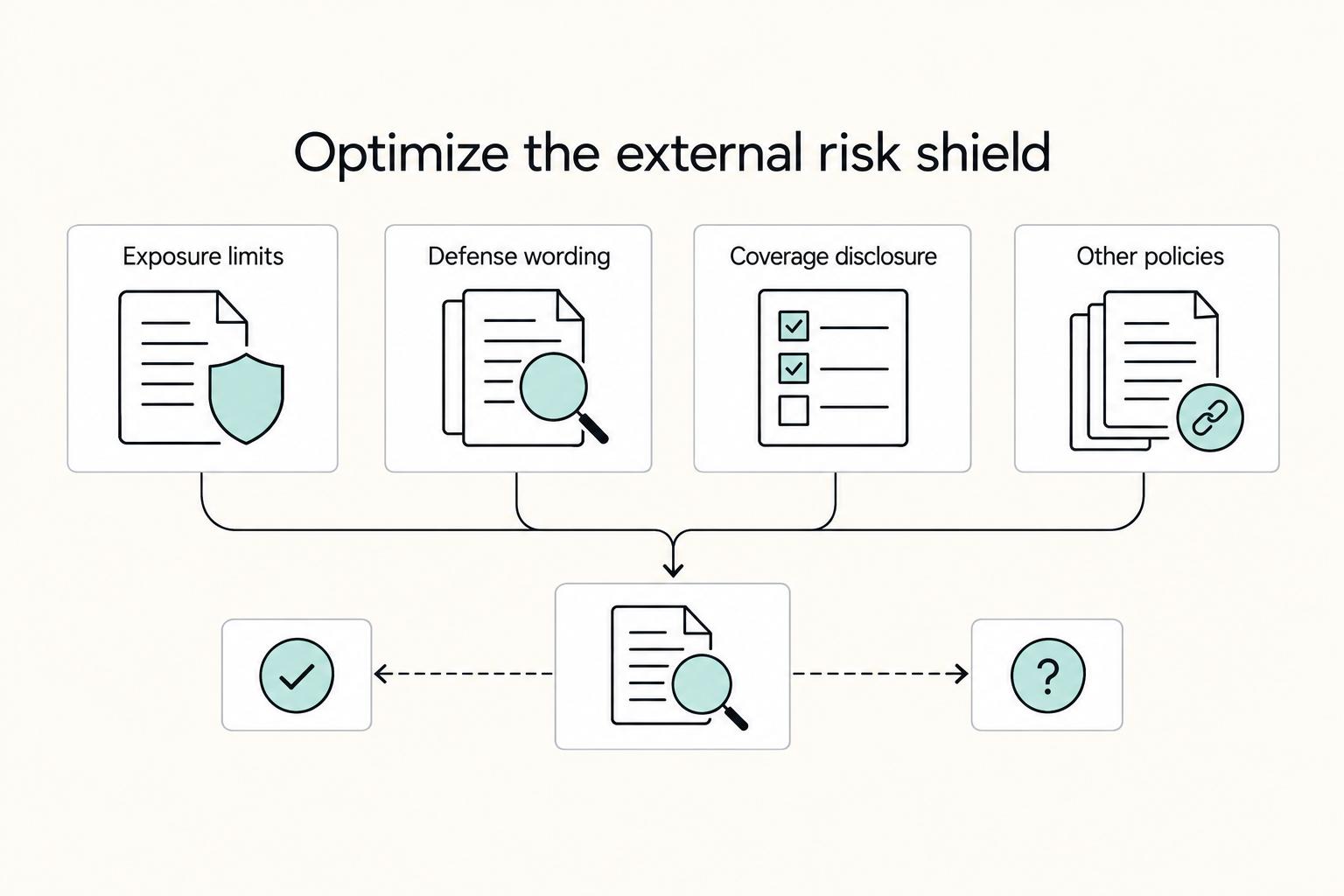
Once your internal controls are reliable, treat policy selection as a wording-and-cash-flow decision alongside price. Before you compare quotes, define three things in writing: the exposure you need covered, how defense costs could affect your cash flow, and where coverage could fail because of wording or insured-party setup. The available grounding is D&O-focused, so keep E&O-specific legal conclusions as verification items, not assumptions.
Choose limits by exposure, not folklore#
Do not anchor on market folklore when you choose limits. Build your approach from three inputs you can document now: client profile, service complexity, and the downside from one serious allegation.
Start by stress-testing concentration risk in your book. Then map complexity in your service model. Then pressure-test the cash impact if defense costs and settlement pressure arrive while coverage handling is delayed or disputed. Turn that into a one-page renewal memo with your largest plausible single-claim scenario, potential same-period multi-matter exposure, required minimums, and realistic retention tolerance. If you want a practical outside comparison point, review SmartAsset’s advisor E&O overview or a broker checklist, then compare price only after confirming the wording is materially comparable.
Read the defense wording for cash flow, not labels#
A quote can look competitive and still fail operationally if the defense mechanics are weak for your firm. Request specimen wording. Compare who controls defense, when defense costs are paid, whether costs erode limits, and what consent rules apply.
| Clause type | Cash-flow impact during a claim | Questions to ask your broker |
|---|---|---|
| Insurer defense obligation wording | The actual burden depends on the policy wording and claim handling process. | Who appoints counsel? When do payments begin? Do defense costs erode limits? |
| Insurer option or right to defend wording | Timing and control can vary if the carrier has discretion rather than a hard obligation. | When might we retain counsel first? What approvals are required for payment? |
| Reimbursement or advancement style wording | Short-term burden depends on documentation rules and payment timing. | What documentation is required? What are payment timelines? What happens during a coverage dispute? |
Also verify insured-party setup before binding. Match named insureds, entity names, affiliates, and individual practitioners against your actual operating structure and client-facing documents.
Disclose coverage without overselling it#
If you mention coverage during onboarding, keep the statement factual, narrow, and review-approved. The practical wording is that the firm maintains professional liability coverage subject to policy terms, limits, retentions, exclusions, and carrier handling decisions.
Do not describe coverage as a guarantee of payment or a promise that every claim will be handled the same way. Avoid absolute language, assign ownership for annual wording review, and date-stamp the approved onboarding language so it stays current at renewal.
Map the other policies before renewal#
Before renewal, map the rest of your insurance stack so you know where notice should start in a real event. Do not assume definitive boundaries between E&O, cyber, fiduciary, and general business policies; scenario-test the layers, then confirm boundaries in your actual declarations and endorsements. Use this coverage-gap check each renewal cycle:
- For your top three claim scenarios, which policy gets first notice?
- Where might two policies each point responsibility elsewhere?
- Which new services, channels, or entities are not clearly reflected in wording?
- Do declarations, endorsements, and insured names match current operations?
If your broker cannot walk through quote comparison, wording differences, insured-party setup, and gap mapping in plain language, keep checking the market before you renew. You might also find this useful: E&O Insurance for Management Consultants Who Need Contract-Ready Coverage.
Part 3: Run Your Practice So the File Explains Your Decisions#
If you want fewer claim surprises, run your practice so a third party can follow your decisions from the file alone. As an RIA, the standard is not only acting in the client’s best interests, but also being able to show that you did through clear records, repeatable communication, and visible oversight.
That approach also supports regulatory expectations. The Investment Advisers Act of 1940, SEC rules, and state securities laws set standards around honesty, disclosure, and recordkeeping, and regulators closely scrutinize core registration and compliance documents.
Turn the checklist into a control set#
A checklist only helps if it produces a coherent record. For each client, you should be able to produce one file that shows what you knew, what you recommended, what the client received, and how understanding was confirmed.
| Artifact | What to document | Where it lives | Who confirms it | What risk it prevents |
|---|---|---|---|---|
| Client profile and risk record | Client facts, goals, constraints, risk discussion, and completion date. | CRM or client file linked to onboarding. | Lead advisor or designated reviewer confirms it is complete before recommendations. | Advice challenged as unsupported by current client facts. |
| Recommendation rationale and planning record | Why the recommendation fits the profile, key assumptions, and meaningful alternatives considered. | Planning file or advice memo folder. | Advisor confirms before implementation; reviewer spot-checks higher-risk files. | Claims that advice lacked documented reasoning. |
| Client understanding confirmation | Written summary of the recommendation, main risks and tradeoffs, plus client acknowledgement or reply. | Timestamped correspondence folder. | Advisor sends it; admin or reviewer confirms it is saved. | Misunderstanding disputes and expectation gaps. |
| Current disclosure record, including the Form ADV used | Which Form ADV materials were delivered, the version date, and the location of the filed copy. | Central compliance folder with IARD filing record and delivery log. | Compliance owner or firm principal. | Disclosure mismatch, stale disclosures, and inconsistent firm statements. |
Timing matters as much as content. Documentation created only after implementation, or after a complaint, can look backfilled and weaken your position.
Set a repeatable communication cadence#
Many expectation problems are easier to prevent when your communication pattern is steady. At onboarding, explain scope, key risks, decision authority, and how recommendations will be documented. In routine reviews, restate what changed in the client’s circumstances, what changed in your advice, and what did not.
In volatile markets, send short written updates that separate market movement from actual advice, then state whether you recommend action, no action, or a follow-up discussion. After any material recommendation, include a client-understanding confirmation step and ask the client to confirm the recommendation, major risks, and intended action.
Choose education that improves defensibility#
Choose continuing education that makes your files stronger, not just your product knowledge broader. Prioritize ethics, fiduciary process, suitability analysis, disclosure, and recordkeeping topics. If two programs are comparable, choose the one most likely to improve how your files explain your decisions.
Keep a simple CE log with the course title, provider, date, topic, why you chose it, and any process change you made afterward. In the compliance file, maintain a dated checklist for SEC, state, firm, and credential-specific training obligations so you can show what was reviewed and when.
Build lightweight peer review#
Peer review is useful when it stays narrow enough to happen consistently. You can set this up with a trusted planner, compliance consultant, or another advisor who understands your service model.
Focus reviews on the files and decisions most likely to create trouble: complex recommendations, concentrated positions, unusual client instructions, communication templates, complaint-adjacent files, and files where client understanding seems uncertain. Trigger review when you add a service, materially change your advice approach, receive a written complaint, or see ambiguity in how a file would read to a regulator or claimant.
Document each review on one page: file reviewed, issue raised, feedback received, decision made, owner, and completion date. Keep both before-and-after records so follow-through is visible during renewals or claim response.
For related professional-liability context, see A Guide to Errors and Omissions (E&O) Insurance for Software Developers. As you formalize your checklist and paper trail, map your payment and payout controls to an auditable workflow in the Gruv docs.
Conclusion: Building on a Foundation of Confidence#
Use this rule going forward: keep your coverage aligned with the work you actually perform, and re-check that alignment whenever your practice changes. Even with E&O in place, policy wording and operational discipline still matter. Keep your operating checklist in three parts:
- Audit your risk. Re-map your real exposure based on your current clients, services, delivery model, and platform relationships. When any of those change, treat that as a trigger to review coverage terms and exclusions.
- Optimize your coverage. Confirm that the policy wording matches your actual advisory work and related services. Do not assume forms are standardized. Wording can vary, and coverage can sometimes be tailored, so review declarations, endorsements, exclusions, and service descriptions against your current risk map. Then verify alignment with any contractual or supervisory requirements, if applicable, and document what you reviewed, when, and with whom.
- Run tighter operating protocols. Maintain the records that show what you recommended, disclosed, promised, and completed: dated recommendation rationales, delivery records, task logs, scope language, and client acknowledgments. If a dispute arises, clear records help show what happened.
Start policy review early with the right internal team and broker. Aon’s December 7, 2023 insight noted non-standardized cyber and E&O wording and recommended starting early even in a softer market because terms can shift quickly.
Your next step is to review your current policy against your current risk map and close any process gaps before renewal. For a step-by-step walkthrough, see A Freelancer's Guide to Professional Liability (E&O) Insurance.
If your risk plan includes cross-border billing or payouts, talk to Gruv to confirm coverage, compliance gates, and rollout fit for your practice.
Frequently Asked Questions
What does e&o insurance for financial planners actually cover?
It is professional liability coverage for client claims tied to mistakes, negligence, alleged omissions, or failure to deliver a promised service. When a claim is covered, it can help pay legal defense costs, settlements, or court judgments. Start by checking whether the allegation arises from your professional services, such as investment advice, disclosure issues, or an administrative error, then confirm that the service is covered in your policy wording.
What does it not automatically cover, and when should you ask about fiduciary liability?
Do not treat this policy as blanket protection, because what falls outside coverage depends on your exact policy language. Ask your broker, in writing, to identify where coverage is limited, carved back, or conditioned in the declarations and endorsements. If fiduciary-liability questions come up in your work, treat them as a separate verification item and confirm in writing how your current policy responds.
Is E&O insurance required for you?
Use a decision framework, not a generic yes or no. Verify current requirements in your jurisdiction, then review any contracts or mandates that apply to your practice. If any of those sources requires coverage, the practical answer is yes, and you should log what you verified, when, and with whom.
What claims should you plan around, and how can that help with cost?
Plan around the exposure areas named here: investment advice, disclosure issues, administrative errors, alleged omissions, and failure to provide a particular service. For advice and disclosure disputes, keep dated recommendation rationales, the exact version delivered, and delivery records. For administrative errors and missed-service allegations, keep task logs with deadlines and completion proof, plus clear scope language and client acknowledgments. These controls can help you respond to disputes with a documented record; any pricing impact should be verified with your broker and policy terms.
How should you think about coverage limits and structure?
Start with your policy wording, then verify any legal, contractual, or supervisory requirements that apply to your practice before choosing limits or structure. Check whether the service descriptions and endorsements match the work you actually perform, whether the per-claim limit, aggregate limit, and deductible align with a claim your firm could survive, and whether any fiduciary-liability questions still need a written answer from your broker or counsel.
Try a related tool
Researched and edited by the Gruv editorial team. Gruv builds cross-border billing, payouts, and finance-operations software for global businesses.
Sources
Includes 7 external sources outside the trusted-domain allowlist.
- sec.gov/files/rules/final/2019/34-86031.pdftrusted
- acc.com/sites/default/files/resources/vl/membersonly...external
- advisorsafeinsurance.com/coverage-highlightsexternal
- affinity.marsh.com/wfg-tfa/insights/8-errors-omissions-insuranc...external
- aon.com/en/insights/articles/buyer-friendly-cyber-an...external
- aon.com/en/insights/articles/why-now-is-the-right-ti...external
- comply.com/resource/the-registered-investment-adviser-s...external
- fkblaw.com/wp-content/uploads/2015/12/PFAC-2014-Are-You...external
Educational content only. Not legal, tax, or financial advice.
Related Posts

A Freelancer's Guide to Professional Liability (E&O) Insurance
Set explicit checkpoints in your risk worksheet: day 30 intake review, day 60 contract review, day 90 claim-readiness review, and a 12-month renewal review.
Liability Insurance for Freelance IT Consultants: Do You Need It?
**Treat your insurance decision like risk management, not online shopping.** As an independent IT consultant, you can face a negligence allegation, a client financial-loss claim, and legal defense costs even when you delivered in good faith. One bad dispute can drain time, focus, and cash before anyone proves fault. If you run solo, you are the CEO of a business-of-one, and risk decisions are part of the job.

The Freelance Payment Penalty: A Modeled Audit of Platform Fees, FX Spreads, and Payout Delays
The money rarely disappears through a single, easy-to-spot fee. The real loss is stacked. A marketplace takes its commission, a processor adds a charge for international cards, a bank or payment company converts the currency at a spread, a platform holds the funds before release, and a wire sheds a little to intermediaries on the way in. Each layer looks defensible on its own, but the worker feels the combined result as a smaller deposit and a later payday.