
Quick Answer
Choose a source-to-pay model for your main gap: supplier sourcing, purchasing, AP or payment execution. A suite or integrated stack can work when approvals and records remain linked from supplier selection through reconciliation. Test uncertain payment outcomes, duplicate events and applicable controls before rollout; treat the 90-day plan as an illustrative pilot.
How source-to-pay works across the procurement lifecycle#
For platform teams, the pain usually does not sit in one isolated procurement task. It shows up in the handoff between finance, ops, product, and engineering as a supplier relationship moves from evaluation to agreement, purchasing, invoice review, and payout. A credible S2P platform should support that path end to end, not just the last mile of AP. In practical terms, the scope includes strategic sourcing, contract lifecycle management, procurement, invoice processing, and payment. You can frame S2P as four linked decisions:
- Source: You identify and evaluate suppliers before money moves. The differentiator is upstream control, because S2P starts with supplier sourcing rather than with an invoice arriving in a shared inbox.
- Contract: Terms, pricing, and obligations need to follow the commercial relationship. The differentiator is continuity, since contract management belongs in the same chain as purchasing and payment, not in a separate legal silo that finance cannot easily see.
- Buy: Requests, approvals, and purchasing activity turn intent into committed spend. The differentiator is operational traceability, because procurement is the bridge between strategic sourcing and downstream invoice processing.
- Pay: Invoice processing and payment close the loop. The differentiator is completeness, since payment without the earlier sourcing and contract context is AP efficiency, not full S2P coverage.
The first mistake to avoid is assuming any AP tool with invoice automation qualifies as Source-to-Pay. If a vendor cannot show how sourcing and contracting connect to buying and paying in one integrated process, your team will still be stitching together the truth across boundaries. That is where finance and procurement alignment starts to break down, especially when different owners need the same history for approval, spend review, and exception handling.
Before demos, ask the vendor to trace one supplier decision through contract, purchasing, receipt or service acceptance, invoice approval, payment and reconciliation. A suite or an integrated stack can do this. Check durable record links and enforced approvals across system boundaries; manual rekeying and unowned status conflicts are the red flags.
Selection Criteria That Separate Real S2P Platforms From Basic AP Tools#
If you need full Source-to-Pay coverage, filter for provable control across the whole lifecycle, not just a polished AP interface. A credible platform should carry one operational history from supplier sourcing through contract, purchase order, invoice, and payment, and let you export that history when exceptions happen.
Integrated lifecycle coverage#
Use lifecycle coverage as your first gate. Ask which system owns supplier approval, contracts, purchasing, invoice decisions, payment execution and accounting. Demonstrate linked records and enforced handoffs across those systems. A payment integration can be part of full S2P coverage when its decisions and outcomes remain traceable.
Compliance gates before payout#
For regulated payout programs, onboarding controls must be enforceable before funds move. KYC checks may be required before payout, and KYB is a separate business-entity check from individual KYC. Focus on whether the platform can actually block or release activity based on those checks and preserve those decisions for review, including AML controls where they are part of your risk model.
Exportable audit trail for finance#
Visual dashboards are not enough for close and audit. You need API- and webhook-level status history plus journal records finance can reconcile. Webhook events can provide machine-readable payment updates, and posting journals are part of the audit trail for ledger entries. If journals or event history are not exportable, reconciliation risk rises quickly.
Retry safety and reconciliation detail#
Require retry protection for money-moving and other non-repeatable operations. Ask vendors to demonstrate duplicate requests, concurrent retries and uncertain outcomes, then export the linked supplier, invoice, accounting and payment records. A repeated request must not create a second payment or accounting effect.
If you are only solving a domestic AP inbox issue, a narrower AP tool may be enough. If supplier management, payout complexity, or cross-border controls are in scope, these criteria help you avoid buying a tool that is too narrow. For teams considering a more outsourced model, see What Is Procurement as a Service? How Platforms Can Outsource Vendor Sourcing and Contracting.
The 5 S2P Automation Models Platform Teams Actually Buy#
Pick the model that removes your tightest constraint first. If invoice workflow is the issue, start there. If payout control and reconciliation are the issue, start there.
AP-first add-ons#
Best when you need invoice intake, coding, approval and payment coordination now, with sourcing handled elsewhere. Verify the actual AP scope: some tools stop at approved invoices and hand payment execution to another provider.
The upside is a narrower rollout focused on invoice intake, coding, and approvals. The tradeoff is weaker upstream control. In demos, confirm supplier record, contract reference, and PO are first-class objects linked to the invoice, not just free-text fields.
Procurement-first suites#
Best when supplier management, spend analysis, e-procurement, and PO control are the main gaps. These suites are built for integrated coverage across source, contract, request, procure, receive, and pay.
The tradeoff is that payments may be a downstream integration, which can duplicate parts of an existing payout stack. Require one end-to-end walkthrough from sourcing through payment handoff with no manual rekeying, or you risk strong procurement governance with weak payout visibility.
Payment-led infrastructure with procurement extensions#
Best when payment execution and status visibility are the bottleneck. Confirm provider-specific retry behavior rather than treating an idempotency key as permanent protection. For example, Stripe idempotency supports keys up to 255 characters and permits pruning after at least 24 hours. Persist the business operation and original request before submission. An unresolved payment needs status reconciliation before any replacement request.
The tradeoff is lighter upstream tooling for sourcing, vendor evaluation, and contract management. Validate early that procurement approvals can actually gate payout readiness, instead of living in a separate system with no enforcement link.
Modular hybrid stack#
Best when no single product fits every business line and you can own integrations. Combine sourcing, contract, AP, ERP and payment components around explicit record links and approval boundaries. Virtual accounts can support payment identification, but do not replace procurement controls.
The upside is flexibility during phased migration. The tradeoff is responsibility across systems. Name the owner of each decision and authoritative record. A Merchant of Record model applies to a sales relationship; do not assume it takes responsibility for your supplier procurement, tax treatment or payment approvals.
Outsourced procurement with embedded payments#
Best when your immediate gap is operating capacity, not software features. Procurement outsourcing is a real model where activities such as sourcing, category management, and transaction management move to a third party.
The upside is external execution support while payments run on embedded rails. The tradeoff is dependency risk and weaker direct process control. Before you sign, set escalation paths, approval boundaries, and evidence access so you do not lose critical operating knowledge.
Once you match the model to your dominant problem, shortlisting gets simpler and tradeoff comparisons become more useful. Related: What Is AP Automation? A Platform Operator's Guide to Eliminating Manual Payables.
Comparison Table for Fast Shortlisting#
Use this table to cut weak fits before demos. If a vendor cannot answer the compliance and integration checks below in writing, treat it as a no for now.
| Model | Best for | Core strengths | Main tradeoff | Must-verify before selection |
|---|---|---|---|---|
| AP-first add-ons | Fast AP cleanup | Invoice automation, accounts payable | Thin supplier sourcing depth | Contract management and purchase order controls |
| Procurement-first suites | Complex sourcing governance | Supplier management, spend analysis, e-Procurement | Slower payout-native execution | API/Webhooks maturity and payout handoff quality |
| Payment-led infrastructure | High-volume payout operations | Payout batches, virtual accounts, idempotency | Lighter upstream procurement UX | Procurement lifecycle coverage and approval logic |
| Modular hybrid stack | Phased modernization | Choice of procurement, ERP and payment components | Integration and ownership complexity | Authoritative records per system and reconciled links |
| Outsourced procurement + embedded payments | Lean teams scaling quickly | Faster vendor evaluation and sourcing operations | Dependency on external operators | Escalation paths, SLA clarity, compliance boundaries |
Score each row against three separate needs: Source-to-Pay, Procure-to-Pay, and payout execution. A common miss is over-scoring invoice or supplier strengths while payment status, reconciliation, or tax handling still depends on manual handoffs.
Ask the vendor to link a supplier, contract, purchase order where required, receipt or service acceptance, invoice and payment reference. For approved non-PO spend, demonstrate the authorized exception and evidence instead of inventing a PO. Structured links across tools are acceptable; free-text references without validation or unresolved CSV handoffs need further control.
Compliance questions that should kill deals early#
Late launch risk often sits in document and verification gaps, not headline features. Require explicit answers on KYC, KYB, AML, VAT validation, and tax-document support where those controls are enabled for your program and jurisdictions. Ask with exact document names:
| Artifact | What it is | What to confirm |
|---|---|---|
| Form W-9 | US person taxpayer identification and certification | Collection, review and reporting linkage where required |
| Forms W-8BEN / W-8BEN-E | Foreign individual / entity status documentation; other forms may apply | Correct form for status and payment, review, changes and expiry |
| Form 1099-NEC | Payer information reporting for reportable nonemployee compensation | Determine reportability, tax-year rules, filing and recipient copies |
| VAT registration validation | Registration evidence from the relevant authority | Save validation results; separately determine transaction VAT treatment |
First have the program owner determine which controls apply to the payer, supplier, transaction and jurisdiction. Then test collection, review, expiry, exceptions and exports for the required records. VIES registration validation does not determine an entire VAT treatment. US Bank Secrecy Act duties depend on the covered entity and activity; ordinary procurement software does not become a regulated financial institution merely by handling invoices.
Integration checks worth doing before technical review#
Run these checks before deep architecture work. Webhooks are useful because they push real-time event data, but webhook support alone does not prove audit readiness.
| Check | Details |
|---|---|
| API coverage | Supplier, contract, purchase order, invoice, payment, and status history |
| Webhook quality | Event types, retry behavior, and payload fields your ops team can act on |
| Ledger journals granularity | Trace between general ledger, subledgers, and originating transactions |
| Idempotency behavior under retries | Repeat requests do not execute the same operation twice during failures or timeouts |
Use one failure test in the demo: replay a webhook and retry the same payment or state-change request. Idempotency supports safe retries, but you still need to see how the product handles duplicate events, stale states, and reconciliation exceptions.
For a modular stack, name the authoritative source for each record: procurement owns approvals, the payment provider supplies execution outcomes, and the accounting system owns posted journals. Reconciliation links these records and resolves differences; one dashboard or journal export does not replace their distinct roles.
For a closer look at the sourcing and vendor-management side, see What Procurement Means for Platform Operators Managing Strategic Sourcing and Vendors.
Decision Rules for Choosing Without Analysis Paralysis#
Choose the model that removes your current bottleneck first, not the one with the longest feature list.
Choose payment-led when execution reliability is the pain#
If payment failures, retries and missing outcomes dominate the workload, start with payment execution and reconciliation. Test duplicate and out-of-order events, concurrent requests and a timeout after provider acceptance. A timeout must leave the operation unresolved while its status is checked, rather than authorize a new payment.
Choose procurement-first when sourcing control is the pain#
If supplier selection, contract drift, purchasing approvals or spend visibility are the gaps, start with procurement coverage. Trace decisions into invoice approval and payment authorization, including receipts, service acceptance and approved non-PO exceptions. Test enforcement across integrated systems rather than requiring every screen to belong to one product.
Avoid modular hybrid if no one can own the joins#
Hybrid can cover more of the lifecycle, but only when your team can own APIs, webhooks, retries, and journal mapping across tools. Require a named owner and a written source of truth for ledger journals, approval status, and payout references. If that ownership is unclear, implementation risk rises toward overruns, misalignment, and delays.
Reject vague cross-border compliance answers early#
When cross-border tax and onboarding are in scope, require support for the documents and checks that actually apply. Form W-8BEN is for individuals; foreign entities may require W-8BEN-E or another appropriate form. Define US reporting obligations and the applicable tax-year filing deadlines with the reporting owner. For VAT, verify the relevant registration through the appropriate authority: VIES does not cover ordinary GB numbers, while XI registration concerns Northern Ireland goods transactions with the EU.
Phase by risk if you need both control and speed#
If you need fast launch and tighter controls, phase implementation instead of changing everything at once. Stabilize accounts payable and invoice automation first, then expand to supplier sourcing and contract management once status history, journals, and tax-document handling are reliable.
For a deeper look at the AP portion of source-to-pay, see Accounts Payable Automation for Dummies for Platform Operators.
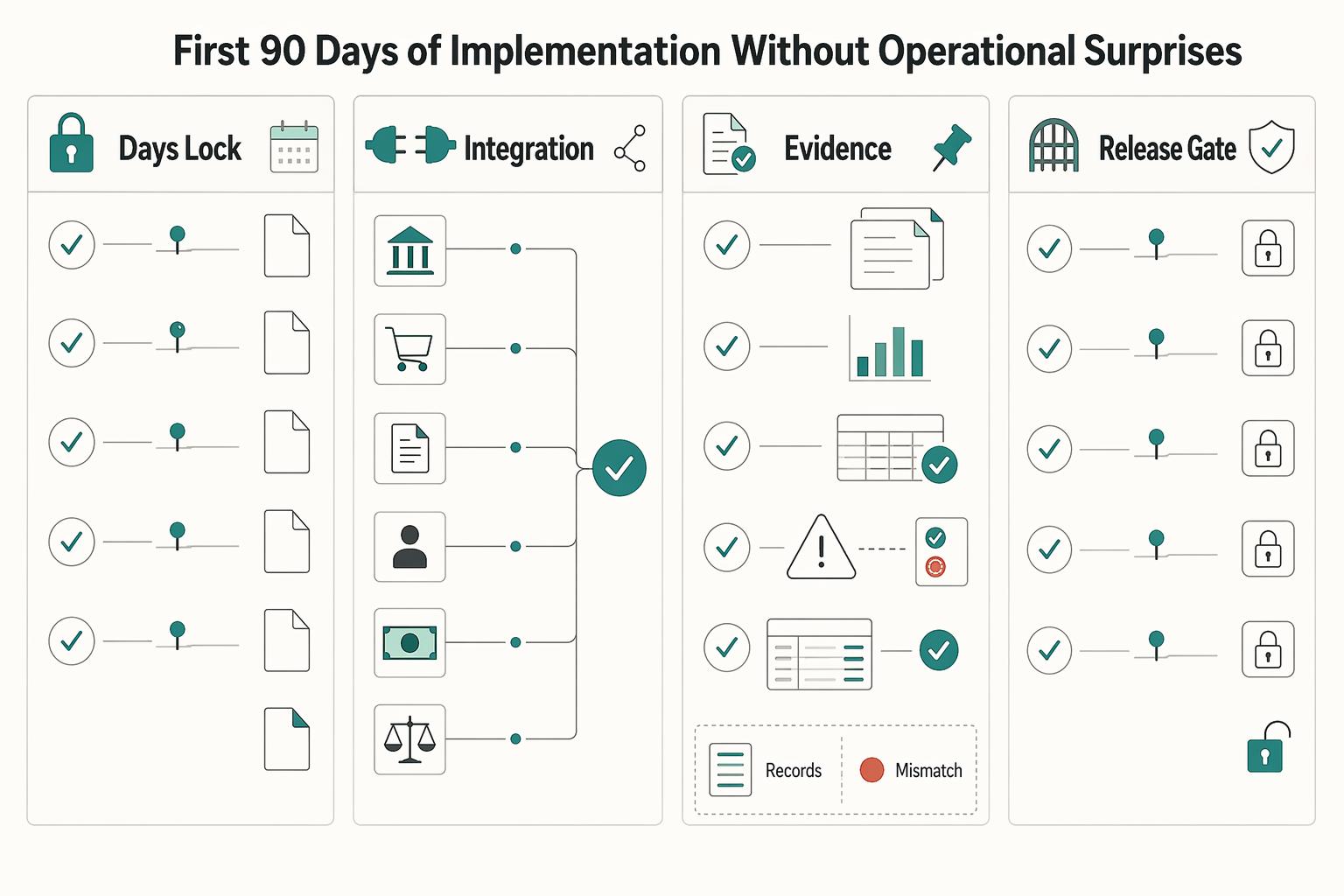
First 90 Days of Implementation Without Operational Surprises#
Use the following 90-day outline as an illustrative pilot plan, not a promised implementation duration. Scope, integrations, controls and migration evidence determine readiness; calendar dates do not authorize cutover.
| Phase | Primary focus | Checkpoint |
|---|---|---|
| Days 1 to 30 | Lock ownership and phase-one scope around the real workflow | Trace one sample transaction from supplier setup to final payout reference without spreadsheet stitching or tribal knowledge |
| Days 31 to 60 | Implement integrations in a retry-safe sequence | Sandbox-test duplicate and concurrent delivery, provider acceptance with a lost response, status lookup and one financial effect |
| Days 61 to 90 | Compare shadow records with one live payment writer | Meet documented tolerances and evidence gates; unresolved operations stay owned and protected from replacement |
Days 1 to 30: lock ownership and phase-one scope around the real workflow#
Map how work actually moves across Source-to-Pay and Procure-to-Pay: supplier management, purchase order creation, invoice automation, approvals, payout initiation, and reconciliation. Assign a named owner to each step, including tax document review, payment exceptions, and ledger export checks. Your checkpoint is simple: can you trace one sample transaction from supplier setup to final payout reference without spreadsheet stitching or tribal knowledge? If not, tighten the scope before moving on.
Days 31 to 60: implement integrations in a retry-safe sequence#
Before enabling submissions, implement authenticated APIs, verified webhook receipt, durable request records, approval enforcement and duplicate protection. Then connect provider status retrieval, journal mapping and exception reconciliation. Test in a sandbox first. Reuse the original key and payload only within the provider contract; if the result remains unknown or the key expires, reconcile the existing operation before a replacement. Deduplicate verified event deliveries and protect each business effect against concurrent workers. Retrieve authoritative status when events are missing or out of order.
Days 61 to 90: run parallel operations until cutover evidence is complete#
Run parallel reconciliation and compare intended operations, provider outcomes, journals and cash settlement. Use a single designated writer for actual payments: a shadow system may calculate and compare but must not submit the same obligations again. Test applicable holds, manual review and release paths. Document required evidence, tolerances, unresolved-operation ownership and rollback rules before broader rollout.
Use failure drills as a go-live gate, not a status meeting#
Include drills for duplicate webhook replay, stale status handling, unmatched payout or deposit investigations, and rollback triggers. Confirm reconciliation can surface open exceptions for the current period and route them to a named owner. A practical readiness test: if an event arrives twice or a payout settles without a matching record, can your team pull request history, event history, ledger journal entries, and exception notes quickly?
Controls and Evidence Finance and Auditors Will Ask For#
After the pilot, the test is proof, not possibility. Your baseline should be clear: for every transaction chain, you can show what happened end to end without digging through chat threads or raw logs.
Require one linked evidence pack for each transaction chain#
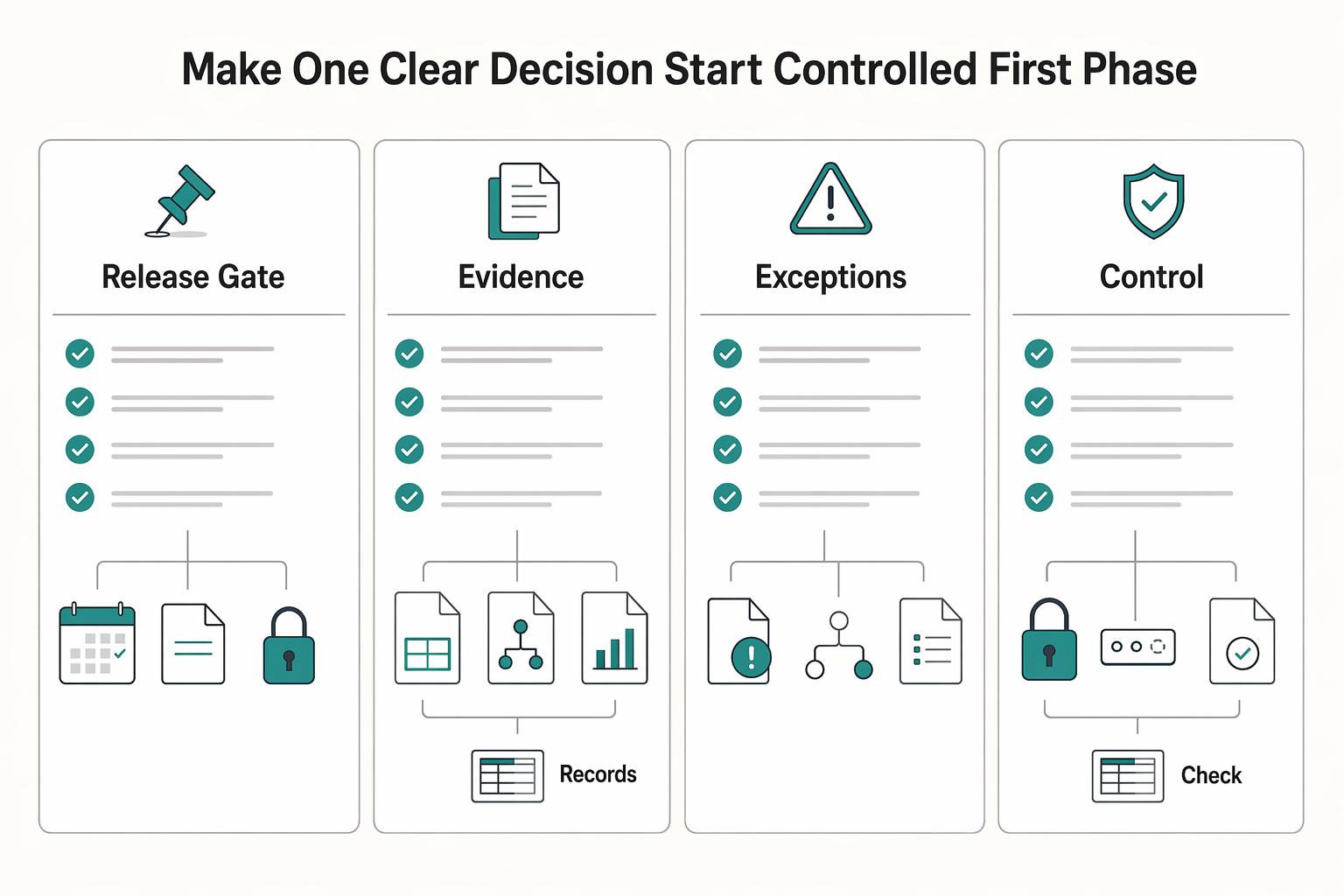
For each purchase order, invoice, and payout flow, retain five linked records: the original request record, the policy decision record (KYC, KYB, or AML where applicable), the provider reference, the ledger journals, and the reconciliation export used by finance. Linkage is the control. If a payout settles and you cannot retrieve the matching provider reference and journal entries quickly, you have fragments, not an audit trail.
Run a sample retrieval check before each phase gate: start from the payout reference and trace back to invoice and request without engineering intervention. Keep event detail, not just final status.
Assign explicit ownership for tax and compliance artifacts up front#
Assign tax-document collection, review and information reporting to named owners. US persons generally provide Form W-9 when requested for information reporting; foreign individuals and entities use the appropriate W-8 form based on their status and payment. These forms are not interchangeable. FBAR and foreign earned income exclusion are separate taxpayer matters, not generic supplier onboarding or payment-release requirements.
A practical split is: one team collects, one team reviews, and one team decides what blocks payment release.
Make status-transition history visible across PO, invoice, and payout states#
Retain transitions for purchasing, invoice approvals and payment operations, including time, actor or event, reason and source record. Link provider updates to the internal operation and accounting entries. Do not infer settlement merely from a webhook delivery or an internal approved status; reconcile provider and cash records separately.
Validate this with replay plus case review: resend an event, confirm no duplicate business outcome, and confirm the case record shows who reviewed the exception and why it was closed.
Use phase gates based on control evidence, not confidence#
For broader rollout, inspect control effectiveness, exception resolution and complete exports. If a covered financial institution is responsible for US customer due diligence, confirm its current rules and provider requirements. FinCEN’s February 13, 2026 relief changes repeat-account beneficial-owner identification requirements; initial identification, doubts about existing information and risk-based ongoing due diligence remain relevant. Do not apply that institution-specific rule to every procurement supplier.
If any one of these checks is weak, hold the gate. Early tolerance for weak exception handling usually becomes a month-end reconciliation problem later.
Common Failure Modes in S2P Automation and How to Catch Them Early#
Most S2P failures come from fragmented ownership, unclear transaction truth, and retry behavior that was never tested. Before cutover, pressure-test these four areas across the full lifecycle, not just invoice intake.
AP-first automation with manual upstream controls#
AP automation does not fill a sourcing or contracting gap by itself. In a full S2P process, link upstream decisions to purchasing and payment controls even when different tools own them. Uncontrolled manual handoffs can lose approvals or contract terms as volume grows.
Sample transactions from supplier selection through contract approval, purchasing, invoice decision and payment release. Verify who owns each decision and whether required approvals are enforced across systems. An external contract tool is compatible with the process when the approved contract and downstream controls stay linked.
No agreed transaction truth between procurement and payout#
If procurement and payout tools show different outcomes for the same chain, AP ends up reconciling two versions of reality. You need one defensible financial record for settled outcomes, with ledger journals linked to provider references and reconciliation exports.
Compare invoice approval, provider outcome, posted journal and cash settlement for the same obligation. Distinguish committed, submitted, settled and returned states. Investigate missing links or timing differences under a named owner; invoice approval alone does not prove payment or settlement.
Webhook handling without idempotency#
Webhook consumers should assume duplicate delivery and retry behavior, so handlers must be idempotent. If every delivery mutates business state, retries can reopen cases, duplicate approvals, or trigger another payout attempt.
In a sandbox, replay an event, deliver two related events concurrently and simulate a lost response after payment acceptance. Keep the operation unresolved until provider lookup or reconciliation establishes its outcome. Retry with the original request identity only as the provider contract allows; a new key, rail or shadow-system submission must not create a second payment for that obligation.
Compliance added after the happy path works#
KYC and AML policy gates should be designed as core flow logic, not a late add-on. Payment and payout capabilities can be blocked until KYC requirements are fulfilled, depending on setup and jurisdiction.
Catch this before launch by testing exception paths such as missing verification data, review-required states, and post-resubmission approval. Your evidence should show the policy decision, the blocked action, and the release event from hold to recovery.
For more on scaling AP operations without adding headcount, see Finance Automation and Accounts Payable Growth: How Platforms Scale AP Without Scaling Headcount.
Frequently Asked Questions
What stages are included in the full S2P lifecycle?
A full lifecycle usually includes need identification, supplier sourcing, contracting, purchasing, invoice processing, and payment. If a vendor only shows you invoice capture and approval screens, you are likely looking at a narrower Procure-to-Pay or AP tool, not full S2P coverage.
How is Source-to-Pay different from Procure-to-Pay?
S2P adds supplier sourcing and contracting before the transactional purchasing, receiving, invoice and payment flow of P2P. This describes process scope. A suite or integrated stack can cover the full lifecycle when the sourcing and contract decisions remain linked to downstream controls.
What does an S2P automation platform actually automate versus a basic AP tool?
An AP tool typically handles invoice intake, approval and payment coordination. S2P also covers supplier sourcing, contracting and purchasing. Ask whether decisions, records and payment outcomes stay linked across the chosen tools and whether required approvals are enforced before release.
What should platform teams evaluate first when selecting a vendor?
Start with your biggest friction point, not the longest feature checklist. If your pain is reconciliation and payout-status blind spots, verify payment-status visibility and audit trails. If your pain is sourcing chaos, test supplier and contract controls first. Red flag: a vendor demos polished approvals but cannot show clear auditability or status history.
How long does a realistic first implementation phase usually take?
There is no universal timeline, and you should be suspicious of one. What is well supported is the rollout pattern: phase it instead of trying a disruptive big bang launch. In practice, keep the first phase scoped and validated before broad rollout.
What controls prove the process is audit-ready, not just automated?
For PO-based goods, compare the purchase order, receipt and invoice; use documented service acceptance or an approved non-PO control where appropriate. Retain approvals, provider references, accounting entries and reconciliation evidence. Scope tax forms and onboarding checks to the actual payer, supplier and transaction, with named review and release owners. For a step-by-step walkthrough, see What Is Vendor Management? A Platform Operator's Guide to Supplier Lifecycle Control.
Try a related tool
Researched and edited by the Gruv editorial team. Gruv builds cross-border billing, payouts, and finance-operations software for global businesses.
Sources
Includes 2 external sources outside the trusted-domain allowlist.
- docs.stripe.com/api/idempotent_requeststrusted
- docs.stripe.com/webhookstrusted
- europa.eu/youreurope/business/finance-and-tax/vat/chec...trusted
- fincen.gov/news/news-releases/fincen-issues-exceptive-r...trusted
- irs.gov/forms-pubs/about-form-w-9trusted
- irs.gov/forms-pubs/about-form-w-8-bentrusted
- gov.uk/register-for-vat/selling-or-moving-goods-bet...external
- ibm.com/think/topics/source-to-payexternal
Educational content only. Not legal, tax, or financial advice.
Related Posts

How Platform Teams Scale AP Volume Without Adding Headcount
Use this as a decision list for operators scaling Accounts Payable, not a generic AP automation explainer. In these case-study examples, invoice volume can grow faster than AP headcount when the platform fit is right, but vendor claims still need hard validation.
What Is AP Automation? A Platform Operator's Guide to Eliminating Manual Payables
AP stops feeling like a back-office admin task once your platform is processing more supplier and vendor payables. At that point, **ap automation for platform operators** is about controlling operational risk as much as efficiency. Manual AP is slower, more error-prone, and more expensive, and those weaknesses surface fast as volume rises.
What Is Procurement as a Service? How Platforms Can Outsource Vendor Sourcing and Contracting
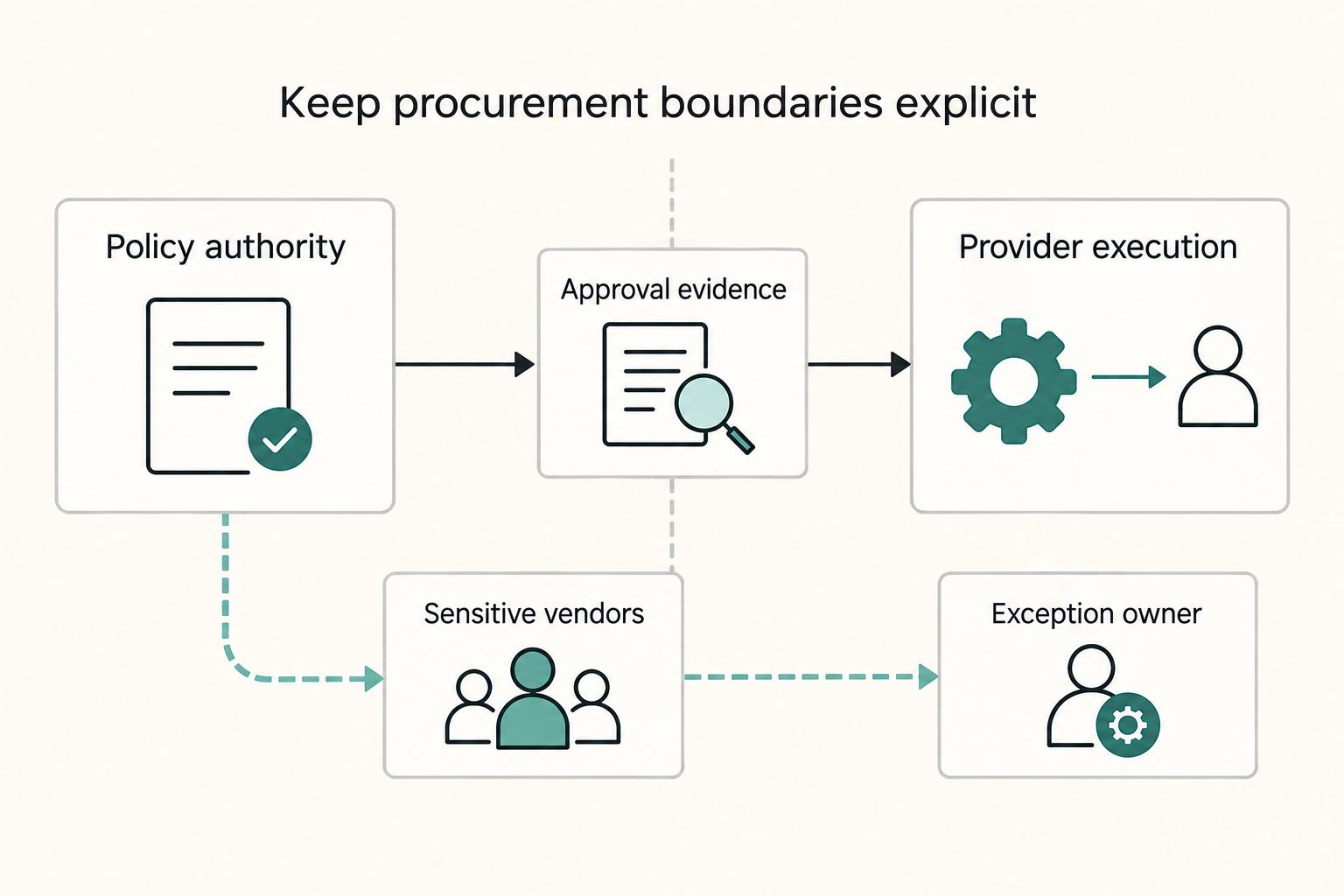
If you are evaluating procurement as a service for vendor sourcing, start by drawing control boundaries before you outsource anything. Hosted services can scale quickly, but faster access to vendors or contracts does not automatically mean better procurement. The harder question is still who owns approvals, evidence, and exceptions.