
Quick Answer
Start by separating AP approval from payout execution, then connect them with evidence at every handoff. In practice, map supplier invoices and PO matching to one payment instruction, one provider reference, and posted ledger journals before you scale volume. Keep ERP as the payable record system, and test a controlled payout batch so finance can reconcile outcomes without spreadsheet backfills. When approvals are stable but disbursements fail or duplicate, prioritize idempotency, webhook handling, and exception ownership.
What Paying Suppliers at Marketplace Scale Requires#
For many retail and ecommerce finance teams, AP automation is the starting point because the first pain is usually obvious: too many invoices, too much manual approval chasing, and not enough visibility into what is owed. Accounts payable is the money you owe suppliers and vendors for goods or services bought on credit, and automation reduces the manual work that slows processing and creates human error.
The catch is that invoice approval is only part of the job. Many AP tools can automate invoice digitization, matching, approval routing, payment processing, and reporting or reconciliation. Some also extend into supplier management, PO management, tax compliance, and global remittance.
But once you are paying a large number of suppliers, often across currencies or countries, the question changes. It is no longer just "can we approve this invoice?" It becomes "can we reliably execute and track the payout to the right party, through the right rail, with the right records in place?"
That is where payout complexity shows up. A clean AP process can still leave gaps if execution is inconsistent, supplier data is incomplete, or exceptions are handled outside your main records.
Teams often discover this late. An invoice is approved, but the payment cannot go out because supplier verification is missing, payment records are incomplete, or the payment method needed is not available in the program you planned to use. When that happens near month end, reconciliation pain follows quickly.
This article helps you avoid that gap. It walks from supplier invoices and PO matching through approvals, payout execution, controls, and month-end reconciliation, with enough detail to decide what to fix first. If your current pain is slow intake and approvals, stabilize AP data and routing before you add custom payout logic. If your pain is failed, duplicate, or hard-to-trace supplier disbursements, better invoice handling alone will not solve it.
One scope note matters up front. Capabilities such as KYB, tax handling, and rail coverage vary by market and by program. Do not assume that a feature shown in a demo applies to every supplier country, entity, or payment flow you run.
A practical checkpoint at each phase is to verify three things before you scale volume: what supplier information and business verification are required, what tax records must be collected and maintained, and what payout coverage actually exists for the suppliers you intend to pay. Building those checks in early can reduce rework in approvals, payment instructions, and close processes as volume increases.
Define the operating model before buying more tools#
Treat this as two connected jobs before you buy another tool: AP decides and records what should be paid, while marketplace payout execution is the step where money reaches suppliers.
| Pain signal | Prioritize first |
|---|---|
| Invoice backlog | Fix AP workflow first |
| Late approvals | Fix AP workflow first |
| Weak coding | Fix AP workflow first |
| Late vendor payments | Prioritize payout execution readiness first |
| Supplier account holds | Prioritize payout execution readiness first |
| Unclear payment outcomes | Prioritize payout execution readiness first |
AP automation is strongest in the invoice workflow. It helps when you have continuous, high-volume invoice inflow by digitizing capture, routing approvals, and matching so teams can scale with less manual error. But approval alone is not payment completion, and that gap is where teams lose visibility.
Keep the operating model explicit. Upstream purchasing documents and invoice data still need to move cleanly between your ERP and suppliers, then into payment execution records your team can track. Before you scale volume, confirm you can follow each payment from invoice and approval through instruction and final recorded outcome, without relying on email or spreadsheets.
Use a practical decision rule:
- If pain is invoice backlog, late approvals, or weak coding, fix AP workflow first.
- If pain is late vendor payments, supplier account holds, or unclear payment outcomes, prioritize payout execution readiness first.
The common mistake is buying more AP tooling when the operational failure is downstream payment execution.
Related: Finance Automation and Accounts Payable Growth: How Platforms Scale AP Without Scaling Headcount.
Map the end-to-end flow from invoice to closed books#
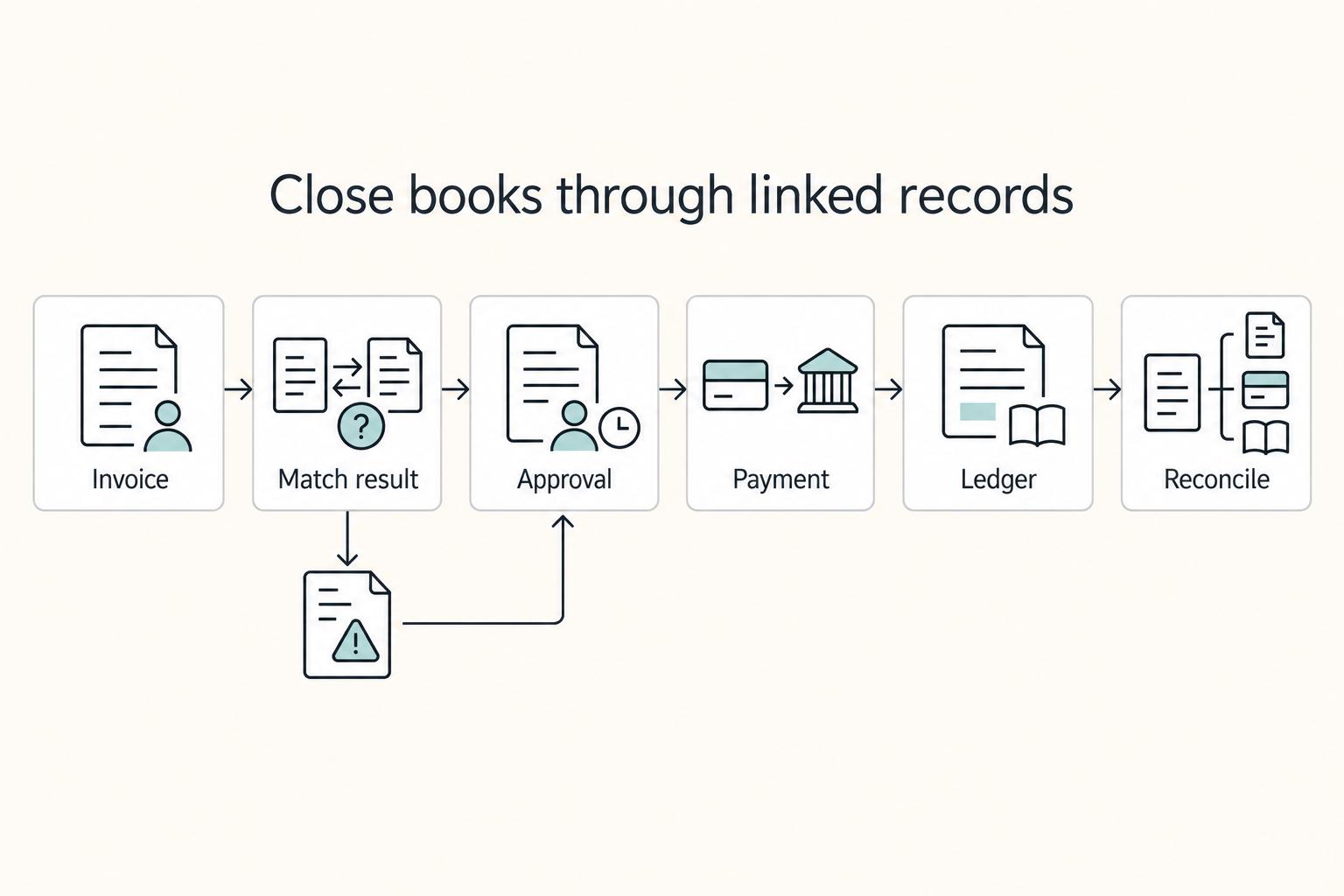
Make each handoff traceable from invoice to reconciliation, or your close will rely on manual explanation instead of records. In practice, full-cycle Accounts Payable (AP) runs from PO activity through invoice receipt, coding, approvals, payment, and reconciliation, so each step needs a clear system record.
Use your Enterprise Resource Planning (ERP) system as the financial and master-data backbone for AP records. If you run an OMS, keep it focused on order lifecycle status and coordination rather than financial truth.
| Step | Record to verify |
|---|---|
| Supplier invoice received | Invoice record, supplier ID, date, amount |
| PO matching and coding | Match result, exceptions, coding fields |
| Approval | Approval record with approver, timestamp, amount |
| Payment instruction | Payment request or batch record linked to the payable |
| Payment outcome | Provider reference and final status |
| Ledger journals | Journal posting ID, posting date, account mapping |
| Reconciliation | AP liabilities aligned with payment outcomes and posted entries |
Focus on status transitions and evidence at each hop. After matching, the invoice should clearly show matched, exception-routed, or blocked; after approval, there should be a system approval record; after payment, there should be a provider reference tied back to the payable; after posting, there should be a journal ID in the ledger trail.
At close, reconcile the three views that matter: open AP liabilities in ERP, payment outcomes from your execution layer, and posted ledger entries. Any item that looks paid in one system but open or unposted in another is the gap to fix first.
If part of the workflow may move to a partner, see Accounts Payable Outsourcing for Platforms When and How to Hand Off Your Payables to a Third Party.
Pick architecture by operating constraints, not vendor demos#
Pick the architecture based on where operational risk sits today, not on which demo looks smoother. If your main friction is approvals, coding, and close visibility, ERP-led AP automation is often enough. If you are orchestrating payouts across many sellers, entities, or countries, payout execution usually becomes the harder control surface, and API-led orchestration becomes more important.
That distinction matters because marketplace operations are different from standard vendor payment runs. Marketplaces can require payment orchestration across large seller networks, and payment infrastructure runs through banks, gateways, compliance checks, and operations. When execution risk outweighs approval workflow risk, state control matters more than demo polish.
Where each model is strongest#
ERP-first AP automation is usually strongest for finance-led control from invoice to liability to close. Integration effort can be lower when ERP/AP already owns supplier data, coding, approvals, and payment-file workflows. In lower-complexity, single-country operations, that can be the fastest path to reliable execution.
API-first payout orchestration is usually stronger when payout logic itself is complex. That includes multi-party splits, async provider outcomes, retries, returns, and cross-entity routing. If payment behavior is product-like rather than a simple back-office batch, direct API control is often a better fit.
The core tradeoff is visibility versus control: ERP-led models are often simpler for finance day to day, while API-led models give engineering tighter control over payout state and exception handling. The failure mode is split ownership of exceptions.
| Criterion | ERP-first AP-led questions | API-first payout-led questions | What to verify in both cases |
|---|---|---|---|
| Payout batches | How are approved payables grouped, released, and tracked back to payable records? | How are batch creation, partial failures, and resubmissions surfaced to finance? | Batch ID, supplier count, amount total, and partial-failure handling |
| Idempotency | How are duplicate submits prevented during UI actions, imports, or reruns? | How are duplicate payout requests and retry replays prevented or detected? | Documented duplicate-prevention method and tested retry behavior |
| Webhook maturity | If provider events are indirect, how do status changes reach finance systems? | Which event types drive state transitions, and how are missed events replayed? | Event/status evidence tied to internal payout references |
| Reconciliation exports | Can finance export outcomes with payable and posting identifiers? | Can finance and engineering access the same outcome data without monthly custom joins? | One report/export linking approval, execution, and ledger evidence |
| Cross-entity controls | How are entities, brands, and bank accounts separated in approvals and payment setup? | How is routing controlled by entity/country before execution? | Clear entity-level mapping across supplier records, payment accounts, and reports |
Decision rules that hold up in practice#
If you are still mostly running standard AP flows, start by confirming whether ERP should remain the operational foundation. As volume rises, early tools and manual workflows can become scaling bottlenecks, so strengthening ERP-centered AP automation is often the right first move.
If your model is becoming more marketplace-like, pressure-test AP-suite-led execution more aggressively. In multi-vendor flows, complexity and cost can scale with payout structure and risk, not just sales volume. In that pattern, API-led payout control often earns its keep while ERP remains the accounting system of record.
A practical test is to evaluate each architecture against recent exception cases, not only happy-path payouts. If teams cannot trace exceptions through the same internal records from payable state to payout outcome to ledger impact, ownership or system boundaries are still unclear.
Hybrid is common, but ownership must stay sharp#
A hybrid model is often the practical endpoint: ERP/AP for approval and liability state, payout infrastructure for execution and event handling. That split matches how accounting truth and money-movement truth relate without being identical.
Hybrid only works if ownership stays explicit. Keep one source of truth for each state transition and one owner for payout exceptions end to end. Dual retry logic across systems is a common risk pattern because it can create duplicate disbursement attempts and reconciliation noise.
Automate in the right order to avoid expensive rewrites#
Sequence is a control decision, not a tooling preference: stabilize intake and approvals first, then automate execution, then harden close. If you automate payout routing before supplier data and approval states are reliable, you just move bad inputs faster and create expensive cleanup later.
| Phase | Focus | Checkpoint |
|---|---|---|
| Phase 1: lock the approval truth first | AP automation, PO matching, and duplicate controls | Recent invoices should show consistent supplier ID, legal entity, approval record, coding outcome, and PO or non-PO status |
| Phase 2: automate execution only after contracts are stable | API flows, webhooks, payout batches, and status dashboards | One approved payable maps cleanly to one payout request, one provider reference, and one user-visible status path |
| Phase 3: harden controls for close and exceptions | Ledger journals, reconciliation packs, and exception SLAs | Keep approval record, execution reference, status event history, and final journal outcome in the same reconciliation pack |
Phase 1: lock the approval truth first#
Start with AP automation, PO matching, and duplicate controls. The goal is to make invoice capture, coding, approval routing, and payment tracking consistent inside the full-cycle AP flow from purchase orders through payment and reconciliation.
This is the right first move because manual ERP invoice keying is slow and risky, and disconnected AP steps increase payment-error and fraud exposure while straining vendor relationships. If volume is climbing toward 10,000+ invoices per month, unstable intake data becomes a scaling blocker.
Checkpoint before Phase 2: in a sample of recent invoices, you should see consistent supplier ID, legal entity, approval record, coding outcome, and PO or non-PO status. If you use 3-way matching, the result should exist as a system state, not an inbox or spreadsheet note.
Phase 2: automate execution only after contracts are stable#
Once approval policy and data contracts are stable, automate execution with API flows, webhooks, payout batches, and status dashboards. Your state model must hold up under retries, partial failures, and asynchronous responses.
If engineering bandwidth is limited, do not start with custom payout routing. First lock the payment instruction contract: which fields leave AP or ERP, which internal payable ID anchors each disbursement, and how execution outcomes return.
Checkpoint: for a small batch, one approved payable should map cleanly to one payout request, one provider reference, and one user-visible status path. If that path still requires manual joins, execution is not ready to scale.
Phase 3: harden controls for close and exceptions#
Last, tighten the controls that make month-end close defensible: ledger journals, reconciliation packs, and exception SLAs. This is where finance proves what happened, why it happened, and how it lands in the books.
For each failed, returned, or retried payment, keep approval record, execution reference, status event history, and final journal outcome in the same reconciliation pack. If finance can close a payable before the payout layer has a final outcome, expect reopened liabilities and journal rework.
For controls around invoice and bank-detail fraud, see How Platforms Stop Business Email Compromise in Accounts Payable.
Put compliance and tax gates in front of payout scale#
Only release payouts after compliance and tax gates pass. Treat KYC, KYB, AML, and tax-document status as release conditions for funds, not follow-up work after a payable is approved.
Payment automation can process transactions almost instantly, so your control model has to be just as explicit. Define who holds funds and who is liable when something breaks, then map that ownership to payout holds and exception handling.
Make payout release conditions binary#
Set clear release states for each supplier type and program. At minimum, require an approved payable, valid payment instructions, and the required compliance status before payout release.
Use system states, not notes. Your payout layer and AP or ERP records should align on statuses like pass, fail, pending, or expired so releases are auditable.
As a checkpoint, sample a small batch and confirm each disbursement traces to a supplier compliance decision, timestamp, and the internal payable ID. If releases depend on email or chat overrides, control gaps usually follow.
Treat W-8 and W-9 capture as payment prerequisites where enabled#
Where your program requires them, collect W-8 and W-9 before payout release. A digital W-9 supports accurate vendor tax data capture and taxpayer validation before filings, and the same gating approach keeps tax-document handling aligned with payment execution.
If you need downstream reporting such as Form 1099, build the document gate up front so payment and reporting records come from the same supplier profile. Keep form status, validation outcome, and change history on the supplier master record rather than in inboxes or shared drives.
Add country rules before you expand cross-border payments#
Before you expand cross-border payouts, define country-and-program rules for VAT validation and payment release controls. Do not assume one global control set applies everywhere.
State this clearly in product copy and operations docs: coverage varies by market and program, and controls are not identical across all regions. That clarity prevents ad hoc release decisions when exceptions hit.
Related reading: How to Build a Global Accounts Payable Strategy for a Multi-Country Platform.
Engineer for failures you can predict#
Once compliance gates determine whether funds can move, failure handling determines whether your payout system stays trustworthy under load. Treat predictable failures as product behavior, not finance cleanup.
If duplicates, rejects, or partial batches are handled later in the ERP, you reintroduce the same manual risk AP automation is meant to reduce. AP tools can automate capture, coding, approvals, and payment tracking, but you still need explicit failure rules when payout execution and internal records diverge.
Build an exception taxonomy before you scale#
Define common failure classes up front so they are handled consistently, not as ad hoc exceptions.
| Failure type | Typical trigger | Automatic action | Required evidence | Manual review trigger |
|---|---|---|---|---|
| Stale payment instructions | Supplier changed bank details after approval | Stop release and request refreshed instructions | Supplier ID, instruction version, payable ID | Repeated edits close to payment time |
| Bank reject | Invalid account details or receiving bank refusal | Mark failed and avoid silent resend | Provider reference, reject code, attempt timestamp | Same reject after corrected details |
| Duplicate attempt | Timeout, user retry, or batch replay | Return prior result instead of creating a new payout | Idempotency key, request hash, payout ID | Conflicting payload for same business intent |
| Partial payout batch | Some items accepted, others failed or pending | Split accepted vs failed items clearly | Batch ID, item-level statuses, provider response | Batch totals do not reconcile |
| Unmatched return from Virtual Bank Accounts (VBAs) | Returned funds without clean linkage to original disbursement | Hold in suspense until matched | Return reference, amount, currency, date, candidate payable IDs | No confident match after your defined review window |
A useful taxonomy gives engineering a clear state model and gives finance a defined evidence standard for reconciliation.
Make retries deterministic#
Retries should follow pre-defined rules by failure class, not operator pressure. This is especially important for duplicate attempts and provider timeouts, where the operational risk is paying twice.
Use idempotency controls on payout creation and webhook ingestion so retries replay the same intent instead of creating a second payment or duplicate state change. Then define escalation paths: recover automatically where appropriate, and route persistent provider errors or compliance-status changes to manual review with complete case evidence.
Verify traceability at the event level#
Your checkpoint is event traceability across all three views: provider reference, internal ledger entry, and user-visible status. If any one is missing, reconciliation and support degrade quickly.
Sample successful, failed, and returned disbursements and confirm the same event appears consistently across payout records, ledger or ERP postings, and user-facing status. AP automation reduces manual intervention, but only if failure states, retry boundaries, and override evidence are defined before scale.
For a step-by-step walkthrough, see Accounts Payable Automation ROI for Platforms That Need Defensible Results.
Use a go-live checklist before the first scaled payment run#
Do not treat successful payout initiation as go-live readiness. Use a standardized checklist with a named process owner so the final pass is consistent, accountable, and actually completed.
| Checklist item | What to confirm | Note |
|---|---|---|
| Named process owner | Use a standardized checklist with a named process owner | Keeps the final pass consistent, accountable, and actually completed |
| Seller and supplier onboarding data | Complete before activation, including payout details | Before activation |
| Release controls | Define where checks can block movement of funds, how tax-document handling works where applicable, who owns exceptions, and what evidence is required before any override | In plain language |
| KYC | Cover identity verification, sanctions screening, and risk assessment | Do not treat KYC as document collection alone |
| Controlled batch | Verify end-to-end traceability for successful and exception cases | Before the first scaled run |
| Mapping validation | Treat mapping validation as a launch gate | Not a post-launch cleanup task |
Make sure seller and supplier onboarding data is complete before activation, including payout details. Then confirm your release controls are defined in plain language: where checks can block movement of funds, how tax-document handling works where applicable, who owns exceptions, and what evidence is required before any override.
Do not treat KYC as document collection alone. Your checklist should cover identity verification, sanctions screening, and risk assessment as a combined control set.
Before the first scaled run, execute a controlled batch and verify end-to-end traceability for successful and exception cases. Data and integration issues are common in ERP migrations, so treat mapping validation as a launch gate, not a post-launch cleanup task.
For a plain-English overview of platform AP workflows, see Accounts Payable Automation for Dummies for Platform Operators.
Want a quick next step? Try the free invoice generator.
Conclusion#
The thread running through the whole article is simple: scale breaks handoff points. Teams that handle it well treat this as an operating model decision, not a feature checklist, because approvals, execution, and reconciliation all have to stay connected as payout volume rises.
That matters even more in retail and ecommerce, where many businesses pay both domestic and international suppliers. Manual processes can hold for a while, then become the bottleneck once you are handling large payout counts or cross-border complexity. The risk is not just more transactions. It is more places where status, evidence, and ownership can drift apart.
The practical target is boring in the best way. You want one approved payable, one payment instruction, one execution outcome, and one reconciliation trail that finance can use at close without guessing. AP automation helps by moving invoice processing, approvals, payments, and reconciliation out of manual workflows. Stronger reconciliation also supports a faster close. Automated payment systems are also used to reduce familiar supplier-payment risks like delays, errors, and fraud, which matters both operationally and in supplier relationships.
If you are deciding what to tighten next, start with the control chain:
- Ownership: decide exactly where liability state lives, where execution state lives, and who owns payout exceptions when transfers fail or come back incomplete.
- Retry controls: define how payment retries and status updates are handled so a failure does not turn into a duplicate or unclear outcome.
- Close readiness: verify that each payout can be tied back to an approval record, payment reference, and reconciliation result before you increase batch size or add another market.
A good red flag is month-end confusion. If finance still has to ask whether a failed transfer was retried, reversed, or paid twice, you are not ready for the next volume jump. Another is document drift: supplier payment instructions, approval evidence, and payout outcomes should not live in separate inboxes or ad hoc spreadsheets once supplier count starts climbing.
So the next move is straightforward. If approvals are unstable, fix AP and source-data quality. If execution status and reconciliation are the weak points, harden payout controls next. If cross-border suppliers are expanding, tighten controls and close evidence before you scale further. That is how you grow supplier payouts without losing control.
Frequently Asked Questions
What is the practical difference between retail AP automation and marketplace supplier payout automation?
Retail AP automation is mostly about moving from manual invoice handling to automated intake, approvals, payments, and reconciliation. Marketplace payout automation typically starts later in the chain and focuses on getting many suppliers paid after sales, commissions, deductions, and payout instructions have been worked out. If your pain starts with invoice capture and approval delays, fix AP first. If the pain starts when you have to execute and reconcile large payout volumes, you are in payout territory.
How do marketplaces pay suppliers at volume without adding headcount each quarter?
They stop treating each payment as a manual finance task. The operational break point usually shows up when teams are still reconciling sales data, calculating commissions, handling deductions, and initiating bank transfers by hand. A good checkpoint is simple: can one approved payable move into execution and reconciliation without someone re-entering the same data across manual tools?
What controls actually prevent duplicate or failed vendor payments?
Use software workflows that connect approval, execution, and reconciliation so teams rely less on manual handoffs and can trace payment status more clearly.
Should we automate supplier invoices, approvals, or payout execution first?
Start where the current failure is most expensive. If supplier invoices arrive in messy formats, coding is inconsistent, or approvals stall, automate intake and approvals first. That is where AP automation usually creates order, and supplier onboarding belongs early too. If approvals are already stable but finance is still drowning in reconciliation work, move next to execution and status tracking.
What changes operationally when cross-border payments are introduced?
Complexity rises fast because manual payables and payment processes already carry fraud risk, errors, and wasted time, and international supplier payments add more operational complexity. You usually need clearer verification and stronger reconciliation discipline so payment details and outcomes are easier to track. If you are adding international suppliers, do not rely on the same loose document habits that may have been survivable in one domestic market.
When should an ERP remain system of record versus handing orchestration to an API-first payout layer?
Manual, high-volume payout operations can become a growth bottleneck, especially when reconciliation and transfers are handled by hand. Use that as the decision lens, and choose an operating model that keeps liabilities, approvals, execution, and reconciliation consistently traceable.
Try a related tool
Researched and edited by the Gruv editorial team. Gruv builds cross-border billing, payouts, and finance-operations software for global businesses.
Sources
Includes 6 external sources outside the trusted-domain allowlist.
- irs.gov/forms-pubs/about-form-w-9trusted
- irs.gov/forms-pubs/about-form-w-8-bentrusted
- airwallex.com/us/blog/accounts-payable-automationexternal
- auxis.com/case-study/accounts-payable-automation-case-...external
- bizowie.com/scaling-your-ecommerce-retail-operations-why...external
- capactix.com/ultimate-guide-accounts-payable-solutions-ec...external
- cleo.com/procure-to-pay-automation-vs-ap-automationexternal
- compliancely.com/blog/middesk-alternativesexternal
Educational content only. Not legal, tax, or financial advice.
Related Posts
Manufacturing Accounts Payable Automation for Industrial Platforms Paying Subcontractors
Industrial finance teams do not need another feature checklist. They need a clear way to decide what belongs inside AP automation, what belongs in payout infrastructure, and what needs to stay tied to ERP and production controls so payables do not create downstream delays.
How Platform Teams Scale AP Volume Without Adding Headcount
Use this as a decision list for operators scaling Accounts Payable, not a generic AP automation explainer. In these case-study examples, invoice volume can grow faster than AP headcount when the platform fit is right, but vendor claims still need hard validation.
How Staffing Platforms Automate Healthcare AP for Clinical Contractors
A key distinction matters: this article focuses on healthcare AP workflows, not contractor-payout orchestration. If your expansion bet depends on reliable contractor payments, generic healthcare AP language is useful context, but it is not enough on its own.