
Quick Answer
Platforms manage regulatory change by turning each update into owned action, a tested control change, and an evidence trail. A credible program starts with intake, triage, interpretation, implementation, verification, and closure, with named owners, clear escalation rules, and proof that policy changes appear in live operations. The goal is control without unnecessary friction.
Why agile controls matter when regulations change#
Regulatory and operational change is constant. Leave updates unmanaged, and confusion, risk exposure, and compliance problems build fast. Overbuild the process, and teams become less responsive. The goal is control without unnecessary friction.
This guide shows how to turn updates into controlled action. We use a simple operating sequence: start with a clear business case, identify the regulatory change that matters, and secure support from leadership and the business teams that will have to implement it. The model is meant to be structured and flexible, not rigid.
Use this operating method across compliance, legal, finance, product, and engineering. Adapt the owner map and review windows to the products, entities, and markets the change affects.
Related reading: FATCA and W-8 Tax Compliance for Platforms: When to Release, Hold, or Withhold Foreign Payouts.
Why tracking updates is not enough for platform risk#
Treat alerts as input, not completion#
If you run a payment platform, alerts are useful, but they are not the control. In practice, monitoring tells you something changed. For platform regulatory change, change management is what turns that signal into accountable action. If your process cannot assign an owner, map the update to a compliance obligation, and keep closure evidence, it is better treated as monitoring support than complete compliance management.
A spreadsheet can work at low volume. If you manage a platform compliance program that way, you should still prove that each regulatory change can move from seen to owned to verified. Higher-volume teams may need a dedicated GRC platform.
Expose where updates die#
A common failure point is after the alert arrives, not before. Updates sit in inboxes, summaries never turn into business-process triggers, or teams cannot say which obligation changed. In multi-jurisdiction operations, overlapping, conflicting, or ambiguous requirements make that gap more dangerous.
Before you mark any update in progress, confirm four points: jurisdiction, obligation, accountable owner, and affected process or product surface. If you cannot name all four, you have information, not control. A common failure mode is updating policy text while leaving operational triggers, approvals, or system checks unchanged.
Connect the change to operations#
For a payment platform, regulatory change is rarely just a legal issue. Even a narrow update can affect business processes and the systems that support them. If legal handles it alone, implementation is often incomplete.
Use a simple routing rule: if the change can affect business processes, technology, data collection, or record retention, assign cross-team owners and capture closure evidence. That can slow operations temporarily during implementation, but it reduces scramble when an audit asks what changed and how the control now works.
What to prepare before you start#
Before you build the workflow, get the baseline in place. To make this concrete, the prep work below uses EU VAT readiness as the example. For payment platforms with EU VAT exposure, that means documenting where you operate, which entity is in scope, whether OSS is used, and what records you already retain.
Gather your baseline maps#
Start with four internal inputs: your product and market map, legal entity map, current control inventory, and current Service-Level Agreements (SLAs) for handling regulatory changes. These are operating inputs, not OSS mandates.
Then tie each EU lane to its VAT posture. Record which entity is VAT-registered, whether the platform may be treated as a deemed supplier, and whether you use the optional One Stop Shop scheme. If OSS is used, record the single Member State of identification for that lane.
A practical way to do this is one row per active EU lane showing entity, VAT registration status, scheme used, and filing path. Avoid regional-only labels when the Member State and entity are missing.
Define the minimum artifacts you will use#
Set up four artifacts before triage starts: an update intake log, an Impact Scoring Checklist, an Evidence Artifacts template, and an escalation matrix. Keep them lightweight, but detailed enough that someone else can reconstruct the decision later.
For EU VAT, capture at least jurisdiction, affected entity, OSS relevance, Member State of identification if applicable, and filing cadence. OSS return cadence differs by scheme: quarterly in Union and non-Union, monthly in import. Your evidence template should also cover registration, declaration and payment handling, and record-keeping and audit evidence. A warning sign is a checklist that scores impact but does not identify the affected return or record set.
Segment exposure without losing the real jurisdiction#
Regional groupings are fine for staffing and routing, but they should not become the legal unit of decision. Broad internal regional buckets can help management, but for VAT readiness that is not enough.
For a Union OSS user established outside the EU with fixed establishments in more than one Member State, choosing one of those states as the Member State of identification generally binds that choice for the current calendar year and the next two. The Commission’s registration guidance describes the conditions and exceptions. Keep the applicable registration choice with the entity record.
Set a hard readiness checkpoint#
If you use ownership controls, record a lane owner and backup approver as internal governance, not an OSS rule.
Before launch, confirm for each relevant EU flow the entity, jurisdiction, OSS usage, filing cadence, and record location. Link those fields to the actual registration and return records so a later change can be mapped to the right filing path.
Set ownership and decision rights before the first alert arrives#
Set decision rights before alerts arrive. If several teams review a change but no one person can decide, delivery slows and accountability fragments.
Assign an accountable owner for intake, interpretation, implementation, and closure. Legal or compliance determines the obligation’s scope; the product or operations owner implements the resulting control. Name a reviewer who can verify the changed behavior and approve closure.
Document a clear split between routine closure and mandatory escalation. Your matrix should show what can be closed routinely, what must be escalated, who approves it, and what evidence is required for closure. Keep that explicit in the record rather than relying on informal alignment.
Tie time-bound commitments to named owners and decision points, not to a shared queue. Track intake, triage, approval or escalation, and closure evidence as owner-level commitments. Each review layer should justify its existence by improving speed or decision quality.
When execution is shared across teams, designate one final decision owner anyway. Shared execution can work. Shared final accountability is where "everyone reviewed, nobody decided" tends to happen.
For sanctions screening workflows, see OFAC Compliance for Payment Platforms: How to Screen Every Payout Against the Sanctions List.
Triage incoming updates with an impact scoring checklist#
Triage is a routing decision, not just intake. Your checklist should show, quickly, what changed, where the exposure sits, and whether the item needs routine handling or fast escalation.
Build an impact mapping table#
Use one shared table so your teams do not reinterpret the same alert over and over. Keep it simple, but specific enough to route work cleanly.
| Impact mapping dimension | What to record | Why it matters |
|---|---|---|
| Jurisdiction affected | The country or market named in the update, plus any linked legal entity or program | Helps teams assess whether exposure appears local or broader |
| Product surface affected | The part of the platform touched, for example onboarding, review, payout gating, monitoring, or reporting output | Shows where implementation and control checks are actually needed |
| Enforcement exposure | Whether the update appears tied to licensing, reporting, control expectations, or another compliance obligation | Separates informational notices from items with direct exposure risk |
| Implementation effort | Likely delivery shape, such as policy update, configuration, code, third-party dependency, or cross-team rollout | Surfaces delivery risk before a "small" item becomes a long-running one |
Avoid false precision. If you do not have strong historical data, a clear qualitative classification is usually more reliable than a weighted scoring formula.
Classify urgency and materiality, then route#
Once impact is mapped, classify each item by urgency, how soon a decision is needed, and materiality, how much risk or business impact it carries. Route based on compliance obligations and escalation triggers, not on who happened to read the alert first.
A practical test is this: does the update change what you must do, what you must report, or whether a live payout or onboarding flow can continue as designed? If yes, route it to active review. If that is still unclear, keep it visible in intake and finish interpretation before starting implementation.
If your policy includes fast-path escalation, make it explicit. Define who reviews first and the response window so high-exposure items do not wait in a general queue.
Require a verification checkpoint before "in progress"#
Before moving an item from new to in progress, confirm the basic execution details: an owner, a target due date, and key dependencies. This checkpoint helps prevent predictable stalls.
Teams often discover blockers too late, and work that should take weeks stretches into months. Capture dependency risk early so status reflects real progress.
Capture the reviewed URL, publication or update date, document version, and effective date at intake. Distinguish a proposal from a final requirement so a later reviewer can reconstruct the decision.
Apply multi-jurisdiction coverage before widening scope#
Start with the jurisdiction named in the update, then assess whether broader coverage is warranted. Shared policy design, shared legal-entity exposure, or technically shared controls can be signals to expand scope.
That discipline prevents overreaction and delivery churn. Changes that look straightforward in planning often break down across different market setups. Start with the named jurisdiction, then test whether the control is truly shared before routing global implementation. A strong triage checklist keeps updates focused on real exposure instead of turning every alert into organization-wide rework.
Map each change to payment controls and system touchpoints#
Once triage is done, the work needs to move from interpretation into enforcement. Treat each regulatory update as a control change, not just a documentation task. The handoff from triage should produce one traceable record that links market context, the control effect, the operational areas you reviewed, and the evidence that shows what changed.
Translate the update into a testable control effect#
Convert the update into a plain-language rule your team can verify. If the change cannot be restated clearly, it is still too abstract to implement safely. Keep that interpretation in the same Impact Mapping record so later reviewers can see exactly what decision drove execution.
Review where the control should appear in product operations#
Identify the operational surfaces where enforcement or evidence should be visible, and mark what is in scope versus out of scope. Treat touchpoints as candidates to validate, not assumptions.
This gives you more than static documentation. It gives you an auditable operating view where you can connect products, markets, controls, and evidence in one place, then retrieve supporting proof from the system of record. That same discipline also makes audit trails easier to review when someone needs to trace a control change across systems.
Keep policy decisions and implementation behavior aligned#
Do not treat a policy text update as completion. A change is complete only when the agreed interpretation shows up in live behavior and has been verified in operations.
Watch for the common failure mode: the document is updated, but operations still reflect the old rule. That gives you documented compliance without real enforcement.
Close with end-to-end traceability and gap visibility#
Tie each completed item back to its Impact Mapping entry and forward to implementation proof. Your closure trail should let a reviewer follow the source update, interpretation, decision, enforcement change, and evidence retrieval.
Design the mapping to do two jobs at once: show where controls can be reused across obligations, and expose where coverage breaks when rules change.
For a practical control set, see 8 Resilient Compliance Controls for Payment Platforms in 2026.
Escalate high-risk updates without slowing normal operations#
Escalation works best when it is selective, explicit, and bounded. If everything waits for review, operations stall. If nothing does, interpretation risk can move straight into live payment flows.
Separate escalation lanes by risk type#
Use distinct escalation lanes rather than one generic review queue. Each lane should make three things clear up front: who decides, what evidence is required, and when a decision is needed.
| Escalation lane | Use it when | Primary reviewer | Minimum record to attach |
|---|---|---|---|
| Legal interpretation | Rule text is unclear, conflicts with prior guidance, or scope is disputed | Legal or external counsel | Source update, plain-language interpretation, affected jurisdiction, proposed decision |
| Financial reporting exposure | Change may affect reporting outputs, classifications, reconciliations, or filing inputs | Finance owner plus compliance | Impacted report or output, affected data fields, control owner, due date |
| Operational control break | A required control cannot be enforced, or evidence of operation is missing | Risk, product, or engineering owner with compliance | Broken control, affected trigger or process, interim mitigation, test gap |
| Customer communication impact | Notices, payout messaging, terms, or disclosures may need revision | Legal plus product or communications | Affected audience, message surface, timing dependency, approval owner |
A simple quality check is whether a reviewer can quickly see why the item belongs in escalation instead of routine handling.
Apply one hard rule for ambiguous interpretation#
Adopt one internal rule: if guidance is ambiguous across functions, escalate for counsel review before implementation.
Do not let delivery teams choose the narrowest reading just to ship faster. When ambiguity exists, pause the final control decision until counsel resolves it. If timing is tight, use temporary containment, for example manual approval or a limited hold, instead of guessing. Send a decision question, not just a copied alert, with scope, affected obligations or triggers, and the business decision date.
Time-box each handoff and define the expiry action#
Every escalation handoff needs an owner, a target decision window, and an expiry action. Legal review should not become an open-ended parking status.
| Escalation field | What to record |
|---|---|
| Receiving owner and backup approver | Who receives the item and who backs them up |
| Target response date and target decision date | The response and decision windows for the item |
| Exact missing information if returned for rework | What is missing if the item is sent back for rework |
| Expiry action | For example escalation to the next approver or a temporary operational restriction |
Do not assume a universal escalation SLA. Set response and decision windows by risk class and record them.
Keep normal operations on a separate track#
Escalation should protect high-risk decisions, not absorb routine updates with settled interpretation. Keep normal control changes and evidence collection moving on their standard path.
Close each escalated item with a complete record: escalation rationale, decision owner, decision date, implementation consequence, and whether controls or communications changed. If your integrated risk register cannot show owners, mitigation plans, and timelines, escalation is not bounded yet.
Implement control changes in the payment flow#
Once a decision is approved, implement it where the relevant behavior is controlled. For a payout change, connect the interpretation to the eligibility check, payment action, and records that will show the new rule operating.
Change payout control logic first#
Make the change at the actual decision point: policy gates, payout approvals, and payout eligibility checks. If a change affects payout eligibility, prioritize gating the disbursement path and roll out corresponding UI or message updates as part of the same control change.
Map each obligation to a concrete trigger in the flow so the system either blocks payout or routes it to review when conditions change. As a release check, name the exact payout state, approval step, or gate that now behaves differently.
Make retries and webhook handling durable before release#
Make money-changing writes replay-safe before release. Webhook delivery can be delayed, repeated, or out of order. Stripe’s webhook documentation describes retries for up to three days in live mode; other providers have their own delivery contracts. Test the changed gate against retries and late events.
Do not release until test evidence shows all three:
- Status transitions behave as expected
- Repeated or late webhook deliveries are handled safely
- Reconciliation outputs still match expected behavior
Keep status updates ledger-linked#
Treat the ledger as the source of truth for movement of funds, and link operational statuses to records that explain credited or debited outcomes. Status surfaces are helpful, but they should not drift from ledger-backed events.
Implementation can differ by country, currency, product, and provider integration. Record which payment paths use the changed gate and which need a separate implementation. Check that the affected path enforces the rule at execution, including a retry that arrives after eligibility changes.
Close changes only with an exportable audit record#
Do not mark a change complete until the audit-readiness pack can be exported and reviewed without reconstruction. Include the source update, decision record, control change, test evidence, reconciliation proof, implementation date, and retained records for later review.
A practical closeout test is whether a reviewer can answer three questions from the export alone: what changed, what payout behavior changed, and what proves the control operated as intended.
Build an evidence pack auditors and executives can trust#
After a control ships, audit readiness should not depend on extra interviews. If a closed item cannot be traced from the original alert to evidence that the control operated, the pack is not ready.
Define a practical minimum Evidence Artifacts set#
Use one consistent internal artifact set so planning, collection, validation, and closure are easy to review. This is an internal operating standard, not a universal regulatory requirement.
| Evidence artifact | What it should show | Verification detail |
|---|---|---|
| Source alert | The regulatory update, notice, or monitored change that triggered review | Keep the original source link or document and the capture date |
| Interpretation note | What the update means for your product, market, or payout flow | Version the note when interpretation changes after review |
| Decision record | What action was approved, deferred, or rejected, and by whom | Record the decision owner and approval date |
| Implementation proof | What changed in controls, configuration, code, or procedures | Point to the exact control point, ticket, config change, or release record |
| Control test | Evidence that the changed control operated as intended | Include results tied to expected status behavior, review path, or reconciliation output |
| Closure sign-off | Confirmation that the change is complete for this obligation | Record the final approver and closure date |
A common failure mode is relying on scattered screenshots and chat messages. That usually creates weak version control, low visibility, and slow audit prep because teams cannot tell which evidence is current.
Link each artifact to Compliance Obligations and closure state#
Evidence is only useful if you can retrieve it in context. Link every artifact to its obligation record in your compliance system. Avoid storing evidence as disconnected files in email, chat, or loosely named shared folders.
At minimum, your records should support both directions: obligation to artifacts, and artifact back to obligation plus closure state. That supports traceability, accuracy, and version control, and gives executives a clean view of what is still pending versus complete.
If one alert creates multiple obligations across teams, split evidence by obligation. Reusing one interpretation note across jurisdictions or product lanes can hide real differences in the required control changes.
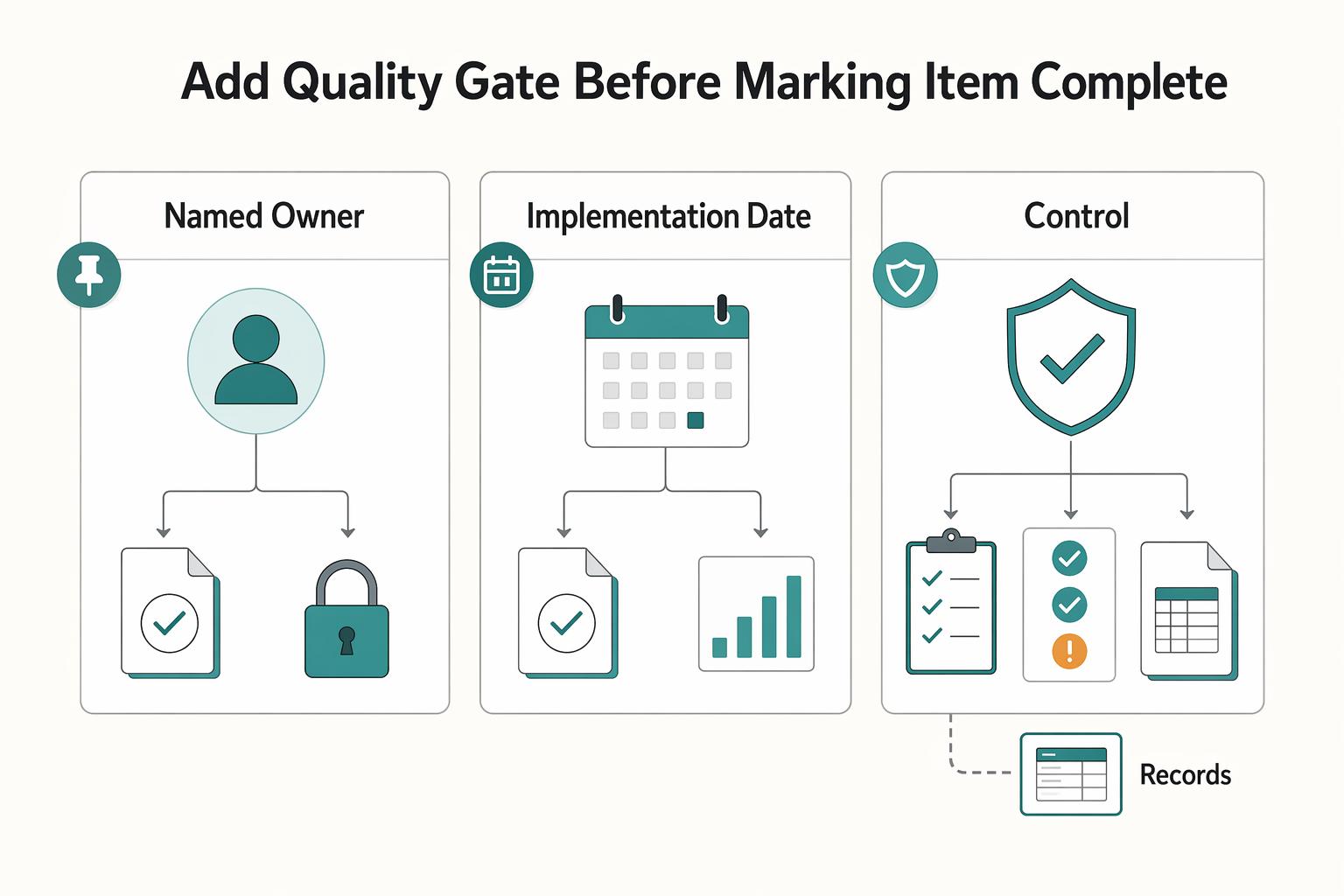
Add a quality gate before marking an item complete#
Before marking an item closed, use a consistent internal quality gate in your compliance system, such as:
- Named owner
- Implementation date
- Proof of control operation
Implementation proof shows that something changed. Proof of operation shows that the changed control actually worked. For payment controls, this can include test results, status transition checks, approval outcomes, or reconciliation outputs aligned to expected behavior.
Automation can reduce collection effort, but it does not replace judgment. Someone still needs to confirm that the obligation was interpreted correctly, linked to the right control, and closed with evidence that will hold up later if remediation or inspection defense is needed.
For a step-by-step walkthrough, see How to Build a Payment Compliance Training Program for Your Platform Operations Team.
Choose software based on operating fit, not vendor lists#
Choose software based on whether it fits the way your team actually works. The right tool can turn a regulatory alert into owned action, deadline visibility, and evidence for closure. If it can only monitor updates and cannot show owner, progress, and audit trail, it will not solve your highest-risk gaps.
Use the evidence pack from the previous step as your buying test, not just your internal control standard.
Separate signal tools from action tools#
Start by deciding whether you need better intake, better execution, or both. Teams can buy for alert volume and still find accountable follow-through is manual.
Use the classes below as working labels for evaluation, not as universal category definitions.
| Tool class | Primary strength | What to verify in a demo | Red flag |
|---|---|---|---|
| Regulatory Intelligence Solutions | Monitoring sources and surfacing updates | Can it route alerts by filters such as topic, deadline, or other relevant attributes? | High alert volume, but no clear owner assignment or closure state |
| Regulatory Change Management Solutions | Turning change events into tasks, impact assessments, and evidence | Can it assign tasks, monitor progress, and maintain an audit trail tied to the change? | Task list exists, but evidence is stored outside the product |
| Connected GRC platform | Cross-silo visibility across compliance and controls | Can teams across compliance, risk, legal, and operations see the same status and control effect? | Teams still work in separate tools and reconcile status manually |
A practical check is whether the product can route events, support impact assessment after triage, track deadlines, and preserve evidence that is usable in audit.
Score options on four operating criteria#
Keep the comparison focused on four criteria that surface fit quickly:
| Criterion | What to test |
|---|---|
| Coverage fit for your operating footprint | Can the tool support the scope of risk and compliance coverage you need? |
| Signal relevance after intake | Can it support rule-based assignment and filtered views, for example by deadline or attribute, so owners and due work are clear? |
| Workflow actionability | Can it support task assignment, progress tracking, and impact assessments after triage? |
| Evidence traceability | Can it maintain an audit trail and connect the change event to assigned work and recorded evidence? |
Pressure-test implementation friction before you buy#
A polished demo can hide a poor operating fit, so test friction early. For integrations, verify that it can work with your current compliance platform, ticketing flow, document storage, and reporting path without duplicate updates.
For ownership, run one real scenario and confirm that named owner and due date stay visible through review. For deadline handling, focus on enforceability: deadline views and ownership visibility by analyst or group.
Match tool depth to your exposure profile#
Evaluate tools against a real update from your own queue. A product that performs well on a sample alert still needs to preserve the affected entity, obligation, owner, due date, and evidence through closure.
If your exposure is more centralized, strong intake, routing, task management, and audit trail may be enough. If your exposure is more fragmented across product lanes, providers, or market rules, test taxonomy, filtering, and impact-mapping depth more aggressively in the product before purchase.
Prefer phased adoption unless closure controls are weak#
Phased adoption can be the lower-risk choice. Keep your current stack if it already supports enforceable controls, named ownership, deadline visibility, and evidence traceability. Replace tooling where action tracking and closure evidence are weak.
Use one checkpoint for a closed regulatory item. Can you retrieve the source alert, owner, due date, progress history, and audit evidence through one product or one linked path? If not, fix that operating gap first.
For audit logging, see What Is an Audit Trail? How Payment Platforms Build Tamper-Proof Transaction Logs for Compliance.
Common mistakes and how to recover fast#
Most recovery work is not about changing tools. It is about tightening how the work runs day to day. Fast gains usually come from four control points: triage, ownership, closure proof, and scope.
Do not treat every update as equal#
When every alert gets the same handling, teams burn time on lower-consequence items and still miss changes that drive deadlines or real compliance risk. Reactive, manual handling is where missed deadlines and compliance failures usually grow.
Start with impact-based triage, then escalate higher-risk items when needed. Keep one required checkpoint before an item moves to in progress: a named owner and a short reason for routine handling or escalation.
If the queue keeps collapsing into broad urgency with stalled items, re-triage the open inventory instead of only tightening new intake.
Do not leave execution with legal alone#
Legal interpretation is essential, but change management also includes identifying, assessing, and implementing change. In practice, that work is shared rather than left only to specialists.
Keep shared execution, but assign one accountable owner for the final decision and completion. That helps avoid the familiar outcome where many teams review a change but no one owns delivery. The same pattern shows up in sanctions work, where screening obligations are interpreted by compliance but still need operational ownership in the payout flow.
Use a simple check: for any active item, can you name the decision owner and the team executing the change from one place?
Do not close tasks without proof#
Closure without evidence gives you a record of activity, not a reliable control, and ongoing compliance verification is part of the job.
Run an audit-readiness check before closure. The record should clearly show that the change was approved, implemented, and verified in operation. If proof only lives in scattered chat threads, email, or personal folders, the item is not truly closed.
Watch for single-control thinking. Updating one document or saving one screenshot without checking dependencies and sequencing can leave downstream steps running the old process.
Map local impact before global rollout#
Applying a local update everywhere by default creates unnecessary product friction and duplicate work. Map impact first, then set scope based on where the obligation actually applies.
Treat internal geography labels as a review aid, not an automatic rollout rule. After infrastructure changes, new deployments, or organizational shifts, run a review and update documentation and priorities. During interpretation, verify unofficial legal notices against official editions before treating them as final.
For European payout operations, see VAT and SEPA: How European Platforms Combine Tax Compliance with Automated Euro Payouts.
Keep the next change traceable#
The practical test is one completed change. Can your team retrieve its source, explain the interpretation, identify the owner, and show that the affected control now works? Use the answer to improve the next handoff.
Keep ownership concrete from the first signal#
Capture the change, affected entity and market, and accountable owner at intake. Keep contributors visible while making responsibility for the next decision and final closure clear.
If you run a payment platform, you should confirm that the owner, due date, and escalation decision are recorded before an item moves forward. That simple gate keeps teams from reviewing updates without deciding what happens next.
Convert updates into operating controls#
A policy edit is not the finish line for a platform compliance program. The control has to change in day-to-day operations, with implementation notes and evidence that the change is working. Without that translation step, teams can look compliant on paper while old behavior continues in practice.
Close with evidence and remove recurring friction#
Review recurring bottlenecks after closure. If interpretations repeatedly wait for missing data, change the intake record. If evidence is assembled only at audit time, capture it during implementation and verification.
Use this copy/paste closeout check before marking an item complete:
- Intake log updated with change summary, affected area, and owner
- Impact assessment completed and escalation decision recorded
- Control change implemented with evidence captured
- Evidence artifacts complete and closure approved
- Recurring bottlenecks reviewed and assigned for fix
If your team needs to confirm market-specific compliance and payout control coverage before rollout, talk to Gruv.
Frequently Asked Questions
What is the practical difference between regulatory tracking and regulatory change management for a payment platform?
Tracking tells you that something changed. Change management decides what it means for your platform, who owns it, what control changes, and what evidence closes the item. For payment and remittance businesses under higher scrutiny, continuous monitoring helps, but execution controls still matter.
What is the minimum set of steps a platform needs to manage regulatory change credibly?
Use intake, triage, interpretation, implementation, verification, and closure as a practical workflow. A spreadsheet can support it at low volume if owners, deadlines, and linked evidence remain clear; larger teams may need a dedicated system.
Who should own each stage of triage, interpretation, implementation, and closure?
Legal or compliance owns interpretation, the affected product or operations team owns implementation, and a named reviewer verifies the result. Assign one accountable person for each handoff and a final owner for closure.
When should a regulatory update be escalated to legal counsel instead of handled operationally?
Escalate when the text is ambiguous, applicability is disputed, or functions reach different interpretations. Send the specific decision question and affected scope. Routine implementation can proceed once the interpretation is settled and the control owner knows what must change.
What evidence should be retained to prove audit-readiness after a control change?
Retain the source update, interpretation, approval, implementation record, test result, and closure sign-off. Link each artifact to the affected obligation and entity so the record shows what changed and how the result was verified.
How should multi-market platforms prioritize updates across North America, Latin America, Asia/Pacific, and EMEA?
Prioritize by effective date, affected entity and product, and the consequences of missing the change. Start with the jurisdiction named in the update; widen the review when other markets share the relevant obligation or technical control.
Researched and edited by the Gruv editorial team. Gruv builds cross-border billing, payouts, and finance-operations software for global businesses.
Sources
Includes 3 external sources outside the trusted-domain allowlist.
- docs.stripe.com/webhookstrusted
- vat-one-stop-shop.ec.europa.eu/one-stop-shop_entrusted
- vat-one-stop-shop.ec.europa.eu/one-stop-shop/register-oss_entrusted
- fivetran.com/learn/compliance-managementexternal
- kitecompliance.ai/vertical-compliance/regulatory-compliance-so...external
- ncontracts.com/nsight-blog/how-to-build-an-agile-change-man...external
Educational content only. Not legal, tax, or financial advice.
Related Posts

The Freelance Payment Penalty: A Modeled Audit of Platform Fees, FX Spreads, and Payout Delays
The money rarely disappears through a single, easy-to-spot fee. The real loss is stacked. A marketplace takes its commission, a processor adds a charge for international cards, a bank or payment company converts the currency at a spread, a platform holds the funds before release, and a wire sheds a little to intermediaries on the way in. Each layer looks defensible on its own, but the worker feels the combined result as a smaller deposit and a later payday.
How to Respond to a Subpoena for Business Records
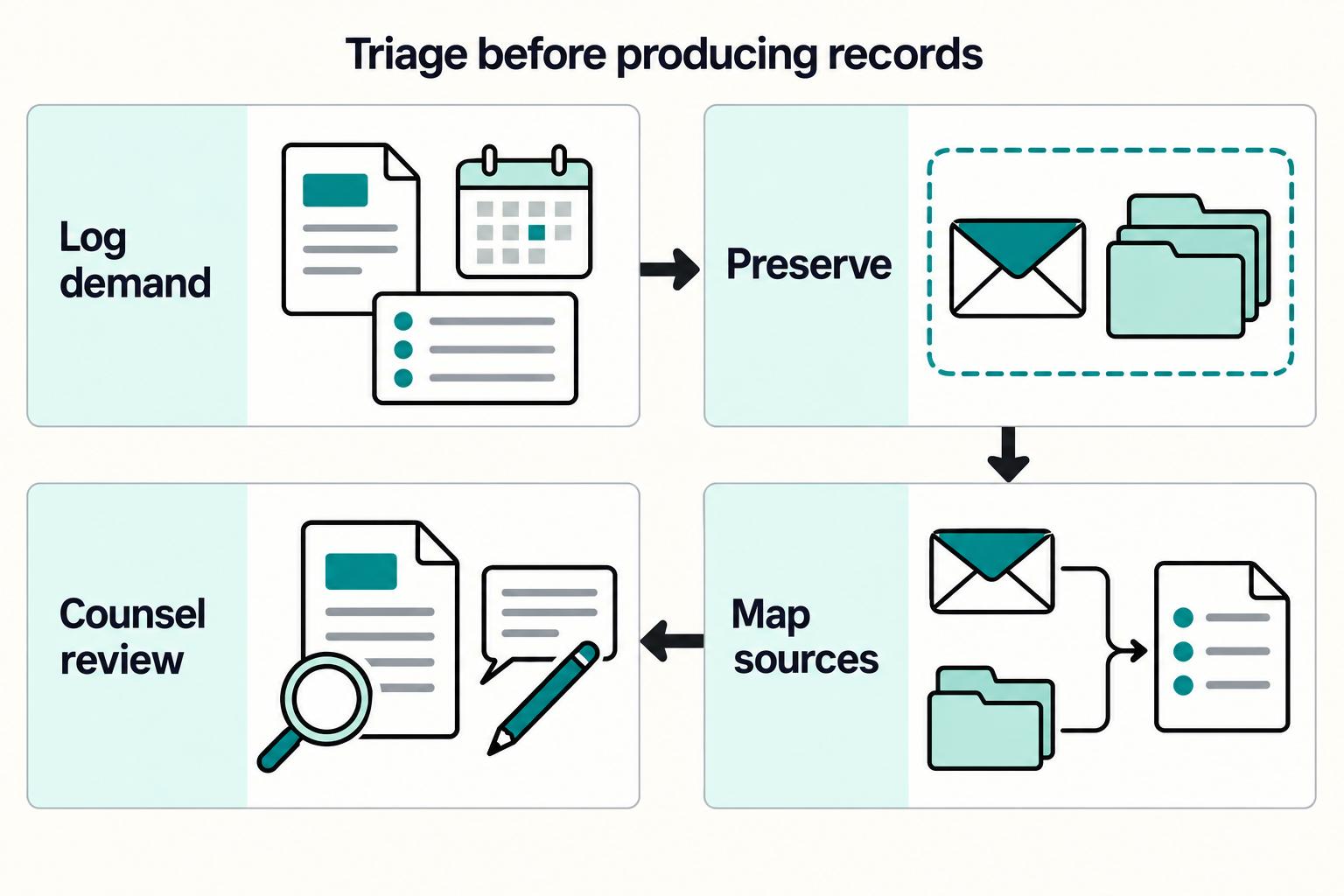
Move fast, but do not produce records on instinct. If you need to **respond to a subpoena for business records**, your immediate job is to control deadlines, preserve records, and make any later production defensible.
A US Expat's Guide to Investing in UCITS ETFs to Avoid PFIC Issues
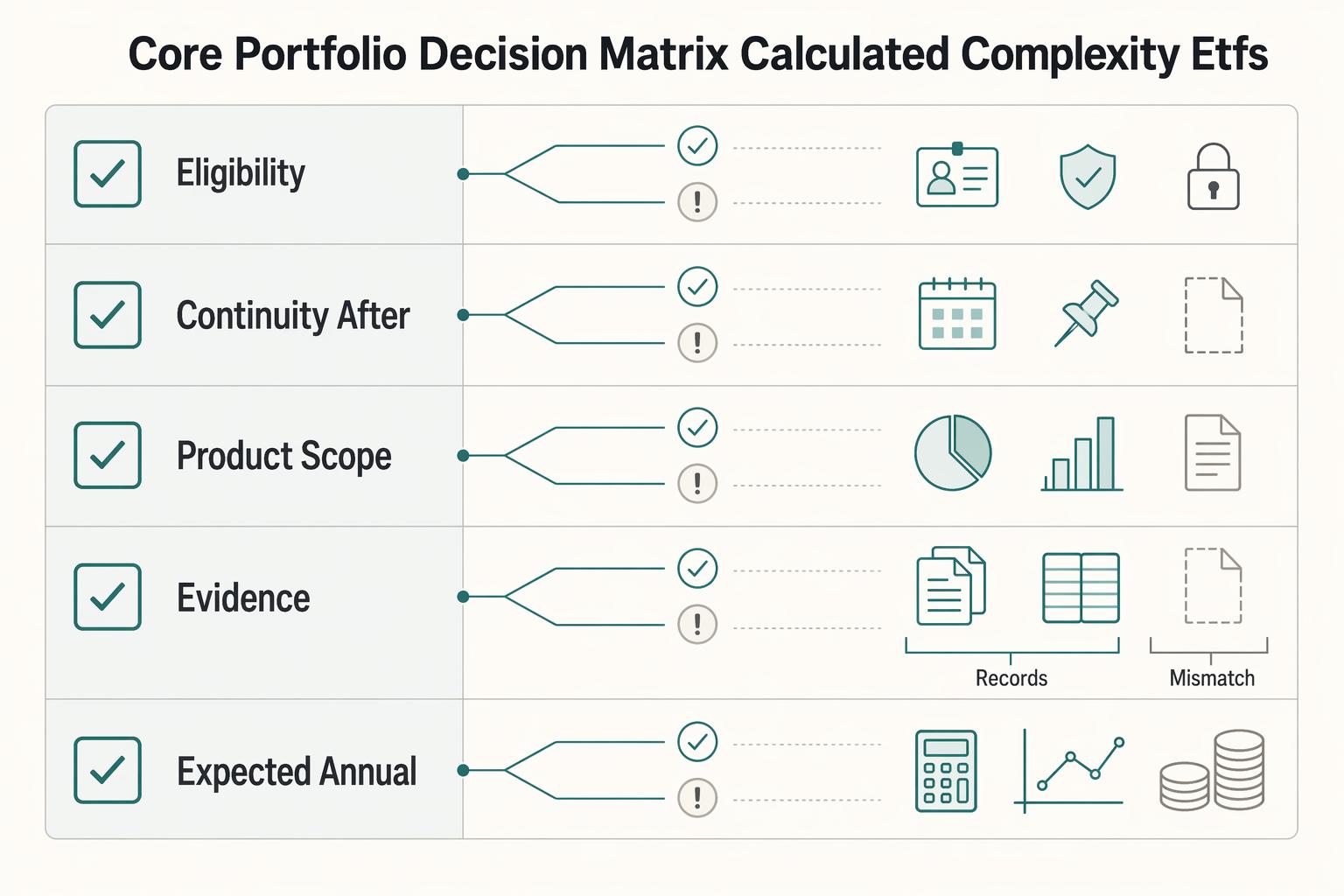
The real problem is a two-system conflict. U.S. tax treatment can punish the wrong fund choice, while local product-access constraints can block the funds you want to buy in the first place. For **us expat ucits etfs**, the practical question is not "Which product is best?" It is "What can I access, report, and keep doing every year without guessing?" Use this four-part filter before any trade: