
Quick Answer
Validate reserve terms, payout failures and the trail from provider events to ledger entries before signing. Phase markets where required controls or route evidence are incomplete. Assign each unresolved item an owner, an agreed launch constraint and a dated integration checkpoint.
What to Validate Before Signing#
A payments-heavy acquisition can look solid until you test whether money movement will actually hold up in practice. This article helps you sort what needs to be validated before signing, what can wait until after close, and where country-specific constraints can change deal confidence.
In M&A, the point of diligence is to turn assumptions into facts. In platform businesses, the operating layer underneath the market story can be the weak point, especially reconciliation architecture, compliance gates, and PSP dependencies that concentrate risk.
This is payment operations diligence within broader M&A, not a full legal or tax opinion. It sits alongside finance, tax, legal, IT, and cyber diligence, but answers a different question: are collection, settlement, reconciliation, controls, and payouts reliable enough to support the strategy you are buying?
Country assumptions can break an otherwise strong thesis. AML and related compliance frameworks are implemented differently across jurisdictions, so a process that works in one market may not transfer cleanly to another. If expansion is part of the deal case, you need evidence that key payment operations can run in each market and where manual work or provider gaps remain.
For finance leaders, the core decision is timing: what must be known before close, and what can be managed during integration with eyes open. If you are leading diligence, we recommend treating missing payment-ops evidence as a current deal issue, not a post-close hope. If core evidence is incomplete, treat that uncertainty as a deal issue, not just an integration task.
This article follows a simple operating sequence:
- pre-sign checks that should change confidence before commitment
- pre-close commitments with clear owners and evidence before Day 1
- Day 1 controls that protect money movement while operations continue
- first 90-day integration priorities that improve accuracy before speed
That sequence is not an industry-mandated standard. It is a practical way to separate must-know-now risks from work that can safely be fixed later.
For a step-by-step walkthrough, see Understanding Payment Platform Float Between Collection and Payout.
Define payment ops due diligence in practical terms#
Payment ops due diligence answers one practical question: can the target move money accurately and prove it across payment, clearing, settlement, recording, and reconciliation flows? In M&A, that means validating transaction flow and controls for breaks, returns, and manual intervention.
This goes well beyond whether a payment request succeeds in the app. Federal Reserve payment-system risk framing covers payment, clearing, settlement, and recording activities, and clearing is the pre-settlement process of transmitting and reconciling transactions before settlement. So you are testing not just front-end success, but whether records and reconciliations line up and exceptions can be resolved with clear evidence.
Keep this lane separate from adjacent diligence work:
| Diligence lane | Core question |
|---|---|
| IT due diligence | Can the technology environment support continuity and mitigate risk during and after the deal? |
| Financial due diligence | Is financial integrity sound, and are there risks that could change price or structure? |
| Tax due diligence | Are there tax exposures or liabilities that change deal economics or compliance risk? |
| Cybersecurity due diligence | Do control gaps create material risk, including potential value erosion or penalties? |
| Payment ops due diligence | Does money movement reconcile across payment, clearing, settlement, and recording activities, and are exceptions owned and controlled? |
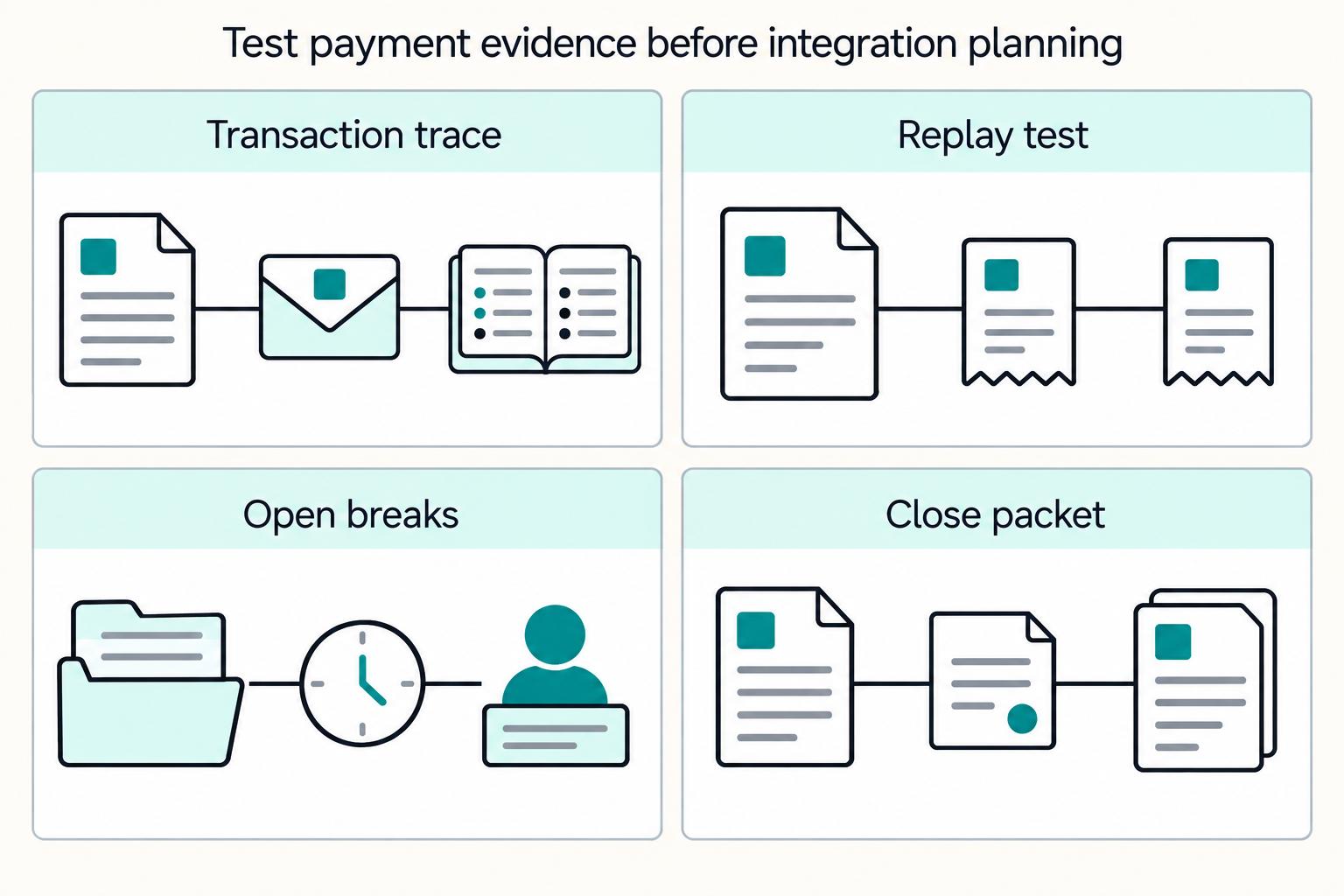
A practical test is a full transaction trail: payment reference to internal event records to ledger posting, then tie that to a recent reconciliation pack and an aged exception list. If you cannot trace one recent payment end to end, we would not call the control set proven. If that evidence is weak, treat it as a live deal risk, not a documentation problem. For a broader checklist, see A M&A Consultant's Guide to Due Diligence Checklists.
Build a country and vertical risk map before valuation assumptions#
Build the risk map before you lock valuation assumptions. We recommend treating unknown controls as phased-rollout risk, not Day 1 readiness. Compare priority markets by operational friction, not TAM alone. As an internal working rule, if two or more core controls are unknown, model that market as phased until validated.
Compliance gates are not uniform across countries. FATF sets an international AML/CFT standard, but countries implement it through local legal and operational measures. So claims like "we support Europe" or "this provider onboards globally" are not enough evidence for readiness across KYC, KYB, AML depth, VAT handling, and payout support.
Put the unknowns in the deal file#
Make the map explicit so assumptions do not drift into the model as if they were facts.
| Market | Gating requirements | Likely blockers | Owner | Evidence status |
|---|---|---|---|---|
| EU member state | Local KYC/KYB/AML controls and VAT number validation through VIES when relevant | VIES is a search engine that queries national VAT databases at lookup time, so result quality and timing depend on country data | Compliance + Tax Ops | Unknown until a recent live lookup record is saved with timestamp and exception handling |
| UK | Separate KYC/KYB/AML treatment and a UK-specific VAT validation path | Team assumes EU VAT validation covers GB, but GB validation in VIES ceased on 01/01/2021 | Tax + Compliance | Unknown until UK validation method and operating steps are confirmed |
| US | Legal-entity onboarding controls, including beneficial ownership identification and verification where required under 31 CFR 1010.230 | No written procedures or sample files showing beneficial owner collection and review | Compliance + Ops | Unknown until procedures and sample onboarding evidence are reviewed |
| Priority market using Virtual Accounts or local payouts | Program approval, account-type support, payout route coverage, and settlement currency support | Market is "onboardable," but required capability is unavailable for that program or governing legal entity | Payments + Treasury | Unknown until provider coverage table, contract schedule, and program confirmation match |
Writing "unknown until validated" is a useful control in itself. If the target cannot produce recent VAT lookup evidence, a sample KYB file, or provider proof tied to the exact market and program, keep the status as unknown.
Use one evidence pack per priority country, not one generic memo. Include a current procedure excerpt, one recent real case, and market-specific external proof such as a VIES lookup result or provider capability confirmation.
Vertical model changes the risk, not just the economics#
Vertical design changes operational readiness, not just margin structure. A Merchant of Record (MoR) can reduce some in-house tax and compliance operations because the MoR is responsible for calculating, collecting, and remitting sales tax, VAT, or GST.
But a MoR also changes legal-seller structure and liability allocation, including refunds and chargebacks. Model MoR-assisted and direct-merchant cases separately where they differ. Do not blend them into one assumption set.
Check rails at the program level#
Validate rails by region, currency, account type, and program, not by global marketing language. Providers note that onboarding eligibility does not guarantee every capability in every market, and settlement currency support varies by country or region.
Ask for the exact support artifact: a coverage table or contract schedule that matches the target's governing legal entity and product setup. For payouts, confirm both route coverage and required settlement currency. A market can look supported at a high level and still miss a required payout path or account type.
For internal go or no-go decisions, check onboarding, business verification, relevant tax validation and rails support in each market. Agree which controls are mandatory before launch. The two-unknown-controls rule above is an illustrative planning convention, not permission to proceed with one missing mandatory control.
Related reading: How to Build a Deterministic Ledger for a Payment Platform.
Pre-signing red flags that should change price, terms, or scope#
Treat payment risks that can impair liquidity, delay onboarding, or become present obligations at acquisition as signing issues. If they are real, they should change price, terms, or scope.
| Red flag | Why it matters before signing | What evidence should exist |
|---|---|---|
| Single PSP dependency across collection, payout, and dispute operations | Concentration risk can become operationally material when one provider supports multiple critical services and there is no credible routing alternative. A hold, outage, or termination can disrupt cash movement across the business. | Executed PSP contracts, service map by function, evidence of secondary routing or fallback, and proof fallback is configured rather than planned |
| Unresolved liabilities, active litigation risk, or vague reserve mechanics | Litigation, contingent liabilities and reserves can affect price or structure. Ask the accounting adviser whether acquisition-date recognition is required under the applicable business-combination standard. | Litigation register, counsel summary, reserve notices, chargeback loss history, withheld-settlement incidents, and side letters that modify reserve or hold rights |
| Card network compliance exposure | Historical breaches can create post-close monitoring or added acquirer scrutiny. Mastercard's ECM program identifies MIDs with excessive monthly chargebacks, and acquirers are notified when thresholds are breached. | Chargeback trend by MID, acquirer notices, remediation history, VMSS or equivalent screening outputs, and current network correspondence |
| Missing payout failure logs and weak reconciliation evidence | If failed payouts are not visibly tracked from failure to retry or return and ledger resolution, near-term expansion assumptions may be overstated. This is a control gap, not an integration convenience issue. | Failure logs, retry outcomes, aged exception reports, month-end tie-outs, and sample transaction trails from provider reference to ledger entry |
PSP concentration is a term problem before it becomes an outage problem#
A single-provider setup is not automatically disqualifying, but it is a red flag if tested alternatives are missing. The risk rises when one PSP controls several critical functions, because concentration creates common-mode failure exposure.
Use a simple checkpoint: request a service map by function, legal entity, and geography, then match it to the contracts. If fallback is claimed, ask for evidence that it has been configured or used.
Liabilities, litigation, and reserve rights belong in valuation#
Keep unresolved liabilities and active litigation in valuation and deal terms. Counsel should identify applicable disclosure duties; accounting advisers should assess recognition and measurement under the relevant business-combination standard. Public-company disclosure requirements do not automatically apply to every private target.
Reserve mechanics belong in the same bucket. Reserves and withheld settlement can directly constrain liquidity, so ask for reserve notices, reserve-release history, and clear loss-allocation evidence.
Network compliance exposure can slow growth after close#
Assume compliance exposure is operational until proven otherwise. Ask for chargeback trends by MID, acquirer warning notices, and remediation history rather than broad statements like "chargebacks are normal."
Request the current rules and program notices applicable to each acquirer relationship and MID, alongside historical breach and remediation records. A dated rulebook alone does not show which obligations or monitoring thresholds apply to the target today.
Reduce expansion assumptions when payout evidence is thin#
If payout failure logs and reconciliation evidence are incomplete, reduce near-term expansion assumptions in the deal model. You do not need a perfect stack at signing, but you do need proof that exceptions are visible and explainable.
At minimum, ask for:
- complete payout failure logs with timestamps, status changes, retry or return outcomes, and operator notes
- reconciliation evidence tying provider balances, internal records, and ledger postings at month end
- retained records that support an audit trail, including accuracy and retention expectations where regulated rules apply
Inspect the clauses that control payment risk transfer#
The contract is where payment risk transfer becomes real. It determines who absorbs liquidity pressure, dispute losses, and remediation costs after close.
| Clause area | What to check | Why it matters |
|---|---|---|
| Reserve and hold clauses | Executed PSP contracts and any MoR agreement, plus reserve and pricing schedules, addenda, side letters, hold notices, and release history | Broad discretion over amount and timing can materially affect liquidity |
| KYC/KYB/AML liability split | Who performs onboarding checks, who owns beneficial-owner verification for legal entities, and who pays when controls fail | The headline operating model may not match the actual liability split |
| Data rights | Contract rights for data sharing, record retention, and audit access to transaction records, dispute evidence, reserve notices, settlement reports, and status history | If transaction history cannot be reconstructed from provider reference to ledger posting, post-close teams inherit risk without control |
Reserve and hold clauses decide whether cash is really available#
Start with executed PSP contracts and any MoR agreement, because reserve and hold clauses can change cash risk quickly. A reserve is a temporary hold on funds, but the diligence question is whether the provider has broad discretion over amount and timing. That discretion can materially affect liquidity.
Do not accept summaries like "standard reserve." Review the base agreement, reserve and pricing schedules, addenda, side letters, hold notices, and release history. If reserve expansion or hold triggers are vague, treat that as a current balance-sheet risk, not boilerplate.
Apply the same standard to termination and survival language. Adyen's terms state that services and transactions processed before termination remain subject to the agreement, so reserve, dispute, and recovery obligations may continue after the relationship ends. In practice, that means switching providers after close does not automatically remove legacy exposure.
A practical test is to run one real dispute or payout issue against the contract. If the target cannot point to the hold trigger, notice path, response timeline, and release condition, the risk transfer is not under control.
Liability splits in KYC, KYB, and AML can differ from team assumptions#
Do not assume the headline operating model matches the actual liability split. A MoR is the legal seller to the end customer, but that does not mean all compliance and payment liability sits with the MoR in every scenario.
Verify who performs onboarding, beneficial-owner checks and remediation, and who bears losses when controls fail. FinCEN’s May 2026 consolidated CDD FAQs cover specified financial institutions, not every platform. Its February 2026 relief permits covered institutions to limit repeated beneficial-owner identification to the first account, reliability concerns and risk-based ongoing checks; exclusions and exemptions also matter. Match inherited procedures to the target’s regulated role and provider contract.
When a target says "the provider handles compliance," ask for the responsibility matrix, the policy version in force, and at least one failed onboarding or remediation case showing who paid and who executed remediation. That is more reliable than commercial positioning.
Stripe Connect shows how sharply this can shift. For some account types, the platform is responsible for disputes. If the platform carries negative-balance liability, Stripe can hold platform funds in reserve and transfer from that reserve after 180 days of a connected account remaining negative.
Data rights must support transaction reconstruction#
If transaction history cannot be reconstructed from provider reference to ledger posting, you are inheriting risk without control. Confirm contract rights for data sharing, record retention, and audit access needed to retrieve transaction records, dispute evidence, reserve notices, settlement reports, and status history on request.
Ask for a sample evidence pack that ties provider reference, internal transaction ID, status timestamps, settlement or payout reference, dispute artifacts where relevant, and final ledger entry. Commercial dashboards are not enough if you lack enforceable rights to obtain sufficiently detailed records fast enough. When that gap exists, post-close finance inherits exceptions it may not be able to prove or unwind.
Validate reconciliation and event integrity before integration planning#
Treat reconciliation and event integrity as a Day 0 diligence gate, not a post-close cleanup task. If the target cannot reconstruct one transaction from API request to provider response, webhook receipt, internal event, and final ledger journal entry, the integration risk is already sitting in the balance sheet.
Trace the money-data chain before you discuss tooling#
Start with one real payment and one real payout. Then walk the full chain end to end: API call, provider response, webhook events, internal state transitions, settlement or payout record, and the ledger posting that changed balances. The test is evidence completeness, not dashboard polish.
Require proof across systems, not screenshots. Webhooks are a synchronization mechanism, so ask for webhook receipts and processing logs tied to the same transaction. If Adyen reporting is part of reconciliation, validate that a Payment accounting report sample includes lifecycle status changes, events, and modifications for the traced item.
Also check ingestion resilience. Adyen changed the interactive Payment accounting report filename format in February 2025. If import logic was not updated, reconciliation gaps may go unnoticed until close.
Test duplicate safety where payout mistakes start#
Assume duplicate webhook delivery will happen and verify the controls directly. A practical control is persisted processed event IDs with repeat suppression, plus replay-safe handling for payout-related events.
Check API retry behavior against the provider contract. Stripe caches the first executed result for a key, including 500 responses; a fresh key can create a second operation. After an ambiguous response, resolve the original outcome before issuing another payment, including through a different provider. Ask for the request parameters, key, provider reference and persisted resolution.
Stripe accepts idempotency keys up to 255 characters and may remove them after at least 24 hours. Verify the actual provider and account scope, retention window and retry policy. Keep an internal duplicate-payment control after a provider key expires.
| Issue | Detection signal | Financial impact | Recovery step |
|---|---|---|---|
| Unmatched deposit or settled funds not tied to ledger | Settlement or payout appears with no corresponding journal entry or open recon item | Cash and revenue can be misstated until corrected | Trace provider reference through internal events, post missing journal entry, document root cause |
| Duplicate payout event processed twice | Same event ID or payout reference appears more than once in processing logs | Duplicate liability recognition or duplicate outbound payout attempt | Suppress repeats using stored processed event IDs, reverse duplicate postings, confirm provider payout status |
| Failed payout not cleared from close | Failed payouts appear in provider reporting, internal balances still assume success | Funds availability and payable balances diverge from actual state | Review failed-payout breakdown, reopen exception, reclassify balances before close |
| Manual or instant payout not traceable to included transactions | Bank payout exists but underlying transactions cannot be identified from provider output alone | Reconciliation becomes manual and break resolution slows | Require operator-side mapping and retain transaction-level evidence with payout support |
Demand close discipline, not just daily reconciliation claims#
Daily reconciliation claims are not enough. The control test is monthly close discipline: who owns breaks, how they are aged, and who escalates when provider, bank, and ledger balances diverge.
Use close-process evidence, not verbal assurance. A credible close model locks posting lanes such as A/P, A/R, and Payroll, then reviews accounts and posts needed adjustments before final close. You do not need a specific ERP, but you do need equivalent controls.
Request the last two close packets, or the closest equivalent: open breaks, aging buckets, owners, posted adjustments, and sign-off. Four- or seven-bucket aging views are both workable. The diligence question is whether aging is consistent and owned.
For payout evidence, validate what the provider can and cannot map. Stripe's payout reconciliation report helps match bank payouts to payment batches and includes failed-payout breakdowns, but Stripe notes it cannot identify included transactions for manual or instant payouts. If those payout types are used without operator-side mapping evidence, treat that as a hard integration constraint.
Set go or no-go launch gates by market before close#
Once reconciliation and event integrity are validated, turn that evidence into market-by-market launch gates. A market is launchable before close only when you can show three things: compliance readiness, payout-route reliability, and reconciliation confidence.
Market risks can affect price, structure and near-term performance. FATF’s risk-based approach informs control design, but simplified measures require support in the applicable law and risk assessment. Do not infer permission to relax a mandatory local check from a country’s broad risk label.
Use three gates, not one blended judgment#
Keep the gate logic simple enough that teams cannot talk around it. Use three gates:
- Compliance readiness: Can you evidence CDD and AML handling appropriate to market risk, including review ownership, documentation, and exception holds from payout?
- Payout-route reliability: Do you have provider evidence that the route works for the specific corridor, not just contract language or product positioning?
- Reconciliation confidence: Can finance tie expected payout and settlement behavior to ledger treatment and close controls without manual guesswork?
If a required gate remains unproven, defer the affected activity. Limited features can proceed only when their own mandatory controls are satisfied; record scope, approval, monitoring and the remediation deadline.
| Market | Gate status | Pre-close required evidence | Post-close allowed deferrals |
|---|---|---|---|
| Core domestic market | Go | Documented CDD path, payout route already used in production, sample reconciliation tie-out from transaction to ledger and payout | Reporting polish, operator training refinements, dashboard cleanup |
| Priority cross-border corridor | Conditional go | Provider proof of route availability for the corridor, test payout evidence, exception handling for failed or delayed payouts, close-treatment confirmed | Broader routing coverage, automation of some exception queues within a 100-day transition plan |
| Higher-risk expansion market | No-go unless controls are staffed and evidenced | Enhanced AML review path, documented hold-and-release decisions, ownership for manual reviews, evidence pack for customer risk profiling and monitoring | None that weaken control, only non-control improvements such as queue tooling or case-view usability |
Be explicit about manual CDD and AML tradeoffs#
Manual review in some markets is not automatically a no-go, but you do need to decide whether speed or control wins and document the tradeoff.
If a market depends on heavy manual CDD or AML handling, ask one direct question: can you prove that the manual step is controlled enough to prevent unsafe payouts? Check reviewer ownership, retained documents, hold reasons in case records, and ledger visibility for held funds. A key risk is review existing on paper while payout approval bypasses it under volume pressure.
Test the procedures that apply to the target’s regulated role and market, including customer identity, beneficial ownership where required, relationship purpose and ongoing monitoring. FinCEN’s consolidated CDD FAQs explain the covered U.S. institution scope and current account-opening relief. A platform-provider responsibility matrix is still needed to show who collects evidence and resolves exceptions.
Choose breadth or control depth, then document the concession#
There are two defensible paths: launch fewer markets now with stronger controls, or launch more markets with constrained features and a dated remediation schedule. Neither is universally better.
If cross-border payouts are central to deal value, plan conservatively. Cross-border payments still face four recurring frictions: high costs, low speed, limited access, and insufficient transparency. Given uncertainty around end-2027 target timing, do not assume those improvements arrive on your Day 1 timeline. A broad launch should therefore include explicit constraints such as payout limits, manual release rules, or delayed corridor activation.
The required output is a market gate register accepted by finance diligence, compliance, and operations, with required evidence by market and each deferral tied to a post-close owner and date.
This pairs well with our guide on Real-Time Reporting Metrics Platform Finance Teams Can Actually Control.
Before locking Day 1 commitments, map each market gate to concrete payout and reconciliation evidence, then review implementation details in Gruv Docs.
Stabilize Day 1 money movement controls#
On Day 1, keep the job simple: prevent unsafe payouts and preserve evidence for every release decision.
| Control area | Day 1 check | Key detail |
|---|---|---|
| Payout release | Sample held, approved, and failed payouts, and confirm each case record shows review outcome, approver, and release reason | Payout creation should depend on documented KYC and AML status, and batch controls should separate initiator, approver, and reconciler roles |
| Event telemetry changes | Freeze nonessential changes to webhook consumers, payout timing logic, and reconciliation posting rules in week 1 | Stripe retries undelivered live-mode webhooks for up to three days and does not guarantee event order; confirm each provider’s own delivery contract |
| Tax-document capture | Preserve applicable W-9 and W-8 certifications, collection dates and validity status; carry them into the correct reporting and withholding process | Determine the payer’s duties and income treatment; a missing form may require withholding rather than an automatic payout ban |
Lock payout release before you optimize throughput#
Treat payout safety as a release gate, not a throughput problem. Payout creation should depend on documented KYC and AML status, and payout-batch controls should separate initiator, approver, and reconciler roles.
Sample held, approved and failed payouts and confirm each record shows the required review, approver and release reason. Verify AML, identity and beneficial-owner duties by regulated role, entity type and date; do not apply bank CIP requirements to every platform automatically.
Assign pause and restart ownership under the provider’s actual rules. Stripe’s Accounts v1 pause feature applies to specified connected-account liability arrangements; in-flight payouts may remain pending for up to 10 days from creation before cancellation. That window is not a universal payout hold rule.
Freeze risky changes until event telemetry is boring#
In week 1, freeze nonessential changes to webhook consumers, payout timing logic, and reconciliation posting rules. Focus first on stable telemetry. Your baseline controls should assume retries and disorder:
- Stripe retries undelivered live-mode webhooks for up to three days; confirm retry windows for other providers
- events are not guaranteed to arrive in creation order
- API retries and event processing should be duplicate-safe and replay-safe, including idempotency and deduplication handling
A common failure mode is quiet duplication or late events that show up later as reconciliation breaks.
Keep tax-document capture continuous#
Keep applicable tax certifications available from Day 1: W-9 for U.S. persons, W-8BEN for foreign individuals and the appropriate W-8 form for other foreign payees or roles. Preserve document, date, status and relevant income classification. Foreign-payee documentation does not automatically feed Form 1099-NEC.
Determine the actual payer’s reporting and withholding duties before migration. The general Form 1099-NEC threshold is $2,000 for 2026 payments, compared with $600 for 2025, with other filing triggers and exceptions. U.S.-source payments to foreign persons can require withholding depending on income type, status, documentation and treaty treatment. Missing documentation may change withholding; it is not a blanket rule to block all foreign payouts.
Prioritize first 90-day integration outcomes#
Once Day 1 controls are stable, sequence the next 90 days by risk: prove ledger accuracy first, then improve payout throughput, then reduce operator friction. If postings or settlement status are still inconsistent, faster release cycles and more automation will only scale bad outputs.
| Priority | Checkpoint | Why it comes first |
|---|---|---|
| Ledger confidence | Confirm settlement outputs, exception status, and final ledger journals match for a defined sample period, with clear ownership for every open break | Prove money-state accuracy before delivery speed |
| Shared exception status | Sample exceptions and confirm every team sees the same transaction reference, settlement state, last-action timestamp, and owner | Keep consolidation ahead of efficiency work if cross-system reconstruction is still required |
| Tax-process ownership | Assign payee-certification, applicable information-return and withholding responsibilities, plus relevant VAT validation | Cross-border integration can break at ownership boundaries |
| Expansion timing | Advance country rollout only when gate evidence is complete across ledger accuracy, shared exception visibility, tax-process ownership, and required regulatory status | Do not anchor launch dates to build completion alone |
Put ledger confidence ahead of speed#
Your first integration wave should prove money-state accuracy before delivery speed. Set a readiness checkpoint that confirms settlement outputs, exception status, and final ledger journals match for a defined sample period, with clear ownership for every open break.
Use these checkpoints as explicit go or hold gates before adding volume or countries. A common risk is quiet drift, not a visible outage: settlement mismatches, duplicate exception queues, and month-end breaks found too late.
Collapse duplicate reporting before you add more markets#
Before expansion, finance, ops, and engineering should work from one agreed record for exception and settlement status. You can run multiple tools, but teams should not disagree on whether a payout is settled, held, failed, or under review.
Use a simple test: sample exceptions and confirm that every team sees the same transaction reference, settlement state, last-action timestamp, and owner. If that still requires cross-system reconstruction, keep consolidation ahead of efficiency work.
Validate tax steps that tend to get missed#
Preserve payee certifications, payment classifications, reporting totals and withholding history across integration. Assign each duty to the actual payer or reporting entity and reconcile migrated records to prior filings. Confirm VAT responsibilities for the target’s transaction model.
Separately, tax diligence should assess the acquired entity’s own foreign accounts and applicable entity-level obligations. Recipients’ personal foreign-earned-income exclusions are not a payment-platform integration workflow.
For relevant EU VAT checks, use VIES with timestamped results, re-checks and escalation for unavailable or delayed national data. GB VAT numbers use a separate UK path; Northern Ireland XI numbers can be relevant to qualifying goods transactions. VAT validation does not by itself establish payout eligibility.
Tie expansion to evidence, not the calendar#
Tie rollout and change-of-control plans to the target’s actual regulated activities. In the UK, determine the required FCA authorization or registration, any applicable exclusion, and any acquisition approvals or notifications with counsel. Non-bank status alone does not determine which regime applies.
Apply the same evidence standard to safeguarding where customer funds are in scope, since requirements can differ by provider type. Do not anchor launch dates to build completion alone. Move when checkpoint evidence is complete across ledger accuracy, shared exception visibility, tax-process ownership, and required regulatory status.
Need the full breakdown? Read The Gig Economy in 2026: Payment Volume Trends Contractor Growth and Platform Consolidation.
Assemble the evidence pack for executive sign-off#
Build one decision packet that can stand on its own for sign-off: what is approved now, what is deferred, and which risks remain open. If the recommendation depends on verbal reassurance, the packet is not ready.
Pull finance due diligence, IT due diligence, and compliance controls into one view instead of separate decks. Keep the core artifacts practical:
- diligence findings summary
- control test results
- go/no-go decision record
- unresolved risk register
The risk register should show each risk, its drivers, current controls, and response approach, so open exposure is visible instead of buried inside a green status.
Make unresolved items hard to ignore#
For every open item, include a named owner, remediation action, milestone, and scheduled completion date. Use the same fields across lanes: finance reconciliation gaps, IT control defects, and compliance documentation shortfalls should all follow one accountability structure.
Avoid vague ownership such as "Ops" or "Engineering" with no deadline. Keep accepted risk separate from unconfirmed facts so the board or investment committee can see what is tested, what is assumed, and what is still pending.
Show the proof behind the recommendation#
Do not stop at statements like "reconciliation validated." Include checkpoint evidence instead: sample reconciliation tie-outs, trend analysis over a defined period, and recorded approvals at formal go/no-go governance gates.
If approval depends on future remediation, state and quantify assumptions where possible: Day 1 scope, phased scope, assumed provider behavior and outstanding evidence. Counsel should assess transaction-specific shareholder disclosure requirements. For a related operational checklist, see Vendor Portal Requirements Checklist for Platform Payment Ops.
Conclusion#
Strong M&A outcomes come from operational evidence, not checklist completion. A deal is decision-ready when assumptions have been converted into verified facts, material risks are understood well enough to price, and Day 1 readiness is explicit.
Use a hard sign-or-no-sign test before close:
- every material pre-close gap is known, priced, and owned
- each owner has dated Day 1 and 100-day commitments
- any risk that could still change price, structure, future performance, or immediate continuity is resolved or explicitly carried in the deal model
Operational due diligence creates value when it produces decision evidence, not just completed workstreams. If ownership, proof requirements, and review dates are still vague, you are still carrying assumptions.
Before you commit to expansion promises, convert diligence findings into market-level launch gates and an execution schedule. Early diligence should support market-aligned go-to-market execution, so if the evidence supports a phased launch, plan that way.
If your diligence pack is complete but market coverage or control depth is still uncertain, contact Gruv to validate fit by country and workflow.
Frequently Asked Questions
What is payment operations due diligence in an M&A context for platform finance teams?
Payment operations due diligence tests whether money movement will stay controllable after close, not just whether revenue appears on paper. For platform finance teams, that means validating settlement behavior, reserve exposure, payout reliability, reconciliation evidence, and traceability from provider events into your ledger. It should run as integrated diligence because control weaknesses can change both deal pricing and integration planning.
Which risks should be validated before signing versus managed after close?
Validate before signing any risk that can change valuation, closing certainty, or Day 1 liquidity. That typically includes reserve mechanics, fund holds, PSP concentration, termination rights, reconciliation proof gaps, and KYC or AML issues that can affect the closing process. Manage items after close only when they do not change deal economics or immediate control safety and already have a named owner, dated milestone, and clear evidence requirement.
How do country-level KYC, KYB, and AML requirements change acquisition economics?
Country requirements change staffing, evidence collection and how soon each collection or payout route can activate. Match duties to the target’s regulated role and provider arrangement. For covered U.S. financial institutions, FinCEN’s CDD requirements and 2026 account-opening relief need review together. Do not assume every platform has identical bank-level duties or model an unproven required control as Day 1 revenue.
When should a target's PSP contracts trigger repricing or tighter deal terms?
Treat PSP terms as a deal-term issue when they include broad reserve rights, hold funds that cannot be paid out or transferred during the reserve period, or allow termination at sole discretion. These terms can constrain liquidity and shift post-close operating risk. Review the executed agreement, amendments, fee schedules, reserve notices, and recent provider correspondence before deciding on repricing, scope reduction, or a closing condition.
What are the earliest signals that reconciliation architecture will fail post-close?
Warnings include duplicate events without safe processing, ambiguous API outcomes followed by fresh payment attempts, and gaps between provider references and ledger entries. Test provider-specific retry and key retention behavior, suppress duplicate event processing and resolve uncertain original payments before sending again. Duplicate webhook delivery itself is expected behavior, not proof of a broken reconciliation system.
How should teams decide between faster rollout and stricter control depth in new markets?
Use a risk-based AML approach, but do not treat that as permission to skip evidence. If KYC or KYB obligations are still unclear, AML review steps are not operationalized, or reconciliation handling is unproven, defer launch or limit features instead of enabling full payout breadth. Move fastest only where compliance readiness, PSP contract exposure, and duplicate-safe reconciliation behavior are already verified.
Try a related tool
Researched and edited by the Gruv editorial team. Gruv builds cross-border billing, payouts, and finance-operations software for global businesses.
Sources
- docs.stripe.com/api/idempotent_requeststrusted
- docs.stripe.com/webhookstrusted
- ecfr.gov/current/title-31/subtitle-B/chapter-X/part-1...trusted
- ecfr.gov/current/title-17/chapter-II/part-229/subpart...trusted
- federalregister.gov/documents/2016/05/11/2016-10567/customer-due...trusted
- federalreserve.gov/frrs/regulations/payment-clearing-and-settle...trusted
- federalreserve.gov/paymentsystems/psr_about.htmtrusted
- fincen.gov/system/files/2026-05/CDD-Rule-Consolidated-F...trusted
Educational content only. Not legal, tax, or financial advice.
Related Posts
How Modern CFOs Make Payment Platform Expansion a Strategic Driver
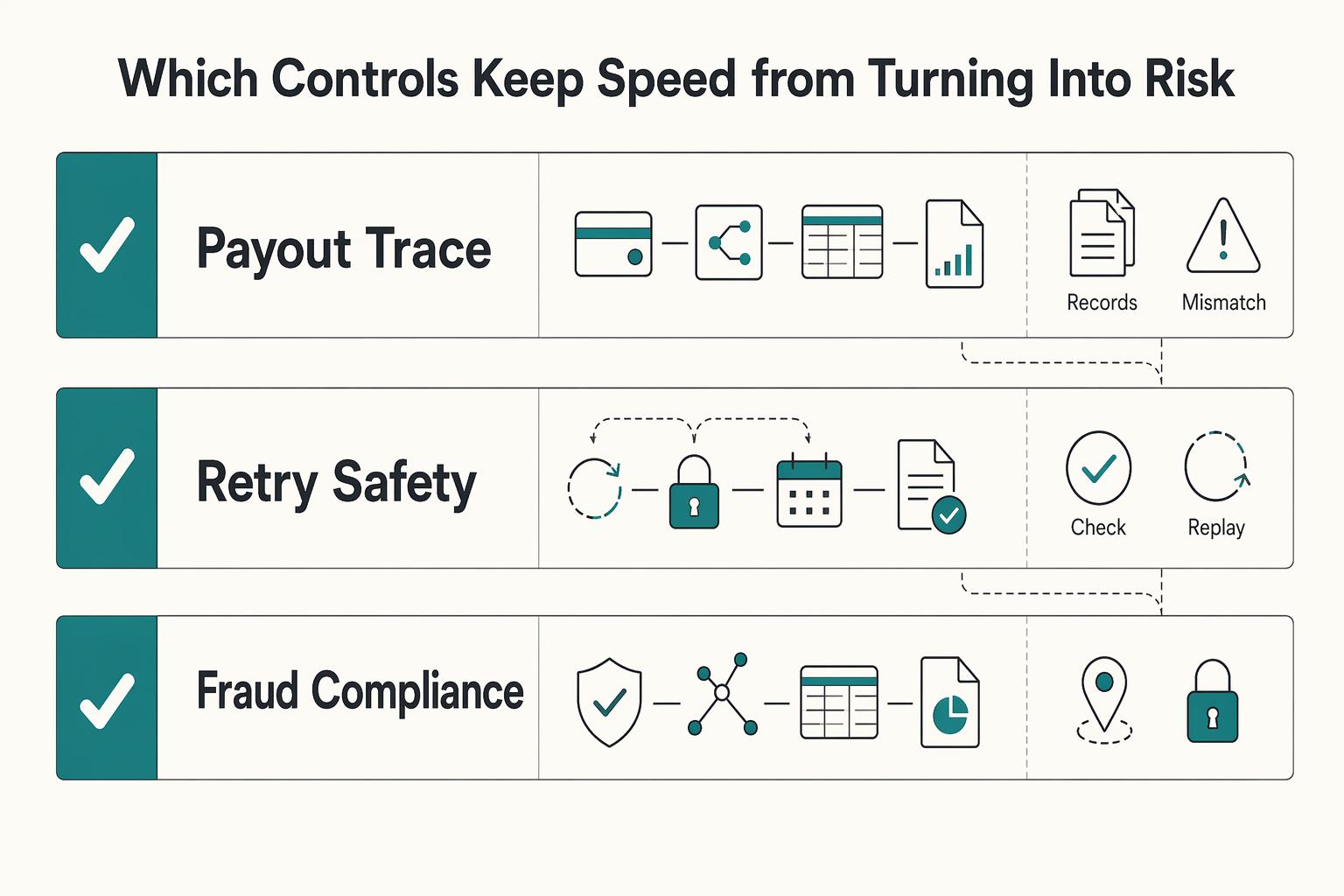
A payment platform should choose its next market based on operational readiness, not volume forecasts alone. The real question is whether you can run that market safely and clearly without creating finance debt that later shows up as payment, reconciliation, or compliance failures. If you cannot explain that operating path cleanly, your forecast should not carry the decision.
A M&A Consultant's Guide to Due Diligence Checklists
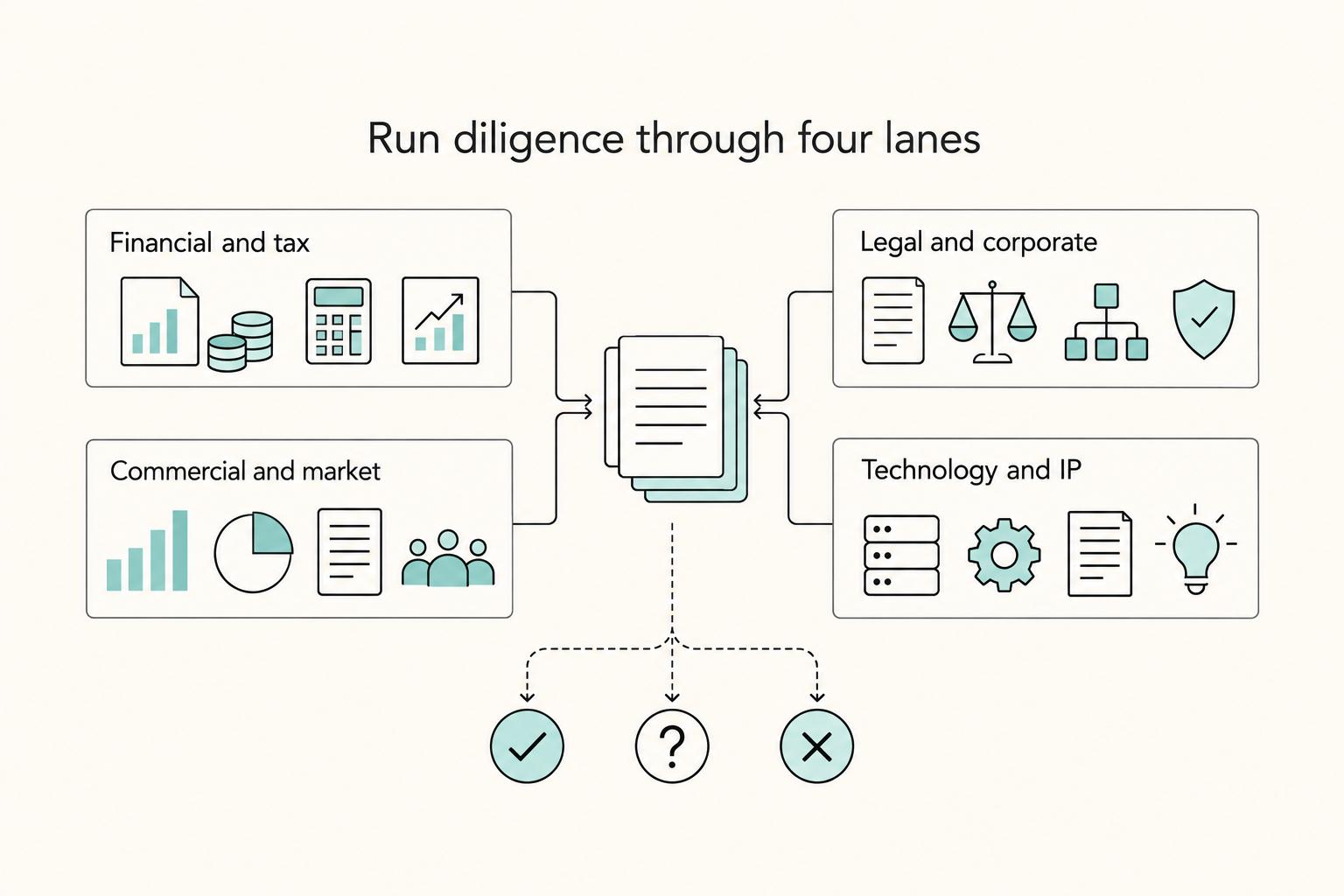
Most mergers and acquisitions fail, not in the negotiation room, but in the months after closing. The deal buckles under operational confusion, cultural friction, and liabilities that were not understood early enough. A common cause is bad due diligence, treated as a defensive box-checking exercise instead of a decision tool. That is the strategic mistake.

Lean Accounting for Payment Platforms: A Small-Team Operating Model
Finance does not become lean by having one person remember every exception. It becomes lean when each payment arrives with the identifiers needed to match it, ordinary matches happen automatically, and the remaining differences have an owner. Reduce re-entry and chasing before reducing control steps.