
Quick Answer
Use an m&a due diligence checklist as a decision system, not a filing exercise. In Pre-LOI, screen seller narrative, customer concentration, key-person dependency, and preliminary financial health to choose walk, reprice, or continue. After LOI, test financial, legal, commercial, and technology/IP evidence and tag each issue as resolve before close, price/protection adjustment, or post-close integration task. Then convert validated findings into owned Day One actions with dependencies and readiness signoff.
Most mergers and acquisitions fail, not in the negotiation room, but in the months after closing. The deal buckles under operational confusion, cultural friction, and liabilities that were not understood early enough. A common cause is bad due diligence, treated as a defensive box-checking exercise instead of a decision tool. That is the strategic mistake.
Good due diligence does more than help you avoid errors. It helps you decide whether to walk, reprice, or proceed. If you proceed, it also tells you whether you are actually ready to run the business on Day One. This three-phase playbook is built to do that.
Phase 1: The Strategic Sanity Check (Pre-LOI)#
Before you sign an LOI, decide whether to walk, reprice, or continue. This phase is a go or no-go screen, not a full investigation. Send a short, tailored request list and screen four areas first: seller narrative, customer exposure, key-person dependency, and preliminary financial health.
Use a simple triage lens as you review what comes back. Deal breaker means the issue breaks your core deal thesis or the seller will not provide basic support. Reprice means the risk is real but can be handled through price, working-capital protection, or transition terms. Monitor means the signal is real but needs deeper post-LOI validation.
- Deal breaker: The issue breaks the thesis or the seller cannot support core facts.
- Reprice: The issue is real but can move into price, protections, or transition mechanics.
- Monitor: The issue is visible now but needs deeper validation before you classify it as solved.
| Pre-LOI check | Evidence to collect | Warning pattern | Next move |
|---|---|---|---|
| Seller narrative | Written sale rationale, current operating update, request-list responses | Story shifts between calls and documents, vague urgency, missing context on recent changes | Pause or narrow scope until the explanation is consistent; classify as deal breaker if your thesis no longer holds |
| Customer concentration | Customer revenue mix by month or quarter, top customer contracts, renewal/churn summary | One customer at or above the 10 per cent marker used in IFRS 8 and (for public entities) ASC 280 disclosure frameworks, or concentration is clearly rising | Reprice if exposure is manageable; treat as deal breaker if losing one account breaks the case |
| Key-person dependency | Key-person dependency map, org chart, relationship-owner map, approval bottlenecks | Key customer ties, approvals, or core know-how appear concentrated in one person with limited backup | Consider repricing and require a transition plan; escalate if value appears heavily tied to one person |
| Preliminary financial health | Normalized financial snapshot, P&L and balance sheet trends, high-level net debt and working-capital view | Margin swings, unclear cash conversion, unexplained balance-sheet movements, thin working-capital position | Reprice and flag net debt and working-capital adjustment as post-LOI negotiation priorities |
To keep this phase practical, collect a small set of artifacts early. A clean data room and a disciplined virtual data room software setup make this easier: a customer revenue mix, a key-person dependency map, and a normalized financial snapshot. Then verify one level deeper. If concentration looks acceptable, tie the mix back to contracts or invoices. If the snapshot looks clean, confirm whether the normal working capital needed to run the business is stable enough to support valuation.
- Customer revenue mix: Confirm concentration with contracts, invoices, and renewal visibility.
- Key-person dependency map: Identify revenue, product, or relationship risk tied to one operator.
- Normalized financial snapshot: Strip noise out of the numbers before you trust valuation logic.
- Room-quality check: Note whether the seller can produce these basics quickly and coherently.
If the seller cannot produce these basics promptly, treat that as a process signal. It does not prove the company is weak, but it may mean the deal needs more time, tighter controls, or stronger price protection than you first assumed.
Phase 2: The Deep Dive Investigation (Post-LOI)#
If Phase 1 says continue, shift into confirmatory diligence. The job now is to validate what you think you know, not to accept management claims at face value. Your m&a due diligence checklist should work as an evidence plan for each issue: what you requested, how you tested it, and what decision follows.
The sequence can flex, but the priorities should not. Reported post-LOI timelines vary. Examples include 30 to 60 days, five to seven weeks, or staged windows like Days 1 to 7, 8 to 21, and 22 to 35. Use the timeline that fits your deal, but keep the early focus on completeness of records, ownership visibility, and transferability of core contracts and assets.
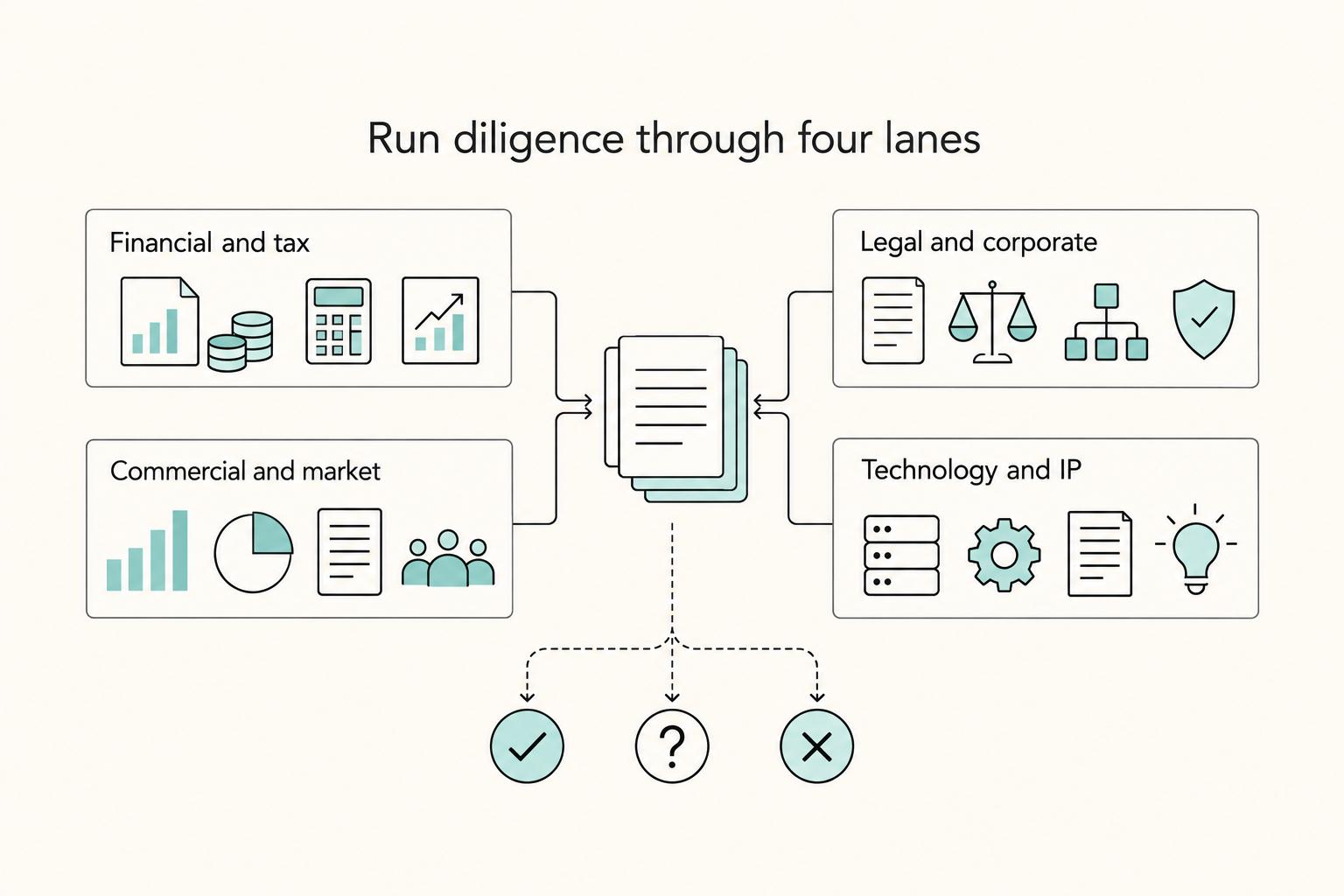
Use the four lanes as decision lanes#
These lanes are not just review categories. Each one should lead to a specific decision about price, protections, closing conditions, or whether the deal still makes sense.
| Inquiry lane | What you are validating | Core documents | Common failure pattern | What to do next |
|---|---|---|---|---|
| Financial and Tax | Earnings quality and working-capital reality | 3 to 5 years of financial records, working-capital detail | Financial support is inconsistent or incomplete | Complete preliminary validation, then run QoE; move unresolved gaps to price/protection adjustment |
| Legal and Corporate | Authority to sell, ownership clarity, and contract rights | Corporate structure and ownership records, material contracts, employment agreements | Ownership or control statements conflict with records; key contract rights are unclear | Classify core authority or contract-rights gaps as resolve before close |
| Commercial and Market | Durability of revenue and credibility of forecast assumptions | Customer revenue mix, major customer contracts, forecast support | Concentration risk rises, or forecast assumptions conflict with recent results | Rebuild forecast and shift supported exposure to price/protection adjustment; treat thesis-breaking concentration as a stop signal |
| Technology and IP | Ownership and defensibility of core product and IP | IP registrations and assignments, product documentation, software/license records | Core IP is not clearly owned by the company | Treat ownership ambiguity as resolve before close; move unsupported exposure out of value assumptions |
Financial and Tax Start here if the numbers drive the case. Your objective is to confirm reported earnings are real and sustainable through closing. Request 3 to 5 years of financial records and working-capital support. Complete preliminary validation before relying on adjustments, then order QoE. If earnings quality or working-capital needs do not hold up, move to price/protection adjustment or stop if the gap is fundamental.
Legal and Corporate If you cannot clearly acquire and operate what you are buying, the rest of the work matters less. Request corporate structure and ownership records, material contracts, and employment agreements. Match management statements to the records. Then review whether core contract rights can transfer without breaking continuity. Missing authority, unclear ownership, or non-transferable core contracts belong in resolve before close.
Commercial and Market This is where you test whether the revenue story deserves your valuation model. Request the current revenue mix, major customer contracts, and support for key forecast assumptions. Compare concentration and forecast assumptions against recent actual revenue, not slide-deck narratives. If one account carries the case, verify the contract terms and renewal risk directly. Weak support usually maps to price/protection adjustment; concentration that breaks the thesis can justify walking.
Technology and IP Do not assume the company owns what it built or can keep using what it depends on. Request IP registration and assignment files, product documentation, and software/license records. Then trace key code, brand, and product rights to company ownership. If ownership cannot be clearly evidenced, treat it as resolve before close or remove it from value assumptions in price/protection adjustment.
Turn findings into a Phase 3 risk register#
Before closing, turn each issue into a line item with evidence, impact, owner, and next action. Use three working labels: resolve before close, price/protection adjustment, and post-close integration task. If an item cannot be tied to a document and a test result, it is still an open question, not a finding. That discipline creates a clean handoff into Phase 3: validated facts, explicit exceptions, and clear ownership. It should already resemble the operating plan you will use in the integration phase after an acquisition.
You might also find this useful: How to Create a 'Data Room' for a Due Diligence Process. If your checklist reveals fragmented payment operations, use the Gruv docs to map required controls, webhooks, and reconciliation workflows before close.
Phase 3: Turn Diligence Findings into an Integration Plan#
This is where diligence either pays off or gets wasted. Treat it as execution, not wrap-up. The goal is to turn Phase 2 findings into a plan that protects Day One continuity and positions the combined company to operate and create value by Day 100.
Start by turning your Phase 2 risk register into a single integration tracker. Every item from diligence should have an owner, priority, dependency, and target window. Add the evidence from diligence and a readiness checkpoint (RCP) so you can confirm what is truly ready, not just discussed. If regulated flows are involved, treat the tracker more like an enhanced due diligence workboard than a generic PMI template. For value items, track planned, forecasted, and actual against target so you can catch drift early.
Convert findings into pre-close and post-close moves#
Do not push material risks into post-close cleanup by default. Use a continuity test: can this issue disrupt shipping products, delivering services, sending invoices, filing required reports, or collecting payments on Day One? If yes, keep a pre-close mitigation tied to it.
- Revenue continuity: Billing, collections, and customer notices can run on Day One.
- Operational access: Critical systems, permissions, and vendor credentials are assigned before cutover.
- Regulatory continuity: Required filings, approvals, and reporting calendars have an owner.
- Escalation path: A material blocker has a decision owner, a due date, and a fallback move.
| Risk theme | Pre-close mitigation | Post-close execution move |
|---|---|---|
| Founder or key-person dependency | Confirm knowledge-transfer scope, decision rights, and access to core files, accounts, and customer history | Complete documented handoff, reduce single-person approvals, and track whether decisions still bottleneck with one person |
| Contract assignability or change-of-control friction | Review material contracts, flag required consents, and classify uncertain continuity as resolve before close | Execute consent follow-through, update contract ownership records, and brief account teams on updated service and notice obligations |
| Finance and reporting gaps | Confirm bank access, reporting responsibility, chart-of-accounts mapping, and invoice-to-cash continuity | Run a unified reporting cadence, reconcile opening balances, and move to target accounting only after handoff criteria are met |
| Technology, IP, or privacy-obligation ambiguity | Verify ownership and access for critical code, systems, and obligation records; keep unresolved core ownership out of Day One assumptions | Execute remediation, assign long-term control owners, and retire manual workarounds only after evidence supports the target state |
Sequence communication before rumors set the narrative#
Communication needs a deliberate sequence, not a generic announcement plan. The integration lead should already be working from the same playbook used in post-close integration planning. Put one message framework in place by signing, then align leadership and functional leads early on facts, unknowns, and what not to promise. If leaders are out of sync, employee uncertainty grows fast.
| Audience | What to cover |
|---|---|
| Employees | What changes now, what does not, and where to escalate questions |
| Customers | Service continuity, points of contact, and contract handling |
| Critical suppliers | Ordering flow, payment process, and escalation paths |
Before release, compare all drafts side by side. If one message promises continuity while another implies immediate process change, you create avoidable confusion.
Quick wins belong in the first 100 days only when they support continuity and momentum. If a quick win competes with core Day One flows, defer it.
Define stable-operation readiness#
Readiness is not the org chart on paper. It is whether the business can actually run without preventable disruption. Use these checkpoints:
| Area | Checkpoint |
|---|---|
| Reporting cadence | Is defined for Day One and ongoing close cycles |
| Each core control | Has a named owner; for SEC registrants, ICFR ownership aligns with management responsibility |
| Bank access, billing, collections, and approval rights | Are assigned and tested |
| Source systems, data handoffs, and fallback procedures | Are documented |
| Any target-system migration | Waits until reconciliation, access, and reporting outputs are verified |
If an item is missing an owner, dependency, evidence link, or RCP, it is not integrated yet. It is still an open risk.
For a step-by-step walkthrough, see Enhanced Due Diligence in FinTech That Holds Up Under Real Case Volume.
From Checklist Review to Running the Business on Day One#
Phases 1 to 3 tell you whether the deal should happen. This last step is about whether you can actually run the business on Day One. Treat the checklist as an execution input: convert each material finding into an owned action with dependencies, a readiness check, and pre-close signoff.
| Mindset | Checklist mentality | Operating mentality | What you do now | Evidence to confirm |
|---|---|---|---|---|
| Goal | Find problems | Prepare to run the business | Classify findings into clear decision paths, then convert open issues into integration work | Formal findings report and decision log |
| Team | Advisors review documents | Leaders own outcomes | Assign a workstream owner and, where relevant, leaders from both companies | Owner roster, operating cadence, escalation path, IMO or equivalent governance |
| Timing | Wait until signing | Start during diligence | Build integration actions before signature, not after | Pre-close integration tracker with dependencies and status |
| Readiness | Assume close equals readiness | Test continuity explicitly | Use readiness checkpoints and require workstream or functional signoff for Day One readiness | Signed readiness status by function or workstream |
Use one conversion rule: each material finding should become an operating work item. A finance gap becomes a controllership task with a finance owner, a data-access dependency, and a defined success signal. A legal or compliance issue becomes an action plan with legal ownership, required approvals or consents, and signoff that readiness conditions are met. If planning requires sensitive data, use a clean room or another controlled mechanism.
Do not run integration as side work. Start planning during due diligence and manage integration as a discrete program. If the deal spans jurisdictions, track regulatory approvals in the main execution tracker with an owner and explicit evidence to confirm readiness.
Your first post-close operating cycle handoff#
Before close, confirm you can hand over one live operating tracker with:
- Owner and deputy: Every workstream has a single accountable owner and a named backup.
- Evidence link: The tracker points back to the document, test, or approval that supports the task.
- Dependency and timing: Blockers, predecessor tasks, and the target handoff window are explicit.
- Readiness signoff: Finance, legal, technology, or operations confirm what is genuinely ready before close.
| Handoff item | Detail |
|---|---|
| Issue tracker | Owner, dependency, status, and success signal for each open item |
| Day One readiness signoff | At the workstream or functional level |
| Legal and compliance action plans | Regulatory approval dependencies where applicable |
| Formal findings report | What was accepted, renegotiated, or deferred |
| Defined cadence | Post-close implementation and performance tracking for the first post-close operating cycle |
When your integration blueprint is finalized, contact Gruv to confirm market coverage, compliance gates, and rollout sequencing for your post-close money movement.
Frequently Asked Questions
What are the biggest red flags in due diligence?
The biggest red flags are gaps that make core facts unreliable. If you cannot verify the financial statement package, confirm basic corporate-status records like the certificate of good standing, or get organized documentation, treat that as a potential deal breaker. If an issue is clear and fixable, it may be a renegotiation item instead. Escalate quickly, then choose whether to renegotiate or abandon based on what the evidence shows.
What is the difference between financial and commercial due diligence?
Financial diligence focuses on whether historical financial records are complete and reliable. Broader diligence also reviews operational and legal factors, with environmental and diversity and inclusion factors increasingly included. You need both because financial records alone do not cover the full risk picture.
How should you prioritize an m&a due diligence checklist?
Prioritize by decision impact, not by running every question at equal depth on day one. Start with organizational and financial basics, then expand across legal, operational, and other material factors as needed. Use findings to decide whether to proceed, renegotiate, or abandon.
What documents should you verify first when the seller opens the room?
Verify basic organizational and financial records first. In practice, start with corporate-status documents, including the certificate of good standing, and quarterly and annual financial statements from the past several years, plus supporting line-item detail where available. Treat disorganization or missing basics as a real risk signal, not an admin issue. Decide whether to proceed, renegotiate, or abandon only after the basics are credible.
What tools are essential for the diligence process?
Focus on controls, not brand names. Use a secure document repository and a clear process for tracking open issues and decisions. A virtual data room is a secure online environment used to store, share, and review diligence files. For each material issue, drive to one outcome: proceed, renegotiate, or abandon.
How long does due diligence usually take?
Use a range, not a fixed promise. Reported timelines run from 30 days to 6 months. Actual timing varies with deal complexity and context, and private-target deals may carry higher information risk. If timing prevents proper review of core records, renegotiate the timeline or pause instead of rushing.
Try a related tool
Researched and edited by the Gruv editorial team. Gruv builds cross-border billing, payouts, and finance-operations software for global businesses.
Sources
Includes 4 external sources outside the trusted-domain allowlist.
- ecfr.gov/current/title-17/chapter-II/part-229/subpart...trusted
- sec.gov/Archives/edgar/data/1490054/0001096906210030...trusted
- sec.gov/rules-regulations/staff-guidance/corporation...trusted
- americanbar.org/groups/young_lawyers/resources/after-the-bar...external
- deloitte.com/us/en/services/consulting/articles/mergers-a...external
- diligent.com/resources/blog/mergers-acquisitions-due-dili...external
- duedilio.com/post-loi-due-diligence-timelineexternal
Educational content only. Not legal, tax, or financial advice.
Related Posts

Germany Freelance Visa Application Path for Freiberufler and Gewerbe
Choose your track before you collect documents. That first decision determines what your file needs to prove and which label should appear everywhere: `Freiberufler` for liberal-profession services, or `Selbständiger/Gewerbetreibender` for business and trade activity.

Digital Nomad Health Insurance Comparison for Long-Stay Moves
Use focused time now to avoid expensive mistakes later. Start with a practical `digital nomad health insurance comparison`, then map your route in [Gruv's visa planner](/tools/visa-for-digital-nomads) so we anchor policy checks to your real plan before pricing pages pull you off course.

The Freelance Payment Penalty: A Modeled Audit of Platform Fees, FX Spreads, and Payout Delays
The money rarely disappears through a single, easy-to-spot fee. The real loss is stacked. A marketplace takes its commission, a processor adds a charge for international cards, a bank or payment company converts the currency at a spread, a platform holds the funds before release, and a wire sheds a little to intermediaries on the way in. Each layer looks defensible on its own, but the worker feels the combined result as a smaller deposit and a later payday.