
Quick Answer
Start with ownership, not vendor features: pick who stores PAN, who can detokenize, and how portability will work before you build integrations. Then lock strict service boundaries, keep most systems token-only, and reserve token-to-card return for tightly controlled paths. Use a phased rollout (new checkout, then recurring migration, then downstream dependencies) with idempotency checks, correlation IDs, and replay tests. In practice, strong execution means proving controls continuously under PCI DSS 4.0.1, not just during an audit window.
What PCI-Compliant Card Vault Tokenization Looks Like in Practice#
Choose the Card Vault ownership model based on who stores PAN, who can reverse tokens, and how much operational burden the platform team wants to own. The right choice lets a PCI-compliant card-vault architecture replace sensitive card data, including the Primary Account Number (PAN), with tokens so fewer systems ever see plain-text card data. It also helps operators avoid a late surprise: a "tokenized" design can leave meaningful PCI DSS work inside the platform boundary.
Tokenization replaces sensitive card data with a non-sensitive token. With the right implementation, engineering and operations teams work with tokens rather than customer card numbers in day-to-day systems. In our reviews, we treat tokenization as a boundary control, not a compliance shortcut. PCI DSS scope still applies if a business accepts, stores, processes, or transmits cardholder data, and tokenization is only one control. It differs from encryption and does not create compliance by itself.
The decision you are actually making#
For CTOs and solution architects, the real choice is about ownership and responsibility: who operates the vault, who can reverse tokens back to card data, and who carries the ongoing operational burden. In practice, that usually means deciding how much tokenization infrastructure is provider-managed versus merchant-operated.
| Artifact | What it shows |
|---|---|
| Current data-flow diagram | Where PAN enters, where tokenization happens, and which services only handle tokens |
| Control ownership matrix | Your responsibilities separated from provider and cloud responsibilities |
| Token-to-PAN return paths | Each return path, its purpose, and audit expectations |
Each model can reduce PAN exposure across a codebase. In our architecture reviews, we ask who stores token-to-card mappings, which services can request card data back, and what evidence the operator can produce when an assessor asks how cardholder data is protected.
Define success before you compare vendors. Success is not "we use tokens." Success is a smaller PCI DSS scope where possible, clear ownership boundaries, and audit-ready evidence.
A useful early check is whether the team can list every service that continues to touch PAN and explain why. If that is unclear, scope is probably unclear too. The control view should also cover data at rest, data in motion, and data in use so the design does not miss risk that never shows up on a storage diagram. The companion guide on building a PCI-compliant workflow for handling credit card data is useful when that inventory is incomplete.
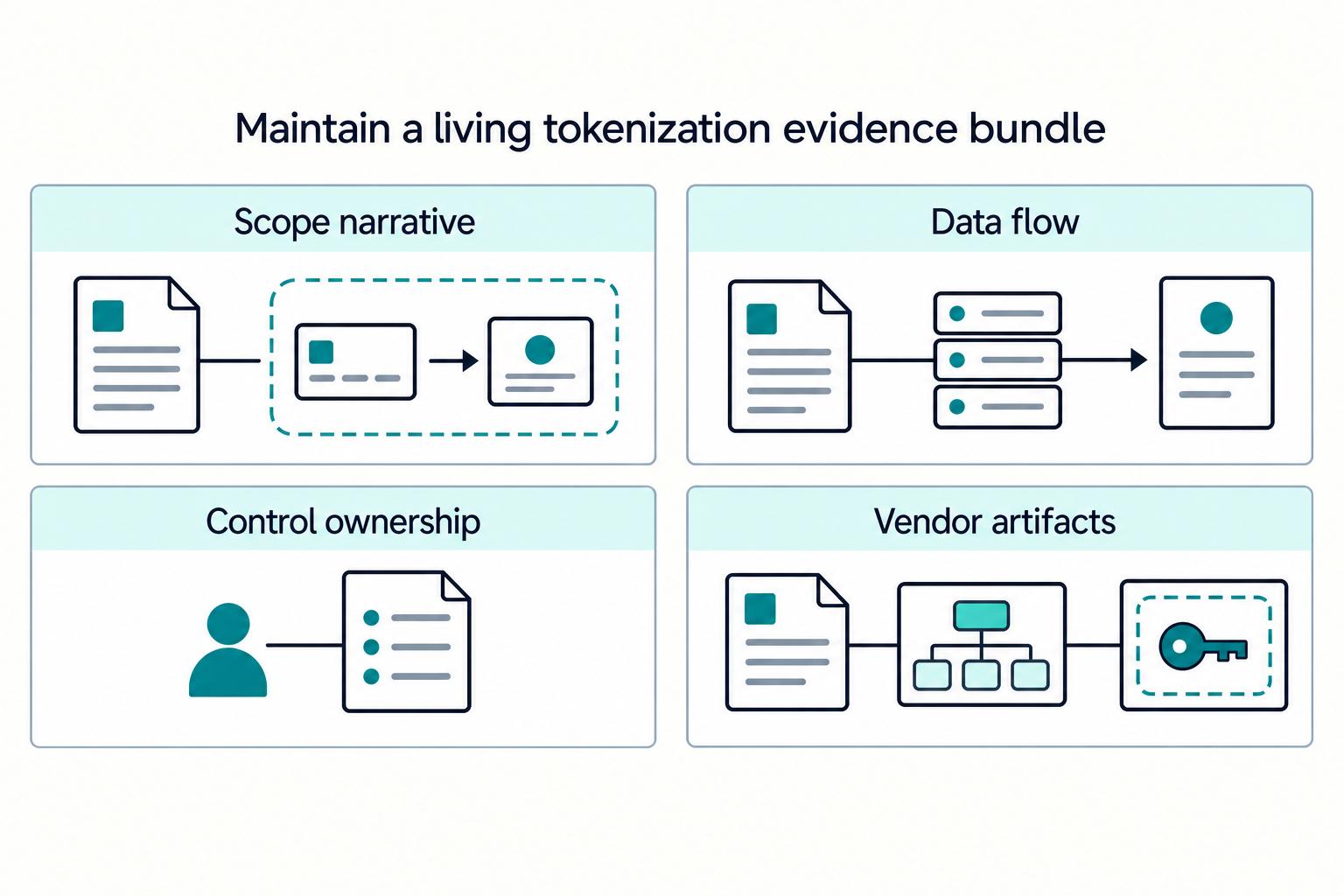
A practical evidence pack usually starts with these three items:
- a current data-flow diagram showing where PAN enters, where tokenization happens, and which services only handle tokens
- a control ownership matrix separating your responsibilities from provider and cloud responsibilities
- a defined list of token-to-PAN return paths, each with purpose and audit expectations
Design for caveats, not assumptions. Assumptions get expensive quickly in this space. Make compliance expectations and ownership boundaries explicit in the design.
Cloud support has limits. It does not make your implementation PCI compliant on its own. If you treat tokenization as a full compliance shortcut, cardholder data can still appear outside your intended token flow. That can widen scope again and raise audit risk, including fines, higher processing fees, or losing card acceptance.
Step 1 Define what tokenization changes in your platform#
Start with data flow, not vendor selection. Define where PAN and other sensitive card data appear before tokenization, then map where tokens replace that handling after the redesign.
1. Draw the smallest useful before-and-after path. Draw a minimal before-and-after diagram. It should show:
- where PAN is captured, stored, forwarded, retried, or exported today
- where card details are replaced with a token in the new flow
- which services handle only tokens after that point
Make the boundary explicit for the selected ownership model: downstream systems use tokens, while PAN and any reversible mappings stay inside the provider-operated or merchant-operated vault boundary. A merchant-owned vault does not move PAN to an issuer merely because it issues tokens.
2. Separate tokenization, encryption, and detokenization. Keep these as distinct design controls.
- Tokenization: replace card details with a surrogate token.
- Encryption: manage this separately from tokenization.
- Detokenization: map a reversible token back to PAN inside the selected vault boundary; document its operator and authorized return paths.
If any service needs key or secret access, document who has it and keep a granular audit trail.
3. Apply portability checks early. If processor portability matters to you, do not assume PSP-issued tokens will be portable by default. PSP or gateway tokens can be proprietary to a provider; EMV payment tokens can have merchant, device, or token-requestor restrictions, which can create a portability tradeoff later.
Verification checkpoint. Before comparing architecture options, list every service that continues to touch PAN after the redesign and justify each one. Include the service owner, any key or secret access permissions, and the audit evidence the team expects to rely on. In our reviews, we pair that checkpoint with PCI DSS 4.0.1 scope and evidence priorities for platform operators so requirement ownership is explicit before build-out starts.
Step 2 Compare vault ownership models before vendor shortlisting#
Decide vault ownership before you shortlist features, because ownership drives portability, control, and outage exposure. If multi-processor flexibility or exit options matter, lean away from processor-owned credential storage and read this alongside When Platforms Should Move to Payment Orchestration and Multi-Gateway Routing. If speed to market is the main constraint, a third-party vault service can be a practical compromise.
Use ownership as the first filter#
"Tokenization" is a control, not an ownership model. According to PCI SSC's Tokenization Product Security Guidelines (Version 1.0, April 2015), tokenization products can be hardware, software, and/or service offerings. The report makes the practical point that security depends on implementation details, not product labeling.
Start your comparison with three questions:
- Who controls the credential layer?
- Who can reverse tokens to card data?
- What happens if you switch processors?
| Model | Portability | Implementation speed | Control | Operating burden |
|---|---|---|---|---|
| PSP tokenization | Often lower. Tokens may be tied to one processor or gateway. | Can be fast if you already use that PSP. | Lowest. Credential control stays with the processor. | Often lower up front, with higher switching and dependency risk later. |
| Third-party vault API | Medium to high when processor-neutral. | Fast to medium, often delivered as a service. | Medium. Better separation from a single processor, but token reversal, tenancy, and key design can vary by vendor. | Medium. Less build effort than self-owned, more diligence than PSP-native. |
| Merchant-owned payment vault | Highest in principle. | Can be slower to implement. | Highest in principle. You set token reversal and access rules and manage processor mapping. | Highest. You own operations, evidence, and failure handling. |
Apply the hard tradeoffs early#
If active multi-processor routing and clean exit paths are non-negotiable, do not make PSP tokens your default credential store. That path may reduce merchant-side PCI scope, but it can also reduce portability.
If launch speed matters most and you can accept the ownership tradeoff, a third-party vault can be the middle ground. Treat "TaaS" as a delivery label, not proof the risk is covered. Confirm token type (reversible or irreversible), token-to-PAN return policy, and tenancy and key isolation.
Merchant-controlled or neutral vaults can give you more control, but only if the implementation is strong. One common failure mode is simple: if the vault is breached, mapped token data is exposed. Availability matters here too. If stored credentials are concentrated with one provider, that dependency can directly affect billing continuity.
Verify claims like TaaS, AWS Marketplace, and PCI DSS Level 1#
Treat labels as a starting point, not evidence. AWS Marketplace presence can make procurement easier, but it does not prove control suitability. "PCI DSS Level 1" claims also need current, scoped evidence and control mapping.
Request current, service-scoped assessment evidence and a responsibility matrix. Also request installation and control documentation aligned with the PCI SSC tokenization guideline’s Annex B (Tokenization Installation Guide). That supplemental guide helps evaluate implementation; it does not replace PCI DSS requirements.
Procurement red flags include the following:
- self-published compliance claims without control mapping and current evidence
- unclear token-to-card return policy, including who can reverse tokens and for what approved purpose
- missing tenancy boundary or key ownership detail
- no clear declaration of reversible versus irreversible token design
- marketplace presence presented as compliance proof
Set a shortlisting checkpoint#
Before you shortlist, require a one-page ownership summary plus evidence bundle for each option. Capture the ownership model, tokenization delivery type (hardware, software, or service), token reversal rules, tenancy and key ownership, outage dependency, and migration assumptions.
If a vendor cannot answer those points clearly, do not shortlist it yet. This check keeps a fast procurement decision from turning into long-term platform debt.
Step 3 Lock PCI scope boundaries and system contracts#
Lock the scope boundary before writing more integration code. If a service does not need Primary Account Number (PAN), it should not receive it. We treat API schemas, event contracts, and logging policy as hard controls, and What Is PCI DSS Compliance and Do You Need It? is a useful baseline when teams need shared scope vocabulary.
This is a contract problem, not a labeling exercise. Published by PCI SSC, PCI SSC e-commerce guidance includes scoping considerations in section 2.10. The operating baseline is straightforward: know where cardholder data exists, and if it is not needed, do not store it. Tokenization replaces PAN with a surrogate token, but implementation choices determine exposure.
Classify each service by allowed data. Classify every component as PAN-handling, token-only, or no payment data, and document exceptions explicitly. These data labels do not determine PCI scope on their own: connected and security-impacting components can remain in scope even without PAN.
| Service type | May handle | Must never handle | Verification checkpoint |
|---|---|---|---|
| Card capture or vault ingress | PAN where capture or vaulting occurs | Unrelated business data stores copying PAN | Request samples, ingress logs, storage path review |
| Billing, subscriptions, retries, reconciliation | Tokens, payment method references, status codes | Raw PAN, full card payloads | API schemas and event payload samples show token-only fields |
| Analytics, support tooling, CRM, data warehouse | Masked references if needed | PAN and recovered card values | ETL mappings, warehouse columns, support exports reviewed |
If a downstream service says it might need PAN later, treat that as a design gap. Move that action behind the vault, or document a narrowly controlled exception path.
Write lifecycle contracts for token events. Define token lifecycle behavior in APIs and webhooks before implementation spreads. We treat event contracts as part of the PCI boundary, and ERP Sync Architecture for Payment Platforms Using Webhooks, APIs, and Event-Driven Patterns is a practical delivery-side reference. For each event, make the business meaning, retry behavior, and system responsibility explicit.
As a baseline, define fields and rules such as:
- event name and business meaning
- stable token identifier and customer or merchant reference
- duplicate-delivery handling for retries
- correlation identifier used across app, vault, processor, and reconciliation outputs
- authoritative system when states conflict
Checkpoint: replay the same webhook or callback twice in non-prod and confirm you get one business outcome.
Map controls across where data is stored, transmitted, and processed. Require a component-level control map, not a generic coverage statement. Document where payment data or token mappings exist, how they move, and where they are exposed during processing.
For each component, document these points:
- whether it stores PAN, tokens, token mappings, or neither
- storage protections for persisted values and backups
- transport protections for APIs, service traffic, and webhook delivery
- processing exposure points, such as admin tools, support views, batch jobs, or exception handling paths
- control ownership: your team, vault provider, PSP, or a shared boundary
Use PCI SSC e-commerce guidance section 5.2 (validation documentation) and section 5.3 (PCI DSS requirement ownership) as anchors.
Create the evidence checkpoint before build-out continues. Do not continue until three artifacts are complete: the architecture diagram, the data-flow inventory, and the control ownership matrix. The diagram should mark where PAN can enter, where it must stop, and where exception boundaries sit. The inventory should list producer, consumer, payload type, and retention behavior for each payment-related flow. The ownership matrix should assign control responsibility and identify shared boundaries that require validation evidence. If any service cannot be classified cleanly, pause and resolve it before moving forward.
Step 4 Pick the card capture pattern that matches your risk tolerance#
Choose the capture pattern that fits delivery constraints, not the one that sounds most flexible. Use a drop-in UI when speed is the priority, and use Hosted Fields when tighter UX control matters. How to Achieve PCI Scope Reduction: Why Platforms Use Hosted Fields and Tokenization is the closest companion pattern when the goal is keeping servers out of PAN handling.
| Pattern | Practical fit | UX control | What to verify before go-live |
|---|---|---|---|
| Drop-in UI | Fastest path to launch | Lower checkout control | Webhook status updates are tested end to end |
Hosted Fields | When tighter UX control matters | Stronger design control and tighter UX | Sensitive fields are hosted by the provider; only its token or nonce reaches your server, and the integration meets the applicable assessment conditions |
| Direct API capture | Treat as an exception path | Highest direct control over the capture flow, with broader PAN exposure and security responsibilities | Document the full PAN path and applicable PCI DSS controls before allowing direct capture |
For a provider-hosted capture flow, card details go directly to the provider and the application receives its token or nonce. The server uses that reference to create the transaction and reconciles authenticated callbacks with authoritative provider status. Check the provider’s integration and assessment conditions; a token-only server path alone does not establish compliance.
Keep sensitive authentication data out of recurring credential storage. PCI DSS prohibits storing card-verification codes after authorization, even encrypted. A card vault is not permission to retain CVV for future renewals.
For the recommended provider-hosted capture path, require sensitive card fields to go directly to the provider and keep PAN out of application servers. A merchant-operated vault or direct-capture exception needs a separately approved PAN-handling boundary and applicable PCI DSS controls. Include idempotent payment API controls and duplicate-prevention tests in both sandbox and go-live checks.
Step 5 Constrain detokenization and key access from day one#
Treat the path back from token to card data as privileged from day one, not as a convenience API for general services. PCI SSC's Tokenization Product Security Guidelines v1.0 (April 2015) puts the core point plainly: tokenization security depends on configuration, implementation, and security features, not token substitution alone.
Classify detokenization as privileged#
Default to need-to-know access. Most services should create, store, and pass tokens. Only a narrow set should be able to request card data back. When that is required, isolate it behind dedicated non-human service accounts with tightly scoped permissions.
That boundary matters because tokenization service accounts often carry elevated privileges and can become a vulnerability if they are mismanaged. Keep an explicit access inventory for each account: allowed tokenization actions, owner, environment, and where its activity is logged and monitored.
Separate key use from broad service access#
Do not bundle token operations and cryptographic key access into one broad permission set. The PCI SSC guideline explicitly treats cryptographic key management as its own domain (Domain 4), so key-use paths should be reviewed and controlled separately.
This rule applies whether the tokenization product is delivered as hardware, software, or a service. Document who can request cryptographic operations, who administers key management, and which services are excluded from both.
Document layered controls for data at rest and data in use#
If tokenization and encryption are both part of your design, write down where each control applies and where sensitive data can exist. Keep this as maintained implementation documentation, not tribal knowledge, so audits and incident reviews can verify how the controls were meant to work in practice.
For service accounts, use unique credentials per account and make sure tokenization-related activity is logged and monitored. You should be able to trace which account performed a sensitive operation and in which environment.
Make privileged access decisions observable#
When token-to-card requests are approved or denied, make those service-account actions clear in logs and monitoring. Avoid quiet fallback paths that bypass the intended boundary, because they can undermine need-to-know access.
Define this operational handling up front so your teams can detect and investigate unexpected activity quickly.
Step 6 Sequence implementation to avoid platform debt#
Use a phased rollout to reduce migration risk. In our rollout plans, we usually sequence this as new checkout, recurring payments, and then payout and reporting dependencies. This is an implementation strategy, not a PCI DSS requirement, and it gives operators room to validate tokenization boundaries before downstream systems depend on them.
| Phase | Focus | Key check |
|---|---|---|
| New checkout | Move fresh card capture to the new flow first | Confirm raw PAN is not landing in application logs or other unintended storage points; webhook-driven status updates are reliable enough for reconciliation; retry behavior cannot create duplicate charges, and idempotency is enforced |
| Recurring payments | Old and new token domains may need to coexist | Keep explicit recurring token records and verify that each attempt uses the expected token for the customer and billing cycle |
| Payout and reporting dependencies | Connect payout, reporting, and finance consumers only after checkout and recurring flows are stable | Follow validated payment-path behavior and avoid binding downstream services to provider-specific token semantics too early |
Start with new checkout#
Move fresh card capture to the approved new flow first. For provider-hosted capture, the provider receives the sensitive fields and the application uses the returned token or nonce for transaction creation. If the selected design includes a merchant-operated vault or approved direct capture, validate its PAN-handling path and controls before rollout rather than assuming client tokenization describes that architecture.
Before you expand the rollout, confirm in production that:
- raw PAN is not landing in application logs or other unintended storage points
- webhook-driven status updates are reliable enough for reconciliation
- retry behavior cannot create duplicate charges, and idempotency is enforced
After launch, update your PCI DSS 4.0.1 PAN data-flow map to reflect the live flow, not just the intended design, and keep evidence current.
Migrate recurring payments with coexistence in mind#
During the transition, old and new token domains may need to coexist. Do not assume existing PSP-issued tokens will be portable across vaults or processors.
Keep explicit recurring token records so billing can distinguish legacy and new paths and detect mismatches early. Do not stop at payment success rates. Verify that each attempt uses the expected token for the customer and billing cycle.
Push payout and reporting dependencies to the end#
Connect payout, reporting, and finance consumers only after checkout and recurring flows are stable. Even systems that do not directly store PAN can still affect PCI scope, so late-stage dependency wiring should follow validated payment-path behavior.
This also keeps debt down. If downstream services bind to provider-specific token semantics too early, the next migration gets harder before this one is complete.
Define rollback before each phase goes live#
Set written rollback criteria before launch for each phase. Include:
- customer-impact thresholds, for example checkout or renewal failure patterns
- token-reconciliation failures, such as unexpected customer-token mismatches
- webhook delay or loss conditions that make status unreliable
- duplicate-attempt signals tied to retries and idempotency keys
If your plan may depend on broad customer card re-entry, pause and revisit your portability assumptions before launch.
Step 7 Build reliability, observability, and incident response into the architecture#
Treat the vault as a critical dependency, not a black box. Define timeout, retry, and fallback behavior for each payment path up front, or token failures can turn into customer-facing payment and reconciliation problems instead of clear, diagnosable incidents.
| Incident class | Meaning |
|---|---|
| Token service degraded | Latency, timeouts, or partial failures on token create or use paths |
| Detokenization denied | Permission, policy, or key-use rejection on token-to-card return paths |
| Stale token mapping | Token mapping does not match the expected customer, provider object, or active token domain |
| Processor mismatch | Token is attempted on a processor route it was not issued for |
Set path-specific failure rules before launch. We set failure behavior based on customer impact and accounting risk, not a single generic retry policy. Checkout, recurring renewal, and reconciliation backfill may need different handling when token creation or token-reversal calls are slow or unavailable.
For customer checkout, preserve state and return a controlled retry response. Avoid routing to a less restricted PAN path just to protect conversion. For recurring billing, prefer pending or controlled reprocessing when provider outcome is unclear instead of blind retries. For card-data return paths, fail closed and treat denial as a security event.
If you cannot prove provider outcome, do not create a second financial action until you reconcile by correlation ID, provider reference, or both.
Trace token operations end to end. The architecture needs an evidence trail that works in practice. PCI DSS includes 12 requirements across six categories, and audit logging is part of the control set, but implementation details in a payment workload remain an operator responsibility. Payout Observability: Logging, Tracing, and Alerting is a useful companion for the telemetry side.
A practical pattern is to carry one trace ID across request intake, token operation, provider response, payment decision, ledger posting, and reconciliation output. Log operation type, object references, token domain, route, and result code, and keep PAN and other cardholder data out of logs.
A simple readiness check is to pick one live payment and trace it end to end from that single trace ID. If you cannot find the provider response, ledger record, and reconciliation artifact without guesswork, observability is not ready.
Define vault-specific incident classes. Use a small vault-focused incident taxonomy so responders do not collapse everything into a generic provider outage. Use the labels above for ownership and escalation, not as PCI-mandated classes.
Watch for silent degradation, because some payments may still succeed while state integrity drifts underneath them.
Prove behavior with game-day outage tests. Before you call the design production-ready, run game-day scenarios that simulate vault failure and confirm payment state stays consistent and auditable. This validates live behavior under stress, even though it is not an explicit PCI DSS requirement.
Test scenarios can include token-service timeout, explicit token-reversal denial, and delayed provider response after app timeout. For each scenario, verify customer status, ledger state transition, reconciliation traceability, and incident ownership and alert routing. Capture an evidence pack for each drill with the scenario, timestamps, trace samples, ledger records, and the decision taken.
Step 8 Prepare the compliance and audit evidence pack continuously#
We build the audit evidence pack continuously, not as a pre-assessment scramble. If a team waits for the review window, scope and control decisions become harder to prove and easier to misstate.
Build a living evidence bundle. Maintain one continuously updated folder or repo for evidence. Include the current scope narrative, data-flow diagrams, control ownership mapping, and proof that raw PAN and other cardholder data stay within the intended boundary.
Start with one explicit answer: where PAN enters, where tokenization replaces it, and which services are not allowed to store, process, or transmit PAN. Keep evidence of PAN flow discovery, removal of unnecessary storage, CDE isolation with restricted connectivity, and centralized logging for CDE monitoring. If you use a customized PCI DSS v4.0.1 approach, keep the targeted risk analysis (TRA) in the same evidence bundle.
Verify vendor claims with artifacts. Treat marketplace listings and badges as a starting point, not proof. For any tokenization vendor, request auditable artifacts: control mappings, architecture diagrams, key-management boundaries, and available Tokenization Installation Guide (TIG) material. In our reviews, we ask vendors to show the exact tenancy and key boundaries that apply to the deployed card-vault service.
For review, map the product to core tokenization control areas: token generation, token mapping, card data vault, and cryptographic key management. If a vendor claim cannot be demonstrated in your tenancy and configuration, do not rely on the label alone.
Add cloud or jurisdiction context as an overlay. Include cloud control context when your design depends on it, but keep it as implementation evidence rather than a substitute for PCI control mapping.
Use the same structure for jurisdiction-specific expectations: attach them as a separate overlay to the PCI evidence pack so scope, ownership, and audit logic stay clear.
Step 9 Handle common implementation failures and recover quickly#
When tokenization fails, first confirm what changed before you retry traffic or expand access. Isolate the failure, verify scope boundaries, and then resume normal operations.
Audit token-to-customer mapping before retrying. If token and customer identity drift appears, pause automated retries until you can establish one authoritative mapping. PCI SSC treats Domain 2: Token Mapping as a distinct control area, so it is a sensible place to start.
Reconcile mappings across sources that can diverge: the application database, vault or provider response records, and processor references used for recurring charges. Data from those three systems should resolve to one active customer-token relationship before retries resume. Match on stable internal IDs, not display fields, and use token lifecycle correlation IDs where available. Resume retries only after each active token maps to one customer identity and that mapping is consistent across sources.
Quarantine suspected PAN leakage in logs and events. Treat suspected PAN leakage as a scope incident first. If raw PAN appears in logs or events, assume your intended CDE boundary may have weakened until proven otherwise.
Containment can include restricting access to affected log streams, pausing downstream exports, running redaction, and inspecting common leak points such as error payloads, webhook archives, telemetry, and traces. Then revalidate the controls, not just the cleanup. Use audit logs with user identity to confirm who accessed affected paths and whether vault or token-reversal access changed during the same window.
Test portability before lock-in becomes expensive. Portability risk is cheaper to find early than during migration. Processor or gateway tokens are often provider-specific; they are distinct from EMV network payment tokens, so teams should test the exit path before options close.
Run a small export and import exercise, verify what token data is retrievable, and confirm whether token reversal is allowed, restricted, or unavailable. If a provider offers network-token options with broader processor acceptance, validate that in platform contracts and test environments rather than assuming portability. Keep those test results and contract terms in the same evidence bundle as the architecture artifacts and any Tokenization Installation Guide material. When Platforms Should Move to Payment Orchestration and Multi-Gateway Routing is a useful companion when portability and routing strategy are being evaluated together.
Run a scoped PCI DSS gap review after every serious incident. After a serious incident, run a targeted PCI DSS gap review across people, process, and technology. Tokenization can support PCI DSS compliance, but it is not a standalone compliance standard.
Review the PCI DSS requirements affected by the incident rather than treating a fixed subset as exhaustive. Check stored-data and transport protection, access controls, logging, monitoring, and response procedures. Verify vault isolation and key-management boundaries against the deployed design and provider responsibilities before closing recovery.
Conclusion and copy-paste launch checklist#
Launch only when the team can prove that the PCI-compliant card-vault scope boundary, operating model, and evidence hold up under change and review, not just at audit time. Under PCI DSS 4.0.1, the expectation is continuous control effectiveness.
- Confirm the architecture decision is documented: the ownership model is explicit, accepted tradeoffs are explicit, and portability or exit risk is acknowledged. If tokenization is in place, record that token security still depends on vault security.
- Confirm PAN scoping is current: your map shows where PAN can enter, how it flows, and where it might be stored. Treat any system that touches cardholder data as in scope.
- Confirm scope controls are real in running paths: documented controls are enforced in day-to-day operations, not only at audit time.
- Confirm implementation readiness is approved: the shipped integration pattern matches the documented scope assumptions, and rollback criteria are written.
- Confirm operations readiness: monitoring, change handling, and incident workflows are active so records stay consistent and auditable under failure conditions.
- Confirm compliance evidence is complete: PAN data-flow map, access reviews, change approvals, vulnerability-fix records, incident tracking, and decision logs are ready. If you used customized controls, include the targeted risk analysis and effectiveness review method.
- Next step: align product, security, and payments ops on this checklist before adding payment rails or entering new regions.
Related reading: How to Evaluate PCI DSS, SOC 2, and ISO 27001 for Payment Platforms.
If you need a second set of eyes on vault ownership tradeoffs, migration sequencing, and compliance gating, talk it through with Gruv.
Frequently Asked Questions
What is a PCI-compliant Card Vault in practical platform terms?
In practical terms, a Card Vault stores the original PAN while downstream systems use tokens instead of raw card numbers. Tokenization solutions can be delivered as hardware, software, or a service. Plain-text card data should be limited to as few places as possible, with token reversal restricted to authorized systems under policy controls.
How is Tokenization different from Encryption for PCI scope reduction?
Tokenization replaces sensitive data with a non-sensitive token, while encryption protects data that can still be recovered with the right key. For PCI scope decisions, that distinction matters because encrypted card data can still keep systems in scope when decryption is possible elsewhere. Treat tokenization as a scope-reduction boundary control and encryption as a supporting control.
Does tokenization alone make a platform compliant with PCI DSS?
No. According to PCI SSC guidance, tokenization can support PCI DSS, but the security outcome depends on configuration, implementation, and product security features. A better validation approach is to compare the running design with the control mapping and Tokenization Installation Guide artifacts, rather than assuming tokenization alone closes compliance gaps.
Which systems remain in PCI scope even after replacing PAN with tokens?
PAN-handling, token-reversal, and decryption components remain relevant to scope. Also assess connected and security-impacting components, including systems that can alter card capture or vault controls even if they never store PAN. Validate scope from actual data flows, access paths, and segmentation rather than token-only labels.
When should a platform choose a Merchant-owned payment vault over PSP tokenization?
Usually, when portability across providers matters enough to justify the higher operating burden and slower implementation. If portability is a priority, test that path early because portability is a known tokenization challenge. Beyond that, choose based on platform constraints and control design rather than assuming a universal threshold. This companion guide can help: How to Achieve PCI Scope Reduction: Why Platforms Use Hosted Fields and Tokenization.
How should Detokenization be constrained so engineers can operate without widening risk?
Treat it as a privileged exception, not a default internal convenience. Sensitive data should be returned only to authorized systems under policy controls. Keep the allowed paths explicit and auditable so operational access stays narrow as engineering teams scale.
Try a related tool
Researched and edited by the Gruv editorial team. Gruv builds cross-border billing, payouts, and finance-operations software for global businesses.
Sources
Includes 2 external sources outside the trusted-domain allowlist.
Educational content only. Not legal, tax, or financial advice.
Related Posts
How Independent Professionals Build a PCI-Compliant Workflow for Card Payments
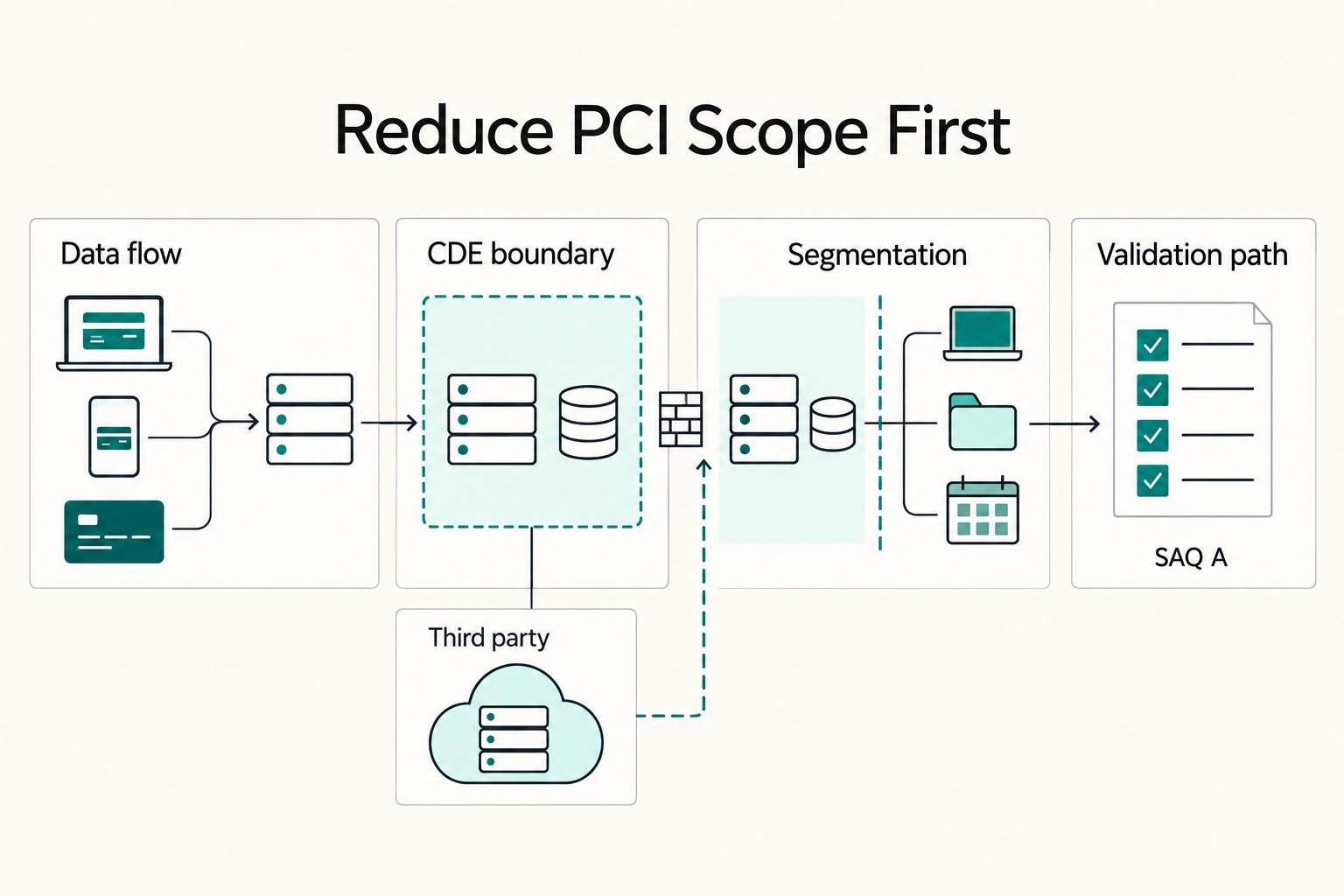
For independent professionals, PCI DSS is mostly a scoping problem. Build a **PCI-compliant workflow** that keeps you out of direct card-data handling unless there is no practical alternative.
PCI Scope Reduction With Hosted Fields and Tokenization
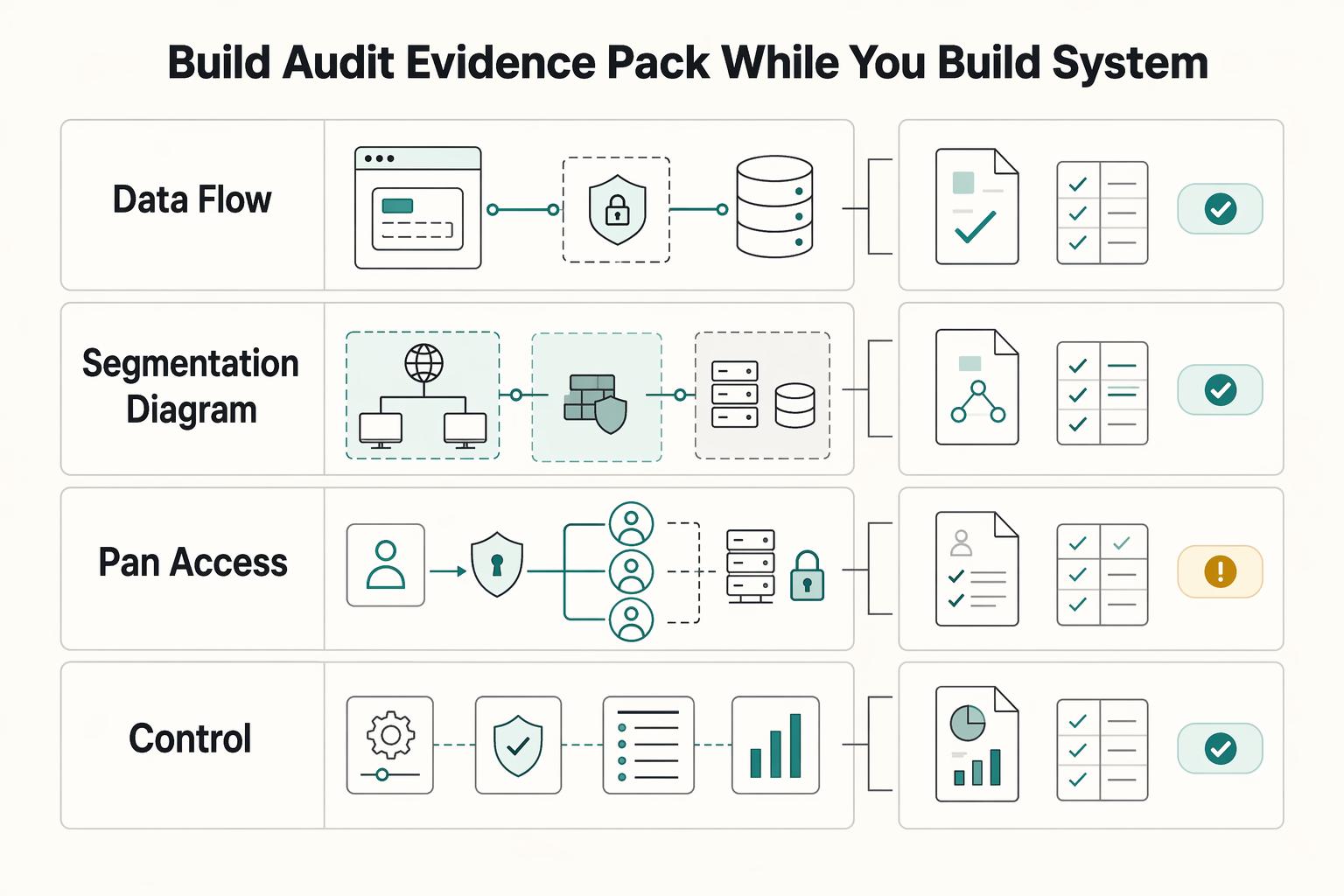
PCI scope reduction is an architecture boundary decision, not a vendor feature. Decide exactly where PAN is allowed to appear, and block it everywhere else.
Integrated Payouts vs Standalone Payouts for Platform Architecture Decisions
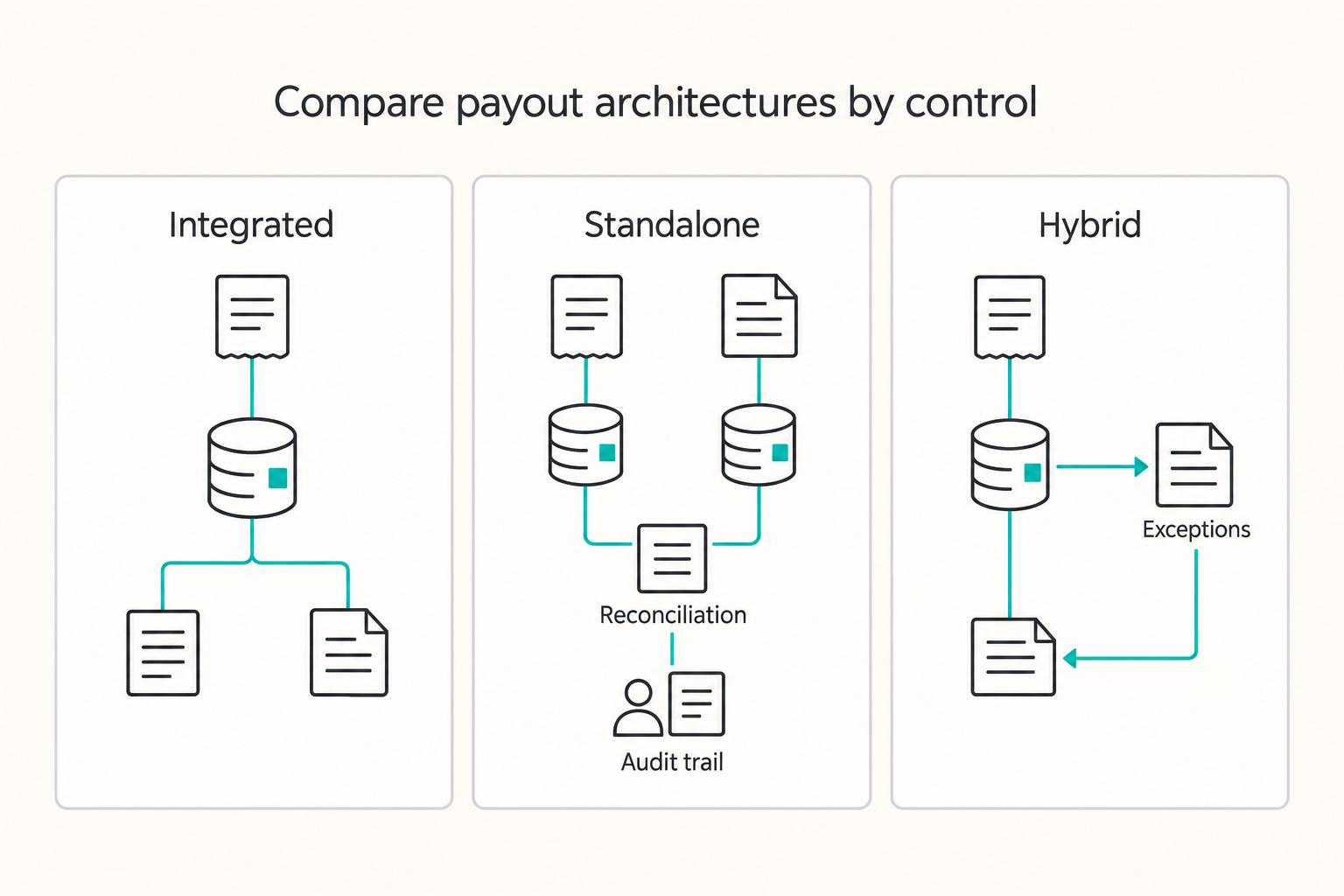
Here, integrated means a provider supports both collection and payout in the platform’s funds flow. Standalone means a separate provider executes disbursements, funded from your platform or another payment system. Hybrid means multiple governed routes. These are working architecture definitions, not universal vendor product categories.