
Quick Answer
Start by locking scope and ownership against PCI DSS v4.0.1, then build evidence continuously instead of waiting for audit season. v4.0.1 is the active baseline, while v4.0 was retired on 31 December 2024, so version drift creates preventable friction. For pci dss 4.0 for platform operators, the practical move is to map where card data enters, define the CDE boundary, and record residual responsibilities when third parties handle payment flows. If a control lacks a named owner or retrievable proof location, treat it as missing.
How platform operators should set scope and evidence priorities#
If you're working through pci dss 4.0 for platform operators, start from PCI DSS v4.0.1 because it is the active version. PCI SSC published v4.0.1 on 11 Jun 2024 as a limited revision that did not add or remove requirements, and v4.0 was retired on 31 December 2024. Use v4.0.1 when you set scope, assign owners, and prepare assessment evidence.
That matters because clarification updates can change how teams read requirement intent and prepare evidence for assessors. One example is Requirement 6: the v4.0.1 clarification says patching within 30 days applies to critical vulnerabilities. If your patch policy, exception logs, or vulnerability-aging reports use different shorthand, that can create avoidable audit friction.
Scope is often where platform teams lose time. PCI DSS applies to organizations that store, process, or transmit cardholder data, and to service providers that do the same on behalf of merchants. For many platforms, scope has to be mapped by payment and operations flow, not by a single company label.
Early evidence planning matters almost as much as control implementation. PCI DSS is a minimum baseline of technical and operational requirements, so teams still need clear ownership and proof that each control operates. If a control is inherited from a payment or hosting partner, document what is covered and what remains your responsibility.
A practical first checkpoint is to align everyone on the current PCI SSC materials, especially the Summary of Changes from PCI DSS v4.0 to v4.0.1 in the PCI SSC Document Library. It is usually easier to resolve source-document confusion early than to revisit scope and remediation decisions later.
This article is an execution map for that work. It will help you:
- decide where your platform is in PCI scope and where the Cardholder Data Environment boundary likely sits
- split control ownership across engineering, security, finance, legal, and external vendors
- build an evidence pack an assessor can retrieve without tribal knowledge
- identify when disagreements should be escalated instead of left unresolved
Keep one red flag in view from the start: outdated end-of-life software can derail an otherwise credible compliance effort. The goal is a quarter-ready checklist aligned to the active standard, the right evidence, and the decisions most likely to become audit risk.
The terms you need before making any decision#
Get the labels straight before you map controls. Early PCI errors can start with scope language, not tooling. Teams use the same term differently, draw the wrong boundary, and ask the wrong party for evidence.
PCI DSS is the payment security standard for protecting cardholder data. For this article, use PCI DSS v4.0.1 as the active version. If your business stores, processes, or transmits cardholder data, PCI DSS scope is a practical concern. It affects architecture, ownership, and the evidence you will need later.
Role labels change the work#
Third-party labels are not just contract language. They affect how you assign responsibilities, inherited controls, and evidence expectations. Avoid forcing a single label too early when different payment flows involve different third-party relationships.
Map each payment flow separately and mark where a third party is involved. PCI SSC third-party assurance guidance points to practical artifacts, including a PCI DSS Responsibility Matrix, mapping third-party services to applicable PCI DSS requirements, and a Frequency of Review field. When a provider says a control is covered, ask for evidence and document what still sits with your team.
CDE is the boundary that matters#
The Cardholder Data Environment (CDE) scope definition is explicitly referenced in PCI SSC guidance and is the boundary that matters for scoping decisions. If that boundary is vague, evidence requests and exception handling get harder to defend.
Do not treat third-party use as automatic scope reduction. PCI SSC guidance explicitly covers failure cases, including when a third-party service provider does not provide requested information or has not validated PCI DSS compliance. If either happens, do not mark the control as inherited and move on. Record the gap, assign an owner, and escalate before implementation spreads.
Does PCI DSS apply to your platform model#
PCI DSS applies if any part of your platform stores, processes, transmits card data, or can affect CDE security. If you outsource payments, the real decision is your boundary and residual ownership, not whether PCI DSS disappears.
PCI DSS v4.0.1 scope is broader than the system that handles card numbers directly. It also includes systems that could impact CDE security, which is why web apps, admin tooling, network paths, and billing-related services can still matter even when a PSP runs core payment processing.
A simple decision table you can use#
Map each payment flow separately and force an initial call for each row.
| Payment flow or component | Where card data enters | Do your systems store, process, or transmit it? | Could this component affect CDE security? | Are you acting as a Service Provider for others? | Initial call |
|---|---|---|---|---|---|
| Hosted payment page by third party | Third-party page | No direct handling by your app | Possibly, if your app, network, or admin access can affect the flow | Maybe | Likely reduced scope, but document residual controls |
| API-based card capture through your app | Your frontend or backend | Yes | Yes | Maybe | In scope immediately |
| Internal admin, logging, or support tooling linked to payment operations | No direct entry point | Not directly | Yes, if it can impact the CDE | Maybe | Often in scope or adjacent enough to require proof |
| Unknown or unresolved path | Unclear | Unclear | Unclear | Unclear | Treat as unresolved until ownership and a target date are set |
The "unknown" row is an internal guardrail against hidden scope drift. If you cannot explain where card data enters, where it goes, and what can touch that path, treat the scope call as open until ownership and timing are clear.
Boundary claims need proof#
Boundary quality usually drives effort. Weak boundaries can turn routine compliance into expensive remediation. Checkout-related flows can also pull both frontend and backend into scope when they handle billing profiles or transaction data.
If segmentation is central to your scope argument, validate it with current architecture and assessment evidence before audit prep. Treat segmentation as an evidence question, not a theory. Keep current network diagrams, access-path records, and control evidence ready.
Use one concrete checkpoint to keep this grounded: review firewall and router rulesets at least every six months, and keep those records retrievable.
What to document when a third party handles payments#
A third party can reduce direct handling, but it does not remove your obligations. Document the handoff point, what the provider covers, and what your team still owns.
For most platforms, keep this evidence pack current:
- data-flow diagrams for entry points, redirects, APIs, and admin access
- systems that could affect CDE security, even without direct card-data processing
- provider boundary documentation plus residual controls your team operates
Be careful with public cloud or shared infrastructure. Isolation can be harder to demonstrate during assessment, and shared-environment controls may receive closer scrutiny. If your scope depends on separation claims, verify them now with configuration and review evidence.
For a broader view of how PCI DSS fits alongside SOC 2 and ISO 27001, see Global Payment Compliance Certifications: PCI DSS SOC 2 ISO 27001 for Payment Platforms.
Split control ownership before teams start implementation#
After you define scope, lock ownership and evidence before teams build. For PCI DSS 4.0 readiness, treat a control as operational only when one team owns it, one proof source is retrievable, and inherited versus operator-run responsibility is explicit.
This is not just documentation hygiene. PCI DSS 4.0 puts more weight on showing controls work continuously, and weak ownership usually surfaces later as heavy evidence requests and release freezes while teams reconstruct proof.
Build the matrix around actual control operation#
Use one responsibility matrix across platform engineering, security, finance ops, and each vendor that touches the CDE, even if that touchpoint is occasional. Map rows to PCI DSS requirement areas, but write rows in plain operational language so non-specialists can still execute them.
Each row should answer who owns it, what dependency exists, where proof lives, and how that proof will be used.
| Control area | Primary internal owner | Vendor or external dependency | Proof source | Likely artifact use |
|---|---|---|---|---|
| Access to payment admin tools and CDE-related consoles | Security or identity owner | PSP portal, cloud identity provider | Access review records, identity exports, approval tickets | Assessment or partner review support |
| Changes to checkout code, payment routing, or CDE-connected services | Platform engineering | Processor SDK, hosted payment page provider | Change approvals, deployment logs, linked tickets | Assessment readiness evidence |
| Vulnerability remediation for CDE-connected assets | Platform engineering with security oversight | Cloud host, managed scanner, processor guidance | Scan results, remediation tickets, closure evidence | Assessment evidence pack |
| Incident handling for payment-impacting events | Security lead | Processor notifications, hosting alerts | Incident records, alert history, escalation logs | Assessment evidence pack |
If you cannot point to the exact log, ticket, config export, or attestation, the row is incomplete.
Separate inherited controls from verified controls#
Treat "inherited" and "verified" as different states. A provider promise can reduce what you operate directly, but it should not remove the need to verify your side of the control boundary.
Keep vendor claims in one column and operator verification in another. Verification might be provider attestation, contract-backed evidence, a configuration export, or an internal review record, but it must be tracked explicitly. Without that split, "covered by provider" becomes a blind spot.
Add a proof source before calling any control complete#
Add a proof-source field to every row, and make it specific enough that another team can retrieve evidence without tribal knowledge. Prefer concrete pointers over generic labels.
For most teams, evidence should clearly cover continuous operation of access reviews, change approvals, vulnerability fixes, and incident tracking. If you use a Targeted Risk Analysis (TRA) or a customized control approach, track that decision as its own row with owner, approval record, and effectiveness-review evidence.
Treat ownerless or proofless controls as missing#
Use one hard rule: if a control has no clear owner and no retrievable evidence location, treat it as missing until fixed.
That prevents ownership drift across engineering, security, finance ops, and vendors. It also reduces late-stage audit friction. Decide early where each artifact will live so evidence is assembled continuously instead of rebuilt under deadline.
For a step-by-step walkthrough, see Making Tax Digital for Income Tax and UK Platform Operators: Confirmed Rules and Open Scope Questions.
Turn the 12 requirements into an operator ownership map#
Turn PCI DSS v4.0.1 requirements into a small set of operator workstreams so teams can run and review controls without losing traceability. Keep requirement references in the map, but manage day-to-day ownership through named areas such as access, monitoring, testing, secure development, policy, and governance.
Use this as an operating view, not a claim of complete one-to-one requirement mapping. PCI DSS v4.0.1 remains the baseline, and formerly "best practice" requirements became mandatory by March 31, 2025.
| Workstream | Typical accountable role | Typical evidence outputs | Internal readiness check (example) |
|---|---|---|---|
| Access | Security or identity owner | Access review records, approvals, role exports | Ready when current evidence is retrievable and exceptions are documented |
| Monitoring | Security operations or platform owner | Alert history, log evidence, escalation records | Ready when reviews are current and records are easy to retrieve |
| Testing | Security lead with engineering support | Vulnerability findings, remediation tickets, closure proof | Ready when findings have owners and closure evidence |
| Secure development | Engineering or application security owner | Change approvals, review records, deployment logs | Ready when payment-impacting changes are traceable |
| Policy | Compliance or security governance owner | Approved policies, version history, acknowledgments | Ready when current policy records are approved and accessible |
| Governance | Compliance, risk, or program owner | Scope decisions, exception log, review notes, evidence index | Ready when open gaps have owners, target dates, and escalation status |
When control timing or frequency depends on risk judgment, capture that decision in the same map rather than leaving it in ad hoc tickets. Keep each record tied to the relevant workstream and requirement reference, with owner, approver, affected boundary, and retrievable evidence location.
Make architecture assumptions explicit in the same ownership map. Architecture choices affect compliance effort across requirements, and weak boundaries can create expensive remediation. Segmentation is one way to reduce scope by isolating the CDE from non-payment systems. In shared cloud environments, demonstrating isolation is typically harder during assessments, so avoid relying on vague provider assurances. If you rely on isolation controls, keep supporting evidence attached to the workstream entry. PCI DSS does not mandate a specific infrastructure model, so treat infrastructure selection as an auditability and operations tradeoff.
Give finance and legal a fast readiness view based on ownership and evidence availability, not ticket volume. Mark assessment-path labels as TBD until assessor input is finalized, rather than pre-classifying outputs as SAQ or ROC.
Publish this ownership map as the single operating document for cross-functional reviews and change approvals. If a change affects segmentation or any component that could affect CDE security, require the map to be updated before the change is treated as complete.
Focus first on the changes that break operations fastest#
Once you have an ownership map, prioritize the controls most likely to block releases and most likely to fail under evidence review. Do not try to mature every workstream at the same pace.
Lock down identity before you polish policy#
Start with authentication and admin access hygiene. The test is simple: can you quickly show who has elevated access, why they still need it, and when that access was last reviewed?
PCI work now expects continuous evidence, not point-in-time snapshots. If your control works but proof is scattered, treat it as an active gap. When capacity is limited, focus first on people and systems that can change checkout behavior or otherwise touch cardholder data.
Treat adjacent hardening as parallel risk reduction#
Run adjacent security hardening work in parallel with your PCI program. Treat it as operational hardening, not as standalone proof of PCI compliance.
Prioritize complete coverage across in-scope processes, and keep evidence retrievable: current configuration state, change approvals, and a named owner for each control area.
Put release checks on the release path#
Security checks belong in the release path, not in optional review rituals. Optional checks are the first thing teams skip under pressure, and they often reappear later as release freezes while people scramble for documentation.
For direct integrations on payment pages, prioritize client-side controls early: maintain a current checkout script inventory, authorize scripts, and enforce CSP and subresource integrity checks. If engineering cannot explain why each script is present, assume a real control gap.
Architecture choices also change operational load. Direct integrations are described as stricter on client-side controls, while iframe or redirect models are described as a simpler compliance path because payment processing is hosted externally.
Use one triage rule when everything feels urgent#
Use a simple rule: fix controls with the highest operational risk and the weakest evidence trail first. Move anything tied to checkout, admin access, or systems that touch cardholder data ahead of lower-risk cleanup if current proof of operation is not readily retrievable. Since March 31, 2025 has passed, "planned" is not the same as "covered."
Build the evidence pack before your first assessor request#
Build the evidence pack now, because PCI DSS 4.0 emphasizes clearer scoping, stronger monitoring, and continuous validation of controls. If a control exists but only one person can find the artifact, treat that as an active gap.
Start with one evidence index#
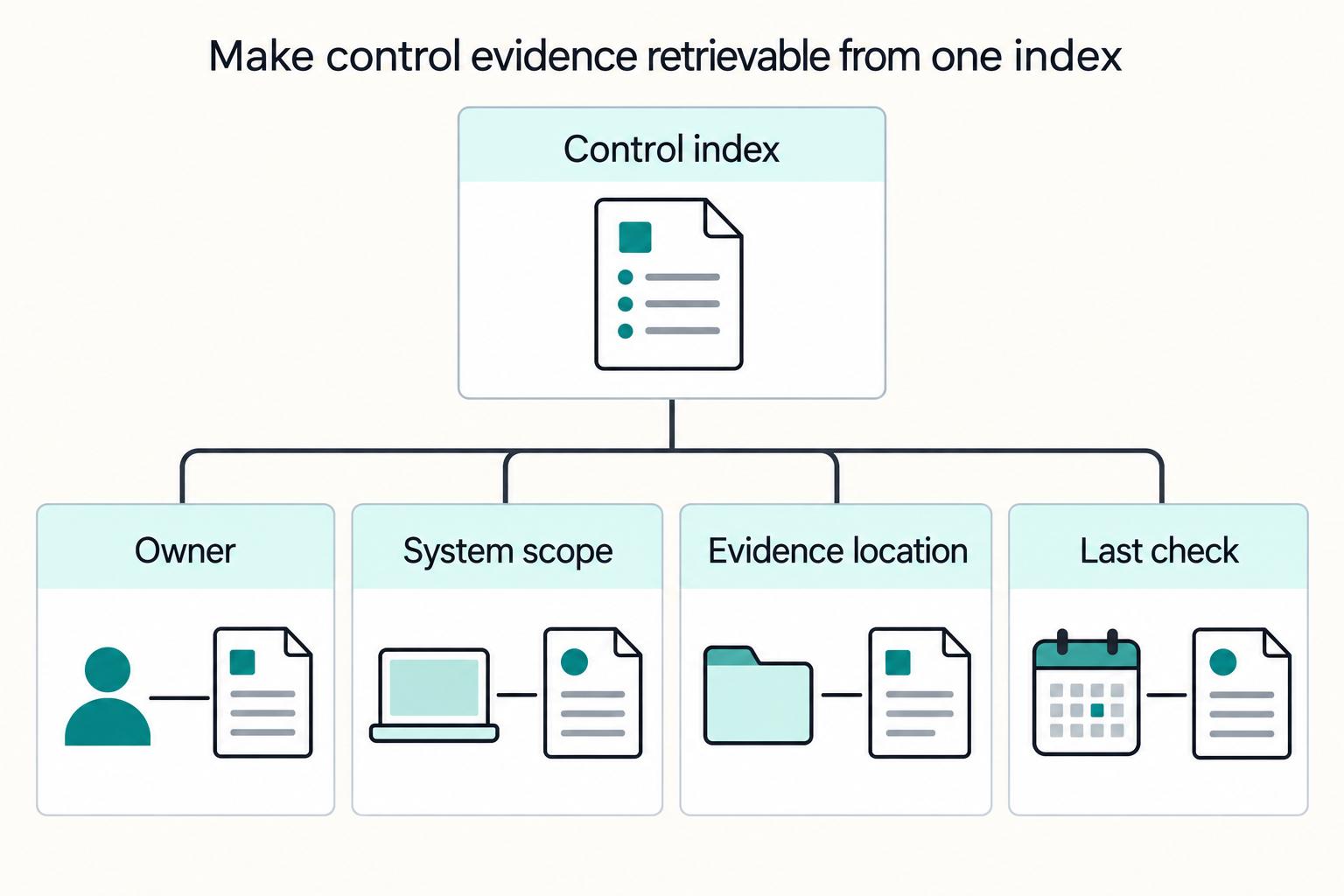
Keep one index that maps each control to:
- owner
- system or service
- artifact retention location
- last verification date
This is a practical control, not a formatting exercise. It helps reduce a common failure mode: expanding scope, heavier evidence requests, and release disruption while teams scramble for documentation.
Tie artifacts to the card-data boundary#
Make scope visible. Map where PAN can enter, how it flows, and where it might be stored, then link evidence back to that boundary. Keep monitoring and authentication evidence in that same traceable path.
If an artifact cannot be tied to the in-scope boundary, it is weaker than it looks. Include occasional card-data touchpoints too, since systems can still be pulled into scope even when interaction is infrequent.
If you use an alternative control approach, attach the related targeted risk analysis so the rationale and effectiveness review are documented.
Keep vulnerability and continuous evidence current#
Store outputs predictably, and pair findings with remediation evidence so a reviewer can follow the full trail.
Apply the same standard to continuous evidence. Access reviews, change approvals, vulnerability fixes, and incident tracking should be current and connected, not one-off snapshots.
Run an independent retrieval check#
Before formal review, ask an independent reviewer to retrieve sample artifacts using only the index. If they cannot find key items without tribal knowledge, the pack is not ready.
Use this as a pass/fail checkpoint for high-risk controls before the first assessor request.
If you are translating this checklist into repeatable controls and audit-ready records, review the implementation surfaces in the Gruv docs.
Sequence the next 90 days so teams can execute without chaos#
Treat the next 90 days as an internal execution cadence, not a PCI-prescribed sequence: lock scope early, collect evidence continuously from real operations, and test retrieval before formal review.
| Window | Focus | Grounded actions |
|---|---|---|
| Days 1-30 | Scope clarity | Define your in-scope boundary and working terminology; turn every "unknown" flow, tool, or integration into a named decision with an owner and deadline; escalate quickly if scope is still unsettled at day 30 |
| Days 31-60 | Operating controls and evidence | Capture proof as work happens using current logs, configurations, and events; map each artifact to a control; give each open exception explicit, time-bound treatment |
| Days 61-90 | Readiness test | Run an internal retrieval drill; package sample evidence quickly for assessor consumption; document unresolved exceptions with clear owners and review timing |
Days 1-30#
The goal in the first 30 days is scope clarity. Define your in-scope boundary and working terminology so teams are not making control decisions from different assumptions.
Turn every "unknown" flow, tool, or integration into a named decision with an owner and deadline in this window. If scope is still unsettled at day 30, escalate quickly so implementation does not continue against a moving boundary.
Days 31-60#
The second 30 days should convert decisions into operating controls and evidence. Capture proof as work happens, using current logs, configurations, and events rather than stale attestations.
Keep traceable lineage: each artifact should map to a control, and each open exception should include explicit, time-bound treatment. This helps reduce retroactive evidence reconstruction.
Days 61-90#
The final 30 days are a readiness test, not just more implementation. Run an internal retrieval drill where a reviewer packages sample evidence quickly for assessor consumption.
Document unresolved exceptions with clear owners and review timing. By day 90, you want current evidence, clear ownership, and a tested retrieval path that supports ongoing validation instead of annual scramble behavior.
Know your escalation points before disagreement stalls progress#
Once your 90 day plan is in motion, unresolved judgment calls become the main execution risk. Escalate early when a dispute changes control ownership or the evidence you can defend.
| Issue | Escalate when | Required follow-up |
|---|---|---|
| Role disputes | Teams cannot align on ownership and the dispute blocks control mapping | Do not let it sit in routine working meetings; involve an authorized auditor, for example a QSA, when the decision can affect formal assessment posture; make Compliance Operator release notes an explicit review input |
| Scope claims | A service is described as "out of scope" but the supporting architecture evidence is incomplete or not current | Use the independent-reviewer test; if others cannot follow the current evidence and configurations without the architect in the room, treat the claim as unproven and escalate |
| Residual risk decisions | Legal, finance, and security do not agree on residual risk acceptance | Require a named owner and written acceptance; record uncertainty plainly if the decision depends on external vulnerability reporting; escalate unresolved uncertainty rather than imply it is settled |
Role disputes that change the whole control model#
Escalate when teams cannot align on ownership and the dispute blocks control mapping. Do not let that sit in routine working meetings, because delayed ownership decisions create rework.
Use compliance automation as input, not final authority. The Compliance Operator is not an auditor, and compliance accountability remains with your organization, so involve an authorized auditor, for example a QSA, when the decision can affect formal assessment posture. As part of updates, make Compliance Operator release notes an explicit review input.
Scope claims without proof#
Escalate when a service is described as "out of scope" but the supporting architecture evidence is incomplete or not current. The problem is not the claim itself. The problem is a claim that others cannot validate without tribal knowledge.
Use a simple test: can an independent reviewer follow the current evidence and configurations without the architect in the room? If not, treat the claim as unproven and escalate before more decisions rely on it.
Residual risk decisions with weak evidence#
Escalate when legal, finance, and security do not agree on residual risk acceptance. Require a named owner and written acceptance so the decision is explicit and auditable.
If the risk decision depends on external vulnerability reporting, record uncertainty plainly. Some bulletin content can be compiled from open-source reporting, and entries may be published before complete CVSS or patch details are available, so unresolved uncertainty should be escalated rather than implied.
Avoid overbuilding by separating PCI obligations from adjacent programs#
Treat PCI DSS 4.0 as its own workstream, then reuse evidence only when it directly proves the PCI requirement in scope. This reduces duplicate effort and false confidence from controls that look strong in another program but do not prove PCI test intent.
Use one internal comparison sheet, but label it as internal mapping, not an official crosswalk. Keep the labels simple: PCI-required, shared evidence, and program-specific.
| Item in your matrix | Label | What to check |
|---|---|---|
| MFA for users accessing payment systems | PCI-required | Verify users actually use MFA every time they log in to payment systems |
| Policy text, ownership records, approved procedures | Shared evidence | Reuse only when the artifact clearly supports the PCI control and current scope |
| SOC 2 report language, ISO 27001 certificate, other attestation output | Program-specific | Treat as context, not proof that a PCI requirement passed |
Use a strict internal decision rule: if a control looks acceptable for SOC 2 or ISO 27001 but you cannot show PCI-specific evidence, log it as a PCI gap. MFA is the practical test case. A broad identity policy may read well, but if you cannot prove MFA is used every time users access payment systems, it is not a PCI pass.
This discipline matters because PCI documentation is extensive, more than 300 pages, and processors may enforce requirements without explaining them. Prioritize retrievable evidence tied to the card environment over polished narrative documentation.
If interpretation diverges at the edges across adjacent programs, route the issue for specialist review before rollout. The PCI DSS 4.0.1 Compliance Guide for jPOS Based Systems can inform implementation, but it does not replace PCI test evidence for your environment.
Failure modes platform operators hit in multi-market environments#
After you separate PCI from adjacent programs, the next risk is control drift. Teams keep an old control and evidence pattern while payment-facing applications change.
| Failure mode | What makes it weak | What to verify or do |
|---|---|---|
| Payment surfaces changed but control narrative did not | If you cannot show the current application inventory, where front-of-app protection sits, and recent alert or block evidence for live public-facing web applications, treat it as a real gap | Re-check scope when card-data-touching application paths change; verify public-facing applications still have front-of-app protection with detection, prevention, and alert evidence |
| Automation-only evidence | Raw scan exports without reviewer notes, decisions, and remediation tracking are weak evidence | Require documented human interpretation after automated scans; keep vulnerability scanning and penetration testing distinct |
| Version confusion | Teams collect evidence against different baselines, so the proof set can conflict even when controls look stable | Keep evidence location, baseline version, last verification date, and the human review step tied to automated outputs clearly documented |
One control narrative can break as payment surfaces change#
PCI DSS applies when your organization processes, stores, or transmits payment card data, so changes to card-data-touching application paths are a good point to re-check scope.
A common miss is placement and proof of web-application protections. Vendor summaries of PCI DSS v4.x describe subsection 6.4.2 as requiring a control in front of public-facing web applications that can continually detect, prevent, and generate alerts on web-based attacks. If you cannot show the current application inventory, where that control sits, and recent alert or block evidence for live apps, treat it as a real gap.
Automation-only evidence creates false confidence#
Automated scanning helps, but it is not self-sufficient evidence. Scan outputs still require human validation and interpretation, so raw exports without reviewer notes, decisions, and remediation tracking are weak evidence.
Do not treat vulnerability scanning and penetration testing as interchangeable. The grounding is explicit: penetration testing is not a tool. Keep these evidence types distinct so coverage is clear without assessor reconstruction.
Version confusion can reopen solved issues#
Baseline drift is still a practical failure mode. PCI DSS v3.2.1 was retired on March 31st, 2024. PCI DSS v4.0.1 was released on June 11, 2024, and vendor summaries describe certain requirements taking full effect on March 31st, 2025.
If teams collect evidence against different baselines, your proof set can conflict even when controls look stable. Keep evidence location, baseline version, last verification date, and the human review step tied to automated outputs clearly documented.
How to keep drift from becoming a quarter-end surprise#
- Run scheduled drift reviews and repeat them after meaningful changes to card-data-touching applications.
- Verify public-facing applications still have front-of-app protection with detection, prevention, and alert evidence.
- Require documented human interpretation after automated scans.
- Escalate immediately when a public-facing app lacks verified front-of-app protection, or when evidence is automation-only.
Related: IRS Form 1042-S for Platform Operators: How to Report and Withhold on Foreign Contractor Payments.
What to do next if you want fewer compliance surprises#
A low-regret sequence is to lock scope and ownership first, then run a dated evidence plan against one current baseline: PCI DSS v4.0.1. This is more than housekeeping because, as of March 31, 2025, formerly best-practice requirements in 4.0.1 became mandatory.
Start by proving scope boundaries before you chase control gaps. If a system stores, processes, or transmits cardholder data or sensitive authentication data, it is in scope. If it connects to the Cardholder Data Environment (CDE) or can impact CDE security, treat it as in scope too.
Lock the boundary before assigning work#
Create a written scope record that identifies:
- the CDE
- connected or security-impacting adjacent systems
- unknown or unproven data flows
If a boundary cannot be clearly demonstrated, treat it as unproven. In shared public cloud environments, a frequent assessment problem is not always control design. It is failing to demonstrate isolation clearly.
If segmentation is part of your scope strategy, treat it as evidence, not intent. Segmentation can reduce scope by isolating the CDE from non-payment systems, but only when you can show that boundary in practice.
Make ownership and proof explicit#
After scope is fixed, convert it into an evidence plan with named owners and dates. Use one tracker that answers, for each in-scope control or decision:
- what is in scope
- who owns it
- what proof is required
- where that proof is stored
- when unresolved issues escalate and to whom
When controls are inherited from providers, do not mark them complete until your team can retrieve operator-side evidence tied to your actual CDE.
Keep versioning and exceptions disciplined#
Keep evidence aligned to one current version and avoid version mixing. If you use a customized approach, maintain current, documented targeted risk analyses alongside the rest of your evidence.
Treat this as an operating discipline, not a one-time project. Re-check scope when payment flows, markets, vendors, or architecture change, and escalate early if boundary proof remains disputed. Weak architectural boundaries are a known path to expensive remediation.
Related reading: What Procurement Means for Platform Operators Managing Strategic Sourcing and Vendors.
If you want a practical review of how this PCI plan maps to your current money-movement setup and market constraints, contact Gruv.
Frequently Asked Questions
Does PCI DSS v4.0.1 apply if our platform never stores raw card data but integrates payment providers?
Not storing raw card data alone does not settle PCI DSS scope. This guide treats card number, expiration date, and CVV as sensitive data, so use PCI SSC scoping guidance before declaring an integration out of scope.
Which PCI SSC documents should our team trust first when guidance conflicts with vendor blogs?
Trust PCI SSC materials first, starting with the resource hub and PCI SSC Document Library. A practical starting set is the standard documents, the PCI DSS v4.0 Quick Reference Guide, the Scoping and Segmentation Guidance for Modern Network Architectures, and the PCI DSS v4.0.1 ROC Template when a formal assessment is expected. Treat vendor blogs as interpretation, not the source of record.
What changed in practice between PCI DSS v4.0 and PCI DSS v4.0.1 for operators?
This guide does not establish a reliable operator-by-operator change list between v4.0 and v4.0.1. Keep your evidence aligned to one current version at a time. One cited timeline risk is that PCI DSS v3.2.1 was retired on 31st March 2024, and post-retirement assessments had to be on v4.0.
How do we choose between a SAQ path and a ROC path without wasting a quarter?
Decide your validation path early, because SAQ and ROC requirements differ in the cited level examples. One cited example says service providers above 300,000 transactions/year are level 1 and require ROC by a QSA, quarterly ASV scans, and an AOC, while level 2 requires SAQ, quarterly ASV scans, and an AOC. If classification is unclear, resolve that first. For a deeper breakdown, see PCI DSS for Platform Operators: What Level Do You Need and What Does It Cost?.
What is the minimum credible action plan for the next quarter if our team is understaffed?
A practical minimum is to confirm scope, lock a single current baseline, and confirm whether your path is SAQ or ROC. Then build the evidence that matches that path, including quarterly ASV scans and AOC, plus ROC by QSA where the level 1 example applies.
Can SOC 2 or ISO 27001 evidence reduce PCI DSS effort, and where does that reuse usually fail?
The reliable point is that SOC 2 or ISO 27001 evidence does not automatically satisfy PCI DSS test intent. Any reuse should be mapped to specific PCI requirements and the in-scope payment environment.
When should we escalate to legal counsel or an external assessor instead of deciding internally?
This guide does not define exact escalation triggers. A conservative approach is to escalate when internal review cannot resolve scope or validation path from PCI SSC materials, including unresolved SAQ-versus-ROC direction or uncertainty about which official assessment artifacts apply.
Try a related tool
Researched and edited by the Gruv editorial team. Gruv builds cross-border billing, payouts, and finance-operations software for global businesses.
Sources
- cisa.gov/news-events/bulletins/sb25-251trusted
- cs4440.eng.utah.edu/texts/tolboom.pdftrusted
- highways.dot.gov/sites/fhwa.dot.gov/files/docs/federal-lands/...trusted
- michigan.gov/-/media/Project/Websites/dtmb/Procurement/Co...trusted
- middlebury.edu/sites/default/files/2025-01/PCI-DSS-v4_0_1.pdftrusted
- nepis.epa.gov/Exe/ZyPURL.cgitrusted
- ntrs.nasa.gov/api/citations/20100028917/downloads/20100028...trusted
- sec.gov/Archives/edgar/data/1907982/0001907982240000...trusted
Educational content only. Not legal, tax, or financial advice.
Related Posts

The Freelance Payment Penalty: A Modeled Audit of Platform Fees, FX Spreads, and Payout Delays
The money rarely disappears through a single, easy-to-spot fee. The real loss is stacked. A marketplace takes its commission, a processor adds a charge for international cards, a bank or payment company converts the currency at a spread, a platform holds the funds before release, and a wire sheds a little to intermediaries on the way in. Each layer looks defensible on its own, but the worker feels the combined result as a smaller deposit and a later payday.

How to Respond to a Subpoena for Business Records
Move fast, but do not produce records on instinct. If you need to **respond to a subpoena for business records**, your immediate job is to control deadlines, preserve records, and make any later production defensible.
A US Expat's Guide to Investing in UCITS ETFs to Avoid PFIC Issues
The real problem is a two-system conflict. U.S. tax treatment can punish the wrong fund choice, while local product-access constraints can block the funds you want to buy in the first place. For **us expat ucits etfs**, the practical question is not "Which product is best?" It is "What can I access, report, and keep doing every year without guessing?" Use this four-part filter before any trade: