
Quick Answer
Present payment operations metrics to your board by using a small, reconciled KPI set tied to decisions, ownership, and consistent definitions. Focus the main deck on a few signals such as transaction volume, payment success rate, payment processing time, and chargeback rate, show trends over time, explain mixed signals plainly, and keep diagnostics and unresolved issues in the appendix with supporting evidence.
What Your Board Needs to See in Payment Operations Reporting#
Board payment decks fail when they present too many disconnected numbers and too little judgment. The board needs a small, trusted KPI set that shows payment operations health, investor risk direction, and where management should act next.
Payments are a strategic topic, not just a back-office function: they affect customer experience and revenue and require top-management attention. In this setting, a KPI belongs in the deck only if it reflects real operational or financial strength and helps the board assess durability, risk, or control quality.
This guide is for operators who run ledgers, settlements, reconciliation, payout execution, and the reporting path behind them. It is not a generic dashboard tutorial. The practical goal is to turn raw payment-flow data into investor-facing signals the board can use.
Start with focus and consistency. Choose the KPI set that is most meaningful to your business, and read those KPIs as trends over time rather than one-off readings.
Use internal trend consistency before external comparability. Cross-company comparisons are meaningful only with truly similar peers, so this guide does not claim universal benchmark thresholds. S&P Global Market Intelligence details were not accessible while researching this article.
When conditions change, label uncertainty plainly. Payment performance can be harder to interpret during regulatory change periods, and explicit caveats are more credible than forced precision.
What investors actually want to see from payment operations#
Investors and the Board of Directors usually do not need your full payment operations view. They need a concise set of signals for oversight: whether growth looks durable, where loss exposure may be building, whether cash timing is reliable, and whether controls look mature enough to support safe decisions.
Use one rule to keep the section tight: if a metric cannot trigger a management decision, remove it from board reporting. A board deck is not a data dump; it should give the board timely, accurate, relevant, and complete information for oversight.
Start with four board signals, then translate them#
For payment operations, a practical headline set is:
| Metric | Board-level question it helps answer |
|---|---|
| Transaction volume | Is demand growing, flat, or weakening? |
| Payment success rate | Is conversion quality holding up, or is execution friction increasing? |
| Payment processing time | Is cash movement reliable, or are delays building in the flow? |
| Chargeback rate | Is dispute and loss exposure rising? |
The translation is what matters. "Payment success rate fell" is an operator observation. "Conversion quality weakened despite stable demand" is a board-level judgment.
Keep the deck readable by splitting signals from diagnostics#
Keep the main deck to a small KPI set, typically 3 to 5 metrics, and move detailed diagnostics to appendices or your operating dashboard. Items like decline-code mix, retry behavior, route-level latency, and dispute reasons are useful for operators, but they should not crowd the headline board view.
Before the board cutoff, confirm each headline metric has one source of truth for the same reporting period and a named owner who can explain movement. If volume is up while success rate is down, state the board implication first and keep the drill-down detail ready behind it.
What to prepare before building the deck#
Before you build slides, make sure each metric is defensible, current, and explainable under diligence. KPI selection matters, but reliability in how the numbers are produced is what keeps investor reporting credible.
- Freeze one reporting cutoff before anyone exports numbers.
- Reconcile the KPI extract before slide production starts.
- Assign one owner to each metric and one backup reviewer.
- Write the board question each slide is meant to answer.
Step 1: Assemble a minimum evidence pack#
Start with a KPI dictionary, the latest reconciliation outputs you use internally, and a source map for each metric. If inputs come from a Provider dashboard, Business intelligence (BI), and a Data warehouse, document that split explicitly so the deck does not imply a single system source.
For each KPI in scope, be ready to show the definition, the latest underlying report or export, and where that support lives. Keep this material outside the main deck as a compact diligence file so follow-up questions do not create avoidable back-and-forth.
Step 2: Confirm payment-flow boundaries before trend discussion#
Define what each metric includes before you present trend lines. Document which payment-flow steps are in scope, where your orchestration layer touches that flow, and which incidents are captured in monitoring and alerting.
The goal is consistent interpretation: the same metric name should refer to the same stage of the flow across teams. If definitions differ by handoff point or event stage, resolve that before the metric reaches the board deck.
Step 3: Bring control artifacts that support confidence in the numbers#
Prepare the control evidence you already use to run operations, such as policy-gate logs, exception queues, and reconciliation-tool outputs. Use them to show that metric production is governed, not just generated.
This is preparation for investor scrutiny, not extra deck clutter. Missing financial detail and unaddressed questions are recurring board-deck pitfalls, so have the control layer ready behind each headline KPI.
If you need a deeper operating companion, How to Build a Payment Reconciliation Dashboard for Your Subscription Platform can support this step.
For the finance-side companion view, connect this deck prep to Accounts Payable KPIs: The 15 Metrics Every Payment Platform Finance Team Should Track so payment operations and finance do not carry two conflicting scorecards into the same board meeting.
Step 4: Assign one owner per KPI#
Set one named owner per metric before drafting the final deck. That owner is accountable for the metric definition and the narrative explaining movement.
Use a simple pre-deck checkpoint table, and hold any metric that has gaps:
| KPI | Source map complete | Evidence location set | Owner assigned |
|---|---|---|---|
| [Metric name] | Yes/No | [Path or file] | Owner name |
Step 1 define one KPI dictionary and normalization rules#
Use one version-controlled KPI dictionary as the single source of truth before you finalize board slides. Keep it in the same governed place you use for reporting logic in your Data warehouse or metrics layer so teams do not publish different values for the same metric.
1.1 Write the definition fields for every board KPI#
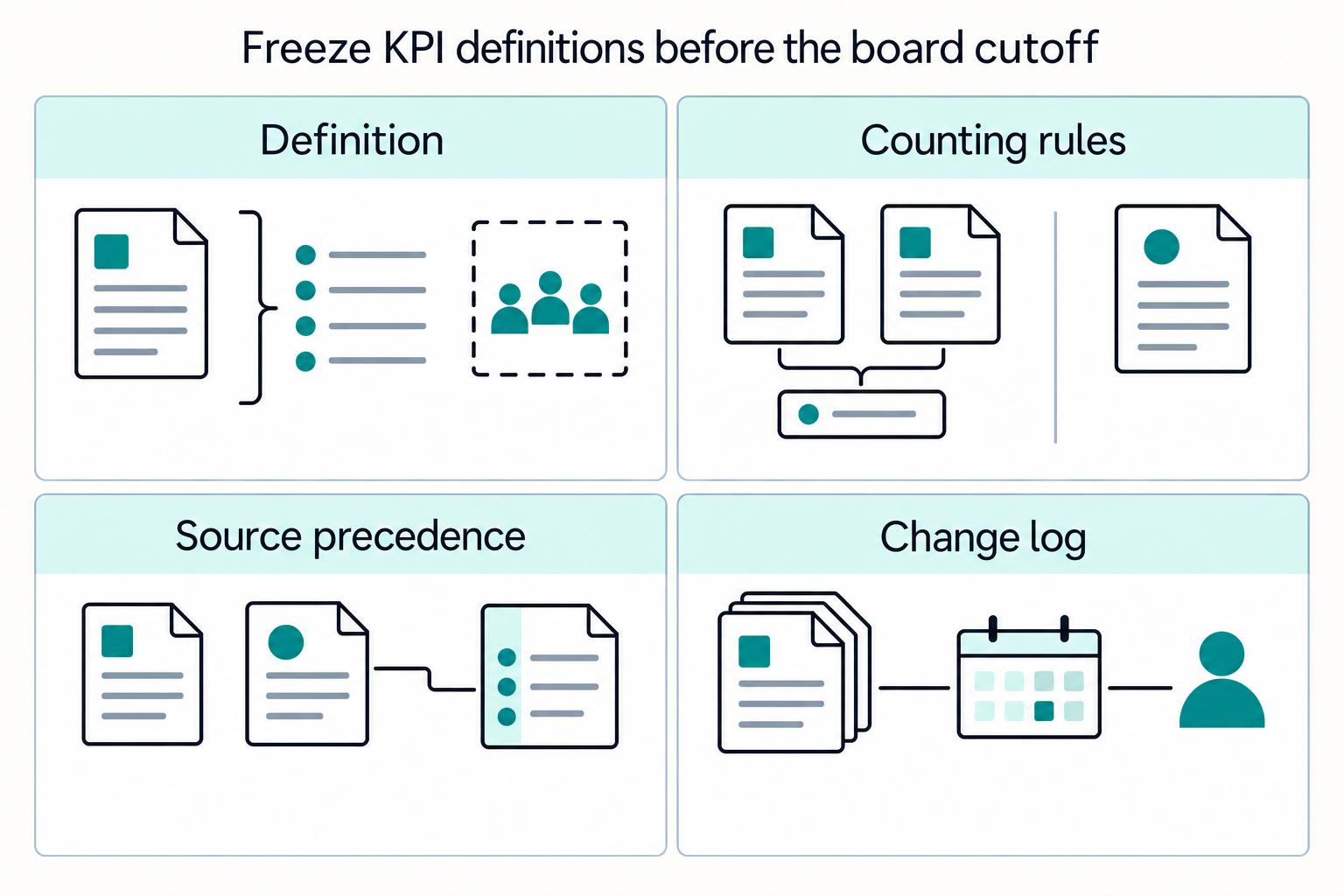
Require the same definition fields for every KPI, not just a name and chart. For Transaction volume, Payment success rate, Payment processing time, and Chargeback rate, require: business meaning, numerator, denominator, exclusions, flow boundary, source report, owner, and evidence location. This keeps logic defined once instead of being re-created across dashboards and reports.
| KPI | What must be explicit in the definition | What must be excluded or scoped | Evidence to attach |
|---|---|---|---|
| Transaction volume | What event counts as a transaction and what population is included | Duplicate attempts, replayed events, out-of-scope flow stages | Latest reconciled extract plus source map |
| Payment success rate | What counts as success and what population sits in the denominator | Duplicate attempts, replay behavior, non-board-scope event types | Supporting report from reporting source and variance notes if needed |
| Payment processing time | Exact start event, end event, unit, and aggregation method | Replayed events, incomplete event chains, out-of-scope stages | Event sample and timestamp audit check |
| Chargeback rate | What chargeback event is recognized and what base population it is compared to | Timing window issues, stage-boundary exclusions, duplicate dispute events | Chargeback support file and reconciliation output |
1.2 Normalize duplicate attempts and replay behavior before you publish rates#
Set normalization rules before publishing board KPIs so retries and replayed events do not distort rates and volume. In the dictionary, state whether each KPI is intent-based or attempt-based, how you identify and collapse duplicates, and how replayed events are treated when they re-enter reporting.
Document the tradeoff explicitly. Over-collapsing retries can hide instability, while counting every retry as a fresh failure can overstate customer impact. Choose the rule that matches the board question, then keep it stable across periods.
1.3 Set source precedence before the Data warehouse and Provider dashboard disagree#
Define source precedence per KPI in advance, because conflicts between Data warehouse and Provider dashboard values are normal. The key control is deciding the rule before slide review, not during it.
Also name who adjudicates conflicts. Keep one accountable path (KPI owner plus designated reviewer), and log the reason for differences in plain language, for example timing, definition mismatch, or missing events, in the evidence pack.
1.4 Add pre cutoff verification and a definition change log#
Before board cutoff, run the same verification checks for each KPI: reconciliation pass complete, late-arriving events flagged, and definition changes signed off. This is the control layer that keeps management and board reporting usable for decisions.
Maintain a definition change log with the dictionary in version control. At minimum include effective date, what changed, affected KPI, whether prior periods were restated, and approver. If history cannot be restated before the meeting, label the trend break clearly and explain it in the appendix.
Step 2 wire the measurement stack from systems to board output#
After KPI definitions are fixed, make traceability the gate: each board number should tie back to a documented flow event, a checked warehouse transformation, and a published dashboard value. Treat this as a control activity, not slide polishing, consistent with the OCC framing of transaction-and-settlement flow documentation and management/board reporting as formal artifacts.
2.1 Map the reporting path before you build the slides#
Write the reporting path in the same evidence pack as your KPI dictionary so lineage is explicit before review. Use your actual stack, but keep the path clear from event capture to warehouse transformation to dashboard publish to board draft.
| Stage | What to document | Verification point | Common failure mode |
|---|---|---|---|
| Payment flow event capture | In-scope events, source system, flow boundary | Event sample matches KPI definition | Missing or duplicate events |
| Data warehouse transformation | Logic owner, transformation location, refresh timing, exclusions | Totals align with expected source counts | Late events or unnoticed logic drift |
| KPI dashboard publish | Metric name, grain, refresh time | Dashboard value matches warehouse output for the same cutoff | Stale cache or stale extract |
| Board reporting draft | Slide source, owner, snapshot time, note context | Slide number matches published KPI and evidence file | Manual copy errors or mixed-period values |
If any step is undocumented, pause and close that gap before deck production.
2.2 Reconcile before slide production, not during review#
Do not put unreconciled KPIs in the main board deck. If a metric is still under review, mark it as provisional in an appendix or hold it for the next cycle.
Run a pre-production reconciliation check against your reconciliation output or equivalent control report, and retain evidence:
- reconciliation output used for signoff
- exact warehouse or BI extract used for the slide
- variance note when provider and internal values differ
- owner approval with snapshot timestamp
The OCC handbook's inclusion of an Internal Control Questionnaire supports this checkpoint mindset: confirm the control ran, exceptions were logged, and release was approved.
2.3 Annotate incident windows and freeze one period cutoff#
Keep one snapshot cutoff across provider exports, BI outputs, and board drafts so trends are period-consistent. Investor reporting conventions use explicit period anchors, and your board metrics need the same discipline to avoid false movement from mixed snapshots.
If incident context affected the period, label that window in chart notes or the appendix so readers can separate operational disruption from underlying business movement. Also keep measured results distinct from forward-looking interpretation, since forward-looking statements are inherently uncertainty-exposed.
Step 3 choose a board KPI set by category and keep it tight#
Keep the main board view small enough that each metric can drive a decision. After you lock lineage and cutoff timing, select only the executive signals that matter most and move deeper diagnostics to supporting pages.
A practical structure is to group the core set into reliability, risk, cash efficiency, and control quality. Use that as an operating frame, then define your own finance crosswalk with your team. This keeps the board view focused instead of turning the deck into a full KPI dashboard. Executive dashboards and detailed reports serve different purposes, and fragmented reporting makes it easier to miss the signals that matter.
Step 3.1 group core metrics into four board categories#
Use one concise board page with these four categories and a clear board question for each:
| Category | Board question |
|---|---|
| Reliability | Are payments completing consistently? |
| Risk | Is downside exposure changing? |
| Cash efficiency | Is payment execution affecting cash timing? |
| Control quality | Can management trust the numbers and process? |
For each category, add one visible metric-quality check so readers can judge trust, not just movement. Internal checks can include definition clarity, reconciliation status, and whether incident context is documented for the reported period.
Step 3.2 build a local crosswalk to finance outcomes#
Do not assume a universal mapping from these categories to finance KPI families. Build a local crosswalk with finance and document it in your evidence pack.
Some signals will inform more than one finance lens, while others are context only. The key test is whether each core metric answers a board-level question in one sentence. If the connection is unclear, keep that metric in the appendix until the link is explicit.
Step 3.3 keep the core set narrow and separate diagnostics#
Resist adding every available metric to the main deck. The board page should stay limited to high-signal indicators, while drill-down analysis lives in appendix pages from the KPI dashboard.
Before you promote a metric to the core set, confirm:
- The metric has a clear owner.
- The source and snapshot are reconciled.
- The narrative is understandable without operator jargon.
- A drill-down view exists if movement needs explanation.
This avoids the common failure mode of disconnected reports that create activity without decision clarity.
If the board keeps asking for growth context beside payment health, keep the payment page narrow and point supporting readers to KPIs for Platform Growth from Seed to IPO Stages and SaaS Revenue Metrics Glossary: MRR, ARR, Churn, NRR, LTV, and CAC for Platform Operators instead of crowding the main deck.
Step 3.4 present mixed signals directly#
If core metrics move in different directions, say so directly. For example, if transaction volume rises while payment success rate falls, present it as mixed performance and use appendix detail to explain likely drivers.
That keeps the board discussion decision-oriented: what changed, how confident you are in the measurement, and what action is required next.
Step 4 connect payment KPIs to investor narrative without finance theater#
Once your core set is fixed, translate each KPI into investor relevance in plain language, without claiming precision you cannot support. If the story is not backed by reconciled operating evidence, present it as directional, not as a financial conclusion. That keeps reporting auditable and aligned with investor expectations for assumptions they can validate.
Step 4.1 translate each KPI into one investor sentence#
State what the KPI signals for revenue quality, downside risk, or cash timing, then stop short of hard causality unless your evidence supports it.
| KPI | Board-level reading | Evidence to show | Do not overclaim |
|---|---|---|---|
| Payment success rate | Movement changes confidence in conversion reliability and can affect revenue quality directionally | Reconciled trend, incident context, dated routing or policy changes | That every move maps directly to recognized revenue |
| Chargeback rate | Movement changes downside-risk posture and control scrutiny | Dispute operations outputs, policy-gate logs, product/geography mix notes | That changes came from one cause only, or imply a fixed loss impact |
| Payment processing time | Movement can signal execution friction and influence cash-timing discussion | Provider and internal timing views, incident windows | That slower processing automatically means liquidity deterioration |
| Settlement behavior | Movement can change cash visibility and inform liquidity discussion | Settlement outputs, treasury timing context, reconciliation status | That operations changes alone caused liquidity improvement or decline |
Step 4.2 anchor cash discussion carefully#
Treat payment processing time and settlement behavior as inputs to liquidity discussion, not liquidity outcomes by themselves. Separate provider effects from your own operating flow before drawing conclusions, and label uncertainty when multiple drivers are plausible.
Step 4.3 prove cause and effect with operating evidence#
Use dated operational evidence to support any causal statement: policy-gate changes, routing updates, and reconciliation improvements. For each claim, show the change date, a reconciled before/after view, stable definitions, and control evidence such as version history or audit trail. If those checks are missing, keep the statement directional.
Step 4.4 label unknowns where comparability is weak#
Call out comparability limits directly when provider coverage, geography, or product mix changes weaken like-for-like reading. Use explicit labels such as "Comparability limited by product mix shift" or "Provider coverage changed this quarter." That preserves trust while keeping useful directional signal in the narrative.
Step 5 build the slide sequence the board can act on#
Build this section of the deck as a decision chain, not a chart gallery. Use this sequence: operating context -> core KPI trend view -> variance drivers -> actions taken -> next-quarter checkpoints, and end each slide with one board checkpoint: approve investment, accept risk, or request remediation follow-up.
| Slide | What to show | Board checkpoint |
|---|---|---|
| Operating context | Scope, cutoff period, and any comparability limits (mix, coverage, or policy changes). | Accept context, or request a revised like-for-like view before conclusions. |
| Core KPI trend view | The board KPI set with stable definitions, consistent cutoffs, and clear incident annotations where relevant. | Confirm which KPI movement needs board attention now. |
| Variance drivers | Evidence-backed drivers, separated by provider effects, operating changes, and mix shifts; label uncertainty when cause is not isolated. | Approve more investment, or accept current risk posture. |
| Actions taken | What changed operationally, expected effect, and owner. | Confirm whether actions are sufficient or need escalation. |
| Next-quarter checkpoints | The exact checks you will report next quarter to verify outcomes. | Request remediation follow-up where risk remains open. |
Keep narrative integrity across the sequence: KPI slides should stay tied to your KPI definitions and supporting evidence, while tactical BI and reconciliation detail stays in the appendix so the main deck remains decision-oriented.
Use a short follow-up calendar so the board can see what should improve next, not just what already moved.
| Window | What to verify before the next board check-in | Board note |
|---|---|---|
| 30 days | Definition changes, incident annotation coverage, and KPI owner follow-through | Confirm that the reporting spine stayed stable after the meeting |
| 60 days | Reconciliation completeness, dispute backlog direction, and any routing or policy changes | Check whether management action is reducing risk or only explaining it |
| 90 days | Trend durability across revenue quality, cash timing, and control maturity | Decide whether the board needs more investment, tighter controls, or a revised metric set |
Decision rules for when a KPI moves#
Once your slide sequence is set, the next job is adjudication: what action follows a KPI move, and what will you tell the board. Treat these rules as context-specific starting points, not universal triggers. Read KPI movement as a trend over time and alongside other KPIs, not as proof from a single chart.
| KPI move | Start with | Evidence named |
|---|---|---|
| Success rate falls on steady volume | Review routing and retry paths | Route-level trends; retry-configuration changes; provider incident context; confirm counting logic stayed consistent with the prior period |
| Chargeback rate worsens | Review control posture and dispute readiness | Control or policy changes; exception volumes; dispute backlog condition; any mix shift that may affect trend interpretation |
| Payment processing time increases | Separate provider latency from internal queueing | Compare timestamps at provider handoff, internal queue stages, and final reporting write; check timezone handling and late-arriving events |
| KPIs conflict | Run data-integrity and reconciliation checks | Verify denominator logic, exclusions, and reconciliation completeness; classify the conflict as operational or reporting-related |
Step 1 verify the movement before you explain it#
Verify the movement before you interpret it. Confirm the same cutoff date, scope, exclusions, and snapshot timestamp across your provider export, BI view, and data warehouse output. If incident notes or policy changes are missing, the movement may be real but still not board-ready.
Use a simple checkpoint: can the metric owner show the KPI definition, the latest reconciliation check, and any definition or source change since the last deck? If not, present the movement as provisional. Board reporting is part of payment-systems risk governance, so metric-quality gaps are reportable.
Step 2 review routing and retry paths first when success rate falls on steady volume#
When payment success rate declines while transaction volume is broadly stable, start with routing and retry-path review as your first diagnostic pass. This helps you test operating changes early, without assuming causality.
Ask for evidence: route-level trends, retry-configuration changes, provider incident context, and confirmation that counting logic stayed consistent with the prior period. If denominator logic differs across systems, resolve that before you present a conclusion.
Step 3 escalate controls and dispute operations when chargeback rate worsens#
When chargeback rate rises, lead with control posture and dispute-readiness review before a growth narrative. The board decision should reflect whether risk controls and dispute operations can explain and manage the movement.
Request a compact evidence pack: control or policy changes, exception volumes, dispute backlog condition, and any mix shift that may affect trend interpretation. If the rate rises and ownership or evidence is unclear, present that as an active control risk.
Step 4 separate provider latency from internal queueing before assigning ownership#
If payment processing time increases, identify where elapsed time grows before assigning ownership. Compare timestamps at provider handoff, internal queue stages, and final reporting write using like-for-like cutoffs.
Check timezone handling and late-arriving events in the same review. If timestamp quality is weak, state uncertainty directly instead of over-assigning cause.
Step 5 reconcile conflicting KPIs before you present a conclusion#
When KPIs conflict, run data-integrity and reconciliation checks before explaining the business outcome. Conflicts can reflect a real operating shift, but they can also come from denominator drift, incomplete events, or source-precedence mismatches.
Use a single source of truth checkpoint: verify denominator logic, exclusions, and reconciliation completeness, then classify the conflict as operational or reporting-related. If you cannot close it by board cutoff, present it as an open item with a clear next checkpoint.
Common mistakes in board KPI decks and how to recover#
The fastest way to lose trust in a board KPI deck is weak metric discipline, not weak visuals. The recovery is usually straightforward: lock definitions, validate pre-read numbers, clean up counting logic, and tie every KPI move to ownership and a board decision.
Step 1 freeze one KPI dictionary and control every definition change#
If finance, product, and operations define the same KPI differently, trend lines stop reflecting performance and start reflecting definition drift. Treat your KPI dictionary as part of your reporting backbone for the next 3-5 years: numerator, denominator, exclusions, source precedence, owner, and plain-language meaning for each KPI.
When a definition must change, log it and move in a more conservative direction, not a flattering one. Before board cutoff, the owner should be able to show the current definition, prior definition, and a short explanation of any change.
Step 2 make pre-read validation the gate for board numbers#
A common failure is moving fast on deck assembly and skipping a validation gate before numbers reach the board. Use the pre-read as the control point: each KPI in the deck should match an approved internal source with the same snapshot timing and a named approver.
A compact 20-slide pre-read can still carry concrete stats while keeping live discussion focused on decisions. If a KPI is still under validation, label it clearly as provisional or keep it out of the main narrative.
When a KPI move follows an incident, keep the appendix disciplined and reuse the same evidence logic you would apply in How to Conduct a Payment Platform Post-Mortem: Root Cause Analysis for Outages and Errors so the board sees cause, control response, and next checkpoint in one chain.
Step 3 clean up counting logic before presenting trends#
Another repeat mistake is mixing different event types inside one KPI and then treating the output as a clean period trend. Recover by documenting counting logic in the KPI definition and keeping the mapping logic auditable.
If you cannot explain how repeated records were handled, present the trend as provisional rather than precise. That protects board decision quality and avoids overconfident conclusions.
Step 4 pair every KPI move with a driver, owner, and board prompt#
Outcome-only charts force the board to infer causes and actions. For each material KPI movement, include three items: best-supported driver, accountable owner, and the explicit decision prompt.
A practical discipline is adding a note on each slide: "Board to weigh in on X." This keeps the session action-oriented and helps a strategy-focused meeting stay under 90 minutes without turning into a debate over what the numbers mean.
How to handle benchmarks and comparability questions#
Comparability is usually the next board question, and the defensible answer is narrow: external benchmarks are context, not proof, unless definitions and scope truly match.
Step 1 state comparability limits before showing external numbers#
Make the limits explicit up front: numerator and denominator, included payment methods, retry treatment, geography, customer mix, and system boundary must align for a valid comparison. A payment success rate that excludes issuer declines is not comparable to one that includes every failed attempt in the payment flow.
| Element | Requirement |
|---|---|
| Numerator and denominator | Must align for a valid comparison |
| Included payment methods | Must align for a valid comparison |
| Retry treatment | Must align for a valid comparison |
| Geography | Must align for a valid comparison |
| Customer mix | Must align for a valid comparison |
| System boundary | Must align for a valid comparison |
Use one checkpoint: if you cannot place the external metric definition beside your KPI dictionary, do not present it as a peer benchmark. Label it as directional context or move it to appendix notes.
Step 2 use Stripe, NetSuite, and insightsoftware as framing only#
Use public material from Stripe, NetSuite, or insightsoftware to frame which metrics are commonly tracked, not to claim your platform is above or below a validated peer set.
Avoid the common failure mode of dropping in a third-party chart and letting the board infer apples-to-apples precision. That is especially risky when your internal metric handles retries or late-arriving events differently from the external source.
Step 3 disclose coverage gaps and lead with your own trendline#
State clearly that S&P Global Market Intelligence content was not accessible when this article was researched, so investor-industry benchmark coverage is incomplete. It is better to disclose that gap than imply market norms you cannot support.
Lead with your own consistent trendline and transparent controls: frozen definitions, one snapshot timestamp, reconciliation status, and notes on material definition changes. If you include outside context, keep it secondary and keep internal like-for-like movement as the headline.
Copy paste pre board checklist for payment operations metrics#
Use this as a strict pass/fail gate before the deck goes out: if any check fails, either close the evidence gap or state the caveat explicitly for the Board of Directors.
| Step | Focus | Pass rule |
|---|---|---|
| Step 1 | Finalize the KPI set | Each KPI view includes trend context and target/progress context, not a single snapshot value |
| Step 2 | Verify the evidence trail | Warehouse snapshot, BI export, and incident notes align to the same reporting cut; if the artifact set does not match, hold the chart |
| Step 3 | Link each KPI to a board decision | If you cannot name the owner or next checkpoint, move the metric to the appendix |
| Step 4 | State limits without spin | Use a requested-documents style discipline, but do not present this checklist as complete by itself |
Step 1 finalize the KPI set#
Lock the core set to Transaction volume, Payment success rate, Payment processing time, and Chargeback rate, then add only category-level signals that help the board interpret profitability, liquidity, efficiency, valuation, or leverage. Treat a KPI as board-ready only when it measures performance over time against a strategic objective, not just activity.
Pass rule: each KPI view includes trend context and target/progress context, not a single snapshot value.
Step 2 verify the evidence trail#
Confirm the deck uses one defined Data warehouse refresh point, with corresponding Reconciliation tools output for each reported KPI. Attach Monitoring and alerting tools incident notes for any window that could affect trend interpretation.
Pass rule: warehouse snapshot, BI export, and incident notes align to the same reporting cut; if the artifact set does not match, hold the chart.
Step 3 link each KPI to a board decision#
For every KPI, include one clear line on why it matters for a board decision, who owns it, and the next checkpoint. If a metric has no action path, it is not board material.
Pass rule: if you cannot name the owner or next checkpoint, move the metric to the appendix.
Step 4 state limits without spin#
State unknowns, comparability limits, and control caveats in the same plain language you will use verbally. Keep external comparisons constrained to similar peers, and flag missing information directly.
Pass rule: use a requested-documents style discipline, but do not present this checklist as complete by itself.
Conclusion#
A strong board presentation for payment operations is smaller, not broader: use a reconciled KPI set tied to decisions, clear ownership, and stable definitions.
Payment should be treated as a strategic topic, not only a back-office cost line, because it affects customer experience and revenue. In 2025, that discipline is even more important as investor conversations emphasize efficiency-first reporting over growth-at-all-costs.
Step 1 build the first draft around decisions, not visibility#
Start with the shortest deck that can answer board-level questions. Keep the main view to the KPIs that drive a decision, then show what changed, what action was taken, and what checkpoint comes next.
If a chart does not help the board approve investment, accept risk, or request remediation follow-up, move it to the appendix. A larger dashboard usually weakens accountability.
If you need modular appendix pages behind the main board packet, use How to Build a Payment Reconciliation Dashboard for Your Subscription Platform for reconciliation detail, Accounts Payable KPIs: The 15 Metrics Every Payment Platform Finance Team Should Track for finance-team metric discipline, and Cash Flow Forecasting for Marketplace Operators: Modeling Inflows and Outflows for the liquidity-side follow-up.
Step 2 verify the evidence before polishing slides#
Before sharing the deck, confirm your reporting cut is consistent across systems and your definitions are documented and unchanged, or clearly flagged if changed. Make sure finance, risk, and operations are reviewing the same KPI dictionary and reporting basis.
If key systems disagree and source-of-truth precedence is unresolved, do not present that metric as settled. A clear unresolved gap is safer than a polished but unreliable trend.
Step 3 pressure-test the narrative against investor questions#
Once data is reconciled, pressure-test the story with finance, risk, and operations owners. Your team should be ready for questions on growth, churn, and cash burn while explaining how payment performance supports decision-making.
Keep causal claims disciplined: show operating evidence, state limits plainly, and define the next checkpoint the board can hold you to. If you include broader investor context like revenue growth rate or Burn Multiple, use it as adjacent context, not proof that one payment KPI caused an investor outcome.
Frequently Asked Questions
Which payment KPIs matter most in a board presentation for investors?
Use only the KPIs that help the board make a decision. A practical headline set is transaction volume, payment success rate, payment processing time, and chargeback rate, usually kept to 3 to 5 key metrics. If a metric cannot trigger action, move it to the appendix.
How should we define Payment success rate so investors trust it?
Define Payment success rate with a clear numerator, denominator, exclusions, flow boundary, source report, owner, and evidence location. State how duplicate attempts, retries, and replayed events are treated, and keep the rule stable across periods. If the definition changes, log it and label any trend break clearly.
How do we connect payment operations metrics to Profitability KPIs and Liquidity KPIs without overclaiming?
Connect these metrics as decision support, not proof of causality. Show how payment performance trends sit alongside profitability and liquidity discussion, then state limits and uncertainty plainly. Keep claims directional unless you have dated operating evidence and stable definitions to support cause and effect.
Which tools are required for reliable KPI reporting across Provider dashboard, BI, and Reconciliation tools?
There is no single mandatory tool stack here. The reliable pattern is a documented reporting path from payment events to warehouse transformation to dashboard publish to board draft, with one consistent cutoff and reconciliation evidence. Whatever tools you use, keep one source of truth for each KPI and reduce manual handling where possible.
Why are payment KPI benchmarks hard to compare across companies?
They are hard to compare because definitions, included payment methods, retry treatment, geography, customer mix, and system boundaries often do not match. An external metric is only comparable when its definition can be placed beside your KPI dictionary and still aligns. Otherwise, present it as directional context, not a true peer benchmark.
How often should we change KPI definitions in investor reporting?
Change KPI definitions as rarely as possible and never silently. Keep a version-controlled change log with the effective date, what changed, whether prior periods were restated, and who approved it. If history cannot be restated before the meeting, label the trend break clearly.
What should we do first when Chargeback rate worsens but Transaction volume is growing?
First validate the reporting basis. Confirm the chargeback and volume views use the same reporting cut, scope, exclusions, and definition logic, then check for data-quality or reconciliation gaps. After that, review control posture, dispute readiness, and any mix shift before presenting a conclusion.
Researched and edited by the Gruv editorial team. Gruv builds cross-border billing, payouts, and finance-operations software for global businesses.
Sources
- crr.umd.edu/sites/crr.umd.edu/files/9780203135105_google...trusted
- dodcio.defense.gov/portals/0/documents/desmf%20edition%20iii%20...trusted
- dublinohiousa.gov/dev/dev/wp-content/uploads/2019/05/Data-Stra...trusted
- newsroom.haas.berkeley.edu/deans-speaker-series-perplexity-ai-ceo-aravi...trusted
- occ.gov/publications-and-resources/publications/comp...trusted
- occ.gov/publications-and-resources/publications/bank...trusted
- pmc.ncbi.nlm.nih.gov/articles/PMC11241174trusted
- pmc.ncbi.nlm.nih.gov/articles/PMC10982069trusted
Educational content only. Not legal, tax, or financial advice.
Related Posts

The Freelance Payment Penalty: A Modeled Audit of Platform Fees, FX Spreads, and Payout Delays
The money rarely disappears through a single, easy-to-spot fee. The real loss is stacked. A marketplace takes its commission, a processor adds a charge for international cards, a bank or payment company converts the currency at a spread, a platform holds the funds before release, and a wire sheds a little to intermediaries on the way in. Each layer looks defensible on its own, but the worker feels the combined result as a smaller deposit and a later payday.

How to Respond to a Subpoena for Business Records
Move fast, but do not produce records on instinct. If you need to **respond to a subpoena for business records**, your immediate job is to control deadlines, preserve records, and make any later production defensible.

A US Expat's Guide to Investing in UCITS ETFs to Avoid PFIC Issues
The real problem is a two-system conflict. U.S. tax treatment can punish the wrong fund choice, while local product-access constraints can block the funds you want to buy in the first place. For **us expat ucits etfs**, the practical question is not "Which product is best?" It is "What can I access, report, and keep doing every year without guessing?" Use this four-part filter before any trade: