
Quick Answer
Do not fully launch contractor payouts in South Korea until you verify classification, tax ownership, payout rails, and FX handling with source-backed evidence. The article recommends a validation pilot by default, keeping KFTC, National Tax Service and HomeTax workflow details, rail behavior, and interbank FX assumptions marked unconfirmed until your counsel, provider, and pilot records prove the path is traceable and reconcilable.
Why this South Korea contractor payments decision is easy to get wrong#
As of 2026, you can get this market wrong before you send a single payout. The usual mistake is bundling legal compliance, tax reporting, and payment-rail design into one workstream, then overbuilding before the South Korea specifics are actually confirmed.
Step 1 set the scope as a market-entry screen#
Use this as a market-entry screen for founders and operators, not a generic payroll explainer. If you are comparing expansion lanes, pair it with guides on paying contractors in the UAE and paying contractors in Saudi Arabia so the South Korea unknowns stay visible against better-defined operating patterns. The current evidence supports a posture of complexity and uncertainty, not a complete contractor payment rulebook.
That distinction matters in practice. Public reporting has described Korea as a difficult place to operate, and WTO reporting has noted multinational difficulty in areas such as transfer pricing and customs valuation. Those are not contractor payment instructions, but they are useful operator signals. Policy detail and execution detail may not line up cleanly, so assumptions get expensive fast.
Step 2 separate the three decisions before you build#
Keep these three decisions separate from day one:
| Decision area | What to define |
|---|---|
| Legal treatment | Confirm how the relationship is being treated before product scope hardens. |
| Tax and reporting ownership | Define what records and reporting evidence are required, and who owns them internally. |
| Money movement design | Define rails, currency handling, provider references, and reconciliation steps. |
If you merge these too early, engineering can optimize the wrong layer first and force rework across ops, finance, and compliance. Use a simple checkpoint: assign one owner to each decision area before production scoping, then review the same owners against a global payout compliance checklist. If any owner is missing, the launch plan is not ready.
Step 3 sequence work by knowns vs unknowns#
Build only as far as your evidence supports. The goal is to separate confirmed inputs from open items, then sequence work accordingly.
WTO reporting supports caution on structure: it describes a multi-rate framework with 84 ad valorem and 46 alternate duties and notes that some policy features can add complexity and uncertainty. That is not a contractor payout rulebook, but it is a good signal against inferring payment, tax, or FX mechanics from partial references.
Use an evidence-first go/no-go gate for each planned payout path: contractor record, payment request ID, expected provider reference, and a defined reconciliation outcome. If that chain is incomplete, keep the initiative in research or pilot mode, and treat a payout error-rate dashboard as part of the launch pack rather than a post-launch cleanup tool.
Define which KFTC you mean before any design decision#
Treat KFTC as unresolved until you have source-backed confirmation. Do not assume a South Korea payment-rail meaning for that acronym until your own documents define it.
This section covers a different lane altogether: U.S. foreign tax credit process details, including Form 1116 filing mechanics and credit-limit rules. So this section should act as a scope guard, not as proof of South Korea rail governance, interbank FX controls, or local tax workflow requirements.
Before you make any architecture choice, lock a one-line acronym definition in your working spec and mark all South Korea rail and regulator assumptions as open items until they are grounded. If that definition is still open, keep design in research mode rather than implementation mode.
Decide if this market is worth building now#
Do not fully launch this market until ownership is clear and unknowns are reduced across tax, rails, and invoicing evidence. For most teams, a validation pilot is the default path, and the pilot should include the same document-refresh checks you would later automate in existing contractor KYC refresh schedules.
Step 1: Score only what is evidenced#
Score operating surfaces, not assumptions. In the current evidence set, key details for National Tax Service and HomeTax portal, BOK-Wire+ and Interbank Remittance System, and XML e-invoicing format scope are still unconfirmed. Apply an explicit unknowns penalty up front so confidence drops before launch, not after an operational failure.
If your memo cannot name an owner, a source, and a verification method for a criterion, score it as low confidence.
| Option | Tax clarity via National Tax Service and HomeTax portal | Rail clarity via BOK-Wire+ and Interbank Remittance System | Invoicing readiness for XML e-invoicing format | Owner coverage for tax, rail ops, reconciliation evidence | Unknowns penalty | Recommendation |
|---|---|---|---|---|---|---|
| Launch now with bounded scope | Low | Low | Low | Medium only if owners are already named | High | Use only with tightly capped volume and manual controls |
| Run a validation pilot | Low to Medium (test document capture and exception handling) | Low to Medium (test status and routing assumptions in practice) | Low to Medium (test invoice artifact handling before scale) | Medium to High if owners are assigned up front | Medium | Default path for most capable teams |
| Defer until unknowns are resolved | Low today, but no operational exposure | Low today, but no routing exposure | Low today, but no invoicing exposure | Not required for launch, but still assign for research | Low | Best choice when ownership or source clarity is missing |
Step 2: Apply a hard defer rule#
If you cannot assign one named owner each for tax, rail operations, and reconciliation evidence, defer full rollout. Require three artifacts before build commitment: a tax assumptions note, a rail assumptions note, and a reconciliation evidence sample for one hypothetical payout. Missing any one of these means the market is not launch-ready.
Step 3: Pick the path that matches unknown-risk tolerance#
A bounded launch is reasonable only when the market is strategically urgent and you accept manual review, capped volume, and unresolved assumptions. A validation pilot is usually the stronger choice because it turns unknowns into test items and exposes evidence gaps early. Defer when attractiveness is high but operating facts are still thin. Historical descriptions of Korea as a tough market are a complexity signal, not proof of current payment or tax readiness.
Gather prerequisites and evidence pack before step 1#
Before step 1, set up internal control documents and a traceability pack, and keep South Korea-specific compliance items explicitly marked unconfirmed until you have primary support. The goal is to stop legal, tax, and payout assumptions from slipping into production decisions.
Step 1: Create three prerequisite documents as controlled drafts#
Use a named owner, version, source column, and last-verified date for each draft. Treat them as working artifacts, not proof of confirmed local requirements.
| Document | Capture now (internal design) | Keep marked unconfirmed |
|---|---|---|
| Contractor agreement template under Civil Code | Baseline contractor terms, scope, fee logic, invoice responsibility, signature flow | South Korea-specific Civil Code clauses required for this use case |
| Worker classification memo under Labor Standards Act | Onboarding facts, role description, supervision pattern, equipment ownership, escalation owner | South Korean legal tests, thresholds, or indicators |
| Tax data capture plan for National Tax Service | Data you plan to collect, storage location, retention owner, reporting owner | NTS submission fields, filing cadence, and HomeTax portal workflow details |
If a line cannot point to a primary source, advisor input, or tested provider output, label it assumed.
Step 2: Write a payout architecture note before build#
Write down your intended KRW versus foreign-currency flow and where FX decisions happen. At minimum, define invoice currency, funding currency, conversion trigger, payout release point, and return or retry handling.
Keep "our design choice" separate from "confirmed local requirement." If the FX decision owner is unclear, keep conversion manual during pilot.
Step 3: Build the evidence-pack structure for each payout event#
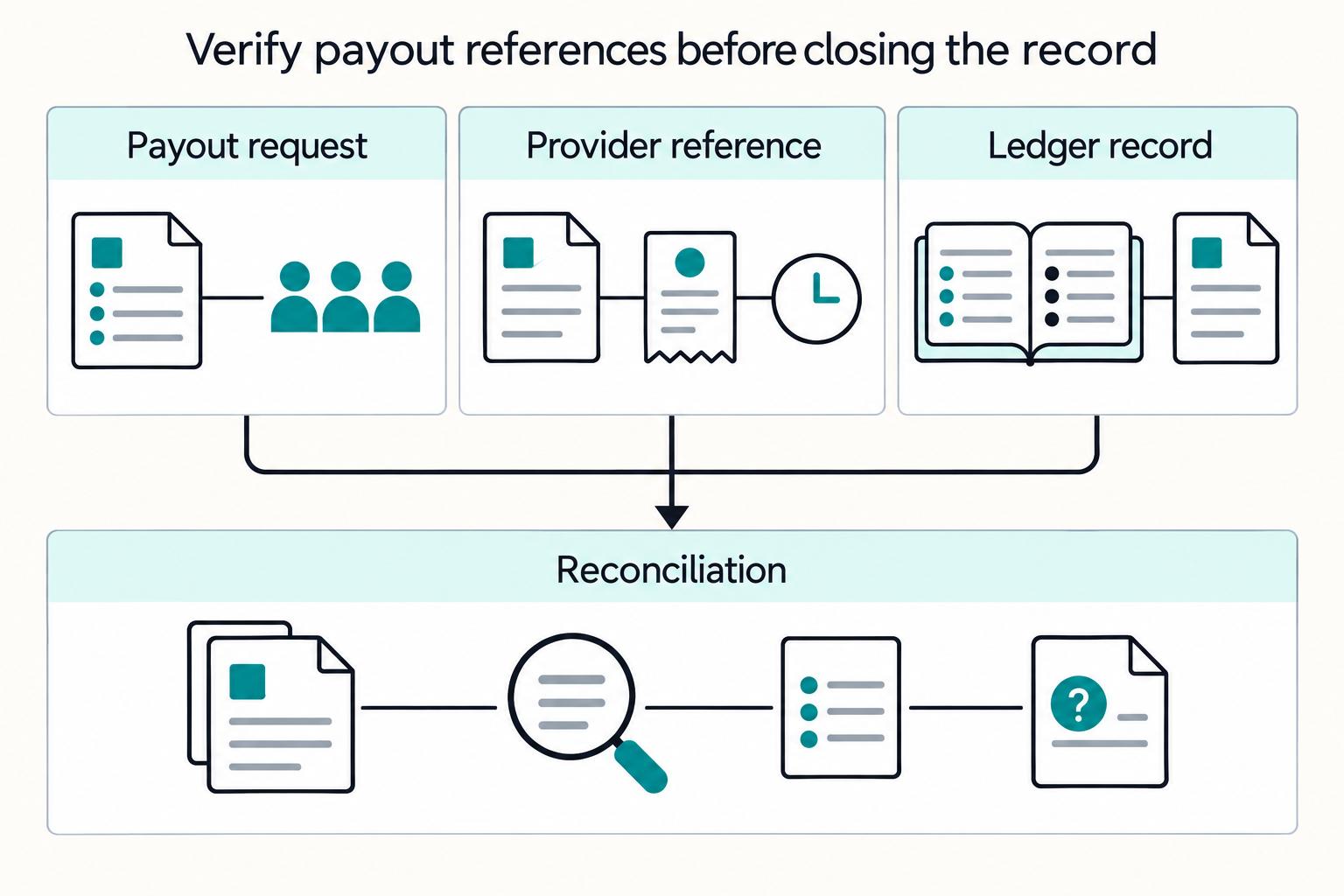
Your pack should let an operator reconstruct one payout from request through ledger outcome. Tie these records together per event:
- payment request ID
- approval or release ID
- provider reference
- internal ledger posting ID
- reconciliation export filename and export date
- exception notes for returns, retries, or manual intervention
Require at least one shared join key across records so finance, ops, and compliance can reconcile without ad hoc evidence.
Step 4: Run a confirmed-vs-unconfirmed checkpoint#
Before build commitment, and again before live traffic, review each item by source, source date, confidence, owner, and next action.
Treat weak sources as unconfirmed for production decisions. A Form 20-F filing context, including Commission file number 1-14926, filed June 29, 2011 for fiscal year ended December 31, 2010, is useful for traceability but not current contractor payout guidance. A World Bank source focused on the 1997 Korean financial crisis, and one that states it does not guarantee data accuracy, also does not confirm current payout compliance requirements.
Step 1 classify contractor relationship and tax ownership#
Classification is a go or no-go gate before first payout. If working conditions look employee-like, pause onboarding and escalate for local legal review.
Step 1 map the role against the Labor Standards Act and Civil Code lanes#
Write a short memo per role based on how work is actually performed, not just the contract label. Keep observed facts separate from legal conclusions, and confirm the exact South Korea tests under the Labor Standards Act and Civil Code with local counsel.
Capture at least:
- who directs day-to-day work
- whether your team sets a fixed schedule
- whether the person sits inside a manager or team reporting line
- whether your company provides the main tools or accounts
- whether work is accepted by milestone or supervised continuously
- whether the person can decline work or serve other clients
Your memo is strong enough only if another operator can read it and understand why the role is treated as contractor or employee.
Step 2 pause employee-like cases before first payout#
Set a clear internal rule now: if facts indicate company control or deep integration, stop before invoice approval or fund release and route for legal review. The exact South Korea legal threshold is not confirmed, so treat this as a risk-control decision rule.
Do not rely on a signed Civil Code contractor template alone. Keep the classification memo as the controlling record, with supporting artifacts such as role description, approval flow, and examples of output-based versus ongoing managed work. If working conditions change, update the memo before the next payout cycle.
Step 3 assign tax ownership for National Tax Service touchpoints#
Assign owners now, and confirm National Tax Service annual forms, deadlines, penalties, and HomeTax portal workflow steps with local counsel or directly on the NTS portal. Ownership still needs to be explicit even while those specifics are being verified.
Assign at minimum:
- one owner for contractor tax profile collection and storage
- one owner to review annual reporting obligations with the National Tax Service
- one operator to retain filing evidence, including HomeTax portal screenshots, exports, or submission references once confirmed
Before launch, verify that you can point to an owner, storage location, review calendar, and evidence file structure for year-end activity. Without that, tax operations are not ready for scale.
Step 2 choose payout currency and FX control points#
Choose one default settlement currency and treat FX as a controlled step, not a side effect of payout release. Use KRW when your invoice, approval, and contractor expectation are all KRW. Use foreign-currency payout only when that expectation is explicit and your team can reconstruct each quote and conversion event.
South Korea's confirmed payment structure gives you architecture context, not end-to-end FX execution detail: one LVPS (BOK-Wire+, operated by the Bank of Korea) and several RPSs, most operated by KFTC.
Step 2.1 choose a default settlement currency by operational impact#
Pick the currency that reduces operational drift between what was approved and what is finally paid.
| Decision lens | KRW payout | Foreign-currency payout |
|---|---|---|
| Operational complexity | Keeps invoice, approval, and local recipient expectation aligned when those are already KRW. | Can fit treasury funding in that currency, but requires tighter control of recipient expectations. |
| Reconciliation burden | Lower when invoice, ledger, and settlement stay in KRW. | Higher when invoice, approval, and settlement currencies differ and you must explain variances. |
| Contractor experience | Clear when the contractor budgets and banks in KRW. | Clear only when the contractor explicitly prefers that currency and accepts downstream conversion on their side. |
If you run a mixed model, record why invoice currency, approval currency, and payout currency differ for that payout path.
Step 2.2 set FX ownership at four control points#
Define these control points in the flow and assign ownership for each:
| Control point | Required handling |
|---|---|
| Quote creation | Capture source or target currency, quote reference, creation time, expiry time, and expected recipient amount after approval. |
| Quote expiry handling | Validate quote freshness before release. If quote expiry or stale-quote rejection is not implemented, do not enable automated conversion. |
| Conversion execution | Execute against a fixed approved amount and link conversion records to the payout request. |
| Payout release | Release only after quote validity and amount checks pass. Otherwise route to hold-and-reprice. |
Step 2.3 require a reconstruction-ready record#
Before you automate, confirm an operator can explain the final payout amount from records alone. The minimum record set is: invoice amount, approved amount, settlement currency, quote reference, quote and expiry timestamps, conversion reference if used, payout reference, and final ledger posting.
If that chain cannot be reconstructed without manual chat history, controls are not ready for scale.
Step 2.4 mark the known gap and pilot before scaling#
Full interbank FX mechanics for this use case are not confirmed. Payment-system structure is confirmed, and foreign-currency settlement categories are signaled, including FCFTS, but there is not enough detail to assume quote behavior, conversion sequencing, or settlement timing for contractor payouts.
Treat FX assumptions as pilot hypotheses and test quote expiry, stale-quote rejection, status delays, and release holds before expanding volume.
Step 3 map payout rails and reconciliation path in South Korea#
Do not scale payout volume until each payout can be traced from request to ledger entry to provider reference. For South Korea, use the rail names as architecture inventory, and treat route behavior as provider-validated only until your own records confirm it.
Step 3.1 build a provisional rail map#
Use this as an internal map, not a production truth table for contractor routing.
| Rail family | Named system | Expected payout use case (for now) | Failure mode | Required operator action |
|---|---|---|---|---|
| Large-Value Payment System | BOK-Wire+ | Keep as a named large-value lane; assign live contractor use only after provider confirmation. | Delayed status propagation | Keep payout pending until provider export and internal ledger state match. |
| Retail Payment Systems | Electronic Banking System | Keep as a retail-lane inventory item; do not pre-assign a contractor path. | Unmatched references | Move to exception review when request ID, ledger entry, and provider reference do not tie. |
| Retail Payment Systems | Interbank Remittance System | Keep as a retail-lane inventory item; use-case mapping requires provider validation. | Unmatched references | Hold closure and require a reconciled reference chain before marking complete. |
| Retail Payment Systems | Cheque Clearing System | Keep listed in architecture context; treat contractor relevance as out-of-scope until explicitly confirmed. | Return handling with weak event continuity | Escalate to manual ops, document return path, and block auto-retry until reconciled. |
Step 3.2 run a reconciliation-first operating sequence#
Use this order internally and keep routes in pilot if a provider cannot support it with evidence.
- Payout request
Create a payout request record tied to contractor, invoice, approved amount, currency, and approval time.
- Compliance gate
Run required pre-release checks and store pass or hold status with timestamp.
- Provider routing
Submit to the provider and capture the provider reference at submission time.
- Status updates
Track status changes and keep an exception queue for lagged, missing, or conflicting states.
- Final reconciliation confirmation
Close only when request ID, provider reference, final amount and currency, and ledger posting reconcile in one record trail.
Step 3.3 apply the scale decision rule#
If your team cannot reconcile each payout from request to ledger entry to provider reference, keep volume capped and the route in pilot. This is the control that stops rail uncertainty from turning into accounting uncertainty.
Step 4 design invoicing and records controls for NTS readiness#
Treat this step as records design first, automation second. The current evidence does not confirm when an XML e-invoicing format applies, whether a near-real-time filing claim is binding in South Korea, or which contractor scenarios require a specific National Tax Service or HomeTax path.
That gap matters. Do not treat incidental web material, such as machine-generated accounting tag text or a cookie-consent page, as substantive South Korea tax guidance. Build controls that preserve filing-ready evidence now, then activate jurisdiction-specific rules only after local confirmation.
Step 4.1 define an invoice evidence bundle per payout cycle#
For each payout cycle, keep one linked bundle: invoice artifact, contractor profile snapshot, payout record, and any National Tax Service or HomeTax submission evidence you actually have. The goal is simple: reconstruct exactly what was approved and paid without guesswork.
| Record element | What to keep | Verification checkpoint |
|---|---|---|
| Invoice payload | Final invoice file and any structured payload your system generates | Confirm amount, currency, invoice date, contractor identity, and service period match the approved payout |
| XML e-invoicing format assumption artifact | If XML is part of your planned path, store the draft XML or field map as an assumption-stage artifact | Validate parseability and required internal fields before release |
| Contractor tax profile snapshot | Profile state at approval time | Confirm profile completeness for your confirmed reporting path, then timestamp and freeze |
| HomeTax submission evidence | Any receipt, export, or confirmation captured when a submission occurs | Confirm evidence links to the exact invoice and payout cycle ID |
| Audit trail | Approval log, payout request ID, provider reference, ledger posting | Verify one continuous trace from invoice to payout to ledger close |
Step 4.2 mark unconfirmed filing rules as assumptions, not controls#
Document the XML e-invoicing requirement and the near-real-time filing claim as unconfirmed assumptions until locally verified. Assign each assumption an owner, decision date, and explicit evidence gap so teams do not treat search-result summaries as binding rules.
Apply the same discipline to HomeTax handling. You can retain submission evidence now, but do not encode specific workflows, forms, or required fields until those details are confirmed.
Step 4.3 add completeness checks before payout release#
Add release checks that protect NTS and HomeTax readiness even while filing rules are still being validated:
- Invoice payload integrity
Confirm the invoice used for reporting is the same artifact tied to the approved amount and payout request.
- Contractor tax profile completeness
Validate the profile against your confirmed reporting path. If completeness is unclear, hold and escalate.
- Audit-log traceability
Verify invoice ID, contractor ID, payout request ID, provider reference, and ledger entry join cleanly in one record chain. That is the same operating standard you would expect in a payment operations maturity model: one event, one owner, one reconcilable record trail.
Design for proof now. Once local confirmation clarifies the applicable NTS and HomeTax requirements for your contractor population, you can automate from stable controls instead of rebuilding records later.
Step 5 implement Gruv controls for idempotent compliant operations#
Treat Step 5 as control design, not as an assumption about South Korea rail behavior. There is no confirmed official callback model, required reference fields, or mandatory gate order for South Korea. One source is raw PDF content, and another states data accuracy is not guaranteed. So the safer approach is strict Gruv-side gates, explicit assumptions, and audit-ready evidence.
The Step 4 handoff is direct: the invoice and tax evidence bundle becomes a release gate. If a payout cannot be traced to a complete contractor record, approval, and payout request, do not release it.
Step 5.1 gate disbursement on evidence, not operator memory#
Require one complete chain before release: identity status, payout approval, invoice bundle, and confirmed route eligibility for this program. This is about traceability of your decision, not guessing an unconfirmed external sequence.
Keep a release log that can reconstruct the decision later. At minimum, store:
- contractor ID and profile version
- payout request ID and idempotency key
- approved amount and currency
- approval actor and approval timestamp
- selected provider or rail path
- release actor or automated job ID
- evidence bundle version linked to NTS or HomeTax support, where applicable
Use explicit hold reasons for blocked payouts, such as profile incomplete, approval missing, or route unconfirmed. Avoid silent overrides.
Step 5.2 enforce idempotency at the payout request layer#
Treat retries as replays of the same business intent, not new outbound sends. Enforce idempotency in your own system regardless of what rail-side duplicate protections may exist.
Scope the idempotency key to intent-level fields such as contractor, payout cycle, amount, currency, and destination account version. If those fields change, require a new request.
Test it with a timeout-after-release scenario: resend the same request and confirm one outbound attempt record with one stable internal status thread.
Step 5.3 normalize webhook updates and build a reconciliation pack#
Use your internal state model as the system of record, and preserve raw webhook payloads. Confirm the official South Korea event taxonomy and any required Interbank Remittance System reference fields with your payment provider.
Build one reconciliation pack per payout event that links:
- internal payout request
- provider reference
- any rail reference the provider returns
- raw webhook payloads
- ledger posting IDs
- operator notes for manual exceptions
If a provider exposes an Interbank Remittance System reference, match on it. If not, keep the item unreconciled until provider or bank evidence closes the loop. Do not auto-overwrite a terminal state with late or ambiguous events.
Step 5.4 keep alternative rails off until the South Korea path is proven#
Keep stablecoin and other alternative rails disabled for this program until coverage, compliance ownership, reconciliation evidence, and support procedures are confirmed. The current materials do not establish approval, prohibition, or required controls for those rails.
Use one rollout rule: prove end-to-end traceability on the bank-based path first, then consider additional rails.
Common failure modes and how to recover without compounding risk#
When a South Korea payout decision becomes unclear, the safest recovery is to stop, document, and re-approve rather than patching forward. The pattern to avoid is creating a payment action that cannot be defended later with a complete record.
Step 1 freeze changes when terms or sources are ambiguous#
If one acronym, label, or source reference is being interpreted in two ways across ops, legal, or finance, treat that as a control failure. Pause related routing or policy changes until the term is expanded consistently and the owning source is explicit in your internal documents.
Then correct affected approvals before resuming. Fix the record first, then restart decisions from the corrected reference point.
Step 2 pause new releases when the evidence chain is incomplete#
Do not continue payouts on memory or informal context. Hold new releases if the contractor record, approvals, or supporting artifacts are incomplete, and require a documented review path before restarting.
Recovery depends on versioned evidence: what changed, when it changed, and who approved continuation. If that trail is missing, any downstream payment decision becomes harder to defend.
Step 3 hold and re-approve when market assumptions go stale#
If pricing or timing assumptions are no longer current, stop and re-approve instead of forcing completion. Record the original intent, hold decision, and replacement request so the supersession path is clear.
This matters most under stress conditions. The OECD notes that late-2008 turbulence included large capital outflows and market turmoil, with stabilization described in early 2009 after policy response. In that context, controlled repricing and explicit approval are safer than manual override.
Step 4 backfill missing support before period close#
If a payout is complete but support is missing, treat it as an evidence incident with an owner and due date. Close the gap before internal period close and keep unresolved items on an exception list rather than marking the cycle complete.
Avoid retrospective reconstruction without labels. If you must rebuild evidence, mark it clearly as reconstructed support. For a broader cross-border control baseline, see How to Manage and Pay a Global Team of Contractors Compliantly.
What to verify in a 30 day pilot before full rollout#
Use the 30-day pilot to validate operational truth, not vendor assurances. Move to full rollout only when your records show the payout flow is traceable, recoverable, and document-complete under both normal and exception conditions.
| Pilot check | What to validate | Scale gate |
|---|---|---|
| Trace the payout end to end | Capture the full chain for each payment: internal request ID, approval record, provider reference, status updates, final outcome, ledger posting, and reconciliation output. | Every payout can be reconstructed from your own evidence. |
| Force exception paths on purpose | Deliberately test duplicate retries, delayed statuses, returns, and reconciliation items that remain open past your review cycle. | A pilot is incomplete if it validates only the happy path. |
| Inspect documentation against your reporting plan | Confirm each contractor record keeps classification support, agreement and invoice artifacts, tax-reporting records, and payout evidence linked in one place. | Another operator should be able to review the file and follow the reporting path without reconstructing context from memory. |
| Set a hard gate for interbank FX unknowns | Document where FX enters the flow, what post-conversion signals you receive, which failures are visible in your logs, and which still require provider escalation. | Go live only when the remaining FX unknowns are reduced to defined, monitored risks with clear ownership. |
Step 1 trace the payout end to end#
Prove that every payout can be reconstructed from your own evidence. Capture the full chain for each payment: internal request ID, approval record, provider reference, status updates, final outcome, ledger posting, and reconciliation output.
If a provider presents real-time or near real-time processing, verify what your logs show in practice. A fast status view without a clean tie to ledger and reconciliation records is not enough.
Step 2 force exception paths on purpose#
A pilot is incomplete if it validates only the happy path. Deliberately test duplicate retries, delayed statuses, returns, and reconciliation items that remain open past your review cycle.
Focus on security and reliability weaknesses early. Even where a retail payment system is not treated as systemically important, weaknesses can still create broader operational and financial impact.
Step 3 inspect documentation against your reporting plan#
Confirm each contractor record keeps classification support, agreement and invoice artifacts, tax-reporting records, and payout evidence linked in one place. The standard is simple: another operator should be able to review the file and follow the reporting path without reconstructing context from memory.
For National Tax Service-related reporting, treat this pilot as a documentation-readiness check, not legal confirmation of local filing details. Track any unresolved reporting assumptions as open risks with owners.
Step 4 set a hard gate for interbank FX unknowns#
Do not scale while interbank FX behavior is still unclear in your own operating data. Complete a short drivers-and-barriers assessment that documents where FX enters the flow, what post-conversion signals you receive, which failures are visible in your logs, and which still require provider escalation.
Go live only when the remaining FX unknowns are reduced to defined, monitored risks with clear ownership.
Make the expansion call only after this copy and paste checklist is complete#
Treat South Korea as not ready until legal classification, tax evidence, rail mapping, and FX controls each have a named owner and pilot proof. Commercial demand or provider coverage claims are not enough.
Step 1: Turn the checklist into a hard gate#
Use this checklist as a go or no-go control, not meeting notes. For each line item, require one owner, one evidence artifact, and one last-verified date. If a line depends on a vendor claim, store the vendor statement with your pilot result so promised behavior and observed behavior are visible side by side.
Start with terminology hygiene. Do not leave "KFTC" ambiguous in docs, tickets, or architecture notes. Expand acronyms on first use and tie each one to the exact institution or internal meaning your team intends.
Step 2: Require proof for unresolved South Korea items#
Several key South Korea items remain to be confirmed before scaling, including Labor Standards Act and Civil Code classification criteria, National Tax Service and HomeTax workflows, KRW-versus-foreign-currency payout rules, and operating requirements tied to BOK-Wire+ or Retail Payment Systems. Make expansion decisions from counsel guidance, provider documentation, and pilot evidence, not assumptions.
For classification, keep evidence showing the logic applied, contract version used, and escalation path when facts become employee-like. For rails and FX, require a pilot trail from payout request through routing and status events to final ledger entry, including return or retry behavior. If that chain is not traceable, keep volume capped.
Do not treat "mapped" as "tested." A rail diagram without live references, rejection behavior, and reconciliation exports is still an assumption. If quote timing, expiry behavior, or conversion-release rules are unresolved, keep automated conversion off.
Step 3: Make tax evidence usable before scale#
"NTS and HomeTax evidence workflow documented" should mean a repeatable record structure that links contractor identity, invoices, payout evidence, and tax-support files to the same payout cycle. That creates an auditable trail while South Korea-specific filing steps are still being confirmed.
If U.S. tax reporting applies to the same income, keep records detailed enough for foreign tax credit analysis. Individuals generally use Form 1116, and it is prepared separately by income category. For the simplified path without Form 1116, keep payee statement support and threshold checks ready ($300, or $600 for joint returns). This is not South Korea guidance, but it is a practical records standard from day one.
Copy and paste checklist#
- KFTC ambiguity removed in internal docs and architecture notes
- Labor Standards Act and Civil Code classification logic approved
- National Tax Service and HomeTax portal evidence workflow documented
- KRW vs foreign currency payout rule chosen with FX control points defined
- BOK-Wire+ and Retail Payment Systems assumptions mapped and pilot-tested
- Idempotency, reconciliation, and exception handling passed in pilot
- Unknowns logged with owners, mitigation, and decision date before scale-up
If any box is still in progress, treat it as a defer signal.
Frequently Asked Questions
What does KFTC mean in this article, and why are there two different KFTCs in South Korea?
This guide does not establish what KFTC refers to in this context or whether two different entities are in scope. Treat the acronym as unresolved until your legal and operations documents spell out the full entity names.
Who operates South Korea’s core payment systems for contractor payouts?
At a high level, BOK-Wire+ operates under the Bank of Korea, and several Retail Payment Systems are operated mostly by KFTC. The exact operator, route selection, or reference fields for your contractor payout path are not confirmed. Before rollout, require your bank or payout provider to document the specific rail, upstream operator, and reconciliation reference fields you will receive.
Can foreign companies pay South Korea contractors in Korean won or foreign currency?
Currency handling between KRW and foreign currency for South Korea contractor payouts is an open launch assumption. Confirm the applicable rule with local counsel and your payment provider before scaling automation. In parallel, define where FX happens, who owns rate selection, and how quote timing and expiry appear in your logs.
How do contractors handle annual tax reporting with the National Tax Service and HomeTax portal?
Confirm South Korea-specific annual filing steps, forms, and deadlines for NTS and HomeTax directly with the National Tax Service or local counsel. Assign owners for invoices, contractor tax data, and payout evidence so records are ready once local reporting guidance is confirmed. If U.S. tax also applies to the same foreign income, individuals generally file Form 1116 and corporations file Form 1118.
Is subcontract settlement regulation the same thing as contractor payout compliance?
Whether subcontract settlement regulation and contractor payout compliance represent the same requirement or different requirements is something to confirm with local counsel. Keep subcontract rules, worker classification, tax reporting, and payment-rail execution as separate review tracks with separate owners.
What key details are still unknown before launching interbank FX at scale?
Confirm South Korea interbank FX mechanics, quote-expiry handling, and scale-launch thresholds with your payment provider before going live. Base the go or no-go decision on pilot evidence, not assumptions. At minimum, document quote timestamp, expiry behavior, rate source, conversion trigger, rejection and return paths, and reconciliation visibility for each event.
Where Gruv fits
Researched and edited by the Gruv editorial team. Gruv builds cross-border billing, payouts, and finance-operations software for global businesses.
Sources
Includes 4 external sources outside the trusted-domain allowlist.
Educational content only. Not legal, tax, or financial advice.
Related Posts

The Freelance Payment Penalty: A Modeled Audit of Platform Fees, FX Spreads, and Payout Delays
The money rarely disappears through a single, easy-to-spot fee. The real loss is stacked. A marketplace takes its commission, a processor adds a charge for international cards, a bank or payment company converts the currency at a spread, a platform holds the funds before release, and a wire sheds a little to intermediaries on the way in. Each layer looks defensible on its own, but the worker feels the combined result as a smaller deposit and a later payday.

How to Respond to a Subpoena for Business Records
Move fast, but do not produce records on instinct. If you need to **respond to a subpoena for business records**, your immediate job is to control deadlines, preserve records, and make any later production defensible.

A US Expat's Guide to Investing in UCITS ETFs to Avoid PFIC Issues
The real problem is a two-system conflict. U.S. tax treatment can punish the wrong fund choice, while local product-access constraints can block the funds you want to buy in the first place. For **us expat ucits etfs**, the practical question is not "Which product is best?" It is "What can I access, report, and keep doing every year without guessing?" Use this four-part filter before any trade: