
Quick Answer
Combine risk-significant change events with a documented periodic backstop where appropriate. Route cases to targeted verification or authorized review, and restrict only the payment action whose prerequisite is unresolved. Keep sanctions blocking separate from routine holds; stale or unavailable required checks cannot become an automatic pass.
Why KYC refresh should be risk-based#
Automating KYC refresh for existing contractors is mainly an operating model change. The move is from manual, calendar-based reviews to risk-based, event-driven monitoring with clear decision rules and defensible records. That shift matters because manual KYC is often slow and error-prone, and fragmented periodic reviews can become a structural bottleneck.
KYC refresh updates identity and risk information after onboarding. Define first whether your platform, its regulated partner or both own the relevant checks. Reuse verified data where permitted, and request new documents or biometric checks only when the changed facts, applicable rules or provider requirements justify them.
The core pKYC idea is simple. React when risk changes instead of waiting for the next calendar checkpoint. In practice, that gives teams a more current view of risk and can reduce low-value periodic review work.
This is not an argument for blind automation. Poor data quality and over-reliance on automated outputs are common failure points, so you still need explicit human ownership for exceptions, adverse alerts, and policy decisions. Effective programs automate document capture, risk scoring, and case routing, while keeping escalation and final judgment under accountable oversight.
Before you start#
You will get more value from this guide if three basics are already clear:
- who currently has active or pending payout access
- which checks are already running today, including manual checks
- who can approve holds, step-up verification, and case closure
Those inputs are prerequisites for schedule design. If population scope, controls, or decision ownership are unclear, automation can look complete on paper and still fail on edge cases.
Before you add new schedules, confirm you can trace each review from trigger to outcome. You should be able to show why the refresh started, which checks ran, what result was produced, and who approved the action. If that chain cannot be reconstructed, improve record quality first. Audit readiness depends on complete transitions and evidence.
The rest of this guide stays practical. It covers schedule design, escalation points, evidence standards, and multi-market operating controls. It also includes a 30-day execution sequence. Use it as a controlled rollout plan, not as a regulator-approved template, because cadence and escalation thresholds still depend on your markets, risk appetite, and data quality.
Step 1 Align scope and decision owners#
Do not design re-verification schedules until scope and ownership are locked. Refresh programs can break early when teams automate triggers before defining who the controls apply to and who makes hard calls when evidence is incomplete.
Set these foundations first:
- Define the covered population explicitly, including whether it includes existing contractors, sellers, and creators with active or pending payout access.
- Assign named decision owners for refresh outcomes, exception handling, and escalations across the functions involved.
- Set policy boundaries for when KYC and KYB checks are required, optional, or not used, including any market-specific differences.
- Separate workflow automation from decision authority. Automate triggers and routing, but keep oversight and final judgment with accountable owners.
- Document these boundaries in an audit-ready control record with controlled access, version tracking, full audit history, and case-log documentation so the trigger-to-outcome path can be reconstructed.
Once ownership is clear, you can baseline the controls you already have and see whether the current records will support automated refresh at all.
Step 2 Baseline your current data and control gaps#
Before you expand re-verification schedules, confirm that your current controls and records can support defensible decisions. If baseline data quality is weak, automation can amplify review friction and oversight risk instead of reducing it.
In practice, KYC verification covers identity checks, risk-based assessment, ongoing monitoring, and regulatory adherence. For each contractor path, you should be able to show what check ran, what data it used, what output it produced, and how the final outcome was decided.
Inventory the controls you already have#
Start with an explicit inventory across ID&V, document checks, biometric checks, sanctions screening, risk scoring, and ongoing monitoring, then confirm how those controls connect in the case record.
| Control area | What to confirm now | Verification detail |
|---|---|---|
| identity verification (ID&V) | Whether checks run only at onboarding or can be re-run for existing contractors | Confirm provider result, reference ID, and final outcome are retained |
| document verification | Whether document capture and authenticity outputs are retrievable | Confirm capture and outputs are linked to the case record |
| biometric verification | Whether biometric checks are available, optional, or absent by cohort | Confirm failed and inconclusive outcomes are distinguishable |
| sanctions screening | Whether screening is one-time, periodic, or ongoing | Confirm match results and follow-on status are retained |
| risk scoring and ongoing monitoring | Whether scores or alerts trigger case handling or stay isolated | Confirm outputs route into case outcomes |
As a practical checkpoint, trace document capture, risk scoring, and case routing for the same case. If those outputs cannot be tied together, the control is only partially operational.
Audit the records before you automate triggers#
Audit record quality for trigger fields, outcome labels, timestamps, and status history before adding automation. Sample both straightforward and exception-heavy cases, since verification timelines can range from a few minutes to several business days or more depending on complexity.
Normalize meaning across providers and internal teams. If equivalent outcomes are labeled differently, for example if one system flags review while another closes approved, your routing logic is not stable enough for scaled automation.
Map OCR and name-matching inconsistencies#
OCR can reduce manual handling, but extracted-field quality and name matching can still create inconsistencies that need oversight. Isolate cases where documents moved to review and test whether extracted text or matching logic aligned with internal records.
Keep both raw provider output and normalized internal values. Without both, you cannot reliably tell whether failures came from OCR parsing, transformation logic, or match-rule design.
Fix review-breaking evidence gaps first#
Fix the evidence gaps that would fail internal or external review before you do anything else. The usual problem set is familiar: missing trigger provenance, incomplete status transitions, missing provider references, or unclear rationale for pass, escalate, or stop outcomes.
Use a hard gate here. If you cannot reconstruct trigger-to-outcome paths on sampled cases, do not expand refresh coverage yet. Close the evidence gaps first, then scale schedules.
Step 3 Define contractor risk tiers and trigger taxonomy#
Combine event-driven checks with a policy backstop where useful. FinCEN’s CDD FAQs describe risk-based updates when covered financial institutions learn of relevant changes; they do not impose one universal calendar refresh interval on every platform or contractor. Document the rule for your entity, partner and jurisdiction.
Rank contractors with explainable factors#
Build risk tiers from factors your team can actually evidence in a case record, not from opaque scoring labels. As an internal starting point, define policy-based factors for your operating model, then tie each factor to a source field, update point, and reason code. If a factor cannot be traced to data and a decision path, remove it or simplify it before automation.
Separate trigger classes before automation#
Use a compact trigger taxonomy to keep routing and escalation consistent.
| Trigger class | Purpose | Examples to evaluate | Evidence to retain |
|---|---|---|---|
| Periodic review | Backstop when no material event fires | Scheduled policy checkpoints, recurring KYC-related review steps | Schedule basis, policy version, rerun checks, disposition |
| Event-driven review | React to policy-defined profile or activity changes | Changes detected in monitored profile or activity fields | Trigger source, timestamp, before/after values, provider outputs |
| Policy-defined required review | Handle events your policy or legal guidance treats as non-skippable | Sanctions-related alerts and other policy-defined non-skippable events | Trigger basis, reviewer, decision rationale |
Separate AML customer-information updates from sanctions controls. FinCEN’s CDD requirements apply to defined covered financial institutions; OFAC restrictions depend on sanctions jurisdiction and the transaction or property involved. Neither is a generic rule that every tax-profile change should stop a contractor payout.
Tag high-signal events by severity#
Do not route all triggers the same way. Keep separate codes for sanctions-related screening results, and retain the raw match output plus final disposition so reviewers can distinguish a potential match from a confirmed concern. Keep different trigger types on separate operational paths so your response stays proportionate and auditable.
Add a KYB branch for business payees#
If you pay businesses, add business-entity triggers alongside individual-contractor triggers. Define those triggers from your policy and data sources, and route them to review rather than forcing automatic conclusions.
If this is a material gap for you, the next useful companion read is Continuous KYB for Platforms: How to Refresh Business Verification Without Re-Onboarding Everyone.
Gate launch with an operator checklist#
Before enabling automation, test sample cases across tiers and trigger classes. Confirm you can answer five questions: what fired, what evidence supported it, what checks reran, who decided, and what outcome was applied. If required reference documents are missing, escalate to the named point of contact instead of progressing the case with incomplete evidence.
Step 4 Set re-verification schedules by tier and market#
Turn your tiers and triggers into a matrix your operators can actually use. For each row, state when review occurs, what reruns, who owns the decision, and where exceptions go. If any row lacks a named reviewer or a manual exception path for adverse results, do not automate that row yet.
Build a matrix your operators can use. Break rows by market and contractor type, then tie each row to the explainable factors from Step 3, such as jurisdiction, payout access, tax status, and trigger class.
| Matrix field | What to record | Red flag |
|---|---|---|
| Market and contractor type | Jurisdiction, individual or business, payout-enabled status | One row reused across all markets |
| Review basis | Policy backstop plus event triggers that open early review | No reason code for why the row exists |
| Controls to rerun | Which checks your policy reruns for that row, and why | All checks rerun in all cases with no reason |
| Tax-profile changes | Legal-name, taxpayer-ID, residency or payee-type changes that conflict with verified payment data | Personal foreign-asset reporting used as a general KYC or payout gate |
| Owner and exception route | First reviewer, escalation owner, and manual exception path for adverse results | No named approver for exceptions |
If reviewers cannot resolve a row from standard evidence, route it to Compliance and Legal rather than forcing an automated outcome.
Specify what reruns at each scheduled review. Do not label everything as a generic KYC refresh. Define reruns per row explicitly so reviewers can see exactly what ran and why.
Validate the design with one sample case per row. A reviewer should be able to show what triggered the review, which controls reran, which outputs were retained, and who approved the outcome.
Keep tax reporting separate from refresh. A changed legal name or tax residency can require targeted identity or withholding-document checks. A contractor’s personal Form 8938 or FBAR obligations are not ordinary platform KYC-refresh criteria. Do not ask for foreign-account balances or personal asset returns merely to complete a routine identity refresh.
Apply tighter rows as policy choices, then require approval. If your internal risk assessment supports tighter handling for specific markets, document that row-level cadence and adverse-hit review path as a policy choice with rationale. Do not treat IRS source material as prescribing a specific KYC cadence.
Before enabling automation, get Legal and Compliance sign-off on row logic, rerun controls, tax checkpoints, and exception routing. The final gate is simple. Sample each row and confirm that no case can proceed with a missing owner, missing review evidence, or unresolved adverse result.
Step 5 Write escalation rules for auto pass manual review and payout holds#
Once your schedule matrix is approved, route each re-verification case through clearly defined internal policy outcomes, such as auto-pass, step-up verification, manual review, or payout hold. The point is not to create more states. It is to make entry and exit rules clear enough that ordinary document noise does not turn into unnecessary payment friction.
| Outcome | Definition |
|---|---|
| auto-pass | rerun controls are clean and no material discrepancy remains |
| step-up verification | the issue is narrow and may be resolved with targeted ID&V or document verification |
| manual review | an analyst must interpret conflicting or incomplete evidence |
| release restriction | a documented legal, contractual or provider-policy restriction on a defined payment action; distinct from legal asset blocking |
Define the outcomes before you automate routing. Write each decision rule in plain language and attach the evidence required to move the case forward. Anchor these rules to your customer acceptance policy so risk appetite and prohibited categories are applied consistently.
A practical split is:
- auto-pass: rerun controls are clean and no material discrepancy remains
- step-up verification: the issue is narrow and may be resolved with targeted ID&V or document verification
- manual review: an analyst must interpret conflicting or incomplete evidence
- release restriction: a defined payment action cannot proceed until its documented prerequisite is met
Use a simple verification checkpoint before launch. Test one sample case per outcome and confirm the reviewer can show the trigger, the controls rerun, the reason for the outcome, and the next required action. Keep routing and evidence capture centralized where possible, since fragmented KYC processes increase compliance-gap risk. If an outcome has no named owner or evidence standard, do not automate it.
Separate higher-risk sanctions alerts from low-grade document noise. Alerts are not equal, so escalation should not be one-size-fits-all. In sanctions screening, an alert is a hit, or multiple hits, against sanctions lists, and alerts that cannot be resolved as false positives generally move to investigation.
For a credible unresolved sanctions match, pause the affected instruction while the authorized reviewer checks the relevant list, identifiers and sanctions program. A PEP result is a risk-review signal, not proof of sanctions or criminal activity. Minor document inconsistencies should use targeted step-up checks. Neither PEP status nor a noisy name match should automatically freeze funds.
Use document-free verification only where applicable rules and your executing provider permit the chosen method for the entity and payee type. Keep the method, data sources and accepted result with the case. An unexplained jurisdiction score is not authority to bypass document requirements.
Distinguish review restrictions from legal blocking. An internal release restriction needs a reason, owner, review deadline and lawful release criteria. OFAC-blocked property is a different state: it cannot be released merely because an internal review ends. OFAC explains blocking as freezing covered property under applicable sanctions, with transfers requiring legal authorization. Keep that state separate from routine KYC case closure.
Your audit trail should log, at minimum:
- trigger source and alert type
- sanctions match details
- checks rerun, including ID&V and document verification
- hold reason code, reviewer, and escalation owner
- evidence required to unblock
- hold re-review point
- each status change tied to payout status
If an unresolved match is established as a false positive before legal blocking, clear the review restriction and record the comparison evidence. If property has already been legally blocked, use the applicable unblocking procedure; ordinary KYC approval is insufficient. A required review that times out stays unresolved, not approved.
Related reading: How Platform Operators Pay Contractors in Colombia with PSE Nequi and DIAN Controls.
Before enforcing payout holds, validate each branch, auto-pass, step-up, manual review, and hold, against clear unblock criteria and audit fields: Review implementation docs.
Step 6 Implement the event pipeline and case queue#
Design a central case queue so payout decisions use current authorized case state instead of an isolated callback. Keep compliance state separate from payment execution state: closing a verification case does not establish that money was sent, received or returned.
Route triggers through one intake path. Use a stable event or provider-reference key to deduplicate repeated deliveries. A unique-key insert can return the existing case on retry rather than create another active case. Keep the original event and attempts, and create a new review when materially changed evidence or a new list version invalidates a previous decision.
Check release eligibility where money moves. At authorization and again immediately before submission, evaluate active restrictions and the required verification version. A queued payout can become ineligible after batch approval. Commit the authorization decision and submission reservation consistently so competing workers do not bypass a new restriction; record any race for reconciliation.
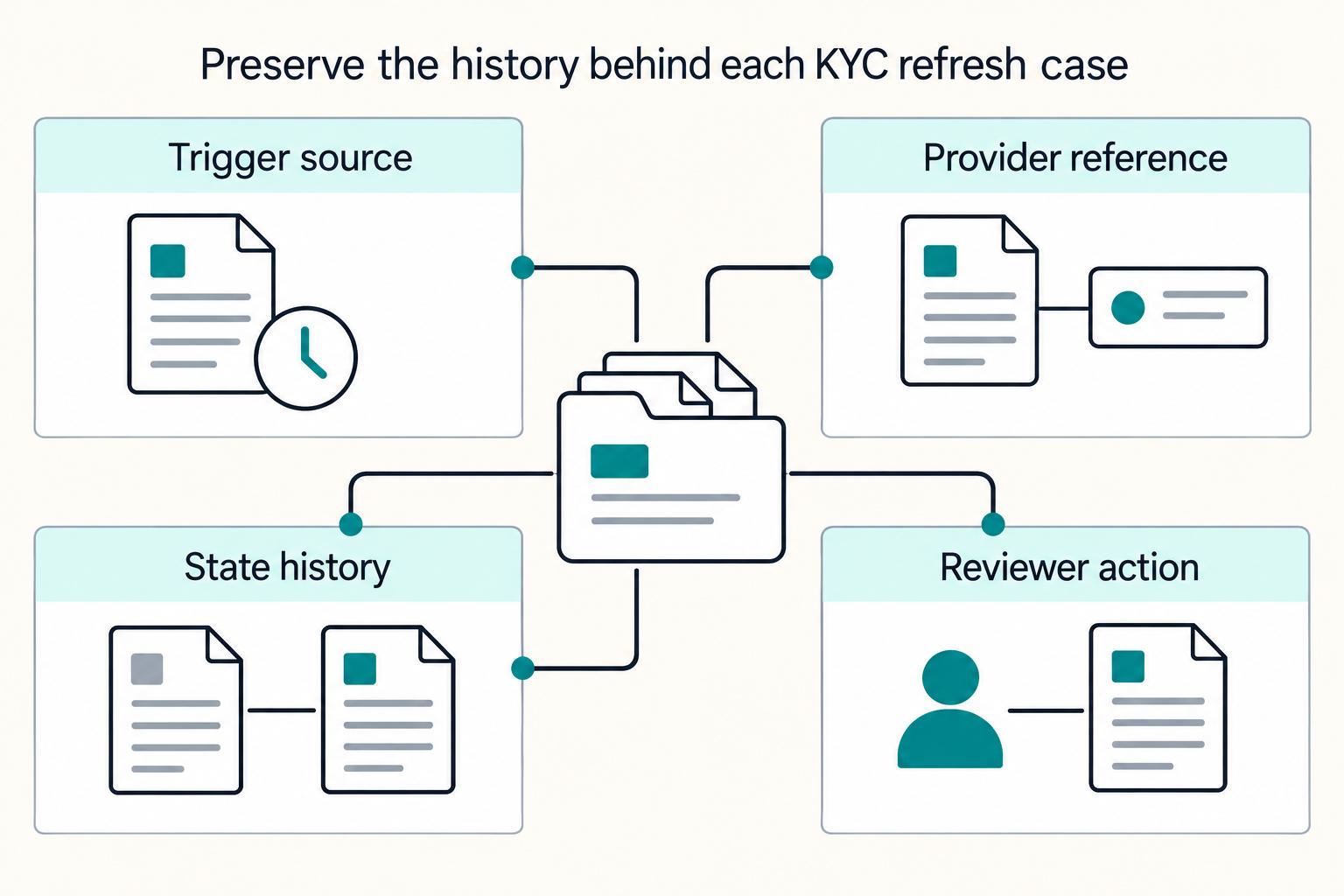
Keep a complete per-case evidence record. Store one evidence trail per case so the decision is explainable later. Fields to consider include:
- trigger source
- provider references
- status transitions
- reviewer actions
- timestamps
If outcomes are changed manually, record who changed what and why. Preserve prior states rather than overwriting them.
Where provider data handling is relevant, record policy-scope boundaries in the case file. For example, a provider privacy policy may explain that an app developer's handling sits outside the provider policy scope. If facial images or facial geometry are processed, treat handling as jurisdiction-sensitive because those data may be considered biometric in some jurisdictions.
Link case decisions to payment records. Attach the restriction or release decision to the logical payout and provider attempt, then reconcile execution independently. For example, a case may be cleared while its earlier payout remains pending at the provider. Releasing eligibility does not authorize a replacement until non-execution or return is confirmed.
If required screening times out, keep the result unknown and retry through the same case with an owner and deadline. A stale “clear” callback must not overwrite a newer adverse result. Record source version, event time and decision version; require a current eligible result before the restricted action proceeds.
Step 7 Connect tax profile changes to KYC refresh logic#
Tax profile changes should not open full KYC review by default. Treat them as refresh triggers only when they change identity, residency, or legal status. Route those updates through the same Step 6 case intake path, and prefer targeted checks over full re-onboarding.
Diff the submitted tax profile against the verified record. Start with a field-level diff, not the form label. Compare normalized legal name, tax residency, taxpayer ID where captured, and payee classification against the verified profile before opening a new review path.
Keep a clear before-and-after checkpoint: prior verified values, new submitted values, source form, submission timestamp, and submitter. If the change is non-material and does not affect identity, residency, or legal status, append it to the record and close it without deeper review.
The main failure mode here is noisy triggering. If every resubmission opens a full case, administrative churn will hide higher-risk mismatches.
Map each update to the smallest necessary KYC check. Use tax-profile updates as change signals, then run only the check needed for the changed field. For example, mismatched name or taxpayer ID can trigger identity matching, residency changes can trigger jurisdiction-sensitive checks, and legal-status changes can trigger status-specific controls.
That keeps controls responsive without forcing repeat onboarding for low-risk updates. If a submission raises treaty or cross-border tax interpretation questions, keep tax interpretation with Legal and connect only the changed identity or residency fields back into KYC.
Escalate conflicts that point to real identity or legal-status risk. Escalate to Compliance and Legal when a tax declaration conflicts with the verified identity record in a way that could affect the basis for payment. Typical examples are repeated taxpayer-ID churn, residency claims that conflict with the verified profile, or payee-classification changes that do not match identity records on file.
Keep the evidence pack complete: submitted form image or payload, parsed fields, prior verified profile, diff output, reviewer notes, and existing provider references. Preserve old and new states side by side so the decision remains explainable.
Route tax interpretation to its own owner. If a changed declaration affects withholding or treaty eligibility, send it to the tax owner while the identity team reviews only the conflicting identity fields. Record whether the existing tax document remains usable, what replacement is needed, and which payment treatment applies during remediation.
Keep these checkpoints in the tax-linked case:
- Previous and new legal name, taxpayer ID, residency and payee type, limited to data needed for the payment relationship.
- Tax document type, effective period and change-of-circumstances date.
- Identity conflict and tax-treatment question as separate reasons and decisions.
- Payment treatment, decision owner and remediation deadline; do not infer asset-reporting obligations from a payout account.
For U.S. withholding-agent workflows, use the applicable W-8 or W-9 instructions and Publication 515 to assess changed documentation. Keep personal Form 8938/FBAR advice outside routine contractor identity refresh.
We covered this in detail in KYC at Scale for 10,000 Contractors Without Killing Conversion.
Step 8 Add sanctions and PEP monitoring without alert fatigue#
Screen sanctions and PEP signals on distinct paths. FATF’s PEP guidance describes preventive risk measures, not an assumption that PEPs commit crimes. Where enhanced due diligence applies, define its evidence and approval requirements separately from sanctions prohibitions.
Tier alerts before they reach reviewers. Route watchlist alerts by severity and urgency instead of sending everything to one queue. Attach an internal review target per tier, and reserve enhanced review for higher-severity alerts while weaker matches go through secondary checks first.
For each alert, keep these fields visible before review starts:
- Source list
- Matched attributes
- Match confidence
- Current contractor risk level
- Review target time
If those fields are incomplete, the case is not ready for a defensible decision. Fragmented manual handling is where false positives and human error tend to rise.
Resolve sanctions matches with identifying attributes and the applicable program, not a blended risk score alone. OFAC’s match guidance distinguishes list types, possible matches, authorizations and required actions. A low customer-risk score cannot override a valid sanctions restriction.
Collapse identical repeated alerts into the same active case, but bind any cleared-match suppression to the list entry/version, matched identifiers and recorded rationale. Reopen when source or customer data changes. Suppression must not hide a new designation or a newly credible match.
If alert volume jumps after a rule or list update, sample the new alerts and check whether they reflect genuine new restrictions or matching noise. Tune documented false-positive controls without deferring legally required action. Keep the validated list version and rollback history with the change.
Preserve source snapshots and decision rationale. For sanctions checks, watchlists, and other source checks used in the case, store a snapshot of what reviewers saw at decision time. Keep the source name, search timestamp, returned record or extract, matched attributes, provider reference if available, and reviewer rationale.
That record is what makes the control defensible in an audit or investigation. KYC controls extend from onboarding and verification into ongoing monitoring and audit review, so source-attributed, traceable evidence matters as much as the screening logic itself. When this step is implemented well, queue noise can fall and analysts can spend more time on complex, higher-risk cases.
Step 9 Build evidence packs and audit outputs your team can defend#
Treat each evidence pack as a decision record, not a document dump. If your team cannot sample a re-verification case and reconstruct the logic end to end, the control is weaker than it looks.
Define a minimum case record before you scale volume. Use a consistent evidence pack for every approval, escalation, reopening, and payout hold, with core fields such as trigger reason, checks run, outcome rationale, linked decision artifacts, and timestamps. That keeps the log audit-ready by showing what was captured, which checks ran, and why the decision was made.
Link each case to the artifacts behind the decision, not just free-text notes. A completed review without linked evidence is hard to defend in an audit or investigation.
Link the audit trail to payout status and approvals. Your audit trail should connect compliance decisions to payout state changes and internal approvals, with no missing transitions between check, decision, hold, release, and outcome.
Test this directly. Pick a held case and trace it from trigger to final payout disposition. If any step exists only in chat, email, or a spreadsheet, your record is fragmented.
This matters more as you move toward ongoing, event-driven monitoring. More triggers can create more edge cases, so centralized decision records are what keep evidence capture consistent across flows.
Protect sensitive data without making evidence unusable. Protect sensitive data according to your control framework while keeping full decision artifacts retrievable for restricted investigations.
Separate everyday review views from restricted evidence views. Keep those views tied to the same case so the investigation trail stays intact.
Standardize recurring outputs and block closure on missing data. Use one recurring export structure, then give Compliance, Finance, and Legal filtered views from the same source. Consistency matters more than a universal template.
| Team | What they need to see | Example recurring fields |
|---|---|---|
| Compliance | Control performance and unresolved risk | holds, escalations, reopenings, unresolved cases, trigger source, timestamps |
| Finance | Payment impact and release history | payout holds, releases, payment status changes, approval references, timestamps |
| Legal | Exception patterns and defensibility | escalations, reopened decisions, rationale summaries, linked artifacts, approval chain |
Before closure, require a completeness check: trigger present where applicable, checks logged, rationale captured, linked decision artifacts, timestamps for status changes, and payout-state linkage when money movement was affected. If anything is missing, return the case for completion instead of closing it with a broken trail.
Step 10 Set operating metrics SLAs and governance reviews#
Use your evidence packs to run the queue in real time, not just explain decisions later. Focus on metrics that change prioritization, staffing, or escalation, especially workload, alert pressure, and unresolved-case aging.
Track decision-shaping metrics by risk tier. Do not manage all cases as one average. Use separate views for higher-risk sanctions-related work and lower-risk KYC refresh queues.
At a fixed interval, sample open cases in each tier and confirm the current owner, time since trigger, and next action. If a case has no named owner or no clear closure path, backlog risk is likely understated.
Treat rising alert pressure as a governance signal, not just a volume signal. If risk scoring or ongoing monitoring generates more alerts without better confirmed outcomes, reviewer load can rise without a matching control benefit.
Set SLAs around harm, not convenience. Set SLA priorities by downside if a case waits. Higher-risk sanctions-related cases should be prioritized ahead of lower-risk KYC refresh work.
Watch unresolved confirmed issues as both an SLA signal and a quality signal. The longer confirmed issues remain open, the more likely they are to create audit exposure.
Hold recurring governance reviews and log every change. Run recurring governance reviews to recalibrate schedules, escalation rules, and staffing before unresolved issues turn into audit exposure. This matters most where poor data quality or over-reliance on automation can degrade control quality.
Use one standardized reporting artifact for each review cycle. For every policy or rule change, record ownership, what changed, and how closure will be verified, then confirm remediation reduced the target issue in that case group.
Common mistakes that break re-verification programs and how to recover#
Many re-verification programs break on operating design, not tooling alone. A practical way to recover is to tighten trigger logic, ownership, alert routing, and audit records before adding more automation.
| Mistake | Recovery |
|---|---|
| treating refresh like a generic periodic rerun with no clear risk signal | trigger refresh from change events and ongoing monitoring, not from periodic reruns alone |
| split ownership across teams | one named owner for case decisions, plus a backup escalation owner |
| treating all alerts equally | risk-based routing that isolates higher-confidence sanctions-related alerts from lower-confidence refresh noise |
| closing cases with thin notes | an audit-ready record that captures what was reviewed, by whom, and when |
| material ownership, control or representative changes without review | apply the risk-based checks required for the entity and record the changed facts and approver |
Rebuild triggers for post-onboarding risk. A common mistake is treating refresh like a generic periodic rerun with no clear risk signal. The fix is to trigger refresh from change events and ongoing monitoring, not from periodic reruns alone.
Use reopened cases to check whether the review basis remains valid. A periodic review can be appropriate under a documented policy even without a new change event. Reduce redundant reruns when previous checks remain current, rather than treating every scheduled review as a defect.
Assign one case owner. Split ownership across teams can become a failure mode. The fix is one named owner for case decisions, plus a backup escalation owner for absences or queue spikes. For every open case, keep owner, last action time, and next escalation point visible so aging risk is not hidden.
Separate high-risk alerts from general noise. Treating all alerts equally is a design mistake, not just an efficiency problem. Recovery is risk-based routing: isolate higher-confidence sanctions-related alerts from lower-confidence refresh noise so reviewers can prioritize real risk first. Manual queues are error-prone and expensive, so this separation is a control quality decision.
Keep closure records audit-ready. Closing cases with thin notes can undermine an otherwise solid process. Recovery is an audit-ready record that captures what was reviewed, by whom, and when.
Check approval time against the action it governed: the reviewer’s release decision must precede the affected payout submission. Trading-date or next-business-day approval rules are not a general contractor KYC standard.
Review ownership and authority changes. For business payees, material changes in ownership, control or authorized representatives should trigger the checks required by your entity’s policy and applicable rules. FinCEN’s 2026 account-opening relief does not remove risk-based updates when covered institutions learn of relevant changes. Record the affected entity, facts and approver rather than automatically treating every notification as a new onboarding.
Related: How to Build a Risk-Based KYC Framework for Your Platform: Tiering Contractors by Risk Level.
30 day execution checklist for a controlled rollout#
Keep the rollout narrow and controlled. In the first 30 days, the goal is not maximum automation. It is a published decision map that creates cases consistently, routes risk-significant changes correctly, and leaves an audit trail a second reviewer can reconstruct.
Assign owners and publish the policy record. Set named decision owners across Compliance, Legal, Ops, and Engineering before launch. If edge cases have no owner, exceptions can drift into ad hoc approvals and controls become inconsistent.
Publish customer acceptance policies as a formal internal record, and review them regularly. Define covered population, prohibited categories, risk appetite, and exception approvers.
Publish the tier and trigger matrix. Lock your tier and trigger matrix before wiring events into production. Classify customers as low, medium, or high risk using factors like jurisdiction and product type, then map each trigger to one outcome: auto-pass, step-up verification, manual review, or payout hold.
Define the extra evidence required for higher-risk cases in advance. Manual review adds control, but heavy reliance slows verification and can create backlog risk, so keep step-up paths for lower-confidence mismatches.
Enable event ingestion and prevent duplicate cases. Centralize provider outputs and platform events into one case-creation path. Where possible, use idempotent or equivalent deduplication controls so retries, replays, or duplicate deliveries do not create conflicting cases.
Connect tax-profile updates to targeted review when identity, residency, or legal-status fields change. Do not assume every tax update requires full re-onboarding. Route conflicting changes to Compliance and Legal review. If you operate as a withholding agent, include checks for when to withhold and for Forms 1042 and 1042-S reporting review under IRS Publication 515.
Block closure without minimum audit fields and tune monitoring. Require minimum audit fields before any case closes:
- trigger source
- checks run
- outcome and rationale
- reviewer identity or automated decision reference
- timestamps for status changes
Then activate continuous KYC monitoring with tuned thresholds. Treat false-positive overload as a control risk: tune matching and duplicate suppression before widening enforcement, and keep enough evidence so reviewers can see what matched at decision time. If your rollout also touches business payees, use the same review to confirm whether Continuous KYB for Platforms: How to Refresh Business Verification Without Re-Onboarding Everyone should sit in the same control plan.
Review first-cycle evidence before expanding. Run a governance review after the first production cycle with Compliance, Legal, Ops, and Engineering. Check queue age, manual-review volume, reopened cases, hold rates, and how often tax-profile changes produced real conflicts versus noise.
Adjust cadence and thresholds only where evidence supports it. Keep policy changes, effective dates, and owners in one published record and review it regularly to avoid fragmented handling and compliance gaps.
Once your 30-day checklist is complete, confirm market coverage and control design before full rollout. Talk to Gruv.
Frequently Asked Questions
What should trigger KYC re-verification for existing contractors?
Use both scheduled refreshes and event-driven checks. Event-driven triggers can include risk-significant changes such as legal-name or EIN changes, bank-account changes, and other profile updates that may change risk. In some payment setups, legal-name or EIN changes may require exception handling instead of straight-through continuation.
How often should a platform refresh contractor KYC?
There is no single interval that fits every platform. KYC process design varies by country, and risk ratings are expected to be updated through the customer lifecycle. Set cadence by risk tier and market rather than forcing one global schedule.
What is the difference between periodic and event-driven refresh?
Periodic refresh updates customer information on a planned cadence. Event-driven refresh reacts to a specific change or monitoring alert. Most programs use both: one helps prevent stale records, and the other addresses live risk signals.
When should payouts be paused during re-verification?
Pause only the payment action covered by a documented legal, contractual or provider-policy requirement. A required unresolved sanctions check should not auto-pass. Keep ordinary KYC review restrictions, PEP enhanced review, legal blocking and payment execution as distinct states, with appropriate release authority for each.
What evidence is needed for an audit-ready record?
Use one internal evidence standard and apply it consistently across cases. A practical internal baseline can include what triggered review, what checks were run, what decision was made, and when status changed. The record should let another reviewer reconstruct why a case was released or held.
Can we automate all of this end to end?
No. Automation is useful for sanctions screening, risk scoring, and ongoing monitoring, but over-reliance becomes a control risk when data quality is weak or rules change. Keep legal or high-risk exceptions in human review.
How do we avoid overbuilding in the first month?
Start with one tiered schedule, one escalation path, and one evidence standard. Test it on real lifecycle changes, then refine after governance review. The first milestone is a process that is consistent and explainable, not maximum automation.
Try a related tool
Researched and edited by the Gruv editorial team. Gruv builds cross-border billing, payouts, and finance-operations software for global businesses.
Sources
Includes 1 external source outside the trusted-domain allowlist.
Educational content only. Not legal, tax, or financial advice.
Related Posts
IRS Form 8233: When Foreign Contractors Claim Treaty Exemptions and What Platforms Must Verify
Form 8233 is used by nonresident alien individuals to claim exemption from withholding on compensation for personal services, but for platform operators the key exposure is often operational: scope decisions, review quality, recordkeeping, and escalation. When you pay nonresident individuals for U.S.-source personal services income, the real risk is often not whether a form exists, but whether your team can show why a claim was accepted.
Continuous KYB for Platforms Without Full Re-Onboarding
Continuous KYB should reduce surprises without turning onboarding into a recurring document chase. For platforms, this is a shift in operating model, not a bigger onboarding form. KYB starts as a legitimacy check, but it now needs to continue through the full merchant lifecycle so you can catch material changes early without dragging every business back through full re-onboarding.
Contractor Onboarding Checklist for KYC, Tax, and Bank Checks
Before the first payout goes out, your contractor onboarding process should answer a small set of high-stakes questions. Who is this contractor? What work are they doing? What risk do they create? What evidence supports the decision? Who can override the controls when something does not line up?