
Quick Answer
Track pre-send block rate, first-attempt execution failure rate and overdue pending/unknown rate for fixed logical-payout cohorts. Show counts, amounts, as-of time and owners. Reconcile operational counts to the payout registry and actual money movement to provider and ledger records. Query unknown attempts before any replacement.
What a payout error rate dashboard should show#
A payout dashboard is only useful if it helps you act. It should tell you what failed, where it failed, who owns the next move, and how you will verify the fix. This guide is for finance, operations, and product owners who need that level of clarity, not another blended error chart that looks tidy but hides the cause of failed disbursements.
Start with a fixed cohort of logical payout requests and an explicit as-of timestamp. Keep pre-send blocks, confirmed execution failures, pending or unknown outcomes and returns separate. A dashboard that excludes unresolved attempts can look healthier merely because confirmation is slow.
For example, consider 1,000 requests: 100 are blocked before send and 900 have a first submission. At the reporting cut, 810 first attempts are confirmed successful, 45 failed and 45 remain unknown. The pre-send block rate is 10%; first-attempt failure and unknown rates are each 5% of submitted payouts. Those numbers answer different questions and should appear together.
Before you start#
You need a minimum evidence base before you build anything. Start with these three basics:
-
Collect the core records. Pull the payout request registry, provider statuses, ledger postings and reconciliation pack. Tie request counts to the registry, including requests blocked before submission; tie actual money movements to provider records and the ledger in the same currency and period. A blocked request need not have a transfer posting.
-
Name the owners. Decide who will act on each signal before you build the chart. A failed disbursement with no clear owner can turn into queue growth, duplicate retries, or noisy escalations that do not resolve the underlying issue.
-
Separate measurement from explanation. Start with clear rates, then segment by cause. If you collapse provider rejects, compliance holds, bad beneficiary data, and asynchronous returns into one number, you get vanity reporting instead of decisions.
The rest of the guide follows a simple build order. First, define the metric stack so payout errors, failed disbursements, and settlement delays are not mixed together. Next, map failure points from request through settlement and attach each one to evidence from the ledger and reconciliation process. Then assign owners, thresholds, and escalation rules so every alert comes with a decision.
Check each total against its appropriate evidence. Request and attempt counts must tie to the operational registries; actual-money totals must reconcile to Finance's ledger and period-close pack. Counts rising while settled value stays flat can reflect blocked or pending requests. Investigate cohort membership, batch mapping and money evidence before issuing another transfer.
By the end, you will have a practical build sequence, concrete verification checks, and a copy-ready checklist you can use in weekly reviews.
Define the metric stack before building charts#
Use three core measures before designing charts: pre-send block rate, first-attempt execution failure rate and pending-past-SLA rate. A broader internal payout-exception rate can include several classes, but its definition must state them explicitly; “Payment Error Rate” is not a universal formula for commercial disbursements.
| Metric | Numerator / denominator for a fixed cohort | Interpretation |
|---|---|---|
| Pre-send block rate | Distinct logical requests blocked before any submission / all logical requests in the request cohort | Shows eligibility or preparation gaps; no assumption that money moved |
| First-attempt execution failure rate | Distinct logical payouts whose first submitted attempt is confirmed failed / all logical payouts with a first submission | Keep pending/unknown visible; exclude later retry attempts from this denominator |
| Pending-past-SLA rate | Submitted logical payouts still pending/unknown after their route-specific deadline / submitted logical payouts in that cohort | Investigate overdue unknown outcomes before replacement |
| Internal payout-exception rate | Distinct requests with at least one defined exception / all requests in the cohort | Deduplicate overlapping classes; show the classes separately |
In the example, 30 of the 45 confirmed failures later recover. Recovery is 30/45 = 66.7% for that failure cohort. The original first-attempt failure rate remains 5%; at the new as-of cut, unrecovered confirmed failures are 15/900 = 1.67%, with the 45 unknown outcomes still shown separately. Counting the 30 retries as new denominator entries would distort the original reliability measure.
Step 1. Write explicit definitions for each rate before you report it#
Write the cohort-selection rule, first-attempt definition, reporting cut, status evidence and late-update policy for each rate. Explain whether history is restated when an apparent success later returns. Preserve earlier snapshots or a versioned correction trail so improvement does not come from silently changing old observations.
Step 2. Publish numerators and denominators for batches and individual payouts#
Show both count and value exposure, separating currencies or documenting the conversion method. At payout level, count each logical payment once for the chosen measure. At batch level, a batch with at least one confirmed failure can count as one affected batch; label that formula instead of averaging payout percentages across differently sized batches.
Use batches to see concentration and individual payouts to see breadth. Reconcile all cohort records to the payout registry, then reconcile actual money movements to provider statements and ledger entries. A blocked request may have no transfer posting; its absence from the ledger is not evidence that the operational record should disappear.
Step 3. Tag each metric as controllable, partially controllable, or external#
Tag each metric by controllability: controllable, partially controllable, or external. This prevents all misses from being treated as the same kind of execution failure and keeps response plans aligned to actual ownership.
For a step-by-step walkthrough, see API Rate Limiting Error Handling for Payout and Webhook Integrations.
Map payout states and failure points end to end#
Separate observed payment status from evidence quality and reconciliation status. An unknown or unclassified outcome belongs on the dashboard with its amount, age and owner; hiding it until evidence is complete understates exposure. Keep a label provisional until provider evidence resolves it.
Step 1. Document a state inventory, then map payout records to it#
Start with a documented state inventory, then map payout records to it. A practical internal model can include requested, compliance check, provider accepted, in flight, settled, failed, and returned, but use only the labels your team can define with clear entry rules, exit rules, and evidence.
Maintain a versioned inventory of states, provider-code mappings, event sources, access permissions and ownership. Define how an unordered callback or a late return updates the current view without destroying the original timeline. Review mapping changes with Payments Ops and Finance before comparing periods.
For each sampled payout, reconstruct the timeline using event time and receipt time. A provider may report apparent success and later failure: Stripe’s payout object explicitly allows that sequence. Keep that change traceable rather than rejecting it as an impossible jump.
| State | Failure mode to watch | Required evidence | Owner | Recovery action |
|---|---|---|---|---|
| Requested / draft | Missing or invalid input | Logical payout ID, request timestamp and destination snapshot | Product or Payments Engineering | Correct input and obtain approval before submission |
| Held before submission | Applicable eligibility requirement unresolved | Case reference, hold reason and release authority | Compliance / responsible review owner | Resolve the requirement; do not switch rails to bypass it |
| Submitted / accepted | Response or provider reference missing | Attempt ID, acknowledgment or request trace | Payments Ops | Query the original attempt; keep outcome unknown until resolved |
| In flight / unknown | Confirmation overdue | Latest provider status, timestamps and attempt history | Payments Ops | Investigate without a new transfer while prior outcome is unknown |
| Provider reports paid | Success evidence without ledger tie-out | Provider status plus statement/balance movement | Finance Ops | Investigate reconciliation separately; do not deny the observed status |
| Confirmed failed | Unclear cause or funds availability | Provider failure evidence and actual balance outcome | Payments Ops | Classify cause and confirm retry safety |
| Returned after apparent success | Return notification without matched funds | Return reference, actual returned credit and ledger adjustment | Finance Ops | Match and recredit the return before using funds for replacement |
Step 2. Build a failure taxonomy by stage and cause#
Build your failure taxonomy by stage and cause, not just final status. Keep buckets such as data quality, provider rejection, compliance hold, retry exhaustion, and asynchronous return after apparent success only if your own records support those labels.
Store the normalized cause and the raw provider detail together. Normalized labels support cross-provider reporting; raw evidence supports escalation, reconciliation, and auditability.
Ensure every request appears in a defined class or an explicit unknown/unclassified bucket. Where a payout can have multiple cause labels, use a documented primary cause or report overlap; do not sum overlapping cause counts as if they were distinct payouts.
Step 3. Add a separate anomaly lane for abnormal disbursement value#
Add a separate anomaly lane for cases where payout volume is normal but disbursement value is abnormal. Treat this as a mandatory investigation path before retries, not as a routine failure spike.
Review concentration, outlier payout sizes, timing shifts, provider mix, and reconciliation evidence before reattempting execution. If counts are stable but value exposure moves sharply, pause automation and require human review.
For recovery workflows across multiple rails, see Payout Retry Strategy: How to Recover Failed Disbursements Across Multiple Rails.
Set data contracts and ownership for every metric#
If metric logic is undocumented or unowned, your dashboard will drift. After mapping states and failure points, lock each KPI behind a clear contract and treat reconciliation as the gate before trend discussion.
Step 1. Write one contract per KPI so another team could rebuild it#
Write one contract per KPI so another team could rebuild the metric from raw evidence. Define source events, transform logic, acceptable latency, and quality checks across webhooks, ledger, and settlements, plus explicit exclusions like compliance-held payouts or late returns outside the reporting window.
Keep each contract scannable:
- Metric definition and reporting grain
- Source tables or event streams
- Transform rules, including joins and dedupe logic
- Freshness expectation
- Required quality checks
- Evidence pack for audit and review
Verification check: trace a request from its registry entry through submission evidence, if submitted, to its final KPI row. For actual money movements, also trace provider transaction references to ledger entries and reconciliation. A pre-submission block should have a reason and timestamp without an invented transfer posting.
Step 2. Assign one DRI per metric and one backup team#
Assign one DRI per metric and one backup team. Product, Payments Ops, and Finance Ops can each contribute data, but one named owner should hold decision rights and discrepancy accountability.
Use role split by control point:
- Product: definition changes tied to flow or payout creation logic
- Payments Ops: status quality and provider-code mapping
- Finance Ops: ledger, settlements, and period-close signoff
Version metric and mapping changes with their effective timestamp, owner, approval and impact on historical reports. Give a backup owner the same evidence access so an absent analyst cannot stall an incident or period close.
Step 3. Require idempotent payout-status ingestion and treat failed checks as incidents#
Authenticate callbacks, store durable event and payout identifiers and process each event once. Ordinary redelivery is expected, so count duplicate deliveries without applying them twice. Alert on conflicting payloads, unexpected state changes, repeated posting or duplicate transfer effects; successful deduplication alone is not an incident.
Before weekly review, tie operational cohort counts to the payout registry and money-movement totals to the same-currency provider and ledger records. Preserve pending and returned items at the same as-of cut. Show freshness and quality flags if reports lag; do not delay containment of an active incident while waiting for close-period data. Related: Retry Logic for Failed Payouts.
Build dashboard views teams actually use#
Build views around decisions first. A dashboard is useful only if it helps teams spot trends or growing problems early enough to act, and each operation needs views matched to its own risk profile. For payout execution, that means every screen should make it clear who acts next, on which payout batches, and with what evidence.
Step 1. Create four views and give each one decision question#
Create four views, and assign one decision question to each:
- Executive rollup: Are we improving or worsening, and why?
- Operations queue: What should we work first today?
- Provider or rail performance: Is failure concentrated in one external path or spread across internal execution?
- Country or cohort drilldown: Is the pattern broad, or isolated to one market, onboarding path, product cohort, or segment?
If a view does not drive a clear decision, remove it from the dashboard and keep it in analyst workflow instead. One blended screen usually hides the handoff where failures actually get resolved.
Step 2. Make the executive rollup a trend with decomposition#
Show first-attempt failures, recoveries from a named failure cohort, confirmed unrecovered failures, returns and pending/unknown exposure separately. Compare the same cohort definitions and observation windows across periods. Also show counts, amounts and data freshness so a mix change or delayed callback is visible beside the rate.
This keeps leadership focused on cause, not just surface movement. Keep the layout sparse so the screen stays directional rather than operational.
Step 3. Prioritize the ops queue by recoverable value and aging#
Prioritize the ops queue by recoverable value and aging, not failure count alone. Put recoverable value, oldest unresolved age, and time-to-resolution ahead of raw volume, then link each card directly to payout batches for immediate action.
Keep the evidence pack close to the queue so teams can decide quickly whether to fix-and-retry, hold, or escalate.
Step 4. Use provider and cohort views as diagnostics after the rollup stabilizes#
Use provider or rail and country or cohort views as diagnostics once the rollup and ops queue are stable. These views help isolate where a pattern is concentrated and whether escalation should be external, internal, or investigative.
Keep definitions aligned with the rollup so teams do not debate math instead of response. If you are tuning response logic across rails, Payout Failure Benchmark Report: Success Rates by Rail, Country, and Error Code can be a useful companion.
Step 5. Publish a compact alert table mapping each metric change to action#
Publish a compact alert table so each metric change maps to action.
| Metric | Threshold | Owner | Action window | Evidence required |
|---|---|---|---|---|
| Failed disbursements | Breach of agreed trend or volume threshold | Payments Ops | Incident-tier triage window | affected payout batches, top error classes, provider references, ledger status |
| Retries recovered | Drops below expected recovery pattern | Product or Payments Ops | Current review cycle unless value exposure is high | retry history, idempotency checks, pre/post retry status |
| Unresolved aged failures | Crosses aged-item threshold | Payments Ops with Finance Ops aware | Before close risk increases | age bucket, exposed value, settlement position, owner queue |
| Settlement lag | Exceeds lag tolerance in data contract | Finance Ops | Before reconciliation review | settlement file status, ledger postings, batch references |
Every alert should identify affected logical payouts, amounts, owner and next action. Missing evidence becomes a named investigation task; it must not suppress urgent containment when a provider outage, duplicate transfer or sanctions signal already warrants escalation.
Add decision rules for alerts triage and escalation#
Set triage and escalation rules as a documented evidence review process, so teams make the same call from the same record instead of debating each spike.
Step 1. Define a short review and comment gate before escalation#
Use a short triage review to confirm the metric, cohort, observed status and evidence gap. Assign a maximum review window by incident severity. Suspected duplicate money movement, severe outage or legal hold can require immediate containment and escalation while the measurement investigation continues.
Step 2. Treat data access quality as a first-order triage signal#
Distinguish a payment incident from a measurement incident. If a join breaks or callbacks stop arriving, show that signal and its affected cohort instead of treating missing successes as confirmed failures. Query provider objects or statements independently, retain uncertainty and give the data repair an owner.
Step 3. Require one standard triage packet format reviewers can reproduce#
Require one standard triage packet format so independent reviewers can reach the same conclusion. Keep it compact, decision-oriented, and grounded in records that can be checked quickly. If reviewers cannot reproduce the same judgment from the packet, revise the packet template before adding more alerts.
Step 4. Predefine escalation checkpoints in your internal policy#
Predefine escalation checkpoints in your internal policy and apply them consistently. An evidence-led review approach is worth following, but payout-specific routing logic, thresholds, and handoff timelines are not established. Write those details explicitly in your operating playbook so incident handling is repeatable under pressure. For teams refining retry-related escalation paths, Retry Logic for Failed Payouts: Exponential Backoff and Error Classification Strategies is a practical reference.
Reduce failures with targeted interventions not blanket retries#
Most failed disbursements improve when you prevent bad inputs first, then retry only recoverable classes, and tune routing last.
Step 1. Start with data quality and pre-send validation#
Start with data quality and pre-send validation before you increase retry volume. Use QC-style checks on critical fields, match records against the data you already trust, and block dispatch when confidence is low.
Check institution identifier, account format, beneficiary verification where supported, currency, amount, funding availability and applicable eligibility before dispatch. Save the approved destination snapshot. Classify a preparation rejection separately from a failure after an actual submission.
Step 2. Retry selectively by failure class with strict idempotency#
Retry only after the original attempt is definitively resolved and the failure class permits it. A temporary-looking timeout can still have succeeded. Keep the logical payout ID permanent, query the saved provider reference and map any replacement to a new attempt. Provider idempotency windows are limited: Stripe can prune keys after at least 24 hours, so reusing an old key is not a permanent duplicate guard.
Keep each retry tied to the original payout reference, prior response context, and current ledger state. If that evidence is incomplete, stop and resolve traceability before sending again. If you are formalizing that process, Payout Retry Strategy: How to Recover Failed Disbursements Across Multiple Rails pairs well with this step.
Step 3. Optimize routing after prevention and retry controls are stable#
Optimize provider or rail routing only after prevention and retry controls are stable. Routing can improve outcomes for specific cohorts, but it will not fix underlying data defects.
Prioritize queue design over generic "work faster" directives: move clean, recoverable items with clear ownership ahead of low-confidence or policy-blocked items. Then validate the change with one end-to-end scenario walkthrough so you can see how the components work together from block or failure through correction, resend, and final settlement.
For benchmark data by rail, country, and error code, see Payout Failure Benchmark Report: Success Rates by Rail, Country, and Error Code.
Prevent compliance and tax blockers from masquerading as payment failures#
Keep pre-send policy blocks outside the execution-failure numerator while showing their own count, value and age. A broad internal exception measure may include both, but label that scope consistently. A block is not resolved by retrying or changing providers.
Step 1. Split blocked and failed outcomes before send#
Use separate states for pre-send holds, local submission failures, confirmed provider failures and unknown submitted outcomes. If no provider trace exists, inspect the request and attempt record: it could be an unsent hold, a local technical failure or an unknown result after a lost response. Absence of a reference alone does not prove the payout was blocked or safe to resend.
A common failure mode is convenience labeling: unpaid items get marked as failed because they sit in one queue, leadership sees PER rise, and the response shifts to retry or rail changes that cannot fix policy-gated work.
Step 2. Add a pre-disbursement readiness check for tax-policy blockers#
Give each required eligibility or tax-document hold a concrete basis, evidence request, release authority and next review time. Finance should identify the actual payer/payee reporting or withholding requirement before making it a release condition. Optional internal paperwork needs its own follow-up rather than an indefinite hold on a due payment.
Do not use a person’s foreign-asset reporting obligation as a generic contractor payout gate. For each held payout, show the requirement that actually applies to this payment, the gross and net amount where a deduction is required, and the authorized release decision. Keep compliance documents in restricted records, with status references in the dashboard.
Step 3. Keep blocker evidence investigation-ready without exposing personal data#
Keep blocker evidence investigation-ready without exposing unnecessary personal data in daily operator views. Show masked identifiers, block reason, policy version, decision timestamp, and case ID in queue-level screens, and keep full-detail traceability in controlled exports for investigations. If unrestricted personal data is needed just to understand a block reason, the evidence model is overexposed.
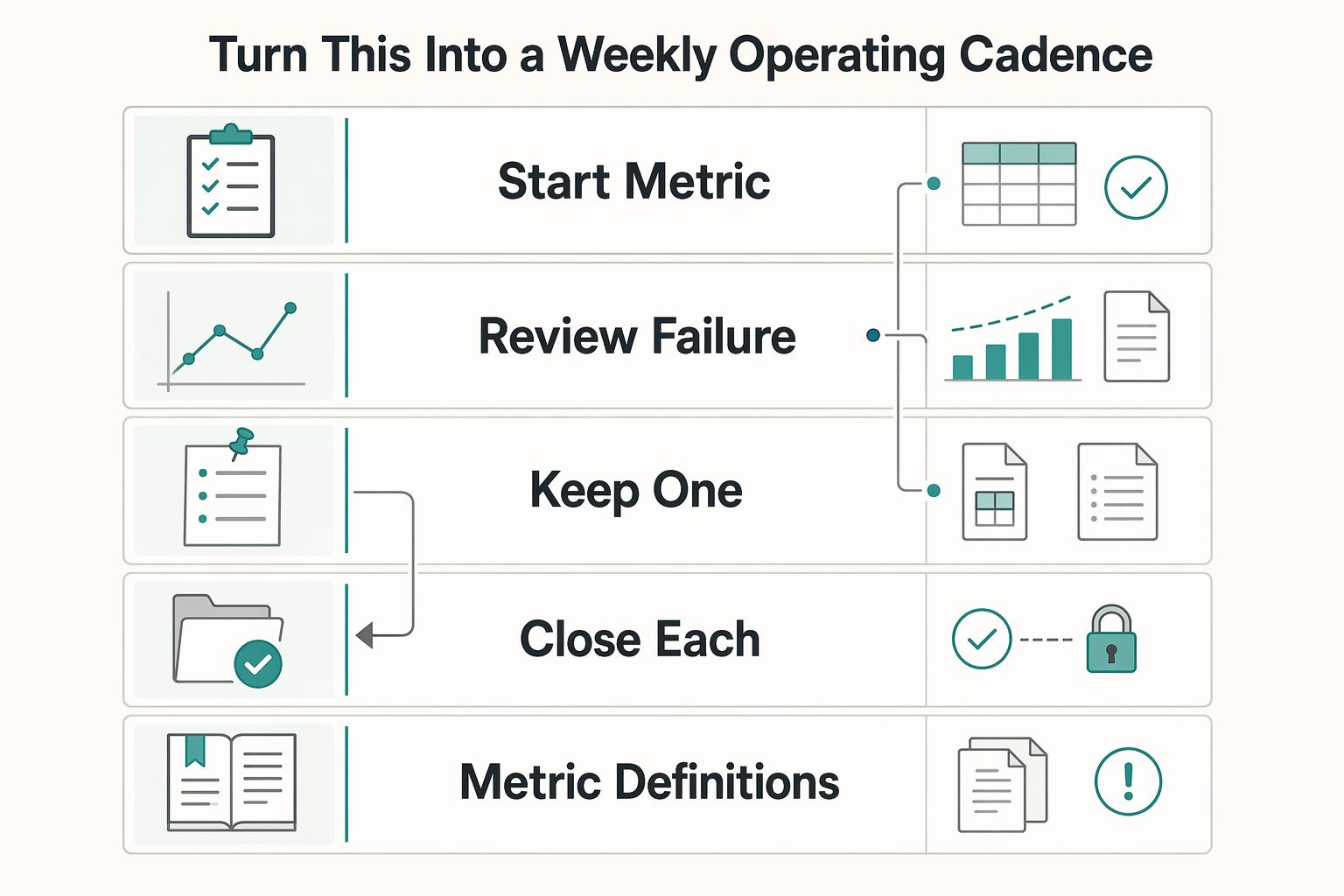
Turn this into a weekly operating cadence#
Run the same four-step weekly review every time: validate metric integrity, review trend evidence, log decisions, then reprioritize based on observed recoveries.
- Start with metric integrity before performance discussion.
Confirm request counts against the request registry and attempt counts against submission records. Reconcile actual-money totals to the same currency and period in the ledger and reconciliation pack. Investigate mismatches while containing any active payment incident. Reduction claims require consistent cohorts, definitions and observation windows.
- Review failure trends by cause, not as one blended number.
Once integrity checks pass, review what changed by queue or cause, and separate compliance blockers from execution failures. Keep action counts tied to evidence, not assumptions.
- Keep one decision log and update it every meeting.
Use one shared record with four fields: what changed, why, expected impact, and what evidence will confirm or reject it next week. If there is no owner or no evidence standard, it is not in flight.
- Close each cycle with a short operating checklist and priority update.
Use this copy/paste checklist each week:
- metric definitions locked
- owners assigned
- alert rules tested
- escalation path confirmed
- compliance blockers separated
- recovery actions tracked
Then update thresholds and queue priorities from observed recovery rates, not from assumptions. If you want a practical example of how payout operations scale while keeping ownership clear, revisit How HR Platforms Scale Employee Recognition Payout Disbursements.
Frequently Asked Questions
What is the difference between payout error rate and failed disbursement rate?
Define an internal payout-exception rate as distinct requests with at least one specified exception divided by all requests in a fixed cohort. Keep its pre-send, confirmed-failure and pending classes visible. First-attempt execution failure rate instead counts confirmed failed first attempts divided by submitted logical payouts; retries do not create new denominator entries.
Which metrics should go live first in a payout error dashboard?
Start with pre-send blocks, first-attempt execution failures and overdue pending/unknown outcomes, alongside counts and amounts. Add recovery from a fixed failure cohort and error causes. Each view needs a named owner, as-of cut, source record and action.
How often should finance and operations teams review payout error metrics?
Review high-volume payout flows daily in operations and take the same metrics into a weekly finance and product review. Whatever cadence you choose, keep the definitions, reporting cut, and evidence pack consistent so teams can compare periods cleanly.
Why can a single error rate mislead leadership decisions?
A blended error rate hides whether the problem came from beneficiary data, compliance holds, provider performance, or reconciliation gaps. Leadership needs those classes separated, because each one has a different owner, recovery path, and cost.
What causes sudden disbursement drops when sales volume looks stable?
Compare request counts, approved-but-unsent requests, submitted attempts, provider confirmations and actual value movement. A drop may come from a hold, outage, backlog or broken reporting join; the dashboard cannot establish the cause from sales volume alone. Keep unknown outcomes visible while querying independent provider evidence.
What are the first three interventions to reduce failed disbursements quickly?
Lock the definitions, rank failure classes by volume and impact, and fix the top recoverable class first. In practice that usually means improving beneficiary validation, retrying only truly retryable errors, and giving ops a queue with clear owners and evidence.
Try a related tool
Where Gruv fits
Plan and approve payout batches
See how payee status, approval rules, route review, and exception handling sit in one payout workflow.
See reconciliation and mismatch review
Compare ledger entries, provider payment records, and statement rows to see what matches and what finance needs to review.
Researched and edited by the Gruv editorial team. Gruv builds cross-border billing, payouts, and finance-operations software for global businesses.
Sources
Educational content only. Not legal, tax, or financial advice.
Related Posts

Payout Retry Strategy for Failed Disbursements Across Multiple Rails
This guide is about handling failed payment attempts with clearer retry decisions. A declined payment is not a single problem type, and treating every failure the same creates avoidable risk.
Retry Logic for Failed Payouts with Exponential Backoff and Error Classification
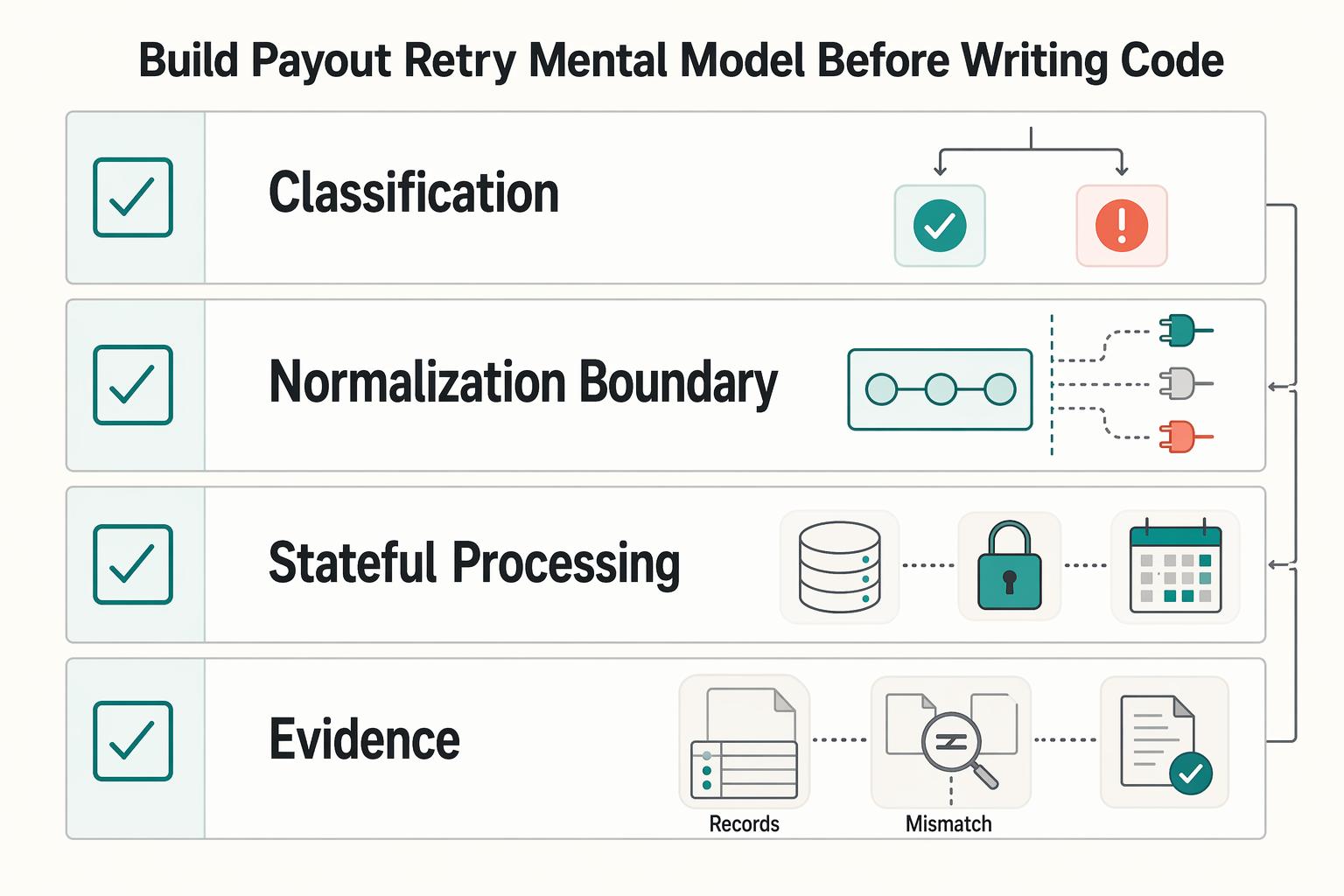
Classify a failed or uncertain payout, decide whether another submission is safe, then apply backoff only to an eligible retry. A timeout alone does not prove the first attempt failed.

Payout Failure Benchmark Report for Platform Teams
A useful **payout failure benchmark report** is not a prettier exception export. It is the operating document that tells your platform team which payout failures are real rail problems, which ones are recipient-data problems, which ones were held before release, and which ones were later recovered.