
Quick Answer
Classify the failure and establish whether resubmission is safe before applying backoff. Hold unknown original outcomes for status lookup or reconciliation. Use bounded delays and jitter for confirmed retryable errors, endpoint-specific duplicate protection, and separate webhook deduplication. Escalate with complete attempt history when automation stops.
Set Retry Rules by Failure Type#
Classify a failed or uncertain payout, decide whether another submission is safe, then apply backoff only to an eligible retry. A timeout alone does not prove the first attempt failed.
These are not ordinary API errors you can hide behind a retry loop. A bad retry decision can create downstream operational work. The real question is always the same: what failed, should you try again, and how long should you wait?
A useful mental model is that failures have two dimensions: where they happen and when. A timeout before you get a provider response is not the same as a hard validation error. A failure during a traffic spike should not be handled the same way as one that keeps showing up hours later. If you do not classify first, retry behavior becomes guesswork.
Both extremes are risky. Missing retry logic can turn transient API errors into permanent failures. Going the other way and hammering the same failing operation on a short interval is not resilience either. Under load, the condition causing the failure may not have cleared by the time the next retry arrives. In payout delivery, that is your signal to slow down, not speed up.
First, classify the error. Then decide whether it is retryable, non-retryable, or unclear. If it is retryable, apply exponential backoff so retries spread out instead of bunching together. If recovery still looks unlikely, stop cleanly and escalate with enough evidence for an operator to act.
Two habits make this work in real systems. First, keep a traceable event record for every retry attempt, including the payout identifier, the failure signal, the attempt count, and the provider response or lack of response. Second, never let the queue become an opaque holding area where items keep cycling without a visible owner or stop condition.
A concrete example is HTTP 429, the standard "Too Many Requests" or RateLimitError response. That often indicates a pacing problem, not a data-quality problem, so your first move should be to back off and reduce pressure. By contrast, if the signal says the request itself is malformed, retrying usually just delays the real fix.
The goal here is implementation clarity. You want recovery where recovery is plausible, restraint where retries would amplify failure, and escalation paths that leave a readable trail instead of mystery failures.
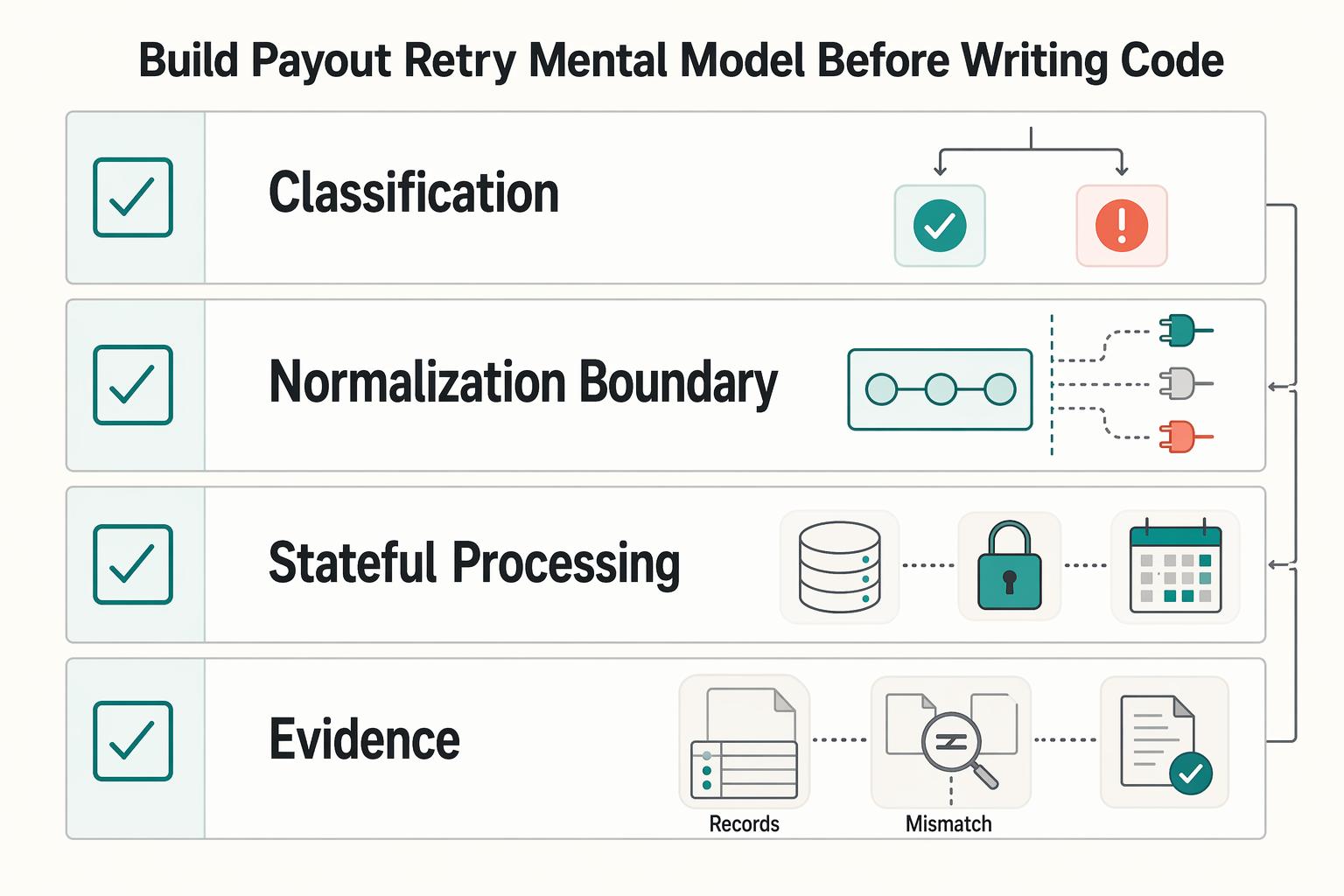
Build the payout retry mental model before writing code#
Start with one rule: classify each failure as recoverable or terminal before you write retry code. That keeps your retry logic tied to a clear decision path instead of guesswork.
| Area | Action | Effect |
|---|---|---|
| Classification | Classify each failure as recoverable or terminal before you write retry code | A clear decision path instead of guesswork |
| Normalization boundary | Translate provider-specific behavior into one internal payout model first | Retries close gaps without creating duplicate outcomes |
| Stateful processing | Reuse the same payout identity, keep a decision history, and respect an explicit retry budget | Handles retries after partial progress |
| Ownership and evidence | Give each terminal path and reconciliation outcome a named owner and an evidence trail | Failures do not end in ambiguous states |
Build that logic behind a normalization boundary so provider-specific behavior is translated into one internal payout model first. Then apply idempotent, persistent retry against that model, so retries close gaps without creating duplicate outcomes.
Treat payout processing as stateful work, not a stateless call loop. Retries can happen after partial progress, so every attempt should reuse the same payout identity, keep a decision history, and respect an explicit retry budget you define up front.
Set ownership before you tune backoff. Each terminal path and reconciliation outcome should have a named owner and an evidence trail, so failures do not end in ambiguous states.
For a step-by-step walkthrough, see API Rate Limiting Error Handling for Payout and Webhook Integrations.
Classify payout failures with explicit stop and retry rules#
Use a decision table so every failure signal maps to one class, one retry path, one owner, and one evidence set. If your team still has to ask "is this retryable?" or "who owns this?" during incident handling, the classification is not operational yet.
Make three control points explicit: where the task goes next, what context moves with it, and how the payout exits the flow. Without that, teams duplicate work, contradict each other, and lose context at handoffs.
Use an operable decision table#
| Failure signal | Class | Retry path | Escalation owner | Evidence required |
|---|---|---|---|---|
| Signal is clearly recoverable in your internal policy | Retryable, non-final | Retry within a constrained retry budget | Engineering | Normalized payout ID, prior attempt history, provider response/event trail |
| Signal is clearly terminal in your internal policy | Non-retryable, final | Stop automated retries and route to manual resolution | Operations/compliance/support (as defined internally) | Final reason code, decision history, required next action |
| Signal is ambiguous or incomplete | Non-final, pending triage | Query or reconcile the original outcome; hold new submissions while uncertain, then escalate with full history | Engineering first, then designated ops owner | Full event timeline and ownership handoff record |
Default to conservative handling when semantics are unclear#
Keep an uncertain original attempt pending investigation. Query status or use the provider’s documented safe-retry mechanism within its supported scope. Do not submit a replacement merely because a retry budget remains.
Make terminal routing actionable#
When automated recovery stops, use explicit reason codes and named operator actions instead of a generic failed label. The handoff should tell the next owner what to do next without re-reading raw logs.
For a broader look at failed payment handling across methods and regions, see How to Handle Failed Payments Across Multiple Payment Methods and Regions.
Set Exponential Backoff policy by payout risk not by engineering habit#
Set retry pacing as explicit contract behavior, not as an SDK default. Define how Exponential Backoff and Jitter are applied, when retries must stop, and when work is handed to a person or a Dead Letter Queue (DLQ).
For a confirmed retryable rate-limit response, honor the provider’s Retry-After or equivalent guidance and use increasing delays with jitter. Confirm the endpoint’s semantics before assuming an HTTP status makes payout resubmission safe.
| Failure signal | Retry stance | Stop rule |
|---|---|---|
429 / RateLimitError | Increase spacing between attempts and add jitter | Stop when retry budget is exhausted, then escalate with full event history |
Classed Non-Retryable Error | Do not auto-retry | Route directly to remediation |
| Ambiguous non-final state | Query or reconcile the original attempt; hold replacement submission until safe | Escalate when the bounded investigation deadline expires; do not consume execution attempts while the original outcome is unknown. |
For an illustrative safe-retry policy, full jitter can sample delay from zero to min(30 seconds, 1 second × 2^n), with n starting at zero. Cap at five retries and a 60-second overall deadline. Honor longer provider Retry-After guidance; park for review if the next allowed attempt would exceed the deadline. These example settings must be adapted to endpoint limits and financial risk.
Keep your Retry Budget visible by error class, provider, and flow type. That makes it clear whether automated recovery is resolving retryable cases or just masking upstream issues.
Choose queue-based retries when durability and observability matter#
Use a durable queue or workflow store when retry schedules and attempt records must survive worker crashes and restarts. In-process timers alone do not preserve that state. Verify the chosen system’s delay, delivery and retention limits.
| Pattern | What changes in production |
|---|---|
setTimeout / in-process scheduler | Traditional in-process retries have production limits, and retries can be lost if the process crashes or restarts. |
Message Queue Retry Pattern (Delayed Requeue Pattern) | Retry state lives in the queue, delay can be applied with native features (for example Amazon SQS DelaySeconds), and non-retryable or max-attempt cases can be routed to DLQ. |
Keep retry state durable and coordinate consumers through one payout intent. Fan-out can distribute observation or accounting events, but multiple consumers must not independently execute the same payout.
Keep implementation order strict so behavior stays consistent across workers:
- Enqueue the event.
- Classify the failure.
- Compute the delay.
- Requeue, or route to
DLQwhen non-retryable or out of budget. - Preserve the last known financial state and Ledger Journal correlation; record stopped automation and escalation separately. Exhausted retries do not prove payment failure.
This design adds operational overhead, but for money movement it usually gives you better failure transparency and control than in-process retries.
Prevent duplicate payouts with idempotency and state guards#
Keep a durable operation ID and endpoint-specific idempotency keys for supported payment retries. Webhook deduplication uses event IDs and application state, not an assumption that the request key appears in every event. Provider keys do not protect replacements through another provider.
| Control | Requirement | Result |
|---|---|---|
Idempotency Key | Keep durable operation identity, supported endpoint keys and separate webhook event deduplication | The same payout instruction should produce the same result when replayed |
| Idempotent operation | Running it multiple times should yield the same result as running it once | Retrying paid calls without idempotency can lead to double payment |
| Current state verification | Verify current state before mutating data | Avoid duplicate financial effects |
| Replayed event handling | Handle replayed events in a way that avoids rewriting already-completed outcomes | Keep already-completed outcomes from being rewritten |
| Write sequence testing | Test the enforced write sequence under timeout, crash, and duplicate-delivery scenarios | Retries should recover safely without creating duplicate financial effects |
An idempotent operation is one where running it multiple times yields the same result as running it once. That matters because retries that look harmless in testing can still create duplicate side effects in production, and retrying paid calls without idempotency can lead to double payment.
Keep the implementation checks strict and consistent in your own state model. A retry path should verify current state before mutating data, and replayed events should be handled in a way that avoids rewriting already-completed outcomes.
If you enforce a write sequence (for example: external result, internal status, then Ledger Journal linkage), test it under timeout, crash, and duplicate-delivery scenarios. The exact order is system-specific, but the bar is the same: retries should recover safely without creating duplicate financial effects.
Handle compliance gates and program variance without breaking retry logic#
Treat compliance-gated failures as a separate path from retryable failures. Retries are for transient, short-lived issues, so when a failure indicates policy or compliance review, move it into an explicit compliance-resolution state instead of routing it through Exponential Backoff.
| Scenario | Meaning | Handling |
|---|---|---|
| Transient, short-lived issue | Retries are for transient, short-lived issues | retry_later means automated recovery may work |
| Policy or compliance review | Something must change before resubmission | Move it into an explicit compliance-resolution state instead of routing it through Exponential Backoff |
| Market and program context | Part of classification at the time of failure | Store the payout context you need for routing decisions up front |
| Compliance-held payout | The hold has not been cleared | Verify the case record shows the failure reason and ownership, and confirm automated retry is off until the hold is cleared |
This split keeps operations honest: retry_later means automated recovery may work, while a compliance state means something must change before resubmission. If those paths are merged, teams can misread blocked payouts as technical delays, and repeated retries can escalate into a retry storm that will not clear without intervention.
Make market and program context part of classification at the time of failure, not an afterthought. Store the payout context you need for routing decisions up front, then classify each failure against that context so retry logic and compliance handling stay distinct.
A practical check is simple: for any compliance-held payout, verify that the case record shows the failure reason and ownership for resolution, and confirm automated retry is off until the hold is cleared.
Related: Smart Dunning Strategies: How to Sequence Retry Logic for Maximum Recovery.
Use an implementation checklist that teams can ship against#
Treat this as a release checklist, not a loose set of ideas: define classification first, then execution behavior. If your team cannot consistently classify failures, backoff tuning is premature.
Start with an explicit order of operations:
- Finalize the error taxonomy.
- Map each class to a decision table action.
- Implement retry behavior from that table.
- Define how non-retryable failures exit the flow.
- Add observability that shows each decision path.
- Set rollout gates only after those pieces are in place.
Map the selected provider’s documented errors into retryable, correction-required, compliance-held and uncertain-outcome states. Authentication, permissions, validation and throttling need different actions; do not import another API’s error names as payout semantics.
For go-live, require a compact evidence pack that lets operators trace real failed attempts end to end in your own stack. At minimum, each sample should clearly show the identifier, classification result, reason, chosen action, and final owner so incidents are diagnosable without guesswork.
Roll out by blast radius. Start with a narrow slice, review behavior, then expand only after the same checklist still passes.
If some failures trace back to invalid European bank details, see What Is an IBAN Number? How Platforms Use IBANs to Send Error-Free European Payouts.
Conclusion#
Retry safety depends on known financial state, provider-specific duplicate protection and explicit stop conditions. Backoff controls load after safety is established; it cannot resolve an unknown payment outcome by itself.
Keep the provider’s request and error semantics beside the internal decision table. Every attempt should have an intent ID, provider reference, observed state and owner so operations can explain why another submission is safe.
So the practical recommendation is simple: do not make your retry loop more aggressive until your evidence trail is stronger. For payout retry logic, the real checkpoint is whether one person can trace a single failed request from first attempt to latest state without opening multiple unrelated tools or guessing which attempt was last. If that trace is broken, faster retries will mostly create noise.
A good final review before rollout should answer a few plain questions:
- Can you show a stable request ID, attempt history, error/response details, timestamps, and current state in one place?
- Do unknown outcomes remain held for status lookup or reconciliation before a replacement submission?
- When retries stop, does the record move to a clear review state with a reason code and an owner?
The most common failure mode is not "we forgot exponential backoff." It is "we cannot explain why this request is still retrying" or "we cannot prove what changed state last." Those are observability and state-control problems first, and they deserve attention before policy tuning.
If your current design cannot explain each failed request from first submission to current state, fix that path first. Then tighten your stop rules, then validate your classification logic, and only then adjust backoff behavior. That order is slower at the start, but it gives you something more valuable than a busy retry engine: a process you can inspect, defend, and operate under pressure.
Related reading: How Platform Operators Recover Failed Payouts Without Duplicate Risk.
Frequently Asked Questions
When should failed payouts be retried versus stopped immediately?
Retry only when the selected endpoint confirms the failure is retryable and duplicate protection is valid, or the original is confirmed unexecuted. Query uncertain outcomes before replacement. Stop for validation or compliance holds until the relevant correction or clearance is recorded.
How do we classify payout failures when provider error messages are vague?
Record the raw response and request reference, then query provider status or reconcile the original attempt. Keep an unknown outcome non-final with an owner and next review time; do not turn an unclear label into automatic resubmission.
What is a practical Exponential Backoff and Jitter policy for payout systems?
Illustrative policy: for a confirmed safe retry, use full jitter with delay uniformly sampled from zero to min(30 seconds, 1 second × 2^n), where n starts at zero for the first retry. Cap at five retries and a 60-second overall deadline. These are example settings, not network rules. Honor a longer provider Retry-After; if it exceeds the deadline, park the operation for review rather than retrying early.
Why is queue-based retry usually better than `setTimeout` for payout reliability?
A durable queue or workflow store preserves scheduled work and attempt history across restarts. An in-process setTimeout alone loses pending schedules when the process exits. Verify the queue’s delay and retention constraints and keep payout state outside the worker.
What should happen after max retries are exhausted in a `Dead Letter Queue (DLQ)` path?
Move exhausted work to a named review queue or DLQ with the operation ID, provider attempts, last known state, reason and next action. Exhaustion ends automation; it does not prove the payment failed or permit a new payout. Reconcile before any approved replay.
How do `Idempotency Key` design and `Webhook` replay handling work together?
Use endpoint-supported request keys for payment retries and event IDs plus state guards for webhook processing. Both link to the same durable payout intent but have different scopes. Query uncertain outcomes and test concurrent duplicate delivery before release.
How should `KYC` and `AML` holds be modeled in payout retry logic?
Keep compliance holds in a separate non-retryable review state. Disable automatic resubmission until an authorized clearance or required correction is recorded; technical backoff does not clear the hold.
Try a related tool
Researched and edited by the Gruv editorial team. Gruv builds cross-border billing, payouts, and finance-operations software for global businesses.
Sources
Includes 3 external sources outside the trusted-domain allowlist.
Educational content only. Not legal, tax, or financial advice.
Related Posts
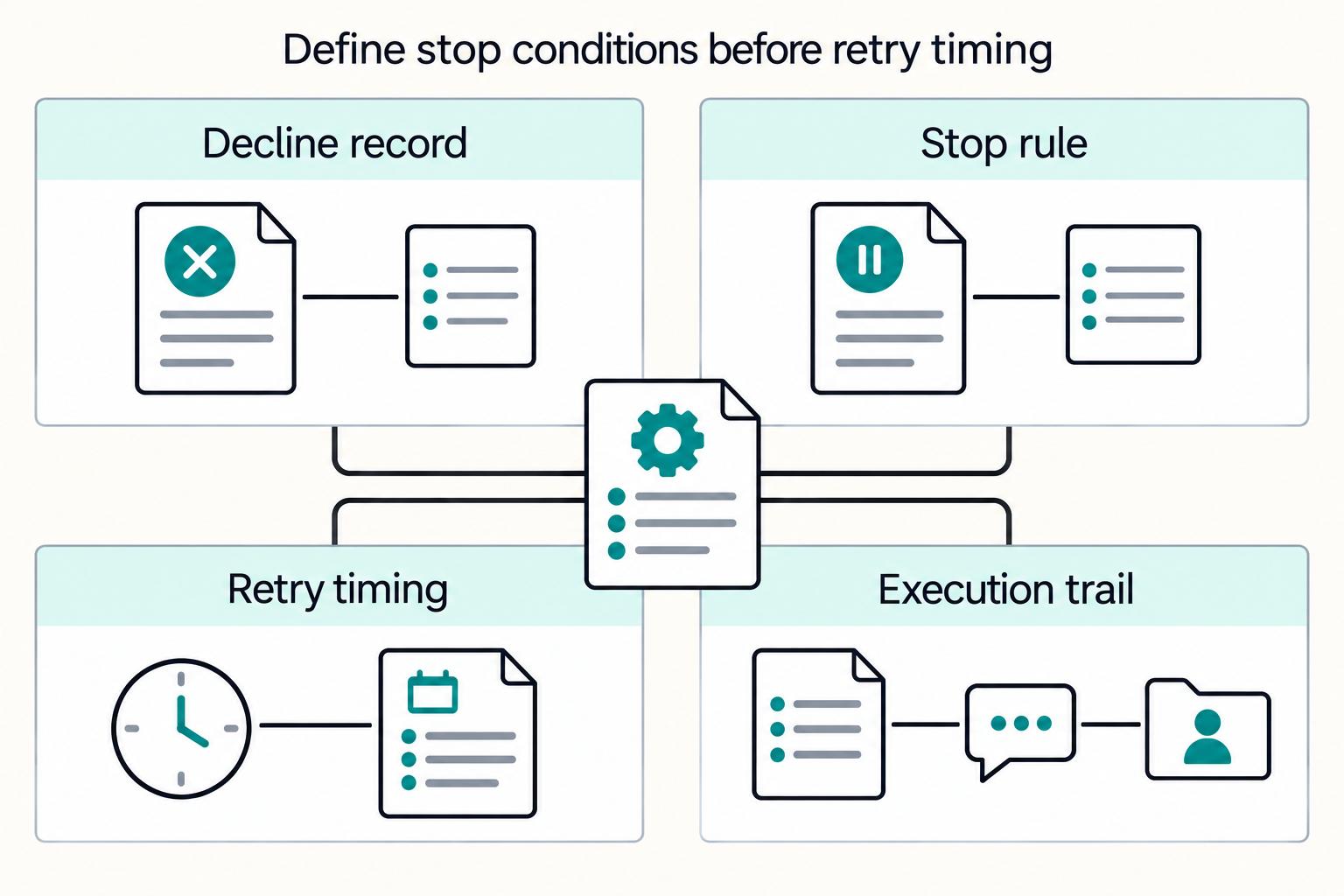
How to Handle Failed Payments Across Multiple Payment Methods and Regions
Treat **failed payment retry logic** as a revenue recovery decision, not a billing toggle. The job is to recover valid revenue while controlling processing cost, customer friction, and compliance or security risk.
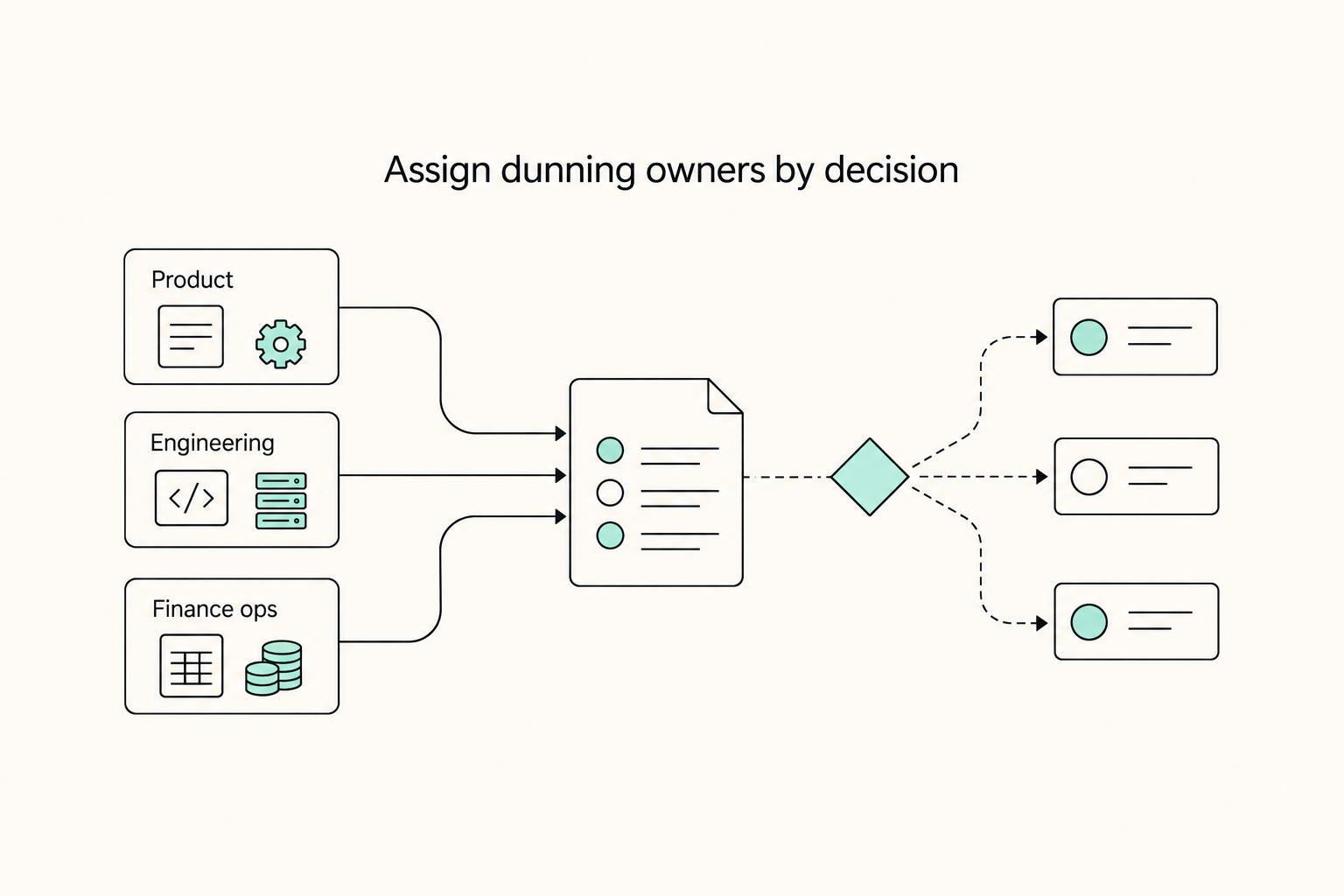
Smart Dunning Strategies to Sequence Retry Logic for Maximum Recovery
If you treat retry logic as a billing setting, you may get some upside and still create hidden operational gaps. A better starting point is shared ownership across teams. Product decides customer treatment. Engineering controls retry execution and event integrity. Finance ops owns reconciliation and audit-trail review.
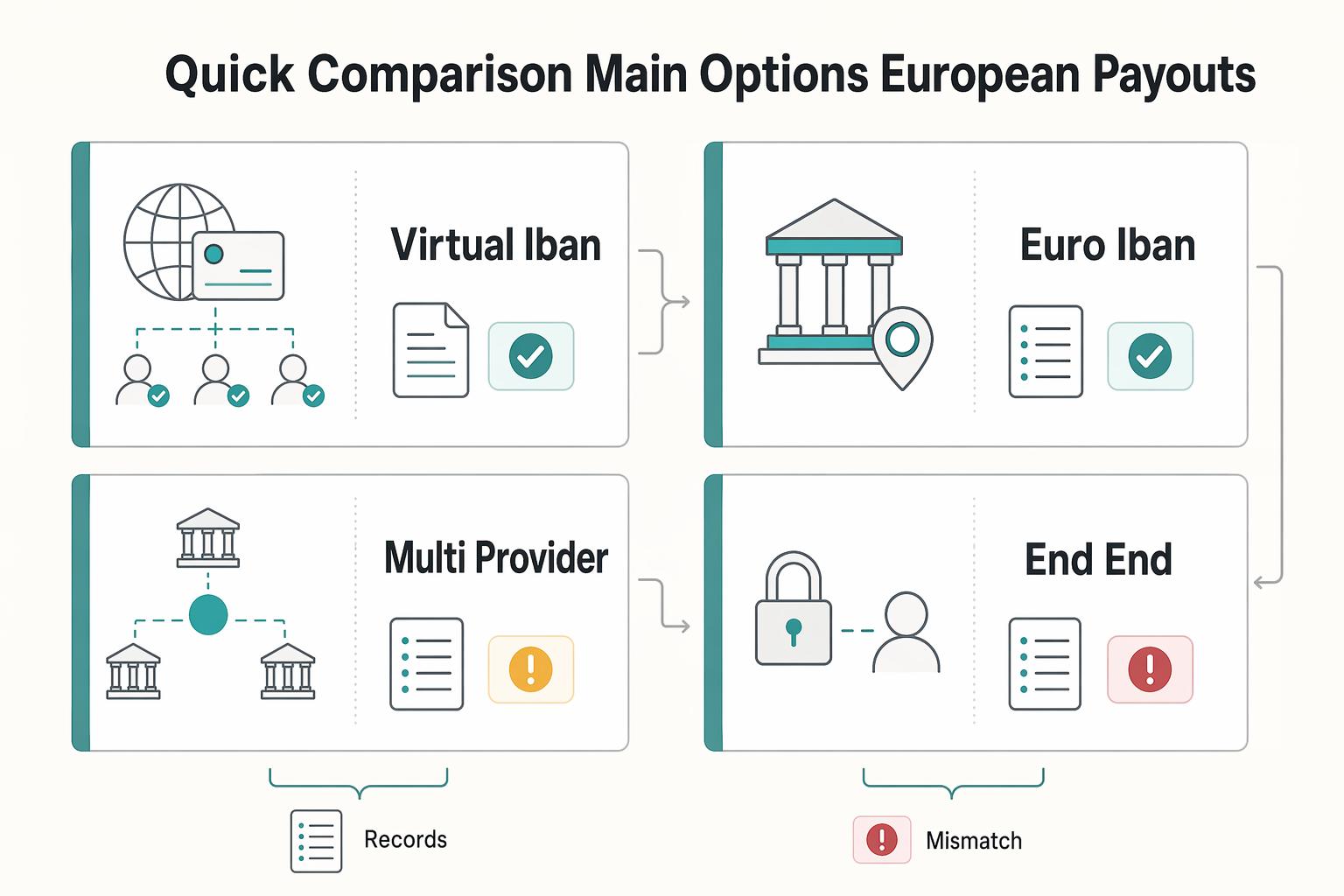
What Is an IBAN Number? How Platforms Use IBANs to Send Error-Free European Payouts
If you are evaluating **iban number platforms european payouts**, skip the glossary. The real decision is which payout setup will keep money moving, exceptions visible, and reconciliation manageable as volume grows. This guide is for platform founders, finance ops leads, and engineering owners who need to ship reliable European payouts, not for readers looking for a basic banking explainer.